책임저자:임수아, 서울시 도봉구 쌍문 3동 388-1
132-703, 한전의료재단 한전병원 성형외과 Tel: 02-901-3109, Fax: 02-901-3104
E-mail: [email protected]
안면부 2도 화상에 있어 부착과 흡수율을 높인 효과적인 드레싱
이재운ㆍ임수아ㆍ송진경
한전의료재단 한전병원 성형외과Effective Dressing Considering Adhesion and Ab- sorptance in Treatment of Second Degree Facial Burn
Jae Un Lee, M.D., Soo A Lim, M.D. and Jin Kyung Song, M.D.
Derpartment of Plastic and Reconstructive Surgery, Kepco Medical Center, Seoul, Korea
Purpose: In second degree burn injuries of face, it is important
to solve much discharge of early burn wound and shorten heal- ing time. We introduce methodical and effective dressing in treatment of second degree facial burn at focus to solve much discharge of early burn wound and to shorten healing time.Methods: From March, 2011 to December 2013, a study was
done with 398 patients who had second degree burn wound on face. Initially we performed dressing with hydrofiber agent (AquacelⓇ). After cleansing with saline, Vasaline guaze was layed on face, and hydrofiber agent were layed over it, and Vasaline guaze was layed over there again, then saline wet guaze dressing performed. When we changed dressing daily, we evaluated burn wound degree. In superficial second degree burn wound like pinkish colored wound, we repeated hydrofiber agent and saline wet guaze dressing. In deep second degree burn wound like pale or mottled colored wound, we changed dressing with cultured allogenic keratinocyte (KalodermⓇ).Results: Number of patients with only superficial second de-
gree burn wound was 272, with superficial second degree and deep second degree burn wound together was 113, with only deep second degree burn wound was 13. In only super- ficial second degree burn wound, the average healing time was 5.1 days with hydrofiber agent and saline wet dressing. In superficial second degree and deep second degree burn wound together, the average healing time was 7.2 days with hydrofiber agent and saline wet guaze dressing and cultured allogenic keratinocyte. In deep second degree burn wound, average healing time was 11 days with hydrofiber agent and saline wet guaze dressing and cultured allogenic keratinocyte.Conclusion: In this strategy, hydrofiber agent is good to be at-
tached on irregular surface of facial burn wound, and we use hydrofiber agent to make wet environment to promotion wound healing, not as absorbable material. We use Saline wet guaze as absorbable material. And after evaluation of degree of burn, we use cultured allogenic keratinocyte to promote wound heal- ing in case of deep second degree burn. We think this strategy using hydrofiber agent and saline wet gauze and cultured allo- genic keratinocyte on facial burn wound is very effective dress- ing method. (J Korean Burn Soc 2014;17:81-85)
Key Words: Facial burn, Aquacel
Ⓡ, KalodermⓇ서 론
안면부 화상은 대부분 보존적 치료를 통해 나을 수 있다.
이는 혈행(blood supply)이 좋아서 신체의 다른 부위에 비 해 치유가 빠르기 때문이다
1). 바꿔 말하면 대부분 드레싱으 로 치유가 되는 부위라서 드레싱의 중요성이 크다고 볼 수 있으며 통증을 감소 시키고 치료 기간을 줄이려는 연구 결 과로 다양한 치료 재료들이 개발되었다.
보편적으로 많이 쓰이는 재료중 하나로 silver sulfadia- zene cream 1% (Silvadene
Ⓡ)은 항균성(antibacterial), 항바 이러스성(antiviral), 항진균성(antifungal)을 가지고 있으며 평균 재상피화(re-epithelization) 기간은 약 9일이다
2,3). 하 지만 얼굴에 바르기가 힘들고 잘 흘러내리며 가피(crust)의 형성이 잘 된다는 단점이 있다
2).
화상 초기에 많은 삼출액(discharge)를 잘 흡수할 수 있는 장점이 있는 폼(foam) 제제들(Medifoam
Ⓡ, Allevyn
Ⓡ, Biatain
Ⓡ등)은 다양한 얼굴의 굴곡에 잘 접촉 하거나 유지 시키기가 힘들다는 단점이 있다. 또한 하이드로콜로이드(hydrocolloid) 제제들(Comfeel
Ⓡ, Duoderm
Ⓡ, Tegasorb
Ⓡ, Replicare
Ⓡ)은 얼 굴의 굴곡에 맞춰 부착이나 조작이 용이 하다는 장점이 있으 나 화상초기에 많은 삼출액을 흡수 하기엔 어려움이 있다.
저자들은 드레싱에 중요한 요소로 오염물질 제거 및 세척
(cleansing), 상처부위 및 상태에 따른 적절한 재료의 선택,
부착된 드레싱 재료의 유지 라고 보고 습윤한 환경을 조성
하면서 많은 삼출액을 흡수하고 다양한 얼굴의 굴곡에 부착
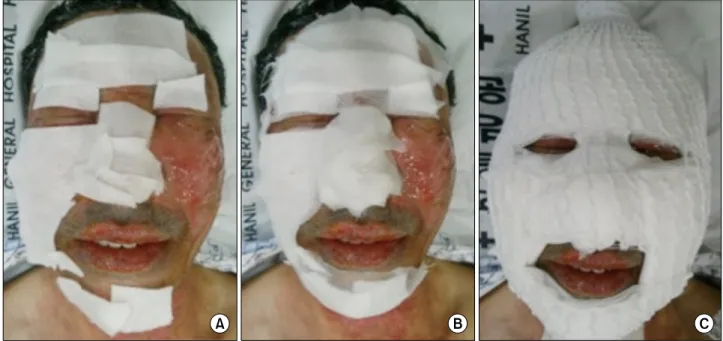
Fig. 1. (A) This photo shows hydrofiber agent dressing after cleansing with saline. (B) Vaseline guaze is layed over Aquacel
Ⓡ. (C) Saline wet guaze and dry guaze apply over vaseline guaze and fixed it with SurginetⓇ.Table 1. Burn Degree and Average Healing Time of Patients
Degree Number of patients Average healingtime (days)
Superficial second 272 5.1
Superficial second &
deep second
113 7.2
Deep second 13 11
Total 398
으로 적용 하였다. 이중 표재성 2도(superficial second)가 272 case, 표재성 2도와 심재성 2도(deep second)가 섞여 있 는 경우가 113 case, 심재성 2도 이상은 13 case 였으며 환자 들의 화상창상은 진피(dermis) 손상을 받은 경우를 심재성 2도 화상으로 기준 삼았다(Table 1).
398예 모두에서 수포(bullae)가 발생하여 작은 수포는 구멍 을 내어 삼출물을 제거 하고 오염된 곳은 모든 수포를 제거한 후 생리식염수로 깨끗이 클렌징(cleansing)을 한후 하이드로화 이버 드레싱 제제를 환부 사이즈에 맞게 적당히 잘라 올린뒤 (Fig. 1A) 모이스트 환경 유지 및 고정을 위해 바세린(vaseline) 거즈를 올리고(Fig. 1B) 생리 식염수를 적신 거즈를 올렸다.
이후 마른거즈(dry gauze)로 덮고 그물망(Surginet
Ⓡ)을 이용하여 고정하였다(Fig. 1C).
삼출물이 많은 수상후 5일 동안은 드레싱을 매일 교환하
간 도포 하고 그 뒤론 보습제를 적용하였다.
결 과
치료가 완료 되는 시점으로는 재상피화(re-epithelization)
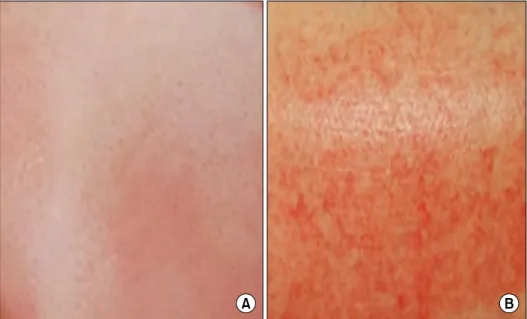
Fig. 2. (A) This photo shows pale
color on deep second degree burn.(B) This photo shows mottled color on deep second degree burn.
Fig. 3. (A) A 49-year-old female
patient with superficial 2nd degree scalding burn on face. (B) This pho- to shows 10 days after injury.가 되어 더 이상 드레싱이 필요 없이 안면부를 개방하여 연 고나 보습제를 바를 정도의 상태로 정의 하였다.
표재성 2도 화상은 평균 5.1일, 표재성 2도와 심재성 2도가 섞여 있는 경우는 7.2일, 심재성 2도는 11일이었다(Table 1).
1. 증례 1
열탕 화상으로 수상한 49세 여자로 표재성 2도 화상으로 진단하에(Fig. 3A) 본 드레싱을 적용하였고 6일째 힐링 되 었다. 우측은 수상후 10일째 사진이다(Fig. 3B).
2. 증례 2
화염 화상으로 수상한 35세 남자로 표재성 2도 화상과 심 재성 2도가 섞여 있는 화상으로 진단하에(Fig. 4A) 본 드레 싱을 적용, 심재성 2도인 뺨 부분에는 수상후 7일째 동종 유래 배양피부를 적용하였다. 10일째 힐링 되었고 우측은 수상후 14일째 사진이다(Fig. 4B).
3. 증례 3
전기불꽃 화상으로 수상한 45세 남자로 표재성 2도 화상
으로 진단하에(Fig. 5A) 본 드레싱을 적용하였고 5일째 힐
Fig. 4. (A) A 35-year-old male
patient with superficial 2nd degree and deep 2nd degree flame burn on face. (B) This photo shows 14 days after injury applicated KalodermⓇ 7 days after injury.Fig. 5. (A) A 45-year-old male
patient with superficial 2nd degree electrical flame burn on face. (B) This photo shows 12 days after injury.링 되었다. 우측은 수상후 12일째 사진이다(Fig. 5B).
고 찰
1962년 George Winter는 습윤창상개념을 도입하여 이상 적인 창상 치료제의 조건을 언급 하였다. 습윤 환경유지 (maintain of moist environment), 수분 및 전해질 손실 방 지(control of evaporative water & electrolyte), 외인성 세균
의 침입방지(impermeability to exogenous microorganism), 경제성(inexpensive), 사용의 간편성(ease of application &
removal) 등과 이에 더하어 빠른 상피화를 촉진 시키는 것 이 중요하다
4).
국소 항생제 중 화상 치료에 가장 널리 사용되고 있는 sil-
ver sulfadiazene cream 1% 제제는 세포독성이 강해 창상
치유를 더디게 하고 수상후 1주 정도까지 가성가피를 형성
하여 화상의 깊이를 가늠하기가 어렵다
2). 또한 얼굴에 바르
기가 어렵고 잘 흘러내린다.
굴곡이 많은 안면부의 특성상 폼 드레싱 제제는 부착 및 조작이 힘들고
4)폴리우레탄 필름(Opsite
Ⓡ)이나 하이드로 콜 로이드 제제등은 초기 화상의 많은 삼출액을 커버하지 못하 여 주위 피부를 손상 시키거나 창상을 악화시킬 우려가 있다.
이에 저자들은 안면부 화상에 있어서 굴곡이 많아 피부에 밀착되지 않아 부착 및 조작이 어렵다는 점과 초기 화상의 많은 삼출물을 해결하기 위하여 하이드로화이버 제제에 바 세린 거즈 와 생리식염수를 적신 거즈를 이용한 드레싱을 적용하기로 하였다.
하이드로화이버(Hydrofiber) 드레싱제제인 Aquacel
Ⓡ은 카복실메틸셀룰로스(carboxymethyl cellose)의 나트륨염 (Na)으로부터 제조된 하이드로화이버라는 섬유로 제조된 부직포 형태의 드레싱 제제이다. 이는 창상면에 부착시 삼 출액과 결합하여 겔(gel) 형태로 변하여 약 30배 정도의 흡 수력을 가지고 삼출액이 넘쳐 흐르는 현상을 방지한다. 그 결과 창상을 습윤 환경으로 만드는 역할을 하며 창상면의 온도를 유지하여 창상 치유에 적절한 환경을 제공한다
5). 여기에 바세린 거즈는 하이드로화이버 제제를 고정해주 고 겔(gel) 형태로 변화시 외부로 새는 것을 어느정도 막아 주는 역할을 하며 생리 식염수를 적신 거즈는 습윤 환경 유 지와 초기 화상의 많은 삼출액을 흡수 하는데 효과적이었다.
안면부 화상은 보통은 이러한 치료로 평균 9일 정도에 상 피화가 이루어지는데 심재성 2도 화상의 징후인 pale 하거 나 얼룩덜룩(mottled)한 양상이 보이면 그 부위에 하이드로 화이버 제제 대신 동종 유래 배양피부를 적용하여 더 빠른 상처 치유 효과를 가져왔다.
현재 국내에서 제품화 되어 사용하고 있는 동중 유래 배 양피부인 Kaloderm
Ⓡ은 2001년 태어난 남아아이의 포피에 서 피부 세포를 분리하여 배양한 것으로 5×6 cm
2size 1장 의 바셀린 거즈에 약 10억 개의 세포로 이루어졌다. 면역세 포를 포함하지 않아 거부 반응이 나타나지 않고 냉동 상태 로 보관이 가능하여 필요시 손쉽게 쓸 수 있는 장점이 있다.
동종유래배양피부의 상처 치유 효과 기전은 아직 정확하게 밝혀지지 않았지만 사이토카인(cytokine)에 의하여 상처 내 와 상처 주변의 피부 세포의 증식과 이동을 일으키고 치유 를 촉진한다고 알려져 있다
6).
결 론
안면부는 사람을 대할 때 가장 먼저 시선이 가는 부위로 우리 신체중 미용적으로 가장 중요한 부분이며 눈, 코, 입
뿐 아니라 얼굴의 작은 주름 하나 까지도 인상에 많은 영향 을 끼칠 수 있다. 그리고 다른 부위에 비해서 피부가 얇아 진피 층 까지 손상 받은 경우 구축이 발생하여 미용적 변형이 쉽게 일어날 수 있는 부위이다. 또한 최근 외모를 중시하는 외모지상주의와 어울려 아름다운 얼굴에 대한 관심은 날이 갈수록 뜨거워 지고 있다
7). 안면부에 화상을 수상한 환자들 대부분이 화상 흉터에 대한 불안감을 가지고 있으며 실제로 화상에 의해 안면부 손상 이후 정신적인 고통 뿐만 아니라 사회로의 복귀에도 어려움을 겪는다
1). 따라서 빠른 상처 치 유를 통하여 반흔을 최소화하는 것이 무엇보다 중요하나 안 면부 화상 치료에 대해서는 많은 의견들이 있다
2). 이에 적극적인 치료를 실시하여 고식적인 드레싱 방법보 다 치료 기간을 줄임으로써 환자에게 육체적인 고통뿐 아니 라 후유증과 흉터로 인한 정신적인 스트레스를 줄이는 것이 중요하다.
본 화상 센터에서는 안면부 화상의 치료에 있어 하이드로 화이버 제제와 바세린 거즈 및 생리 식염수를 적신 거즈를 사용하였고 심재성 2도 화상에서는 동종 유래 배양피부를 추가 적용하여 더 빠른 상처 치유 효과를 가져왔다.
이에 치료 시기의 단축과 반흔 감소를 유도할 수 있고 나 아가 심리적인 만족감을 증대할 수 있는 유용한 방법이라고 생각되어 이를 보고 하고자 한다.
REFERENCES
1) Bujang-safawi E, Halim AS, Khoo TL, Dorai AA. Dried irradiated human amniotic membrane as a biological dressing for facial burns-A 7 year case series. Burns. 2010;36:876-882.
2) Leon-villapalos J, Jeschke MG, Herndon DN. Topical manage- ment of facial burns. Burns. 2008;34:903-911.
3) Genuino GA, Baluyut-Angeles KV, Espiritu AP, Lapitan MC, Buckley BS. Topical petrolatum gel alone versus topical silver- sulfadiazine with standard gauze dressings for the treatment of superficial partial thickness burns in adults: A randomized con- trolled trial. Burns. 2014;40:1267-1273.
4) Kim SK, Sohn CY, Kim HT. Treatment of facial burn patients using hydrocolloid dressing material. J Korean Burn Soc.
2004;7:23-26.
5) Robinson BJ. The use of a hydrofibre dressing in wound management. J Wound Care. 2000;9:32-34.
6) Choi WY, Kim GB, Yang JY. The usefulness of cultured allogenic keratinocyte (Kaloderm) for 2nd degree burn patient treatment. J Korean Burn Soc. 2011;14:111-117.
7) Kwon MJ, Koh JH, Seo DK, Lee JW, Choi JK. Clinical application of phototherapy (Omnilux) in 2nd degree facial burn. J Korean Burn Soc. 2009;12:139-144.