• 검색 결과가 없습니다.

Synthesis of Au@TiO<sub>2</sub> Core-shell Nanoparticle-decorated rGO Nanocomposite and its NO<sub>2</sub> Sensing Properties

N/A
N/A
Protected

Academic year: 2021

Share "Synthesis of Au@TiO<sub>2</sub> Core-shell Nanoparticle-decorated rGO Nanocomposite and its NO<sub>2</sub> Sensing Properties"

Copied!
6
0
0

로드 중.... (전체 텍스트 보기)

전체 글

(1)

http://dx.doi.org/10.5369/JSST.2019.28.4.225 pISSN 1225-5475/eISSN 2093-7563

Synthesis of Au@TiO 2 Core-shell Nanoparticle-decorated rGO Nanocomposite and its NO 2 Sensing Properties

Gautam Kumar Naik and Yeon Tae Yu

+

Abstract

Au@TiO

2

core-shell decorated rGO nanocomposite (NC) was prepared using a simple solvothermal method followed by heat treat- ment for gas sensor application. The crystal structure and morphology of the composites were characterized by X-ray powder diffraction and transmission electron microscopy, respectively. The NO

2

sensing response of the Au@TiO

2

/rGO NC was tested at operating tem- peratures from 250°C to 500°C, and was compared with those of the bare rGO and Au@TiO

2

core-shell NPs. The Au@TiO

2

/rGO NC- based sensor showed a far higher response than the rGO or Au@TiO

2

core-shell based sensors, with the maximum response detected when the operating temperature was 400°C. This improved response was due to the high rGO gas absorption capability for NO

2

gas and the catalytic effect of Au@TiO

2

core-shell NPs in oxidizing NO

2

to NO

3

.

Keywords: Au@TiO

2

core-shell NPs, NO

2

, gas sensing response, rGO, nanocomposite

1. INTRODUCTION

Rapid industrialization can cause serious air pollution. Gases such as CO and NO

x

(NO

2

, N

2

O, and NO) are often prime emission constituents, and, being highly carcinogenic in nature, can cause serious human health problems [1-4] which has led to a high demand for gas sensors which can detect NO

2

and other nitrogen oxide gases. Among various gas sensors, metal oxide semiconductors (MOS) have been widely used based on their simple sensing mechanism, low cost, and very small size. Various studies have been undertaken to develop MOS-based sensors with enhanced selectivity and sensitivity [5,6]. The efficiency of a sensor material generally depends on its physical (surface area and thermal stability) and electrical properties, and many strategies, such as surface modification, doping of different noble metals and formation of composites, have been studied in an effort to enhance their sensing performance [7-10].

Reports have been published on resistant type, TiO

2

based gas

sensors, for NO

2

and CO gas sensing [11-13]. Our recent study found that Au@TiO

2

core-shell nanoparticles showed very good response and selectivity for CO gases, at an operating temperature of 600°C, however there have been very few reports on use of a TiO

2

based sensor for NO

2

gas sensing [14]. In addition, the available reports only showed the sensitivity of TiO

2

in targeting gases like CO and NO

2

operating temperature > 500°C. This sensitivity can be increased by adding Au nanoparticles (NPs) to the TiO

2

surface, and detailed studies have shown that insertion of Au NPs facilitated oxidation of target gases such as CO and ethanol, which resulted in improved sensitivity [15-17]. This showed that there was scope to develop TiO

2

based sensing materials for NO

2

sensing at low temperature, by forming composites with nanomaterials that contributed catalytic and electrical effects.

Among developed nanostructured mateials, it has been established that reduced graphene oxide (rGO) has a relatively high surface area and electrical conductivity, indicating that rGO had potential to improve MOS gas sensing properties. Early reports have stated that the working principle of an rGO-based gas sensor relies on charge transfer between adsorbed gas molecules and the rGO sheet [18].

In our work, in order to develop improved NO

2

gas sensing ability at low operating temperatures, we synthesized nanocomposite (NC) consisting of Au@TiO

2

core-shell NPs with rGO, using a microwave-assisted hydrothermal method, and investigated their gas sensing properties toward NO

2

gas across concentrations Division of Advanced Materials Engineering and Research Centre for

Advanced Materials Development, Chonbuk National University, Jeonju 54896, South Korea

+
Corresponding author: [email protected]

(Received : Jul. 19, 2019, Revised : Jul. 30, 2019, Accepted : Jul. 31, 2019)

This is an Open Access article distributed under the terms of the Creative Commons Attribution Non-Commercial License(http://creativecommons.org/

licenses/bync/3.0) which permits unrestricted non-commercial use, distribution,

and reproduction in any medium, provided the original work is properly cited.

(2)

ranging between 5-100 ppm. The Au@TiO

2

/rGO NC gas sensing mechanism, in relation to NO

2

gas, has also been discussed herein.

2. EXPERIMENTAL

2.1 Chemicals

All chemicals were analytical grade and were used without further purification. Hydroaurochloric acid (HAuCl

4

) and tri- sodium citrate (Na

3

C

6

H

5

O

7

), used for the synthesis of Au NPs, were obtained from SHOWA Chemicals. Titanium fluoride (TiF

4

), used as a TiO

2

precursor, was obtained from ACROS Organics, China, and graphite obtained from SIGMA Aldrich was used to synthesize graphene oxide.

2.2 Au NP synthesis

Au NPs were synthesized using the sodium citrate reduction method [19]. In a typical reaction, a 500 mL solution of HAuCl

4

(1 mM) was heated, with mild stirring, until boiling, and then a solution of freshly prepared tri-sodium citrate (25 mL, 34 mM) was added, in the presence of rapid stirring. The resulting solution was kept at 97°C for 15 min, with constant stirring, after which the solution was allowed to cool. This solution was directly used as the precursor for Au core NPs.

2.3 Au@ TiO

2

core-shell NP synthesis

Au@TiO

2

core-shell NPs were synthesized using a modified, microwave-assisted hydrothermal process [19]. In a typical reaction, 8 mL of TiF

4

solution (0.04 M) were mixed with 16 mL of prepared Au NP colloids, drop-by-drop, under moderate stirring. The volume of the mixture solution was then made up to 60 mL, with Milli-Q water, and the solutions were transferred to a Teflon-lined autoclave. The microwave-assisted hydrothermal reaction was conducted at 180°C, for 1 h, at a heating rate of 15°C / min. The products were then cooled to room temperature, before being separated by centrifugation (12,000 rpm, 12 min). Finally, the products were dried, at 60°C for 12 h, named as Au@TiO

2

, and used in Au@TiO

2

/rGO NC synthesis.

2.4 Synthesis of graphene oxide (rGO)

Reduced GO (rGO) was synthesized from graphite, using a modified Hummers-Hoffman method [20]. In a particular reaction, 0.5 g graphite powder and 0.5 g NaNO

3

were

suspended in 23 mL of concentrated H

2

SO

4

. This suspension was stirred for 15 min with a magnetic stirrer, and then the container was kept in an ice bath. 4 g KMnO

4

were slowly added to the suspension, after which the container was transferred to a water bath and kept at a steady 40 °C. The suspension was then stirred for 90 min, followed by addition of 50 mL deionized (DI) water and then 20 more min stirring. 20 mL of 30% H

2

O

2

were then slowly added, to produce a golden brown solution; 50 mL DI water was added, and the resultant solution was centrifuged and washed several times, using DI water. The final product was then dried, at 80°C for 24 h.

2.5 Au@TiO

2

/rGO NC synthesis

To synthesize Au@TiO

2

/rGO NC, a microwave-assisted chemo-hydrothermal method was used. In a particular reaction, a certain amount of synthesized rGO was suspended in a certain amount of ethanol, and sonicated for 30 min. After that, a calculated amount (the weight ratio between Au@TiO

2

core-shell NPs and rGO needed to be 1:9) of Au@TiO

2

core-shell NPs was added, and the mixture stirred, under sonication, for > 30 min. The colloids then underwent microwave-assisted hydrothermal reaction, at 150°C for 1h. After this, the solution was cooled to room temperature, and the products were separated by centrifugation (12,000 rpm, 12 min) before being washed with water and then ethanol. The product was finally dried, at 60°C for 12 h, and named as Au@TiO

2

/rGO NC.

2.6 Gas sensor device preparation and sensing measurements

The as-prepared calcined gas sensing materials were mixed, and then ground with a drop of α-terpineol to form a paste which was coated onto the surface of an interdigital, 10 × 10 mm alumina circuit board of two printed platinum electrodes. The Pt-electrode- based interdigital alumina board was purchased from Ogam Technology Co. Ltd, South Korea. After drying at 60°C in an oven, the as-prepared sensor devices were further heat-treated, at 500°C for 2 h, for stabilization. The prepared sensors were tested in the presence of NO

2

gas at various temperatures in the range 250-500 °C, using a homemade gas sensing apparatus (Fig. 1).

The maximum gas flow through the mass flow controller was 100

sccm. Nitrogen (background gas) and dry air (21 % oxygen) were

used during the gas sensing test. A resistance meter (Agilent

34970A) was used to observe the sensor device resistance changes

before and after the supply of target gases. The gas sensing

(3)

response (R

s

) was defined as R

s

= R

a

/ R

g

, where R

a

is the sensor resistance value obtained in the presence of air, and R

g

is the resistance value obtained in the presence of the target gas.

2.7 Other characterizations

Morphological analysis of the as-prepared Au@TiO

2

/rGO NC was carried out using transmission electron microscopy (TEM; JEM-2010, JEOL), and X-ray diffraction patterns of the prepared samples were recorded with an X-ray diffractometer (D/Max-2005, Rigaku), using a Cu-Kα target (λ = 1.54178 Å) with a scan rate of 3° (2θ) / min. A micrometrics instrument (TriStar 3000) was used to measure the Brunauer-Emmett- Teller (BET) specific surface area.

3. RESULTS AND DISCUSSIONS

3.1 Morphological characterization

A TEM image of the Au@TiO

2

/rGO NC is shown in Fig. 2, where it can be seen that the Au@TiO

2

core shells are well anchored within the rGO sheet, making a uniform composite. The rGO sheet thickness was also uniform throughout the composite, and the image clearly indicates that the 15 nm diameter Au NPs have been completely encapsulated by the TiO

2

, and that the core- shell NPs are spherical in shape. The average Au@TiO

2

core-shell NP particle size was ~ 90 nm, with TiO

2

shell thicknesses in the 20-40 nm range.

3.2 Structural characterization

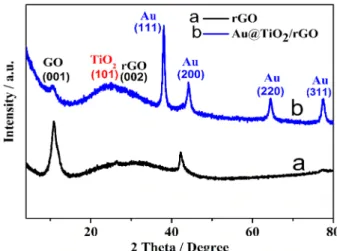
XRD analysis was carried out to investigate the crystal structure of the synthesized samples. XRD patterns for all samples were recorded between the 2θ angles, from 5°-80°, and can be seen in Fig. 3. The XRD pattern of Fig. 3a has two sharp peaks, at 11.07°

and 42.4°, and one broad peak, at ~ 31°. The sharp diffraction peaks correspond to graphene oxide (GO), and the broad peak is the characteristic peak of a reduced graphene oxide (rGO); these results show that the rGO prepared in this work still included some unreduced graphene oxide.

Fig. 3b shows the Au@TiO

2

/rGO NC diffraction pattern, after hydrothermal reaction at 150°C. This profile has four strong peaks, which consist of the following: the planes of Au, as indexed in Joint Committee on Powder Diffraction Standards (JCPDS) file no 01-1174; the small intensity peak of 11.07°, Fig. 1. Schematic diagram of gas sensing measurement setup

Fig. 2. TEM image of Au@TiO

2

/rGO NC.

Fig. 3. XRD patterns for rGO and Au@TiO

2

/rGO NC.

(4)

which is related to the GO and the broad peak at around 25°, which came from the rGO and amorphous TiO

2

. In fact, the peak at 25.5° corresponds to the (101) plane of the anatase phase of TiO

2

, as indexed in JCPDS file no 21-1272, which indicated that the TiO

2

forming the shell part of the core-shell NPs had formed an amorphous structure during the hydrothermal reaction.

3.3 Gas sensing properties

Pure Au@TiO

2

core-shell NPs, rGO, and Au@TiO

2

/rGO NC were tested for their responses to various NO

2

concentrations (5- 100 ppm), in operating temperatures ranging between 250-500°C.

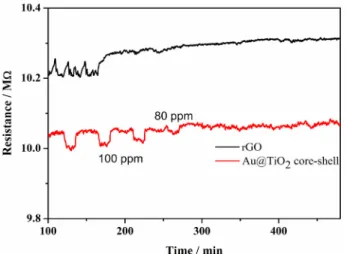
First, Fig. 4 shows the dynamic response-recovery signals for bare rGO and Au@TiO

2

core-shell NPs, to NO

2

gas at 400 °C operating temperature. In Fig. 4a, the rGO shows a very weak and irregular response, even to 100 ppm NO

2

. The Au@TiO

2

core- shell NPs showed low level responses to both 100 ppm and 80 ppm NO

2

, as shown in Fig. 4b, where it can be seen that the response value (R

s

) to 100 ppm NO

2

was only 1.004, which was very low.

Fig. 5 shows the resistance change of the prepared Au@TiO

2

/ rGO NC at various operating temperatures. From the figure, it could be seen that the baseline electrical resistance (R

a

) decreased in comparison to the rGO or the Au@TiO

2

core-shell NPs. This decrease may be attributed to the high electrical conductivity of rGO. The baseline resistance further decreased, with increasing operating temperature, as some electrons had been produced by the TiO

2

and rGO semiconductors, and electron mobility had increased in the NC. The baseline resistances at 250°C, 400°C, and 500°C were 9.9, 8.5, and 7.4 MΩ, respectively.

From the gas sensing test results presented in Fig 5, the

relationship between Au@TiO

2

/rGO NC response and operating temperatures, at different NO

2

gas concentrations, was plotted in Fig. 6. The responses increased with increasing operating temperature, up to 400°C for all NO

2

concentrations, after which the responses started to decrease, up to 500°C. It can be determined, therefore, that the optimum temperature, at which Au@TiO

2

/rGO NC gave its maximum response to NO

2

gas, was 400°C. The maximum response to 100 ppm NO

2

, at 400°C, was 1.13, which decreased to 1.08 when the operating temperature reached 500°C. This decrease at higher operating temperature was considered to be due to rapid NO

2

gas desorption, which allowed less time for reaction with the adsorbed O

2-

ions.

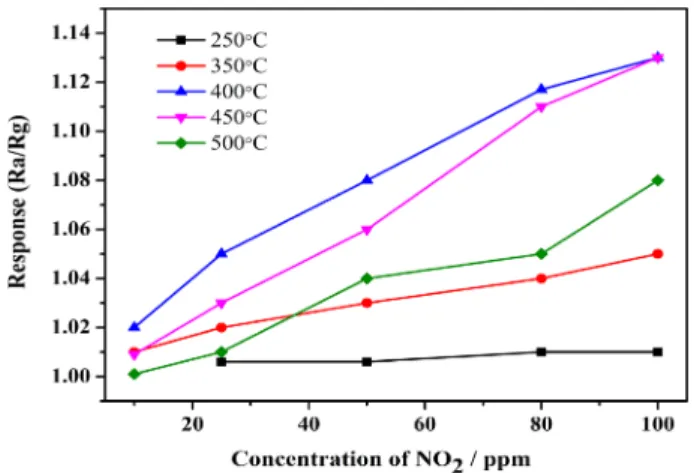
Fig. 7 shows the sensor response change with respect to NO

2

concentration at various temperatures, and at 250°C operating temperature, the response rate increase was negligible, while at other operating temperatures, the increase rates were almost linear.

Fig. 4. Resistance changes to various NO

2

gas concentrations for bare rGO and Au@TiO

2

core-shell NPs at 400°C.

Fig. 5. Resistance changes to various NO

2

gas contents for Au@TiO

2

/rGO NC, at different operating temperatures.

Fig. 6. Plot of response vs. operating temperature at different NO

2

concentration for Au@TiO

2

/rGO NC.

(5)

3.4 Gas sensing mechanism

The basic mechanism for NO

2

gas sensing is through the change in the electrical resistance of the fabricated sensor. When testing the gas sensor device, air (oxygen) was first supplied to the testing chamber; oxygen molecules are chemisorbed onto the surfaces of Au@TiO

2

core-shell NPs and Au@TiO

2

/rGO NC, and attract free electrons from the conduction band of n-type semiconductor, TiO

2

, to form ionized oxygen species, such as O²

-

, O

-

, or O

2-

. As a result, an electron depletion layer is induced on the TiO

2

sensor surface, which leads to an increase in the resistance of the TiO

2

based sensors. Then, when target reducing or oxidizing gases are introduced to the sensor device, reducing gases react with the adsorbed oxygen species, and decreasing the resistance of the sensor device, while oxidizing gases are ionized on the surface of the TiO

2

based sensors, leading to increased resistance.

In Fig. 4b, the Au@TiO

2

core-shell NPs-based sensor showed decreased resistance when NO

2

gas was introduced, indicating that NO

2

behaved as a reducing gas here. This means that TiO

2

NPs act as a catalyst, to help oxidize NO

2

to NO

3

[21]. When NO

2

was introduced to the sensor, the chemisorbed oxygen species reacted with NO

2

gas molecules to form NO

3

as a byproduct, and released the captured electrons to the TiO

2

sensor. As a result, the width of the depletion layer decreased, and the potential barrier height also decreased. This process decreased Au@TiO

2

core-shell NP resistance, and this change in resistance corresponded to the response of the sensing material.

The Au@TiO

2

/rGO NC-based sensor showed a greater level of response than the Au@TiO

2

core-shell NPs-based sensor, as shown in Fig. 5. This could be explained by virtue of a synergistic effect between the oxidizing nature of TiO

2

and the high gas

absorption capability of rGO. As mentioned above, Au@TiO

2

core-shell NPs act as a catalyst for the oxidation of NO

2

to NO

3

. On the other hand, rGO plays an important role in accelerating gas sensing performance, due its large specific surface area (318 m²/g), which helps in adsorbing large amounts of reaction gas onto its surface. The specific surface areas of Au@TiO

2

core-shell NPs and Au@TiO

2

/rGO NC were 75 and 278 m²/g, respectively.

So, upon exposure to NO

2

, the resistance of Au@TiO

2

/rGO NC significantly decreased, as a large number of NO

2

molecules react with O

2-

and O

-

ions to produce NO

2

, and release free electrons

.

The released free electrons were the reason for the decreased resistance of Au@TiO

2

/rGO NC.

4. CONCLUSIONS

Au@TiO

2

/rGO NC, with the weight ratio of 1:9, was successfully prepared through a hydrothermal reaction, using Au@TiO

2

core-shell NPs and rGO powder. The gas sensing response of Au@TiO

2

/rGO NC to NO

2

gas was far higher than that of either bare rGO or Au@TiO

2

core-shell NPs. The maximum response was reached at 400°C operating temperature for 100 ppm NO

2

gas. This improved response was due to both the high NO

2

gas absorption capability of rGO, and to the catalytic effect of Au@TiO

2

core-shell NPs in oxidizing the NO

2

to NO

3

.

ACKNOWLEDGMENT

This work was supported by: 1) the BK21 plus program from the Ministry of Education and Human-Resource Development (Korea); 2) the National Research Foundation of Korea, through grants funded by the Korean government (BRL No. 2015042417, 2016R1A2B4014090).

REFERENCES

[1] S. Zhuiykov, “Carbon monoxide detection at low tem- peratures by semiconductor sensor with nanostructured Au- doped CoOOH films”, Sens. Actuators B, Vol. 129, No.1, pp. 431-441, 2008.

[2] N. L. Hung, H. Kim, S. K. Hong, and D. Kim, “Enhance- ment of CO gas sensing properties in ZnO thin films depos- ited on self-assembled Au nanodots”, Sens. Actuators B, Vol. 151, No. 1, pp. 127-132, 2010.

[3] Y. J. Chiang and F. M. Pan, “PdO nanoflake thin films for co gas sensing at low temperatures”, J. Phys. Chem. C, Vol.

117, No. 30, pp. 15593-15601, 2013.

Fig. 7. Plot of response vs. NO

2

concentration at different operating

temperature for Au@TiO

2

/rGO NC.

(6)

[4] G. Neri, A. Bonavita, G. Micali, G. Rizzo, E. Callone, and G. Carturan, “Resistive CO gas sensors based on In

2

O

3

and InSnO

x

nanopowders synthesized via starch-aided sol-gel process for automotive applications”, Sens. Actuators B, Vol. 132, No. 1, pp. 224-233, 2008.

[5] J. Tan, W. Wlodarski, and K. Z. Kourosh, “Nitrogen dioxide gas sensors based on titanium dioxide thin films deposited on langasite,” Thin Solid Films, Vol. 515, No. 24, pp. 8738- 8743, 2007.

[6] A. Forleo, L. Francioso, M. Epifani, S. Capone, A. Taurino, P. Siciliano, “NO-gas-sensing properties of mixed InO SnO thin films,” Thin Solid Films, Vol. 490, No. 1, pp. 68-73, 2005.

[7] J. T. Mecue and J. Y. Ying, “SnO

2

-InO

2

nanocomposites as semiconductor gas sensors for CO and NOx detection”, Chem. Mater., Vol. 19, No. 5, pp. 1009-1015, 2007.

[8] A. M. Ruiz, G. Sakai, A. Cornet, K. Shimanoe, J. R.

Morante, and N. Yamazoe, “Cr-doped TiO

2

gas sensor for exhaust NO

2

monitoring”, Sens. Actuators B, Vol. 93, No.

1-3, pp. 509-518, 2003.

[9] T. Akamatsu, T. Itoh, N. Izu, and W. Shin, “NO and NO

2

Sensing Properties of WO

3

and Co

3

O

4

Based Gas Sensors”, Sensors, Vol. 13, No. 9, pp. 12467-12481, 2013.

[10] M. Amin, N. A. Shah, A. S. Bhattib, and M. A. Malik,

“Effects of Mg doping on optical and CO gas sensing prop- erties of sensitive ZnO nanobelts”, CrystEngComm., Vol.

16, No. 27, pp. 6080-6088, 2014.

[11] C. W. Zou, J. Wang, and W. Xie, “Synthesis and enhanced NO

2

gas sensing properties of ZnO nanorods/TiO

2

nanopar- ticles heterojunction composites”, J. Colloid Interface Sci., Vol. 478, No. 1, pp 22-28, 2016.

[12] X. Li, Y. Zhao, X. Wang, J. Wang, A. M. Gaskov, and S. A.

Akbar, “Reduced graphene oxide (rGO) decorated TiO

2

microspheres for selective room-temperature gas sensors”, Sens. Actuators B, Vol. 230, No. 1, pp 330-336, 2016.

[13] L. Wang, J. Gao, B. Wu, Kan Kan, S. Xu, Y. Xie, Li Li, and

K. Shi, “Designed synthesis of In

2

O

3

beads@TiO

2

-In

2

O

3

composite nanofibers for high performance NO

2

sensor at room temperature”, ACS Appl. Mater. Interfaces, Vol. 49, No. 7, pp. 27152-27159, 2015.

[14] J. S. Park, Y. S. Kim, P. Rai, and Y. T. Yu, “Effect of crys- tallinity of TiO

2

in Au@TiO

2

core-shell nanoparticles on CO sensing properties”, Sens. Lett., Vol. 12, No. 8, pp.

1213-1217, 2014.

[15] S. Roy Morrison, “Mechanism of semiconductor gas sensor operation”, Sens. Actuators, Vol. 11, No. 3, pp. 283-287, 1987.

[16] P. Rai, R. Khan, S. Raj, S. M. Majhi, K. K. Park, Y.-T. Yu, I.-H. Lee, and P. K. Sekhar, “Au@Cu

2

O core-shell nanopar- ticles as chemiresistors for gas sensor applications: effect of potential barrier modulation on the sensing performance”, Nanoscale, Vol. 6, No. 1, pp. 581-588, 2014.

[17] Z. Zanolli, R. Leghrib, A. Felten, J. J. Pireaux, E. Llobet, and J. C. Charlier, “Gas sensing with Au-decorated carbon nanotubes,” ACS Nano, Vol. 6, No. 5, pp. 4592-4599, 2011.

[18] S. Liu, B. Yu, H. Zhang, T. Fei, and T. Zhang, “Enhancing NO

2

gas sensing performances at room temperature based on reduced graphene oxide-ZnO nanoparticles hybrids”, Sens. Actuators B, Vol. 202, No. 1, pp. 272-278, 2014.

[19] X. F. Wu, H. Y. Song J. M. Yoon, Y. T. Yu and Y. F. Chen,

“Synthesis of Core−Shell Au@TiO

2

Nanoparticles with Truncated Wedge-Shaped Morphology and Their Photo- catalytic Properties”, Langmuir, Vol. 25, No.11, pp. 6438- 6447, 2009.

[20] R. K. Singh, R. Kumar, and D. P. Singh, “Graphene oxide:

strategies for synthesis, reduction and frontier applications”, RSC Adv., Vol. 6, No. 1, pp. 64993-65011, 2016.

[21] J. A. Rodriguez, T. Jirsak, G. Liu, J. Hrbek, J. Dvorak, and A. Maiti, “Chemistry of NO

2

on Oxide Surfaces: Formation of NO

3

on TiO

2

(110) and NO

2

↔O Vacancy Interactions”, J.

Am. Chem. Soc., Vol.123, No. 39, pp. 9597-9605, 2001.

수치

Fig. 3. XRD patterns for rGO and Au@TiO 2 /rGO NC.
Fig. 4. Resistance changes to various NO 2  gas concentrations for bare rGO and Au@TiO 2  core-shell NPs at 400°C
Fig. 7. Plot of response vs. NO 2  concentration at different operating temperature for Au@TiO 2 /rGO NC.

참조

관련 문서

Abstract: Highly porous polymethyl methacrylate (PMMA) microspheres impregnated by TiO 2 powder were prepared by spray drying method.. The particle size and the porosity

Our investigation revealed that both the concentration of NaOH and sonication time affects the sensing properties of the TiO 2 nanosheet based sensors.. The difference

For the efficient coating of gold shell, we attempt an in-situ synthesis method such that the nuclei of the gold nanoparticles are generated and grown on the surface of

The PL enhancement factor depends on parameters such as the Au nanoparticle radius, the separation between Au nanoparticles and TiO 2 molecules, the total absorption

Abstract A carbon doped TiO 2 (C-TiO 2 ) photocatalyst, which shows good photocatalytic activity to Ultra- violet irradiation and visible irradiation, was successfully prepared

Abstrat Thermal stabilizing effect of Yb 3+ , Er 3+ codoping into TiO 2 powder prepared by sol-gel method and its upconversion characteristics were analyzed.. The effect of TiO 2 :

In this study, we investigate the effects of the self- assembled Au nanodot nucleation layer on the surface morphological properties as well as the CO gas sensing properties of

But it was also observed that the dispersion of the TiO 2 particles for B series of CNT/TiO 2 composites prepared with different TNB concentration was not evidently changed