• 검색 결과가 없습니다.

Synthesis and Characterization of CNT / TiO<sub>2</sub> Photoelectrocatalytic Electrodes for Methlene Blue Degradation

N/A
N/A
Protected

Academic year: 2021

Share "Synthesis and Characterization of CNT / TiO<sub>2</sub> Photoelectrocatalytic Electrodes for Methlene Blue Degradation"

Copied!
9
0
0

로드 중.... (전체 텍스트 보기)

전체 글

(1)

Vol. 18, No. 11 (2008)

583

Corresponding author

E-Mail : [email protected](W. C. Oh)

Synthesis and Characterization of CNT / TiO 2 Photoelectrocatalytic Electrodes for Methlene Blue Degradation

Feng-Jun Zhang*

,

**, Ming-Liang Chen*, Won-Chun Oh*

*Department of Advanced Materials & Science Engineering, Hanseo University, Chungnam 356-706, Korea

**Anhui Key Laboratory of Advanced Building Materials, Anhui University of Architecture, Anhui Hefei 230022 P. R. China

2008

10

1

일접수

: 2008

10

26

일 최종수정

: 2008

10

27

일 채택

Abstract In this study, two series of CNT/TiO

2

electrodes were prepared. The decrease of surface area compared with that of the pristine carbon nanotubes (CNTs) indicated the blocking of micropores on the surface of the CNTs; was further supported by scanning electron microscopy (SEM) and field emission SEM (FE-SEM) observations. The X-ray diffraction (XRD) results showed that the CNT/TiO

2

composites contained a mix of anatase and rutile forms of TiO

2

particles when the precursor was TiO

2

powder, whereas when the precursor was Ti (OC

4

H

7

) (TNB), the composites contained only the typical single and clear anatase TiO

2

particles. The energy dispersive X-ray spectroscopy (EDX) spectra showed the presence of C, O and Ti peaks for all samples.

It was found that catalytic decomposition of methylene blue (MB) solution could be attributed to synthetic effects between the TiO

2

photocatalysis and electro-assisted CNTs network, and that photoelectrocatalytic oxidation increased with an increase of CNT composition. It was also found that the photoelectrocatalytic oxidation efficiency for MB is higher than that of photocatalytic oxidation. Moreover, the CNT/TiO

2

composites catalyst prepared by the impregnation method demonstrates higher photoelectrocatalytic activity than the mechanical mixture with the same CNT content.

Key words CNT/TiO

2

electrode, photoelectrocatalysis; methylene blue (MB), XRD, SEM, EDX

1. Introduction

In recent years, functional composites including carbon nanotubes (CNT) have attracted considerable attention in the research and industrial communities, due to their special characteristics, such as high chemical stability, extraordinary mechanical and unique electronic properties and adsorption

1-2)

; furthermore, it can absorb organic substance strongly with particular π-electron structure.

3)

On the other hand, TiO

2

has been widely used in solving various environmental problems such as wastewater treatment, air clean, as a photocatalyst.

4-6)

In order to improve the photocatalytic (PC) efficiency at TiO

2

surfaces, a great deal of effort has been devoted

7-9)

the activity of TiO

2

as photocatalyst is well recognized to depend strongly upon the method of preparation.

10)

According to our former studies,

11-14)

carbon-TiO

2

composites had a high surface area, porous texture distribution and showed an excellent photoactivity, especially CNT/TiO

2

composites.

15-16)

It is very important work that improving comprehensive PC performance of CNTs and TiO

2

through combining they better. There are some endeavors to combine CNTs with TiO

2

to form catalyst composites. Wang

17)

reported that Multi-walled carbon nanotubes (MWCNT) and nanocrystalline titanium composite catalysts were prepared by a modified acid-catalyzed sol–gel method. Hernadi

18)

reported that MWCNT-based titanium composite material has been prepared by an impregnation method, which provides a homogeneous inorganic cover layer on the surface of purified MWCNT. Coating MWCNT surface with TiO

2

has been performed by a sol–gel method using different alkoxides and by hydrothermal hydrolysis of TiOSO

4

, which can lead to different morphologies

19)

. Phang

20)

considered that addition of TiO

2

, SWNT and MWNT, and different SWNT contents are significant factors which will affect the magnetization, dielectric and conductivity.

However, the CNT/TiO

2

photocatalyst above present

seems to have the application form of particle, which

high cost and time consuming for the particle-fluid

separation after radiation treatment for the reuse of the

catalyst restrained its industrial applications

21)

. So,

(2)

development of TiO

2

photocatalysts immobilized on a certain suitable electrode such as CNT electrode would be of great significance, not only to avoid the disadvantages of filtration of fine photocatalyst particles, but to lead to high photodecomposition efficiency.

22, 23)

The PC method was based on the reactive properties of photogenerated electron–hole pairs. They were generated in the semiconductor (TiO

2

) particles under UV irradiation, at the same time these electrons and holes could also recombine. Since the hole was a powerful oxidizing agent, it could decompose water and/or contaminants adsorbed on the TiO

2

surface. In photoelectrocatalytic (PEC) method, positive potential was applied on the working electrode, which could inhibit the recombination of electrons and holes and enhance the rate of PEC degradation of organic compounds.

24–26)

The purpose of this study is to propose synergetic effects of photolysis and electrolysis with CNT/TiO

2

composites electrode system by an electrochemical method. The electrical driving force may play role in the sorption and decomposition of azo compounds.

In this study, we focused on the preparation and characterization of the CNT/TiO

2

composites electrodes.

Two series of CNT/TiO

2

electrodes were synthesized.

The prepared electrodes were characterized by BET surface area, X-ray diffraction (XRD), scanning electron microscope (SEM), energy dispersive X-ray (EDX). The catalytic efficiency of the prepared electrode was evaluated by the photoelectrodegradation of an azo compound, methylene blue (MB, C

16

H

18

N

3

S · Cl · 3H

2

O).

2. Experimental procedure

2.1 Materials

CNTs were selected as the support material. The CNTs, supplied from carbon nano-material technology Co., Ltd, Korea. Korea (Multiwall nanotubes, diameter: ~ 20nm, length: ~ 5um), were used without further purification.

The pristine TiO

2

was commercially available and was supplied from Duksan Pure Chemical Co., Ltd, Korea.

The TNB (Ti (OC

4

H

7

)) as a titanium source for the preparation of CNT/TiO

2

composite was purchased from Acros Organics, New Jersey, USA. Benzene (99.5%) was used as an organic solvent which was purchased from Samchun Pure Chemical Co., Ltd, Korea. The novolac typed phenol resin (PR) was supplied from Kangnam

Chemical Co., Ltd, Korea. The methylene blue (MB, C

16

H

18

N

3

S ·Cl·3H

2

O) was used as analytical grade which was purchased from Duksan Pure Chemical Co., Ltd, Korea. It was selected because it can be readily under anaerobic conditions to produce potentially more hazardous aromatic amines.

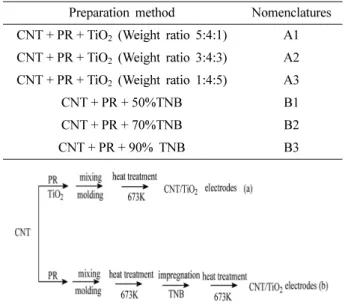
2.2 Preparation of CNT/TiO2 electrodes Two processes for the fabrication of CNT/TiO

2

electrodes were used. The preparation procedures for the A and B series of CNT/TiO

2

electrodes are given in scheme 1(a), (b) respectively. The preparation conditions and the sample code used in this study are listed in Table 1. The CNT/TiO

2

electrodes were pressed at the pressure of 250 kg/cm

2

in a mould, the dimension of CNT/TiO

2

electrodes was 9.95mm × 39.5mm × 5.95mm. The curing temperature of the CNT matrix was 423K, and then the cured sample pyrolyzed at 673K for 1 h in order to completely cure the binder.

2.3 Characteristics and investigations of the samples

The Brunauer-Emett-Teller (BET) surface area of the CNT/TiO

2

composites was evaluated from N

2

adsorption isotherm at 77 K using a BEL Sorp Analyzer (BEL, Japan).

XRD was used for crystal phase identification and estimation of the anastase-to-rutile ratio. XRD patterns were obtained at room temperature with a diffractometer Shimata XD-D1 (Japan) using Cu K α radiation. SEM

Table 1. Nomenclatures of CNT/TiO

2

electrode

Preparation method Nomenclatures CNT + PR + TiO

2

(Weight ratio 5:4:1) A1 CNT + PR + TiO

2

(Weight ratio 3:4:3) A2 CNT + PR + TiO

2

(Weight ratio 1:4:5) A3

CNT + PR + 50%TNB B1

CNT + PR + 70%TNB B2

CNT + PR + 90% TNB B3

Scheme. 1. The preparation procedure for the fabrication of

CNT/TiO

2

electrodes: (a) A series, (b) B series.

(3)

was used to observe the surface state and porous structure of the CNT/TiO

2

composites were carried out using a JSM-5200 JOEL electron microscope (Japan).

EDX was used to measure the elemental analysis of the CNT/TiO

2

composites. UV-VIS spectra for the MB solution obtained from degradation by CNT/TiO

2

composites dispersion under different conditions were recorded using a Genspec (Hitachi, Japan) spectrometer.

2.4 PEC decompositions

The PEC decomposition was performed by using CNT/

TiO

2

electrode and an aqueous solution of MB in a 100 mL glass container and then irradiating the system with 20W UV light at 365 nm, which was used at the distance of 100 mm from the solution in darkness box. The same CNT/TiO

2

electrode was placed in 50 mL of 1.0 × 10⁻⁵ mol/L MB solution. The PEC degradation of MB was performed with a potential voltage of 3.0V and UV light.

The PEC activities of the CNT/TiO

2

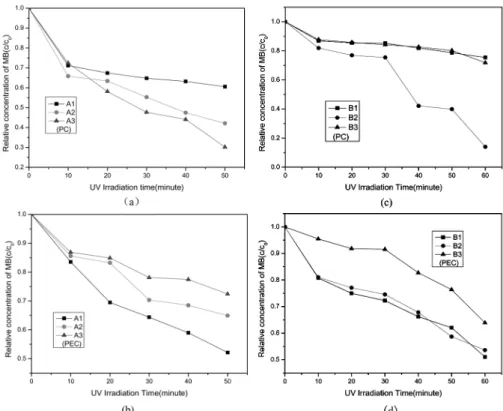
electrodes were investigated using the PEC rate of MB, which was measured for 10 min, 20min, 30 min, 40 min and 50 min. The blue color of the solution faded gradually with time due to the adsorption and decomposition of MB.

And then the concentration of MB in the solution was determined as a function of irradiation time from the absorbance change at a wavelength of 660 nm.

3. Results and Discussion

3.1 Structure and morphology of CNT/TiO

2

composites

The N

2

adsorption isotherms for CNT/TiO

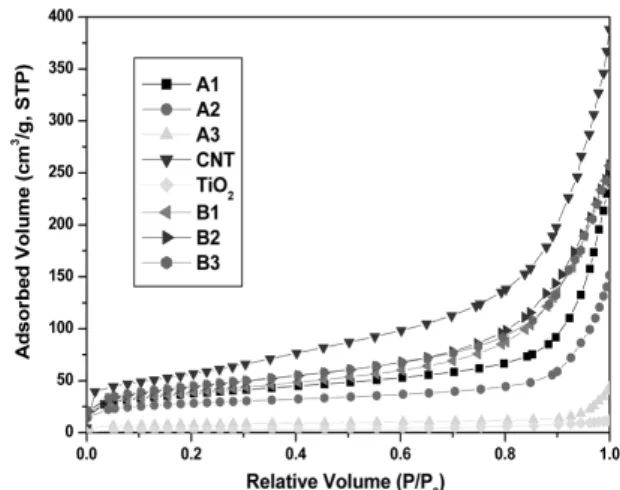
2

composites are shown in Fig. 1. Fig. 1 shows an idealized form of the adsorption isotherm for physisorption on CNT/TiO

2

composites. At low pressures the surface is only partially occupied by the gas, until at higher pressures the monolayer is filled and the isotherm reaches a plateau.

All of the isotherms were type II classified with an IUPAC, which suggests a mixed micro-and mesoporous texture. The values of BET surface area of CNT/TiO

2

composites are shown in Table 2. As the results of Table 2, the BET surface areas of pristine CNT was 299.15 m

2

/ g, while the BET surface areas of A and B series of CNT/TiO

2

composites are changed from 28.863 m

2

/g to 185.32 m

2

/g, it demonstrated that there is a markedly decrease in the BET surface area of the CNT/TiO

2

composites with an increase of TiO

2

concentration, which

suggesting that some porosity was developed during the heat treatment. It was considered that there are two aspect reasons. First, this could be attributed to the partly blocking of micropores by the formation of TiO

2

on the CNTs surface with the heat treatment. Second, the BET surface area decreased due to the curing of polymer resin with heat treatment, which blocked the micropores and formed some new mesopores. It was possible that the polymer resin had coated some CNT particles to form some larger composite particles during the hardening process. The same phenomena can be well confirmed by the SEM morphology of CNT/TiO

2

composites.

However, for A series, the BET surface areas of all composites were small, and all surface areas were a considerably more decrease than that of pristine CNTs, and increased the amount of CNTs would increase the surface area. The same phenomena had also been observed in Wang’s studies

27, 28)

.

The XRD results for the catalyst samples are shown in Fig. 2. The XRD results illuminated that the CNTs are

Fig. 1. Adsorption isotherms of N

2

at 77 K on the pristine materials and CNT/TiO

2

composites.

Table. 2. Textural properties of pristine materials and CNT/

TiO

2

composites

Sample S

BET

(m

2

/g)

A1 135.05

A2 100.38

A3 28.863

B1 185.32

B2 137.55

B3 157.71

CNT 299.15

TiO

2

8.3190

(4)

coated with a mixing type of anatase and rutile TiO

2

particles when the precursor is TiO

2

powder (A series), or with a typical single and clear anatase TiO2 particles when the precursor is Ti (OC

4

H

7

) (TNB) (B series). For A series, the structure showed a mixing anatase and rutile crystals. The samples were heated at 673 K for 1 h. The peaks at 25.3, 37.8, 48.0 and 62.5 are the diffractions of (101), (004), (200) and (204) planes of anatase, indicating the developed CNT/TiO2 composites existed in anatase state. The peaks at 27.4, 36.1, 41.2 and 54.3 belong to the diffraction peaks of (110), (101), (111) and (211) of rutile. Therefore, it can be concluded that the developed CNT/TiO

2

composites had a mixing structures

of anatase and rutile crystals. On contrast to the work of Chen and his co-worker

29)

, we have evidenced that C/

TiO

2

composites had a mixing structure of anatase and rutile crystals by crystallization when the temperature reached 973 K. But in present case, we prepared CNT/

TiO

2

composites using different composition of CNT and TiO

2

; the crystal had translated from anatase to rutile at 673 K, Moreover, the ratio of rutile crystals for A3 is higher than that of A1 and A2, which indicate the ratio of rutile crystals increased with an increase of the amount of TiO

2

.

However, for B series, the structure for the CNT/TiO

2

composites showed a typical single and clear anatase crystal structure. It is well known that the crystal structure of the titanium dioxide is mainly determined by the heat treated temperature. After the heat treatment at 673 K for 1 h, the main crystalline phase is not transformed to the rutile structure. The major peaks at 25.3, 37.8, 48.0, 53.8 and 62.5 are the diffractions of (101), (004), (200), and (105) and (204) planes of anatase, indicating the prepared CNT/TiO

2

composites existed in anatase crystal phase. The result is in accordance with cited reference

30)

.

The micro-surface structures and morphology of CNT/

TiO

2

composites were characterized by SEM and FE-

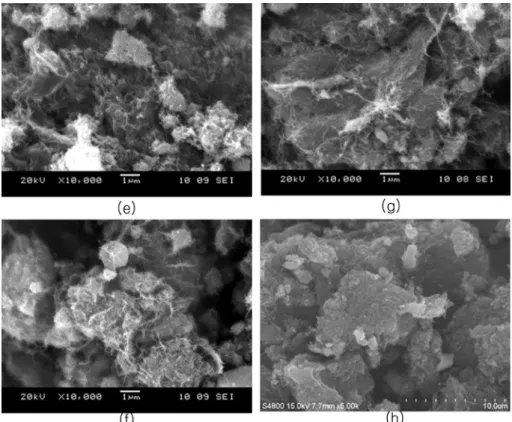
SEM. Fig. 3 shows the changes in the morphology of

Fig. 2. XRD patterns of CNT/TiO

2

composites.

(5)

CNT/TiO

2

composites. As shown in Fig. 3((a), (b) and (c)), TiO

2

particles of A series were fixed well on the surface of the CNTs network, which the conductive of CNTs network facilitating the electron transfer between the adsorbed MB molecules and the catalyst substrate, it was beneficial for the PEC reaction because the PEC reaction is carried out on the surface of the CNT/TiO

2

composites catalysts and the CNTs network. So the CNT/

TiO

2

composites would show an excellent PEC activity.

It was also observed that some clusters of TiO

2

particles were found, the aggregated degree of A3 is higher than that of A1 and A2, which indicate the amount of clusters increased with an increase of the amount of TiO

2

. According to the Fig. 3(d), the FE-SEM image presents a close-up scale view of TiO

2

introduced from composites with external diameters ranging from 0.5 to 1.5 µm. It was considered that a good dispersion of small particles could provide more reactive sites for the reactants than aggregated particles. It is consistent with the Wang’s reports

27,28)

that CNT introduced into TiO

2

can prevent TiO

2

particles from agglomerating. The size of TiO

2

particles became large with an increase of the amount of TiO

2

. Therefore, the higher PC activity of the CNT/TiO

2

composites prepared might be attributed to chemical

degradation.

According to the Fig. 3((e), (f) and (g)), in case of B1, the particles of TiO

2

were well distributed among the CNTs network, and some TiO

2

particles aggregated to be small clusters, this result is as well confirmed by FE- SEM inspection of CNT/TiO

2

composites. According to the Fig. 3(h), the image presents a close-up scale view of TiO

2

introduced from composites with external diameters changing below 2.0 µm. It was still considered that a good dispersion of small particles could provide more reactive sites for the reactants than aggregated particles.

But it was also observed that the dispersion of the TiO

2

particles for B series of CNT/TiO

2

composites prepared with different TNB concentration was not evidently changed among the CNTs networks. Therefore, the higher PC activity of the CNTs/TiO

2

composites prepared might be attributed to chemical degradation. At the same time, the conductive of CNTs network can facilitate the electron transfer between the adsorbed MB molecules and the catalyst substrate

31-34)

; it was beneficial for the PEC reaction because the PEC reaction is carried out on the surface of the CNT/TiO

2

composites catalysts and the CNTs network. So the CNT/TiO

2

composites would show an excellent PEC activity.

Fig. 3. SEM and FE- SEM images obtained from powdered CNT/TiO

2

composites: (a) A1, (b) A2 (c) A3, (d) A1, (e) B1 and

(f) B2, (g) B3 and (h) B3.

(6)

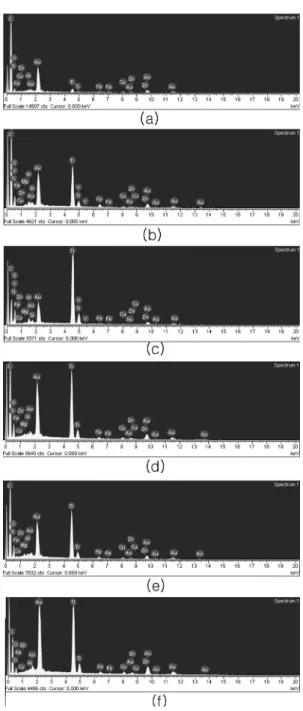
Fig. 4 shows the EDX spectra of CNT/TiO

2

composites prepared. From the EDX data, the main elements such as C, O and Ti were existed and other impure elements were also existed. The results of EDX elemental microanalysis of CNT/TiO

2

composites are listed in Table 3. As expected, for A series, the Ti element contents in the composites increased with an increase of TiO

2

composition. But for B series, the Ti content percents of B1, B2 and B3 are 22.54%, 19.02% and 35.62 %, respectively. It was not observed that the Ti element contents in the composites increased with an increase of

TNB concentration. The Ti content of B2 was some lower than expected. It was proposed that the Ti content introduced into the composites has been affected by the pore structure of the prepared CNT matrix. The same phenomena can be observed in the structure of CNT/TiO

2

composites.

3.2 Catalytic activities

Fig. 5 shows the changes in relative concentration (c/

c

0

) of the CNT/TiO

2

composites in MB concentration of 1 × 10

-5

mol/L under UV irradiation in the aqueous solution. From the present results in Fig. 5(a), it can be seen that the PC process of MB with fast degradation efficiency was observed with an increase of TiO

2

components. It is considered that decrease of MB concentration in the aqueous solution can be occurred in two physical phenomena such as adsorption by CNTs and PC decomposition by TiO

2

, and that the PC decomposition was mainly here. As the result of EDX, the A1 had the most content of carbon and A3 had the most content of Ti. From the Fig. 5 (b), the PEC oxidation increased with an increase of CNTs composition. According to the studies of Oh and his co- worker

35,36)

, it was possible that catalytic decomposition of MB solution could be attributed to combination effects between TiO

2

PC and CNTs electro-assisted. The applied potential was in PEC, the recombination of photo generated e/h

+

pairs was suppressed by the externally applied electric field, and thus the life time of the holes and electrons became longer

37)

. Moreover, the conductivity of CNTs network facilitated the electron transfer between the adsorbed MB molecules and the catalyst substrate. It indicated that the decrease of MB can be concluded to combination effects of PC decomposition by TiO

2

and CNTs network electro- assisted. From the present results in Fig. 5(c), it can be Fig. 4. EDX elemental microanalysis of CNT/TiO

2

composites:

(a) A1, (b) A2, (c) A3, (d) B1, (e) B2 and (f) B3.

Table 3. EDX elemental microanalysis of CNT/TiO

2

composites

Sample Elements (wt. %)

C O Ti Other Total

A1 81.30 10.35 2.68 5.67 100

A2 56.98 18.97 17.32 6.73 100

A3 26.64 33.49 36.77 3.10 100

B1 48.55 22.87 22.54 6.04 100

B2 53.54 22.51 19.02 4.93 100

B3 39.40 16.27 35.62 8.71 100

(7)

seen that the PC process of MB with fast degradation efficiency of B2 was observed. It is considered that decrease of MB concentration in the aqueous solution can be occurred in two physical phenomena such as adsorption by CNTs and PC decomposition by TiO

2

, and that the adsorption by CNTs was mainly here. As the result of EDX, the B2 has the most content of carbon and the lowest content of Ti. As shown in the Fig.5. (d), the PEC oxidation of B1 and B2 are higher than that of B3, it was possible that the PEC oxidation increased with

an increase of CNTs composition, the carbon content of B3 is the lowest among the three samples, so the CNTs electro-assisted effect of B3 is littler than that of B1 and B2. According to the works

16,35)

, it was possible that catalytic decomposition of MB solution could be attributed to combination effects between TiO

2

photocatalytic and CNTs electro-assisted.

Fig. 6 shows the effects of different CNT/TiO

2

electrode on the photoelectrodegradation of MB. From an overall point of view, as shown in the Fig.6, the B series of CNT/ TiO

2

composite electrode catalyst prepared by the impregnation method demonstrates higher PEC activity than the A series through mechanical mixture method with the same CNT content. It was indicated that not only the presence of CNT but also how to combine CNT with TiO

2

should be taken into account to explain the synergetic effect.

The synergetic effect of CNT on the activity of the CNT/TiO

2

composite catalysts can be ascribed (scheme 2).

Considering the semiconductive properties of CNT, CNT may absorb the irradiation and transfer the photo-induced electron (e

-

) into the conduction band of the TiO

2

particles (equation (1)). This electrons transfer between Fig. 5. Dependence of relative concentration of MB in the aqueous solution c/c

0

on time of UV irradiation for different CNT/

TiO

2

electrode: PC series (UV irradiation using the electrodes but without any electron current) and PEC series (UV irradiation using the electrodes with an electron current).

Fig. 6. Effects of different CNT/ TiO

2

electrode on the

photoelectrodegradation of MB (in PEC series).

(8)

carbon materials and TiO

2

semiconductor. Simultaneously, a positive charged hole (h

+

) might be formed by electron migrating from TiO

2

valence band to CNT (equation (3)).

With this understanding, the role played by CNT can be illustrated by injecting electrons into TiO

2

conduction band under UV light irradiation and triggering the formation of very reactive radicals superoxide radical ion O2 ·

-

(equation (2)) and hydroxyl radical HO · (equation (4)), which are responsible for the degradation of the organic compound. The PC reaction occurs while both HO · radical and MB molecule are adsorbed(equation (5)-(6)). According to this mechanistic approach, the MB molecule decomposed into some aliphatic compounds, thus resulting to their mineralization.

In present case, the applied potential was in PEC, the recombination of photogenerated e/h

+

pairs was suppressed by the externally applied electric field, and thus the life of the e/h

+

got longer, and hence are able to migrate to the solid-liquid interface, promoting redox reactions

36,37)

. As the experimental results based above, we can conclude that this degradation mechanism is

suitable results of MB PEC degradation using the prepared CNT/TiO

2

composite electrodes.

4. Conclusion

In this study, the PEC properties of CNT/TiO

2

electrodes were investigated. The BET surface areas for CNT/TiO

2

composites decreased with an increase of TiO

2

components. The XRD results illuminated that the CNTs are coated with a mixing type of anatase and rutile TiO

2

particles when the precursor is TiO

2

powder or with a typical single and clear anatase TiO

2

particles when the precursor is TNB. The TiO

2

particles were fixed well on the surface of the CNTs network for all CNT/TiO

2

composites. From the EDX data, the main elements such as C, O and Ti were existed. The results demonstrated that the PEC oxidation of MB concentration in the aqueous solution can be contributed to the synthetic effects of PC decomposition by TiO

2

and CNTs network electro-assisted, and that PC oxidation of MB increased with an increase of TiO

2

composition and PEC oxidation increased with an increase of CNTs composition. The CNT/TiO

2

composites catalyst prepared by the impregnation method demonstrates higher PEC activity than the mechanical mixture with the same CNT content.

Reference

1. P. Serp, M. Corrias and P. Kalck, Appl. Catal. A. Gen., 253, 337 (2003).

2. J. J. Ge, D. Zhang, Q. Li and H. Hou, J. Am. Chem. Soc., l27, 9984 (2005).

3. B. Fugetsu, S. Satoh, T. Shiba and T. Mizutani, Environ.

Sci. Technol., 38, 6890 (2004).

4. A. Masakazu, Bull. Chem. Soc. Jpn.,77, l427 (2004).

5. B. J. Liu, T. Torimoto, H. Matsumoto and H. Yoneyama, J. Photochem. Photobiol. A.,108, 187 (1997).

6. R. H. Michael, T. M. Scot, W. Y. Choi and W. B. Detlef, Chem. Rev., 95, 69 (1995).

7. A. P. Mandelbaum, A. E. Regazzoni, M. A. Blesa and S.

A. Bilmes, J. Phys. Chem. B., 103(26), 5505 (1999).

8. S. Yamazaki, S. Tanaka and H. Tsukamoto, J. Photochem.

Photobiol. A., 121, 55 (1999).

9. K. Katagiri, T. Suzuki, H. Muto, M. Sakai and A.

Matsuda, Colloids and Surfaces A: Physicochem. Eng .Aspects., 321, 233 (2008).

10. Z. P. Zhu, K. L. Huang and Y. Zhou, Trans. Nonferrous.

Met .Soc. China., 17, 1117 (2007).

11. M. L. Chen, J. S. Bae, W. C. Oh, Carbon Science, 7, 259 (2006).

12. M. L. Chen, J. S. Bae and W. C. Oh, Bull. Chem. Soc.

Kor., 27, 1423 (2006).

Scheme. 2. Schematic representation of photo induced electron

transfer processes in the electrode /solution system.

(9)

13. M. L. Chen, J. S. Bae and W. C. Oh, Anal. Sci. Technol., 19, 376 (2006).

14. M. L. Chen, Y. S. Ko, W. C. Oh, Carbon Science., 8(1), 6 (2007).

15. W. C. Oh, A. R. Jung and W. B.Ko, J. Ind. Eng.

Chem.,13(7), 1208 (2007).

16. W. C. Oh, M. L. Chen, Bull. Korean. Chem. Soc., 29(1), 159 (2008).

17. W. D. Wang, P. Serp, P. Kalck and J. L .Faria, Appl. Catal.

B. Environ., 56, 305 (2005).

18. K. Hernadi, E. Ljubovic, J. W. Seo and L. Forro, Acta.

Mater., 51, 1447 (2003).

19. A. Jitianu, T. Cacciaguerra, R. Benoit, S. Delpeux, F.

Beguin and S. Bonnamy, Carbon., 42, 1147 ( 2004).

20. S. W. Phang, M. Tadokoro, J .Watanabe, N. Kuramoto, Synthetic. Metals.,158, 251 (2008).

21. A. K. Ray, Chem. Engi. Sci., 54, 3113 (1999).

22. P. F. Fu, Y. Luan and X. G. Dai, J. Mol. Catal. A. Chem., 221, 81 (2004).

23. Z. Ding, X. J. Hu, P. L .Yue, G. Q. Lu and P. F. Greenfield, Catal. Today.,68, 173 (2001).

24. X. Z. Li, H. L. Liu and P. T .Yue, Environ. Sci. Technol., 34, 4401 (2000).

25. F.Y. Oliva, L. B. Avalle, E. Santos and O. R. C´amara, J.

Photochem. Photobiol. A. Chem., 146, 175 (2002).

26. G. Colon, M. C. Hidalgo and J. A. Navio, Appl. Catal. B.

Environ., 45, 39 (2003).

27. W. D. Wang, P. Serp, P. Kalck, C. G. Silva and J. L .Faria, Mater. Res. Bull., 43, 958 (2008).

28. W. D. Wang, P. Serp, P. Kalck and J. L. Faria, J. Mol.

Catal. A. Chem., 235, 194 (2005).

29. M. L. Chen, J. S. Bae, W. C. Oh and Carbon Science., 7, 259 (2006).

30. W. C. Oh, M. L. Chen, J. Ceram .Process. Res., 9(2), 100 (2008).

31. P. A. Christensen, T. P. Curtis, T. A. Egerton, S. A. M.

Kosa and J. R. Tinlin, Appl. Catal. B. Environ., 41, 371 (2003).

32. X. Z. Li, F. B. Li, C. M. Fan and Y. P. Sun, Water. Res., 36, 2215 (2002).

33. D. Jiang, H. Zhao and S. Zhang, R. John, J. Catal., 223, 212 (2004).

34. J. Chen, M. Liu, L .Zhang, J. Zhang and L. Jin, Water.

Res., 37, 3815 (2003).

35. W. C. Oh, A. R. Jung and W. B. Ko, J. Ind. Eng. Chem., 13(7), 1208 (2007).

36. M. J. O’connell, Carbon Nanotubes Properties and Applications, CRC press, USA, 2006.

37. B. Gao, C. Peng, G. Z. Chen, G. L. Puma, Appl. Catal. B.

Environ., 2008, doi:10.1016/ j.apcatb.2008.06.027.

수치

Table 1. Nomenclatures of CNT/TiO 2  electrode
Fig. 1. Adsorption isotherms of N 2  at 77 K on the pristine materials and CNT/TiO 2  composites.
Fig. 3. SEM and FE- SEM images obtained from powdered CNT/TiO 2  composites: (a) A1, (b) A2 (c) A3, (d) A1, (e) B1 and (f) B2, (g) B3 and (h) B3.
Fig. 4 shows the EDX spectra of CNT/TiO 2  composites prepared. From the EDX data, the main elements such as C, O and Ti were existed and other impure elements were also existed
+2

참조

관련 문서

Bactericidal effect of photocatalytic reactor depending on the UV-A illumination time and flow rate of V.. Bactericidal effect of photocatalytic reactor

52 Sheet resistance and carrier mobility of the spin-coated Al substrates by using PTFE or PTFE/CNT powder with a different CNT contents · ·

For job characteristics sub-factors, while the average of functional diversity was high in graduate school graduates, the average of task importance, job

These results revealed that TiO 2 NM surface had positive affect on activity of alkaline phosphatase after 15 days cell culturing time... 티타늄은

Determining optimal surface roughness of TiO₂blasted titanium implant material for attachment, proliferation and differentiation of cells derived from

Using RTM1688-2, Silicon Surface-Barrier Detector that can measure both Radon and Thorium at the same tome, Radon concentration was measured for 10 kinds of construction

It was found that the NO emission decreased significantly at various condition of operation with the 2-stage combustion type diesel engine, but CO and

In the POLARIS-2 and POLARIS-3 studies 14 , it was not determined that SOF/VEL/VOX for 8 weeks was non-inferior to SOF/VEL for 12 weeks for the treatment of non-cirrhotic