115
Enhancing photoluminescence of Au – TiO 2 nanoparticles using Drude model
Diem Thi-Xuan Dang* and Thi Hanh Thu Vu*★
Abstract
The enhancement of photoluminescence of Au-TiO2 nanoparticles by surface plasmon resonance has been studied extensively by experiment in recent years. For the purpose of optimizing the photoluminescence property of Au-TiO2 nanoparticles, the manufacturing parameters related to the Au nanoparticles and TiO2
nanoparticles need to be considered. In this paper, Drude model and Maier's effective volume method are used to analyze the variation of the metal nanoparticle radius, separation between metal nanoparticle and dielectric molecule, and total absorption cross-section with original radiative efficiency on the photoluminescence property of Au-TiO2 nanoparticles. The results show that to obtain the optimized enhancement factor for photoluminescence process, the size of Au nanoparticle is about 13−20 nm, the separation between Au nanoparticle and TiO2 molecule is about 5 15 nm− , the total absorption cross-section of TiO2 molecules is about 1 100 nm− 2 and the original radiative efficiency of TiO2 molecule is weak about 0.001 0.1− . With these fabrication parameters, the photoluminescence property of Au-TiO2 nanoparticles can be enhanced several thousand times compared to traditional TiO2 nanoparticles.
Key words: surface plasmon resonance, photoluminescence, Drude model, Maier effective volume method, Au- TiO2.
* Faculty of Physics and Engineering Physics, University of Science, Vietnam National University Ho Chi Minh City, Vietnam.
★ Corresponding author:
e-mail:[email protected] tel: ++84.0975.547.404
※ Acknowledgment
Manuscript received Jun. 13, 2017; revised Aug. 16, 2017 ; accepted Sep. 19, 2017
This is an Open-Access article distributed under the terms of the Creative Commons Attribution Non-Commercial License (http://creativecommons.org/licenses/by-nc/3.0) which permits unrestricted non-commercial use, distribution, and reproduction in any medium, provided the original work is properly cited.
I. Introduction
The enhancement of photoluminescence (PL) from dielectric molecules located in the proximity of rare metal nanoparticles such as gold (Au), silver (Ag), copper (Cu), … is particularly interested [1 – 3]. Unlike Ag and Cu, Au is not oxygenated in different environments so it is widely used.
Depending on using or researching, Au is embedded into a compatible medium such as TiO2, ZnO, GaN, ... [4 – 9].
Incorporating Au nanoparticles into TiO2 dielectric material enables the absorption of light to expand from visible to near-infrared light and to enhance the photovoltaic conversion by Surface Plasmon Resonance (SPR) [10, 11]. The enhancement of optical properties of Au nanoparticles embedded into TiO2 have been confirmed by experimental investigations [10, 12 – 14] but theoretical studies on this problem are limited. The most important theoretical investigations are papers of G. Sun et al.
[15 – 17].
G. Sun et al. employed Drude model and Maier's effective volume method to develop a theoretical model of the enhancement of photoluminescence of dielectric molecules in the vicinity of metal nanoparticles in the case of considering radiative decay of surface plasmon. These papers have received a lot of attention of physicists who specialize in plasmons, fluorescence, and emission for applications in the field of the diode, sensor, ...
[18 – 20].
In this paper, following the research by G.
Sun, we investigated the effect of Au nanoparticles on the photoluminescence property of the Au-TiO2 nanoparticles by calculating PL enhancement factor and optimizing this factor. The PL enhancement factor depends on parameters such as the Au nanoparticle radius, the separation between Au nanoparticles and TiO2 molecules, the total absorption cross-section and the original radiative efficiency of TiO2 molecule, we gave the suggestions to select the appropriate value of these parameters to enhance the photoluminescence property.
II. Theoretical model
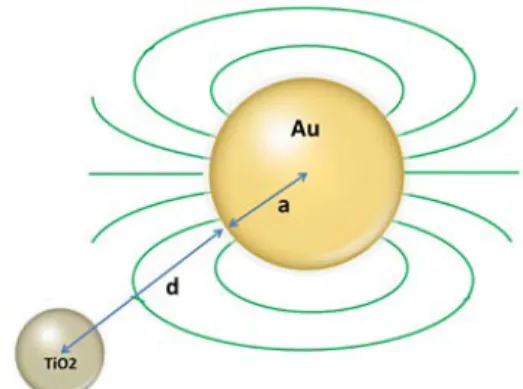
An Au nanoparticle with the dielectric constant
ωM and the radius r is embedded into the dielectric medium with the dielectric constant εD
and is separated to a TiO2 molecule about d as shown in Fig 1. Each Au nanoparticle simultaneously has a lot of charge distribution and generates many different electric multipole moments (modes). However, due to the good coupling between dipole mode and external radiation fields, we are only interested in the effects of dipole mode on the enhancement of photoluminescence. Therefore, to eliminate the effect of higher modes, we calculated the PL enhancement factor from the separation d≥5 nm
for the Au-TiO2 nanoparticles.
The process of PL enhancement consists of two mechanisms. When the beams of excited light, which
have the frequencyωex, converged on the area of Au–TiO2 nanoparticles, the excited light beams will couple with the dipole modes of Au nanoparticles to generate energy. Then, these energy will be absorbed by the TiO2 molecules, radiative decayed and the non-radiative decayed. The energies of the TiO2 molecules will be partly reduced by lattice vibrations, heat transfer, … and the rest is radiated back to the dipole mode in frequency ωPL. Therefore, the PL enhancement process consists of optical absorption and emission. It is clear that ωex≥ωdp≥ωPL
is always satisfied, where ωdp is the dipole frequency [15]. When the appearance of resonance
ex dp PL
ω =ω =ω , this process becomes stronger, so, PL enhancement factor increases significantly.
Fig 1. An Au nanoparticle with the dielectric
constant ωM and the radius r is embedded into the dielectric medium with the dielectric constant εD
and is separated to a TiO2 molecule about d. The PL enhancement factor when the resonance occurs is [15]
( ) ( ) ( )
PL dp ABS dp EL dp
F ω =F ω F ω . (1)
The PL enhancement factor FPL depends on the
absorption enhancement factor FABS and the electroluminescence enhancement factor FEL.
The expression of the absorption enhancement factor when resonance occurs is [15]
( ) 9
(
3 1 1)
2 1 64
D d
ABS dp n a
F ε Q Q χ
ω χ
χ
−
− − −
= + + + , (2)
where
1 2
p dp
D
ω ω
= ε
+ is the resonant frequency,
2
dp
πa
χ= λ is the normalized radius, d 2 dp
πd
χ = λ is the
normalized separation,
( )
2 1 2
dp n
D
Q ω
γ ε
≈ + is the non-
radiative decay factor and
6 3 2
1 3
dp d
a
D a a
Q N
χ λ χ
πε σ χ
≈ +
is
the absorption decay factor. In the formula of ωdp,
8.45
p eV
ω = is the plasma frequency of Au nanoparticles [15], εD=6.2 is the dielectric constant of TiO2 [21]. From there, we calculated ω =dp 2.31 eV. In the formula of Qn, hγ =0.045 eVis the loss in Au [22]. In the expression of Qa, dp 1 22 215
D dp
c nm
λ π
=ε ω ≈ is
the dipole wavelength of Au. Thus, the absorption enhancement factor FABS is a function depends on the radius r of Au nanoparticles, the separation d from Au nanoparticle to TiO2 molecule, and the total absorption cross-section Naσaof TiO2 molecules.
Each optimized Au radius, the separation d and the cross-sectionNaσa, we determined the value of the optimized absorption enhancement factor is
( ) ( )
6 1 2 2
, 2
,
9 3 1 2
1 2
4 2
D D a a D
ABS opt dp
ABS opt dp dp
d N
F
a
ε πε σ γ ε
ω λ ω
− −
= + + +
(3)
The electroluminesce enhancement factor when resonance occurs is [5]
( ) ( )
( )
,1
,1
1 1
p dp dp
EL dp
p dp rad
F F
F ω ω η
ω η
= +
+ , (4)
in which Fp,1( )ωdp is Purcell factor of the dipole mode, ηrad is the original radiative efficiency of TiO2 when Au nanoparticles are not loaded and
ηdp is the radiative coupling efficiency of the dipole mode. Purcell factor of the dipole modes when resonance occurs is [15]
( )
(
3 1)
1 6,1 3
9 1
2
D d
p dp n
F ε Q χ
ω χ
χ χ
−
− −
= + +
, (5)
and the radiative coupling efficiency of the dipole modes is [15]
( )
1
3 1
1 nrad 1
dp n
rad
γ Q
η χ
γ
−
= + = + −
. (6)
So, the electroluminescence enhancement factor is a function of the radius r , the separation d, and the efficiency ηrad.
Totally, FPL depends on the radius r , the separationd , the cross-section Naσa and the efficiency ηrad.
III. Results and discuss
In theory, the PL enhancement factor FPL
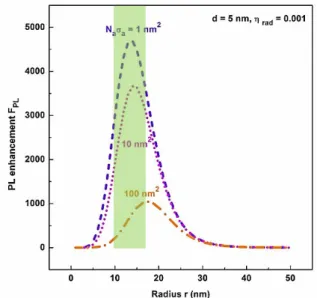
depends on the radius r, the separation d, the cross-section Naσa and the efficiency ηrad . Herein, we performed FPL factor by fixed two parameters and showed the radius r in some of the remaining parameter values as shown in Fig 2.
Fig 2. The graph of PL enhancement factor on the radius r of Au nanoparticle with separation
5
d= nm, original radiative efficiencyηrad =0.001 on some values of total absorption cross-section
a a
Nσ .
In Fig 2, we found that the curves of FPL
factor increase on the radius r when fixed at
5
d= nm , ηrad=0.001 with three different Naσa
values, factorFPL increases to a maximum value then decreases
Fig 3. The graph of PL enhancement factor on the radius r of Au nanoparticle with the separation
5
d= nm , the total absorption cross-section
1 2 a a
Nσ = nm on some values of the original radiative efficiency ηrad.
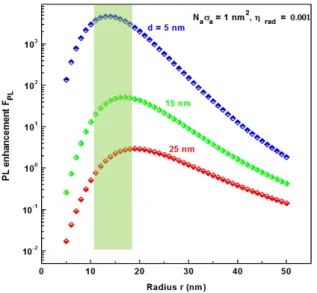
Fig 4. The graph of PL enhancement factor on the radius r of Au nanoparticle with the total absorption cross-section Naσ =a 1 nm2, the original radiative efficiency ηrad =0.001 on some values of separation d between Au nanoparticle with TiO2
molecule.
sharply to 0. When the cross-section Naσa
increases, FPL factor falls gradually. For each value of Naσa, FPL has a value close to 0 when the radius is greater than 30 nm . Henceafter, we should not produce Au nanoparticles with radii larger than 30 nm in applications requiring high photoluminescence for Au–TiO2 nanoparticles. In Fig 3, for each value of efficiencyηrad, factor FPL
falls dramatically. For ηrad=0.1, FPL
seems too small. Like Fig 2, when the radius is greater than
30 nm, the value of FPL is near 0. For Fig 4, when separation d increases, factor FPL decreases spectacularly. The maximum value of FPL
corresponding to each value r is in the range
13−20 nm. In summary, separation d or cross- section Naσa or efficiency ηrad rises, FPL factor
falls, in which, when d increases, FPL will fall most then ηrad and finally Naσa . Therefore, in order to PL process to be strengthened, one should ensure that the separation between Au nanoparticle with TiO2 molecule and original radiative efficiency are small. Moreover, one should not fabricate Au nanoparticles with radii of
30 nm or more.
For each optimized radius of Au nanoparticles, the optimized PL enhancement factor FPL opt, is a function of the separation d, the cross-section
a a
Nσ and the efficiency ηrad. Because factor FPL opt,
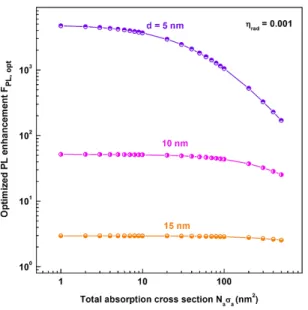
is a function of three parameters, we cannot perform a graph of this factor depends on the parameters by three – dimensional graph. On the other hand, to easily visualize, we have performed a graph of factor FPL opt, depends on the cross-section Naσa by fixing ηrad=0.001 and an other graph of factor FPL opt, depends on the efficiency ηrad by fixing Naσ =a 1 nm2 with some values of separation d. In general, the curves of factor FPL opt, are reduced. In Fig 5, when the cross-section Naσa has a value from 1 100 nm− 2,
Fig 5. The optimized PL enhancement factor FPL opt, on the total absorption cross-section Naσa by fixing the original radiative efficiency ηrad=0.001 with some values of the separation d between Au nanoparticle with TiO2 molecule.
Fig 6. The optimized PL enhancement factor FPL opt, on the original radiative efficiency ηrad by fixing the total absorption cross-section Naσ =a 1 nm2 with some values of the separation d between Au nanoparticle with TiO2 molecule.
factor FPL opt, falls slightly, when Naσa is greater than 100 nm2, FPL opt, falls modestly and when Naσa
continues to increase, then FPL opt, approaches zero. The separation d increases too much,
, PL opt
F almost unchanges on Naσa. In Fig 6, when the efficiency ηrad boosts in the case the separation d is small, factor FPl opt, decreases rapidly; as d increases, FPL opt, falls marginally.
Consequently, the PL enhancement factor is optimized when some molecules, which have small absorption cross-section and original radiative efficiency, are placed near metal nanoparticles.
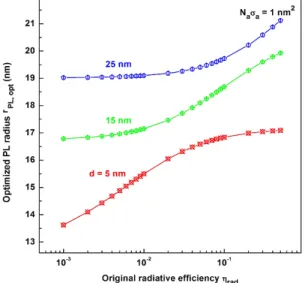
Fig 7. The optimized radius of Au nanoparticle rPL opt, at PL enhancement factor is maximum on the total absorption cross-section Naσa with the original radiative efficiency ηrad=0.001 some values of separation d between Au nanoparticle and TiO2
molecule.
To gain factor FPL opt, for each value of the separation d, the cross-section Naσa, and the efficiency ηrad, the radius of Au nanoparticle must be optimized rPL opt, . Fig 7 shows the optimized radius rPL opt, depending on the cross- section Naσa and Fig 8 shows the optimized radius rPL opt, depending on the original radiative efficiency ηrad. In general, the curves of rPL opt, are quite complex. Thus, similar to the above, one
wants to get factor FPL opt, of great value, the separation between Au nanoparticle and TiO2
molecule is about 5 15 nm− , the absorption cross-section of TiO2 molecules is between
1 100 nm− 2 and the original radiative efficiency of TiO2 molecule is weak between 0.001 0.1− , so the radius must be within the range 13−20 nm.
Fig 8. The optimized radius of Au nanoparticle rPL opt, at PL enhancement factor is maximum on the original radiative efficiency ηrad with the total absorption cross-section Naσ =a 1 nm2 some values of the separation between Au nanoparticle and TiO2 molecule.
III. Conclusions
In this report, Drude model and Maier's effective volume method are used to show the enhanced photoluminescence factor as well as the optimization of this factor on Au nanoparticle radius, the separation between Au nanoparticle with TiO2 molecule, the total absorption cross-section and the original
radiative efficiency based on Au-TiO2
nanoparticles. The results show that to obtain the optimized enhancement factor for photoluminescence process, we need to fabricate Au nanoparticles, which have the sizes of 13−20 nm, separated from TiO2 molecule about 5 15 nm− , the absorption cross-section of TiO2 molecules or the density of TiO2
molecules on an Au nanoparticle is small enough to make total absorption cross-section between 1 100 nm− 2 and original radiative efficiency of TiO2 molecule is weak between
0.001 0.1− .
References
[1] T. Chen, G. Z. Xing, Z. Zhang, H. Y. Chen and T. Wu, “Tailoring the photoluminescence of ZnO nanowires using Au nanoparticles ” , Nanotechnology, Sep, 2008.
[2] S. A. Ansari, M. M. Khan, M. O. Ansari, J. Lee and M. H. Cho, “ Biogenic Synthesis, Photocatalytic, and Photoelectrochemical Performance of Ag−ZnO Nanocomposite”, The Journal of Physical Chemistry C, Dec, 2013.
DOI: 10.1021/jp410063p
[3] C. X. Xu, X. W. Sun, X. H. Zhang, L. Ke and S. J. Chua, “ Photoluminescent properties of copper-doped zinc oxide nanowires ” , Nanotechnology, Jun, 2004. DOI:
https://doi.org/10.1088/0957-4484/15/7/026 [4] E. J. Guidelli, O. Baffa and D. R. Clarke,
“Enhanced UV Emission From Silver/ZnO And
Gold/ZnO Core-Shell Nanoparticles:
Photoluminescence, Radioluminescence, And Optically Stimulated Luminescence ” , Scientific Reports, Sep, 2015. DOI:
10.1038/srep14004
[5] A. Orlov, D. A. Jefferson, N. Macleod, R. M.
Lambert, “Photocatalytic Properties of TiO2 Modified with Gold Nanoparticles in the Degradation of 4-Chlorophenol in Aqueous Solution”, Catalysis Letters, Jan, 2004.
DOI:https://doi.org/10.1023/B:CATL.00000110 84.43007.80
[6] D. S. Rahman and S. K. Ghosh, “Manipulating Electron Transfer in Hybrid ZnO–Au Nanostructures: Size of Gold Matters”, The Journal of Physical Chemistry C, Jun, 2016.
DOI: 10.1021/acs.jpcc.6b03551
[7] S. Sakthivela, M.V. Shankarb, M.
Palanichamyb, Banumathi Arabindoob, D.W.
Bahnemanna, V. Murugesan, “Enhancement of photocatalytic activity by metal deposition:
characterisation and photonic efficiency of Pt, Au and Pd deposited on TiO2 catalyst”, Water
Research, July, 2004. DOI:
https://doi.org/10.1016/j.watres.2004.04.046 [8] S-C. Yang, P-K. Wei, H-H. Hsiao, P-A.
Mante, Y-R. Huang, I-J. Chen, H-C. Chang and C-K. Sun,“Enhanced detection sensitivity of higher-order vibrational modes of gold nanodisks on top of a GaN nanorod array through localized surface plasmons”, Applied Physics Letters, November, 2014.
DOI: http://dx.doi.org/10.1063/1.4902830 [9] S-C. Yang, T-P. Shen, T-T. Wu, Y. R.
Huang and C-K. Sun,“Investigation of gold/GaN nanorod arrays for hypersonic detection: The effect of periodicity”, Applied Physics Letters, Oct, 2015.
DOI: http://dx.doi.org/10.1063/1.4934259 [10] Y. Nishijima, K. Ueno, Y. Yokota, K.
Murakoshi and H. Misawa,“Plasmon-Assisted Photocurrent Generation from Visible to Near- Infrared Wavelength Using a Au- Nanorods/TiO2 Electrode”, The Journal of Physical Chemistry Letters, Jun, 2010.
DOI: 10.1021/jz1006675
[11] D. Behera, B. Bag and R. Sakthivel, “Synthesis, characterization and photoluminescence study of modified titania”, Indian Journal of Pure & Applied Physics, Nov, 2011.
[12] L. Wu, F. Li, Y. Xu, J. W. Zhang, D. Zhang, G. Li, and H. Li, “Plasmon-induced photoelectrocatalytic activity of Au nanoparticles enhanced TiO2 nanotube arrays electrodes for environmental remediation”, Applied Catalyst B: Environmental, Mar, 2015.
DOI: https://doi.org/10.1016/j.apcatb.2014.09.029 [13] K. Yu, Y. Tian and T. Tatsuma, “Size effects of gold nanoparticles on plasmon- induced photocurrents of gold-TiO2 nanocomposites”, Physical Chemistry Chemical Physics, Oct, 2006.
DOI: 10.1039/B610720F
[14] Z. Zhan, J. An, H. Zhang, R. V. Hansen and L. Zheng, “ Three-Dimensional Plasmonic Photoanodes Based on Au-Embedded TiO2
Structures for Enhanced Visible-Light Water Splitting”, ACS Applied Material and Interfaces, Jan, 2014. DOI: 10.1021/am404738a
[15] G. Sun, J. B. Khurgin and R. A. Soref,
“Practical enhancement of photoluminescence by metal nanoparticles”, Applied Physics Letters, Mar, 2009.
DOI: http://dx.doi.org/10.1063/1.3097025
[16] G. Sun, J. B. Khurgin and C. C. Yang,
“Impact of high-order surface plasmon modes of metal nanoparticles on enhancement of optical emission”, Applied Physics Letters, Sep, 2009.
DOI: http://dx.doi.org/10.1063/1.3250160 [17] G. Sun and J. B. Khurgin, “Theory of optical emission enhancement by coupled metal nanoparticles: An analytical approach”, Applied Physics Letters, Feb, 2011.
DOI: http://dx.doi.org/10.1063/1.3565170 [18] A. Kinkhabwala, Z. Yu, S. Fan, Y. Avlasevich, K. Müllen and W. E. Moerner, “Large single- molecule fluorescence enhancements produced by a bowtie nanoantenna”, Nature Photonics, Oct, 2009.
DOI: 10.1038/nphoton.2009.187
[19] G. Lozano, D. J. Louwers, S. R. K.
Rodríguez, S. Murai, O. T. A. Jansen, M. A.
Verschuuren and J. G. Rivas, “Plasmonics for solid-state lighting: enhanced excitation and directional emission of highly efficient light sources”, Light: Science & Applications, May, 2013. DOI: 10.1038/lsa.2013.22
[20] D. Ratchford, F. Shafiei, S. Kim, S. K. Gray and X. Li, “Manipulating Coupling between a Single Semiconductor Quantum Dot and Single Gold Nanoparticle”, Nano Letters, Jan, 2011.
DOI: 10.1021/nl103906f
[21] T. Radhakrishnan, “The Optical of Titanium Dioxide”, Proceedings of the Indian Academy of Sciences – Section A, Mar, 1952.
[22] I. E. Protsenko, A. V. Uskos, J. V. M Rudoi,
“Relaxation of Excited States of an Emitter near a Metal Nanoparticle: An Analysis Based on Superradiance Theory ” , Atoms, Molecules,
Optics, Aug, 2014. DOI:
https://doi.org/10.1134/S1063776114080147
BIOGRAPHY
Diem Thi-Xuan Dang (Member)
2015: BS degree in Faculty of Physics, Ho Chi Minh City University of Education.
2015-now: MS student in Faculty of Physics and Engineering Physics, University of Science, Vietnam National University Ho Chi Minh City.
Thi Hanh Thu Vu (Member)
2001: BS degree in Faculty of Physics, University of Science, Vietnam National University Ho Chi Minh City.
2005: MS degree in Faculty of Physics, University of Science, Vietnam National University Ho Chi Minh City.
2009: PhD degree in Faculty of Physics, University of Science, Vietnam National University Ho Chi Minh City.
2014: Associate Professor in Faculty of Physics and Engineering Physics, University of Science, Vietnam National University Ho Chi Minh City.
2001~2013: Lecturer, Faculty of Physics, University of Science, Vietnam National University Ho Chi Minh City.
20014~now: Lecturer, Faculty of Physics and Engineering Physics, University of Science, Vietnam National University Ho Chi Minh City.