INTRODUCTION
According to the Diagnostic and Statistical Manual of Men-tal Disorders-5th Edition (DSM-5) of the American Psychi-atric Association, attention-deficit/hyperactivity disorder (ADHD) is a common childhood psychiatric disorder [1]. The main symptoms of ADHD are inattention, hyperactivi-ty, and impulsivity; the onset of ADHD occurs in childhood before the age of 12 and influences many functional aspects of life, such as home, school, emotional control, and social re-lationships [1]. It is important to help children with ADHD access appropriate treatments and aid them in social adap-tation before their symptoms worsen. ADHD symptoms are known to persist from childhood into adulthood [2]; indeed,
although adults do not always meet diagnostic criteria, the duration of ADHD symptoms in adulthood is reported to be about 30–70% [3,4].
Among the ADHD symptoms, inattention persists most often into adulthood [5]. ADHD-inattentive type (ADHD-I) is frequently seen in girls and has more comorbid internaliz-ing disorders [5]. However, it is difficult for teachers and par-ents to perceive this characteristic because it is characterized by hypo-arousal, low activity, and passive social relationships [6]. Conversely, ADHD-combined type (ADHD-C) is char-acterized by distraction and sloppy work [7]. If these symp-toms persist into adulthood, they are not only associated with low socioeconomic status, mental illness, and increased dys-function [5] but also with low academic and work performance, lack of interpersonal skills, emotional problems, antisocial behavior, and adaptation difficulties [8].
Inattention is known to be associated with working mem-This is an Open Access article distributed under the terms of the Creative Commons
Attribution Non-Commercial License (https://creativecommons.org/licenses/by-nc/4.0) which permits unrestricted non-commercial use, distribution, and reproduction in any medium, provided the original work is properly cited.
The Moderating Effect of Working Memory on the
Relationship between Inattention and Aggressive
Behavior in Attention-Deficit/Hyperactivity Disorder
Mi Young Jeong1, Yeon Jung Lee2, Jung Ho Kim3, and Seo Young Park41Michuhol-gu Community Mental Health Welfare Center, Incheon, Korea
2Department of Psychiatry, Seoul Hospital, College of Medicine, Soonchunhyang University, Seoul, Korea 3Department of Nursing, Masan University, Changwon, Korea
4Department of Medical Sciences, Graduate School of Soonchunhyang University, Asan, Korea
Objectives: Although aggressive behavior in children and adolescents with attention-deficit/hyperactivity disorder (ADHD) has previ-ously shown correlations with hyperactivity/impulsivity, few studies have examined its association with inattention or the effect of work-ing memory on aggressive behavior. This study aimed to assess the relationship between inattention and aggressive behavior and the ef-fect of working memory on the relationship between inattention and aggressive behavior in children and adolescents with ADHD. Methods: Thirty-one children and 26 adolescents with ADHD were retrospectively investigated. The subjects completed the Korean Wechsler Intelligence Scale for Children-Fourth Edition (K-WISC-IV), the Korean Child Behavior Checklist (K-CBCL), and the Korean Children’s Depression Inventory (CDI).
Results: Inattention was positively correlated with aggressive behavior in children and adolescents with ADHD and working memory showed an insignificant correlation. However, working memory had a significant moderating effect on aggressive behavior by interact-ing with inattention. The moderatinteract-ing effect of workinteract-ing memory manifested when the workinteract-ing memory index score on the K-WISC-IV was 73.5 points or higher, and it had a significant effect on aggressive behavior.
Conclusion: This study shows that the severity of inattention and hyperactivity/impulsivity should be addressed to provide appropriate treatment to children and adolescents with ADHD who exhibit aggressive behavior.
Key Words: Attention-deficit/hyperactivity disorder; Attention; Child; Adolescent; Aggression; Working memory.
Received: May 20, 2020 / Revision: June 23, 2020 / Accepted: July 2, 2020
Address for correspondence: Yeon Jung Lee,Department of Psychiatry, Seoul Hospital, College of Medicine, Soonchunhyang University, 59 Daesagwan-ro, Yongsan-gu, Seoul 04401, Korea
ory in various cognitive domains of ADHD children [9]. Children with ADHD are reported to have various cogni-tive impairments in various areas, including working mem-ory, executive function, organization, processing speed, and intelligence [10]. Among these impairments, weakness in working memory has been attracting attention as an inter-nal phenotype of ADHD [11]. Inattention has been reported as being more significant among children with low working memory by the parent report scale of ADHD symptoms [12]. Children with ADHD have been shown to have more inat-tention in phonological and visuospatial working memories than healthy control children [10,13].
Aggressive behavior for children with ADHD, although not included in the diagnostic criteria, is highlighted as one of the secondary problems in children with ADHD [14]. For such children, aggressive behavior, defined as hostile, harm-ful, or destructive behavior [15], is reactive aggression asso-ciated with the prefrontal lobe [16]. In an environment that caused reactive aggression, a group of children with ADHD/ Disruptive Behavior Disorder showed lower activation in the prefrontal lobe than the healthy control group [17]. The pre-frontal lobe is a region closely correlated with persistent at-tention as well as inhibition [18]. Children with ADHD showed higher aggressive behavior compared to the healthy control group in the aggressive behavior scale of Child Behavior Checklist (CBCL). As with other ADHD subtypes [i.e., AD-HD-C and ADHD-Hyperactive/Impulsive type (ADHD-H)], ADHD-I children showed higher aggressive behavior scores than the healthy control group [19]. This neurological corre-lation predicts that aggressive behavior can be a behavioral problem in children with ADHD who suffer from inattention as their main symptom [17].
Previous studies have investigated the positive correlation between aggressive behavior and hyperactivity/impulsivity in children with ADHD [20]. However, peers, parents, and teachers often interpret interpersonal behavior due to hyper-activity/impulsivity and social immaturity of children with ADHD as aggressive behavior [21]. Another previous study reported that the aggressive behavior of children with ADHD is more dominant in ADHD-C and ADHD-I children than in ADHD-H children [19]. Therefore, this study focuses on inattention persisting more than other symptoms until adult-hood [4], the close relationship between inattention and working memory [11], and the aggressive behavior that is more dominant in ADHD-I children than ADHD-H children [19]. Based on the existing research, we hypothesized the fol-lowing: 1) a positive correlation exists between inattention and aggressive behavior; 2) working memory influences the relationship between inattention and aggressive behavior, serving as a moderating effect; 3) there is a level at which the
positive influence of working memory manifests.
METHODS
Subjects
This study retrospectively reviewed the medical records of children and adolescents (n=118) admitted to the univer-sity hospital in Seoul, South Korea, from March 2015 to Sep-tember 2018. Among the subjects, 38 children (age 6–10) and 39 adolescents (age 11–16) were both in- and out-patients who visited the hospital due to inattention or hyperactivity/im-pulsivity. They completed a comprehensive psychological test, including the Korean Wechsler Intelligence Scale for Chil-dren-Fourth Edition (K-WISC-IV), the Korean Child Behav-ior Checklist (K-CBCL), and the Children’s Depression In-ventory (CDI). Five children and seven adolescents with intellectual disability (ID), two children and six adolescents who scored 22 points (mildly depressed status) or more in CDI were excluded. This study was approved by the Institu-tional Review Board at Soonchunhyang University Seoul Hos-pital (IRB 2018-09-011). Obtaining consent was not necessary for this study, owing to its retrospective nature.
Measures
Wechsler Intelligence Scale for Children
The Wechsler Intelligence Scale for Children-Fourth Edi-tion (WISC-IV) is an intelligence test performed individu-ally on children and adolescents. The K-WISC-IV evaluates the cognitive abilities of children and adolescents from age 6–16, and the main outcome is the Full-Scale IQ (FSIQ). In-dices include the Working Memory Index (WMI), Process-ing Speed Index (PSI), Perceptual ReasonProcess-ing Index (PRI), and Verbal Comprehension Index (VCI). The score ranges are 69 and below (extremely low), 70–79 (borderline), 80–89 (low average), 90–109 (average), 110–119 (high average), 120– 129 (superior) and 130 and over (very superior). A trained clinical psychologist performed the test following the instruc-tions in the manual. This study used the average score of the four indices and FSIQ indicators standardized in Korea [22]. Child Behavior Checklist
The CBCL measured the emotional and behavioral prob-lems of children and adolescents between the ages of 6 and 18 and was completed by a parent or the child’s primary caregiver. It was developed by Achenbach and Edelbrock (1983), and the K-CBCL was standardized by Oh et al. [23]. It comprises 118 items evaluated on a three-point Likert scale, not at all true (0 points), sometimes or tends to be true (1 point), or frequently or very much true (2 points). The scales are
di-vided into a Social Competence Scale and a Problem Behav-ior Scale. The Problem BehavBehav-ior Scale has eight subscales (withdrawn, somatic complaints, anxious/depressed, social problems, thought problems, attention problems, delinquent behavior, and aggressive behavior) as well as internalization, externalization, and total behavior problems. In this study, data concerning only two of the eight subscales in the prob-lem behavior scale—attention probprob-lems and aggressive be-havior—were used in the analyses; “attention problems” was named “inattention.” The higher the score on each scale, the more severe the symptoms.
Statistical analyses
According to the groups of children and adolescents, the homogeneity of each research variable was verified by using the Mann-Whitney test. Because VCI, PRI, WMI, and PSI— the sub-scales of K-WISC–IV—have interaction effects, we performed a partial correlation analysis to determine the re-lationship between inattention, aggressive behavior, and WMI after controlling for VCI, PRI, and PSI. The moderating effect of working memory on the relationship between inattention and aggressive behavior was tested using Haye’s PROCESS Macro Model 1, based on the regression analysis. The statis-tical significance of working memory by level was tested us-ing the Johnson-Neyman Technique, which specifically sug-gests a certain area where the moderating effect is significant. The criterion for statistical significance in the Mann-Whit-ney test and partial correlation analysis was set at p<0.001. The moderating effect of working memory was set following the range of confidence intervals, not including zero. All data were processed using the SPSS win 23.0 program (IBM Corp., Armonk, NY, USA).
RESULTS
Demographic characteristics of the participants In the final analysis, the data from 57 participants (exclud-ing participants who had ID or depression) were used. The demographic characteristics are shown in Table 1.
Verification of homogeneity
Table 2 details the difference and homogeneity of the two groups. The difference between the two groups according to age was significant (Z=6.51, p<0.001), with 31 for children (8.55±1.31) and 26 for adolescents (12.46±1.39). The FSIQ (p=0.591), VCI (p=0.917), PRI (p=0.516), WMI (p=0.872), and PSI (p=0.841) were all homogeneous even if there were some differences among children and adolescents.
Inattention (p=0.610) and aggressive behavior (p=0.500) were also homogeneous in children and adolescents.
The relationship between working memory, inattention, and aggressive behavior
The results of the correlation after controlling for VCI, PRI, and PSI (between VCI, PRI, WMI, and PSI, which are sub-indices of K-WISC–IV) to determine the relationships be-tween WMI, inattention, and aggressive behavior are shown in Table 3. There was a positive correlation between inatten-tion and aggressive behavior (r=0.58, p<0.001). However,
Table 1. Demographic characteristics of the participants (n=57)
Variable n (%) Sex Children Male 19 (61.3) Female 12 (38.7) Adolescents Male 14 (53.8) Female 12 (46.2) Age (mean±SD) 10.33±2.38 SD: standard deviation
Table 2. Verification of homogeneity by research variables of
chil-dren and adolescents with ADHD (n=57)
Variable n Mean SD Z p K-WISC-IV FSIQ 0.54 0.591 Children 31 92.00 16.93 Adolescents 26 93.08 13.31 VCI 0.10 0.917 Children 31 97.45 15.11 Adolescents 26 96.54 13.85 PRI 0.65 0.516 Children 31 97.13 18.91 Adolescents 26 96.31 20.96 WMI 0.16 0.872 Children 31 88.65 16.25 Adolescents 26 90.23 16.94 PSI 0.20 0.841 Children 31 89.00 22.19 Adolescents 26 90.31 13.40 K-CBCL Inattention 0.51 0.610 Children 31 58.26 7.88 Adolescents 26 59.04 7.57 Aggressive behavior 0.67 0.500 Children 31 57.03 6.78 Adolescents 26 56.73 8.63
K-WISC-IV: Korean Wechsler Intelligence Scale for Children (fourth edition), FSIQ: Full Scale Intelligence Quotient, VCI: Verbal Com-prehension Index, PRI: Perceptual Reasoning Index, WMI: Work-ing Memory Index, PSI: ProcessWork-ing Speed Index, K-CBCL: Korean Child Behavior Checklist, SD: standard deviation
WMI did not have a positive correlation with inattention (r= -0.52, p=0.711). Furthermore, the relationship between WMI and aggressive behavior was not statistically significant (r= 0.01, p=0.978).
The moderating effect of working memory
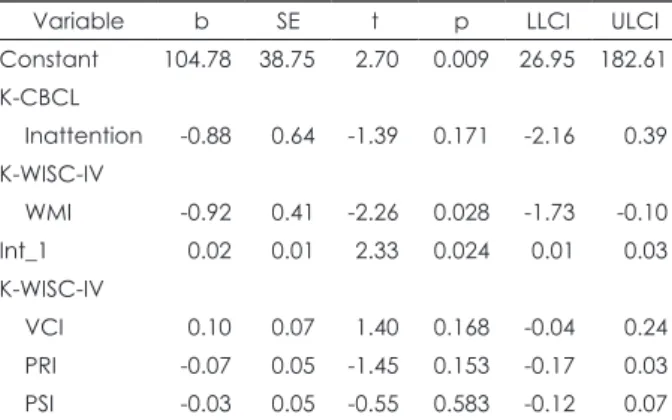
The moderating effect of working memory on the relation-ship between inattention and aggressive behavior is shown in Table 4. Although inattention did not affect aggressive be-havior [b=-0.88, p=0.171 (-2.16, 0.39)], working memory was found to have a statistically significant negative effect on ag-gressive behavior [b=-0.92, p=0.028 (-1.73, -0.10)]. Concern-ing the moderatConcern-ing effect, it was found that inattention and working memory interact to have a statistically significant positive effect on aggressive behavior [b=0.02, p=0.024 (0.01, 0.03)]. VCI [b=0.10, p=0.168 (-0.04, 0.24)], PRI [b=-0.07, p= 0.153 (-0.17, 0.03)], and PSI [b=-0.03, p=0.583 (-0.12, 0.07)], which are other sub-indices of K-WISC-IV, were found to not affect aggressive behavior (Table 4). The WMI, which had moderating effects based on its interaction with inattention,
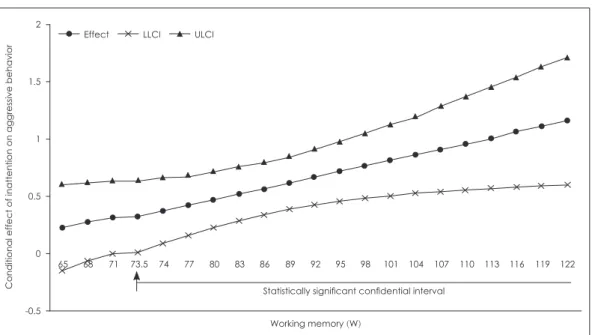
was found to be significant [b=0.02, p=0.024 (0.01, 0.03)]. Fur-thermore, the moderating effect of working memory mani-fested when the WMI score on the K-WISC-IV was greater than or equal to 73.5 points and had a significant effect on aggressive behavior (Fig. 1).
DISCUSSION
This study aimed to understand the effect of working mem-ory on the relationship between inattention and aggressive behavior in children and adolescents with ADHD. Some sig-nificant results were obtained from the analysis. First, among the sub-indices of K-WISC-IV in children with ADHD, the mean levels of WMI (M=88.65, SD=16.25) and PSI (M=89.00, SD=22.19) were low average, which was lower than the mean levels of VCI (M=97.45, SD=15.11) and PRI (M=97.13, SD= 18.91). Second, inattention in children and adolescents with ADHD was found to be positively correlated with aggressive behavior. Third, the moderating effect of working memory interacted with inattention to positively affect aggressive be-havior. Fourth, the positive moderating effect of working mem-ory was found to manifest when the WMI score was greater than or equal to 73.5 points.
First, among the sub-indices of K-WISC-IV in children with ADHD, the mean levels of WMI and PSI were low av-erage, which was lower than the mean levels of VCI and PRI. The correlation between inattention of children with ADHD and WMI/PSI was reported to be low average in various stud-ies similar to the results of this study. The low level of two sub-indices were observed in ADHD-I children [24]. However, in another study that distinguished the sub-indices of WISC-IV as predictors of inattention severity and treatment results in children with ADHD-I, only PSI was reported as a predic-tive index [25]. In this study, we confirmed the effect of work-ing memory and controlled other cognitive functions that could interact with it (i.e., PSI, VCI, and PRI). However, the sample size was small, and this is a single-institution study; future studies are necessary with larger samples.
Second, inattention in children and adolescents with ADHD was positively correlated with aggressive behavior. An exist-ing study on aggressive behavior in children with ADHD has been conducted concerning inattention and hyperactivity-impulsivity [20]. To determine the effect of major symptoms of ADHD on adult criminal involvement, the authors collect-ed childhood data and adult statuses. As a result, hyperactiv-ity-impulsivity was reported to be relevant, but not inat-tention [20]. However, aggressive behavior in children and adolescents with ADHD is not only a problem that can be seen in ADHD-HI but a behavioral problem of all children and adolescents with ADHD. Previous studies have
report-Table 3. Correlation between working memory, inattention, and
aggressive behavior (n=57)
Variable WMI Inattention
Aggressive behavior r r r K-WISC-IV WMI 1 K-CBCL Inattention -0.52 1 Aggressive behavior 0.01 0.58* 1 *p<0.001. K-WISC-IV: Korean Wechsler Intelligence Scale for Chil-dren (forth edition), WMI: Working Memory Index, K-CBCL: Kore-an Child Behavior Checklist
Table 4. Testing the moderating effects of working memory on the
relationship between Inattention and aggressive behavior (n=57) Variable b SE t p LLCI ULCI Constant 104.78 38.75 2.70 0.009 26.95 182.61 K-CBCL Inattention -0.88 0.64 -1.39 0.171 -2.16 0.39 K-WISC-IV WMI -0.92 0.41 -2.26 0.028 -1.73 -0.10 Int_1 0.02 0.01 2.33 0.024 0.01 0.03 K-WISC-IV VCI 0.10 0.07 1.40 0.168 -0.04 0.24 PRI -0.07 0.05 -1.45 0.153 -0.17 0.03 PSI -0.03 0.05 -0.55 0.583 -0.12 0.07 Int_1: the moderating effect of working memory interacted with inattention to positively affect aggressive behavior, SE: standard error, LLCI: low limit confidence interval, ULCI: upper limit confi-dence interval, K-WISC-IV: Korean Wechsler Intelligence Scale for Children (fourth edition), WMI: Working Memory Index, K-CB-CL: Korean Child Behavior Checklist
ed that aggressive behavior is more prominent in ADHD-C and ADHD-I children than ADHD-HI children [19]. In an-other study, when the normal group and subtypes of ADHD were compared, girls with ADHD-I showed higher aggres-sive behavior than girls with other subtypes of ADHD [26]. The results of our study, which showed a correlation between inattention and aggressive behavior in children and adoles-cents with ADHD as in previous studies [19,26], demonstrat-ed that besides hyperactivity/impulsivity, inattention was also important in the evaluation of children and adolescents with ADHD.
Third, the moderating effect of working memory and its interaction with inattention positively affect aggressive havior. Previous studies focused on the direct correlation be-tween working memory and aggressive behavior [27]. How-ever, this study may have produced different results because it tried to find the indirect moderating effect on the relation-ship between inattention and aggressive behavior. Addition-ally, when using the same variable in the analysis, there may not be a significant interaction in the moderating effect, even if there is a significant correlation [28]. Previous studies did not have any condition to control for other cognitive func-tions or interact with attention problems. Because the cogni-tive functions of humans have an interaccogni-tive effect, it is dif-ficult to ignore the effects of other cognitive functions [29]. Indeed, one previous study reported that damage to the work-ing memory of children with ADHD can affect their process-ing speed and that slower processprocess-ing speed played a role in developing reading disorders [30]. Therefore, controlling for other cognitive functions and analyzing correlations and
moderating effects can provide important information about the positive effects of how working memory interacts with inattention to produce moderating effects on aggression.
Fourth, the positive moderating effect of working memory was found to manifest when the WMI score was greater than or equal to 73.5 points. Many studies have been conducted on the low levels of cognitive function in children with ADHD [24]. Most of these studies focused on children with ADHD having weakness or low levels of WMI [11,24]. However, our results showed that if children or adolescents who have been diagnosed with ADHD or have inattention, have a level of WMI that is 73.5 points (borderline) or higher, inattention manifests clinically aggressive behavior. This finding implies that the focus should not only be on the low WMI levels of ADHD children and adolescents but also the fact that work-ing memory affects aggressive behavior by interactwork-ing with inattention. One must be aware of the severity of the children and adolescents’ inattention when treating their aggressive behavior.
Despite these significant findings, this study has several limitations. First, the sample size was relatively small, and the study was conducted in children and adolescents treated at a single institution. Therefore, there may be limitations concerning the generalizability of the results to all children and adolescents with ADHD. It is necessary to research with larger samples from multi-institutions in the future. Second, because this is a retrospective study and we did not exclude the effects of medication, care must be taken when interpret-ing the results. At the time of this study, 23 of the children were taking medication (methylphenidate: seven subjects;
2 1.5 1 0.5 0 -0.5
Conditional effect of inattention on aggressive behavior Statistically significant confidential interval Working memory (W)
65 68 71 73.5 74 77 80 83 86 89 92 95 98 101 104 107 110 113 116 119 122
Effect LLCI ULCI
Fig. 1. The conditional effect of inattention (X) on aggressive behavior (θx→y) as a function of working memory (W). LLCI: low limit
atomoxetine: five subjects; aripiprazole: five subjects; escita-lopram: six subjects), and some subjects were prescribed more than one medication. Therefore, future studies need to be con-ducted by targeting children and adolescents not on medica-tion or by proactively controlling the medicamedica-tion intake of the subjects. Third, we did not ascertain the existence of comor-bid diseases other than depression. Although the coexistence of depression in ADHD was excluded using CDI, further stud-ies are necessary to supplement this and evaluate other co-morbid diseases. Fourth, we did not discriminate among the main sub-symptoms of children and adolescents with ADHD. In ADHD, there are cognitive and behavioral differences be-tween the main sub-symptoms. In the future, selecting only children and adolescents with inattention will help research-ers examine the effect of inattention more thoroughly.
CONCLUSION
This study found that aggressive behavior in children and adolescents diagnosed with ADHD had a positive correla-tion with inattencorrela-tion. In addicorrela-tion, working memory had a mod-erating effect that interacted with inattention to have a posi-tive effect on aggressive behavior. Therefore, inattention and working memory should be addressed when treating ADHD children and adolescents with aggressive behavior. Further-more, it is necessary to confirm the related factors that lead to aggressive behavior and to identify aspects of aggressive be-havior in children and adolescents with ADHD symptoms.
Acknowledgments
This work was supported by the Korean government (MSIT; Min-istry of Science and ICT) [grant number 2017R1C1B5074462] and the Soonchunhyang University Research Fund.
Conflicts of Interest
The authors have no potential conflicts of interest to disclose. Author Contributions
Conceptualization: Mi Young Jeong, Yeon Jung Lee. Data curation: Mi Young Jeong, Seo Young Park. Formal analysis: Jung Ho Kim. Funding ac-quisition: Yeon Jung Lee. Investigation: all authors. Visualization: Jung Ho Kim. Validation: Yeon Jung Lee. Writing—original draft: Mi Young Jeong. Writing—review & editing: Yeon Jung Lee, Jung Ho Kim.
ORCID iDs
Mi Young Jeong https://orcid.org/0000-0002-2409-8060 Yeon Jung Lee https://orcid.org/0000-0001-8953-5893 Jung Ho Kim https://orcid.org/0000-0003-2763-7186 Seo Young Park https://orcid.org/0000-0002-5033-8689
REFERENCES
1) American Psychiatric Association. Diagnostic and statistical man-ual of mental disorders: DSM-5. 5th ed. Arlington, VA: American Psychaitric Association;2013.
2) Mannuzza S, Klein RG, Bessler A, Malloy P, LaPadula M. Adult outcome of hyperactive boys: educational achievement, occupa-tional rank, and psychiatric status. Arch Gen Psychiatry 1993;50: 565-576.
3) Mannuzza S, Klein RG, Bonagura N, Malloy P, Giampino TL, Ad-dalli KA. Hyperactive boys almost grown up: V. replication of psy-chiatric status. Arch Gen Psychiatry 1991;48:77-83.
4) Tuithof M, Ten Have M, van Dorsselaer S, de Graaf R. [Prevalence, persistency and consequences of ADHD in the Dutch adult popu-lation]. Tijdschr Psychiatr 2014;56:10-19.
5) Weiss M, Worling D, Wasdell M. A chart review study of the inat-tentive and combined types of ADHD. J Atten Disord 2003;7:1-9. 6) Barkley RA, DuPaul GJ, McMurray MB. Comprehensive
evalua-tion of attenevalua-tion deficit disorder with and without hyperactivity as defined by research criteria. J Consult Clin Psychol 1990;58:775-789. 7) Hartman CA, Willcutt EG, Rhee SH, Pennington BF. The relation between sluggish cognitive tempo and DSM-IV ADHD. J Abnorm Child Psychol 2004;32:491-503.
8) Barkley RA, Fischer M, Smallish L, Fletcher K. Young adult outcome of hyperactive children: adaptive functioning in major life activi-ties. J Am Acad Child Adolesc Psychiatry 2006;45:192-202. 9) Kofler MJ, Rapport MD, Bolden J, Sarver DE, Raiker JS. ADHD
and working memory: the impact of central executive deficits and exceeding storage/rehearsal capacity on observed inattentive be-havior. J Abnorm Child Psychol 2010;38:149-161.
10) Barkley RA. Behavioral inhibition, sustained attention, and exec-utive functions: constructing a unifying theory of ADHD. Psychol Bull 1997;121:65-94.
11) Willcutt EG, Doyle AE, Nigg JT, Faraone SV, Pennington BF. Va-lidity of the executive function theory of attention-deficit/hyperac-tivity disorder: a meta-analytic review. Biol Psychiatry 2005;57: 1336-1346.
12) Lui M, Tannock R. Working memory and inattentive behaviour in a community sample of children. Behav Brain Funct 2007;3:12. 13) Kasper LJ, Alderson RM, Hudec KL. Moderators of working
mem-ory deficits in children with attention-deficit/hyperactivity disorder (ADHD): a meta-analytic review. Clin Psychol Rev 2012;32:605-617. 14) Siever LJ. Neurobiology of aggression and violence. Am J
Psychia-try 2008;165:429-442.
15) Coccaro EF, Kavoussi RJ. Fluoxetine and impulsive aggressive be-havior in personality-disordered subjects. Arch Gen Psychiatry 1997; 54:1081-1088.
16) Yeo KE, Lee JJ, Lee MH. The effect of ADHD children’s inadapt-ability act towards self-expression art activities. Journal of special education: theory and practice 2006;7:331-349.
17) Bubenzer-Busch S, Herpertz-Dahlmann B, Kuzmanovic B, Gaber TJ, Helmbold K, Ullisch MG, et al. Neural correlates of reactive aggression in children with attention-deficit/hyperactivity disorder and comorbid disruptive behaviour disorders. Acta Psychiatr Scand 2016;133:310-323.
18) Knight RT, Grabowecky MF, Scabini D. Role of human prefrontal cortex in attention control. Adv Neurol 1995;66:21-36.
19) Connor DF, Chartier KG, Preen EC, Kaplan RF. Impulsive aggres-sion in attention-deficit/hyperactivity disorder: symptom severity, co-morbidity, and attention-deficit/hyperactivity disorder subtype. J Child Adolesc Psychopharmacol 2010;20:119-126.
20) Babinski LM, Hartsough CS, Lambert NM. Childhood conduct problems, hyperactivity-impulsivity, and inattention as predictors of adult criminal activity. J Child Psychol Psychiatry 1999;40:347-355.
21) Pope AW, Bierman KL, Mumma GH. Relations between hyperac-tive and aggressive behavior and peer relations at three elementary grade levels. J Abnorm Child Psychol 1989;17:253-267.
22) Kwak KJ, Oh SW, Kim CT. Korean-Wechsler Intelligence Scale for Children. 4th ed. Seoul: Hakjisa;2011.
23) Oh KJ, Lee HL, Hong KE, Ha EH. Korean version of child behavior checklist (K-CBCL). Seoul: ChungAng Aptitude Publishing;1997. 24) Mulder H, Pitchford NJ, Marlow N. Inattentive behaviour is asso-ciated with poor working memory and slow processing speed in very pre-term children in middle childhood. Br J Educ Psychol 2011;81:147-160.
25) Adalio CJ, Owens EB, McBurnett K, Hinshaw SP, Pfiffner LJ. Pro-cessing speed predicts behavioral treatment outcomes in children with attention-deficit/hyperactivity disorder predominantly inat-tentive type. J Abnorm Child Psychol 2018;46:701-711.
26) Zalecki CA, Hinshaw SP. Overt and relational aggression in girls with attention deficit hyperactivity disorder. J Clin Child Adolesc Psychol 2004;33:125-137.
27) Ziermans T, Dumontheil I, Roggeman C, Peyrard-Janvid M,
Mats-son H, Kere J, et al. Working memory brain activity and capacity link MAOA polymorphism to aggressive behavior during develop-ment. Transl Psychiatry 2012;2:e85.
28) Lin QL, Kim HK, Ann JS. Relationship between depression and quality of life in elderly women living alone: the moderating and mediating effects of social support and social activity. Journal of the Korea Gerontological Society 2011;31:33-47.
29) Fry AF, Hale S. Relationships among processing speed, working memory, and fluid intelligence in children. Biol Psychol 2000;54: 1-34.
30) Jacobson LA, Ryan M, Martin RB, Ewen J, Mostofsky SH, Denckla MB, et al. Working memory influences processing speed and read-ing fluency in ADHD. Child Neuropsychol 2011;17:209-224.