INTRODUCTION
Atrial flutter (AFL) is associated with an increased risk of thromboembolism.1,2 Radiofrequency catheter ablation of AFL
has a high success rate with rare complications. Thus, catheter ablation is generally accepted as a first-line treatment strategy for patients with typical AFL.3 Nonetheless, subsequent
devel-opment of atrial fibrillation (AF) is common after AFL abla-tion. A prior meta-analysis reported that the overall incidence
of AF after AFL ablation was 33.6%, with an average follow-up of 15 months; however, 3 years after ablation, the incidence of AF was up to 56.6%.4 If no atrial arrhythmias are apparent, the
prevalent practice is to stop anticoagulation one month after successful AFL ablation.5-7 As a result, a subset of patients who
undergo catheter ablation of AFL may be at risk for thrombo-embolic complications, including ischemic stroke. Risk assess-ment using readily available clinical variables is the key to identify patients at increased risk of postablation stroke. Previ-ous studies suggested that old age and postablation AF were risk factors of stroke;7-10 however, a predictor of stroke among
patients with AFL who have undergone cavotricuspid isthmus (CTI) ablation have not been elucidated. No clear strategy ad-dressing antithrombotic therapy after successful AFL ablation has emerged.
CHA2DS2-VASc score is a recommended risk stratification
scheme for prediction of stroke or thromboembolism in non-valvular AF patients. Recently, this scoring system has been val-idated to have predictive capacity for outcomes in patients in Received: May 10, 2017 Revised: August 28, 2017
Accepted: October 17, 2017
Corresponding author: Dr. Boyoung Joung, Division of Cardiology, Severance
Cardiovascular Hospital, Yonsei University College of Medicine, 50-1 Yonsei-ro, Seodaemun-gu, Seoul 03722, Korea.
Tel: 82-2-2228-8460, Fax: 82-2-393-2041, E-mail: [email protected] •The authors have no financial conflicts of interest.
© Copyright: Yonsei University College of Medicine 2018
This is an Open Access article distributed under the terms of the Creative Com-mons Attribution Non-Commercial License (http://creativecomCom-mons.org/licenses/ by-nc/4.0) which permits unrestricted non-commercial use, distribution, and repro-duction in any medium, provided the original work is properly cited.
CHA
2
DS
2
-VASc Score in the Prediction of Ischemic
Stroke in Patients after Radiofrequency Catheter
Ablation of Typical Atrial Flutter
Moo-Nyun Jin, Changho Song, Tae-Hoon Kim, Jae-Sun Uhm,
Hui-Nam Pak, Moon-Hyoung Lee, and Boyoung Joung
Division of Cardiology, Severance Cardiovascular Hospital, Yonsei University College of Medicine, Seoul, Korea.
Purpose: Despite undergoing successful catheter ablation of typical atrial flutter (AFL), patients remain at increased risk for isch-emic stroke. However, data on risk prediction tools for the development of stroke after AFL ablation are lacking. This study investi-gates whether CHA2DS2-VASc score is useful for predicting ischemic stroke after successful ablation of typical AFL.
Materials and Methods: A total of 293 patients (236 men, mean age 56.1±13.5 years) who underwent successful radiofrequency catheter ablation for typical AFL were included in this study. The clinical end point was occurrence of ischemic stroke during fol-low-up after AFL ablation.
Results: During the follow-up period (60.8±45.9 months), ischemic stroke occurred in 18 (6%) patients at a median of 34 months (interquartile range, 13−65 months). CHA2DS2-VASc score [hazard ratio 2.104; 95% confidence interval (CI), 1.624−2.726; p<0.001]
was an independent predictor for the occurrence of stroke after AFL ablation. The area under the receiver operating characteristic curve for CHA2DS2-VASc score was 0.798 (95% CI, 0.691−0.904). The CHA2DS2-VASc score could be used to stratify patients into two
groups with different incidences of ischemic stroke (1.6% vs. 14.4%, p<0.001) at a cutoff value of 2.
Conclusion: CHA2DS2-VASc score is useful in a prediction model for the risk of stroke after catheter ablation of typical AFL.
Key Words: Atrial flutter, atrial fibrillation, stroke, catheter ablation, CHA2DS2-VASc score
pISSN: 0513-5796 · eISSN: 1976-2437 Yonsei Med J 2018 Mar;59(2):236-242
different clinical situations. The aims of this study were to in-vestigate predictors of stroke and whether CHA2DS2-VASc score
is useful risk assessment tool for ischemic stroke in patients following successful AFL ablation.
MATERIALS AND METHODS
Study populationThe subjects were consecutive patients who underwent suc-cessful catheter ablation for typical AFL at Severance Cardio-vascular Hospital from October 2003 to January 2013. Typical AFL was diagnosed when a surface electrocardiogram (ECG) showed readily visible negative flutter wave in the inferior leads and positive flutter wave in lead V1 with a regular atrial rate.11 Of
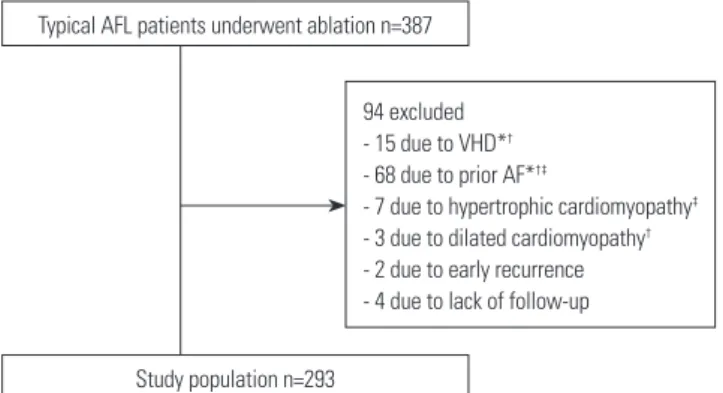
the 387 patients enrolled, exclusion criteria were prior history of AF (n=68), moderate-to-severe valvular heart disease (n=15), hypertrophic cardiomyopathy (n=7), dilated cardiomyopathy (n=3), early recurrence less than 3 months (n=2), and follow-up period less than 6 months (n=4) (Fig. 1). Patient data including age, sex, comorbidities, use of medications, electrocardio-graphic findings, echocardioelectrocardio-graphic features, result of the abla-tion procedure, and follow-up informaabla-tion were collected. The CHA2DS2-VASc scores [congestive heart failure, hypertension,
age ≥75 years (doubled), diabetes mellitus, prior stroke or tran-sient ischemic attack (TIA) (doubled), vascular disease, age 65 to 74 years, sex category] were calculated for each patient at the time of the ablation procedure. All signed written informed con-sent for the ablation procedures. Patients were enrolled pro-spectively in a longitudinal registry, and analysis was performed retrospectively. The study was approved by the Institutional Re-view Board of Severance Hospital, Yonsei University Health System, Seoul, Korea (#4-2017-0937) and complied with the Declaration of Helsinki.
Electrophysiology study and catheter ablation
Antiarrhythmic drugs were discontinued for at least 5 half-lives
before ablation. Electrophysiological studies were performed in the postabsorptive state. Multipolar catheters were posi-tioned as follows: 1) A duodecapolar catheter with 2-5-2 mm interelectrode was positioned in the right atrium (RA), parallel to the tricuspid annulus so that the distal pole was located in the medial region of the CTI. 2) A decapolar catheter was in-serted within the coronary sinus, with the proximal bipole lo-cated at the ostium. 3) Quadripolar catheters were positioned at the His bundle and RA. Surface ECG and bipolar endocardi-al electrograms were monitored continuously and stored on a computer-based digital amplifier/recorder system with optical disk storage for offline analysis. Intracardiac electrograms were filtered from 30 Hz to 500 Hz and measured with computer-assisted calipers at a sweep. Ablation was typically started on the ventricular aspect of the CTI region, and sequential radio-frequency lesions were created extending from the tricuspid valve to the posterior aspect of the CTI. Ablation was deemed successful if AFL terminated during radiofrequency delivery, AFL was no longer inducible, and bidirectional CTI block was demonstrated.
Periprocedural anticoagulation strategy
Almost all patients were treated with warfarin to maintain an international normalized ratio between 2 and 3 for at least 3 weeks before the procedure, and continued to receive warfa-rin for at least 1 month after the procedure. After 1 month, de-cisions on continuing anticoagulation was determined at the physician’s discretion, based on individual patient stroke risk factors. Antithrombotic drugs were administered according to characteristics of each patient.
Follow-up and clinical end point
The patients were monitored by continuous ECG recordings in a hospital for at least 24 hours. After discharge, all patients were followed up with clinical examination, 12-lead ECG, and 24-hour ambulatory Holter monitoring at 1, 3, 6, and 12 months after the procedure, and every 6 months thereafter. Subse-quently, patients were seen every 3 to 6 months at our cardiolo-gy clinic. A successful outcome was defined as the absence of any atrial arrhythmia after the 3-month blanking period. New-onset AF was defined as symptomatic or asymptomatic AF documented by 12-lead ECG or ambulatory rhythm monitor-ing that lasted at least 30 seconds.12 The clinical endpoint was
an ischemic stroke, which was defined as onset of a new neu-rologic impairment that occurred after the ablation. Diagnosis of a stroke was confirmed by a neurologist, and correlated with cranial imaging evidence (computed tomography and/or mag-netic resonance imaging). Stroke severity at baseline was as-sessed with the National Institutes of Health Stroke Scale (NI-HSS) score by a neurologist.13 Etiology of ischemic stroke was
classified into five categories by the Trial of Org 10172 in Acute Stroke Treatment (TOAST) classification: 1) large-artery ath-erosclerosis, 2) cardioembolism, 3) small vessel occlusion, 4)
Typical AFL patients underwent ablation n=387
Study population n=293
94 excluded - 15 due to VHD*†
- 68 due to prior AF*†‡
- 7 due to hypertrophic cardiomyopathy‡
- 3 due to dilated cardiomyopathy†
- 2 due to early recurrence - 4 due to lack of follow-up
Fig. 1. Flow chart of the study population. *6 patients had VHD and AF, †2
patients had VHD, AF, and dilated cardiomyopathy, ‡1 patient had AF
and hypertrophic cardiomyopathy. AFL, atrial flutter; AF, atrial fibrilla-tion; VHD, valvular heart disease.
stroke of other determined etiology, and 5) stroke of undeter-mined etiology.14 Patients were censored at death, loss of
fol-low-up, or end of study, whichever occurred first.
Statistical analysis
Continuous data are expressed as mean±standard deviation, and categorical variables are expressed as counts and percent-ages (%). Normality tests were performed for each variable to determine whether a dataset was well-modeled by normal distribution. Univariate comparisons were performed using Student’s t-test or Mann-Whitney U test for continuous ables, and chi-square test or Fisher’s test for categorical vari-ables. Cox proportional hazards model was performed to iden-tify predictors associated with ischemic strokes. Due to the small number of stroke events, multivariate Cox regression was performed using variables that had significant association with the risk for stroke by univariate analysis. The predictive accu-racy of CHA2DS2-VASc score and the optimal cutoff value in the
prediction of stroke after AFL ablation were identified using
receiver operating characteristic (ROC) curves and Youden in-dex (sensitivity+specificity-1). Event free survival curves were plotted by the Kaplan-Meier method with the statistical signifi-cance tested by the log-rank test. Statistical signifisignifi-cance was es-tablished at a value of p<0.05. Statistical analyses were per-formed with SPSS version 23.0 (IBM Corp., Armonk, NY, USA).
RESULTS
Clinical characteristics and predictors of stroke after AFL ablation
A total of 387 patients were enrolled; 94 patients were exclud-ed from the present study. The study population comprisexclud-ed 293 patients who underwent successful catheter ablation for typical AFL (Fig. 1). During the follow-up period of 60.8±45.9 months, ischemic strokes occurred in 18 (6%) patients. Median time to stroke occurrence was 34 months (interquartile range, 13−65 months) after ablation, and median NIHSS score on admission Table 1. Comparison of Baseline Characteristics of Patients with and without Stroke after Catheter Ablation of AFL
Variable Total population (n=293) Stroke (n=18) No stroke (n=275) p value
Age (yr) 56.1±13.5 64.0±12.3 55.6±13.4 0.01 Age ≥65 yrs 71 (24.2) 12 (66.7) 59 (21.5) <0.001 Age ≥75 yrs 12 (4.1) 5 (27.8) 7 (2.5) <0.001 Female 58 (19.8) 1 (5.6) 57 (20.7) 0.216 Body mass index (kg/m2) 23.9±3.1 24.0±2.7 23.9±3.1 0.913
Medical history
Congestive heart failure 15 (5.5) 2 (11.1) 13 (4.7) 0.233 Hypertension 105 (35.8) 9 (50.0) 96 (34.9) 0.196 Diabetes mellitus 57 (19.5) 6 (33.3) 51 (18.5) 0.131 Prior stroke/TIA 15 (5.1) 5 (27.8) 10 (3.6) 0.001 Vascular disease 15 (5.1) 2 (11.1) 13 (4.7) 0.233 Coronary artery disease 36 (12.3) 4 (22.2) 32 (11.6) 0.254 Dyslipidemia 33 (11.3) 3 (16.7) 30 (10.9) 0.439 Echocardiogram characteristics
LVEF (%) 61.5±10.3 60.3±9.1 61.6±10.4 0.619 LA diameter (mm) 41.9±6.1 44.2±6.3 41.7±6.1 0.112 LA volume index (mL/m2) 34.4±12.5 38.8±14.9 34.2±12.2 0.197
Antithrombotic drugs use during follow-up period
Antiplatelets after ablation 138 (47.1) 8 (44.4) 130 (47.3) 0.816 Warfarin after ablation 69 (23.5) 7 (38.9) 62 (22.5) 0.148 New-onset AF after ablation 96 (32.8) 12 (66.7) 84 (30.5) 0.002 Recurrence of AFL 8 (2.7) 2 (11.1) 6 (2.2) 0.08 CHA2DS2-VASc score 1.2±1.1 2.6±1.4 1.2±1.0 <0.001
0 85 (29) 1 (5.6) 84 (30.5)
1 104 (35.5) 2 (11.1) 102 (58.3) 2 67 (22.9) 7 (38.9) 60 (21.8)
3 28 (9.6) 4 (22.2) 24 (8.7)
≥4 9 (3.1) 4 (22.2) 5 (1.8)
AF, atrial fibrillation; AFL, atrial flutter; CHA2DS2-VASc score, congestive heart failure, hypertension, age, diabetes mellitus, history of stroke or TIA score,
vascu-lar disease and sex category; LA, left atrial; LVEF, left ventricuvascu-lar ejection fraction; TIA, transient ischemic attack; SD, standard deviation. Values are given as n (%) or as mean±SD, unless otherwise noted.
DISCUSSION
Main findingsThis analysis investigated the incidence and predictors of isch-emic stroke events in patients undergoing successful catheter ablation of typical AFL. By utilizing CHA2DS2-VASc score, the
risk of stroke after AFL ablation was revealed to be correlated with the score, with an increasing trend in stroke with ascend-ing CHA2DS2-VASc score. The main findings of this study were
as follows: 1) the incidence of ischemic stroke after AFL abla-tion was 1.15 strokes per 100 person-years; 2) CHA2DS2-VASc
score, AFL recurrence, and postablation AF were independent predictors; 3) CHA2DS2-VASc score was useful for stratifying the
risk of stroke after catheter ablation of AFL; and 4) a CHA2DS2
-VASc score of ≥2 was associated with higher risk of stroke fol-lowing ablation.
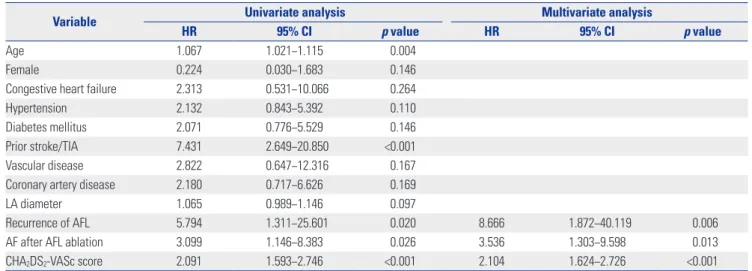
Table 2. Univariate and Multivariate Logistic Regression Analysis for Predictors of Ischemic Stroke after Catheter Ablation of AFL
Variable Univariate analysis Multivariate analysis
HR 95% CI p value HR 95% CI p value
Age 1.067 1.021−1.115 0.004 Female 0.224 0.030−1.683 0.146 Congestive heart failure 2.313 0.531−10.066 0.264 Hypertension 2.132 0.843−5.392 0.110 Diabetes mellitus 2.071 0.776−5.529 0.146 Prior stroke/TIA 7.431 2.649−20.850 <0.001 Vascular disease 2.822 0.647−12.316 0.167 Coronary artery disease 2.180 0.717−6.626 0.169 LA diameter 1.065 0.989−1.146 0.097
Recurrence of AFL 5.794 1.311−25.601 0.020 8.666 1.872−40.119 0.006 AF after AFL ablation 3.099 1.146−8.383 0.026 3.536 1.303−9.598 0.013 CHA2DS2-VASc score 2.091 1.593−2.746 <0.001 2.104 1.624−2.726 <0.001
AF, atrial fibrillation; AFL, atrial flutter; CHA2DS2-VASc score, congestive heart failure, hypertension, age, diabetes mellitus, history of stroke or TIA score,
vascu-lar disease and sex category; CI, confidence interval; HR, hazard ratio; LA, left atrial; TIA, transient ischemic attack. To avoid collinearity, variables included in the CHA2DS2-VASc score were not entered into the multivariate model.
7 6 5 4 3 2 1 0
Incidence (per 100 person years)
0
CHA2DS2-VASc score
1 2 3 ≥4 0.36 p<0.001 0.2 2.14 3.21 6.35
Fig. 2. Graded increase in incidence of stroke by CHA2DS2-VASc score.
CHA2DS2-VASc score, congestive heart failure, hypertension, age,
dia-betes mellitus, history of stroke or transient ischemic attack score, vas-cular disease and sex category.
for stroke was 2.5 (interquartile range, 1−6). Among 18 patients who developed stroke, the causes of stroke were as follows: car-dioembolic stroke (n=15), large artery atherosclerosis (n=1), small-vessel occlusion (n=1), and undetermined etiology (n=1). No patients had hemorrhagic stroke during follow-up periods. The 1-year and 5-year successful outcomes defined as absence of atrial arrhythmias were 94.9% and 72.7%, respectively. New-onset AF was detected in 96 patients (32.8%) during the follow-up period, including 87 (90.6%) paroxysmal and 9 (9.4%) per-sistent AFs.
Baseline characteristics in relation to development of isch-emic stroke after AFL ablation are presented in Table 1. Higher CHA2DS2-VASc scores, advanced age, prior history of stroke or
TIA, recurrence of AFL, and occurrence of AF after ablation were significant univariate predictors for postablation stroke. In multivariate analysis, CHA2DS2-VASc score, relapse of AFL,
and development of AF after ablation remained independent predictors for ischemic stroke after AFL ablation (Table 2).
CHA2DS2-VASc score for prediction of stroke after AFL
ablation
CHA2DS2-VASc score was the strongest predictor of s stroke
event after AFL ablation for a 1-point increase. The incidence of stroke increased with increases in patients’ CHA2DS2-VASc
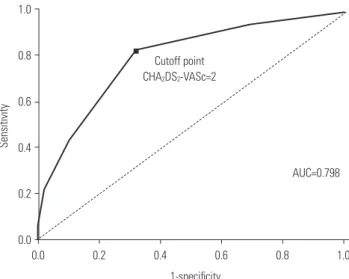
scores (Fig. 2). ROC curves for the performance of CHA2DS2
-VASc score in predicting incident stroke after AFL ablation were drawn. The area under the curve for the CHA2DS2-VASc
score was 0.798 (95% CI, 0.691−0.904). A cutoff point of 2 was identified using the ROC curve (sensitivity 83.3%, specificity 67.6%) (Fig. 3). The Kaplan-Meier survival analysis revealed that the cumulative incidence of stroke after AFL ablation was higher in patient with a CHA2DS2-VASc score ≥2 than in those
with CHA2DS2-VASc score <2 (14.4% vs. 1.6%, p<0.001) during
Relationship among CHA2DS2-VASc score and stroke
after catheter ablation of AFL
In the HRS/EHRA/ECAS Consensus Statement on the continu-ation of anticoagulcontinu-ation after AF ablcontinu-ation, CHA2DS2-VASc
scores or CHADS2 are recommended for estimating stroke
risk.12 No separate statements for the management of patients
with AFL exist. The CHA2DS2-VASc score uses the primary risk
factors in the CHADS2 scoring system, although it includes
ad-ditional risk factors (65 to 74 years of age, female sex, and vas-cular disease) and has a broader score range. Recent studies reported that CHA2DS2-VASc score improved predictive ability
for stroke and thromboembolism, compared to CHADS2 score.15-17
There has been a marked shift in antithrombotic strategy for low-risk patients to improve outcomes by using CHA2DS2-VASc
score. Both updated US and European clinical practice guide-lines on AF recommend use of CHA2DS2-VASc score for
assess-ment of stroke risk.11,18 The role of CHA
2DS2-VASc score has
been extended beyond its initial purpose of estimating the risk of thromboembolism in patients with nonvalvular AF. CHA2DS2
-VASc score has been indicated to predict clinical outcomes in various conditions, including thromboembolism risk after AF ablation,19 stroke risk in patients without AF,20 and left atrial
th-rombus risk among AFL patients.21 Besides, the components of
the CHA2DS2-VASc score are associated with ischemic stroke
regardless of heart rhythm. The Atherosclerosis Risk in Com-munities study reported that old age, hypertension, and dia-betes were independent risk factor for all ischemic stroke sub-types involving cardioembolism,22 and heart failure was
as-sociated with increased risk of stroke and thromboembolism whether or not AF was present.23,24 In addition, patients with
high CHA2DS2-VASc scores have been shown to have higher
risk of developing AF,25 which is common after successful AFL
ablation4,26 and may contribute to subsequent ischemic
st-roke.7,27 It is logical that this scoring system may have clinical
utility for risk assessment of stroke following AFL ablation. Nev-ertheless, in spite of these previous findings, there is little data about the relation between the CHA2DS2-VASc score and stroke
after catheter ablation of AFL. As expected, higher CHA2DS2
-VASc scores identified patients who are likely to develop stroke. The C statistics indicated CHA2DS2-VASc score had good
dis-criminatory performance. To the best of our knowledge, this is the first study to evaluate the predictive ability of CHA2DS2
-VASc score in assessing the risk for ischemic stroke in AFL pa-tients who have received catheter ablation. Our results provide evidence for extending clinical value of CHA2DS2-VASc score
to a risk stratification model for predicting stroke after typical AFL ablation.
Clinical implications
In the present cohort, over an average follow-up of 5 years af-ter AFL ablation, ischemic strokes occurred in 6% of patients, amounting to an incidence of 1.15 strokes per 100 person-years. The stroke rate in our study was lower than what would have been expected from the natural history of chronic AFL (1.55 strokes per 100 person-years),28 but higher than that of
the general population (0.53 strokes per 100 person-years).29
This result was consistent with those found in the earlier stud-ies.7 Although patients had successful catheter ablation of
typ-ical AFL, patients were at continued risk of ischemic stroke. This raises concerns for the process of selecting patients for
1.0 0.8 0.6 0.4 0.2 0.0 Sensitivity 0.0 0.2 0.4 0.6 0.8 1.0 1-specificity Cutoff point CHA2DS2-VASc=2 AUC=0.798
Fig. 3. ROC curve for CHA2DS2-VASc score predicting ischemic stroke
after AFL ablation. The AUC for CHA2DS2-VASc score for predicting
event was 0.798. At a best cutoff of 2, the sensitivity and specificity for stroke event were 83.3% and 67.6%, respectively. AUC, area under the curve; CHA2DS2-VASc score, congestive heart failure, hypertension, age,
diabetes mellitus, history of stroke or transient ischemic attack score, vascular disease and sex category; ROC, receiver operating characteristic.
CHA2DS2-VASc<2 CHA2DS2-VASc≥2 1.0 0.9 0.8 0.7 0.6 0.0
Stroke free survival
0 20 40 60 80 100 120 189 104 187 98 187 96 187 93 186 92 186 90 186 89 Months CHA2DS2-VASc<2 CHA2DS2-VASc≥2 Log rank p<0.001 No. at risk
Fig. 4. Stroke free survival curves for patients with different CHA2DS2
-VASc scores. Kaplan-Meier survival analysis demonstrated that pa-tients with a CHA2DS2-VASc scores ≥2 had a higher event rate
com-pared with patients with a CHA2DS2-VASc score <2 (14.4% vs. 1.6%,
p<0.001). CHA2DS2-VASc score, congestive heart failure, hypertension,
age, diabetes mellitus, history of stroke or transient ischemic attack score, vascular disease and sex category.
continuation of antithrombotic therapy after flutter ablation. Thus, appropriate selection of patients at high risk of stroke is an important for optimal risk-based therapeutic decisions. How-ever, previous studies did not suggest useful methods to iden-tify patients at risk of stroke after AFL ablation. CHA2DS2-VASc
score is composed of commonly collected clinical variables and can be applied easily in clinical practice. The present study demonstrated the ability of CHA2DS2-VASc score to reliably
discriminate between “high-risk” and “low-risk” patients for stroke following ablation of AFL. A CHA2DS2-VASc score ≥2
identified patients with absolute risk of ischemic stroke of >1% per year. In the general AF population, an annual risk of stroke of >1% often used to identify patients in whom the benefits of long-term oral anticoagulation may outweigh the risks of bleeding.30 Patients with a score ≥2 who have high absolute risk
of stroke may benefit from continuation of anticoagulation, al-though randomized trial studies in direct support of this ap-proach are still deficient. These findings may help physicians to identify patients at high risk of stroke and to perform closer follow-up after ablation. It would be reasonable to suggest that physicians make a decision about continuation of anticoagu-lation after AFL abanticoagu-lation based on the CHA2DS2-VASc score.
Study limitations
This study had several limitations. First, it was based on a sin-gle center experience, which could have caused site specific bias. Second, the study was performed in a cohort of predom-inantly male patients, which may limit generalizability. In the population-based investigation, AFL was 2.5 times more com-mon in men than in women.31 However, the number of women
was a fourth of those of men in this study. Third, patient up was not uniform, but almost all patients underwent follow-up regularly. Fourth, the antithrombotic strategy was determined by the physicians responsible for treatment according to the individual characteristics of each patient. However, the man-agement was based on the same principle for individuals with similar risk.
Conclusions
Patients undergoing successful catheter ablation of typical AFL remain at continued risk for ischemic stroke. CHA2DS2
-VASc score is a useful predictor for ischemic stroke and in strat-ifying patients at risk of stroke after AFL ablation. This scoring system may be reliable in identifying high risk patients who may benefit from antithrombotic therapy.
ACKNOWLEDGEMENTS
This study was supported by research grants from the Basic Science Research Program through the National Research Foundation of Korea funded by the Ministry of Education, Science and Technology (NRF-2017R1A2B3003303, 2012R1A2A2A02045367), and grants from the Korean Healthcare Technology R&D
proj-ect funded by the Ministry of Health & Welfare (HI16C0058, HI15C1200, HI11C1606).
ORCID
Moo-Nyun Jin https://orcid.org/0000-0001-5482-4441 Boyoung Joung https://orcid.org/0000-0001-9036-7225
REFERENCES
1. Halligan SC, Gersh BJ, Brown RD Jr, Rosales AG, Munger TM, Shen WK, et al. The natural history of lone atrial flutter. Ann Intern Med 2004;140:265-8.
2. Biblo LA, Yuan Z, Quan KJ, Mackall JA, Rimm AA. Risk of stroke in patients with atrial flutter. Am J Cardiol 2001;87:346-9.
3. Verma A, Macle L, Cox J, Skanes AC; CCS Atrial Fibrillation Guide-lines Committee. Canadian Cardiovascular Society atrial fibrilla-tion guidelines 2010: catheter ablafibrilla-tion for atrial fibrillafibrilla-tion/atrial flutter. Can J Cardiol 2011;27:60-6.
4. Pérez FJ, Schubert CM, Parvez B, Pathak V, Ellenbogen KA, Wood MA. Long-term outcomes after catheter ablation of cavo-tricuspid isthmus dependent atrial flutter: a meta-analysis. Circ Arrhythm Electrophysiol 2009;2:393-401.
5. Chinitz JS, Gerstenfeld EP, Marchlinski FE, Callans DJ. Atrial fi-brillation is common after ablation of isolated atrial flutter during long-term follow-up. Heart Rhythm 2007;4:1029-33.
6. Dixit S, Lavi N, Robinson M, Riley MP, Callans DJ, Marchlinski FE, et al. Noncontact electroanatomic mapping to characterize typi-cal atrial flutter: participation of right atrial posterior wall in the re-entrant circuit. J Cardiovasc Electrophysiol 2011;22:422-30. 7. Tomson TT, Kapa S, Bala R, Riley MP, Lin D, Epstein AE, et al. Risk
of stroke and atrial fibrillation after radiofrequency catheter abla-tion of typical atrial flutter. Heart Rhythm 2012;9:1779-84. 8. Moubarak G, Pavin D, Donal E, Laviolle B, Daubert JC, Mabo P.
Ischemic strokes after ablation of typical atrial flutter. Int J Cardiol 2011;147:183-4.
9. Tai CT, Chen SA, Chiang CE, Lee SH, Wen ZC, Huang JL, et al. Long-term outcome of radiofrequency catheter ablation for typical atrial flutter: risk prediction of recurrent arrhythmias. J Cardiovasc Electrophysiol 1998;9:115-21.
10. Movsowitz C, Callans DJ, Schwartzman D, Gottlieb C, Marchlins-ki FE. The results of atrial flutter ablation in patients with and with-out a history of atrial fibrillation. Am J Cardiol 1996;78:93-6. 11. January CT, Wann LS, Alpert JS, Calkins H, Cigarroa JE, Cleveland
JC Jr, et al. 2014 AHA/ACC/HRS guideline for the management of patients with atrial fibrillation: a report of the American College of Cardiology/American Heart Association Task Force on Practice Guidelines and the Heart Rhythm Society. J Am Coll Cardiol 2014; 64:e1-76.
12. Calkins H, Kuck KH, Cappato R, Brugada J, Camm AJ, Chen SA, et al. 2012 HRS/EHRA/ECAS expert consensus statement on catheter and surgical ablation of atrial fibrillation: recommendations for pa-tient selection, procedural techniques, papa-tient management and follow-up, definitions, endpoints, and research trial design: a re-port of the Heart Rhythm Society (HRS) Task Force on Catheter and Surgical Ablation of Atrial Fibrillation. Developed in partner-ship with the European Heart Rhythm Association (EHRA), a reg-istered branch of the European Society of Cardiology (ESC) and the European Cardiac Arrhythmia Society (ECAS); and in collab-oration with the American College of Cardiology (ACC), Ameri-can Heart Association (AHA), the Asia Pacific Heart Rhythm
Soci-ety (APHRS), and the SociSoci-ety of Thoracic Surgeons (STS). Endorsed by the governing bodies of the American College of Cardiology Foundation, the American Heart Association, the European Car-diac Arrhythmia Society, the European Heart Rhythm Association, the Society of Thoracic Surgeons, the Asia Pacific Heart Rhythm So-ciety, and the Heart Rhythm Society. Heart Rhythm 2012;9:632-96. 13. Goldstein LB, Bertels C, Davis JN. Interrater reliability of the NIH
stroke scale. Arch Neurol 1989;46:660-2.
14. Adams HP Jr, Bendixen BH, Kappelle LJ, Biller J, Love BB, Gordon DL, et al. Classification of subtype of acute ischemic stroke. Defi-nitions for use in a multicenter clinical trial. TOAST. Trial of Org 10172 in Acute Stroke Treatment. Stroke 1993;24:35-41.
15. Lip GY, Nieuwlaat R, Pisters R, Lane DA, Crijns HJ. Refining clini-cal risk stratification for predicting stroke and thromboembolism in atrial fibrillation using a novel risk factor-based approach: the euro heart survey on atrial fibrillation. Chest 2010;137:263-72. 16. Olesen JB, Lip GY, Hansen ML, Hansen PR, Tolstrup JS,
Lindhard-sen J, et al. Validation of risk stratification schemes for predicting stroke and thromboembolism in patients with atrial fibrillation: nationwide cohort study. BMJ 2011;342:d124.
17. Friberg L, Rosenqvist M, Lip GY. Evaluation of risk stratification schemes for ischaemic stroke and bleeding in 182 678 patients with atrial fibrillation: the Swedish Atrial Fibrillation cohort study. Eur Heart J 2012;33:1500-10.
18. Camm AJ, Lip GY, De Caterina R, Savelieva I, Atar D, Hohnloser SH, et al. 2012 focused update of the ESC Guidelines for the man-agement of atrial fibrillation: an update of the 2010 ESC Guide-lines for the management of atrial fibrillation. Developed with the special contribution of the European Heart Rhythm Association. Eur Heart J 2012;33:2719-47.
19. Chao TF, Lin YJ, Tsao HM, Tsai CF, Lin WS, Chang SL, et al. CHADS(2) and CHA(2)DS(2)-VASc scores in the prediction of clinical out-comes in patients with atrial fibrillation after catheter ablation. J Am Coll Cardiol 2011;58:2380-5.
20. Mitchell LB, Southern DA, Galbraith D, Ghali WA, Knudtson M, Wilton SB; APPROACH investigators. Prediction of stroke or TIA in patients without atrial fibrillation using CHADS2 and CHA2DS2-VASc scores. Heart 2014;100:1524-30.
21. Parikh MG, Aziz Z, Krishnan K, Madias C, Trohman RG. Usefulness of transesophageal echocardiography to confirm clinical utility of
CHA2DS2-VASc and CHADS2 scores in atrial flutter. Am J Cardiol 2012;109:550-5.
22. Ohira T, Shahar E, Chambless LE, Rosamond WD, Mosley TH Jr, Folsom AR. Risk factors for ischemic stroke subtypes: the Athero-sclerosis Risk in Communities study. Stroke 2006;37:2493-8. 23. Lip GY, Ponikowski P, Andreotti F, Anker SD, Filippatos G,
Hom-ma S, et al. Thrombo-embolism and antithrombotic therapy for heart failure in sinus rhythm. A joint consensus document from the ESC Heart Failure Association and the ESC Working Group on Thrombosis. Eur J Heart Fail 2012;14:681-95.
24. Melgaard L, Gorst-Rasmussen A, Lane DA, Rasmussen LH, Lars-en TB, Lip GY. AssessmLars-ent of the CHA2DS2-VASc score in pre-dicting ischemic stroke, thromboembolism, and death in patients with heart failure with and without atrial fibrillation. JAMA 2015;314:1030-8.
25. Jacobs V, May HT, Bair TL, Crandall BG, Cutler M, Day JD, et al. The impact of risk score (CHADS2 versus CHA2DS2-VASc) on long-term outcomes after atrial fibrillation ablation. Heart Rhythm 2015;12:681-6.
26. Spector P, Reynolds MR, Calkins H, Sondhi M, Xu Y, Martin A, et al. Meta-analysis of ablation of atrial flutter and supraventricular tachycardia. Am J Cardiol 2009;104:671-7.
27. Seara JG, Roubin SR, Gude Sampedro F, Barreiro VB, Sande JM, Mañero MR, et al. Risk of atrial fibrillation, stroke, and death after radiofrequency catheter ablation of typical atrial flutter. Clin Res Cardiol 2014;103:543-52.
28. Wood KA, Eisenberg SJ, Kalman JM, Drew BJ, Saxon LA, Lee RJ, et al. Risk of thromboembolism in chronic atrial flutter. Am J Cardiol 1997;79:1043-7.
29. Carandang R, Seshadri S, Beiser A, Kelly-Hayes M, Kase CS, Kan-nel WB, et al. Trends in incidence, lifetime risk, severity, and 30-day mortality of stroke over the past 50 years. JAMA 2006;296: 2939-46.
30. Eckman MH, Singer DE, Rosand J, Greenberg SM. Moving the tipping point: the decision to anticoagulate patients with atrial fi-brillation. Circ Cardiovasc Qual Outcomes 2011;4:14-21.
31. Granada J, Uribe W, Chyou PH, Maassen K, Vierkant R, Smith PN, et al. Incidence and predictors of atrial flutter in the general pop-ulation. J Am Coll Cardiol 2000;36:2242-6.