53
ISSN: 2288-2766 © 2021 KODISA & EABEA. http://eajbe.jams.or.kr
doi: http://dx.doi.org/10.20498/eajbe.2021.9.1.53
Regional Multinationals: Evidence from Wal-Mart’s Withdrawal
from the South Korean Market
11Se-Yeon AHN
Ph. D., College of Business Administration, Seoul National University, Korea
E-mail: [email protected]
Received: February 15, 2021. Revised: February 21, 2021. Accepted: February 26, 2021.
Abstract
Purpose
– This study aims to understand the phenomenon called “regional multinational” in the geographical
expansion of multinational enterprises and to find some evidence whether globalization of multinational enterprises tends to have a strong home region bias.Research design, data, and methodology
– Through an in-depth case analysis, we analyze the series of strategic
behaviors Wal-Mart made in South Korea from its entry in 1998 to its withdrawal in 2006. Then, we discuss the plausible causes of this exit, seeking to provide some evidence on the “regional multinational” phenomenon. Result– This study finds some evidence on the regional-based expansion of multinational enterprises. Our case
study shows that Wal-Mart in South Korea focused on global standardization strategy and made an exit from the market as they were faced with increasing localization demands. From the perspective of multinational enterprises’ globalization strategy, Wal-Mart’s exit from the South Korean market can be considered as a strategic exit.Conclusion
– The findings of this study suggest that while national responsiveness and localized adaptation are
considered as a panacea for penetrating international markets, in reality most multinational enterprises attempt to add value primarily by capitalizing on similarities across markets and remain as regional multinationals.Keywords: Regional Multinational, Firm Specific Advantages, Liability of Foreignness, Localization Strategy, Global Integration Strategy
JEL Classification Code: M10, M16, M19
ⓒ Copyright: The Author(s)
This is an Open Access article distributed under the terms of the Creative Commons Attribution Non-Commercial License (http://Creativecommons.org/licenses/by-nc/4.0/) which permits unrestricted noncommercial use, distribution, and reproduction in any medium, provided the original work is properly cited.
54
1. Introduction
What is the goal of multinational corporations to pursue a global strategy? In particular, why do multinational enterprises expand their markets to overseas countries? In general, when multinational enterprises from the advanced economies enter the emerging markets, they are expected to easily succeed in market penetration by utilizing their company specific advantages such as brands, proprietary technologies, knowledge, etc. Indeed, global market expansion is recognized as an essential aspect of international business (IB), and the extant mainstream research posits that a multinational enterprise arises out of its superior efficiency as an organizational vehicle by which to transfer this knowledge across borders (Kogut & Singh, 1988; Caves, 1996; Kogut & Zander, 1993). However, multinational enterprises have not been always successful in their foreign expansion.
“The Multinational giant struggled in South Korea…Wal-Mart stores became another global brand to flounder in an economy with some of the most demanding customers…(May 2006, New York Times)”
Wal-Mart, the world’s largest multinational retailer, entered to South Korean market in 1998 but failed to penetrate into the local markets and finally withdrew in 2006. Due to the price war led by E-Mart, which was the largest local discount retailer in South Korea, Wal-Mart's Everyday Low Price (EDLP) strategy yielded no competitive advantage in the South Korean market. Upon Wal-Mart’s withdrawal, media outlets said that South Korean market is the grave of multinational corporations where global practices cannot be transplanted. Based on the global top retailers’ consecutive withdrawals from the Korean market, and relatively lower market share of McDonald's and Zara's in the South Korean market, the media says Korea is a very difficult market where global leading multinational enterprises cannot easily win the competitions. Experts at home and abroad pointed out that Wal-Mart failed to target the taste of South Korean consumers who have a habit of buying high proportion of fresh food, frequent daily purchasing of small quantities rather than weekend all at once purchasing, and more caring for the quality of products rather than the price. Was it really true?
The purpose of this paper is to understand the motivations and actual practices of multinational enterprises’ foreign expansion. According to Rugman and Verbeke (2004), globalization of multinational enterprises (MNEs hereafter) tends to have a strong home region bias. While national responsiveness or localization strategy in response to local demands is considered as a panacea and essential for MNEs to enter overseas markets, high performing MNEs in reality carry out globalization strategies mainly focusing on homogeneous markets where they can minimize localization costs. To call these strategic behavioral characteristics by MNEs, Rugman (2003) introduced the term “regional multinational”.
In this study, we aim to find some evidence of “regional multinationals” by re-analyzing Wal-Mart’s entry to and exit from the South Korean market from 1998 to 2006, which has been considered as a representative case of a MNE’s failure to localize. We pay attention to the facts that Wal-Mart indeed did not make a loss from their withdrawal from the South Korean market, and that they did not make a huge investment for localization. Did Wal-Mart really fail in the South Korean market? This study aims to develop a new interpretation on Wal-Wal-Mart’s exit from the South Korean market, from the perspective of MNE’s regional based strategy, proposed by Rugman and Verbeke (2004).
This study is expected to add value to international business (IB) research in that this study tries to view Wal-Mart’s withdrawal from the South Korean market from the perspective of MNEs’ internationalization strategy and to give some alternative explanation on the withdrawal. Unlike many previous studies that view Wal-Mart’s withdrawal from the South Korean market as a failure case from the perspective of international marketing (Boehe, 2011; Kim, 2008; Gandolfi & Strach 2009; Zhang & Wei, 2015), this study tries to view another facet of the phenomenon and to provide some more meaningful insights to help both researchers and IB practitioners from emerging economies, who are interested in and concern the actual practices of MNEs’ foreign market expansion.
The sections below are organized as follows. Section 2 outlines a literature review of existing studies on internationalization strategy of MNEs. Section 3 explains research method. Section 4 summarizes the Wal-Mart case analysis, and Section 5 summarizes the results and implications of this study.
55
2. Theoretical Background
2.1. Challenges of foreign market expansion
From the perspective of international marketing, Wal-Mart’s entry and competition in the South Korean market can be considered as a failure case of a multinational company’s localization strategy. So far, in many studies, scholars introduce Wal-Mart in the South Korean market as a representative case of failure and explain that their inadequate localization to adapt to South Korean customers’ tastes and preferences eventually contributed to their failure (Kim, 2008; Gandolfi & Strach 2009; Zhang & Wei, 2015). Earlier literature reports the main causes of Wal-Mart’s failure as Wal-Wal-Mart’s inability to understand and respond to South Korean consumers and misunderstanding of idiosyncrasies of a foreign culture (Gandolfi & Strach 2009; Zhang & Wei, 2015), mismatched merchandising, assortment, and marketing that missed local needs (Kim, 2008), poor locations not to create sufficient customer traffic (Kim, 2008), failure to achieve sufficient market scale against strongly entrenched incumbent retailers (Durand & Wrigley, 2009), the Buy Korean campaigns launched by local South Korean retailers as a way to compete with the U.S. retail giant (Gereffi & Christian, 2009), as well as ill-matched business practices for consumers who are significantly different from American consumers (Burt, Coe & Davies, 2019).
While all of these studies’ claims are true, from the perspective of MNE’s internationalization strategy, regional and global internationalization represent two possible pathways available to MNEs and MNEs may determine the level of effort and resources needed to internationalize entering countries by considering economical, geo-political, institutional and cultural factors (Kuivalainen et al., 2013). In this regard, the poor level of localization of Wal-Mart in the South Korean market may be a result of careful calculations on the pay-offs of input resources and efforts. In the sections below, we will discuss more on the drivers of MNEs’ foreign market expansion.
2.2. Drivers of MNEs’ Foreign Market Expansion
A multinational corporation is defined as one that carries out cross-border management activities in two or more countries. It is commonly understood that the general purpose of the globalization of MNEs is to discover opportunities in a wide range of markets and to reach as many countries as possible (Prahalad & Doz, 1987; Narula & Dunning, 2010).
The two most central concepts in developing an MNE’s globalization strategy are firm-specific advantages and liability of foreignness. Firstly, firm specific advantages (FSA, hereafter) is a term that collectively refers to the competitive advantage factors that enable MNEs to enter into overseas markets, and refers to the resources and capabilities that can be transferred and utilized across borders, such as technology, knowledge, brand, and management capabilities (Birkinshaw, Hood & Jonsson, 1988) .
Secondly, the term liability of foreignness (LOF, hereafter) is a generic term to call different barriers foreign firms face that arise naturally in the course of conducting business operations abroad, such as unfamiliarity and lack of understanding of the local environments, and coordinating costs occurred due to cultural, psychological and geographical distances (Zaheer, 1995).
Figure 1. Global Integration vs Localization Strategy
The FSA and LOF are key factors underlying MNEs’ overseas expansion strategies, and it is common for MNEs to take these two factors into consideration to decide on their foreign geographic expansions. Depending on the host country factors, if they can transplant and implement FSAs in the host country, MNEs will adopt global integration strategy, however, if the level of LOFs is expected to be high, MNEs will have to follow local practices and adopt localization strategy. Thus, from the perspective of the MNEs’ headquarters, the economies of scale can be achieved
56 when the scope of localization needs is minimized. In this regard, MNE’s preference for host countries where high level of FSAs transferability and low level of LOFs can be achieved, seem natural. In other words, MNEs will favor markets where they can maximize the effect of global integration strategy and minimize localization efforts, in selecting global expansion territories. Below Figure 1, an illustrative by the author, summarizes the two competing forces.
Several previous studies support this idea. According to Rugman and Verbeke (2008), most economic activities of MNEs are location bound, taking place in clusters in the ‘triad’ of the E.U., North America and Japan. In the analysis of the data of world’s 500 largest MNEs, Rugman and Verbeke (2004) found that these MNEs average 72% of their sales in their home region. Among MNEs worldwide, North America has 167 home-region oriented, Europe has 86, and Asia has 66 home-based MNEs.
2.3. Regional Multinationals
Based on these statistics, Rugman and Verbeke (2004) posited MNEs are indeed "regional multinational" in their nature. Relying on Kenichi Omae (1989) 's concept of triad power, they distinguished the level of globalization of Fortune 500 companies in 2001 and classified companies with at least 20% of sales in the three triad regions, namely the United States, Europe, and Asia, and less than 50% of sales in a particular region, as global multinationals. According to them, among the 320 of Fortune 500 MNEs that have sufficient data to be classified in the survey, only nine (2.4%) are global MNEs, while 84.2% of them are classified as home region oriented MNEs making 80.3% of their sales in their home regions.
Some possible explanation to this phenomenon is that the geography of location and the drawing power of nearby markets give rigidities that influence the strategic management decisions of MNEs (Rugman, 2003). Also, these data may indicate a lack of globalization in the sense of a homogenization of markets as envisaged by Levitt (1983). To summarize, while many MNEs claim to be pursuing a ‘global strategy’, the majority of them remain regional-based because these MNEs cannot emulate their domestic success outside of their home region since the liability of foreignness is too costly (Verbeke & Kano, 2016).
3. Methodology
This study analyzed and viewed Wal-Mart's major strategic decisions in the South Korean market from their entry in 1998 to withdrawal in 2006, to understand the drivers of regional expansion in the globalization strategy of MNEs.
Case study method is characterized as applying a technique of analytical generalization, so it is of significant importance to select a case that meets the purpose of the study (Yin, 2017). In this regard, Wal-Mart’s case is considered a very suitable one to understand MNEs' regional expansion strategies. Wal-Mart is a leading international player with its presence in 29 countries and 11,700 stores, however, this multinational giant struggled in South Korea and was forced to withdraw from the market after eight years of operation. The case analysis results are expected to provide some clues why global MNEs with enormous resources and capabilities not always win the competitions in certain host countries, while they are very successful and win them in most of other countries.
Our case study occurs in two parts. First, we analyze the series of strategic behaviors Wal-Mart made in South Korea from its entry to its withdrawal. Then, we discuss the plausible causes of their exit, seeking to provide some evidence on the “regional multinational” phenomenon.
Most of the data used in the analysis were secondary data. To find Wal-Mart's managerial activities in the South Korean market during the period from Wal-Mart's entry into Korea to withdrawal, we refer to executive interviews and newspaper articles published during the period. In addition, for data on Wal-Mart's overseas operations and financial performance related to the withdrawal of the South Korean market were referred to the Wal-Mart’s annual reports and disclosures.
4. Analysis and Findings
4.1. Wal-Mart’s firm specific advantages
Wal-Mart is the world’s largest multinational retail company with $500 billion sales as of 2018. Since 2002, it has kept the No 1 position in Fortune Global 500, in terms of sales volume. Wal-Mart is renowned as a pioneer and a
57 leader for the “Everyday low price (EDLP)” strategy, which is its core competence and was the founding ideology of its founder, Sam Walton. Wal-Mart has been acknowledged as a textbook example of modern supply chain management which has strong focus on vendor partnerships, distribution and inventory management, all of which are linked to realize its founding ideology. Wal-Mart is also a leading international player with its presence in 29 countries and 11,700 stores worldwide.
Wal-Mart's founding vision and the most important core value of today is "Everyday Low Price (EDLP)." Founded in 1962 by Sam Walton in Arkansas, Wal-Mart’s mission was to serve its customers at the “lowest possible prices anytime, anywhere”. In the U.S., the regulations for unfair trades are very strict, so it is not easy for merchandisers to use their buying power to buy products at cheaper prices than other competitors. Thus, the key to successfully operate at the lowest possible cost lies in having an efficient operational management, which includes supply chain management, logistics, inventory management, etc.
Wal-Mart’s supply chain management is considered the best to known practice. Wal-Mart has capitalized its supply chain capability in effective design and execution of its marketing strategy (Gandolfi & Strach, 2009). Usually the costs of inventory management account for more than 20% of distribution costs, and due to lowest level of distribution costs acquired by the excellent inventory management system, Wal-Mart realizes the cost leadership in the industry. Also remarkable in Wal-Mart’s inventory management are the adoption of cross-docking inventory and the reliance on its own transportation system. Both allow keeping storage costs significantly low, as well as restocking stores more rapidly, thus help realize just-in-time inventory management. Through these continuous innovation and revolutionary technologies, such as cross-docking, barcode systems, and POS systems, Wal-Mart successfully lowered their distribution and logistics costs to the level of less than half of its competitors', thus successfully maintain the unrivaled cost leadership (Gandolfi & Strach, 2009).
4.2. Malfunctioning of firm specific advantages in South Korean market
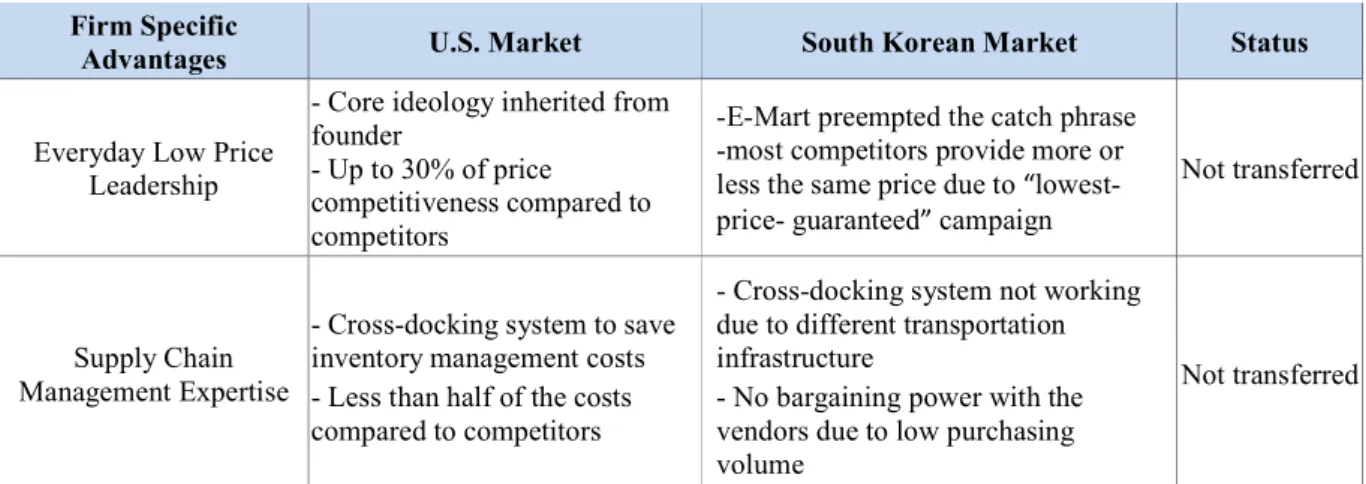
However, Wal-Mart failed to take such EDLP as its core competence in the South Korean market. E-Mart, a subsidiary company of Shinsegye group and the No. 1 discount store in the South Korean market, had neutralized Mart's core competitiveness by preempting the EDLP catchphrase in the South Korean market. Upon Wal-Mart’s entry, E-Mart implemented a so-called “lowest-price-guaranteed” campaign. That campaign was run in a way that E-Mart compensated twice of the price differences if customers find lower prices for the same product in any other discount stores, thus customers did not have to go around other stores to find the lowest pricing stores. Even worse, most of other discount stores also participated in the pricing campaign in one way another, to keep up with the competitions, thus the EDLP strategy in Korean discount store industry became no more than a common cliché. Naturally, customers considered the price level of all discount stores to be more or less the same, and Wal-Mart's EDLP strategy has lost its value as a core competence in the South Korean market. After all, the “lowest-price-guaranteed” campaign initiated by E-Mart changed the rule of the game, and the new rule of competition changed from price competitiveness to product mix, location, service, etc., the areas where Wal-Mart did not have competitive advantages over competitors even in the US market.
Table 1: Comparison of the U.S. and South Korean Markets on Firm Specific Advantages Firm Specific
Advantages U.S. Market South Korean Market Status
Everyday Low Price Leadership
- Core ideology inherited from founder
- Up to 30% of price competitiveness compared to competitors
-E-Mart preempted the catch phrase -most competitors provide more or less the same price due to “lowest-price- guaranteed” campaign
Not transferred
Supply Chain Management Expertise
- Cross-docking system to save inventory management costs - Less than half of the costs compared to competitors
- Cross-docking system not working due to different transportation infrastructure
- No bargaining power with the vendors due to low purchasing volume
Not transferred
58 In fact, Wal-Mart had a significantly lower bargaining power in the primary food supply compared to E-Mart, and in terms of volume, W-Mart purchased from one fourth of suppliers compared to E-Mart. All in all, E-Mart had a 6% point lower sales costs than Wal-Mart. Furthermore, in terms of distributor-manufacturer relationship, Wal-Mart was new to the unique sales incentive system in the South Korean market, which accounted for 60% of domestic distributor's operating profits. Moreover, Wal-Mart's inventory management system based on the advanced IT technology could not be implemented in the Korean market. For example, the cross-docking system could not be applied due to the different transportation infrastructure. The high traffic jam all time of the day made the cross-docking truck useless and Wal-Mart had to build a separate warehouse. Unfortunately, Wal-Mart faced higher costs related to LOFs stemming from differences between U.S. and South Korean markets.
To summarize, the core value of Wal-Mart, EDLP, was no longer a core competence and most of the cost-cutting capabilities could not be transferred to South Korean market. Eventually, Wal-Mart was put in a situation to decide whether they would spend substantial localization costs or not, to continue competitions with local rivals.
4.3. Forced Withdrawal or Strategic Exit?
In May 2006, Wal-Mart announced the sale of its retail business in South Korea to Shinsegye Group. Upon the contract deal, Mr. Joe Hatfield, president of Wal-Mart Asia, stated, "There were difficulties in establishing a position in the South Korean market and we decided to sell Wal-Mart because we judged that it would be difficult to reach the level we want in the next five years, we judged that the market did not benefit us."
It is obvious that Wal-Mart withdrew from the South Korean market because the services did not meet local customer needs. However, considering Wal-Mart’s unrivaled market position and enormous domestic success, one might question whether Wal-Mart's failure to localize is a real failure or an intended strategic choice not to localize in the South Korean market. In fact, Wal-Mart operated only 16 stores in the Korean market during 8 years since 1998. Compared to the UK market, where Wal-Mart made an entry in 1999 and operated 319 stores with sales of 26.8 billion dollars, the number of stores was insignificant. It was also contrary to Wal-Mart's aggressive investment in the Mexican market, where they started big from the beginning and operated 789 stores as of 2006. Moreover, Wal-Mart's overseas expansion at the time was very aggressive. Started from scratch in 1991, Wal-Mart International had grown into a $63 billion business in 2006 and it was the fastest-growing part of Wal-Mart, with nearly 12 percent of sales growth, about double the rate of Wal-Mart’s American stores.
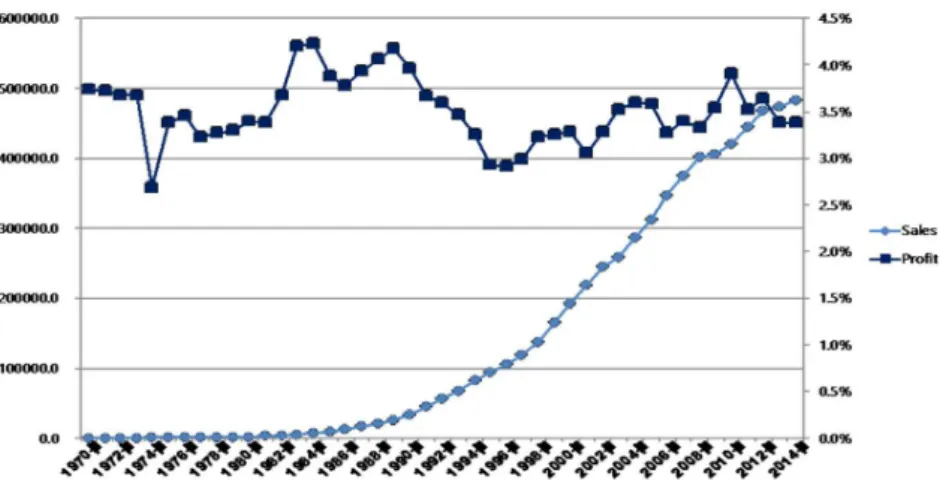
Figure 2 Sales and Profit Growth of Wal-Mart Corporation (1970-2015), data Source: COMPUSTAT From the perspective of MNE’s globalization strategy, it would be reasonable to suspect that the Wal-Mart’s withdrawal was more a strategic choice rather than a failure, for the following reasons. Firstly, from the very beginning of its entry into the South Korean market, Wal-Mart made no efforts to localize. It seemed that they tried to implement their U.S. practices without many alterations. Wal-Mart stores were considered a mere copy of U.S. stores with the same store ambience, product mix and location, etc. and having a false value proposition for Korean
59 consumers. Secondly, Mart made only a very small investment in the South Korean market. Given that Wal-Mart, who had a revolutionary pricing model, could not have overlooked the importance of realizing an economy of scale, it would be fair to interpret that Wal-Mart's entry into the South Korean market at that time was a test takeover rather than a full range market penetration, to learn and test Asian market characteristics. In fact, Wal-Mart entered into Japan only in 2002, 4 years after its first Korean operation. Lastly, as soon as Wal-Mart found that they could not depend on their firm specific advantages in the South Korean market, they decided to sell the business and made an exit. In fact, Wal-Mart recorded a pretax gain of $103 million on the sale of their South Korean business and allocated $206 million of goodwill in 2007. And as shown in Figure 2, Wal-Mart’s sales and profit growth were not damaged by the withdrawal from the South Korean market.
5. Conclusion
5.1. Key Findings and Implications
In this paper, we challenge the traditional explanation on Wal-Mart’s withdrawal from the South Korean market by adopting the concept of “regional multinationals” proposed by Rugman and Verbeke (2004), and examine the regional-based nature of MNE’s geographical expansion.
The case analysis finds that Wal-Mart's withdrawal from the South Korean market can be a good example of MNE’s “regional-based” internationalization strategy. The key findings of this study are as follows.
Firstly, Wal-Mart’s entry to the South Korean market was solely based on the global integration strategy. Since its launch, Wal-Mart tried to transfer their FSAs to the South Korean market: Wal-Mart implemented its standardized model of everyday low prices (EDLP) and information technology-based centralized distribution system without considering local conditions of the South Korean market, and utilized its uniform merchandising and distribution strategies that limit differentiation and constrain adapting to local tastes and preferences. They also build stores in distant areas where land prices were low, which replicate the U.S. practices (Kim, 2008). However, it did not take long until when Wal-Mart found the heterogeneity between the U.S. market and the South Korean market is too big to manage and thus decided to drop the business from the South Korean market. Thus, we posit that Wal-Mart has withdrawn from the South Korean market, where they thought to be unprofitable due to the difficulties of carrying out global integration strategies.
Secondly, Wal-Mart has made little investment in localization in the South Korean market. Indeed, Wal-Mart entered the Korean market on relatively small scale and did not obtain a rapid entry (Kim, 2008), which was a stark contrast to the investment in Mexico where they started very big from the very beginning. They did not hire a local country manager, did not invest in local distribution system, and operated only 16 stores during 8 years. Eventually, Wal-Mart exited from the South Korean market, however, the company even made some capital gain on the sale of its South Korean operations. Indeed, Wal-Mart continued its remarkable growth even during the period when it entered and withdrew from the South Korean market. Therefore, we argue that Wal-Mart’s withdrawal from the South Korean market could be a result of an intended localization avoiding strategy by an MNE.
To summarize, we argue that Wal-Mart made a strategic exit from the South Korean market as they were faced with high level of liabilities of foreignness, to focus on the markets where they can rely on their firm specific advantages.
5.2. Theoretical and Practical Contribution
This study adds some value to IB research by providing some evidence on “regional multinational”. As was posited by some previous research, MNEs tend to have a strong home region bias and to focus on homogeneous markets where they can carry out global integration strategies (Rugman & Verbeke, 2004; Rugman & Verbeke, 2008; Kuivalainen et al., 2013).
This study also implies that to understand MNEs’ local market operations, one must view the MNEs global operations as a whole instead of having a micro-view on the regional operations. In other words, one must understand why global leading MNEs with enormous resources and capabilities become incompetent in certain markets properly. In general, companies implement strategies to operate with the maximum efficiency, and this is applied for entering overseas markets with no exception.
60 Also, the findings of this study give meaningful implications to MNEs from emerging economies seeking to expand their overseas markets. While scholars and executives generally consider national responsiveness and localized adaptation as a panacea for penetrating international markets, it is important to understand that high-performing MNEs focus on competitions where they can maximize the effect of economies of scale by executing global integration strategy and minimize localization costs. Thus, companies that are considering entering overseas markets must carefully calculate the costs of localization in advance. For example, Wal-Mart's strategy in the South Korean market was clearly different from that of E-Mart's in China, who emphasized the importance of localization from the very beginning. Unfortunately, E-Mart made a complete withdrawal from the Chinese market 20 years after from their initial launch, with a big loss, even though they made a huge investment for local adaptations. What should be considered in expanding the global market is not only the size of the market or future market outlook but also the transferability of the company's core capabilities in the market, and it will be more important for small medium sized MNEs with lower level of resources and capabilities.
This study views MNEs’ competition in a host country from the perspective of MNE’s globalization strategy. Certainly, it is not that we argue the previous views on Wal-Mart’s withdrawal from the perspective of international marketing are erroneous or inappropriate. While it is true that Wal-Mart has failed to meet local market needs, what we want to suggest is that we need to understand why they failed from a different perspective. Instead of concluding that South Korean market is the grave of multinational corporations where global practices do not work as media says, we should pay attention to the underlying mechanisms why multinational giants with unrivaled resources and capabilities did not make full use of their advantages in the South Korean market.
Why did Wal-Mart withdraw from the South Korean market? This study may provide some clues to this question from the perspective of MNEs' internationalization strategy. After all, as commented by New York Times, “Wal-Mart found that its formula doesn’t fit every culture…”, and they decided to remain as regional multinational.
References
Birkinshaw, J., Hood, N., & Jonsson, S. (1988). Building firm‐specific advantages in multinational corporations: the role of subsidiary initiative. Strategic Management Journal, 19(3), 221-242.
Boehe, D. M. (2011). Exploiting the liability of foreignness: Why do service firms exploit foreign affiliate networks at home? Journal of International Management, 17(1), 15-29.
Burt, S., Coe, N. M., & Davies, K. (2019). A tactical retreat? Conceptualizing the dynamics of European grocery retail divestment from East Asia. International Business Review, 28(1), 177-189.
Caves, R. E., & Caves, R. E. (1996). Multinational enterprise and economic analysis. Cambridge university press. Durand, C., & Wrigley, N. (2009). Institutional and economic determinants of transnational retailer expansion and
performance: a comparative analysis of Wal-Mart and Carrefour. Environment and Planning A, 41(7), 1534-1555.
Gandolfi, F., & Strach, P. (2009). Retail internationalization: gaining insights from the Wal-Mart experience in South Korea. Review of International Comparative Management, 10(1), 187-199.
Gereffi, G., & Christian, M. (2009). The impacts of Wal-Mart: The rise and consequences of the world's dominant retailer. Annual Review of Sociology, 35,573–591
Kim, R. B. (2008). Wal-Mart Korea: Challenges of entering a foreign market. Journal of Asia-Pacific Business, 9(4), 344-357.
Kogut, B., & Singh, H. (1988). The effect of national culture on the choice of entry mode. Journal of international business studies, 19(3), 411-432.
Kogut, B., & Zander, U. (1993). Knowledge of the firm and the evolutionary theory of the multinational corporation. Journal of international business studies, 24(4), 625-645.
Kuivalainen, O., Sundqvist, S., Saarenketo, S., McNaughton, R. B., D'Angelo, A., Majocchi, A., & Buck, T. (2013). Geographical pathways for SME internationalization: insights from an Italian sample. International Marketing Review, 30(2), 80-105
Levitt, T. (1983). The Globalization of Markets, Harvard Business Review, 61 (May/June), 92-102.
Narula, R., & Dunning, J. H. (2010). Multinational enterprises, development and globalization: Some clarifications and a research agenda. Oxford Development Studies, 38(3), 263-287.
61 Prahalad, C. K., & Doz. Y. (1987) The Multinational Mission. Balancing local demands and global vision, Simon
and Schuster, New York.
Rugman, A. M. (2003). Regional strategy and the demise of globalization. Journal of International Management, 9(4), 409-417.
Rugman, A. M., & Verbeke, A. (2004). A perspective on regional and global strategies of multinational enterprises. Journal of International Business Studies, 35(1), 3–18.
Rugman, A. M., & Verbeke, A. (2008). A new perspective on the regional and global strategies of multinational services firms. Management International Review, 48(4), 397–411.
Verbeke, A., & Kano, L. (2016). An internalization theory perspective on the global and regional strategies of multinational enterprises. Journal of World Business, 51(1), 83-92.
Yin, R. K. (2017). Case study research and applications: Design and methods, Sage publications.
Zaheer, S. (1995). Overcoming the liability of foreignness. Academy of Management Journal, 38(2), 341-363. Zhang, L., & Wei, Y. D. (2015). Foreign hypermarket retailers in China: spatial penetration, local embeddedness,