© Korean Powder Metallurgy Institute 725
-1. Introduction
Titanium is well suited as metallic implant material, due to its best biocompatibility in comparison to other metals [1,2]. Disadvantages of using c.p.Ti as implant material are its low strength and insufficient hardness. Until now, the improvements of strength and wear resistance of titanium have been realized by alloying and by coating.
The aim of the present investigations was to obtain a significant increase in strength and hardness of titanium materials by developing a novel ultra-fine grained and dispersion-strengthened titanium material. The dispersoids are used to reduce the grain growth in the subsequent technologically necessary thermal treatment as well as to increase hardness and strength of the nanocrystalline titanium material. Titanium silicides and carbides are chosen as dispersoids because they have no deteriorating effect on the favourable TiO2 passive layer and will not
affect the body tissue.
2. Experimental and Results
As shown in previous investigations of the author group the granules with the desired nanocrystalline microstructure and finest dispersoids had been created by high energy ball milling of Ti-Si or Ti-C (graphite) powder mixtures in a RETSCH PM400 planetary ball mill [3].
With the aim of getting finer and more homogeneously distributed dispersoids hexamethyldisilane – HS, (CH3)6Si2,
was used in the milling process [3] as carrier of the
dispersiod forming elements Si and C. Prior to compaction, a heat treatment was necessary to remove the organic fluid
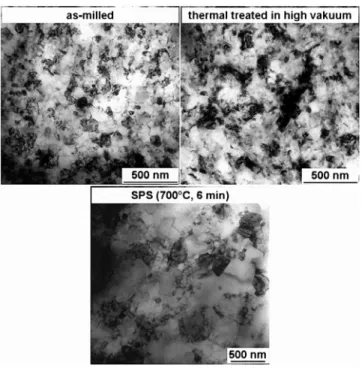
Fig. 1. TEM micrographs of Ti/HS after milling, high vacuum thermal treatment and SPS.
introduced hydrogen from the granules. Spark Plasma Sintering (SPS) was used to consolidate the powder
2006 POWDER METALLURGY World Congress
C02-03-2
Ultra-fine Grained and Dispersion-strengthened Titanium Materials Manufactured
by Spark Plasma Sintering
Dirk Handtracka, Christa Sauerb, Bernd Kiebackc
Technische Universitaet Dresden, Institute of Materials Science 01062 Dresden, Germany
a
[email protected], b [email protected], c [email protected] Abstract
Ultra-fine grained and dispersion-strengthened titanium materials (Ti-Si, Ti-C, Ti-Si-C) have been produced by high energy ball milling and spark plasma sintering (SPS). Silicon or/and carbon were milled together with the titanium powder to form nanometer-sized and homogeneously distributed titanium silicides or/and carbides as dispersoids, that should prevent grain coarsening during the SPS compaction and contribute to strengthening of the material. The microstructures and the mechanical properties showed that strength, hardness and wear resistance of the sintered materials have been significantly improved by the mechanisms of grain refinement and dispersion strengthening. The use of an organic fluid as carrier of the dispersoid forming elements caused a significant increase in ductility.
© Korean Powder Metallurgy Institute 726 -granules. The microstucture of the material after the processing steps can be seen in Fig. 1.
Composition, processing parameters and bulk composition are shown in Table 1. The mechanical properties of the testet materials show a high strength and hardness caused by the effects of the Hall-Petch-relation and the Orowan mechanism. The poor ductility for Ti/1Si and Ti/1.5C created by powder mixtures could significantely be impoved by using HS for the milling process. For Ti/HS a plastic elongation of 9,6 % was measured without significant losses in strength and hardness.
Table 1. Composition, processing parameters and mechanical properties of new nanocrystalline ds-titanium materials (* 3-point bending test)
Ti/1Si Ti/1.5C Ti/HS
alloying element composition
Si [wt.-%] 1 - 0.5
C [wt.-%] - 1.5 0.65
milling parameters
rotation speed [rpm] 150 150 150 milling time [hrs] 64 20 64 thermal treatment in high
vacuum
-
- 30 min 400°C 30 min400°C SPS parameters
pressure [MPa] 80 80 80 heating rate [K/min] 100 100 100 sintering temperature [°C] 700 700 700 sintering time [min] 6 6 6 bulk composition
Ti5Si3 dispersoids [Vol.-%] 4.2 - 2.1
TiCX dispersoids [Vol.-%] - 9.2 4.0
Ti matrix [Vol.-%] rest rest rest mechanical properties
vickers hardness [HV0.5] 392 348 320 *yield strength [MPa] 1425 1135 1310 *bending strength [MPa] 1650 1615 1930 *plast. elong. at break [%] 0.5 2 9.6 A pin-on-disc experimental set-up was used to investigate the wear behaviour of the new developed materials in comparison to c.p.Ti and TiAl6V4 as pin materials against TiAl6V4 as the material for the rotating disc.
s
F
l
A
k
⋅
∆
⋅
=
(1)The wear coefficient k for each pin was calculated using equation (1) where A is the cross section area of the pin, l is the decrease of the pin length, F is the contact force
between the pin and the disc and s is the total sliding distance. The wear curves in Fig. 2 show clearly an improvement in wear restistance by the new nanocrystalline and dispersion strengthened titanium materials Ti/1Si,
Ti/1.5C and Ti/HS in comparison to c.p.Ti and also to the implant alloy TiAl6V4.
Consistant with the wear curves the wear coefficients of the new materials show no significant differences amongst each other (Table 2). Their wear coefficient is about five times better then c.p.Ti and twice as good as the implant alloy TiAl6V4. sliding distance in km -0.5 0 0.25 0 2 4 6 8 cumul a ti v e w e ar in mm c.p.Ti TiAl6V4 10 Ti/1.5C Ti/1Si Ti/HS -0.25 -0.75
pin-on-disc in phosphate buffered saline, 37°C, 2 MPa, 0.1 m/s sliding distance in km -0.5 0 0.25 0 2 4 6 8 cumul a ti v e w e ar in mm c.p.Ti TiAl6V4 10 Ti/1.5C Ti/1Si Ti/HS -0.25 -0.75
pin-on-disc in phosphate buffered saline, 37°C, 2 MPa, 0.1 m/s
Fig. 2. Wear curves of the Ti/1Si, Ti/1,5C, Ti/HS, TiAl6V4 and c.p.Ti tested against a TiAl6V4.
Table 2. Wear coefficients of the testet materials in mm3/Nm
c.p.Ti TiAl6V4 Ti/1Si Ti/1.5C Ti/HS 5.5·10-5 2.3·10-5 1.1·10-5 1.2·10-5 1.0·10-5
3. Summary
Ultra-fine grained and dispersion-strengthened titanium materials manufactured by high energy ball milling followed by a compaction via SPS show a high strength, hardness and wear resistance. Use of the organic fluid as carrier of the dispersiod forming elements led to a significant ductility increase in the material which is supposedly caused by the finer and more homogeneously distributed dispersoids.
4. References
1. M. Peters, C. Leyens, J. Kumpfert (Eds.), Titan und Titanlegierungen, DGM Informationsgesellschaft mbH, 1996.
2. E. Wintermantel, S.-W. Ha (Eds.), Biokompatible Werkstoffe und Bauweisen, 2., vollst. neubearb. Aufl., Springer, Heidelberg, 1998.
3. D. Handtrack, C. Sauer, B. Kieback, Proc. PM2004, Vienna, Austria, Vol. 1, p.419(2004).