Tunable emission from blue to white light in
single-phase Na
0.34
Ca
(0.66-x-y)
Al
1.66
Si
2.34
O
8
:
xEu
2+
,yMn
2+
(x = 0.07) phosphor for white-light
UV LEDs
Ga-yeon Lee,1 Won Bin Im,2 Artavazd Kirakosyan,1 Sang Hoon Cheong,1 Ji Yeon Han,1 and Duk Young Jeon1,*
1Department of Materials Science and Engineering, Korea Advanced Institute of Science and Technology, Daejeon
305-701, South Korea
2Department School of Materials Science and Engineering, Chonnam National University, 300 Yongbong-Dong,
Buk-Gu, Gwangju, 500-757, South Korea
Abstract: A series of single-phased emission-tunable
Na0.34Ca0.66Al1.66Si2.34O8:Eu2+,Mn2+ phosphors were successfully
synthesized by a wet-chemical synthesis method. Photoluminescence excitation (PLE) spectra indicate that the phosphor can be efficiently excited by UV radiation from 250 to 420 nm. Also, NCASO:Eu2+,Mn2+
phosphor exhibit a broad blue emission band at 440 nm and an orange emission band at 570 nm, which originate from Eu2+ and Mn2+ ions, respectively. Therefore, overall emission color can be tuned from blue to white by increasing the concentration of Mn2+ ions in the host lattice
utilizing energy transfer from Eu2+ to Mn2+ ions. This energy transfer
phenomenon was demonstrated to be a resonant type through dipole-dipole interaction determined with the help of PL spectra, decay time measurement, and energy transfer efficiency of the phosphor. These results indicate that NCASO:Eu2+,Mn2+ can be a promising single-phased
white-emitting phosphor for white-light UV LEDs.
©2013 Optical Society of America
OCIS codes: (160.2540) Fluorescent and luminescent materials; (230.3670) Light-emitting
diodes; (250.5230) Photoluminescence.
References and links
1. S. Nakamura and G. Fasol., The Blue Laser Diode: GaN-based Light Emitters and Lasers (Springer, 1996). 2. R. J. Xie, N. Hirosaki, T. Suehiro, F. F. Xu, and M. Mitomo, “A simple, efficient synthetic route to
Sr2Si5N8:Eu2+-based red phosphors for white light-emitting diodes,” Chem. Mater. 18(23), 5578–5583 (2006).
3. Y. Q. Li, A. C. A. Delsing, G. de With, and H. T. Hintzen, “Luminescence properties of Eu2+-activated
alkaline-earth silicon-oxynitride MSi2O2-δN2+ 2/3δ (M= Ca, Sr, Ba): a promising class of novel LED conversion
phosphors,” Chem. Mater. 17(12), 3242–3248 (2005).
4. H. S. Jang, Y. H. Won, and D. Y. Jeon, “Improvement of electroluminescent property of blue LED coated with highly luminescent yellow-emitting phosphors,” Appl. Phys. B 95(4), 715–720 (2009).
5. H. S. Jang, W. B. Im, D. C. Lee, D. Y. Jeon, and S. S. Kim, “Enhancement of red spectral emission intensity of Y3Al5O12:Ce3+ phosphor via Pr co-doping and Tb substitution for the application to white LEDs,” J. Lumin.
126(2), 371–377 (2007).
6. J. S. Kim, P. E. Jeon, Y. H. Park, J. C. Choi, H. L. Park, G. C. Kim, and T. W. Kim, “White-light generation through ultraviolet-emitting diode and white-emitting phosphor,” Appl. Phys. Lett. 85(17), 3696–3698 (2004). 7. Y. Uchida and T. Taguchi, “Lighting theory and luminous characteristics of white light-emitting diodes,” Opt.
Eng. 44(12), 124003 (2005).
8. X. Piao, T. Horikawa, H. Hanzawa, and K. Machida, “Characterization and luminescence properties of Sr2Si5N8:Eu phosphor for white light-emitting-diode illumination,” Appl. Phys. Lett. 88(16), 161908 (2006).
9. Y. Liu, M. Nishiura, Y. Wang, and Z. Hou, “π-Conjugated aromatic enynes as a single-emitting component for white electroluminescence,” J. Am. Chem. Soc. 128(17), 5592–5593 (2006).
10. N. Guo, Y. Huang, M. Yang, Y. Song, Y. Zheng, and H. You, “A tunable single-component warm white-light Sr3Y(PO4)3:Eu2+,Mn2+ phosphor for white-light emitting diodes,” Phys. Chem. Chem. Phys. 13(33), 15077–
15082 (2011).
11. K. H. Kwon, W. B. Im, H. S. Jang, H. S. Yoo, and D. Y. Jeon, “Luminescence properties and energy transfer of site-sensitive Ca6-x-yMgx-z(PO4)4:Euy2+,Mnz2+ phosphors and their application to near-UV LED-based white
LEDs,” Inorg. Chem. 48(24), 11525–11532 (2009).
12. W. J. Yang, L. Luo, T. M. Chen, and N. S. Wang, “Luminescence and energy transfer of Eu-and Mn-coactivated CaAl2Si2O8 as a potential phosphor for white-light UVLED,” Chem. Mater. 17(15), 3883–3888 (2005).
13. N. Guo, H. You, Y. Song, M. Yang, K. Liu, Y. Zheng, Y. Huang, and H. Zhang, “White-light emission from a single-emitting-component Ca9Gd(PO4)7:Eu2+,Mn2+ phosphor with tunable luminescent properties for near-UV
light-emitting diodes,” J. Mater. Chem. 20(41), 9061–9067 (2010).
14. G. Yao, J. Lin, L. Zhang, G. Lu, M. Gong, and M. Su, “Luminescent properties of BaMg2Si2O7:Eu2+,Mn2+,” J.
Mater. Chem. 8(3), 585–588 (1998).
15. C. Guo, L. Luan, X. Ding, and D. Huang, “Luminescent properties of SrMg2(PO4)2:Eu2+, and Mn2+ as a potential
phosphor for ultraviolet light-emitting diodes,” Appl. Phys. A: Mater. 91(2), 327–331 (2008).
16. G. Li, D. Geng, M. Shang, C. Peng, Z. Cheng, and J. Lin, “Tunable luminescence of Ce3+/Mn2+-coactivated
Ca2Gd8(SiO4)6O2 through energy transfer and modulation of excitation: potential single-phase
white/yellow-emitting phosphors,” J. Mater. Chem. 21(35), 13334–13344 (2011).
17. C. Guo, L. Luan, Y. Xu, F. Gao, and L. Liang, “White light–generation phosphor Ba2Ca(BO3)2:Ce3+, Mn2+ for
light-emitting diodes,” J. Electrochem. Soc. 155(11), J310–J314 (2008).
18. C. K. Chang and T. M. Chen, “Sr3B2O6:Ce3+,Eu2+: A potential single-phased white-emitting borate phosphor for
ultraviolet light-emitting diodes,” Appl. Phys. Lett. 91(8), 081902 (2007).
19. J. Y. Han, W. B. Im, D. Kim, S. H. Cheong, G. Lee, and D. Y. Jeon, “New full-color-emitting phosphor, Eu2+
-doped Na2− xAl2− xSixO4 (0≤ x≤ 1), obtained using phase transitions for solid-state white lighting,” J. Mater.
Chem. 22(12), 5374–5381 (2012).
20. G. Y. Lee, J. Y. Han, W. B. Im, S. H. Cheong, and D. Y. Jeon, “Novel blue-emitting NaxCa1-xAl2-xSi2+xO8:Eu2+ (x
= 0.34) phosphor with high luminescent efficiency for UV-pumped light-emitting diodes,” Inorg. Chem. 51(20), 10688–10694 (2012).
21. R. Shannon, “Revised effective ionic radii and systematic studies of interatomic distances in halides and chalcogenides,” Acta Crystallogr. A 32(5), 751–767 (1976).
22. C. H. Huang, T. M. Chen, W. R. Liu, Y. C. Chiu, Y. T. Yeh, and S. M. Jang, “A single-phased emission-tunable phosphor Ca9Y(PO4)7:Eu2+,Mn2+ with efficient energy transfer for white-light-emitting diodes,” ACS. Appl.
Mater. Inter. 2(1), 259–264 (2010).
23. R. Pang, C. Li, L. Shi, and Q. Su, “A novel blue-emitting long-lasting proyphosphate phosphor Sr2P2O7:Eu2+,Y3+,” J. Phys. Chem. Solids 70(2), 303–306 (2009).
24. C. H. Huang and T. M. Chen, “Ca9La(PO4)7:Eu2+,Mn2+: an emission-tunable phosphor through efficient energy
transfer for white light-emitting diodes,” Opt. Express 18(5), 5089–5099 (2010).
25. N. Ruelle, M. Pham-Thi, and C. Fouassier, “Cathodoluminescent properties and energy transfer in red calcium sulfide phosphors (CaS: Eu,Mn),” Jpn. J. Appl. Phys. 31(Part 1, No. 9A), 2786–2790 (1992).
26. W. J. Yang and T. M. Chen, “White-light generation and energy transfer in SrZn2(PO4)2:Eu,Mn phosphor for
ultraviolet light-emitting diodes,” Appl. Phys. Lett. 88(10), 101903 (2006).
27. D. Dexter and J. H. Schulman, “Theory of concentration quenching in inorganic phosphors,” J. Chem. Phys.
22(6), 1063 (1954).
28. G. Blasse, “Energytransfer in oxidicphosphors,” Philips Res. Rep. 24, 131 (1969).
29. R. Reisfeld, E. Greenberg, R. Velapoldi, and B. Barnett, “Luminescence quantum efficiency of Gd and Tb in borate glasses and the mechanism of energy transfer between them,” J. Chem. Phys. 56(4), 1698 (1972). 30. N. Guo, Y. Huang, H. You, M. Yang, Y. Song, K. Liu, and Y. Zheng, “Ca9Lu(PO4)7:Eu2+,Mn2+: a potential
single-phased white-light-emitting phosphor suitable for white-light-emitting diodes,” Inorg. Chem. 49(23), 10907–10913 (2010).
31. B. M. Antipeuko, I. M. Bataev, V. L. Ermolaev, E. I. Lyubimov, and T. A. Privalova, “Ion-to-ion radiationless transfer of electron excitation energy between rare-earth ions in POCl3-SnCl4,” Opt. Spektrosk. 29, 335 (1970).
32. R. Reisfeld and N. Lieblich-Soffer, “Energy transfer from UO22+ to Sm3+ in phosphate glass,” J. Solid State
Chem. 28(3), 391–395 (1979).
33. R. J. Xie, N. Hirosaki, N. Kimura, K. Sakuma, and M. Mitomo, “2-phosphor-converted white light-emitting diodes using oxynitride/nitride phosphors,” Appl. Phys. Lett. 90(19), 191101 (2007).
34. C. H. Huang, W. R. Liu, and T. M. Chen, “Single-phased white-light phosphors Ca9Gd(PO4)7:Eu2+,Mn2+ under
near-ultraviolet excitation,” J. Phys. Chem. C 114, 28698 (2010).
35. N. Hirosaki, R. J. Xie, K. Kimoto, T. Sekiguchi, Y. Yamamoto, T. Suehiro, and M. Mitomo, “Characterization and properties of green-emitting β-SiAlON:Eu2+ powder phosphors for white light-emitting diodes,” Appl. Phys.
Lett. 86(21), 211905 (2005).
1. Introduction
In recent years, white light-emitting-diode (LED) technology has attracted much attention in lighting industry due to the advantages of white-LEDs including low power consumption,
reliability, long lifetime, safety, and environmentally friendly characteristics [1, 2]. The most dominant way to produce commercial white light-emitting diodes (WLEDs) is a combination of a blue emitting InGaN chip with a yellow emitting Y3Al5O12:Ce3+ (YAG:Ce3+) phosphor.
However, that combination shows several disadvantages including high correlated color temperature (CCT~7750 K) and low color-rendering index (CRI~70-80) because of a lack of sufficient red emission [3–5]. Therefore, as an alternative, a combination of UV LED with red, green and blue emitting phosphors has been developed to improve the CRI, color stability and to tune CCT value [6, 7]. However, the luminescence efficiency is low in this system because the blue emission is reabsorbed by green and red phosphors [8]. Therefore, a single composition white-emitting phosphor which can be effectively excited by UV light ought to receive much attention to enhance the luminous efficiency. More importantly, a single- phased white light emitting phosphor with UV-LED chip system show better performances in stability, color reproducibility, and fabrication process than those of white LEDs with multiple emitting components phosphor system [9, 10]. The method of co-doping sensitizer and activator into one host lattice is one way to create a single–phased white-light-emitting phosphor using the principle of energy transfer from sensitizer to activator, such as Eu2+ and
Mn2+ co-doping system, which has been introduced and demonstrated in several previous
works. The examples are follows, Ca6-x-yMgx-z(PO4)4:yEu2+,zMn2+, CaAl2Si2O8:Eu2+,Mn2+,
Ca9Gd(PO4)7: Eu2+,Mn2+, BaMg2Si2O7: Eu2+,Mn2+, SrMg2(PO4)2: Eu2+,Mn2+,
Ca2Gd8(SiO4)6O2:Ce3+,Mn2+, Ba2Ca(BO3)2:Ce3+,Mn2+, Sr3B2O6:Ce3+,Eu2+ phosphors [11–18].
In this work, we prepared a novel single-phased emission-tunable Na0.34Ca0.66Al1.66Si2.34O8:Eu2+,Mn2+ (NCASO:Eu2+,Mn2+) phosphor suitable for UV-pumped
white-emitting LED applications. Photoluminescence excitation (PLE) of NCASO:Eu2+,Mn2+
phosphor ranging from 250 to 420 nm fits well for the UV-LED application. Photoluminescence (PL) spectrum shows that the phosphor covers the full range of visible region which can create warm white emission resulted from the energy transfer from Eu2+ to
Mn2+ ions. Furthermore, we have also investigated its luminescence properties as well as the
energy transfer mechanism which was confirmed by observing the change in the luminescence spectra, energy transfer efficiency, and by decay profile analysis.
2. Experimental 2.1. Synthesis
Powder samples Na0.34Ca(0.66-x-y)Al1.66Si2.34O8:xEu2+,yMn2+ (x = 0.07, y = Mn dopant
concentration) were synthesized by a wet chemical synthesis method based on hydrolysis of tetraethylorthosilicate (TEOS) [19]. As raw materials, sodium nitrate (NaNO3 ≥ 99.99%,
Aldrich), europium (III) chloride hexahydrate (EuCl3·6H2O ≥ 99.99%, Aldrich), calcium
nitrate nonahydrate (Ca(NO3)2·9H2O ≥ 99.99%, Aldrich), aluminum nitrate nonahydrate
(Al(NO3)3·9H2O ≥ 98%, Aldrich), Manganese (II) chloride tertahydrate (MnCl2·4H2O ≥ 98%,
Aldrich), tetraethyl orthosilicate (TEOS, 99.999%, Aldrich) were used. All materials except for TEOS were dissolved in deionized water, and then the TEOS was dissolved in ethanol. These two solutions were thoroughly mixed together. The mixture was dehydrated in an oven at 120°C for about 24 h until the solvent was completely dried. The dried powders were fired at 1400°C in a reducing atmosphere of a mixture of H2 (5%) and N2 (95%) for 3 h.
2.2. Characterizations
The luminescent properties and quantum efficiency of NCASO:Eu2+,Mn2+ phosphors were
analyzed by using a F-7000 Hitachi fluorescence spectrophotometer PL system equipped with a xenon lamp (500 W) as an excitation source. X-ray diffraction (XRD) data was obtained over a range of 15° ≤ 2θ ≤ 60° at step of 3°/min with Cu-Kα radiation using a diffractometer (D/MAX-RB(12KW), RIGAKU, Japan). Decay characteristics are probed by a Fluorescence
Lifetime Spectrometer (FL920, Edinburgh Instruments, Wales) which is operated based upon time correlated single photon counting scheme.
3. Result and discussion
3.1 phase identification of NCASO:0.07Eu2+,yMn2+ phosphor
Fig. 1. XRD patterns of NCASO:0.07Eu2+,yMn2+ phosphors.
Phase purity of all samples was analyzed by XRD analysis. Figure 1 illustrates the X-ray diffraction (XRD) patterns of NCASO:0.07Eu2+,yMn2+ phosphors with various Mn2+doping
concentration (y = 0, 0.05, 0.1, 0.2, 0.3). All of the profiles were found to match well with that reported in JCPDS file 86-1650 regardless of the content of dopants and this observation indicates that no impurity phase is present in the prepared samples. It clearly suggests that the activator and sensitizer have been incorporated in the lattice. The crystal structure of NCASO host, which is included in the plagioclase feldspars group, was reported in our previous report [20]. In the crystal structure of NCASO phosphor, Na+ and Ca2+ ions share the same sites.
The Na+/Ca2+ ions have four different coordination numbers (Na+/Ca2+-1, Na+/Ca2+-2, and
Na+/Ca2+-4 are 8-coordinated; Na+/Ca2+-3 is 10-coordinated). Typically, effective radii (r) of
cations change depending on the coordination number (CN) [21]. The ionic radii of Eu2+ ions
(r = 1.25 Å when CN = 8, r = 1.35 Å when CN = 10) and those of Mn2+ ions (r = 0.96 Å when
CN = 8) are similar to those of Na+ ions (r = 1.18 Å when CN = 8, 1.24 Å when CN = 9, 1.39
Å when CN = 12) and Ca2+ ions (r = 1.12 Å when CN = 8, 1.23 Å when CN = 10). Since both
4-coordinated Al3+ (r = 0.39 Å) and Si4+ (r = 0.26 Å) sites are too small for Eu2+ and Mn2+
ions to occupy, we have suggested that Eu2+ and Mn2+ ions are expected to occupy the Na+/Ca2+ shared sites in the host lattice.
3.2 Photoluminescence properties
Fig. 3. Spectral overlap between the normalized PL spectrum of NCASO:Eu2+ and the PLE
spectrum of NCASO:Mn2+.
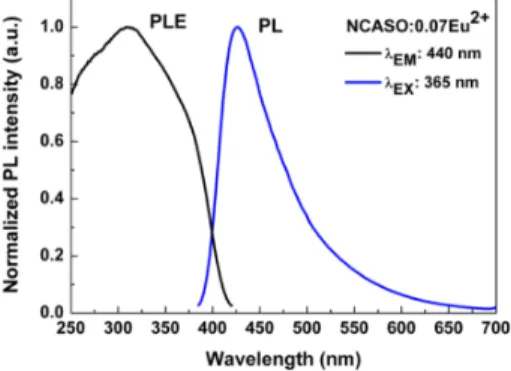
PLE and PL spectra of NCASO:0.07Eu2+ phosphor are presented in Fig. 2. PLE spectrum
shows a broad band from 250 to 420 nm which corresponds to the 4f7→ 4f65d1 transition of
Eu2+ ions. Under excitation at 365 nm, the NCASO:Eu2+ phosphor produces broad band blue
emission centered at around 440 nm which is attributed to the 4f65d1→4f7 of the Eu2+ ion. As
represented in Fig. 3, PL spectrum of NCASO:Eu2+ shows a very broad blue emission band
peaking at around 440 nm, which is assigned to the typical 4f65d1→ 4f7 transition of Eu2+ ion
and the PLE spectrum of NCASO:Mn2+ consist of several bands centered at around 342, 405,
420, and 460 nm, corresponding to the transition of the Mn2+ ion from the ground level
6A
1(6S) to 4T2(4D), [4A1(4G), 4E(4G)], 4T2(4G), and 4T1(4G) levels, respectively [13]. We have
observed a spectral overlap between the emission band of the Eu2+ ions and the excitation
band of the Mn2+ ions at around 410 nm which implies that a part of energy transfers between
Eu2+ and Mn2+ ions. Therefore, effective energy transfer from Eu to Mn (ET
Eu→Mn) was
expected.
Fig. 4. PLE and PL spectra of NCASO:0.07Eu2+,0.20Mn2+ phosphor.
In addition, another evidence for the energy transfer in NCASO:Eu2+,yMn2+ is shown in
Fig. 4. PLE spectra monitored at 440 nm and 570 nm of Eu2+ and Mn2+, respectively, appears
very similar to each other. Moreover, the absence of characteristic Mn2+ excitation band rules
out direct excitation of Mn2+ ions which indicates efficient energy transfer form Eu2+ ions to
Mn2+ ions. The PLE spectrum shows a broad band ranged at 250-420 nm which means that
the NCASO:Eu2+,Mn2+ phosphor has a potential for UV LED application. After co-doping
Eu2+ and Mn2+ ion in NCASO host lattice, the sample exhibits two broad emission bands
centered at around 440 and 570 nm under the 365 nm excitation which consist of a blue band and orange one originating from the f-d transition of the Eu2+ ion and the 4T
1-6A1 transition of
Thus, white-light can be obtained by combining the emission of Eu2+ and Mn2+ ions present in
a single host lattice by simply adjusting the relative ratio of Eu2+ and Mn2+ activators via the
principle of energy transfer.
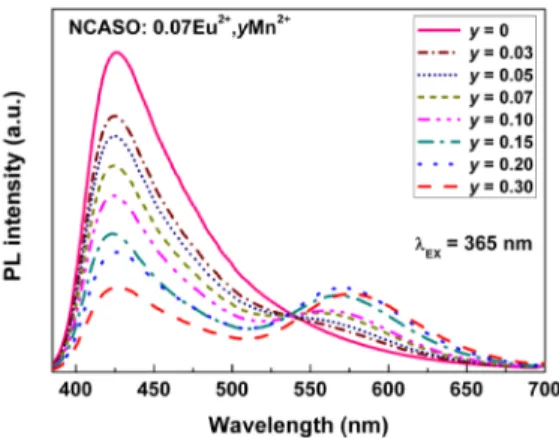
Fig. 5. PL spectra for NCASO:0.07Eu2+,yMn2+ phosphors on Mn2+ doping content (y)
In order to further investigate the energy transfer mechanism between the Eu2+ and Mn2+
ions on NCASO phosphor, a series of samples were synthesized and their luminescent properties are demonstrated. Figure 5 shows that the PL spectra of NCASO:0.07Eu2+,yMn2+
phosphors with different Mn2+ contents (y = 0, 0.03, 0.07, 0.10, 0.15, 0.20, 0.30) under 365
nm excitation. The PL emission intensity of Eu2+ at around 440 nm was found to decrease
with increasement of Mn2+ content due to the enhancement of the energy transfer from Eu2+
to Mn2+ ions. On the other hand, the emission intensity of Mn2+ at 570 nm reaches a
maximum when y = 0.20 and decreases on account of the Mn2+-Mn2+ internal concentration
quenching [22]. This result further supports the energy transfer process from Eu2+ to Mn2+ ions.
Fig. 6. Decay curves of Eu2+ emission for NCASO:0.07Eu2+,yMn2+ monitored at 440nm.
Table 1. Decay times of NCASO:0.07Eu2+,yMn2+ phosphors excited at 375 nm with
emission monitored at 440nm. Samples τ1 A1 τ2 A2 τ(μs) y = 0 0.364 4048.1 0.734 5606.9 0.637 y = 0.05 0.295 4412.3 0.682 5168.4 0.578 y = 0.10 0.264 4933.1 0.662 4455.1 0.540 y = 0.15 0.223 5149.7 0.619 3963.9 0.492 y = 0.20 0.202 5287.3 0.594 3798.8 0.468 y = 0.30 0.173 5397.6 0.564 3369.1 0.435
The decay curves of NCASO:0.07Eu2+,yMn2+ phosphor samples excited at 375 nm and
monitored at 440 nm are shown in Fig. 6. The corresponding luminescence decay curves can be fitted by a second-order exponential decay mode by following equation [23, 24]:
1exp - 1 2exp - 2
I=A ( / )t τ +A ( / )t τ (1)
where I is the luminescence intensity; A1 and A2 are constant; t is the time, and τ1 and τ2
are decay time for exponential components. Using this parameters, the average decay time (τ) can be obtained by the formula given in the following [25];
2 2
1 1 2 2 1 1 2 2
A A A A
τ =( τ + τ ) ( τ + τ ) (2) The value of τ1, τ2, A1, and A2 are analyzed and summarized in Table 1. The average decay
times were determined to be 0.637, 0.578, 0.540, 0.492, 0.468, and 0.435 μs for NCASO:0.07Eu2+,yMn2+ with y = 0, 0.05, 0.10, 0.15, 0.20, and 0.30, respectively. The results
show that the average decay time for the Eu2+ ions decreases with increase in the Mn2+ doping
content y, which is a strong evidence for the energy transfer from Eu2+ to Mn2+ ions in the
NCASO:0.07Eu2+,yMn2+ phosphor.
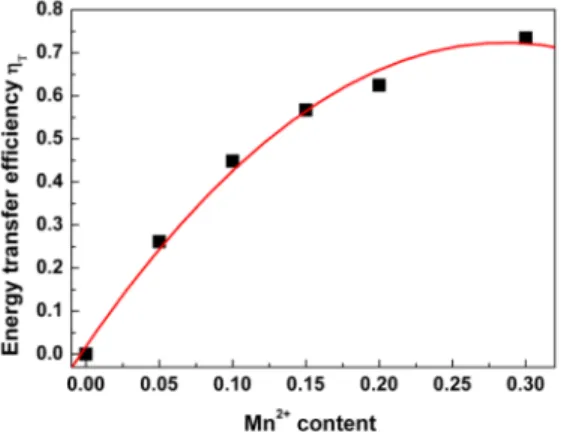
Fig. 7. Dependence of the energy transfer efficiency ηT on the Mn2+ content (y)
Generally, energy transfer efficiency (ηT) can be described by using the following formula
[26]; 1- S T SO I I η = (3)
where IS0 is the luminescence intensities of the Eu2+ of the samples in the absence of the
Mn2+ ions and I
S is the luminescence intensities of the Eu2+ ions in the presence of the Mn2+
ions. The dependance of the energy transfer efficiency (ηT) as a function of Mn2+ content is
displayed in Fig. 7. It is shown that the energy transfer efficiency (ηT) of
NCASO:0.07Eu2+,yMn2+ phosphor increase gradually with increasing the Mn2+ doping
concentration. Thus, we confirm that the energy transfer process from Eu2+ to Mn2+ ions is
efficient in NCASO host.
According to Dexter and Schulman, the concentration quenching of luminescence occurs due to the energy transfer from one activator to another until the energy is consumed in the lattice [27]. The critical distance REu-Mn for energy transfer from Eu2+ to Mn2+ ions was
suggested by Blasse [28]. The critical distance can be expressed according to the following equation: 1 3 -3 2 4 Eu Mn V R xN π = ( ) (4)
where V is the volume of the unit cell; x is the critical concentration; and N is the number of available cation site for dopant in the unit cell. For the NCASO host, N = 8 and V = 1345.28 Å3 [20]. The critical concentration is 0.13 at which the luminescence intensity of
Eu2+ becomes only half of that of the sample with no Mn2+ included (when the energy transfer
efficiency is 0.5). From the above equation, the critical distance REu-Mn was calculated to be
about 13.52 Å. There are two types of energy transfer: one is exchange interaction and the other is multi-polar interaction [29, 30]. In the case of the exchange interaction, the critical distance between the sensitizer and activator should be shorter than 3-4 Å [31]. However, the calculated critical distance for NCASO:Eu2+,Mn2+ phosphor is much longer than 3-4 Å so that
the energy transfer between the Eu2+ and Mn2+ ion in NCASO phosphor is probably the
electric multi-polar interaction type.
Fig. 8. Dependence of I0 /I of Eu2+ on (a) C6/3,(b) C8/3, and (c) C10/3
On the basis of Dexter’s energy transfer formula for exchange interaction and the Reisfeld’s approximation, the following relation can be described [27, 32]:
0 Cn3
η
η ∝ (5)
where η0 and η are the luminescence quantum efficiency of Eu2+ without and with Mn2+; C
is the sum of the content of Eu2+ and Mn2+; n = 6, 8, and 10 correspond to dipole-dipole,
dipole-quadrupole, and quadrupole-quadrupole interactions, respectively. The value of η0/η
can be approximately calculated by the ratio of relative luminescence intensities [27, 28, 32]:
0 n3
I C
I ∝ (6)
where I0 is intrinsic luminescence intensity of Eu2+ and I is the luminescence intensity of
Eu2+ with the presence of Mn2+. The results of I
0 /I-Cn/3 plots are illustrated in Fig. 8 and a
linear relationship was found when n = 6. This clearly implies that the energy transfer mechanism from the Eu2+ to Mn2+ ions in NCASO:Eu2+,Mn2+ phosphor is an electric
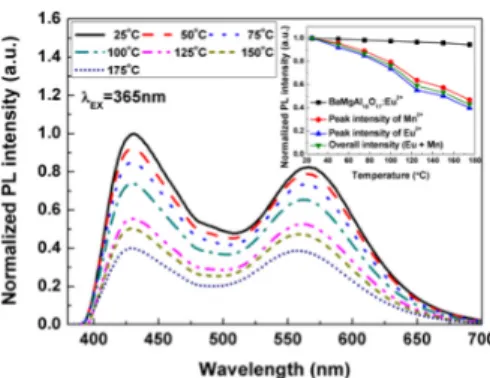
Fig. 9. PL spectra of NCASO:0.07Eu2+,0.20Mn2+ phosphor excited at 365 nm with different
temperatures. The inset shows the normalized PL intensity as a function of temperatures.
For high power LED applications, thermal stability of phosphor is one of the important parameter. Temperature-dependent emission spectra of NCASO:0.07Eu2+,0.20Mn2+ phosphor
under 365 nm excitation are indicated in Fig. 9. The inset displays the thermal quenching of Eu2+ and Mn2+ emission intensity in NCASO and that of commercial BaMgAl
10O17:Eu2+
phosphor (KEMK63/F-P1, Phosphor Technology Ltd). It can be seen that normalized PL peak intensity of Eu2+ and Mn2+ ions decreased to 74% and 79% of the initial value at 100 °C,
respectively (integrated intensity of NCASO: 0.07Eu2+,0.20Mn2+ phosphor decreased to
76%). Above 100 °C, the thermal quenching of NCASO:0.07Eu2+,0.20Mn2+ phosphor is
much significant. Also, compared to BaMgAl10O17:Eu2+ phosphor,
NCASO:0.07Eu2+,0.20Mn2+ phosphor shows lower thermal stability. These thermal
quenching phenomena can be explained by the help of configurational coordinate diagram. With increasing temperature, electron-phonon interaction is enhanced. Through phonon interaction, the excited luminescent center is thermally activated and subsequently released through cross-over between the excited state and ground state. As a result, the emission intensity decreases due to enhanced population density of phonon [33].
To better understand the thermal quenching phenomena, the thermal quenching data were fitted using the Arrhenius equation [34],
ln o ln - a B
I A E
I = k T
( ) (7)
where I0 and I(T) are the luminescence intensity of NCASO:0.07Eu2+,0.20Mn2+ (by
integrating the area of each spectrum) at room temperature and a given temperature, respectively, A is constant, Ea is the activation energy for thermal quenching, and kB is
Boltzmann’s constant (8.617 x 10⁻⁵ eV K−1). From the equation, we have obtained E
a of
Fig. 10. CIE chromaticity diagram for NCASO:Eu2+,yMn2+ phosphors (point A to H) excited at
365nm and the ideal white point (0.33, 0.33) depending on the different y value.
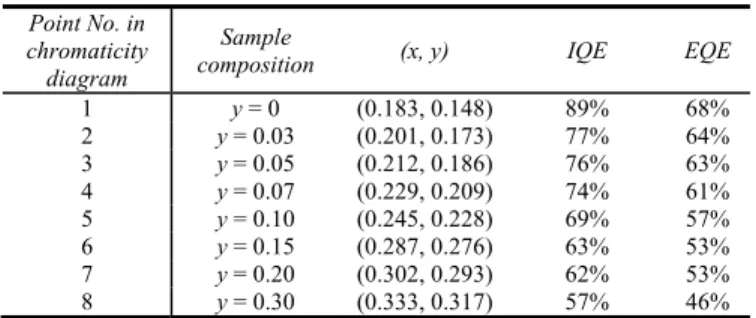
Table 2. Comparison of the CIE chromaticity coordinates (x, y), IQE and EQE for NCASO:0.07Eu2+,yMn2+ phosphors excited at 365nm
Point No. in chromaticity diagram
Sample
composition (x, y) IQE EQE 1 y = 0 (0.183, 0.148) 89% 68% 2 y = 0.03 (0.201, 0.173) 77% 64% 3 y = 0.05 (0.212, 0.186) 76% 63% 4 y = 0.07 (0.229, 0.209) 74% 61% 5 y = 0.10 (0.245, 0.228) 69% 57% 6 y = 0.15 (0.287, 0.276) 63% 53% 7 y = 0.20 (0.302, 0.293) 62% 53% 8 y = 0.30 (0.333, 0.317) 57% 46%
Table 2 reports the Commission Internationale de L’Eclairage (CIE) chromaticity coordinates, Internal Quantum Efficiency (IQE), and External Quantum Efficiency (EQE) of NCASO:Eu2+,yMn2+ phosphors excited at 365nm, which were calculated based on the
corresponding PL spectrum. Figure 10 represents the data in the CIE chromaticity diagram. The result shows that the emission color can be gradually modulated from blue to white by increasing the Mn2+ concentration from 0 to 0.30. In other words, it is possible to obtain both
blue emission from the Eu2+ ions and the orange emission from the Mn2+ ions in a single host
based on the energy transfer mechanism under 365nm excitation. In particular, the sample composition of NCASO:0.07Eu2+,0.30Mn2+ with CIE coordinates of (0.333, 0.317) shows the
warm white light with correlated color temperatures of 5469 K and is very close to ideal white point (0.333, 0.333). Thus, we can simply control the color of the phosphor and make the white light with a preferred CCT value through changing the Mn2+ doping concentration
so as to meet the requirements of practical lighting application.
In addition, the quantum efficiency (QE) of a phosphor is an important parameter for LED application. In order to determine the absolute quantum efficiency of photo conversion for phosphor, the internal quantum efficiencies (IQE, ηi) and external quantum efficiencies (EQE,
ηo) were calculated by using the following equations [35];
0 ( ) ( ) P d E d λ λ λ η λ λ λ =
(8)( ) [ ( )- ( )] i P d E R d λ λ λ η λ λ λ λ =
(9)where E(λ)/hν, R(λ)/hν, and P(λ)/hν are the number of photons in the spectrum of excitation, reflectance, and emission of the phosphor, respectively. The reflection spectrum of spectralon diffusive white standards is used for calibration (the reflectivity is nearly 100% in the range of 200-900 nm). Under 365 nm excitation, IQE and EQE of NCASO:Eu2+,yMn2+
phosphors are displayed in Table 2. The IQE and EQE of NCASO:Eu2+,yMn2+ phosphor
decrease from 89% to 57% and from 68% to 46%, respectively for an increase in y content from 0 to 0.3. The tendency shows that the QE decreases with increase of Mn2+ content. The
overall QEs can be enhanced through further optimization of the experimental condition and composition of phosphors.
4. Conclusion
In summary, we have successfully synthesized a new single-phased emission-tunable NCASO:Eu2+,Mn2+ phosphor. The phase formation of NCASO:Eu2+,Mn2+ was identified by
the XRD analysis. Under 365 nm excitation, the emission color can be easily tuned from blue to white by simply adjusting the Mn2+ content in the host lattice due to energy transfer from
Eu2+ to Mn2+ ions. An efficient energy transfer was inferred from the changes in relative
intensity of blue and orange emission from Eu2+ and Mn2+ respectively and was identified as
electric dipole-dipole mechanism. Finally, a warm-white-light emission with CIE coordinates of (0.333, 0.317) and CCT of 5469 K was realized in NCASO:0.07Eu2+,0.30Mn2+ phosphor
under 365 nm excitation. Thus, the obtained phosphor has been proven to be potentially useful as a single-phased white- emitting phosphor for UV-LEDs.
Acknowledgments