저작자표시-비영리-변경금지 2.0 대한민국 이용자는 아래의 조건을 따르는 경우에 한하여 자유롭게
l 이 저작물을 복제, 배포, 전송, 전시, 공연 및 방송할 수 있습니다. 다음과 같은 조건을 따라야 합니다:
l 귀하는, 이 저작물의 재이용이나 배포의 경우, 이 저작물에 적용된 이용허락조건 을 명확하게 나타내어야 합니다.
l 저작권자로부터 별도의 허가를 받으면 이러한 조건들은 적용되지 않습니다.
저작권법에 따른 이용자의 권리는 위의 내용에 의하여 영향을 받지 않습니다. 이것은 이용허락규약(Legal Code)을 이해하기 쉽게 요약한 것입니다.
Disclaimer
저작자표시. 귀하는 원저작자를 표시하여야 합니다.
비영리. 귀하는 이 저작물을 영리 목적으로 이용할 수 없습니다.
변경금지. 귀하는 이 저작물을 개작, 변형 또는 가공할 수 없습니다.
Master ’ s Thesis of Rehabilitation Medicine
Sarcopenia is an independent risk factor for dysphagia in community-
dwelling older adults
지역사회 거주 노인에서 근감소증이 연하곤란에 미치는 영향
February 2019
Graduate School of Medicine Seoul National University Rehabilitation Medicine Major
Seungwoo Cha
지역사회 거주 노인에서 근감소증이 연하곤란에 미치는 영향
지도 교수 백 남 종
이 논문을 의학석사 학위논문으로 제출함.
2018년 10월
서울대학교 대학원 의학과 재활의학 전공
차 승 우
차승우의 의학석사 학위논문을 인준함 2018년 12월
위 원 장 (인)
부위원장 (인)
위 원 (인)
i
Abstract
Introduction: Dysphagia is common in older adults and associated with increased socioeconomic burdens. Recently, sarcopenia is considered to be a possible contributor for dysphagia. The purpose of this study is to investigate association of dysphagia with sarcopenia in a geriatric population in Korea.
Methods: This is a cross-sectional study using data from the Korean Longitudinal Study on Health and Aging (KLoSHA). Community- dwelling men and women aged 65-year and older without common causes of dysphagia in Seongnam City, Korea were included (N = 236). Dysphagia was screened using Standardized Swallowing Assessment. Appendicular skeletal muscle mass was calculated by dual-energy X-ray absorptiometry. Grip strength and long-distance corridor walk were assessed.
Results: Of 236 subjects, 54 (22.9%) showed dysphagia and 38 (16.1%) showed sarcopenia. Fourteen (5.9%) participants were diagnosed with sarcopenic dysphagia. In multiple logistic regression analysis for dysphagia, sarcopenia was the only significant variable with odds ratio of 2.584 (95% confidence interval: 1.074 – 6.218).
Conclusion: Sarcopenia was associated with increased risk of dysphagia in community dwelling older adults having no common causes of dysphagia even after adjusting for possible confounders. A prospective study with a larger sample size is needed to reveal their causal relationship in the future.
Keyword: sarcopenia; deglutition; deglutition disorders; aged; older adults
Student number: 2017-25601
ii
Table of Contents
Introduction... (1)
Methods ... (3)
Results ... (7)
Discussion ... (10)
Conclusion ... (13)
Reference... (14)
Abstract in Korean ... (18)
i
List of Tables and Figures
Tables
Table 1 Baseline characteristics of subjects ... (8) Table 2 Forced entry logistic regression analysis for dysphagia ... (9)
Figures
Figure 1 Patient flow... (9)
1
Introduction
Dysphagia is one of the common symptoms among older adults.
Overall prevalence of dysphagia in community-dwelling older adults is about 15%, ranging from 5% to 72% [1]. In Korea, the prevalence was about 33.7% [2]. Dysphagia increases the risk of aspiration pneumonia and choking that can lead to hospital admission or even death. It increases socioeconomic burdens and reduces quality of life of patients substantially [3,4]. Therefore, timely diagnosis and treatment including swallowing rehabilitation and diet modification are important. Although common causes of dysphagia in older adults include neurological diseases (such as stroke, Parkinson’s disease, and Alzheimer disease) and chronic illnesses such as chronic obstructive lung disease [5,6], the exact causes of dysphagia are unclear in many cases [7].
In recent years, it has been suggested that sarcopenia may be closely associated with dysphagia in the elderly population [8,9].
Sarcopenia is characterized by progressive and generalized loss of skeletal muscles. It is recognized as an independent condition with an ICD-10-CM code [10]. Sarcopenia is diagnosed when low skeletal muscle mass with either muscle weakness or poor physical performance is apparent [11]. Kuroda et al. [12] used the term
‘sarcopenic dysphagia’ first. Since then, several Japanese studies have suggested that dysphagia is significantly associated with sarcopenia in older adults [13–15]. However, these studies included older adults staying in hospital or other facilities which might increase the risk of selection bias. In addition, subjects with cognitive dysfunction or chronic illnesses related to dysphagia were also included, making it difficult to define pure sarcopenic dysphagia.
2
Therefore, the objective of this study was to investigate the association of sarcopenia with dysphagia in community-dwelling older adults without common causes of dysphagia using data from the Korean Longitudinal Study on Health and Aging (KLoSHA).
3
Methods
Study population
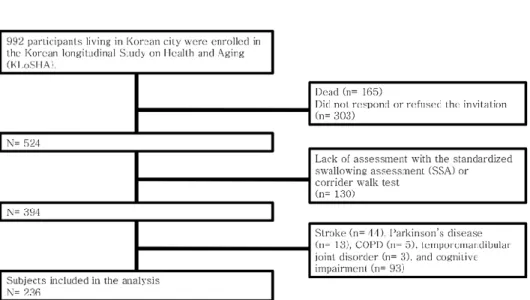
This study was a part of the KLoSHA, a population-based, prospective cohort study on health status and common geriatric diseases in elderly Koreans [16]. At baseline, 992 participants living in Seongnam City were enrolled from September 2005 to September 2006. At the first follow-up period from May 2010 to March 2012, 165 participants died while 303 participants did not respond or agree to the invitation for follow-up assessment. Of the remaining 524 participants, 130 participants who were not assessed by standardized Swallowing Assessment (SSA) or corridor walk test were excluded.
Participants with history of diseases (stroke, n = 44; Parkinson’s disease, n = 13; chronic obstructive pulmonary disease, n = 5;
temporomandibular joint disorder, n = 3; cognitive impairment, n = 93) that could cause dysphagia were excluded. Thus, 236 participants were included for analysis in this study (Figure 1). Mini Mental Status Examination (MMSE) was used for global cognition measurement [17]. Cognitive impairment was defined as MMSE score of less than 23 which was corrected according to education level. No patient had a history of head and neck cancer.
Dysphagia Assessment
Swallowing was assessed using the Standardized Swallowing Assessment (SSA) [18]. We used the Korean version of SSA which has been validated in nursing home setting [19]. The SSA consists of three sections. In the first section, levels of alertness, responsiveness, and availability of upright position with head control were evaluated. In the second section, voluntary cough, salivary
4
management, ability to lick top and bottom lips, respiratory function, and vocal quality were assessed. If all items in sections 1 and 2 were passed, the participant underwent examination for section 3. A spoon of water (5 ml) was tried three consecutive times followed by a trial of a half glass of water (about 120 ml). Coughing, choking, breathlessness during swallowing, and wet voice after swallowing were considered as abnormal findings. An overall judgment of swallowing safety was made by a trained occupational therapist.
Participants who showed any abnormalities in these three sections were categorized to the dysphagia group.
Sarcopenia Assessment
Sarcopenia was defined by low hand grip strength, low skeletal muscle mass, and low physical performance, which corresponded to
‘severe sarcopenia’ according to the revised European Working Group on Sarcopenia in Older People (EWGSOP2) guidelines [20].
Cut-off values were determined according to the Asian Working Group for Sarcopenia diagnostic criteria [21]. Handgrip strength of the dominant hand was measured using a digital grip strength dynamometer (Sammons Preston, Bolingbrook, IL, USA). Two consecutive attempts with one-minute interval were performed in a neutral position of the arm, forearm, and wrist. The Asian Working Group for Sarcopenia cut-off values for handgrip strength were < 26 kg for men and < 18 kg for women.
Muscle mass was measured with a dual-energy X-ray absorptiometry (Lunar Corporation, Madison, WI, USA). Muscle mass of the four extremities was defined as appendicular skeletal muscle mass (ASM). Skeletal muscle ma2ss index (SMI) was defined as ASM/height2 (kg/m2). Cut-off values of SMI for men and women
5
were 7.0 kg/m2 and 5.4 kg/m2, respectively.
Physical performance was assessed by long-distance corridor walk.
Participants were instructed to walk 400 m in a hall way without running at a pace they could maintain. The cut-off value of 362 seconds was used according to the study of Newman et al. [22]. If participants failed to complete the test or took more than 362 seconds, they were classified as having low physical performance.
Other variables
As functional assessment tools, the Korean ADL (K-ADL) scale for basic activities and the Korean Instrumental ADL (K-IADL) scale for instrumental activities were used [23]. K-ADL consisted of seven domains (dressing, washing face and hands, bathing, eating, performing transfers, toileting, and continence) while K-IADL consisted of ten domains (grooming, doing housework, preparing meals, doing laundry, taking a short trip, using transportation, shopping, managing money, using a telephone, and taking medicine).
K-ADL and K-IADL ranged from 7 to 21 points and 10 to 37 points, respectively, with lower score indicating more independent state.
Participants answered questionnaires with the aid of trained nurses.
The geriatric quality of life scale (G-QOL) [24] was used to assess quality of life. It consisted of 25 items assessing physical and psychological health, independence, relationship, environment, religions, and global quality of life. Each item was scored from 1 (not satisfactory) to 4 (fully satisfactory). Total score ranged from 25 (no quality of life) to 100 (perfect quality of life).
Past medical history of hypertension and diabetes was evaluated using self-reported questionnaires. Smoking and alcohol history were also assessed. Subjects who were currently smoking (those
6
who answered “Yes” to the question “Are you currently smoking?”) were defined as smokers. Alcohol intake was calculated by adding total number of standard drinking units (one bottle of beer, one glass of wine, or one unit of Soju (a clear distilled liquor that is popular in Korea), approximately equivalent to 10 g of ethanol) per month.
Regular exercise was defined as moderate to vigorous physical activity for more than 30 minutes at least three times a week.
Calcium, albumin, total cholesterol, and low-density lipoprotein cholesterol levels were measured enzymatically using an autoanalyzer (Hitachi 747; Hitachi, Ltd, Tokyo, Japan). Serum total 25[OH]D concentration was measured using Diels-Alder derivatization and ultrahigh performance liquid chromatography- tandem mass spectrometry (Waters, Milford, MA, USA). High sensitivity C-reactive protein (hsCRP) was measured by immunoradiometry.
Statistical analyses
Demographic data are reported as mean ± standard deviation (SD) or number (percentages). Differences were analyzed using Welch’s t-test for continuous variables and Chi-square test for categorical variables. Multivariate logistic regression analysis was performed to determine variables that were independently associated with the presence of dysphagia. Variables with p < 0.25 in univariate analysis as well as age and gender were entered into the regression model for multivariate analysis. Effect sizes were expressed as odds ratios (ORs) with 95% confidence intervals (CIs). Two-sided p values <
0.05 were deemed to be statistically significant. All analyses were performed using IBM SPSS Statistics V21.0 (Armonk, NY, USA).
7
Results
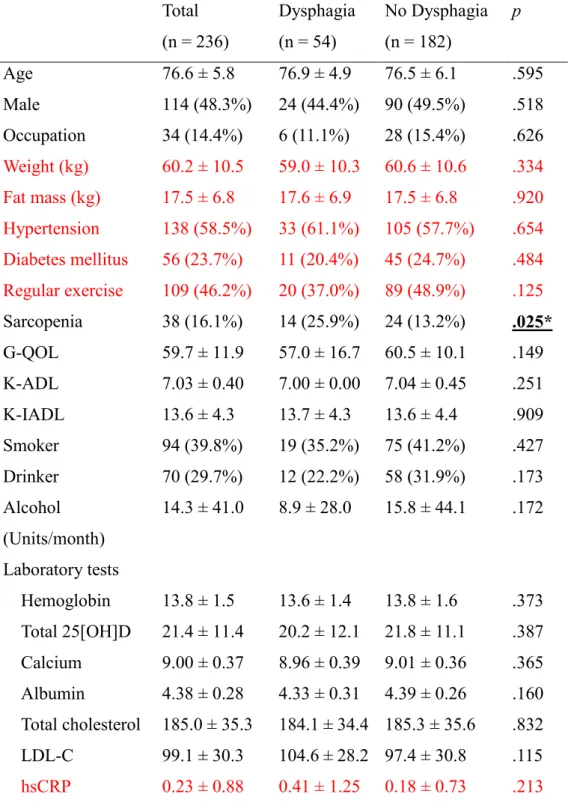
Baseline characteristics of study subjects are presented in Table 1.
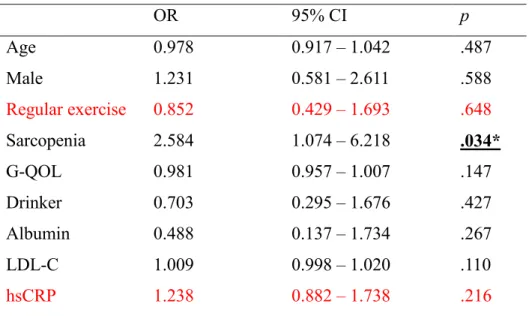
Mean age of subjects was 76.6 years. Of 236 subjects, 114 (48.3%) were males. Fifty-four (22.9%) participants showed dysphagia and 38 (16.1%) participants were diagnosed with sarcopenia. Fourteen (5.9%) subjects had sarcopenia and dysphagia simultaneously (or sarcopenic dysphagia). Subjects with dysphagia showed more sarcopenia than subjects without dysphagia (25.9% vs. 13.2%). G- QOL of participants with dysphagia was lower than that of participants without dysphagia (57.0 vs. 60.5), although the difference between the two was not statistically significant. In forced entry logistic regression analysis, sarcopenia was the only significant risk factor for dysphagia, with an odds ratio of 2.584 (95% confidence interval: 1.074 – 6.218) (Table 2).
8
Table 1. Baseline characteristics of subjects
Total
(n = 236)
Dysphagia (n = 54)
No Dysphagia (n = 182)
p
Age 76.6 ± 5.8 76.9 ± 4.9 76.5 ± 6.1 .595
Male 114 (48.3%) 24 (44.4%) 90 (49.5%) .518 Occupation 34 (14.4%) 6 (11.1%) 28 (15.4%) .626 Weight (kg) 60.2 ± 10.5 59.0 ± 10.3 60.6 ± 10.6 .334 Fat mass (kg) 17.5 ± 6.8 17.6 ± 6.9 17.5 ± 6.8 .920 Hypertension 138 (58.5%) 33 (61.1%) 105 (57.7%) .654 Diabetes mellitus 56 (23.7%) 11 (20.4%) 45 (24.7%) .484 Regular exercise 109 (46.2%) 20 (37.0%) 89 (48.9%) .125 Sarcopenia 38 (16.1%) 14 (25.9%) 24 (13.2%)
.025*G-QOL 59.7 ± 11.9 57.0 ± 16.7 60.5 ± 10.1 .149 K-ADL 7.03 ± 0.40 7.00 ± 0.00 7.04 ± 0.45 .251 K-IADL 13.6 ± 4.3 13.7 ± 4.3 13.6 ± 4.4 .909 Smoker 94 (39.8%) 19 (35.2%) 75 (41.2%) .427 Drinker 70 (29.7%) 12 (22.2%) 58 (31.9%) .173 Alcohol
(Units/month)
14.3 ± 41.0 8.9 ± 28.0 15.8 ± 44.1 .172
Laboratory tests
Hemoglobin 13.8 ± 1.5 13.6 ± 1.4 13.8 ± 1.6 .373 Total 25[OH]D 21.4 ± 11.4 20.2 ± 12.1 21.8 ± 11.1 .387 Calcium 9.00 ± 0.37 8.96 ± 0.39 9.01 ± 0.36 .365 Albumin 4.38 ± 0.28 4.33 ± 0.31 4.39 ± 0.26 .160 Total cholesterol 185.0 ± 35.3 184.1 ± 34.4 185.3 ± 35.6 .832 LDL-C 99.1 ± 30.3 104.6 ± 28.2 97.4 ± 30.8 .115 hsCRP 0.23 ± 0.88 0.41 ± 1.25 0.18 ± 0.73 .213
* denotes statistical significance.
G-QOL: the geriatric quality of life scale; ADL: the Korean activity of daily living scale; K-IADL: the Korean instrumental activity of daily living scale; LDL-C: low
9 density lipoprotein cholesterol.
Table 2. Forced entry logistic regression analysis for dysphagia
OR 95% CI
pAge 0.978 0.917 – 1.042 .487
Male 1.231 0.581 – 2.611 .588
Regular exercise 0.852 0.429 – 1.693 .648
Sarcopenia 2.584 1.074 – 6.218
.034*G-QOL 0.981 0.957 – 1.007 .147
Drinker 0.703 0.295 – 1.676 .427
Albumin 0.488 0.137 – 1.734 .267
LDL-C 1.009 0.998 – 1.020 .110
hsCRP 1.238 0.882 – 1.738 .216
* denotes statistical significance.
G-QOL: the geriatric quality of life scale; LDL-C: low density lipoprotein cholesterol.
Figure 1. Study flow
10
Discussion
This study showed that sarcopenia was an independent risk factor for dysphagia in Korean older adults living in the community without common causes of dysphagia. The risk for dysphagia was 2.6 times higher in participants with sarcopenia compared to that in those without sarcopenia (Table 2). The prevalence of dysphagia was 22.9%
and that of sarcopenic dysphagia was 5.9%. The total number of subjects with dysphagia regardless of underlying diseases was 131.
Of these subjects, only 77 (58.8%) had related etiologies (25 with stroke, 6 with Parkinson’s disease, 2 with COPD, 3 with temporomandibular joint disorder, and 41 with cognitive impairment).
This suggests that the chance to meet elderly patients with dysphagia without common etiology is relatively high in geriatric care and the need to evaluate sarcopenia in this population.
Few studies have investigated the underlying mechanism of sarcopenic dysphagia. Maeda et al. [25] have suggested that generalized sarcopenia may cause impaired swallowing function by decreased tongue pressure. In addition, changes of musculature associated with swallowing mechanism accompanied by aging including decreased muscle mass of masseter and tongue, increased fatty infiltration, and atrophied type I fiber have been suggested as possible pathophysiology of dysphagia in older adults [8,26]. When these changes of swallowing related musculature are combined with physical inactivity, chronic illness, or malnutrition (aggravating factors for sarcopenic dysphagia) which is common in older adults, the chance of dysphagia occurrence could increase [9].
Considering possible mechanisms of sarcopenic dysphagia, strategies to improve the strength and function of swallowing related
11
musculature including tongue resistance exercise program, Shaker exercise, and chin tuck resistance exercise could be provided as treatment options [27,28]. To overcome the effect of aggravating factors on sarcopenic dysphagia such as physical inactivity and malnutrition, interventions to increase skeletal muscle mass including resistance training and essential amino acid supplementation could be recommended [29]. Oral care and food modification should also be taken into account to reduce adverse events associated with sarcopenic dysphagia such as aspiration pneumonia [30]. If all these treatments are offered comprehensively, sarcopenic dysphagia could improve and its related complication could decrease. Although Maeda et al. [31] have reported that sarcopenic dysphagia could be improved with comprehensive rehabilitation approach including nutritional support, clinical trials are needed to prove the efficacy of possible suggested interventions for sarcopenic dysphagia.
This study has several limitations. First, dysphagia was evaluated by one screening tool, SSA. Although test such as video fluoroscopic swallowing study makes it possible to diagnose dysphagia more accurately, it has disadvantages of high cost, time, and radiation. SSA evaluates both symptoms and signs of dysphagia. It has been validated as a good screening tool for dysphagia [32]. Second, the prevalence of sarcopenic dysphagia in this study (5.9%) was lower than that reported in the previous studies (ranging from 26 to 42.3%) [15,25,33]. This higher prevalence of sarcopenic dysphagia in previous studies could be due to different study population (institutionalized older adults). It is well-known that the prevalence of dysphagia is much higher in hospitalized or nursing homes [34]. In contrast, only community dwelling older adults without common causes of dysphagia were included in this study. Subjects in this
12
study showed independent activity with near normal ADL and IADL scores (Table 1). Considering that the prevalence of dysphagia in community-dwelling elderly was about 15% [1], the prevalence of sarcopenic dysphagia at about 6% in our study might be appropriate for community dwelling independent older adults. Third, since this study was cross-sectional, the causal relationship between sarcopenia and dysphagia could not be evaluated.
13
Conclusion
Among 236 community-dwelling older adults without common causes of dysphagia, 23% showed dysphagia and 6% showed sarcopenic dysphagia. Sarcopenia was associated with increased risk of dysphagia in these subjects. Due to the cross-sectional nature and small sample size of this study, a prospective cohort study with a larger sample size is needed to reveal their causal relationship. An interventional study is also needed to improve dysphagia in such sarcopenic dysphagia population in the future.
14
Reference
1. Madhavan A, Lagorio LA, Crary MA, Dahl WJ, Carnaby GD (2016) Prevalence of and risk factors for dysphagia in the community dwelling elderly: A systematic review. J Nutr Health Aging. 20(8):806–15.
2. Yang EJ, Kim MH, Lim J, Paik NJ (2013) Oropharyngeal Dysphagia in a Community-Based Elderly Cohort: the Korean Longitudinal Study on Health and Aging. J Korean Med Sci.
28(10):1534-9.
3. Cabré M, Serra-Prat M, Force L, Almirall J, Palomera E, Clavé P (2014) Oropharyngeal dysphagia is a risk factor for readmission for pneumonia in the very elderly persons: Observational prospective study. J Gerontol - Ser A Biol Sci Med Sci. 69(3):330–7.
4. Ekberg O, Hamdy S, Woisard V, Wuttge-Hannig A, Ortega P (2002) Social and psychological burden of dysphaiga: its impact on diagnosis and treatment. Dysphagia. 17(2):139–46.
5. Roy N, Stemple J, Merrill RM, Thomas L (2007) Dysphagia in the elderly: Preliminary evidence of prevalence, risk factors, and
socioemotional effects. Ann Otol Rhinol Laryngol. 116(11):858–65.
6. Suh MK, Kim H, Na DL (2009) Dysphagia in patients with
dementia: Alzheimer versus vascular. Alzheimer Dis Assoc Disord.
23(2):178–84.
7. Yeom J, Song YS, Lee WK, Oh BM, Han TR, Seo HG (2016) Diagnosis and clinical course of unexplained dysphagia. Ann Rehabil Med. 40(1):95–101.
8. Wakabayashi H (2014) Presbyphagia and Sarcopenic Dysphagia : Association Between Aging , Sarcopenia , and Deglutition Disorders.
J Frailty Aging. 3(2):97–103.
15
9. Sakai K, Sakuma K (2017) Sarcopenic Dysphagia as a New Concept. Frailty Sarcopenia - Onset, Dev Clin Challenges.
IntechOpen. https://doi.org/10.5772/intechopen.68791.
10. Anker SD, Morley JE, von Haehling S (2016) Welcome to the ICD-10 code for sarcopenia. J Cachexia Sarcopenia Muscle.
7(5):512–4.
11. Cruz-Jentoft AJ, Baeyens JP, Bauer JM, Boirie Y, Cederholm T, Landi F, et al (2010) Sarcopenia: European consensus on definition and diagnosis. Age Ageing. 39(4):412–23.
12. Kuroda Y, Kuroda R (2012) Relationship Between Thinness and Swallowing Function in Japanese Older Adults: Implications for Sarcopenic Dysphagia. J Am Geriatr Soc. 60(9):1785–6.
13. Shiozu H, Higashijima M, Koga T (2015) Association of sarcopenia with swallowing problems, related to nutrition and activities of daily living of elderly individuals. J Phys Ther Sci.
27(2):393–6.
14. Wakabayashi H, Matsushima M, Uwano R, Watanabe N, Oritsu H, Shimizu Y (2015) Skeletal muscle mass is associated with
severe dysphagia in cancer patients. J Cachexia Sarcopenia Muscle.
6(4):351–7.
15. Maeda K, Akagi J (2016) Sarcopenia is an independent risk factor of dysphagia in hospitalized older people. Geriatr Gerontol Int. 16(4):515–21.
16. Park JH, Lim J (2007) An Overview of the Korean Longitudinal Study on Health and Aging. Mov Disord. 4(2):84.
17. Lee DY, Lee KU, Lee JH, Kim KW, Jhoo JH, Kim SY, et al (2004) A normative study of the CERAD neuropsychological assessment battery in the Korean elderly. J Int Neuropsychol Soc.
10(1):72–81.
16
18. Perry L (2001) Screening swallowing function of patients with acute stroke. Part two: Detailed evaluation of the tool used by nurses. J Clin Nurs. 10(4):474–81.
19. Park YH, Han HR, Oh S, Chang H (2014) Validation of the
Korean Version of the Standardized Swallowing Assessment Among Nursing Home Residents. J Gerontol Nurs. 40(2):26-35.
20. Cruz-Jentoft AJ, Bahat G, Bauer J, Boirie Y, Bruyère O,
Cederholm T, et al (2018) Sarcopenia: revised European consensus on definition and diagnosis. Age Ageing.
https://doi.org/10.1093/ageing/afy169. [Epub ahead of print]
21. Chen LK, Liu LK, Woo J, Assantachai P, Auyeung TW, Bahyah KS, et al (2014) Sarcopenia in Asia: Consensus report of the Asian working group for sarcopenia. J Am Med Dir Assoc. 15(2): 95–101.
22. Newman AB, Simonsick EM, Naydeck BL, Boudreau RM, Kritchevsky SB, Nevitt MC, et al (2006) Association of long- distance corridor walk performance with mortality, cardiovascular disease, mobility limitation, and disability. J Am Med Assoc.
295(17):2018–26.
23. Kang S, Choi S, Lee B, Kwon J (2002) The reliability and validity of the Korean Instrumental Activities of Daily Living (K- IADL). J Korean Neurol Assoc. 20(1):8–14.
24. Lee HS, Kim DK, Ko HJ, Ku HM, Kwon EJ, Kim JH (2003) The Standardization of “Geriatric Quality of Life scale.” Korean J Clin Psychol. 22(4):859–81.
25. Maeda K, Akagi J (2015) Decreased Tongue Pressure is Associated with Sarcopenia and Sarcopenic Dysphagia in the Elderly. Dysphagia. 30(1):80–7.
26. Humbert IA, Robbins JA (2008) Dysphagia in the elderly. Phys Med Rehabil Clin N Am. 19(4):853-66.
17
27. Yoon WL, Khoo JKP, Liow SJR (2014) Chin tuck against resistance (CTAR): New method for enhancing suprahyoid muscle activity using a shaker-type exercise. Dysphagia. 29(2):243–8.
28. Robbins J, Gangnon RE, Theis SM, Kays SA, Hewitt AL, Hind JA (2005) The effects of lingual exercise on swallowing in older adults. J Am Geriatr Soc. 53(9):1483–9.
29. Cruz-Jentoft AJ, Landi F, Schneider SM, Zúñiga C, Arai H, Boirie Y, et al (2014) Prevalence of and interventions for sarcopenia in ageing adults: A systematic review. Report of the International Sarcopenia Initiative (EWGSOP and IWGS). Age Ageing. 43(6):748–59.
30. Marik PE, Kaplan D (2003). Aspiration pneumonia and dysphagia in the elderly. Chest. 124(1):328–36.
31. Maeda K, Akagi J (2016) Treatment of Sarcopenic Dysphagia with Rehabilitation and Nutritional Support: A Comprehensive Approach. J Acad Nutr Diet. 116(4):573–7.
32. Park YH, Bang HL, Han HR, Chang HK (2015) Dysphagia Screening Measures for Use in Nursing Homes: A Systematic Review. J Korean Acad Nurs. 45(1):1-13.
33. Maeda K, Takaki M, Akagi J (2017) Decreased Skeletal Muscle Mass and Risk Factors of Sarcopenic Dysphagia: A Prospective Observational Cohort Study. J Gerontol - Ser A Biol Sci Med Sci.
72(9):1290–4.
34. Clavé P, Shaker R (2015) Dysphagia: Current reality and scope of the problem. Nat Rev Gastroenterol Hepatol. 12(5):259–70.
18
국문 초록
소개: 연하곤란은 노인에서 흔하며 사회경제학적인 문제와 밀접한 관련을 가지고 있다. 최근, 근감소증이 연하곤란에 중요하게 기여하는 것으로 생각되고 있다. 이번 연구의 목적은 한국 노인 인구를 대상으로 연하곤란과 근감소증의 상관관계를 분석하는 것이다.
방법: 이 연구는 단면조사 연구로서, 성남시에 거주하는 65세 이상의 노인을 대상으로 하는 코호트 (the Korean Longitudinal Study on Health and Aging, KLoSHA)의 정보를 기반으로 분석하였다. 코호트에 포함된 노인 중 연하곤란과 관련된 흔한 질환 (뇌졸중, 파킨슨병, 만성폐쇄성폐질환, 턱관절장애, 인지장애)을 가진 환자들은 제외되어 총
236명이 연구에 포함되었다. 연하곤란은 표준화 연하 평가
(Standardized swallowing assessment)를 이용하여 정의하였고, 근육량은 dual-energy X-ray absorptiometry로 측정하였다. 악력 및 보행능력 평가도 시행하였다.
결과: 236명 중에서 54명 (22.9%)이 연하곤란을 보였고, 38명 (16.1%)이 근감소증을 보였다. 14명 (5.9%)은 연하곤란과 근감소증을 동시에 보였다. 다변량 로지스틱 회귀분석에서 근감소증은 연하곤란과 유의미한 상관관계를 보이는 유일한 변수로 나타났다 (Odds ratio 2.584 with confidence interval of 1.074 – 6.218)
결론: 근감소증은 기저질환이 없는 지역사회 거주 노인에서 연하곤란과 밀접한 상관관계를 보였다. 추후 인과관계를 밝히기 위한 전향적인 코호트 연구가 필요할 것이다.
주요어: 근감소증; 연하; 연하곤란; 노인 학번: 2017-25601