저작자표시-비영리-변경금지 2.0 대한민국 이용자는 아래의 조건을 따르는 경우에 한하여 자유롭게
l 이 저작물을 복제, 배포, 전송, 전시, 공연 및 방송할 수 있습니다. 다음과 같은 조건을 따라야 합니다:
l 귀하는, 이 저작물의 재이용이나 배포의 경우, 이 저작물에 적용된 이용허락조건 을 명확하게 나타내어야 합니다.
l 저작권자로부터 별도의 허가를 받으면 이러한 조건들은 적용되지 않습니다.
저작권법에 따른 이용자의 권리는 위의 내용에 의하여 영향을 받지 않습니다. 이것은 이용허락규약(Legal Code)을 이해하기 쉽게 요약한 것입니다.
Disclaimer
저작자표시. 귀하는 원저작자를 표시하여야 합니다.
비영리. 귀하는 이 저작물을 영리 목적으로 이용할 수 없습니다.
변경금지. 귀하는 이 저작물을 개작, 변형 또는 가공할 수 없습니다.
외교학석사 학위논문
Intra-Legislative Motives or Constituency Preferences?
The Domestic Politics of Human Rights Foreign Policy
2019 년 2 월
서울대학교 대학원
정치외교학부 외교학전공
배 수 현
Intra-Legislative Motives or Constituency Preferences?
The Domestic Politics of Human Rights Foreign Policy
지도 교수 이 옥 연
이 논문을 외교학석사 학위논문으로 제출함
2019 년 2 월
서울대학교 대학원
정치외교학부 외교학전공
배 수 현
배수현의 외교학석사 학위논문을 인준함
2019 년 2 월
위 원 장 박 종 희 (인)
부위원장 한 규 섭 (인)
위 원 이 옥 연 (인)
Abstract
In less salient international issue areas, do legislators care more about intra-legislative motives or citizens preferences when engaging in legislative activity? Exploring the cosponsorship data of 440 legislators of the 108th House of Representatives from 2003-2005, this paper tests the effect of ideological homophily, measured as the absolute distance between a pair of legislators’ DW-nominate scores, and ideological extremism on legislators’
propensity to cosponsor together. Cosponsoring is mainly a relational action for enabling legislators’ express their support on the legislation’s issue, but also to signal support or ties to another legislator. While previous literature emphasizes position-taking motivations for cosponsoring, this paper seeks to examine intra-legislative motivations focusing on legislator preferences and relationships by employing a dyadic-level analysis.
The results demonstrate that one unit change in ideological distance in the first dimension decreases the odds of cooperating by 76%. Results confirm the positive association among ideological extremism, the majority party membership, and higher participation in cosponsorships. In the individual-level analysis, if the legislator was an ethnic minority, a member of the minority party, and had low unemployment levels in his or her district,
such conditions increased cosponsorship participation. More so than constituency interests, influence in Congress measured by seniority and leadership positions positively affected sponsorship decisions. However, in the dyadic analysis, district-level demographics, such as gay population and unemployment levels, significantly explained both cosponsorship and sponsorship cooperation to a greater degree than ideological homophily or institutional influence. Results imply that dyadic cosponsoring behavior is a motive of both extra- and intra-legislative motivations.
Keyword : Ideological Homophily, U.S. Congress, Cosponsorship, Sponsorship, Legislative Behavior, Intra-legislative Motivations, Human Rights Foreign Policy
Student Number : 2016-20125
Table of Contents
Chapter 1. Introduction... 1
Chapter 2. Literature Review ... 5
2.1. The Electoral Connection of Sponsor-Cosponsorships ... 5
2.2. Domestic Politics in International Relations... 16
Chapter 3. Research Design... 27
3.1. Individual-Level Model Variables ... 33
3.2. Dyad-Level Model Hypotheses and Variables ... 37
3.3. Statistical Model ... 48
Chapter 4. Empirical Analyses ... 51
4.1. Individual-Level Analysis ... 51
4.2. Dyad-Level Analysis ... 58
Chapter 5. Conclusion ... 72
5.1. Summary of Findings ... 72
5.2. Further Improvements ... 75
References ... 77
Appendix ... 87
국문초록 ... 95
List of Figures
Figure 1. Histogram of Sponsor-Cosponsorship Count Data for the 108th Congress ... 3 Figure 2. Human Rights Foreign Policy Legislation in the House and
Senate (1972-2016) ... 28 Figure 3. Plot of sponsorship count and absolute 1st dimension DW-
Nominate scores (left).
Plot and regression line of cosponsorship count and absolute 1st dimension DW-Nominate scores (right) ... 39 Figure 4. Plot and regression line of relationship between sponsorship (left)
or cosponsorship count (right) and absolute value of
congressman’s ideological distance from the House median ... 39 Figure 5. Ideal point locations of 108th Congress (left) and only ideal point
locations of Sponsors of human rights bills (right) ... 41 Figure 6. Sponsorship-Cosponsorship Count Histogram ... 49
List of Tables
Table 1. Individual-level Model Dependent Variables ... 33
Table 2. Individual-level Model Independent Variables ... 35
Table 3. Dyad Model Dependent Variables ... 42
Table 4. Dyad Model Between-Dyads Variables ... 44
Table 5. Dyad Model Within-Dyads Variables ... 47
Table 6. Individual-level Model Negative Binomial Regression Results . 53 Table 7. List of Top Twenty Cosponsors and Sponsors ... 56
Table 8. Logistic Regression for Cooperation Dependent Variable and Between-Dyads Variables ... 59
Table 9. Logistic Regression for Undirected Cooperation and Ideology Variables ... 63
Table 10. Logistic Regression for Directed Cooperation and Ideology Variables ... 65
Table 11. Model of Logistic Regression for Undirected Cooperation ... 87
Table 12. Model of Logistic Regression for Directed Cooperation ... 91
Chapter 1. Introduction
It is not a mystery that legislators endeavor to represent constituent interests in roll-call votes and cosponsorships. As the crux of representative democracy, members of Congress (MCs) are elected by their local constituents and thereby serve for the interest of their constituencies (Kingdon 2007). Although extensive literature exists in examining the electoral connection, the more interesting question lies in the conditions under which legislators’ other motivations may trump constituency preferences, such as intra-legislative relationships or legislators’ ideological preferences. In general, previous literature focuses on high salience issues, whereas one focus of this research lies in uncovering legislative behavior surrounding less salient issues among the domestic pork-barreling agendas.
This paper focuses on the extent to which ideological homophily between a pair of legislators explains member cooperation by controlling for constituency preferences in the case of human rights foreign policy legislation. The logic behind hypothesizes that legislators have more freedom to act according to their preferences due to the constituents’ lack of vigilance towards human rights foreign policy position-taking.
In the vein of literature delving into domestic explanations for international politics and foreign policy behavior, this paper is concerned with the causal mechanism between legislative behavior and national foreign policy. This research places itself within a macroscopic question regarding citizen preferences and democratic accountability at the subnational level, where it endeavors to place a stepping stone in the microscopic foundation on U.S. legislative behavior and democratic accountability. Working at the legislative level contains difficulties in clearly drawing on causal relationships with foreign policy behavior, but it is an attempt to sketch how the electoral connection could be viewed in relation to human rights foreign policy, and a novel approach from previous literature focusing mainly on presidential leadership.
The issue selection on human rights foreign policy stemmed from U.S.
incompliance to human rights treaties. America stands nearly alone among Western democracies in failing to ratify the major international treaties on discrimination against women, rights of the child, socioeconomic rights, persons with disabilities’ rights, and migrant worker’s rights (Moravcsik 2005, 148; United Nations Human Rights Office of the High Commissioner 2017). This paradox of non-compliance is heightened by its historical advocacy of human rights and unilateral efforts to promote freedom and
democracy. In explaining the double standard of human rights, essentially meaning that a human rights standard applicable to the U.S. and another standard for the rests of the world exist separately, academics have turned to the idea of American exceptionalism (Forsythe 1990; Moravcsik 2001; Koh 2003; Ignatieff 2005).
As an endeavor to contribute to understanding the paradoxical puzzle of America’s human rights foreign policy, especially during the War on Terror, this study seeks to examine the domestic mechanisms and motivations of Congress members in proposing and cosponsoring human rights legislation in foreign policy. From 2003-2005, during the George W. Bush administration in the 108th Congress, one legislator cosponsored an average of 276 legislations in total, but only an average of nine human rights foreign
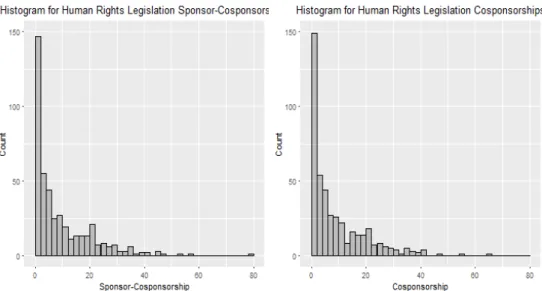
Figure 1. Histogram of Sponsor-Cosponsorship Count Data for the 108th Congress
policy legislation. Although the mean is low, the maximum number of cosponsors by a single legislator reaches 65. The purpose of this paper is to investigate the possible explanations of this variation at the individual-level, and the dyad-level. The focus on human rights foreign legislation seeks to examine whether intra-legislative or preference-based hypotheses may be more suitable to less salient issue areas in contrast to the traditional position-taking hypotheses.
As the legislative scholar, Richard F. Fenno once remarked, “the more we try to understand Congress, the more we are forced to peel back the institutional layers until we reach the individual member” (Fenno 2004).
Hence, studying the individual legislator as the unit of analysis will help explain why there is variation in legislative sponsor-cosponsorship following the studies that have emphasized the domestic context to explain the diffusion of norms and compliance to human rights treaties at the international level (Finnemore & Sikkink 1998; Simmons 2009).
Chapter 2. Literature Review
This thesis endeavors to address three questions. First, what are the individual motivations of legislators in the U.S. House for proposing and supporting human rights foreign policy? Second, how do institutional constraints, characterized by relationships with other legislators called
“intra-legislative motivation” in this thesis, affect legislators’ decisions to sponsor and cosponsor human rights legislations? Finally, how do these legislative behavior connect to international relations? This research mends the gap among various subjects pertaining to legislative behavior on cosponsorships and sponsorship, human rights foreign policy, and the significance of the electoral connection to international politics.
2.1. The Electoral Connection of Sponsor-Cosponsorships
Mayhew’s electoral connection thesis and Fenno’s three goals of legislative behavior comprise the heart of my argument. Mayhew (1974) pellucidly describes legislators as single-minded seekers of re-election. In Mayhew’s thesis, MCs are self-interested agents based on rational choice theory and re-election is prioritized in their actions, since election must be
achieved to entertain other goals. Legislators engage in credit-claiming, position-taking, and advertising for re-election purposes. According to Fenno, legislators not only have re-election goals but the desire for good public policy-making and prestige in Congress.
Initial work on cosponsorship focused on its position-taking role. As one of the activities that legislators engage in, position-taking is “the public enunciation of a judgmental statement on anything likely to be of interest to political actors” (Mayhew 1974, 61). Mayhew utilizes cosponsoring behavior as an example of position-taking.① Cosponsorships transmit inexpensive signals to voters, with high returns, especially when voters may be attuned to policy efforts. To a legislator seeking reelection, cosponsorship is an efficient way to strengthen his or her electoral connection with politically relevant constituents outside the legislature at a small cost. In accordance, Campbell (1982) attributes position-taking as the reason for variation among active and reluctant cosponsors. Koger (2003) also
① The difference between credit-claiming and position-taking lies primarily in whether the legislative action is tangible or intangible, and the degree of abstraction. Credit-claiming plays a role when legislators can claim credit for a legislative action, such as passing a bill or implementing a policy. In the case of intangible actions, or a policy that is difficult to implement, Position-taking may be more appropriate. For such reasons, sponsoring and cosponsoring are connected to position-taking because the legislation are in the agenda- setting stage. Position-taking is more appropriate for complex issues because it is difficult to earn trust from people that the legislator could make a complex idea feasible, as in the case of international issues.
emphasizes that members’ incentives to take positions for constituents, interest groups, and donors explain cosponsorship activity.
I assert that MCs cosponsor to reap the political rewards of position- taking, rather than to achieve the goal of seeking policy outcomes. The main assumption here considers MCs as re-election seekers who commit to sincere position-taking using cosponsorships, and that the ideological slant of the legislation aligns with the legislators’ ideology. If, however, legislators’ utilize cosponsorships as insincere or strategic position-taking, then the legislation’s ideology would not demonstrate the MCs’ ideology, and the MC would have stronger policy-seeking motives.
My primary question is how legislators act within the sphere of international issue agendas. The hypothetical assumption is that citizens are dispassionate about international issues and legislators’ activities on human rights foreign policy. Allendoerfer (2017) tests the general assumption using survey experiments that constituents favor using foreign policy to promote human rights in foreign aid related contexts. Results demonstrate support by major constituents to punish human rights violations with cuts to foreign aid.
However, the scant literature existing on human rights public opinion does not help us discern whether constituents are interested in human rights issues as to penalize or award MCs who actively entrepreneur human rights
foreign policy bills. The next step for this paper would be to evaluate the extent of citizen interest in human rights international issues, but for this paper, an intuitive and general assumption that people do not care about MCs actions on human rights will be adopted and tested with demographic variables. In such low salient issue areas, do legislators’ behave otherwise to Mayhew’s proposition, when it comes to sponsoring and cosponsoring bills?
Previous works highlight the collaborative and relationship-oriented nature of cosponsorship behavior. Sponsorship and cosponsorship are one of the core activities involving collaboration and sharing of interests in legislative agenda-setting (Bratton & Rouse 2011). Because bill sponsor- cosponsorships are one of the few activities that legislators can exert control over, the action signals the legislator’s choice of an issue to be associated with and the reputation he or she wishes to acquire among colleagues (Schiller 1995). Acknowledging cosponsorships as an indicator of legislators’ abilities to persuade others, Wawro (2000) utilizes cosponsorships as a measure of coalition building in operationalizing
“legislative entrepreneurship.”
In comparison to the roll-call voting stage of the legislative process during which legislators are restricted to a yea-nay vote on the determined set of policy proposals, sponsor-cosponsorships enable legislators to define
their boundaries of legislative outcomes. Cosponsorships can be associated with “yea,” “do not care,” “not interested,” or “no opinion” (Wolbrecht 2000, 76). The degree of choice associated with cosponsorship is greater than roll call votes, which is an argument that bolsters why cosponsorships could be indicative of member preferences and policy interests (Wolbrecht 2000, 76).
To elaborate, cosponsorship provides low-cost information to MCs about the political benefits of a bill, in an environment where fully informed agenda setting is unlikely (Koger 2003). Because the alternatives of random bill selection or caucus meetings involve high cost, party and committee leaders rely to a degree on cosponsorships to consider which bills should be advanced to the level of a general agenda. Within such purview, previous works have examined the costs and benefits of sponsorship (Schiller 1995), cosponsorship as providing cues to fellow legislators regarding issue importance (Kessler & Krehbiel 1996; Krutz 2005), cosponsorship as information shortcuts (Kingdon 1989), and its contribution to legislative success and perceived effectiveness (Krutz 2005).
This line of literature falls in relation to the scholarship that advocates for, what I call, intra-legislative motives of cosponsorship behavior. The focal audience here refers to internal members of the legislation, rather than the external constituents. Members of Congress utilize cosponsorships to
signal messages to internal audiences in the legislation, perhaps to promote an agenda or align with a specific issue for reputation building. More specifically, Kessler & Krehbiel (1996) evoke signaling theories of legislative policies; heterogeneous signalers enhance the utility of the bill by reducing the uncertainty about the policy consequences (Gilligan &
Krehbiel 1989). Wilson & Young (1997) also illustrate that cosponsorship has a bandwagon, ideological, and expertise signal, but the strength of the signal weakens after the outset of the legislative process.
As such, I adopt the position that sponsoring and cosponsoring is an intra-legislative action in connection with Fenno’s triumvirate goals. Intra- legislative motivations realize the necessity for power in Congress, and the desire for good policymaking more so than position-taking or considering constituency interests. First, in comparison to roll call votes, a floor vote is a more public act than sponsorships and cosponsorships. Roll call votes elicit constituent responses, whereas cosponsorships have a lesser possibility of being noticed by voters.② A roll call vote has direct results and consequences, but sponsorships and cosponsorships may not bring any fruition. Second, cosponsorships are largely recognized as symbolic actions, and the high frequency of this legislative action undermines its value.
② The extent to which voters pay attention to cosponsorships is another under studied area.
Nonetheless, given the smaller frequency on sponsorships and cosponsorships on human rights foreign policy, this act could be interpreted as having more sincerity since one would need to spend resources to consider the legislation. Sponsoring indicates that the MC desires change in the specific policy area because not taking any action would bring no change in the status quo. This reflects interest and interest in being associated with the policy area. Such acts are characterized as legislative entrepreneurship (Schiller 1995; Wawro 2000); MCs utilize sponsorships and cosponsorships to construct their legislative agendas and build coalitions.
Cosponsorships have less of the willful characteristic of sponsorships, but rather, motivations could be due to internal pressure from fellow MCs.
The simple logic here is “you scratch my back, and I’ll scratch your back”
as members exchange cosponsorships for the respective bills. Thus, the limited visibility of sponsoring and cosponsoring behavior, the coalitional characteristic, and internal, relational pressure from fellow MCs, signaling theory arguments support my hypothesis that sponsorships and cosponsorships tend to be an intra-legislative behavior signaling towards the inner members of the legislation.
Factors accounting for sponsorship and cosponsorship differ.
Determinants of sponsorship decisions include the following: majority party status (Garand & Burke 2006), seniority (Campbell 1982; Garand & Burke 2006; Rocca & Sanchez 2008), and ideological extremism (Garand and Burke 2006; Rocca & Sanchez 2008; Schiller 1995). In general, high sponsorship activity is associated with influential legislators with majority party membership, committee chair status, and high seniority.
Research on factors influencing cosponsorship present more mixed results due to variations in time period, independent variables, and research design. While sponsorship is associated with influence, cosponsorship tends to be endorsed by legislators with less power: lower seniority (Campbell 1982; Garand & Burke 2006; Rocca & Sanchez 2008), higher ideological extremism (Campbell 1982; Garand & Burke 2006; Rocca & Sanchez 2008), minority party affiliation (Bratton & Rouse 2011; Garand & Burke 2006;
Koger 2003), and re-election prospects (Campbell 1982; Rocca and Sanchez 2008). However, the margin of electoral victory is not significant in Campbell (1982) or Krehbiel (1995). Thus, institutional, individual, and electoral factors affect legislators’ behaviors in participating in sponsoring- cosponsoring legislation.
Between the two contending hypotheses mentioned above on intra and extra-audiences, this paper sides with the intra-legislative argument, but follows a more specific layer advocated as the preference-based approach by Regens (1989) and Krehbiel (1995). The preference-based hypothesis suggests that “legislators cosponsor measures whose anticipated policy consequences they like relative to the status quo, and they choose not to cosponsor measures whose anticipated policy consequences they dislike relative to the status quo” (Krehbiel 1995, 910). While taking into account legislators’ ideological preferences, it also suggests that ideologically extreme or those further from the House median would be more cooperative as sponsors and cosponsors. Previous literature seemed to neglect such individual preferences over electoral or signaling interests. In one interview included in Koger (2003), a second-term Republican claimed that he often cosponsors bills that advance his personal preferences:
“I cosponsor when it’s something I believe in. For example, I cosponsored the bill to abolish the death tax because I strongly support the idea and want it to become law… A lot of members avoid cosponsorship if the bill is controversial – I take the opposite tack. If I believe in an issue, I cosponsor the bill to give it energy.”
(qtd. from Koger 2003, 231).
Personal belief and conviction would rise to the surface more clearly in policy areas, such as human rights.
I wish to know if preference, measured by ideology in this paper, affects cosponsorship decisions, but also seek to explore the patterns of cooperation among ideologically similar MCs. The critical key word here is
“cooperation.” Although it is difficult to say that cosponsoring together directly implies cooperation, we will be able to see to the extent to which similar ideologies bring legislators to indirectly or directly engage with one another through legislative activity. A legislator’s idea of what constitutes good policy may depend on his or her political ideology (Regens 1989).
Especially for human rights legislation, bill content differs based on who from which party sponsored the bill. Republicans tend to sponsor bills calling for action or expressing negative sentiment towards repressive regimes, while Democrats have sponsored more bills calling for support of United Nations and global agendas.
In exploring the effect of ideology, this paper adopts the homophily model that argues “birds of the same feather flock together” specifically within the realm of ideological dispositions. Taking into consideration the limitations of previous works in which cosponsorship activities are separate, distinct individual-level designs, this paper employs dyads as the central
unit of analysis. The focus on individual-level methods or aggregated group- level analysis of sponsorship-cosponsorship data has made it difficult to evaluate what what brings two legislators together. At the conceptual and theoretical level, sponsorship-cosponsorship should be analyzed in terms of its interactive and collaborative process, rather than limiting it to institutional and individual contexts (Bratton & Rouse 2011).
The concept of homophily comes from social identity theory, which is employed in communications research. Iyengar, Konitzer & Tedin (2018) investigates polarization through inter-party marriage survey questions founded on the idea of homophily. The notion of ideological homophily is not unexplored in cosponsorship literature. Gross & Shalizi (2008) finds that shared committee service, the similarity in ideology, and being elected from the same state or region are significantly associated with cosponsorship.
Bratton & Rouse (2011) uncover that legislators cosponsor bills proposed by sponsors who are similar to them in ideology and district proximity, but other characteristics such as, seniority, sex, race, party did not have a significant effect. This paper focused on providing a foundational analysis of dyadic relations and explore possibilities for network analysis.
2.2. Domestic Politics in International Relations
Scrutinizing the behavior of domestic actors contributes to our understanding of international relations. According to constructivist theory, international structures and state identity are mutually constructive as states constitute the system, and the system, in turn, socially constructs the interests of the state (Wendt 1995). Applying human rights into this framework enables the thought that international systems influence the states to adopt certain human rights stances, but that states’ position on human rights also constitutes the international system (Mertus 2008, 12).
Thereby focusing on the domestic actors who directly create legislation on U.S. human rights foreign policy, this work attempts to empirically complement domestic components of international politics. While this paper is theoretically limited in making a causal connection, it attempts to acknowledge the role of domestic politics, following the examples of studies that have emphasized the domestic context to explain the diffusion of norms and compliance to human rights treaties at the international level (Finnemore & Sikkink 1998; Simmons 2009).
During the Bush administration, Congress introduced resolutions calling for unconditionally releasing political prisoners and military soldiers in
Syria, China, Vietnam, Cuba, Lebanon and elsewhere (H.Res.139, H.Res.476, H.Con.Res.73, H.Res.506, H.Con.Res.123, H.Res.107).
Similarly, while pursuing war for democracy in Iraq, the Bush administration turned a blind eye to lack of democracies in supporting states (Forsythe 2004, 93). Such acts of criticizing others of human rights violation, while continuing its own crimes against humanity are the double standard of America’s foreign policy on human rights.
The controversial question captured in the previous works on the Bush administration and human rights is whether the War on Terror ended the multilateral human rights orientation of the U.S. foreign policy. Weiss, Crahan, and Goering (2004) argue that the Bush administration pursued multilateralism to a similar degree with Clinton’s administration (Weiss et al.
2004, 4). From a broader perspective, Donnelly (2004) acknowledges that human rights became devalued due to security concerns and that the size of considering human rights changed, but not the “design.” Forsythe (2004) similarly notices the failures of other administrations on pressing aggressively for rights but emphasizes the nationalist and unilateralist characteristics of the Bush administration.
More critical studies point out how Bush compromised human rights and reduced weights in multilateralism in favor of security, which
denigrated human rights norms internationally (Roberts 2003). Specifically, Bush employed human rights language when describing necessity for regime change, but relied on unilateral declarations and bilateral economic incentives for other purposes (Roberts 2003, 632). In accordance, Roth (2004) explains that human rights for the Bush administration were a dispensable means considering its illegal ways of combating terrorism and its intense opposition to the enforcement of international human rights law.
The overall focus of explaining human rights during the Bush administration returns to the idea mentioned above of American exceptionalism. Hancock (2007) utilizes Foucaultian discourse analysis to discover that Bush and his policymakers applied human rights discourse to coalesce support and legitimacy around U.S. foreign policies in terms of exceptionalism. Mertus (2008) finds that rhetoric on human rights changes from one administration to another, but American exceptionalism appears consistently since Jimmy Carter’s presidency.
In literature generally dealing with the U.S. and human rights, exceptionalism is explained in terms of historical, cultural, institutional, and political forces (Moravcsik 2001). Indeed, academics reach a consensus that human rights come from a pre-existing U.S. identity and distinctive rights
culture③ (Koh 2003; Farer 2004; Hancock 2007; McCain 2010). Here, rights culture signifies one of the three: (1) international obligations violate the U.S. Constitution and political institutions; (2) American belief in local government and popular sovereignty inclines the people to reject centralized judicial norms; (3) libertarian preference for negative rights are incompatible with international human rights obligations (Moravcsik 2005, 154).
However, the political reasons are less evident in explaining each administration’s inconsistent and consistent application of human rights.
Bradley (2014) suggests that human rights were a bipartisan issue among the public during Carter’s administration uniting both liberals and conservatives (14). In contrast, Forsythe (1988) analyzes congressional roll call votes on human rights bills during Carter and Reagan’s administration to discover that partisanship and ideology on national security influenced voting patterns.
As such, there are reasons to examine Congress and study the political aspects of human rights legislation making. It should be noted here that support for international treaties comes disproportionately from Democratic
③ Deputy Assistant Secretary of Human Rights and Humanitarian Affairs in the Reagan Administration, Paula Dobriansky proclaimed that U.S. commitment to human rights dates from the Declaration of Independence (Dobriansky qtd. By Hancock 2007, 17).
Senators while opposition comes mainly from Republican Senators (Kaufman & Whiteman 1988; Moravcsik 2005, 184). Yet, previous literature has not focused on the motivation of legislators in promoting human rights legislation. Although congressional activity increased significantly over the years, academic work on Congress and foreign policy has been limited to studying consequences of military intervention, military assistance, economic sanctions, and economic assistance (Shea 2008; Choi
& James 2007).
Nonetheless, in areas of foreign policy, explanatory variables for cosponsoring antiwar legislation (Heaney 2011) and pro-Israel legislation (Rosenson, Oldmixon, & Wald 2009) have been analyzed. In both studies, elite factors, such as partisanship and ideology influenced legislators’
behaviors. Since human rights legislations are left unexplored since Forsythe (1988), this study will examine legislators’ motivations in supporting human rights foreign policy legislation in the era of the War on Terror.
The contending point in the literature on legislators’ motivation of supporting a bill is whether constituency preferences are reflected in the legislators’ behavior, generally studied with roll call votes that signify position taking. Fenno (1973) and Mayhew (1974) posit that Congressmen
are inspired by re-election and thereby act according to his or her constituent’s preference.④ Multitude of studies on constituency influence on representation have provided empirical analyses on the electoral marginal hypothesis (Fiorina 1973), salience of policy domain (Kulinski &
McCrone 1980), constituency opinion (Page et al. 1984), public opinion on defense budget (Bartels 1991), the effect of diffuse interests and representation (Bailey 2001), and subconstituency preferences (Clinton 2006). In the area of human rights, Hildebrandt et al. (2013) find that partisanship and ideological distance from the president motivate Congressmen to vote for humanitarian intervention.
Therefore, in dealing with what motivates legislators, the question of the electoral constituency should be included. This leads to exploring the nexus between public opinion of human rights (i.e., the constituencies’ preference of human rights) and its influence on the legislators’ position. Lindsay (1994) touches upon the electoral fallacy regarding Congress’ role in foreign affairs. It presumes that electoral connections will highly influence Congressmen, making them unfit for conducting foreign policy. On the other hand, constituents may not be interested or knowledgeable about foreign policy, providing leeway for legislators’ to take more personal
④ Fenno considers two more goals which are influence within the legislature, and the production of good public policy.
positions. However, recent evidence suggests public wishes to engage more in foreign policymaking (Sobel 2001).
Recent literature points to domestic audience costs to explain why international commitments are effective. Domestic audience costs are defined as the cost paid by the leader for making empty foreign threats. The cost is incurred by the citizens who would think less of leaders that do not commit to international promises. Such tendentiousness would prevent leaders from making empty threats and promises. Researchers have incorporated the idea generally in various areas of international relations from modes of alliances to international cooperation. Fearon (1994) hypothesized that higher audience costs in democracies in comparison to autocracies cause the two types of regimes to behave differently.
However, previous literature does not reveal the causal relationship of whether the effect of democracy on foreign policy originates from audience costs or political regime difference (Tomz 2007, 822). Some scholars highlight citizens’ disgust of leaders’ empty threats, while others point out that citizens seldomly take interest in foreign policy. Thus, direct observation of audience cost is necessary for reaching a consensus on the existence, and effect of audience costs.
A recent body of literature has begun testing the microfoundations of audience costs. Notably, Tomz (2007) provides evidence of audience costs based on survey experiments demonstrating how constituents disapprove of leaders who renege from international threats. Comparing two types of presidents, people preferred the president who did not get involved in crises rather than the president who issued an empty threat.
However, considering audiences’ preferences over the policy choices, Chaudoin (2014) finds that respondents to the survey experiment with expressed policy preferences had a significantly smaller effect compared to those without strong policy preferences when informed on leaders’ empty promises. For example, workers’ preferences for high tariff policy may trump their preferences over low tariff policy. Thereby international agreements are likely to have weaker effects on countries with domestic audiences hostile to the commitments.
Putnam and Shapiro (2017) analyze how invoking international law conditions public support for punitive policies against foreign human rights abusers. The research reveals that voters in liberal democracies positively respond to information about human rights abuses in foreign countries, leading to support for punishing violators, under the condition that the violations described are not too severe. Hence, the international legal status
of the issue brings incentives to leaders when justifying punitive actions against foreign governments.
Domestic audience cost theories are central to crisis situations.
Nonetheless, more research needs to reveal which factors are crucial in shaping public opinion on foreign policy especially in non-crisis settings.
For MCs to legislate bills proposing punitive action against human rights violations of foreign governments, they need the belief that the public endorses or does not oppose those actions (Putnam & Shapiro 2017). Hence, this thesis tackles the relationship among legislative actions concerning human rights foreign policy and the citizens’ induced response from demographic features.
A nation-wide survey on citizens’ preferences would have created the ideal data to measure constituency preferences; yet, considering that legislators also lack access to aggregated constituency opinions on human rights foreign policy, it could be argued that the data used in this research reflects the real world situation wherein MCs base decisions on indirect information about constituency preferences on less salient issues.
This thesis contains empirical and theoretical limitations in completing the entire causal dynamics on citizens preferences, responses by political elites, and foreign policy change; nonetheless, it addresses two questions
regarding the role of domestic politics on international systems that have not been discussed before. Primarily, domestic audience cost theory focuses on presidential leadership as the unitary actor responding to domestic preferences. However, I acknowledge the U.S. Congress as an institutional force that constrains presidential action and expresses its own preferences, in the complicated connection with local preferences in their districts. Thus, I focus on legislative politics which is a different focus on political leadership.
Second, previous research focuses on testing citizens’ voting behavior and opinion on foreign policy, whereas my research emphasizes political elites’ behaviors on policymaking. Are political elites attuned to constituency preference in foreign policy? Do indirect constituency preferences affect the legislative agenda of legislators? Finally, I am concerned with the everyday politics of foreign policymaking, not constrained by national crises or war situations. The scope of this study involves the willingness of individual legislators to take actions against international issues as legislative entrepreneurs.
In this section, I have discussed literature on legislative representation, the Bush administration’s human rights policy, and the connection with the domestic and international politics. In the process, I emphasized that the
structural holes in previous literature are the lack of research on human rights legislation and domestic mechanisms, such as Congress members’
motivations to signal support for certain legislation. This paper posits that rather than the extra-legislative motivations (electoral connection), intra- legislative motives drives legislators to signal positions on human rights legislation.
Chapter 3. Research Design
The novelty of this research lies in examining domestic legislation in hand with international treaty context, employing cosponsorship data on human rights legislation, and exploring the paradoxes of U.S. human rights foreign policy during the War on Terror. Based on the influence U.S.
domestic politics has on international human rights conditions, its paradoxical behavior⑤ justifies selecting the U.S. as the country of study.
There are two reasons for studying the Bush administration (107th – 110th Congress). First, the particular circumstance in which security trumps human rights, but human rights discourse is advocated more strongly than previous presidencies, will highlight legislators’ decisions in aligning with individual ideology, partisanship, or constituent preferences (Mertus 2008).
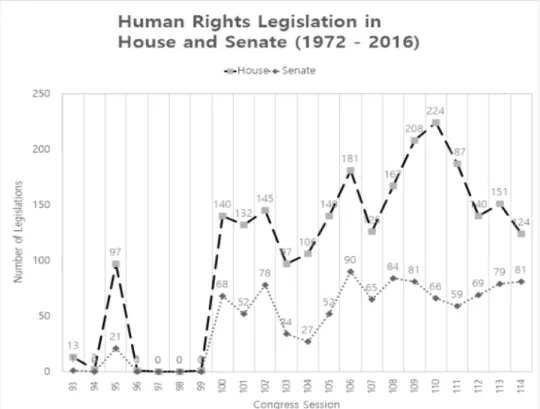
Second, the Bush administration proposed the most number of human rights legislation compared to any other administration as demonstrated in Figure 2. In total, 725 legislations originated from the House (subject to the International Relations Committee), and 296 legislations originated from the
⑤ Simmons examines domestic level variables (veto players in the executive-legislative relations, ratification process, executive’s party) that affect whether a country is a ‘sincere ratifier,’ ‘false negative,’ or a ‘strategic ratifier.’ The results demonstrate that the U.S. is a false negative, meaning that it commits to international norms in principle, but fail to ratify treaties (Simmons 2009, 58).
Figure 2 Human Rights Foreign Policy Legislation in the House and Senate (1972- 2016)
Senate (subject to the Foreign Affairs Committee). Compared to Clinton (524 House legislation, 203 Senate legislation) and Obama (602 House legislation, 288 Senate legislation), there is an advantage to studying the Bush era. The greater quantity of human rights bills during a time of national crisis sparks the question, “why are there so many human rights legislations during the war on terror, and do they comply with international standards?” The data depicted in Figure 2 was obtained from the Library of
Congress website. ⑥ The Library of Congress website contains all legislation introduced from the 93rd to 115th Congress (1973-
2017) (Library of Congress 2017). The data on sponsor-cosponsors can also be obtained from the website.⑦
The dependent variable is the legislators’ support of the human rights legislation. In the individual-level design, the variable is operationalized as the total count of (1) sponsorships and (2) cosponsorships for each member of the House. In the dyadic-design, the dependent variable is binary signifying whether or not the MC sponsored or cosponsored a bill with its partner legislator.
It is necessary to explain why this research employs sponsor- cosponsorship data, instead of the roll call vote in the human rights policy context. First, given the few numbers of bills that come to a vote in Congress, roll call votes make it difficult to generalize about Congress members’ behaviors on human rights. From 2001-2008, only 218 human rights legislations from the House and 95 bills from the Senate undergo roll
⑥ The scope of my data is limited to human rights legislation under the jurisdiction of the International Relations Committee for the House, and the Foreign Affairs Committee for the Senate from the 107th to 110th Congress.
⑦ This research includes bills, joint resolutions, concurrent resolutions, and simple resolutions. Bills and joint resolutions become laws once they are passed in both Chambers of Congress and signed by the president; although resolutions do not have the force of law, they are utilized to express the sentiments of one or both Chambers. Since the focus of this research is on understanding why congressmen cosponsor human rights legislations, endorsements of resolutions also contribute to this understanding.
call votes. Also, the bill data will be biased because many of the human rights legislations sponsored by Democrats advocate international agendas.
However, these legislations receive less general support and do not advance the Committee stage. Examples include “International Violence Against Women Act of 2008” (30 cosponsors), “United Nations Transparency, Accountability, Reform Act of 2007” (58 cosponsors), “United Nations Durban Review Conference Funding Prohibition Act” (29 cosponsors) and others. Still, the legislations mentioned above do have a significant number of cosponsors which is meaningful data, even if the legislation does not pass as a bill since the purpose of this paper is to reveal the effect of ideological homophily. Also, to examine the extent to which international norms are reflected in U.S. human rights legislations, the non-passed legislations will provide valuable data.
Second, it is difficult to measure a legislators’ position-taking with human rights roll call votes because most legislators vote in accordance to the median voter. In general, roll call votes on human rights legislations receive nearly unanimous support from Congress members. For example, a legislation that proposed providing assistance to Darfur (2004) received 412 yeas and 3 nays. “The North Korea Human Rights Act of 2004” also received a unanimous vote in the Senate. “Calling on China to immediately
and unconditionally release Dr. Yang Jianli” (2004) received 412 yeas, 0 nays, and 22 non-votes. Previous research has demonstrated that higher numbers of cosponsors a legislation acquires, the higher the possibility the legislation will become a bill (the more cosponsors, the more bipartisan the legislation seems). Most human rights legislations obtain 50 to 70 cosponsor signatures before being voted on. Thus, there is not much variation in legislators’ positions during the actual roll call vote. The characteristics of a human rights legislation make it difficult for a legislator to vote independently from the general consensual sentiment on human rights. In other words, a higher risk-taking cost is associated with voting “nay” on a human rights legislation on North Korea. Therefore, sponsorship- cosponsorship data enables a more proactive outlook on operationalizing support for human rights legislation because it is a less limited action.
Although cosponsoring has no formal effect on the legislative process, there are three reasons to suspect that cosponsorship provides valuable information on legislative behavior. First, Congress members invest time and staff effort to recruit cosponsors for their bills and review other members’ requests to cosponsor legislation (Campbell 1982; Koger 2003).
Second, the number and diversity of cosponsors are cited by legislators as evidence of bipartisanship or majority support for the bill during floor
debate (Campbell 1982). Research also implies that a higher number of cosponsors are correlated with a higher probability of the bill being recommended to the committee (Wilson & Young 1997). Third, the frequency of bill cosponsorships delineates its importance. The average number of cosponsorships by a congress member shows a gradual increase signifying that cosponsorship activity has become more active over the years (93rd Congress: 129 mean bills cosponsored per legislator; 96th Congress: 187; 99th Congress: 329; 102nd Congress: 339; Fowler 2006). For these reasons, examining cosponsorship behavior may offer a different perspective on agenda-setting, position-taking, and credit-claiming since it delves into a sphere of legislative influence that MCs can control and act according to their strategic calculations. Cosponsorship is also a way for members to attempt to manipulate Congress’s agenda in favor of their preferences even if the bill does not become law (Koger 2003). In all, the decision to cosponsor or propose legislation is dependent on the will of the member of Congress.
This research makes the main argument that cosponsorship of legislators has stronger intra-legislative motivations than extra-legislative motivations.
This is partly due to the problem of measuring district and state level preferences for human rights. Indirect constructs will be used to capture
national issue salience of human rights during the War on Terror. The salience may pose as limiting conditions to legislators’ cosponsorship behavior, as riskier issues call for higher costs. Nonetheless, the area of foreign affairs provides considerable leeway to legislators, and they may be willing to act according to institutional logics.
3.1. Individual-Level Model Variables
While the dyad design comprises the core of this paper, I conduct an analysis of the individual-level variables in relation to the frequency of sponsoring and cosponsoring activity by each legislator. This analysis is to provide insight into directly what variables account for the variation.
Although previous literature exists on the individual-level reasons explaining sponsoring and cosponsoring motivations, the issue-specific aspect of this paper necessitates a look into the individual reasons as well.
Table 1. Individual-level Model Dependent Variables
Summary Mean SD Min. Max. Description
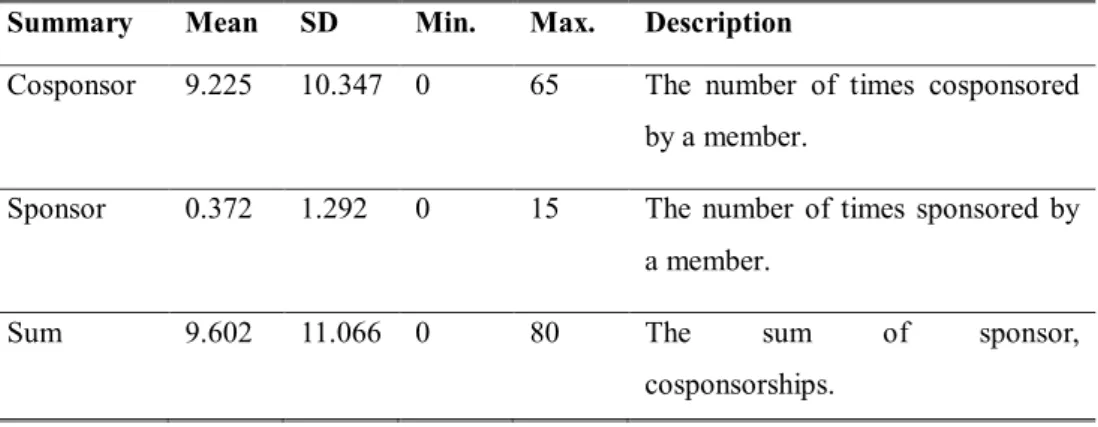
Cosponsor 9.225 10.347 0 65 The number of times cosponsored by a member.
Sponsor 0.372 1.292 0 15 The number of times sponsored by a member.
Sum 9.602 11.066 0 80 The sum of sponsor,
cosponsorships.
I introduce separate variables for the individual-level model that account for legislators’ motivation to sponsor or cosponsor human rights foreign policy proposals. Legislators’ personal attributes such as race and gender, are known to influence their cosponsorship and sponsorship activities. On coethnic legislation, Chaturvedi (2015) finds that Asian American MCs are more likely than non-Asian American MCs to provide support or propose bills. However, Rocca and Sanchez (2007) discuss that African American and Latino American legislators participate less in sponsorship and cosponsorship actions than non-minority MCs.
While few research focus on gender differences in cosponsorship and sponsorships, Bratton and Rouse (2011) supports the argument that the same gender engenders more cosponsorship and sponsorship cooperations.
Heaney (2011) also reports gender as a statistically significant variable regarding MCs sponsorship and cosponsorship of antiwar legislation from 2001 to 2011.
Second, MCs position in Congress represented by variables indicating participation in the related committee, seniority, and party leadership positions also determine their choices in legislative activity (Heaney 2011).
Seniority has a negative effect on cosponsorship, or a positive but meager effect (Campbell 1982; Kessler & Krehbiel 1996; Rocca & Sanchez 2008;
Heaney 2011). Committee leadership induces the MC to participate actively in cosponsorship and sponsorships, while party leadership decreases the MC’s legislative activity (Rocca & Sanchez 2008). As institutional constraints influence MCs decisions, it is necessary to include related variables. It could be hypothesized that positions affiliated with more power in Congress lead to smaller cosponsorships, whereas positions signifying lack of power motivate greater legislative activities.
Lastly, the MCs incumbency in the election and the margin of victory are included in the individual-level model to test the electoral connection thesis. Campbell (1982) states that electoral margins had an insignificant effect on cosponsoring decisions in the 95th Congress. Kessler and Krehbiel (1996) find that intra-legislative signaling have a more prominent effect than extra-legislative position-taking. That is, the electoral margin has a positive but insignificant effect on cosponsorship in the 103rd Congress. Consistent with previous literature, I expect incumbency and margin of electoral victory to have less significant influences on human rights foreign policy legislation compared to personal attributes or institutional factors.
Table 2. Individual-level Model Independent Variables
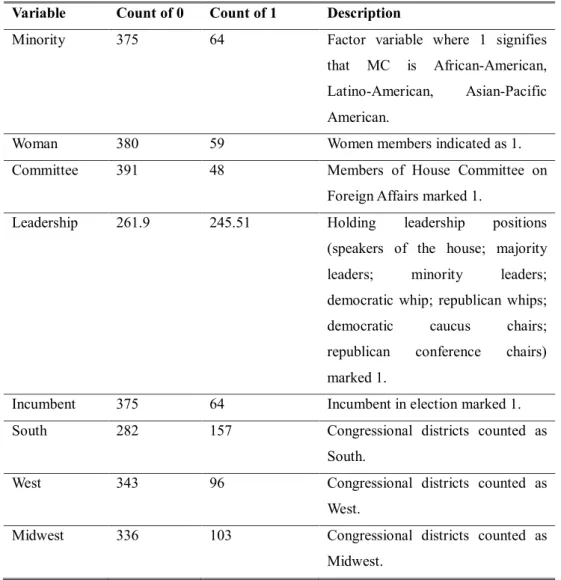
Variable Count of 0 Count of 1 Description
Minority 375 64 Factor variable where 1 signifies that MC is African-American, Latino-American, Asian-Pacific American.
Woman 380 59 Women members indicated as 1.
Committee 391 48 Members of House Committee on
Foreign Affairs marked 1.
Leadership 261.9 245.51 Holding leadership positions (speakers of the house; majority leaders; minority leaders;
democratic whip; republican whips;
democratic caucus chairs;
republican conference chairs) marked 1.
Incumbent 375 64 Incumbent in election marked 1.
South 282 157 Congressional districts counted as
South.
West 343 96 Congressional districts counted as
West.
Midwest 336 103 Congressional districts counted as
Midwest.
*variables explanations included in dyad-level designs are excluded here.
Variable Mean SD Min. Max. Description Margin of
Victory
0.422 0.263 0.0006 1.0002 Difference between first and second frontrunners divided by vote total in the 2002 U.S. House general elections.
3.2. Dyad-Level Model Hypotheses and Variables
The goal of this paper is to test the relationship between extra- and intra- legislative motivations. I propose a novel operationalization of legislators’
ideology by measuring the absolute difference between two legislators’ DW- NOMINATE scores. Although legislators’ ideologies are core explanatory variables in sponsor-cosponsorship literature, previous works’
operationalized ideology as “ideological extremism” posing contextual problems. Since individual level designs cannot utilize the ideology scores with negative or positive directions (that would flummox the effect of ideology on the dependent variable as liberals and conservative scores would amount to a different number), the ideology was calculated by taking the absolute value of an ideological score provided by the ADA (Americans for Democratic Action) or the DW-NOMINATE (Campbell 1982, Krehbiel 1995).
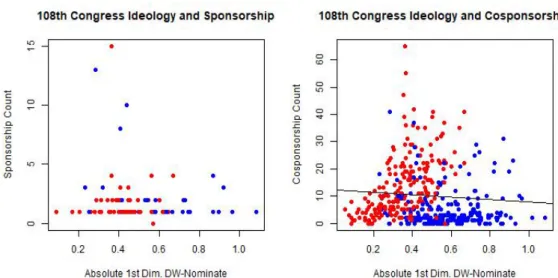
In addition to ideological homophily, this paper operationalizes ideological extremism as a control variable, which is the absolute value of the legislator’s ideological distance from the House median following Garand & Burke (2006). Figure 3 depicts a negative relationship between the past ideological extremism measure of taking the DW-NOMINATE’s absolute value and cosponsorship behavior. This result differs from previous
accounts that extreme ideology induces higher cosponsorship activity.
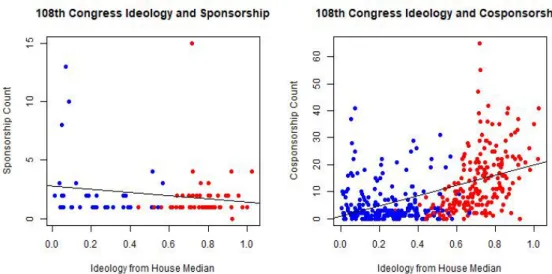
However, utilizing Garand & Burke’s operationalization, Figure 4 demonstrates that the further away from the House median ideology, the more likely it is for the legislator to cosponsor. A positive coefficient for ideological extremism, a negative coefficient for absolute ideology is expected.
Complementing previous operationalizations on ideology, I hypothesize that measurement of the ideological distance between two legislators facilitates their cooperation in cosponsorship activities.
H1. The closer the ideological distance between two legislators, the more likely it is that they will cosponsor together.
The ideological model contends that the ideology of cosponsors send a signal regarding the bill’s content (Wilson & Young 1997). The diverse ideological mix of cosponsors signals the bipartisan content and majority support of the bill (Campbell 1982), while a bill with extreme ideological cosponsors signals a narrow representation or partisan preferences. Hence, taking into consideration that legislators often endeavor to gather support from a more diverse pool of legislators, I observe if legislators cooperate more with legislators with different or similar ideological preferences.
Figure 3. Plot of sponsorship count and absolute 1st dimension DW-Nominate scores (left). Plot and regression line of cosponsorship count and absolute 1st dimension DW- Nominate scores (right). Not a strong relation and rather an opposite effect claimed by previous literature of extreme ideology is observed on human rights bills. Legislators’
ideologies clustered along 0.4 (mean = 0.476) show a strong tendency to cosponsor more.
Figure 4. Plot and regression line of relationship between sponsorship (left) or cosponsorship count (right) and absolute value of congressman’s ideological distance from the House median. Observed to be a more accurate explanation of ideological extremity than the absolute value of DW-Nominate.
The degree to which legislators cooperate with members of similar ideology enables us to predict if legislators tend to follow their ideological preferences or cooperate with members with dissimilar interests perhaps for strategic reasons, or represent the preferences of their electorate.
In relation, examining the ideological distance between the sponsor and the cosponsor will provide further information on whether the legislation could imply a signal of the bill's content, and if legislators cosponsor due to their ideological preferences.
H2. The closer the ideological distance between two legislators, the more likely it is for the legislator to cosponsor the sponsor’s legislation.
The second hypothesis has not explicitly been examined by previous literature. The differences between the sponsor and cosponsor relationships are not taken into account and aggregated as a cosponsorship network (Bratton & Rouse 2011, Gross & Shalizi 2008).
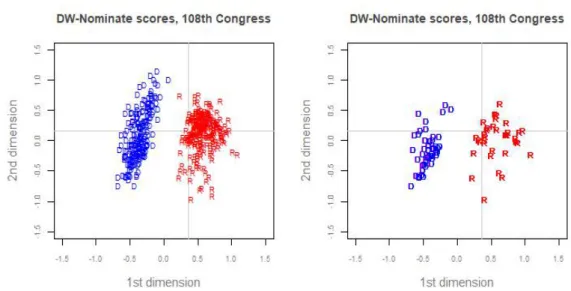
The DW-NOMINATE scores from Poole & Rosenthal (1991) measure legislators’ ideological locations over time. The “dynamic, weighted, nominal three-step estimation” is a probabilistic model of a binary choice of legislators in a parliamentary setting over time (Carroll et al. 2009). A legislator’s overall utility for voting yea is the sum of a deterministic utility and a random error. Each member’s ideal point in each Congress is estimated along the first and second dimension, and the member’s location can vary over time. First dimension locations are understood to reveal standard left-right or economic cleavages, whereas the second-dimension positions reflect social and sectional divisions, such as racial conservatism and liberalism.
Figure 5. Ideal point locations of 108th Congress (left) and only ideal point locations of Sponsors of human rights bills (right). Lines drawn are House medians.
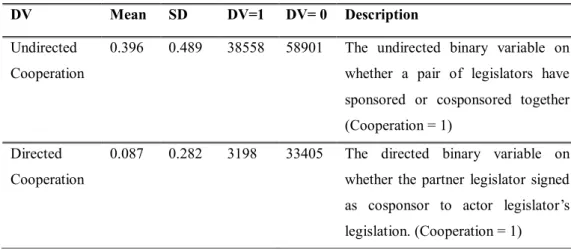
Table 3. Dyad Model Dependent Variables
DV Mean SD DV=1 DV= 0 Description
Undirected Cooperation
0.396 0.489 38558 58901 The undirected binary variable on whether a pair of legislators have sponsored or cosponsored together (Cooperation = 1)
Directed Cooperation
0.087 0.282 3198 33405 The directed binary variable on whether the partner legislator signed as cosponsor to actor legislator’s legislation. (Cooperation = 1)
The independent variable measures the ideological distance between two legislators. Thereby, the unit of analysis is a pair of two legislators, and the dependent variable is whether two legislators cooperated or not. The first model consists of undirected dyads and considers only if a partner legislator has cosponsored together with the actor legislator regardless of whether the actor’s position as a sponsor or cosponsor.
In the second model, directed dyads between a sponsor of a bill and all other legislators of the House create the dependent variable. Here, the distinction between a sponsor (actor) and the cosponsor (partner) is clear.
While the first model (97459 dyads) is symmetric, as in the data consists of each dyadic pair of all 440 members, but the second model (36603 dyads) is asymmetric because only sponsor actors are considered. Four hundred forty
members include those who were replaced in the middle of the Congressional term, but exclude delegates.
The control variables include electoral and institutional factors. It is important to distinguish here between-dyads independent variable and within-dyads variables. A between-dyads independent variable varies from dyad to dyad, but within each dyad, both dyad members have the same score (Kenny, Kashy & Cook 2006).
A within-dyads independent variable is one that varies from person to person within a dyad, but the dyad average is the same across all dyads (Kenny, Kashy & Cook 2006). Using both variables lead to a mixed-dyads design. Such distinctions are necessary to control for the effects of the independent variables when assessing nonindependence.
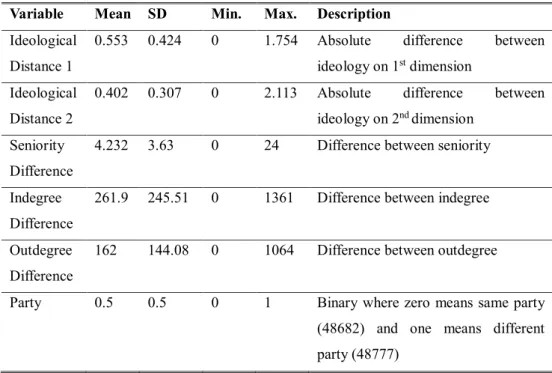
The between-dyads variables in this research refer to the two leading independent variables that measure the absolute ideological distance between two legislators (Ideological Distance 1, Ideological Distance 2), and the control variables. The basic statistics are provided in the tables. The within-dyads variable scores are entered separately for each dyad unit.
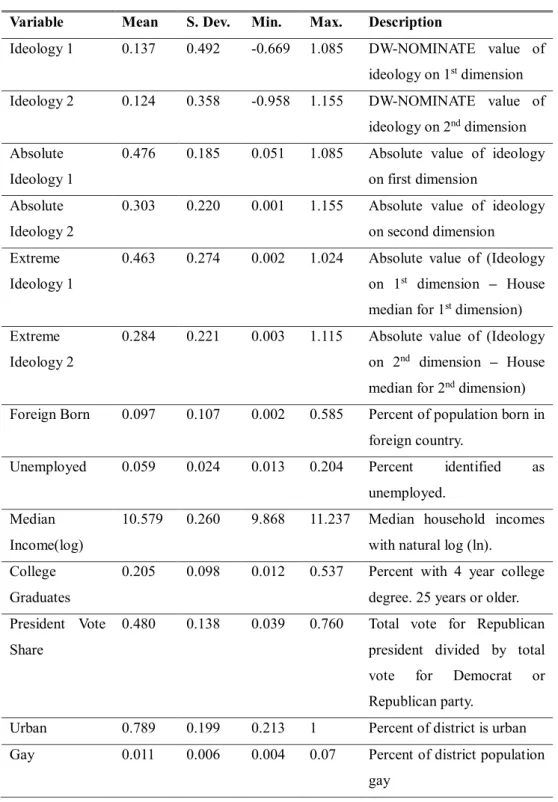
These include the absolute value of the first and second dimension scores (Absolute Ideology 1, Absolute Ideology 2), and the absolute distance from
the House median for the first and second dimension scores (Extreme Ideology 1, Extreme Ideology 2).
The expectation is that the less ideologically extreme, and more ideologically distant from the House median the legislator is, the more likely he or she will sponsor-cosponsor more human rights legislations.
Table 4. Dyad Model Between-Dyads Variables
Variable Mean SD Min. Max. Description Ideological
Distance 1
0.553 0.424 0 1.754 Absolute difference between ideology on 1st dimension
Ideological Distance 2
0.402 0.307 0 2.113 Absolute difference between ideology on 2nd dimension
Seniority Difference
4.232 3.63 0 24 Difference between seniority
Indegree Difference
261.9 245.51 0 1361 Difference between indegree
Outdegree Difference
162 144.08 0 1064 Difference between outdegree
Party 0.5 0.5 0 1 Binary where zero means same party (48682) and one means different party (48777)
Other research includes the minority or majority party status as a dummy variable. It is presumed that minority party members in Congress tend to cosponsor more to voice their opinions since they have less opportunity to change the agenda in comparison to the majority party.
Additional within-dyads level variables are constituency preferences measured indirectly through district-level demographic variables representing median income (Median Income (log)), foreign-born (Foreign Born), unemployed (Unemployed), urban districts (Urban), college-level education (College Graduates), gay population (Gay), and population that voted for the current president (President Vote Share). I expect a positive relationship between the demographic variables and cosponsorship activity, except for the unemployed levels.
Previous literature on citizens’ human rights interests and demographics, associate higher income levels and higher education levels with greater support for human rights (Allendoerfer 2017; Koo, Jeong & Ramirez 2015).
The inclusion of the gay population in this paper is a more novel approach, especially concerning legislators’ cosponsorship activity. The district demographics’ effect should be lesser than those of the ideological variables, to successfully argue that legislators’ follow personal ideological preferences rather than constituency interest in the area of human rights foreign policy.
I collected cosponsorship and sponsorship data from the Library of Congress webpage, based on 167 human rights policy legislation. District- level data are obtained from the U.S. Census Bureau’s 2010 Decennial