• 검색 결과가 없습니다.

Surgical Outcomes of Congenital Atrial Septal Defect Using da VinciTM Surgical Robot System

N/A
N/A
Protected

Academic year: 2021

Share "Surgical Outcomes of Congenital Atrial Septal Defect Using da VinciTM Surgical Robot System"

Copied!
5
0
0

로드 중.... (전체 텍스트 보기)

전체 글

(1)

http://dx.doi.org/10.5090/kjtcs.2013.46.2.93 ISSN: 2233-601X (Print) ISSN: 2093-6516 (Online)

Department of Thoracic and Cardiovascular Surgery, Asan Medical Center, University of Ulsan College of Medicine Received: August 27, 2012, Revised: October 9, 2012, Accepted: October 9, 2012

Corresponding author: Jae Won Lee, Department of Thoracic and Cardiovascular Surgery, Asan Medical Center, University of Ulsan College of Medicine, 88 Olympic-ro 43-gil, Songpa-gu, Seoul 138-736, Korea

(Tel) 82-2-3010-3580 (Fax) 82-2-3010-6966 (E-mail) [email protected]

C

The Korean Society for Thoracic and Cardiovascular Surgery. 2013. All right reserved.

CC
This is an open access article distributed under the terms of the Creative Commons Attribution Non-Commercial License (http://creative- commons.org/licenses/by-nc/3.0) which permits unrestricted non-commercial use, distribution, and reproduction in any medium, provided the original work is properly cited.

Surgical Outcomes of Congenital Atrial Septal Defect Using da VinciTM Surgical Robot System

Ji Eon Kim, M.D., Sung-Ho Jung, M.D., Gwan Sic Kim, M.D., Joon Bum Kim, M.D., Suk Jung Choo, M.D., Cheol Hyun Chung, M.D., Jae Won Lee, M.D.

Background: Minimally invasive cardiac surgery has emerged as an alternative to conventional open surgery. This report reviews our experience with atrial septal defect using the da VinciTM surgical robot system. Materials and Methods: This retrospective study included 50 consecutive patients who underwent atrial septal defect repair using the da VinciTM surgical robot system between October 2007 and May 2011. Among these, 13 patients (26%) were approached through a totally endoscopic approach and the others by mini-thoracotomy. Nineteen patients had concomitant procedures including tricuspid annuloplasty (n=10), mitral valvuloplasty (n=9), and maze procedure (n=4).

The mean follow-up duration was 16.9±10.4 months. Results: No remnant interatrial shunt was detected by intra- operative or postoperative echocardiography. The atrial septal defects were mainly repaired by Gore-Tex patch clo- sure (80%). There was no operative mortality or serious surgical complications. The aortic cross clamping time and cardiopulmonary bypass time were 74.1±32.2 and 157.6±49.7 minutes, respectively. The postoperative hospital stay was 5.5±3.3 days. Conclusion: The atrial septal defect repair with concomitant procedures like mitral valve repair or tricuspid valve repair using the da VinciTM system is a feasible method. In addition, in selected patients, com- plete port access can be helpful for better cosmetic results and less musculoskeletal injury.

Key words: 1. Heart septal defects

2. Minimally invasive cardiac surgery 3. da VinciTM surgical robot system 4. Totally endoscopic approach

INTRODUCTION

Broadly, if the ratio of pulmonary to systemic flow is 1.5 or more, an atrial septal defect closure is recommended.

Percutaneous transcatheter device closure is now widely ac- cepted as the first choice of treatment because it is less in- vasive than surgery. However, it is not always available and depends on the number, size, location of defects and co- morbid diseases [1].

Recently, as in other surgical fields, minimally invasive ro- botic surgery is becoming more common in cardiac surgery.

With the development of surgical instruments and peripheral

access to cardiopulmonary bypass, robotic cardiac surgery is

a good alternative for conventional open surgery. It has been

reported to be a safe and feasible method and shows rapid

recovery and improved quality of life. We have performed

robotic cardiac surgery using the da VinciTM surgical system

since August 2007, and reported early outcomes [2,3]. In this

(2)

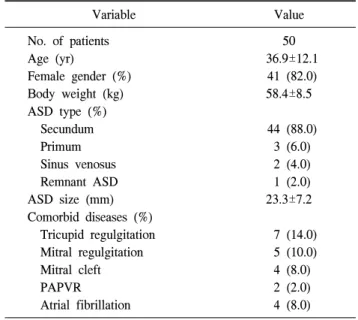
Table 1. Baseline characteristics

Variable Value

No. of patients Age (yr)

Female gender (%) Body weight (kg) ASD type (%) Secundum Primum Sinus venosus Remnant ASD ASD size (mm) Comorbid diseases (%) Tricupid regulgitation Mitral regulgitation Mitral cleft PAPVR Atrial fibrillation

50 36.9±12.1

41 (82.0) 58.4±8.5

44 (88.0) 3 (6.0) 2 (4.0) 1 (2.0) 23.3±7.2

7 (14.0) 5 (10.0) 4 (8.0) 2 (2.0) 4 (8.0) Values are presented as mean±standard deviation or number (%).

ASD, atrial septal defect; PAPVR, partial anomalous pulmo- nary venous return.

study, we reviewed our experience with an atrial septal defect and cormobid disease repairs using the da VinciTM surgical system.

MATERIALS AND METHODS 1) Patients

Fifty consecutive patients who underwent atrial septal de- fect repair using the da VinciTM surgical system (Intuitive Surgical Inc., Sunnyvale, CA, USA) from October 2007 to May 2011 were included in this study. The mean age was 36.9±12.1 years (range, 16 to 65 years; median age, 35 years), and 41 (82%) patients were female.

2) Preoperative diagnosis

Preoperative echocardiographic data were obtained from all patients. The types of atrial septal defects included secundum in 44 patients (88%), primum in 3, and sinus venosus in 2.

The remaining one patient had a remnant atrial septal defect and had undergone atrial septal defect closure with a bovine pericardial patch and mitral cleft repair via conventional ster- notomy 8 years earlier in another hospital. The mean size of the defects was 23.3±7.2 mm (range, 11 to 42 mm) and three patients had multiple defects. Nineteen patients had comorbid diseases including tricuspid regurgitation >grade 2 in 7, mi- tral regurgitation >grade 2 in 5, mitral cleft in 4, atrial fi- brillation in 4, and partial anomalous pulmonary venous re- turn in 2 (Table 1).

3) Surgical methods

(1) Patient preparation: Under general anesthesia, patients were intubated with double-lumen endotracheal tubes or sin- gle-lumen tubes with bronchial blockers to allow left-sided single-lung ventilation. Adhesive external defibrillator patches (Quik-Combo; Physio-Control Co., Redmond, WA, USA) were applied for defibrillation. A transesophageal echo- cardiography (TEE) probe inserted for pre- and post-operative evaluation. A 17–21Fr venous cannula was inserted percuta- neously into the right internal jugular vein after systemic hep- arinization (30 IU/kg) to prevent thrombus formation. Patients were placed in a left semi-lateral decubitus position with the right arm fixed on the table. After sterile preparation and

draping, the right femoral vessels were accessed through a 2 cm oblique incision along the inguinal crease. After systemic heparinization (300 IU/kg), a 22–28Fr venous cannula was in- serted through the right femoral vein into the inferior vena cava and the right common femoral artery was cannulated (14–17Fr).

① Mini-thoracotomy: An anterior mini-thoracotomy was made in the fourth intercostal space via a 4 cm skin incision.

Two additional port incisions were made in the third inter- costal space, just anterior to the anterior axillary line and in the sixth intercostal space, posterior to the anterior axillary line for the left and right robotic arms, respectively. The en- doscopic camera was placed through the mini-thoracotomy.

The Chitwood aortic clamp was inserted in the third inter- costal space as posteriorly as possible to the mid-axillary line to prevent interference between the instruments. The atrial re- tractor that was equipped with the third arm of the robot was inserted through the anterior margin of the mini-thoracotomy.

② Complete port access: The port for left and right ro-

botic arms and Chitwood aortic clamp were inserted into the

same site of the mini-thoracotomy case. The endoscopic port

incision was made in the fourth intercostal space, anterior to

(3)

the anterior axillary line and the assistant entrance in the fourth intercostal space, at the anterior axillary line (near the center of the triangle composed of the three ports for the left and right robotic arms and endoscope). The fifth port for the atrial retractor was made in the fourth or fifth intercostal space, at the midclavicular line.

(2) Intrathoracic procedure: A pericardiotomy was made and pericardial stay sutures placed. Caval snares were placed and cardiopulmonary bypass initiated with moderate hypothermia. A root cannula was inserted after purse string suture. Perfusion pressure was reduced and aortic cross clamping was performed. Cardioplegic solution (Custodiol histidine-tryptophan-ketoglutarate [HTK] solution, 2,000 mL;

Odyssey Pharmaceuticals, East Hanover, NJ, USA) was administered. In complete port access cases, the root cannula was removed after cardioplegia. An atrial incision was made near the interatrial septum for better surgical exposure. All surgical procedures (including atrial septal defect closure, tri- cuspid annuloplasty [TAP] and mitral valvuloplasty [MVP]) were performed without any limitation.

4) Follow-up

The mean follow-up duration was 16.9±10.4 months.

Follow-up was done by reviews of the records from admis- sion and the outpatient visits. We routinely took postoperative chest radiographs, electrocardiograms, and echocardiograms.

RESULTS

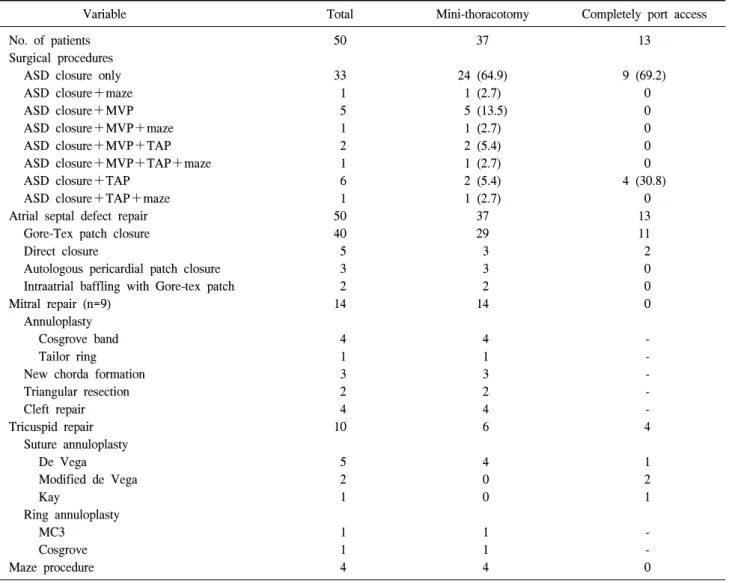
A total of 50 atrial septal defect repairs were performed with concomitant tricuspid annuloplasty in 10, mitral valvulo- plasty in 9, and a maze procedure in 4. Thirteen patients (26%) were approached by a totally endoscopic approach, while all tricuspid ring annuloplasty, mitral valvuloplasty, and maze procedures were approached by mini-thoracotomy. The atrial septal defects were mainly repaired by Gore-Tex patch closure (80%). In the two cases of sinus venosus type atrial septal defects, partial anomalous pulmonary venous returns were accompanied by right superior pulmonary veins draining into the superior vena cava and right atrium. Those were re- paired by interatrial baffling. All maze procedures were per- formed using cryoablation. Two patients underwent right-sid-

ed and the others biatrial maze procedures. The surgical pro- cedures are described in detail in Table 2.

The mean cardiopulmonary bypass (CPB) times were 157.6±49.7 minutes: 153.2±50.1 minutes for mini thor- acotomy cases and 170.3±48.1 minutes for totally endoscopic cases. The aortic cross-clamp (ACC) times were 74.1±32.2 minutes: 72.3±33.6 and 79.0±28.2 minutes, respectively.

There were no significant differences in CPB and ACC time (p=0.290, p=0.525).

Postoperatively, the mean hospital stay and intensive care unit stay were 5.5±3.3 days (range, 2 to 17 days) and 26.8±19.0 hours (range, 5 to 119 hours). During the same pe- riod, compared to sternotomy patients (n=30), there was sig- nificant difference (9.6±5.3 days, p<0.001; 71.3±110.9 hours, p=0.004). Automated endoscope system for optimal positioning (AESOP) patients (n=44) tended to stay longer, but the difference was not statistically significant (6.7±2.9 days, 36.5±16.7 hours).

There was no early or late mortality. Nor did any early surgical complications occur including reoperation for surgical failure (remnant atrial septal defect, mitral regurgitation, and tricuspid regurgitation), postoperative bleeding, or conversion to thoracotomy or sternotomy. There was no remnant in- teratrial shunt on intraoperative or postoperative echocar- diography. All the patients who underwent maze procedures maintained sinus rhythm without medication for the duration of follow-up (mean duration 13 months).

Three patients suffered from late complications that re- quired readmission. Two patients were clinically diagnosed with post-pericardiotomy syndrome; one patient was treated with steroid and the other with pericardiostomy and non- steroidal anti-inflammatory drugs. The last one had a periph- eral vascular access site infection with femoral artery pseu- doaneurysm formation at 30 days after surgery. She under- went an emergency operation for superficial femoral artery angioplasty and was treated with antibiotics.

DISCUSSION

As an alternative to the conventional sternotomy approach, less invasive cardiac surgery has been widely performed.

Particularly, the da VinciTM surgical robot system has been

(4)

Table 2. Operative data

Variable Total Mini-thoracotomy Completely port access

No. of patients Surgical procedures

ASD closure only ASD closure+maze ASD closure+MVP ASD closure+MVP+maze ASD closure+MVP+TAP ASD closure+MVP+TAP+maze ASD closure+TAP

ASD closure+TAP+maze Atrial septal defect repair

Gore-Tex patch closure Direct closure

Autologous pericardial patch closure Intraatrial baffling with Gore-tex patch Mitral repair (n=9)

Annuloplasty Cosgrove band Tailor ring New chorda formation Triangular resection Cleft repair Tricuspid repair

Suture annuloplasty De Vega

Modified de Vega Kay

Ring annuloplasty MC3

Cosgrove Maze procedure

50

33 1 5 1 2 1 6 1 50 40 5 3 2 14

4 1 3 2 4 10

5 2 1

1 1 4

37

24 (64.9) 1 (2.7) 5 (13.5)

1 (2.7) 2 (5.4) 1 (2.7) 2 (5.4) 1 (2.7) 37 29 3 3 2 14

4 1 3 2 4 6

4 0 0

1 1 4

13

9 (69.2) 0 0 0 0 0 4 (30.8)

0 13 11 2 0 0 0

- - - - - 4

1 2 1

- - 0 Values are presented as number or number (%).

ASD, atrial septal defect; MVP, mitral valvuloplasty; TAP, tricuspid annuloplasty.

considered as the representative of less invasive techniques.

The present study demonstrated that atrial septal defect clo- sure and other comorbid disease repair using the da VinciTM surgical system is feasible and safe.

The biggest reason for performing robotic surgery is that it is less invasive, with smaller incisions, less pain, and quicker recovery. Previous reports on postoperative quality of life af- ter robotic surgery noted the minimized degree of invasive- ness, hastened postoperative recovery and return to employ- ment-based activities, and improved quality of life, although the length of hospital stay was unchanged [4-6]. In our expe-

rience, although it is a subjective evaluation, patients who un- derwent robotic surgery have shown greater satisfaction with cosmetic results and less pain. In addition, the length of hos- pital stay was shorter than for conventional sternotomy patients.

In our experience, da VinciTM operations showed great

safety, even in redo operation cases. As mentioned above,

there were only three cases with late complications. Other

than two post-pericardiotomy syndrome cases, there was only

one complication. Also, a da VinciTM operation could be ap-

plied to any atrial septal defect regardless of type, size, and

(5)

location. We used a patch for atrial septal closures in most of the cases (45/50, 90%). Other procedures, including TAP, MVP, and the maze procedure, were performed without any limitation.

Totally endoscopic atrial septal defect closures were first reported by Torracca et al. [7] in 2001 and Argenziano et al.

[8] in 2003. We also approached completely by a port access in thirteen patients with relatively simple diseases. Complete port access can reduce incisions and musculoskeletal injury and shows better cosmetic results. In these cases, we used a long metal needle for the root cannula, instead of a 14-gauge angiocatheter or endo-aortic clamp balloon [9]. After car- dioplegia infusion, the root cannula was removed for better accessibility. In this situation, it was difficult to remove air from the left heart. However, by using CO

2

gas (flow 1.5 L/min), minimizing left atrial blood suction during the oper- ation, and identifying the air by TEE, we prevented air embolism. Furthermore, unlike earlier reports, we performed patch closures in most cases. By doing so, every type of at- rial septal defect could be repaired without additional oper- ation risks, regardless of the size, number, and location.

Despite its many advantages, robotic surgery has several limitations. First, it is difficult to access the da VinciTM sur- gical system. It is very expensive equipment and health in- surance in the Republic of Korea does not cover robotic sur- gery, so the cost of surgery is very high. In our hospital, the cost of surgery to the patient is 2 to 3 times more expensive than conventional sternotomy surgery (sternotomy 7–8;

AESOP 10; da VinciTM 15 million KRW). Also, robotic sur- gery requires more operation time and few surgeons are skil- led in robotic surgery. However, as time passes, it can be ex- pected that the da VinciTM surgical system will come into widespread use. Then, because the learning curve of the oper- ation technique is steep [10,11], more patients should have easy access to da VinciTM operation.

CONCLUSION

Atrial septal defect repair and concomitant mitral valve re- pair, tricuspid annuloplasty, or maze procedure using the da VinciTM surgical system can be performed safely under any

conditions with reasonable surgical outcomes. Complete port access is a helpful method in selected patients.

CONFLICT OF INTEREST

No potential conflict of interest relevant to this article was reported.

REFERENCES

1. Brickner ME, Hillis LD, Lange RA. Congenital heart dis- ease in adults: first of two parts. N Engl J Med 2000;342:

256-63.

2. Je HG, Lee YJ, Jung SH, et al. The first 20 cases of car- diac surgery using the da Vinci (TM) surgical system: a sin- gle center experience. Korean J Thorac Cardiovasc Surg 2008;41:423-9.

3. Kim GS, Lee JW, Jung SH, Kim JB, Jung JP. Completely port-accessed atrial septal defect patch closure using the da Vinci System: a case report. Korean J Thorac Cardiovasc Surg 2010;43:409-12.

4. Morgan JA, Peacock JC, Kohmoto T, et al. Robotic techni- ques improve quality of life in patients undergoing atrial septal defect repair. Ann Thorac Surg 2004;77:1328-33.

5. Suri RM, Antiel RM, Burkhart HM, et al. Quality of life af- ter early mitral valve repair using conventional and robotic approaches. Ann Thorac Surg 2012;93:761-9.

6. Bonaros N, Schachner T, Wiedemann D, et al. Quality of life improvement after robotically assisted coronary artery bypass grafting. Cardiology 2009;114:59-66.

7. Torracca L, Ismeno G, Alfieri O. Totally endoscopic com- puter-enhanced atrial septal defect closure in six patients.

Ann Thorac Surg 2001;72:1354-7.

8. Argenziano M, Oz MC, Kohmoto T, et al. Totally endo- scopic atrial septal defect repair with robotic assistance.

Circulation 2003;108 Suppl 1:II191-4.

9. Stevens JH, Burdon TA, Peters WS, et al. Port-access coro- nary artery bypass grafting: a proposed surgical method. J Thorac Cardiovasc Surg 1996;111:567-73.

10. Bonaros N, Schachner T, Oehlinger A, et al. Robotically as- sisted totally endoscopic atrial septal defect repair: insights from operative times, learning curves, and clinical outcome.

Ann Thorac Surg 2006;82:687-93.

11. Bonatti J, Schachner T, Bernecker O, et al. Robotic totally endoscopic coronary artery bypass: program development and learning curve issues. J Thorac Cardiovasc Surg 2004;

127:504-10.

수치

Table 1. Baseline characteristics Variable Value No.  of  patients Age  (yr) Female  gender  (%) Body  weight  (kg) ASD  type  (%)     Secundum     Primum     Sinus  venosus     Remnant  ASD ASD  size  (mm) Comorbid  diseases  (%)     Tricupid  regulgitati
Table 2. Operative data

참조

관련 문서

Intraoperative photograph shows grossly total removal of tumor using the navigation system

In this paper, defect of nuclear energy pipe and composite material were, measured using dual-beam shearography and infrared thermography, quantitatively

This showed that the surgical outcome was successfulin 269 patients (98.89%),butthe revision surgery due to surgicalrelapse was performed in three patients.Of 152 patients

Purpose: Giant cell tumor of the tendon sheath are the most common tumors after ganglionic cysts in benign soft tissue tumors which could be recurred after surgical

Kameoka, “Sentinel lymph node biopsy for breast cancer patients using fluorescence navigation with indocyanine green,” World Journal of Surgical Oncology, Vol..

1) It could be lengthened defected columella without additional surgical procedure. 2) It could be avoided a complication as like meganostril and delaying

Polypoid lesions of the gallbladder; Report of 111 cases with surgical reference to operative indication.. Polypoid lesion of GB: Indication of carcinoma

The lateral size of the defect obtained from the deformation amount and the defect detection test using the shearing interferometer, width and depth of