ABSTRACT
Background and Objectives: Balloon sizing remains the main technique for determining occluder device size for atrial septal defects (ASDs). New evidence has proposed that accurate estimation of device size could be possible without using the balloon technique. Operators have predicted the amount of possible enlargement depending on their experiences. Thus, selection criteria have mostly relied on personal observations and experiences. The objective of this study was to determine the relationship between age, sex, defect size, and deployed device size based on the balloon technique.
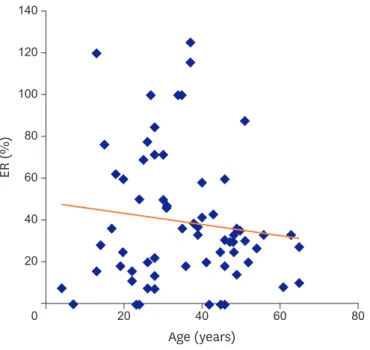
Subjects and Methods: Sixty-six patients who underwent percutaneous ASD closure with a Cardi-O-Fix occluder between 2011 and 2012 were retrospectively evaluated. Patients whose maximum defect size and device size were available were included. Enlargement amount (EA) (device size−defect size) and enlargement ratio (ER) (EA/defect size) were calculated. The relationship between these 2 calculations and age, sex, and defect size were analyzed.
Results: EA and ER were 5.2±3.6 mm (min: 0, max: 15, median: 5) and 39.3%±31.5% (min:
0, max: 125, median: 32), respectively. EA and ER did not differ between genders (p=0.800;
p=0.430). EA and ER were not correlated with maximum defect size (p=0.310; p=0.050).
EA and ER showed no correlation with age (p=0.970; p=0.640). However when patients were dichomotized based on age 40, ER was significantly lower in older group (p=0.030).
Unexpectedly, no difference was observed between the 2 groups in terms of EA (p=0.110).
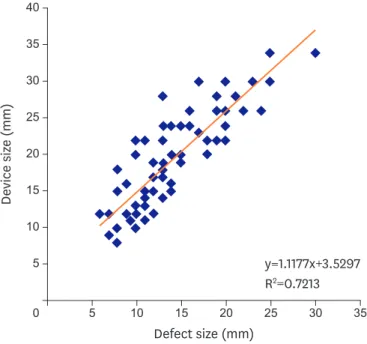
Size of deployed device had a strong correlation with defect size measured with two- dimensional (2D) transesophageal echocardiography (TEE; device size=1.1177×TEE defect size+3.5297; R=0.84; p<0.010).
Conclusion: EA and ER did not show a significant correlation with sex and defect size in our study. Patients older than 40 had a significantly lower ER compared to younger patients.
Device size was strongly correlated with defect size measured with TEE.
Keywords: Heart septal defects, atrial; Heart defects, congenital; Echocardiography
INTRODUCTION
Atrial septal defects (ASDs) are the most common congenital defects in adults following bicuspid aortic valve defects. Prevalence is about 2 per 1,000 live births. ASDs comprise 13% of all congenital defects.
1)Morbidity and mortality of ASDs are well documented when
Original Article
Received: Apr 3, 2017 Revised: May 14, 2017 Accepted: May 31, 2017 Correspondence to Semi Ozturk, MD
Department of Cardiology, Haseki Training and Research Hospital, Millet Caddesi Aksaray/
Fatih, Istanbul 34130, Turkey.
Tel: +90-212-529-4400 Fax: +90-212-589-6229 E-mail: [email protected] Copyright © 2017. The Korean Society of Cardiology
This is an Open Access article distributed under the terms of the Creative Commons Attribution Non-Commercial License (https://
creativecommons.org/licenses/by-nc/4.0) which permits unrestricted noncommercial use, distribution, and reproduction in any medium, provided the original work is properly cited.
ORCID iDs Semi Ozturk
https://orcid.org/0000-0001-5696-6849 Conflict of Interest
The authors have no financial conflicts of interest.
Semi Ozturk , MD 1 , Ahmed Seyfettin Gurbuz, MD 2 , Suleyman Cagan Efe, MD 3 , Mehmet Fatih Yılmaz, MD 4 , and Cevat Kırma, MD 4
1
Department of Cardiology, Haseki Training and Research Hospital, Istanbul, Turkey
2
Department of Cardiology, Yunus Emre State Hospital, Eskişehir, Turkey
3
Department of Cardiology, Ağrı State Hospital, Ağrı, Turkey
4