ABSTRACT
Background and Objectives: We sought to evaluate nationwide trends, characteristics, and clinical outcomes in patients undergoing percutaneous coronary intervention (PCI) in Korea.
Methods: From National Health Insurance claims data in Korea, 81,115 patients, who underwent PCI for the first episode of coronary artery disease between 2011 and 2015, were enrolled. Patients were categorized into angina (n=49,288) or acute myocardial infarction (AMI, n=31,887) groups and analyzed.
Results: The mean age of patients was 64.4±12.2 years and 56,576 (69.7%) were men.
Diabetes, hyperlipidemia, and hypertension were observed in 27,086 (33.4%), 30,675 (37.8%), and 45,389 (56.0%) patients, respectively. There was a 10% increase in the number of patients undergoing PCI for angina between 2011–2012 and 2014–2015 (11,105 vs. 13,261; p=0.021).
However, the number of patients undergoing PCI for AMI marginally decreased between 2011–2012 and 2014–2015 (8,068 vs. 7,823; p=0.052). In procedures, drug-eluting stent was the most frequently used device (93.2%), followed by balloon angioplasty (5.5%) and bare metal stents (1.3%). The mean number of stents per patient was 1.39±0.64. At discharge, dual-anti platelet therapy, statin, beta-blockers, and angiotensin converting enzyme inhibitor or angiotensin receptor blocker were provided to 76,292 (94.1%), 71,411 (88.0%), 57,429 (70.8%), and 54,418 (67.1%) patients, respectively. The mean in-hospital and 1-year total medical costs were 8,628,768±4,832,075 and 13,128,158±9,758,753 Korean Won, respectively.
In-hospital mortality occurred in 2,094 patients (2.6%).
Conclusions: Appropriate healthcare strategies reflecting trends, characteristics, and clinical outcomes of PCI are needed in Korea.
Keywords: Percutaneous coronary intervention; Angina pectoris; Myocardial infarction;
Coronary artery disease
Original Article
Received: Nov 23, 2017 Revised: Jan 7, 2018 Accepted: Jan 17, 2018 Correspondence to Gyung-Min Park, MD
Department of Cardiology, Ulsan University Hospital, University of Ulsan College of Medicine, 877, Bangeojinsunhwando-ro, Dong-gu, Ulsan 44033, Korea.
E-mail: [email protected] Copyright © 2018. The Korean Society of Cardiology
This is an Open Access article distributed under the terms of the Creative Commons Attribution Non-Commercial License (https://
creativecommons.org/licenses/by-nc/4.0) which permits unrestricted noncommercial use, distribution, and reproduction in any medium, provided the original work is properly cited.
ORCID iDs Seungbong Han
https://orcid.org/0000-0003-2938-8072 Gyung-Min Park
https://orcid.org/0000-0001-5846-0606 Yong-Giun Kim
https://orcid.org/0000-0002-0816-9025 Mahn-Won Park
https://orcid.org/0000-0001-5293-8461 Sung Ho Her
https://orcid.org/0000-0002-1548-4154
Seungbong Han , PhD1, Gyung-Min Park , MD2, Yong-Giun Kim , MD2, Mahn-Won Park , MD3, Sung Ho Her , MD3, Seung-Whan Lee , MD4, and Young-Hak Kim , MD4
1Department of Applied Statistics, Gachon University, Seongnam, Korea
2Department of Cardiology, Ulsan University Hospital, University of Ulsan College of Medicine, Ulsan, Korea
3Department of Cardiology, Daejeon St. Mary's Hospital, The Catholic University of Korea, Daejeon, Korea
4Department of Cardiology, Asan Medical Center, University of Ulsan College of Medicine, Seoul, Korea
Trends, Characteristics, and Clinical
Outcomes of Patients Undergoing
Percutaneous Coronary Intervention
in Korea between 2011 and 2015
Seung-Whan Lee
https://orcid.org/0000-0002-2662-5952 Young-Hak Kim
https://orcid.org/0000-0002-3610-486X Funding
This study was supported by research grants from Korean Circulation Society (201505-03) and Basic Science Research Program through the National Research Foundation of Korea funded by the Ministry of Science and ICT (2017R1C1B1006717).
Conflict of Interest
The authors have no financial conflicts of interest.
Author Contributions
Conceptualization: Park GM; Data curation:
Han S, Park GM; Formal analysis: Han S, Park GM; Funding acquisition: Han S, Park GM;
Investigation: Han S, Park GM; Methodology:
Han S, Park GM; Project administration: Park GM, Her SH; Supervision: Kim YG, Park MW, Her SH, Lee SW, Kim YH; Validation: Park GM; Writing - original draft: Han S, Park GM;
Writing - review & editing: Han S, Park GM, Kim YG, Park MW, Her SH, Lee SW, Kim YH.
INTRODUCTION
Percutaneous coronary intervention (PCI) is the main strategy for the treatment of
obstructive coronary artery disease (CAD).1) In addition, with recent advances in devices and adjuvant pharmacologic agents, PCI indications were expanded to the high-risk patients.2) However, when taking the entire clinical practice into account, limited data are available to describe nationwide contemporary practice patterns of PCI in Korea. Recent registry studies have analyzed the current status of PCI in Korea.3)4) However, these studies analyzed limited populations, with particularly focusing on relatively higher PCI volume centers. Therefore, using claims data of the National Health Insurance (NHI) in South Korea, we sought to evaluate nationwide trends, characteristics, and clinical outcomes of patients undergoing PCI in Korea.
METHODS
Data sources
In Korea, all healthcare providers have had to join the NHI system on a fee-for-service basis. The Health Insurance Review & Assessment Service (HIRA) is a quasi-governmental organization that systematically reviews medical fees to minimize the risk of redundant and unnecessary medical services. Consequently, all NHI claims are reviewed by the HIRA.5) For this study, data from the 2011–2015 claims records of the HIRA were used. Diagnosis codes were used according to the International Classification of Diseases, 10th revision (ICD-10).
In addition, specific information about the drugs, devices, and procedures were identified by codes from the HIRA database.5)6) This study was approved by the local Institutional Review Board of Ulsan University Hospital, Ulsan, Korea (approval number: 2016-10-022).
Study population
From the claims database of the HIRA between July 2011 and June 2015, we identified patients aged 18 years and older who had undergone PCI (M6551, M6552, M6561–4, M6571, and M6572) for the diagnosis of CAD (ICD-10 codes I20.X–I25.X). To examine national trends in patients with the first episode of CAD, patients with at least 6 months of eligibility prior to the index day were selected. Specifically, we excluded patients if the HIRA database indicated that they had a previous history of CAD (ICD-10 codes I20.X–25.X) within 6 months of the index day to ensure that it was the patients' first episode of CAD. Additionally, patients were categorized as either those with acute myocardial infarction (AMI) or angina pectoris and analyzed separately. AMI was defined by using the hospital discharge databases of the HIRA (ICD-10 codes I21.X–I22.X)
Study variables
The ICD-10 codes were used to identify comorbid conditions, such as diabetes mellitus, diabetes mellitus with chronic complications, hyperlipidemia, hypertension, congestive heart failure, arrhythmia, valvular disease, peripheral vascular disease, cerebrovascular disease, chronic pulmonary disease, moderate to severe liver disease, renal disease, cancer, and rheumatic disease.7)8) The Charlson comorbidity index (CCI) was obtained from the ICD-10 codes.7) In the HIRA database, all prescribed medications were recorded with rigorous accuracy. Patients were also considered to have diabetes mellitus, hypertension, and hyperlipidemia if anti-diabetic, anti-hypertensive, and anti-hyperlipidemic drugs were identified from the medication codes within 6 months of the index day. Furthermore,
we identified used medications, such as anti-platelet agents, statins, beta-blockers, and angiotensin-converting enzyme inhibitors (ACEIs) or angiotensin receptor blockers (ARBs).6) We classified claims as drug-eluting stents (DESs) if DES device codes (J5083XXX) appeared.
The claims were designated as bare metal stents (BMSs) if there were BMS device codes (J5231XXX). The claims were also assigned as a non-stent coronary balloon angioplasty if device codes were unaccompanied by any code indicating a DES or BMS.
Clinical outcomes and medical costs
Death was identified by all in- and out-patient claims that indicated death. Myocardial infarction was defined using the hospital discharge databases of the HIRA (ICD-10 codes I21.X–22.X). Coronary revascularizations in the HIRA database were identified using the procedure codes of PCI (M6551, M6552, M6561–4, M6571, and M6572) and coronary artery bypass surgery (O1641, O1642, O1647, OA641, OA642, and OA647). In this current study, for the evaluation of clinical outcomes, the HIRA database was used until July 2016.9) In patients with multiple events, the first event was considered to be the component of the composite outcome.
We also examined and calculated medical costs on the basis of the Korean Won (KRW). Total medical costs were defined as the sum of 3 direct medical costs: inpatient care, outpatient care, and prescription drugs. We assessed 1-year medical costs regardless of events. For the measurement of CAD-related medical costs, we obtained CAD-related claim costs from the HIRA databases (ICD-10 codes I20–25).10)
Statistical analysis
We summarized patient characteristics, procedure/drug information and medical costs from 2011 to 2015 by presenting the mean±standard deviation or frequency (percentage) for continuous or categorical variables, respectively. We analyzed the 5-years trend based on the χ2 test, the logistic regression or the linear regression according to the categorical or the continuous variables. When there are more than three categories such as the device information, we used the multinomial logistic regression model. Survival outcomes, such as all-cause death and death/coronary revascularization, were summarized by the Kaplan-Meier method. Cumulative incidence rates between the angina and AMI groups were compared using the log-rank test. Furthermore, the Cox regression model was used to detect any trend from July 2011 to June 2015 after truncating the survival outcomes at the 1-year time point.
Statistical significance was defined as p<0.05 for all two-tailed tests. All data analysis was performed using the R software version 3.3.1 (R Foundation for Statistical Computing, Vienna, Austria; www.r-project.org).
RESULTS
PCI trends across Korea
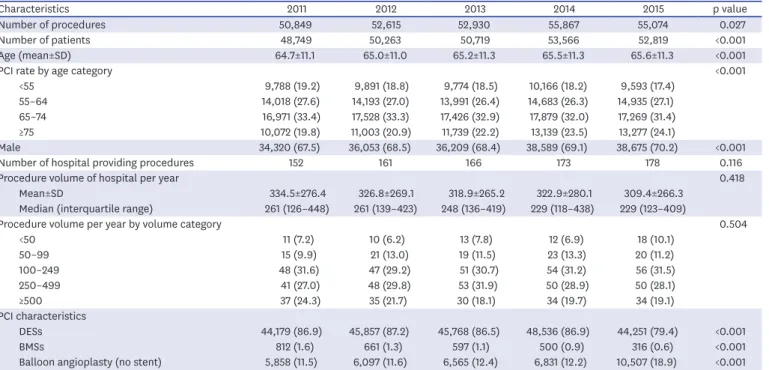
Between 2011 and 2015, a total of 256,116 patients who underwent 267,335 PCI procedures were identified from the claims database of HIRA (Table 1). During a period of 5 years, PCI became more prevalent over time, increasing from 50,849 procedures in 2011 to 55,074 procedures in 2015 (an 8% increase). The mean age of patients and the proportion of male also increased during the same time period. Furthermore, a 17% increase in the number of PCI-providing hospitals occurred between 2011 and 2015 (152 versus 178 hospitals), with a
gradual decrease in the mean caseload per hospital (334.5±276.4 in 2011 vs. 309.4±266.3 in 2015). In the PCI procedures, DES was the most frequent device (n=228,591, 85.3%), followed by balloon angioplasty (n=35,858, 13.4%) and BMS (n=2,886, 1.1%). In addition, although DES and BMS showed a gradual decrease over time, balloon angioplasty gradually increased during this period of 5 years.
Characteristics in patients undergoing PCI
Among patients undergoing PCI, 81,115 patients met the eligibility criteria for the first episode of CAD and were included in the study population (Figure 1). Between July 2011 Table 1. Characteristics of patients who underwent PCI and of hospitals that performed PCI in Korea between 2011 and 2015
Characteristics 2011 2012 2013 2014 2015 p value
Number of procedures 50,849 52,615 52,930 55,867 55,074 0.027
Number of patients 48,749 50,263 50,719 53,566 52,819 <0.001
Age (mean±SD) 64.7±11.1 65.0±11.0 65.2±11.3 65.5±11.3 65.6±11.3 <0.001
PCI rate by age category <0.001
<55 9,788 (19.2) 9,891 (18.8) 9,774 (18.5) 10,166 (18.2) 9,593 (17.4)
55–64 14,018 (27.6) 14,193 (27.0) 13,991 (26.4) 14,683 (26.3) 14,935 (27.1)
65–74 16,971 (33.4) 17,528 (33.3) 17,426 (32.9) 17,879 (32.0) 17,269 (31.4)
≥75 10,072 (19.8) 11,003 (20.9) 11,739 (22.2) 13,139 (23.5) 13,277 (24.1)
Male 34,320 (67.5) 36,053 (68.5) 36,209 (68.4) 38,589 (69.1) 38,675 (70.2) <0.001
Number of hospital providing procedures 152 161 166 173 178 0.116
Procedure volume of hospital per year 0.418
Mean±SD 334.5±276.4 326.8±269.1 318.9±265.2 322.9±280.1 309.4±266.3
Median (interquartile range) 261 (126–448) 261 (139–423) 248 (136–419) 229 (118–438) 229 (123–409)
Procedure volume per year by volume category 0.504
<50 11 (7.2) 10 (6.2) 13 (7.8) 12 (6.9) 18 (10.1)
50–99 15 (9.9) 21 (13.0) 19 (11.5) 23 (13.3) 20 (11.2)
100–249 48 (31.6) 47 (29.2) 51 (30.7) 54 (31.2) 56 (31.5)
250–499 41 (27.0) 48 (29.8) 53 (31.9) 50 (28.9) 50 (28.1)
≥500 37 (24.3) 35 (21.7) 30 (18.1) 34 (19.7) 34 (19.1)
PCI characteristics
DESs 44,179 (86.9) 45,857 (87.2) 45,768 (86.5) 48,536 (86.9) 44,251 (79.4) <0.001
BMSs 812 (1.6) 661 (1.3) 597 (1.1) 500 (0.9) 316 (0.6) <0.001
Balloon angioplasty (no stent) 5,858 (11.5) 6,097 (11.6) 6,565 (12.4) 6,831 (12.2) 10,507 (18.9) <0.001 Data shown are number (%) not otherwise specified.
BMS = bare metal stent; DES = drug-eluting stent; PCI = percutaneous coronary intervention; SD = standard deviation.
Patients aged 18 years and older undergoing PCI for a diagnosis of CAD from July 2011 to June 2015 (n=191,926)
Angina group
(n=49,228) AMI group
(n=31,887) Included in analysis (n=81,115)
Excluded–CAD history in the HIRA database within 6 months (n=110,811)
Figure 1. Overview of the study population.
CAD = coronary artery disease; HIRA = Health Insurance Review & Assessment Service; AMI = acute myocardial infarction; PCI = percutaneous coronary intervention.
and June 2015, HIRA claims data indicated that PCI procedures were performed for angina pectoris (n=49,288, 60.7%) or AMI (n=31,887, 39.3%). The mean age of patients was 64.4±12.2 years and 56,576 (69.7%) were men. Diabetes, hyperlipidemia, and hypertension were observed in 27,086 (33.4%), 30,675 (37.8%), and 45,389 (56.0%) patients, respectively.
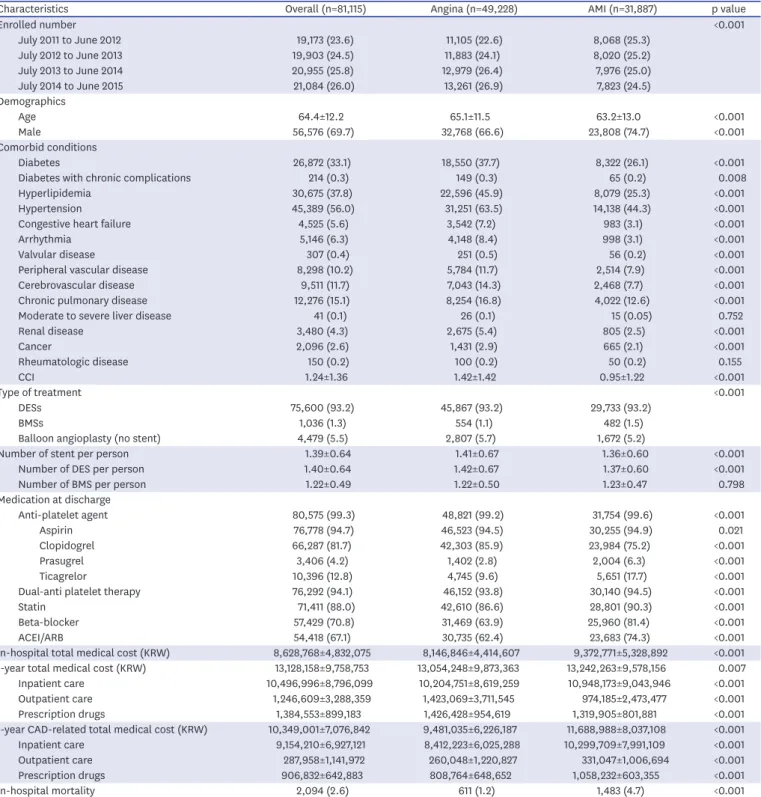
Patients with angina were older and had more comorbid conditions than those with AMI (Table 2). In PCI procedures, DES was the most frequently used treatment modality (93.2%).
BMS and balloon angioplasty were also used in 1.3% and 5.5% of patients. The mean number of stents per patient was 1.39±0.64. At discharge, aspirin, P2Y12 inhibitors, statins, beta-blockers, and ACEI or ARB were provided to 76,778 (94.7%), 80,089 (98.7%), 71,411 (88.0%), 57,429 (70.8%), and 54,418 (67.1%) patients, respectively. The mean in-hospital and 1-year total medical costs were 8,628,768±4,832,075 and 13,128,158±9,758,753 KRW. In- hospital mortality occurred in 2,094 patients (2.6%). During the follow-up period (median 2.1 [interquartile range, 1.1–3.2] years), 5,849 (7.2%) deaths and 7,884 (9.7%) coronary revascularizations were observed (Figure 2).
Trends in patients undergoing PCI for angina
In patients undergoing PCI for angina (Table 3), a 10% increase in the number of patients was noted between 2011–2012 and 2014–2015 (11,105 vs. 13,261; p=0.021). The average age of patients and proportion of male increased over time. However, there was no significant difference in comorbid conditions of patients, reflected by the CCI. In PCI procedures, the proportion of patients treated with DES showed a modest increase for 4 years. On the contrary, the proportion of BMS significantly decreased during the same period. The mean number of stents per patient decreased from 1.42±0.66 in 2011–2012 and 1.40±0.69 in 2014–
2015. In the discharge medications, although the use of statins was much improved over 4 years, the use of ACEI or ARB was significantly reduced. The 1-year total and CAD-related medical costs significantly decreased from 2011–2012 to 2014–2015, which was mainly due to the reduction of in-hospital medical costs. However, no significant differences were found in the incidence of clinical outcomes for 4 years.
No. at risk
Angina 49,228 38,757 25,379 13,775 3,995
AMI 31,887 24,186 16,592 9,440 2,691
No. at risk
Angina 49,228 36,547 22,955 12,207 3,418
AMI 31,887 22,246 14,560 8,143 2,288
Years after enrollment
All-cause death Death/coronary revascularization
A
0 1 2 3 4
Cumulative incidence (%)
20 15 10 5
Years after enrollment
0 1 2 3 4
B
Cumulative incidence (%)
40 30
10 20 Angina
AMI p<0.001
Angina AMI p<0.001
7.5 15.0
19.6 22.6
17.6
25.2
20.2 14.4
9.5
8.7 10.2 11.7
7.2 8.7 5.6
4.0
Figure 2. Cumulative incidence rates for (A) all-cause death and (B) death/coronary revascularization between angina and AMI groups.
The numbers in each figure represent the cumulative incidence rates at each time point.
AMI = acute myocardial infarction.
Table 2. Characteristics of patients who underwent PCI in Korea between 2011 and 2015
Characteristics Overall (n=81,115) Angina (n=49,228) AMI (n=31,887) p value
Enrolled number <0.001
July 2011 to June 2012 19,173 (23.6) 11,105 (22.6) 8,068 (25.3)
July 2012 to June 2013 19,903 (24.5) 11,883 (24.1) 8,020 (25.2)
July 2013 to June 2014 20,955 (25.8) 12,979 (26.4) 7,976 (25.0)
July 2014 to June 2015 21,084 (26.0) 13,261 (26.9) 7,823 (24.5)
Demographics
Age 64.4±12.2 65.1±11.5 63.2±13.0 <0.001
Male 56,576 (69.7) 32,768 (66.6) 23,808 (74.7) <0.001
Comorbid conditions
Diabetes 26,872 (33.1) 18,550 (37.7) 8,322 (26.1) <0.001
Diabetes with chronic complications 214 (0.3) 149 (0.3) 65 (0.2) 0.008
Hyperlipidemia 30,675 (37.8) 22,596 (45.9) 8,079 (25.3) <0.001
Hypertension 45,389 (56.0) 31,251 (63.5) 14,138 (44.3) <0.001
Congestive heart failure 4,525 (5.6) 3,542 (7.2) 983 (3.1) <0.001
Arrhythmia 5,146 (6.3) 4,148 (8.4) 998 (3.1) <0.001
Valvular disease 307 (0.4) 251 (0.5) 56 (0.2) <0.001
Peripheral vascular disease 8,298 (10.2) 5,784 (11.7) 2,514 (7.9) <0.001
Cerebrovascular disease 9,511 (11.7) 7,043 (14.3) 2,468 (7.7) <0.001
Chronic pulmonary disease 12,276 (15.1) 8,254 (16.8) 4,022 (12.6) <0.001
Moderate to severe liver disease 41 (0.1) 26 (0.1) 15 (0.05) 0.752
Renal disease 3,480 (4.3) 2,675 (5.4) 805 (2.5) <0.001
Cancer 2,096 (2.6) 1,431 (2.9) 665 (2.1) <0.001
Rheumatologic disease 150 (0.2) 100 (0.2) 50 (0.2) 0.155
CCI 1.24±1.36 1.42±1.42 0.95±1.22 <0.001
Type of treatment <0.001
DESs 75,600 (93.2) 45,867 (93.2) 29,733 (93.2)
BMSs 1,036 (1.3) 554 (1.1) 482 (1.5)
Balloon angioplasty (no stent) 4,479 (5.5) 2,807 (5.7) 1,672 (5.2)
Number of stent per person 1.39±0.64 1.41±0.67 1.36±0.60 <0.001
Number of DES per person 1.40±0.64 1.42±0.67 1.37±0.60 <0.001
Number of BMS per person 1.22±0.49 1.22±0.50 1.23±0.47 0.798
Medication at discharge
Anti-platelet agent 80,575 (99.3) 48,821 (99.2) 31,754 (99.6) <0.001
Aspirin 76,778 (94.7) 46,523 (94.5) 30,255 (94.9) 0.021
Clopidogrel 66,287 (81.7) 42,303 (85.9) 23,984 (75.2) <0.001
Prasugrel 3,406 (4.2) 1,402 (2.8) 2,004 (6.3) <0.001
Ticagrelor 10,396 (12.8) 4,745 (9.6) 5,651 (17.7) <0.001
Dual-anti platelet therapy 76,292 (94.1) 46,152 (93.8) 30,140 (94.5) <0.001
Statin 71,411 (88.0) 42,610 (86.6) 28,801 (90.3) <0.001
Beta-blocker 57,429 (70.8) 31,469 (63.9) 25,960 (81.4) <0.001
ACEI/ARB 54,418 (67.1) 30,735 (62.4) 23,683 (74.3) <0.001
In-hospital total medical cost (KRW) 8,628,768±4,832,075 8,146,846±4,414,607 9,372,771±5,328,892 <0.001
1-year total medical cost (KRW) 13,128,158±9,758,753 13,054,248±9,873,363 13,242,263±9,578,156 0.007
Inpatient care 10,496,996±8,796,099 10,204,751±8,619,259 10,948,173±9,043,946 <0.001
Outpatient care 1,246,609±3,288,359 1,423,069±3,711,545 974,185±2,473,477 <0.001
Prescription drugs 1,384,553±899,183 1,426,428±954,619 1,319,905±801,881 <0.001
1-year CAD-related total medical cost (KRW) 10,349,001±7,076,842 9,481,035±6,226,187 11,688,988±8,037,108 <0.001
Inpatient care 9,154,210±6,927,121 8,412,223±6,025,288 10,299,709±7,991,109 <0.001
Outpatient care 287,958±1,141,972 260,048±1,220,827 331,047±1,006,694 <0.001
Prescription drugs 906,832±642,883 808,764±648,652 1,058,232±603,355 <0.001
In-hospital mortality 2,094 (2.6) 611 (1.2) 1,483 (4.7) <0.001
Data shown are number (%) or mean±SD.
ACEI = angiotensin-converting enzyme inhibitor; AMI = acute myocardial infarction; ARB = angiotensin receptor blocker; BMS = bare metal stent; CAD = coronary artery disease; CCI = Charlson comorbidity index; DES = drug-eluting stent; KRW = Korean Won; PCI = percutaneous coronary intervention; SD = standard deviation.
Trends in patients undergoing PCI for AMI
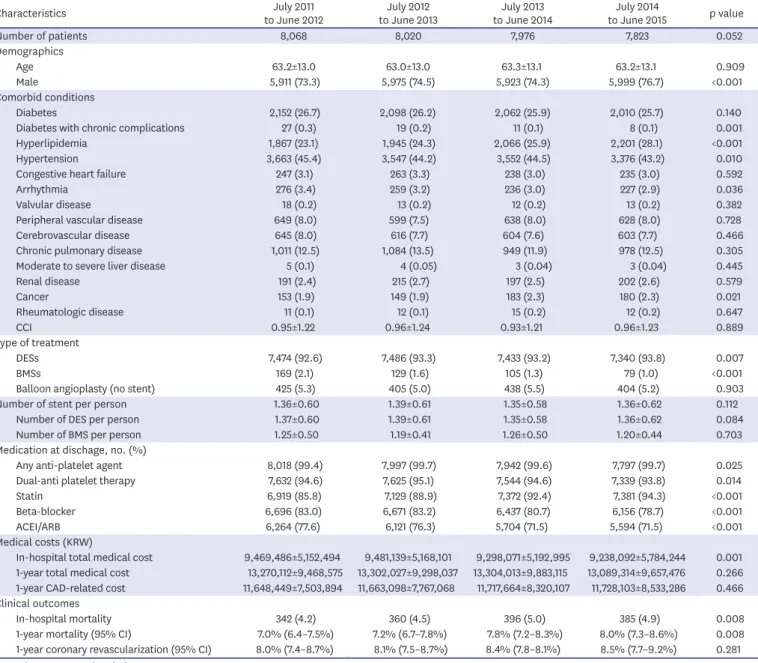
In patients who underwent PCI for AMI (Table 4), the number of patients marginally decreased between 2011–2012 and 2014–2015 (8,068 vs. 7,823; p=0.052). The proportion of male significantly increased during 4 years. However, the mean age and CCI of patients did not differ during same period. In PCI procedures, DES was the most commonly used device with a modest increase. Conversely, the use of BMS significantly decreased over time. In the discharge medications, the use of statins was significantly increased. However, beta- blockers and ACEI or ARB use was significantly reduced. In-hospital medical costs gradually decreased from 2011–2012 to 2014–2015. However, the improvement in clinical outcomes was not observed.
Table 3. Characteristics of patients with angina who underwent PCI in Korea between 2011 and 2015
Characteristics July 2011
to June 2012 July 2012
to June 2013 July 2013
to June 2014 July 2014
to June 2015 p value
Number of patients 11,105 11,883 12,979 13,261 0.021
Demographics
Age 64.8±11.3 65.1±11.4 65.2±11.5 65.4±11.7 <0.001
Male 7,325 (66.0) 7,873 (66.3) 8,604 (66.3) 8,966 (67.6) 0.008
Comorbid conditions
Diabetes 4,148 (37.4) 4,479 (37.7) 4,889 (37.7) 5,034 (38.0) 0.362
Diabetes with chronic complications 60 (0.5) 38 (0.3) 27 (0.2) 24 (0.2) <0.001
Hyperlipidemia 4,787 (43.1) 5,347 (45.0) 5,963 (45.9) 6,499 (49.0) <0.001
Hypertension 7,204 (64.9) 7,703 (64.8) 8,164 (62.9) 8,180 (61.7) <0.001
Congestive heart failure 760 (6.8) 892 (7.5) 924 (7.1) 966 (7.3) 0.406
Arrhythmia 935 (8.4) 1,016 (8.6) 1,095 (8.4) 1,102 (8.3) 0.675
Valvular disease 69 (0.6) 62 (0.5) 60 (0.5) 60 (0.5) 0.055
Peripheral vascular disease 1,269 (11.4) 1,391 (11.7) 1,529 (11.8) 1,595 (12.0) 0.152
Cerebrovascular disease 1,595 (14.4) 1,764 (14.8) 1,843 (14.2) 1,841 (13.9) 0.124
Chronic pulmonary disease 1,902 (17.1) 2,004 (16.9) 2,159 (16.6) 2,189 (16.5) 0.171
Moderate to severe liver disease 8 (0.1) 8 (0.1) 6 (0.05) 4 (0.03) 0.116
Renal disease 568 (5.1) 639 (5.4) 733 (5.6) 735 (5.5) 0.100
Cancer 297 (2.7) 354 (3.0) 394 (3.0) 386 (2.9) 0.293
Rheumatologic disease 16 (0.1) 34 (0.3) 18 (0.1) 32 (0.2) 0.454
CCI 1.41±1.41 1.44±1.41 1.42±1.43 1.42±1.42 0.909
Type of treatment
DESs 10,299 (92.7) 11,064 (93.1) 12,113 (93.3) 12,391 (93.4) 0.026
BMSs 177 (1.6) 141 (1.2) 143 (1.1) 93 (0.7) <0.001
Balloon angioplasty (no stent) 629 (5.7) 678 (5.7) 723 (5.6) 777 (5.9) 0.614
Number of stent per person 1.42±0.66 1.42±0.66 1.40±0.64 1.40±0.69 0.003
Number of DES per person 1.43±0.67 1.43±0.66 1.40±0.64 1.41±0.70 0.001
Number of BMS per person 1.24±0.51 1.21±0.48 1.20±0.51 1.22±0.53 0.630
Medication at discharge
Any anti-platelet agent 10,928 (98.4) 11,807 (99.4) 12,899 (99.4) 13,187 (99.4) <0.001
Dual-anti platelet therapy 10,355 (93.2) 11,222 (94.4) 12,193 (93.9) 12,382 (93.4) 0.741
Statin 9,008 (81.1) 10,032 (84.4) 11,510 (88.7) 12,060 (90.9) <0.001
Beta-blocker 7,079 (63.7) 7,604 (64.0) 8,431 (65.0) 8,355 (63.0) 0.446
ACEI/ARB 7,150 (64.4) 7,501 (63.1) 8,017 (61.8) 8,067 (60.8) <0.001
Medical costs (KRW)
In-hospital total medical cost 8,322,562±4,371,847 8,344,799±4,343,881 8,055,496±4,292,884 7,911,723±4,612,568 <0.001 1-year total medical cost 13,153,657±9,669,082 13,318,153±9,793,798 13,142,459±9,972,496 12,648,185±10,004,093 <0.001 1-year CAD-related cost 9,596,176±5,986,055 9,663,700±6,200,825 9,436,095±6,257,645 9,264,916±6,406,114 <0.001 Clinical outcomes
In-hospital mortality 119 (1.1) 170 (1.4) 142 (1.1) 180 (1.4) 0.218
1-year mortality (95% CI) 3.6% (3.3–4.0%) 4.2% (3.9–4.6%) 3.7% (3.4–4.1%) 4.1% (3.7–4.4%) 0.178
1-year myocardial infarction (95% CI) 0.6% (0.4–0.7%) 0.6% (0.5–0.8%) 0.6% (0.4–0.7%) 0.7% (0.5–0.8%) 0.385 1-year coronary revascularization (95% CI) 6.1% (5.7–6.4%) 6.3% (5.9–6.8%) 5.4% (5.0–5.8%) 5.7% (5.3–6.2%) 0.043 Data shown are number (%) or mean±SD.
ACEI = angiotensin-converting enzyme inhibitor; ARB = angiotensin receptor blocker; BMS = bare metal stent; CAD = coronary artery disease; CCI = Charlson comorbidity index; CI = confidence interval; DES = drug-eluting stent; KRW = Korean Won; PCI = percutaneous coronary intervention; SD = standard deviation.
DISCUSSION
In the present analysis using NHI claims data in Korea, our main findings were as follows:
1) In patients who underwent PCI for the first episode of CAD, the number of patients for angina significantly increased, but the number of those for AMI marginally decreased; 2) Irrespective of clinical presentations, DES was the most commonly used device; 3) The use of medication at discharge was still inappropriate and clinical outcomes did not improve between 2011–2012 and 2014–2015.
Table 4. Characteristics of patients with AMI who underwent PCI in Korea between 2011 and 2015
Characteristics July 2011
to June 2012 July 2012
to June 2013 July 2013
to June 2014 July 2014
to June 2015 p value
Number of patients 8,068 8,020 7,976 7,823 0.052
Demographics
Age 63.2±13.0 63.0±13.0 63.3±13.1 63.2±13.1 0.909
Male 5,911 (73.3) 5,975 (74.5) 5,923 (74.3) 5,999 (76.7) <0.001
Comorbid conditions
Diabetes 2,152 (26.7) 2,098 (26.2) 2,062 (25.9) 2,010 (25.7) 0.140
Diabetes with chronic complications 27 (0.3) 19 (0.2) 11 (0.1) 8 (0.1) 0.001
Hyperlipidemia 1,867 (23.1) 1,945 (24.3) 2,066 (25.9) 2,201 (28.1) <0.001
Hypertension 3,663 (45.4) 3,547 (44.2) 3,552 (44.5) 3,376 (43.2) 0.010
Congestive heart failure 247 (3.1) 263 (3.3) 238 (3.0) 235 (3.0) 0.592
Arrhythmia 276 (3.4) 259 (3.2) 236 (3.0) 227 (2.9) 0.036
Valvular disease 18 (0.2) 13 (0.2) 12 (0.2) 13 (0.2) 0.382
Peripheral vascular disease 649 (8.0) 599 (7.5) 638 (8.0) 628 (8.0) 0.728
Cerebrovascular disease 645 (8.0) 616 (7.7) 604 (7.6) 603 (7.7) 0.466
Chronic pulmonary disease 1,011 (12.5) 1,084 (13.5) 949 (11.9) 978 (12.5) 0.305
Moderate to severe liver disease 5 (0.1) 4 (0.05) 3 (0.04) 3 (0.04) 0.445
Renal disease 191 (2.4) 215 (2.7) 197 (2.5) 202 (2.6) 0.579
Cancer 153 (1.9) 149 (1.9) 183 (2.3) 180 (2.3) 0.021
Rheumatologic disease 11 (0.1) 12 (0.1) 15 (0.2) 12 (0.2) 0.647
CCI 0.95±1.22 0.96±1.24 0.93±1.21 0.96±1.23 0.889
Type of treatment
DESs 7,474 (92.6) 7,486 (93.3) 7,433 (93.2) 7,340 (93.8) 0.007
BMSs 169 (2.1) 129 (1.6) 105 (1.3) 79 (1.0) <0.001
Balloon angioplasty (no stent) 425 (5.3) 405 (5.0) 438 (5.5) 404 (5.2) 0.903
Number of stent per person 1.36±0.60 1.39±0.61 1.35±0.58 1.36±0.62 0.112
Number of DES per person 1.37±0.60 1.39±0.61 1.35±0.58 1.36±0.62 0.084
Number of BMS per person 1.25±0.50 1.19±0.41 1.26±0.50 1.20±0.44 0.703
Medication at dischage, no. (%)
Any anti-platelet agent 8,018 (99.4) 7,997 (99.7) 7,942 (99.6) 7,797 (99.7) 0.025
Dual-anti platelet therapy 7,632 (94.6) 7,625 (95.1) 7,544 (94.6) 7,339 (93.8) 0.014
Statin 6,919 (85.8) 7,129 (88.9) 7,372 (92.4) 7,381 (94.3) <0.001
Beta-blocker 6,696 (83.0) 6,671 (83.2) 6,437 (80.7) 6,156 (78.7) <0.001
ACEI/ARB 6,264 (77.6) 6,121 (76.3) 5,704 (71.5) 5,594 (71.5) <0.001
Medical costs (KRW)
In-hospital total medical cost 9,469,486±5,152,494 9,481,139±5,168,101 9,298,071±5,192,995 9,238,092±5,784,244 0.001 1-year total medical cost 13,270,112±9,468,575 13,302,027±9,298,037 13,304,013±9,883,115 13,089,314±9,657,476 0.266 1-year CAD-related cost 11,648,449±7,503,894 11,663,098±7,767,068 11,717,664±8,320,107 11,728,103±8,533,286 0.466 Clinical outcomes
In-hospital mortality 342 (4.2) 360 (4.5) 396 (5.0) 385 (4.9) 0.008
1-year mortality (95% CI) 7.0% (6.4–7.5%) 7.2% (6.7–7.8%) 7.8% (7.2–8.3%) 8.0% (7.3–8.6%) 0.008
1-year coronary revascularization (95% CI) 8.0% (7.4–8.7%) 8.1% (7.5–8.7%) 8.4% (7.8–8.1%) 8.5% (7.7–9.2%) 0.281 Data shown are number (%) or mean±SD.
ACEI = angiotensin-converting enzyme inhibitor; AMI = acute myocardial infarction; ARB = angiotensin receptor blocker; BMS = bare metal stent; CAD = coronary artery disease; CCI = Charlson comorbidity index; CI = confidence interval; DES = drug-eluting stent; KRW = Korean Won; PCI = percutaneous coronary intervention; SD = standard deviation.
There are limited data available to provide a contemporary snapshot of PCI in Korea. A recent large-scale multicenter registry described the current status of PCI in Korea.3)4) However, these efforts may be limited somewhat either by short-term clinical outcomes or institutional selection. Therefore, considering the nationwide situation in clinical practices, this present study was designed. Well-controlled and reliable data from the HIRA database in Korea (i.e., a quasigovernmental organization) enabled to provide an overview of the national trends for PCI. In addition, compared with the 2014 Korean Percutaneous Coronary Intervention (K-PCI) registry,3)4) the similar age ranges for patients and similar proportion of male, diabetes, hypertension, hyperlipidemia, and intervention for AMI or angina were noted. The frequency of DES usage (93.2% vs. 91.3%) and in-hospital mortality (2.6% vs. 2.3%) did not differ between our study and the 2014 K-PCI registry. Therefore, we believe that this study reflects the contemporary status of PCI in Korea.
In Korean patients undergoing PCI for the first episode of CAD, the total number of PCI procedures increased between 2011 and 2015, with a progressive increase of patients with angina and a gradual decline of those with AMI. With cognition of importance and impact of cardiovascular disease, in many western countries, health programs have been developed for the prevention and management of major cardiovascular risk factors such as diabetes, hypertension, and hyperlipidemia.11)12) Consequently, control of these cardiovascular risk factors has improved cardiovascular outcomes in these countries.13)14) In Korea, CAD has become one of the leading causes of death because of prolonged life expectancy and rapid westernization.15)16) In the present study, no significant changes in comorbid conditions reflected by the CCI were detected in angina group between 2011–2012 and 2014–2015. However, the absolute number of patients with major risk diseases such as diabetes, hyperlipidemia, and hypertension increased in the same period. In AMI group, although the proportion of diabetes or hypertension was stabilized, the proportion of hyperlipidemia also increased during 4 years. Therefore, to reduce the burden of CAD in Korea, tailored management for cardiovascular risk factors with a risk prediction model, considering differences of risk factors attributable to development of CAD in a Korean population, is necessary.
In the early-generation DES, clinical data were challenged by less favorable long-term safety issues such as stent thrombosis and late failure.17)18) Accordingly, these findings led to a marked improvement in stent design, and the development of new drugs and drug-carrier systems. Based on these enhanced properties, newer-generation DES demonstrated better clinical efficacy and safety than those of BMS and first-generation DES.19)20) A registry data also indicated that routine use of DES was associated with a decline in the incidence of restenosis and stent thrombosis.21) Furthermore, even in patients with ST-segment-elevation myocardial infarction, newer-generation DES showed advantages in efficacy and safety over BMS.22) Reflecting these findings, BMS use continued to decline between 2011 and 2015, while DES implantation was on the rise. DES has become the main strategy for PCI in Korea regardless of clinical presentations.
In the present study, clinical outcomes between 2011 and 2015 did not improve. To enhance clinical outcomes of patients with CAD, appropriate medical treatment is important.23) Optimal medical therapy (OMT), defined as the combination of at least 1 anti-platelet agent, statin, beta-blocker, and ACEI/ARB, is the suggested initial treatment strategy and recommended for all patients with CAD.24)25) In the SYNergy between percutaneous coronary intervention with TAXus and cardiac surgery (SYNTAX) trial, a post hoc analysis
demonstrated that the lack of OMT was associated with adverse clinical outcomes of patients with complex CAD requiring coronary revascularization.24) However, in the current study, the number of patients taking OMT in the angina and AMI groups were 20,731 (42.1%) and 19,249 (60.4%), respectively. Overall, only 39,980 (49.3%) patients were taking OMT.
Accordingly, the use of OMT remains suboptimal. In the literature, OMT provided clinical benefits in patients with CAD.24)25) Therefore, to improve clinical outcomes, OMT should be considered for all patients undergoing PCI unless contraindicated.
Our study had several limitations. First, the present study was based on administrative data from the HIRA in South Korea. Similar to previous studies using administrative databases, our study lacked patient clinical data and test findings. Thus, our findings might be limited by uncertainties in unmeasured confounding variables that may affect the management of patients.8)26) Second, although we used a database from a quasi-governmental organization, a possibility that these data did not fully reflect patient outcomes still exists. Additionally, we did not specify the cause of death.
This study provides a contemporary overview of PCI procedures performed in Korea. In addition, it provides an important perspective on many healthcare aspects, including trends, characteristics, clinical outcomes, and medical costs. Together with the further researches with nationwide database, we hope that this study encourages the further development of clinical guidelines and implementation of these guidelines into clinical practice to improve cardiovascular outcomes in Korea.
REFERENCES
1. Epstein AJ, Polsky D, Yang F, Yang L, Groeneveld PW. Coronary revascularization trends in the United States, 2001–2008. JAMA 2011;305:1769-76.
PUBMED | CROSSREF
2. Authors/Task Force membersWindecker S, Kolh P, et al. 2014 ESC/EACTS Guidelines on myocardial revascularization: the Task Force on Myocardial Revascularization of the European Society of Cardiology (ESC) and the European Association for Cardio-Thoracic Surgery (EACTS)Developed with the special contribution of the European Association of Percutaneous Cardiovascular Interventions (EAPCI). Eur Heart J 2014;35:2541-619.
PUBMED | CROSSREF
3. Jang JS, Han KR, Moon KW, et al. The current status of percutaneous coronary intervention in Korea:
based on year 2014 cohort of Korean Percutaneous Coronary Intervention (K-PCI) Registry. Korean Circ J 2017;47:328-40.
PUBMED | CROSSREF
4. Gwon HC, Jeon DW, Kang HJ, et al. The practice pattern of percutaneous coronary intervention in Korea:
based on year 2014 cohort of Korean Percutaneous Coronary Intervention (K-PCI) Registry. Korean Circ J 2017;47:320-7.
PUBMED | CROSSREF
5. Park GM, Han S, Kim SH, et al. Model for assessing cardiovascular risk in a Korean population. Circ Cardiovasc Qual Outcomes 2014;7:944-51.
PUBMED | CROSSREF
6. Lee PH, Park GM, Kim YH, et al. Effect of beta blockers and renin-angiotensin system inhibitors on survival in patients with acute myocardial infarction undergoing percutaneous coronary intervention.
Medicine (Baltimore) 2016;95:e2971.
PUBMED | CROSSREF
7. Quan H, Sundararajan V, Halfon P, et al. Coding algorithms for defining comorbidities in ICD-9-CM and ICD-10 administrative data. Med Care 2005;43:1130-9.
PUBMED | CROSSREF
8. Shreibati JB, Baker LC, Hlatky MA. Association of coronary CT angiography or stress testing with subsequent utilization and spending among Medicare beneficiaries. JAMA 2011;306:2128-36.
PUBMED | CROSSREF
9. Park GM, Kim YH, Yun SC, et al. Anatomic or functional evaluation as an initial test for stable coronary artery disease: a propensity score analysis. J Nucl Med 2016;57:1364-9.
PUBMED | CROSSREF
10. Park GM, Kim SH, Jo MW, et al. Clinical impact and cost-effectiveness of coronary computed tomography angiography or exercise electrocardiogram in individuals without known cardiovascular disease. Medicine (Baltimore) 2015;94:e917.
PUBMED | CROSSREF
11. Wilson PW, D'Agostino RB, Levy D, Belanger AM, Silbershatz H, Kannel WB. Prediction of coronary heart disease using risk factor categories. Circulation 1998;97:1837-47.
PUBMED | CROSSREF
12. Conroy RM, Pyörälä K, Fitzgerald AP, et al. Estimation of ten-year risk of fatal cardiovascular disease in Europe: the SCORE project. Eur Heart J 2003;24:987-1003.
PUBMED | CROSSREF
13. McWilliams JM, Meara E, Zaslavsky AM, Ayanian JZ. Differences in control of cardiovascular disease and diabetes by race, ethnicity, and education: U.S. trends from 1999 to 2006 and effects of medicare coverage. Ann Intern Med 2009;150:505-15.
PUBMED | CROSSREF
14. Nabel EG, Braunwald E. A tale of coronary artery disease and myocardial infarction. N Engl J Med 2012;366:54-63.
PUBMED | CROSSREF
15. Kook HY, Jeong MH, Oh S, et al. Current trend of acute myocardial infarction in Korea (from the Korea Acute Myocardial Infarction Registry from 2006 to 2013). Am J Cardiol 2014;114:1817-22.
PUBMED | CROSSREF
16. Ueshima H, Sekikawa A, Miura K, et al. Cardiovascular disease and risk factors in Asia: a selected review.
Circulation 2008;118:2702-9.
PUBMED | CROSSREF
17. Lagerqvist B, James SK, Stenestrand U, et al. Long-term outcomes with drug-eluting stents versus bare- metal stents in Sweden. N Engl J Med 2007;356:1009-19.
PUBMED | CROSSREF
18. Camenzind E, Steg PG, Wijns W. Stent thrombosis late after implantation of first-generation drug-eluting stents: a cause for concern. Circulation 2007;115:1440-55.
PUBMED | CROSSREF
19. Levine GN, Bates ER, Bittl JA, et al. 2016 ACC/AHA guideline focused update on duration of dual antiplatelet therapy in patients with coronary artery disease: a report of the American College of Cardiology/American Heart Association Task Force on Clinical Practice Guidelines. J Am Coll Cardiol 2016;68:1082-115.
PUBMED | CROSSREF
20. Palmerini T, Biondi-Zoccai G, Della Riva D, et al. Stent thrombosis with drug-eluting and bare-metal stents: evidence from a comprehensive network meta-analysis. Lancet 2012;379:1393-402.
PUBMED | CROSSREF
21. Harnek J, Nilsson J, Friberg O, et al. The 2011 outcome from the Swedish Health Care Registry on Heart Disease (SWEDEHEART). Scand Cardiovasc J 2013;47 Suppl 62:1-10.
PUBMED | CROSSREF
22. Bangalore S, Amoroso N, Fusaro M, Kumar S, Feit F. Outcomes with various drug-eluting or bare metal stents in patients with ST-segment-elevation myocardial infarction: a mixed treatment comparison analysis of trial level data from 34 068 patient-years of follow-up from randomized trials. Circ Cardiovasc Interv 2013;6:378-90.
PUBMED | CROSSREF
23. Boden WE, O'Rourke RA, Teo KK, et al. Optimal medical therapy with or without PCI for stable coronary disease. N Engl J Med 2007;356:1503-16.
PUBMED | CROSSREF
24. Iqbal J, Zhang YJ, Holmes DR, et al. Optimal medical therapy improves clinical outcomes in patients undergoing revascularization with percutaneous coronary intervention or coronary artery bypass grafting: insights from the Synergy Between Percutaneous Coronary Intervention with TAXUS and Cardiac Surgery (SYNTAX) trial at the 5-year follow-up. Circulation 2015;131:1269-77.
PUBMED | CROSSREF
25. Goyal A, Alexander JH, Hafley GE, et al. Outcomes associated with the use of secondary prevention medications after coronary artery bypass graft surgery. Ann Thorac Surg 2007;83:993-1001.
PUBMED | CROSSREF
26. Lin GA, Dudley RA, Lucas FL, Malenka DJ, Vittinghoff E, Redberg RF. Frequency of stress testing to document ischemia prior to elective percutaneous coronary intervention. JAMA 2008;300:1765-73.
PUBMED | CROSSREF