INTRODUCTION
Women tend to experience worse clinical outcomes than men after undergoing contemporary interventional therapies.
1-3Poorer clinical outcomes in women may be because women have higher risk profiles for delayed onset of disease, older age,
smaller body surface area, and comorbidities at the time of clinical presentation of coronary artery disease.
1-3In addition, women reportedly exhibit higher procedural risk than men ac- cording to the National Cardiovascular Data Registry
4and a lower revascularization rate of lesions with chronic total occlu- sion (CTO) after coronary artery bypass graft surgery, based on
The Effect of Sex and Anthropometry on Clinical Outcomes in Patients Undergoing Percutaneous
Coronary Intervention for Complex Coronary Lesions
Seung-Yul Lee 1 , Dong-Ho Shin 2,3 , Jung-Sun Kim 2,3 , Byeong-Keuk Kim 2,3 , Young-Guk Ko 2,3 , Donghoon Choi 2,3 , Yangsoo Jang 2,3,4 , and Myeong-Ki Hong 2,3,4
1
Sanbon Hospital, Wonkwang University College of Medicine, Gunpo;
2
Severance Cardiovascular Hospital, Yonsei University Health System, Seoul;
3
Cardiovascular Research Institute, Yonsei University College of Medicine, Seoul;
4
Severance Biomedical Science Institute, Yonsei University College of Medicine, Seoul, Korea.
Purpose: To evaluate the effects of sex and anthropometry on clinical outcomes in patients who underwent percutaneous coro- nary intervention (PCI).
Materials and Methods: From three randomized trials (REal Safety and Efficacy of 3-month dual antiplatelet Therapy following Endeavor zotarolimus-eluting stent implantation, Impact of intraVascular UltraSound guidance on outcomes of Xience Prime stents in Long lesions, Chronic Total Occlusion InterVention with drUg-eluting Stents), we compared 333 pairs of men and wom- en matched by propensity scores, all of whom underwent intravascular ultrasound (IVUS)-guided PCI for complex lesions.
Results: For 12 months, the incidence of adverse cardiac events, defined as the composite of cardiac death, target lesion–related myocardial infarction, and target lesion revascularization, was not different between women and men (2.4% vs. 2.4%, p=0.939).
Using multivariable Cox’s regression analysis, post-intervention minimum lumen area [MLA; hazard ratio (HR)=0.620, 95% con- fidence interval (CI)=0.423–0.909, p=0.014] by IVUS was a predictor of adverse cardiac events. Height on anthropometry and le- sions with chronic total occlusion were significantly related to post-intervention MLA. However, female sex was not indepen- dently associated with post-intervention MLA. In an age and sex-adjusted model, patients in the low tertile of height exhibited a greater risk for adverse cardiac events than those in the high tertile of height (HR=6.391, 95% CI=1.160–35.206, p=0.033).
Conclusion: Sex does not affect clinical outcomes after PCI for complex lesions. PCI outcomes, however, may be adversely affect- ed by height.
Key Words: Coronary artery disease, sex, intravascular ultrasound
pISSN: 0513-5796 · eISSN: 1976-2437
Received: August 18, 2016 Revised: September 26, 2016 Accepted: October 18, 2016
Corresponding author: Dr. Myeong-Ki Hong, Division of Cardiology, Department of Internal Medicine, Severance Cardiovascular Hospital, Yonsei University College of Medicine, 50-1 Yonsei-ro, Seodaemun-gu, Seoul 03722, Korea.
Tel: 82-2-2228-8460, Fax: 82-2-2227-7732, E-mail: [email protected]
•The authors have no financial conflicts of interest.
© Copyright: Yonsei University College of Medicine 2017
This is an Open Access article distributed under the terms of the Creative Commons Attribution Non-Commercial License (http://creativecommons.org/licenses/by-nc/3.0) which permits unrestricted non-commercial use, distribution, and reproduction in any medium, provided the original work is properly cited.
Yonsei Med J 2017 Mar;58(2):296-304
https://doi.org/10.3349/ymj.2017.58.2.296
the Canadian Multicenter CTO Registry.
5However, other stud- ies have shown that after adjusting for confounding risk factors, sex-specific risk was limited, and adjusted rates of adverse car- diac events, including long-term mortality and revasculariza- tion, were similar between women and men.
1-3Accordingly, al- though sex differences may exist in a high-risk subset of coronary artery disease patients, sex-specific clinical outcomes have not been well established, partly because of the small sam- ple of women in prospective trials.
Compared to men, women have smaller vessels,
6-8and a small- er target vessel size has been shown to be associated with a greater likelihood of target lesion revascularization.
9Mean- while, however, women reportedly show a similar rate of target lesion revascularization after stent implantation, compared to men, despite smaller vessel sizes.
1Although differences in body size and clinical risk factors may explain this paradoxical find- ing, detailed associations among sex, anthropometric measure- ments, and procedural/clinical outcomes after percutaneous coronary intervention (PCI) have not yet been established.
In this study, we sought to investigate the effects of sex and anthropometric measurements on clinical outcomes after next- generation drug-eluting stent (DES) implantation for complex coronary lesions with long stenosis or CTO using intravascular ultrasound (IVUS).
MATERIALS AND METHODS
Study population
Patients were identified from three randomized trials: REal Safety and Efficacy of 3-month dual antiplatelet Therapy fol- lowing Endeavor zotarolimus-eluting stent implantation (RE- SET),
10,11Impact of intraVascular UltraSound guidance on out- comes of Xience Prime stents in Long lesions (IVUS-XPL),
12and Chronic Total Occlusion InterVention with drUg-eluting Stents (CTO-IVUS).
13Unique identifiers of Clinical Trial Regis- tration-URL: http://www.clinicaltrials.gov were as follows:
NCT01145079 for RESET, NCT01308281 for IVUS-XPL, and NCT01563952 for CTO-IVUS. Briefly, the RESET trial tested the non-inferiority of 3-month dual antiplatelet therapy following Endeavor sprint zotarolimus-eluting stent (Medtronic Inc., Santa Rosa, CA, USA) implantation, compared with 12-month dual antiplatelet therapy after implantation of another avail- able DES. In the pre-specified long lesion subset of this study, 543 patients were randomly assigned to either IVUS- or angi- ography-guided DES implantation groups.
11The IVUS-XPL tri- al investigated the usefulness of IVUS guidance during everoli- mus-eluting stent (Xience prime, Abbott Vascular, Santa Clara, CA, USA) implantation for long coronary lesions. A total of 1400 patients were randomly assigned to receive either IVUS- or angiography-guided stent implantation. The CTO-IVUS trial was undertaken to test the hypothesis that IVUS-guided CTO intervention would be superior to angiography-guided inter-
vention. Four hundred two patients with CTO lesions were ran- domized to either IVUS- or angiography-guided intervention.
Detailed protocols of these trials have been published previous- ly.
10-13The study protocols of these trials were approved by the Institutional Review Board of each participating institution, and written consent was obtained from all patients.
Of 1129 patients (333 women and 796 men) who underwent IVUS-guided intervention, women were older than men. In ad- dition, there were significant differences in the frequencies of hypertension, dyslipidemia, current smoking, multi-vessel dis- ease, and CTO lesions between women and men (Supplemen- tary Table 1, only online). Accordingly, we performed propensi- ty score matching to adjust for significant differences in clinical and angiographic characteristics in the women and men. After matching propensity scores for 333 women and 796 men, 333 matched pairs were selected for analysis.
Stent implantation
Next-generation DESs composed of everolimus-, zotarolimus-, and biolimus-eluting stents were implanted according to stan- dard techniques. If a lesion could not be covered with a single stent, overlapping stents were used. Stent diameter and length were based on online IVUS measurements. Adjunct high-pres- sure dilation was performed at the discretion of the operators, based on the IVUS findings. Although IVUS could be performed at any step of DES implantation, post-intervention IVUS exami- nation was mandatory.
11-13One of two commercially available IVUS systems [Atlantis or I-Lab (Boston Scientific Corp/SCIMED, Minneapolis, MN, USA) or Eagle Eye (Volcano Therapeutics, Rancho Cordova, CA, USA)] was used.
Pre-PCI, all patients received at least 75 mg of aspirin. A load- ing dose of 300 mg of clopidogrel was administered at least 12 hours pre-PCI.
10-13However, if the loading dose of clopidogrel was not administered 12 hours in advance, the patient received a 600 mg loading dose of clopidogrel in the catheterization lab- oratory prior to PCI.
10-12Unfractionated heparin was adminis- tered to maintain an activated clotting time >250 seconds. Use of glycoprotein IIb/IIIa inhibitors was left to the operator’s dis- cretion. After stent implantation, aspirin (100 mg, daily) was pre- scribed indefinitely; the duration of clopidogrel administration (75 mg, daily) depended on the randomized assignments in the RESET and IVUS-XPL trials.
11-12In the CTO-IVUS trial, clopido- grel was used for at least 12 months.
13Anthropometry
At the time of the index procedure, height and body weight
were measured using a digital scale in all patients. Body surface
area (m
2) was calculated using the Mosteller formula: √[weight
(kg)×height (cm)/3600],
14and body mass index (kg/m
2) was
calculated from the following formula: weight (kg)/[height
(m)]
2. Lean body mass (kg) was calculated using the James for-
mula as follows: [1.1×weight (kg)]-{128×[weight (kg)/height
(cm)]
2} for men; [1.07×weight (kg)]-{148×[weight (kg)/height
(cm)]
2} for women.
15Fat mass (kg) was calculated as lean body mass subtracted from body weight.
Angiographic and IVUS evaluation
Angiographic and IVUS measurements were performed by an- alysts who were blinded to patient information and treatment assignments in an independent core laboratory at the Cardio- vascular Research Center, Seoul, Korea. Quantitative coronary angiography analysis was performed using an off-line quantita- tive coronary angiographic system [Cardiovascular Angio- graphic Analysis System (CAAS), Pie Medical Instruments, Maastricht, the Netherlands]. Using a guiding catheter for mag- nification-calibration, the diameters of reference vessels (the average of the proximal and distal reference lumen diameters), the minimal luminal diameter, and the percent diameter steno- sis were measured before and after DES implantation from dia- stolic frames in a single, matched view showing the smallest minimal luminal diameter.
Standardized planimetry of the lumen, stent, and vessel cross- sectional area was performed using planimetry software (Echo- plaque, INDEC Systems, Santa Clara, CA, USA) in accordance with the IVUS guidelines of the American College of Cardiolo- gy.
16Target lesions and both proximal and distal reference seg- ments were assessed quantitatively. The post-intervention tar- get lesion site was the image slice with the minimal lumen area (MLA). Proximal and distal reference segments were the most normal-looking segments within 5 mm proximal and distal to the target lesion.
Clinical outcomes and follow-up
Post-PCI clinical assessments were performed in-hospital and at 1, 3, 6, and 12 months after discharge either by clinic visit or telephone interview. Clinical events were defined according to the Academic Research Consortium.
17All deaths were consid- ered cardiac deaths unless a definite non-cardiac cause could be established.
17Target lesion-related myocardial infarction during the 1-year follow-up after hospital discharge was de- fined as the presence of clinical symptoms, electrocardiographic changes, or abnormal imaging findings of myocardial infarction, combined with an increase in the creatine kinase myocardial band fraction above the upper normal limits or an increase in troponin-T/troponin-I to greater than the 99th percentile of the upper normal limit. The territory of the myocardial infarction was supplied by the coronary artery containing the stented le- sions.
12,17Ischemia-driven target lesion revascularization was defined as a repeat PCI or bypass surgery of the target lesion with either of the following: 1) angiographic diameter stenosis
≥50% by quantitative coronary angiographic analysis with docu- mented evidence of a positive stress test or 2) angiographic di- ameter stenosis ≥70% irrespective of documented evidence of a positive stress test.
17Statistical analysis
Statistical analysis was performed using SPSS (version 18.0.0, SPSS Inc., Chicago, IL, USA) and R (version 2.8.0, R Foundation for Statistical Computing, Vienna, Austria) software. Propensity scores were estimated by fitting a logistic regression model us- ing the following variables for women and men: age, hyperten- sion, diabetes mellitus, dyslipidemia, current smoking, clinical presentation of acute myocardial infarction, angiographic multi- vessel disease, and lesions with CTO. Propensity score match- ing was performed using nearest neighbor matching without calipers. The Hansen and Bowers balance test p-value was 0.913, indicating good covariate balance. The C-statistic for the model was 0.567. Categorical variables are reported as numbers and percentages and were compared using the χ
2test or Fisher’s ex- act test. Continuous variables are reported as means±standard deviations or medians (interquartile ranges). Differences be- tween women and men were analyzed with Student’s t test or the Mann-Whitney U test (if data were skewed), and those among the tertiles of patients’ height were analyzed by one-way analysis of variance or the Kruskal-Wallis test (if data were skewed). Adverse cardiac events at 12 months were compared using Cox’s regression analysis stratified by enrolled trials. To determine independent predictors of adverse cardiac events, multivariable Cox’s regression analysis with a stepwise method was performed and stratified by trials. Multivariable linear re- gression model using a stepwise method was applied to evalu- ate associations between anthropometric measurements and post-intervention MLA as assessed by IVUS. All p-values were two-sided, and a p-value <0.05 was considered statistically sig- nificant.
RESULTS
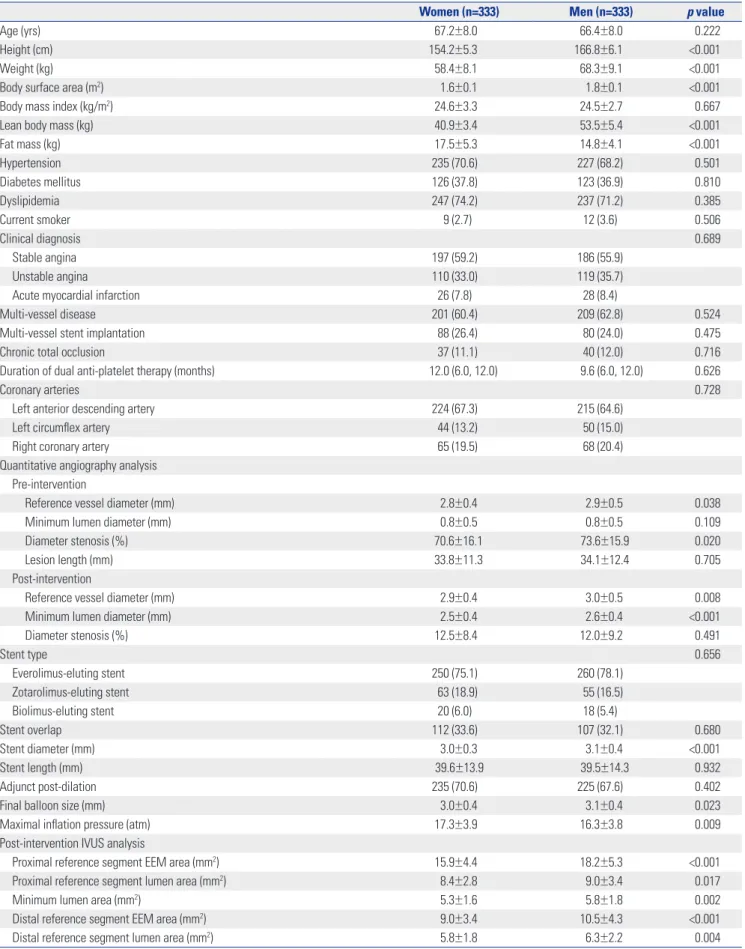
Table 1 shows the clinical, procedural, and IVUS characteristics of the 666 patients who were matched by propensity scores.
Compared to men, women were shorter in stature, weighed less, and had a smaller body surface area and lower lean body mass. Fat mass, however, was greater in women than in men.
Body mass index was not different between women and men.
Pre- and post-intervention reference vessel diameters by quan- titative coronary angiographic analysis were smaller in women.
In post-intervention IVUS analysis, MLA at the target lesions, as well as the lumen and external reference membrane area at the proximal and distal reference segments, were also significantly smaller in women than men.
PCI-related outcomes at 12 months are shown in Table 2. The
incidence of adverse cardiac events, including cardiac death,
target lesion-related myocardial infarction, and ischemia-driv-
en target lesion revascularization, was not significantly different
between women and men. The only significant predictor of ad-
verse cardiac events was post-intervention MLA by IVUS [haz-
ard ratio (HR)=0.620, 95% confidence interval (CI)=0.423–0.909,
Table 1. Baseline, Procedural, and IVUS Characteristics by Sex
Women (n=333) Men (n=333) p value
Age (yrs) 67.2±8.0 66.4±8.0 0.222
Height (cm) 154.2±5.3 166.8±6.1 <0.001
Weight (kg) 58.4±8.1 68.3±9.1 <0.001
Body surface area (m
2) 1.6±0.1 1.8±0.1 <0.001
Body mass index (kg/m
2) 24.6±3.3 24.5±2.7 0.667
Lean body mass (kg) 40.9±3.4 53.5±5.4 <0.001
Fat mass (kg) 17.5±5.3 14.8±4.1 <0.001
Hypertension 235 (70.6) 227 (68.2) 0.501
Diabetes mellitus 126 (37.8) 123 (36.9) 0.810
Dyslipidemia 247 (74.2) 237 (71.2) 0.385
Current smoker 9 (2.7) 12 (3.6) 0.506
Clinical diagnosis 0.689
Stable angina 197 (59.2) 186 (55.9)
Unstable angina 110 (33.0) 119 (35.7)
Acute myocardial infarction 26 (7.8) 28 (8.4)
Multi-vessel disease 201 (60.4) 209 (62.8) 0.524
Multi-vessel stent implantation 88 (26.4) 80 (24.0) 0.475
Chronic total occlusion 37 (11.1) 40 (12.0) 0.716
Duration of dual anti-platelet therapy (months) 12.0 (6.0, 12.0) 9.6 (6.0, 12.0) 0.626
Coronary arteries 0.728
Left anterior descending artery 224 (67.3) 215 (64.6)
Left circumflex artery 44 (13.2) 50 (15.0)
Right coronary artery 65 (19.5) 68 (20.4)
Quantitative angiography analysis Pre-intervention
Reference vessel diameter (mm) 2.8±0.4 2.9±0.5 0.038
Minimum lumen diameter (mm) 0.8±0.5 0.8±0.5 0.109
Diameter stenosis (%) 70.6±16.1 73.6±15.9 0.020
Lesion length (mm) 33.8±11.3 34.1±12.4 0.705
Post-intervention
Reference vessel diameter (mm) 2.9±0.4 3.0±0.5 0.008
Minimum lumen diameter (mm) 2.5±0.4 2.6±0.4 <0.001
Diameter stenosis (%) 12.5±8.4 12.0±9.2 0.491
Stent type 0.656
Everolimus-eluting stent 250 (75.1) 260 (78.1)
Zotarolimus-eluting stent 63 (18.9) 55 (16.5)
Biolimus-eluting stent 20 (6.0) 18 (5.4)
Stent overlap 112 (33.6) 107 (32.1) 0.680
Stent diameter (mm) 3.0±0.3 3.1±0.4 <0.001
Stent length (mm) 39.6±13.9 39.5±14.3 0.932
Adjunct post-dilation 235 (70.6) 225 (67.6) 0.402
Final balloon size (mm) 3.0±0.4 3.1±0.4 0.023
Maximal inflation pressure (atm) 17.3±3.9 16.3±3.8 0.009
Post-intervention IVUS analysis
Proximal reference segment EEM area (mm
2) 15.9±4.4 18.2±5.3 <0.001
Proximal reference segment lumen area (mm
2) 8.4±2.8 9.0±3.4 0.017
Minimum lumen area (mm
2) 5.3±1.6 5.8±1.8 0.002
Distal reference segment EEM area (mm
2) 9.0±3.4 10.5±4.3 <0.001
Distal reference segment lumen area (mm
2) 5.8±1.8 6.3±2.2 0.004
IVUS, intravascular ultrasound; EEM, external elastic membrane.
Data are presented as n (%), means±SD, or medians (interquartile ranges).
p=0.014], not female sex (Supplementary Table 2 and 3, only online).
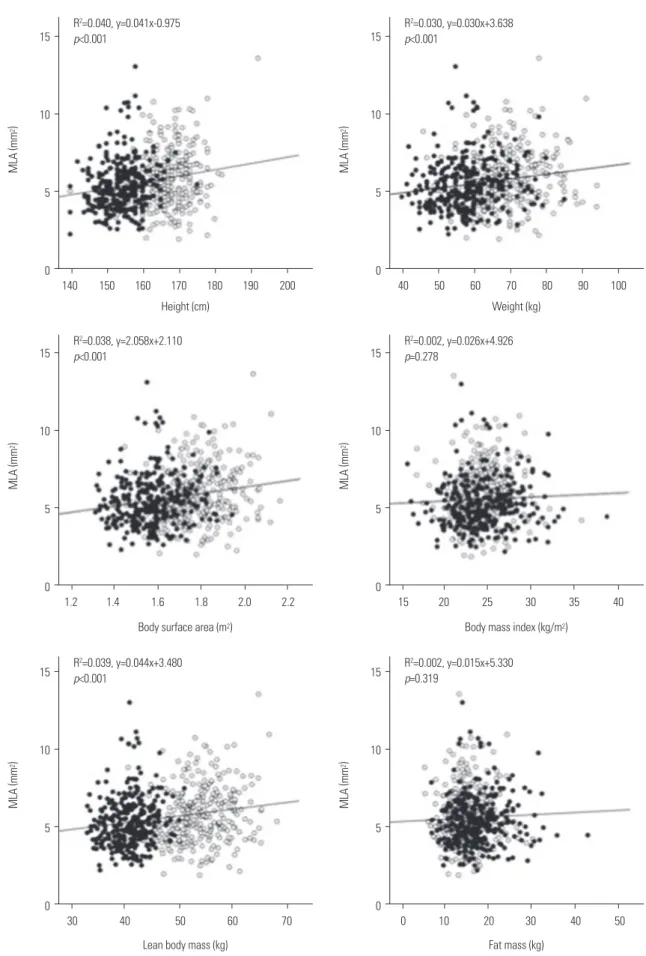
Fig. 1 shows the associations between anthropometric mea- surements and post-intervention MLA evaluated by IVUS.
While height, weight, body surface area, and lean body mass were significantly associated with post-intervention MLA, body mass index, and fat mass were not. The final multivariable linear regression analysis revealed that height (coefficient=0.041, 95%
CI=0.025–0.057, p<0.001) and CTO lesions (coefficient=-0.622, 95% CI=-1.077–-0.167, p=0.008) were independently associated with post-intervention MLA as assessed by IVUS (Supplemen- tary Table 4, only online).
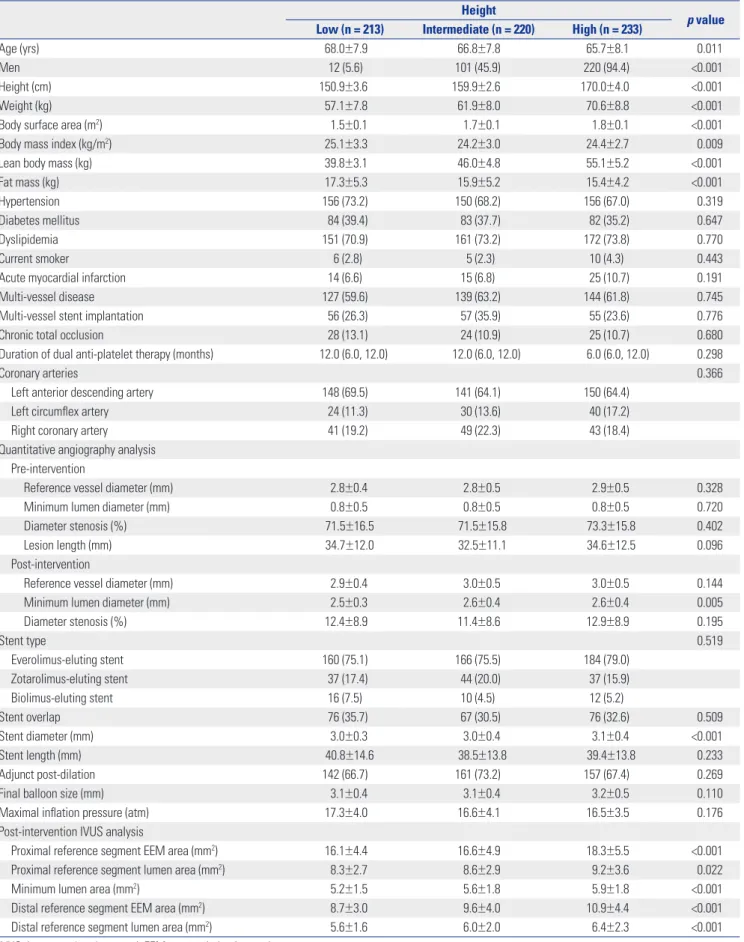
Clinical, procedural, and IVUS characteristics were compared according to tertiles of patient height, as shown in Table 3. Com- pared to the intermediate or high tertile patients, those in the low tertile of height were older and mostly female. Although their weight, body surface area, and lean body mass were the small- est, patients in the low tertile of height had a greater body mass index and fat mass than intermediate or high tertile patients.
Post-intervention IVUS showed that the external elastic mem- brane and lumen area of the reference segment, as well as a MLA of target lesions, were smallest in patients in the low tertile of height. In an adjusted (age and sex) model, patients in the low tertile of height were at greater risk for adverse cardiac events at 12 months than those in the high tertile of height (HR=6.391, 95% CI=1.160–35.206, p=0.033) (Fig. 2).
DISCUSSION
In this IVUS study, sex was not independently associated with adverse cardiac events at 12 months after next-generation DES implantation for lesions with long stenosis or CTO. After next- generation DES implantation, the only significant predictor of adverse cardiac events was post-intervention MLA as evaluated by IVUS. Although women had smaller-sized reference vessels and post-intervention MLA than men, independent factors that affected post-intervention MLA were height and CTO lesions.
Compared to patients in the high tertile of height, those in the low tertile of height were at greater risk of adverse cardiac events at 12 months.
Compared to men, women have smaller coronary arteries, regardless of body surface area.
6-8These findings were based on angiography and autopsy,
6,7and a previous IVUS study also demonstrated the presence of these characteristics, explaining
the increased susceptibility of women to vessel occlusion.
8How- ever, despite the intrinsic effect of sex on coronary dimensions, little is known about sex differences in clinical outcomes, such as mortality or target lesion revascularization.
1-3In the present study, we evaluated complex lesions based on the hypothesis that adverse cardiac events could differ significantly in inci- dence between males and females. Similar to previous stud- ies,
6-8we found that the vessel size of lesions with long stenosis or CTO was smaller in women than in men, and this feature of women was consequently associated with a smaller post-inter- vention MLA of the target lesion. However, sex was not associ- ated with adverse clinical outcomes at 12 months post-inter- vention, and furthermore, its associations with post-intervention MLA were attenuated after adjusting for anthropometric vari- ables. Accordingly, our results suggest that there is no sex-spe- cific risk for procedural or clinical outcomes in coronary artery disease patients with complex lesions.
Previous cohort studies have consistently shown that over- weight or obese patients with coronary artery disease exhibit better survival and lower cardiovascular events than normal weight patients.
18-20However, it is controversial whether this obesity paradox is a real phenomenon, and the mechanisms responsible for this reversed association are still unknown.
18-20Recently, an IVUS study suggested that a high body mass index was associated with a larger post-intervention stent area.
21How- ever, confounders were not fully adjusted for, and other anthro- pometric variables, with the exception of body mass index, were not evaluated.
21In the present study, height, weight, body surface area, and lean body mass were associated with post-in- tervention MLA; body mass index and fat mass were not. Thus, tall and heavier patients might have a larger MLA after PCI than short and relatively thin patients, despite similar body mass in- dexes. Because height and weight contribute to body mass in- dex in opposite ways, the lack of association between body mass index and post-intervention MLA suggests that a more impor- tant determinant of cardiovascular risk based on body mass in- dex may be height, rather than weight.
22In addition, the present study suggests that body mass index does not reflect obesity ac- curately, because it did not differentiate lean mass from body fat. This finding is consistent with the suggestion of a previous study,
18and raises the question of whether body mass index is truly associated with cardiovascular events. Most previous stud- ies have only used body mass index as a measure of obesity.
18Among the anthropometric variables measured in this study, height was most closely correlated to post-intervention MLA, Table 2. Adverse Cardiac Events at 12 Months
Women (n=333) Men (n=333) Hazard ratio (95% confidence interval) p value
Adverse cardiac events 8 (2.4) 8 (2.4) 1.039 (0.390–2.769) 0.939
Cardiac death* 0 (0) 2 (0.6) - 0.499
Target lesion–related myocardial infarction* 0 (0) 2 (0.6) - 0.499
Ischemia-driven target lesion revascularization 8 (2.4) 6 (1.8) 1.381 (0.479–3.982) 0.551
*Categorical variables were compared with Fisher’s exact test (for 2-way comparisons).
Fig. 1. Associations among anthropometric measurements and post-intervention minimum lumen area (MLA) as evaluated by intravascular ultrasound.
While height, weight, body surface area, and lean body mass were significantly associated with post-intervention MLA, body mass index and fat mass were not. Black dots indicate women and white dots indicate men.
Height (cm)
Lean body mass (kg) Body surface area (m
2)
Weight (kg)
Fat mass (kg) Body mass index (kg/m
2) 15
10
5
0
15
10
5
0 15
10
5
0
15
10
5
0
15
10
5
0 15
10
5
0
MLA
(mm
2
) MLA
(mm
2
) MLA (mm
2
) MLA
(mm
2
) MLA
(mm
2
) MLA (mm
2