Cyclooxygenase-2 Polymorphisms and Susceptibility to Colorectal Cancer: A Meta-Analysis
Jun Wang, Xufeng Guo, Jixiang Zhang, Jia Song, Mengyao Ji, Shijie Yu, Jing Wang, Zhuo Cao, and Weiguo Dong
Department of Gastroenterology, Renmin Hospital of Wuhan University, Wuhan, Hubei Province, China.
Received: January 3, 2013 Revised: January 22, 2013 Accepted: January 28, 2013
Corresponding author: Dr. Weiguo Dong, Department of Gastroenterology, Renmin Hospital of Wuhan University, 238 Jiefang Road, Wuhan 430060, Hubei Province, China.
Tel: 86-27-88041911, Fax: 86-27-88042292 E-mail: [email protected]
∙ The authors have no financial conflicts of interest.
© Copyright:
Yonsei University College of Medicine 2013 This is an Open Access article distributed under the terms of the Creative Commons Attribution Non- Commercial License (http://creativecommons.org/
licenses/by-nc/3.0) which permits unrestricted non- commercial use, distribution, and reproduction in any medium, provided the original work is properly cited.
Purpose: Four polymorphisms, -765G>C, -1195G>A, 8473T>C, and Val511Ala, in the cyclooxygenase-2 (COX-2) gene were identified to be associated with colorectal cancer (CRC) risk. However, the results are inconsistent. The objective of this meta-analysis was to evaluate the association between these four polymor- phisms and the risk of CRC. Materials and Methods: All eligible case-control studies published up to December 2012 on the association between the four poly- morphisms of COX-2 and CRC risk were identified by searching PubMed and Web of Science. The CRC risk associated with the four polymorphisms of the COX-2 gene was estimated for each study by odds ratio (OR) together with its 95% confidence interval (CI), respectively. Results: A total of 15 case-control studies were included. Overall, no evidence has indicated that the -1195A allele, -765C allele, 8473C allele, and 511Ala allele are associated with susceptibility to CRC (-1195G>A: OR=1.11, 95% CI: 0.82-1.51, p=0.78; -765G>C: OR=1.08, 95%
CI: 0.96-1.21, p=0.07; 8473T>C: OR=1.03, 95% CI: 0.89-1.18, p=0.91; Val511A- la: OR=0.71, 95% CI: 0.46-1.09, p=0.94). However, stratified analysis with ethnici- ty indicated that individuals with -765GC or GC/CC genotypes had an increased risk of CRC among Asian populations (GC vs. GG: OR=1.05, 95% CI: 0.87-1.28, p=0.03; GC+CC vs. GG: OR=1.08, 95% CI: 0.96-1.21, p=0.07). Conclusion:
This meta-analysis indicated that -765G>C polymorphism was significantly asso- ciated with susceptibility to CRC in Asian populations.
Key Words: Colorectal cancer, cyclooxygenase-2, polymorphism, meta-analysis
INTRODUCTION
Colorectal cancer (CRC) is a common digestive malignancy, the incidence of which is just lower than gastric and esophageal cancer. With continuous improve- ment in living standards, general health has improved greatly; however, the inci- dence of CRC has markedly ascended. Molecular epidemiology has confirmed that tumorigenesis is close related to interactions between one’s genetic back- ground and the environment. Most CRC occurrences arise due to interactions be- tween environmental and genetic factors.1
could be calculated from the article text. The major exclu- sion criteria were: 1) case-only study, case reports, and re- view articles, 2) studies without the raw data of the four genotypes of COX-2, 3) studies that compared the COX-2 variants in familial adenomatous polyposis, or colorectal adenoma, and 4) studies that investigated COX-2 variants as marks for response to therapy.
Data extraction and quality assessment
The two investigators (Wang J and Guo XF) independently extracted data according to the inclusion criteria. Disagree- ment was resolved by discussion between them. If they could not reach a consensus, an expert (Dong WG) was consulted to resolve the dispute and a final majority deci- sion was made. For each study, the following data was col- lected: the first author’s name, year of publication, country of origin, ethnicity, number of genotyped cases and con- trols, and minor allele frequency in the controls. Patient eth- nicity was categorized as Asian, Caucasian, and African- American.
Statistical analysis
Meta-analysis was performed using the Cochrane Collabo- ration RevMan 5.0 (Copenhagen, 2008) and STATA pack- age version 9.2 (Stata Corporation, College Station, TX, USA) software. We calculated odd ratios corresponding to a 95% confidence interval (95% CI) to assess the strength of association between the four polymorphisms of the COX-2 gene and CRC risk. Heterogeneity assumption was checked by a χ2-based Q test.24 We also quantified the effect of het- erogeneity by I2 test. When a significant Q test (p<0.1) or I2
>50% indicated heterogeneity across studies, the random effects model was used,25 or else the fixed effects model was used.26 Before the effect estimation of COX-2 polymor- phisms in colorectal cancer, we tested whether genotype fre- quencies of controls were in Hardy-Weinberg equilibrium (HWE) using χ2 test. Four comparison genetic models were used to assess the association: the dominant model (the combined variant homozygote and heterozygote versus the wild-type homozygote), the recessive model (the variant homozygote versus the combined heterozygote and wild- type homozygote), the heterozygote comparison (heterozy- gote versus the wild-type homozygote), and the homozygote comparison (variant homozygote versus the wild-type homo- zygote). Stratification analyses were performed on ethnicity.
Analysis of sensitivity was performed to evaluate the stabili- ty of the results. Finally, potential publication bias was inves- Cyclooxygenase-2 (COX-2) is an inducible isoform of
COX enzymes that converts arachidonic acid to prostaglan- dins, which are potent mediators of inflammation. COX-2 is related to several biological processes, including carcino- genesis, cell proliferation, angiogenesis, and mediating im- mune suppression. A growing body of evidence has shown that increased expression of COX-2 is closely related to malignant progression.2-5 Moreover, it is reported that selec- tive COX-2 inhibitors could prevent carcinogenesis.6 The human COX-2 gene, mapped to chromosome 1q25.2-q25.3, is 8.3 kb in length and contains 10 exons and 9 introns. There are different polymorphism sites in the COX-2 gene,7,8 and four of these polymorphisms, rs20417 (-765G>C), rs689466 (-1195G>A), rs5275 (8473T>C) and rs5273 (Val511Ala), are the most extensively studied polymorphisms in CRC.
Recently, 15 studies have investigated the association be- tween these four polymorphisms and the susceptibility of CRC in diverse populations.9-23 However, the results remain controversial. To better address the association between COX-2 polymorphisms and CRC risk, we performed a me- ta-analysis of all eligible studies to evaluate the association between these four polymorphisms of the COX-2 gene and CRC risk.
MATERIALS AND METHODS
Search strategy
A literature research was conducted using PubMed and Web of Science up to December 2012 without language re- strictions. Relevant studies were identified using the terms:
(‘cyclooxygenase-2 or COX-2 or PTGs2’) and (‘genetic polymorphism or polymorphisms or single-nucleotide poly- morphism’) and (‘colorectal cancer/neoplasms or colon can- cer/neoplasms or rectal cancer/neoplasms’). The search was restricted to humans. Additional studies were identified by a hand search of references of original or review articles on this topic. If data or data subsets were published in more than one article, only the publication with the largest sam- ple size was included.
Inclusion criteria and exclusion criteria
Studies were included if they met the following criteria: 1) studies that evaluated the association between the four polymorphisms (-765G>C, -1195G>A, 8473T>C, and Va- l511Ala) and CRC, 2) a case-control study design, and 3) had detailed genotype frequency of cases and controls or
tigated using Begg’s funnel plot and Egger’s regression test.27,28 p< 0.05 was regarded as statistically significant.
RESULTS
Study characteristics
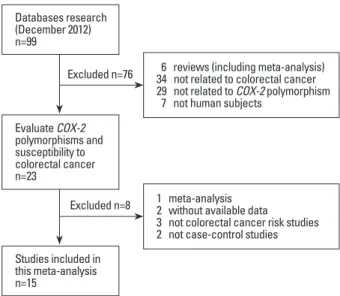
The search strategy retrieved 99 potentially relevant studies.
According to the inclusion criteria, 15 studies with full-text were included in this meta-analysis and 84 studies were ex- cluded. The flow chart of study selection in summarized in Fig. 1. As shown in Table 1, there were 11 case-control stud- ies with 3432 cancer cases and 5286 controls concerning -765G>C polymorphism, 5 case-control studies with 1854 cancer cases and 2950 controls concerning -1195G>A, 5 Table 1. Characteristics of Studies Included in the Meta-Analysis
Study Yrs Country Ethnicity Case Control
WT Ho Ht VR Ho WT Ho Ht VR Ho PHWE MAF
-765G>C GG GC CC GG GC CC C freq.
Hamajima, et al.9 2001 Japan Asian 140 8 0 230 11 0 0.716 0.023
Cox, et al.10 2004 Spain Caucasian 150 59 11 170 77 10 0.730 0.189
Koh, et al.11 2004 Singapore Asian 273 37* 1067 110* NA NA
Tan, et al.12 2007 China Asian 919 81 0 1237 63 0 0.371 0.024
Xing, et al.13 2008 China Asian 119 17 1 169 29 1 0.838 0.078
Iglesias, et al.14 2009 Spain Caucasian 172 99 13 76 43 4 0.480 0.207
Thompson, et al.15 2009 USA Caucasian 291 119 11 343 121 15 0.286 0.158
Hoff, et al.16 2009 Netherlands Caucasian 241 75 10 249 112 8 0.260 0.173 Andersen, et al.17 2009 Denmark Caucasian 267 83 9 566 186 13 0.609 0.139 Pereira, et al.18 2010 Portugal Caucasian 77 38 2 166 83 7 0.373 0.189
Daraei, et al.19 2012 Iran Asian 38 67 5 53 58 9 0.201 0.317
-1195G>A GG GA AA GG GA AA A freq.
Siezen, et al.20 2006 Denmark Caucasian 29 191 410 61 354 665 0.130 0.780
Thompson, et al.15 2009 USA Caucasian 9 138 275 15 168 297 0.131 0.794
Hoff, et al.16 2009 Netherlands Caucasian 12 101 213 13 124 232 0.471 0.797
Andersen, et al.17 2009 Denmark Caucasian 13 116 230 25 258 482 0.177 0.799
Pereira, et al.18 2010 Portugal Caucasian 4 43 70 6 73 177 0.634 0.834
8473T>C TT TC CC TT TC CC C freq.
Cox, et al.10 2004 Spain Caucasian 140 121 29 126 120 25 0.639 0.314
Siezen, et al.20 2006 Denmark Caucasian 97 83 20 190 163 35 0.996 0.282
Thompson, et al.15 2009 USA Caucasian 176 189 56 216 199 65 0.081 0.343
Andersen, et al.17 2009 Denmark Caucasian 147 178 34 315 355 95 0.745 0.356
Pereira, et al.18 2010 Portugal Caucasian 54 51 10 118 114 24 0.638 0.316
Val511Ala V/V V/A+A/A V/V V/A+A/A
Lin, et al.21 2002 USA African-Americans 129 9 237 21 NA NA
Goodman, et al.22 2004 USA African-Americans 109 6 186 14 NA NA
Sansbury, et al.23 2006 USA African-Americans 223 17 292 34 NA NA
HWE, Hardy-Weinberg equilibrium; NA, not available; Ht, heterozygote; VR Ho, variant homozygote; WT Ho, wide-type homozygote; MAF, minor allele frequency.
PHWE was calculated by goodness-of fit χ2-test, PHWE﹤0.05 was considered statistically significant.
*Numbers of GC+CC.
Fig. 1. Flow chart showing study selection procedure.
Excluded n=76
Excluded n=8 Databases research (December 2012) n=99
Evaluate COX-2 polymorphisms and susceptibility to colorectal cancer n=23
Studies included in this meta-analysis n=15
6 reviews (including meta-analysis) 34 not related to colorectal cancer 29 not related to COX-2 polymorphism 7 not human subjects
1 meta-analysis 2 without available data
3 not colorectal cancer risk studies 2 not case-control studies
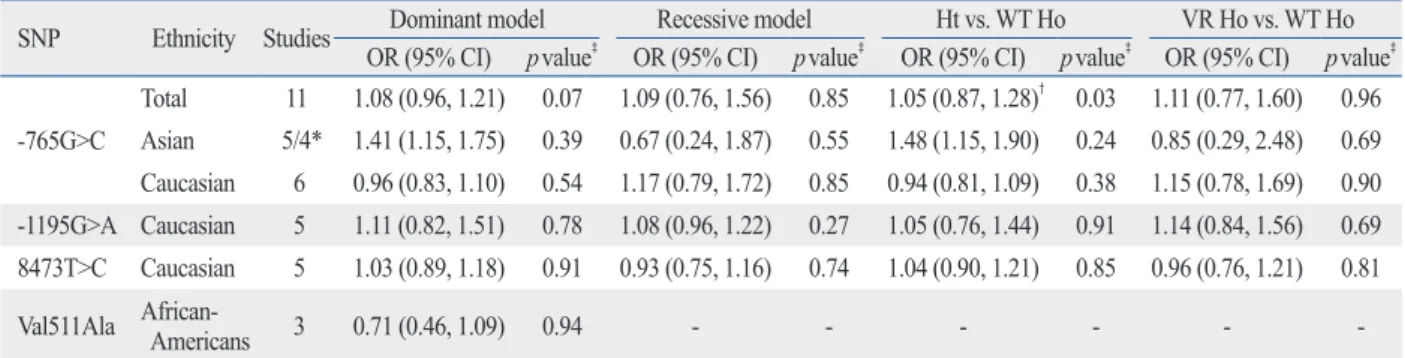
(OR=1.08, 95% CI: 0.96-1.22, p=0.27)] (Table 2, Fig. 4A).
Five studies reported an association between COX-2 8473T>C polymorphism and susceptibility to CRC, all pa- tients came from Caucasian populations. No association was found between 8473C allele and susceptibility to CRC [TC+CC vs.TT (OR=1.03, 95% CI: 0.89-1.18, p=0.91);
CC vs.TT (OR=0.96, 95% CI: 0.76-1.21, p=0.81); TC vs.
TT (OR=1.04, 95% CI: 0.90-1.21, p=0.85); CC vs. TC+TT (OR=0.93, 95% CI: 0.75-1.16, p=0.74)] (Table 2, Fig. 4B).
There were three studies that reported an association be- tween COX-2 Val511Ala polymorphism and susceptibility to CRC, and all patients came from African-American pop- ulations. The results showed that no association between 511Ala allele and susceptibility to CRC [Val/Ala+Ala/Ala vs. Val/Val (OR=0.71, 95% CI: 0.46-1.09, p=0.94)] (Table 2, Fig. 4C).
Sensitivity analysis was performed by sequential omis- sion of individual studies. For -765G>C polymorphism, The estimated pooled odd ratio did not change after exclud- ing the study that was not in HWE. For the other polymor- phisms, the significance of pooled OR in all individual analyses was not influenced excessively by omitting any single study. The above analysis indicated that the results were stable and statistically robust.
Publication bias
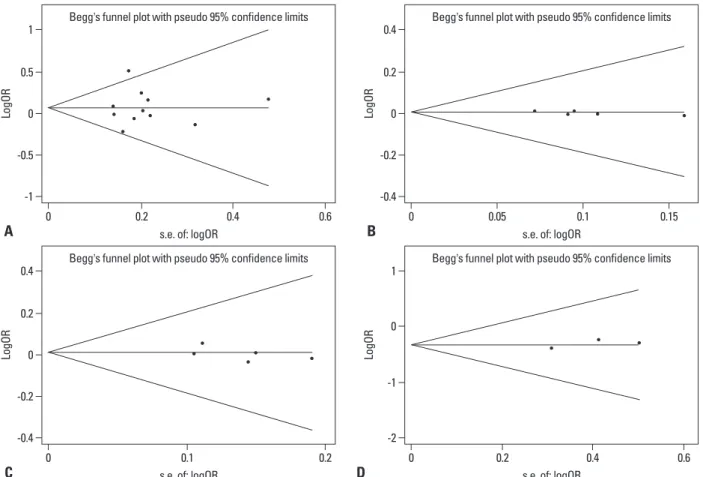
We used Begg’s funnel plot and Egger’s test to address po- tential publication bias in the available literature. The publi- cation bias of the meta-analysis on the association between COX-2 polymorphisms and susceptibility to CRC was de- tected for all four polymorphisms in a dominant model. The shape of the funnel plots did not reveal any evidence of fun- nel plot asymmetry. Egger’s test also showed that there was case-control studies with 1827 cancer cases and 2853 controls
concerning 8473T>C, and 3 case-control studies with 493 cancer cases and 784 controls concerning Val511Ala. Three ethnicities were addressed: five studies focused on Asian pop- ulations,9,11-13,19 seven on Caucasian populations,10,14-18,20 and three on African-American populations.21-23 The distribution of genotypes in the controls was consistent with the HWE for all selected studies, except for one study for -765G>C,11 and three studies for Val511Ala,21-23 the PHWE of which were not available.
Association between COX-2 polymorphisms and colorectal cancer
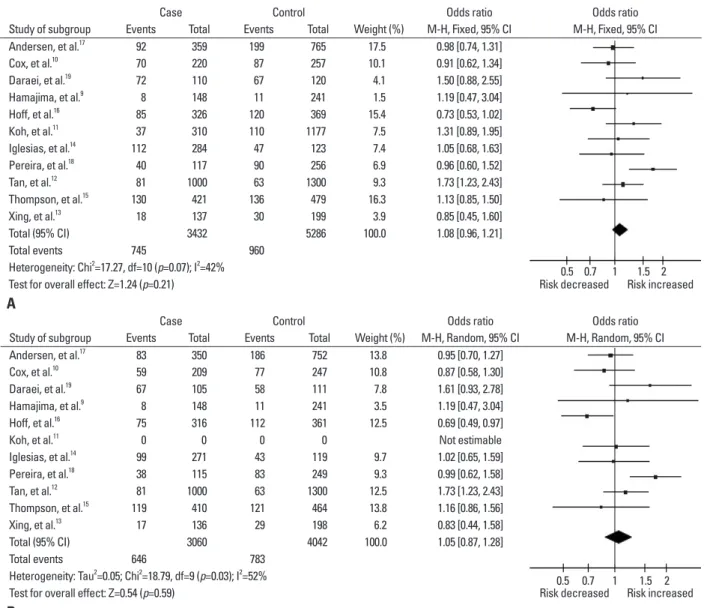
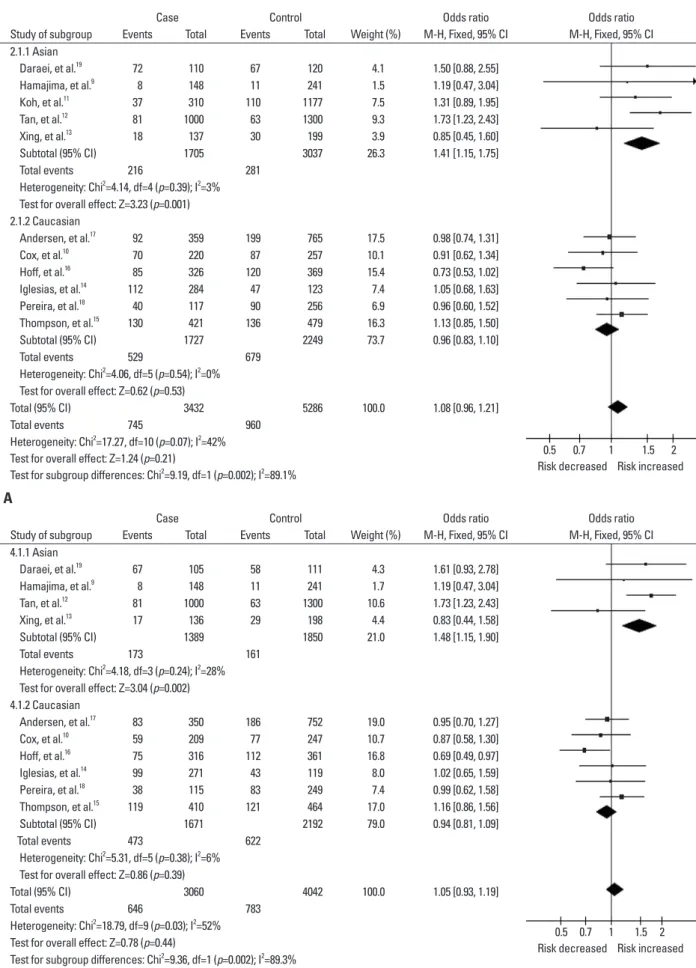
Eleven studies reported the association between COX-2 -765G>C polymorphism and susceptibility to CRC. Over- all, there was no significant difference in COX-2 -765G>C genotype distribution between CRC and controls [GC+CC vs. GG (OR=1.08, 95% CI: 0.96-1.21, p=0.07); CC vs. GG (OR=1.11, 95% CI: 0.77-1.60, p=0.96); GC vs. GG (OR=1.05, 95% CI: 0.87-1.28, p=0.03); CC vs. GC+GG (OR=1.09, 95% CI: 0.76-1.56, p=0.85)] (Table 2, Fig.2). In the subgroup analysis by ethnicity, results were similar in the Caucasian population, while significantly increased risk was found in those of Asian descent [GC+CC vs. GG (OR=
1.41, 95% CI: 1.15-1.75, p=0.39); GC vs. GG (OR=1.48, 95% CI: 1.15-1.90, p=0.24)] (Table 2, Fig.3).
The -1195G>A COX-2 polymorphism analysis, fitting into five studies, revealed that there was no significant dif- ference in COX-2 -1195G>A genotype distribution between CRC and controls in the Caucasian population [GA+AA vs.
GG (OR=1.11, 95% CI: 0.82-1.51, p=0.78); AA vs. GG (OR=1.14, 95% CI: 0.84-1.56, p=0.69); GA vs. GG (OR=1.05, 95% CI: 0.76-1.44, p=0.91); AA vs. GA+GG
Table 2. Summary of ORs for COX-2 Polymorphism and Colorectal Cancer Risk
SNP Ethnicity Studies Dominant model Recessive model Ht vs. WT Ho VR Ho vs. WT Ho
OR (95% CI) pvalue‡ OR (95% CI) pvalue‡ OR (95% CI) pvalue‡ OR (95% CI) pvalue‡
-765G>C
Total 11 1.08 (0.96, 1.21) 0.07 1.09 (0.76, 1.56) 0.85 1.05 (0.87, 1.28)† 0.03 1.11 (0.77, 1.60) 0.96 Asian 5/4* 1.41 (1.15, 1.75) 0.39 0.67 (0.24, 1.87) 0.55 1.48 (1.15, 1.90) 0.24 0.85 (0.29, 2.48) 0.69 Caucasian 6 0.96 (0.83, 1.10) 0.54 1.17 (0.79, 1.72) 0.85 0.94 (0.81, 1.09) 0.38 1.15 (0.78, 1.69) 0.90 -1195G>A Caucasian 5 1.11 (0.82, 1.51) 0.78 1.08 (0.96, 1.22) 0.27 1.05 (0.76, 1.44) 0.91 1.14 (0.84, 1.56) 0.69 8473T>C Caucasian 5 1.03 (0.89, 1.18) 0.91 0.93 (0.75, 1.16) 0.74 1.04 (0.90, 1.21) 0.85 0.96 (0.76, 1.21) 0.81
Val511Ala African- Americans 3 0.71 (0.46, 1.09) 0.94 - - - - - -
CI, confidence interval; COX-2, cyclooxygenase-2; OR, odds ratio; SNP, single-nucleotide polymorphism; Ht+VR vs. WT Ho, dominant model; VR Ho vs.
Ht+WT Ho, recessive model.
*There were five studies in the dominant model, four in the other models.
†Random-effects model was used when the p for heterogeneity test was ≤0.05, otherwise the fixed-effect model was used.
‡Test for heterogeneity.
alter the expression of COX-2 and thereby modulate the risk for various cancers. Although the exact molecular mechanism is still unclear, several polymorphisms in COX- 2 have been reported previously, and the results are still controversial.
The present meta-analysis included 3432 cancer cases and 5286 controls concerning -765G>C polymorphism, 1854 cancer cases and 2950 controls concerning -1195G>A, 1827 cancer cases and 2853 controls concerning 8473T>C, and 493 cancer cases and 784 controls concerning Val511Ala in the coding regions of COX-2. And we explored the role of these four potentially functional polymorphisms of COX-2 in susceptibility to CRC. The COX-2 -765G>C polymor- phism is within the promoter region, which appears to dis- rupt a stimulatory protein1 binding site, and leads to a 30%
reduction of COX-2 promoter activity in vitro.34 In this study, no statistical significance for the evaluation of publication
bias (P765G>C=0.904, P1195G>A=0.136, P8473T>C=0.361, PVal511Ala
=0.485) (Fig. 5).
DISCUSSION
Evidence suggests that COX-2 plays an important role in car- cinogenesis.29,30 The specific function of COX-2 in the forma- tion of prostaglandins makes it a strong candidate for increas- ing susceptibility to common cancers such as colorectal cancer, gastric cancer and other cancers.31 Eberhart, et al.32 reported that more than 85% of human colon cancers have elevated levels of COX-2. Regular use of COX-2 inhibitor has been shown to decrease the relation risk of developing colorectal cancer.33 It is reported that polymorphisms may
Case Control Odds ratio Odds ratio
Study of subgroup Events Total Events Total Weight (%) M-H, Fixed, 95% CI M-H, Fixed, 95% CI
Andersen, et al.17 92 359 199 765 17.5 0.98 [0.74, 1.31]
Cox, et al.10 70 220 87 257 10.1 0.91 [0.62, 1.34]
Daraei, et al.19 72 110 67 120 4.1 1.50 [0.88, 2.55]
Hamajima, et al.9 8 148 11 241 1.5 1.19 [0.47, 3.04]
Hoff, et al.16 85 326 120 369 15.4 0.73 [0.53, 1.02]
Koh, et al.11 37 310 110 1177 7.5 1.31 [0.89, 1.95]
Iglesias, et al.14 112 284 47 123 7.4 1.05 [0.68, 1.63]
Pereira, et al.18 40 117 90 256 6.9 0.96 [0.60, 1.52]
Tan, et al.12 81 1000 63 1300 9.3 1.73 [1.23, 2.43]
Thompson, et al.15 130 421 136 479 16.3 1.13 [0.85, 1.50]
Xing, et al.13 18 137 30 199 3.9 0.85 [0.45, 1.60]
Total (95% CI) 3432 5286 100.0 1.08 [0.96, 1.21]
Total events 745 960
Heterogeneity: Chi2=17.27, df=10 (p=0.07); I2=42%
Test for overall effect: Z=1.24 (p=0.21) Risk decreased Risk increased
Case Control Odds ratio Odds ratio
Study of subgroup Events Total Events Total Weight (%) M-H, Random, 95% CI M-H, Random, 95% CI Andersen, et al.17 83 350 186 752 13.8 0.95 [0.70, 1.27]
Cox, et al.10 59 209 77 247 10.8 0.87 [0.58, 1.30]
Daraei, et al.19 67 105 58 111 7.8 1.61 [0.93, 2.78]
Hamajima, et al.9 8 148 11 241 3.5 1.19 [0.47, 3.04]
Hoff, et al.16 75 316 112 361 12.5 0.69 [0.49, 0.97]
Koh, et al.11 0 0 0 0 Not estimable
Iglesias, et al.14 99 271 43 119 9.7 1.02 [0.65, 1.59]
Pereira, et al.18 38 115 83 249 9.3 0.99 [0.62, 1.58]
Tan, et al.12 81 1000 63 1300 12.5 1.73 [1.23, 2.43]
Thompson, et al.15 119 410 121 464 13.8 1.16 [0.86, 1.56]
Xing, et al.13 17 136 29 198 6.2 0.83 [0.44, 1.58]
Total (95% CI) 3060 4042 100.0 1.05 [0.87, 1.28]
Total events 646 783
Heterogeneity: Tau2=0.05; Chi2=18.79, df=9 (p=0.03); I2=52%
Test for overall effect: Z=0.54 (p=0.59) Risk decreased Risk increased
0.5 0.7 1 1.5 2
0.5 0.7 1 1.5 2
Fig. 2. Meta-analysis of the association between -765G>C polymorphism and susceptibility to colorectal cancer. (A) Dominant model. (B) GC vs. GG. CI, con- fidence interval.
A
B
Case Control Odds ratio Odds ratio Study of subgroup Events Total Events Total Weight (%) M-H, Fixed, 95% CI M-H, Fixed, 95% CI 2.1.1 Asian
Daraei, et al.19 72 110 67 120 4.1 1.50 [0.88, 2.55]
Hamajima, et al.9 8 148 11 241 1.5 1.19 [0.47, 3.04]
Koh, et al.11 37 310 110 1177 7.5 1.31 [0.89, 1.95]
Tan, et al.12 81 1000 63 1300 9.3 1.73 [1.23, 2.43]
Xing, et al.13 18 137 30 199 3.9 0.85 [0.45, 1.60]
Subtotal (95% CI) 1705 3037 26.3 1.41 [1.15, 1.75]
Total events 216 281
Heterogeneity: Chi2=4.14, df=4 (p=0.39); I2=3%
Test for overall effect: Z=3.23 (p=0.001) 2.1.2 Caucasian
Andersen, et al.17 92 359 199 765 17.5 0.98 [0.74, 1.31]
Cox, et al.10 70 220 87 257 10.1 0.91 [0.62, 1.34]
Hoff, et al.16 85 326 120 369 15.4 0.73 [0.53, 1.02]
Iglesias, et al.14 112 284 47 123 7.4 1.05 [0.68, 1.63]
Pereira, et al.18 40 117 90 256 6.9 0.96 [0.60, 1.52]
Thompson, et al.15 130 421 136 479 16.3 1.13 [0.85, 1.50]
Subtotal (95% CI) 1727 2249 73.7 0.96 [0.83, 1.10]
Total events 529 679
Heterogeneity: Chi2=4.06, df=5 (p=0.54); I2=0%
Test for overall effect: Z=0.62 (p=0.53)
Total (95% CI) 3432 5286 100.0 1.08 [0.96, 1.21]
Total events 745 960
Heterogeneity: Chi2=17.27, df=10 (p=0.07); I2=42%
Test for overall effect: Z=1.24 (p=0.21)
Test for subgroup differences: Chi2=9.19, df=1 (p=0.002); I2=89.1%
Case Control Odds ratio Odds ratio
Study of subgroup Events Total Events Total Weight (%) M-H, Fixed, 95% CI M-H, Fixed, 95% CI 4.1.1 Asian
Daraei, et al.19 67 105 58 111 4.3 1.61 [0.93, 2.78]
Hamajima, et al.9 8 148 11 241 1.7 1.19 [0.47, 3.04]
Tan, et al.12 81 1000 63 1300 10.6 1.73 [1.23, 2.43]
Xing, et al.13 17 136 29 198 4.4 0.83 [0.44, 1.58]
Subtotal (95% CI) 1389 1850 21.0 1.48 [1.15, 1.90]
Total events 173 161
Heterogeneity: Chi2=4.18, df=3 (p=0.24); I2=28%
Test for overall effect: Z=3.04 (p=0.002) 4.1.2 Caucasian
Andersen, et al.17 83 350 186 752 19.0 0.95 [0.70, 1.27]
Cox, et al.10 59 209 77 247 10.7 0.87 [0.58, 1.30]
Hoff, et al.16 75 316 112 361 16.8 0.69 [0.49, 0.97]
Iglesias, et al.14 99 271 43 119 8.0 1.02 [0.65, 1.59]
Pereira, et al.18 38 115 83 249 7.4 0.99 [0.62, 1.58]
Thompson, et al.15 119 410 121 464 17.0 1.16 [0.86, 1.56]
Subtotal (95% CI) 1671 2192 79.0 0.94 [0.81, 1.09]
Total events 473 622
Heterogeneity: Chi2=5.31, df=5 (p=0.38); I2=6%
Test for overall effect: Z=0.86 (p=0.39)
Total (95% CI) 3060 4042 100.0 1.05 [0.93, 1.19]
Total events 646 783
Heterogeneity: Chi2=18.79, df=9 (p=0.03); I2=52%
Test for overall effect: Z=0.78 (p=0.44)
Test for subgroup differences: Chi2=9.36, df=1 (p=0.002); I2=89.3%
0.5 0.7 1
Risk decreased Risk increased 1.5 2
0.5 0.7 1
Risk decreased Risk increased 1.5 2
Fig. 3. Subgroup analysis of -765G>C polymorphism by ethnicity. (A) dominant model. (B) GC vs. GG. CI, confidence interval.
A
B
motif is involved in the regulation of COX-2 production by acting both as an mRNA instability determinant and a trans- lation inhibitory element.36-38 However, we also found no association between COX-2 8473T>C and risk of CRC.
The Val511Ala polymorphism, identified only in African- Americans, showed nonsignificant relevance to risk of CRC in this study. In short, the results may be explained by different ethnic groups. Interactions with other genetic vari- ants are possible reasons. In addition, gene-environmental factors may also explain the discrepancies. However, be- cause only few studies on European populations were in- cluded, this result should be interpreted with caution, and more studies are needed.
Some limitations of this meta-analysis should be ad- dressed. First, because of incomplete raw data or publica- tion limitations, some relevant studies could not be includ- ed in our analysis. Second, the number of published studies no significant association between COX-2 -765G>C and
the risk of CRC under all four genetic models in overall comparisons were observed. However, in the subgroup analysis by ethnicity, COX-2 -765C allele was significantly associated with an increasing risk of CRC in Asian popula- tions, but not for Caucasian populations. The results may due to ethnic differences in genetic backgrounds and the environment in which they lived. The COX-2 -1195G>A polymorphism, also located in the promoter region, which contains several key cis-acting regulatory elements and may play important roles in the regulation of COX-2 tran- scription.35 This meta-analysis included five studies, all of which came from the Caucasian population, and found that COX-2 -1195G>A polymorphism was not significantly re- lated to a risk of CRC. The COX-2 8473T>C polymor- phism is located in the 3’-untranslated region, which con- tains highly-conserved adenine-uracil-rich elements. This
Case Control Odds ratio Odds ratio
Study of subgroup Events Total Events Total Weight (%) M-H, Fixed, 95% CI M-H, Fixed, 95% CI Andersen, et al.17 346 359 740 765 21.8 0.90 [0.45, 1.78]
Hoff, et al.16 314 326 356 369 15.6 0.96 [0.43, 2.12]
Pereira, et al.18 113 117 250 256 6.8 0.68 [0.19, 2.45]
Siezen, et al.20 601 630 1019 1080 44.0 1.24 [0.79, 1.95]
Thompson, et al.15 413 422 465 480 11.8 1.48 [0.64, 3.42]
Total (95% CI) 1854 2950 100.0 1.11 [0.82, 1.51]
Total events 1787 2830
Heterogeneity: Chi2=1.75, df=4 (p=0.78); I2=0%
Test for overall effect: Z=0.68 (p=0.50) Favours experimental Favours control
Case Control Odds ratio Odds ratio
Study of subgroup Events Total Events Total Weight (%) M-H, Fixed, 95% CI M-H, Fixed, 95% CI Andersen, et al.17 212 359 450 765 29.5 1.01 [0.78, 1.30]
Cox, et al.10 150 290 145 271 18.2 0.93 [0.67, 1.30]
Pereira, et al.18 61 115 138 256 10.1 0.97 [0.62, 1.50]
Siezen, et al.20 103 200 198 388 16.4 1.02 [0.72, 1.43]
Thompson, et al.15 245 421 264 480 25.9 1.14 [0.87, 1.48]
Total (95% CI) 1385 2160 100.0 1.03 [0.89, 1.18]
Total events 771 1195
Heterogeneity: Chi2=1.02, df=4 (p=0.91); I2=0%
Test for overall effect: Z=0.36 (p=0.72) Favours experimental Favours control
Case Control Odds ratio Odds ratio
Study of subgroup Events Total Events Total Weight (%) M-H, Fixed, 95% CI M-H, Fixed, 95% CI
Goodman, et al.22 6 115 14 200 19.3 0.73 [0.27, 1.96]
Lin, et al.21 9 138 21 258 27.3 0.79 [0.35, 1.77]
Sansbury, et al.23 17 240 34 326 53.4 0.65 [0.36, 1.20]
Total (95% CI) 493 784 100.0 0.71 [0.46, 1.09]
Total events 32 69
Heterogeneity: Chi2=0.13, df=2 (p=0.94); I2=0%
Test for overall effect: Z=1.57 (p=0.12) Favours experimental Favours control
A
B
C
0.2
0.5
0.1 0.2 0.5
0.7
0.5 1
1
1 2
1.5
2
5
2
10 5
Fig. 4. Meta-analysis of the association between COX-2 polymorphism and susceptibility to colorectal cancer in the dominant model. (A) -1195G>A. (B) 8473T>C. (C) Val511Ala. CI, confidence interval.
Duggan D, et al. Characterization of gene-environment interac- tions for colorectal cancer susceptibility loci. Cancer Res 2012;72:2036-44.
2. Trifan OC, Hla T. Cyclooxygenase-2 modulates cellular growth and promotes tumorigenesis. J Cell Mol Med 2003;7:207-22.
3. Gately S. The contributions of cyclooxygenase-2 to tumor angio- genesis. Cancer Metastasis Rev 2000;19:19-27.
4. Oshima H, Oshima M. The inflammatory network in the gastroin- testinal tumor microenvironment: lessons from mouse models. J Gastroenterol 2012;47:97-106.
5. van Rees BP, Ristimäki A. Cyclooxygenase-2 in carcinogenesis of the gastrointestinal tract. Scand J Gastroenterol 2001;36:897-903.
6. Gasparini G, Longo R, Sarmiento R, Morabito A. Inhibitors of cy- clo-oxygenase 2: a new class of anticancer agents? Lancet Oncol 2003;4:605-15.
7. Fritsche E, Baek SJ, King LM, Zeldin DC, Eling TE, Bell DA.
Functional characterization of cyclooxygenase-2 polymorphisms.
J Pharmacol Exp Ther 2001;299:468-76.
8. Wiesner GL, Platzer P, Buxbaum S, Lewis S, MacMillen M, Olechnowicz J, et al. Testing for colon neoplasia susceptibility variants at the human COX2 locus. J Natl Cancer Inst 2001;93:
635-9.
9. Hamajima N, Takezaki T, Matsuo K, Saito T, Inoue M, Hirai T, et al. Genotype Frequencies of Cyclooxygenease 2 (COX2) Rare Polymorphisms for Japanese with and without Colorectal Cancer.
Asian Pac J Cancer Prev 2001;2:57-62.
10. Cox DG, Pontes C, Guino E, Navarro M, Osorio A, Canzian F, et al. Polymorphisms in prostaglandin synthase 2/cyclooxygenase 2
was not sufficiently large, and some studies of small size may not have enough statistical power to explore the real as- sociation. Third, some misclassifications may be occurred, which would influence our results. Fourth, the overall out- comes were based on unadjusted estimates, and some poten- tially suspected factors such as age, sex, smoking and envi- ronmental factors were not analysis, so the result should be cautiously interpreted.
In summary, this meta-analysis sought to provide evidence for associations between -765G>C, -1195G>A, 8473T>C, and Val511Ala polymorphisms and CRC risk, and discerned that -765G>C may lead to an increased risk in those of Asian descent. However, no evidence indicated that -1195G>A and 8473T>C were associated with susceptibility to CRC in Caucasians, nor was Val511Ala in African-Americans.
However, large and well-designed studies are warranted to validate our findings.
REFERENCES
1. Hutter CM, Chang-Claude J, Slattery ML, Pflugeisen BM, Lin Y,
Fig. 5. Begg’s funnel plot for publication bias. Each point represents a separate study for the indicated association. Log [OR], natural logarithm of OR.
Horizontal line, mean effect size. (A) -765G>C. (B) -1195G>A. (C) 8473T>C. (D) Val511Ala. OR, odds ratio.
A
C
B
D
-1
-0.4
-0.4
-2 -0.5
-0.2
-0.2
-1 0
0
0 0.5
0.2
0.2
0 1
0.4
0.4
1
LogORLogOR LogORLogOR
0
0
0
0 0.2
0.1
0.05
0.2
0.4 0.1
0.4 0.6
0.2
0.15
0.6 s.e. of: logOR
s.e. of: logOR
s.e. of: logOR
s.e. of: logOR Begg’s funnel plot with pseudo 95% confidence limits
Begg’s funnel plot with pseudo 95% confidence limits
Begg’s funnel plot with pseudo 95% confidence limits
Begg’s funnel plot with pseudo 95% confidence limits
2467-72.
23. Sansbury LB, Millikan RC, Schroeder JC, North KE, Moorman PG, Keku TO, et al. COX-2 polymorphism, use of nonsteroidal an- ti-inflammatory drugs, and risk of colon cancer in African Ameri- cans (United States). Cancer Causes Control 2006;17:257-66.
24. Lau J, Ioannidis JP, Schmid CH. Quantitative synthesis in system- atic reviews. Ann Intern Med 1997;127:820-6.
25. DerSimonian R, Laird N. Meta-analysis in clinical trials. Control Clin Trials 1986;7:177-88.
26. Mantel N, Haenzel W. Statistical aspects of the analysis of data from retrospective studies of disease. J Natl Cancer Inst 1959;
22:719-48.
27. Begg CB, Mazumdar M. Operating characteristics of a rank cor- relation test for publication bias. Biometrics 1994;50:1088-101.
28. Egger M, Davey Smith G, Schneider M, Minder C. Bias in meta- analysis detected by a simple, graphical test. BMJ 1997;315:629- 29. Wang D, Mann JR, DuBois RN. The role of prostaglandins and 34.
other eicosanoids in the gastrointestinal tract. Gastroenterology 2005;128:1445-61.
30. Leahy KM, Koki AT, Masferrer JL. Role of cyclooxygenases in angiogenesis. Curr Med Chem 2000;7:1163-70.
31. Prescott SM, Fitzpatrick FA. Cyclooxygenase-2 and carcinogene- sis. Biochim Biophys Acta 2000;1470:M69-78.
32. Eberhart CE, Coffey RJ, Radhika A, Giardiello FM, Ferrenbach S, DuBois RN. Up-regulation of cyclooxygenase 2 gene expression in human colorectal adenomas and adenocarcinomas. Gastroenter- ology 1994;107:1183-8.
33. Gupta RA, Dubois RN. Colorectal cancer prevention and treat- ment by inhibition of cyclooxygenase-2. Nat Rev Cancer 2001;1:
11-21.
34. Papafili A, Hill MR, Brull DJ, McAnulty RJ, Marshall RP, Humphries SE, et al. Common promoter variant in cyclooxygen- ase-2 represses gene expression: evidence of role in acute-phase inflammatory response. Arterioscler Thromb Vasc Biol 2002;22:
1631-6.
35. Dixon DA. Regulation of COX-2 expression in human cancers.
Prog Exp Tumor Res 2003;37:52-71.
36. Shaw G, Kamen R. A conserved AU sequence from the 3’ un- translated region of GM-CSF mRNA mediates selective mRNA degradation. Cell 1986;46:659-67.
37. Gou Q, Liu CH, Ben-Av P, Hla T. Dissociation of basal turnover and cytokine-induced transcript stabilization of the human cyclo- oxygenase-2 mRNA by mutagenesis of the 3’-untranslated region.
Biochem Biophys Res Commun 1998;242:508-12.
38. Dixon DA, Kaplan CD, McIntyre TM, Zimmerman GA, Prescott SM. Post-transcriptional control of cyclooxygenase-2 gene ex- pression. The role of the 3’-untranslated region. J Biol Chem 2000;275:11750-7.
(PTGS2/COX2) and risk of colorectal cancer. Br J Cancer 2004;91:339-43.
11. Koh WP, Yuan JM, van den Berg D, Lee HP, Yu MC. Interaction between cyclooxygenase-2 gene polymorphism and dietary n-6 polyunsaturated fatty acids on colon cancer risk: the Singapore Chinese Health Study. Br J Cancer 2004;90:1760-4.
12. Tan W, Wu J, Zhang X, Guo Y, Liu J, Sun T, et al. Associations of functional polymorphisms in cyclooxygenase-2 and platelet 12-li- poxygenase with risk of occurrence and advanced disease status of colorectal cancer. Carcinogenesis 2007;28:1197-201.
13. Xing LL, Wang ZN, Jiang L, Zhang Y, Xu YY, Li J, et al. Cyclo- oxygenase 2 polymorphism and colorectal cancer: -765G>C vari- ant modifies risk associated with smoking and body mass index.
World J Gastroenterol 2008;14:1785-9.
14. Iglesias D, Nejda N, Azcoita MM, Schwartz S Jr, González-Agu- ilera JJ, Fernández-Peralta AM. Effect of COX2 -765G>C and c.3618A>G polymorphisms on the risk and survival of sporadic colorectal cancer. Cancer Causes Control 2009;20:1421-9.
15. Thompson CL, Plummer SJ, Merkulova A, Cheng I, Tucker TC, Casey G, et al. No association between cyclooxygenase-2 and uri- dine diphosphate glucuronosyltransferase 1A6 genetic polymor- phisms and colon cancer risk. World J Gastroenterol 2009;15:
2240-4.
16. Hoff JH, te Morsche RH, Roelofs HM, van der Logt EM, Nagen- gast FM, Peters WH. COX-2 polymorphisms -765G-->C and -1195A-->G and colorectal cancer risk. World J Gastroenterol 2009;15:4561-5.
17. Andersen V, Ostergaard M, Christensen J, Overvad K, Tjønneland A, Vogel U. Polymorphisms in the xenobiotic transporter Multi- drug Resistance 1 (MDR1) and interaction with meat intake in re- lation to risk of colorectal cancer in a Danish prospective case-co- hort study. BMC Cancer 2009;9:407.
18. Pereira C, Pimentel-Nunes P, Brandão C, Moreira-Dias L, Me- deiros R, Dinis-Ribeiro M. COX-2 polymorphisms and colorectal cancer risk: a strategy for chemoprevention. Eur J Gastroenterol Hepatol 2010;22:607-13.
19. Daraei A, Salehi R, Mohamadhashem F. PTGS2 (COX2) -765G>C gene polymorphism and risk of sporadic colorectal can- cer in Iranian population. Mol Biol Rep 2012;39:5219-24.
20. Siezen CL, Bueno-de-Mesquita HB, Peeters PH, Kram NR, van Doeselaar M, van Kranen HJ. Polymorphisms in the genes in- volved in the arachidonic acid-pathway, fish consumption and the risk of colorectal cancer. Int J Cancer 2006;119:297-303.
21. Lin HJ, Lakkides KM, Keku TO, Reddy ST, Louie AD, Kau IH, et al. Prostaglandin H synthase 2 variant (Val511Ala) in African Americans may reduce the risk for colorectal neoplasia. Cancer Epidemiol Biomarkers Prev 2002;11:1305-15.
22. Goodman JE, Bowman ED, Chanock SJ, Alberg AJ, Harris CC.
Arachidonate lipoxygenase (ALOX) and cyclooxygenase (COX) polymorphisms and colon cancer risk. Carcinogenesis 2004;25: