A
lthough most denture-wearing patients appear to adapt to wearing their prostheses, a sig- nificant number do not.1The introduction of osseointegrated implant for replacement of miss- ing or lost dentition by Bra�nemark et al. has revolutionized restorative dentistry.2,3After the Toronto Conference, universally began used endosseous implants for the restoration of eden- tulous patients.4-6Initially, the concept of osseoin- tegration was only proposed for the treatment of edentulous patients2,7However favorable extend- ed prognosis for osseointegrated titanium implants in edentulous patients8has led to expandingapplication in partial edentulism. Furthermore, in the replacement of missing single teeth, it has become an accepted form of treatment.9-11
But, within the country, implants have not been popularized as yet. A fear of the implant surgery should partially account for that, but the greatest reason seems to be a expensive fee due to the high price of implant materials which entirely have depend on an income.
Recently, in order to work this problem, some types of domestic implant have been developing and the interest about them has increased.
Neverthless most of dentists are anxious about the use of domestic implants, because there have
RETROSPECTIVE MULTICENTER STUDY OF CSM ENDOSSEOUS DENTAL IMPLANT
Eun-Young Park, D.D.S., M.S.D.
Department of Dentistry, College of Medicine, Youngnam University
Statement of problem. To work the economic limitation of dental implant usage, some types of domestic implant have been developing. But, there have been seldom reported about the clinical success rate of them as yet.
Purpose.The aim of this retrospective multicenter study was to evaluate the performance of CSM implants(CSM company, Daegu, Korea).
Material and methods.Thirty-five patients were rehabilitated with 150 CSM implants in this multicenter study.
Results.The success rate was 96.2%. CSM Titanium fixtures can obtain slightly higher success rate when a cover screw was not used for implant installation than when used.
However it doesn′t show significant difference(p=.7615, Fisher’s Exact test).
Conclusion.This multicenter retrospective study demonstrated the efficacy of the CSM implant in the treatment of variety of clinical manifestation of tooth loss. And it can be assumed that whether a cover screw is used or not should no influence on the osseointegration.
Key Words
CSM implants, Cover screws, Success rate
J Korean Acad Prosthodont : Volume 45, Number 3, 2007
been seldom reported about the clinical success rate of them as yet.
It is difficult to evaluate a implant system with- out th clinical results basis on a long-term study.
But, in process of introduction and employment of a new implant system, most failures occur early on. Thus we could predict a subsequent prog- nosis with a careful observation during the initial phase.
The purpose of this study was to evaluate the performance of CSM implants(CSM company, Daegu, Korea), to contribute to a long-term study of this system, to enhance a reliance of domestic implants and ultimately to offer a superior treat- ment for a patient. And, it was evaluated if yes or no of cover screws in CSM implant installation had an effect on implant success.
MATERIAL AND METHODS
In present study, we review 30 months(from March, 2001 to December, 2003) of retrospective data of implants accumulated from multicen- ter.
Thirty-five patients, 11 males and 24 females, 15 to 72 years age(mean age 45 years), participated
in this multicenter study.
They were rehabilitated with 150 CSM implants (CSM company, Daegu, Korea), which are tita- nium-threaded, endosseous implants. In present study were used 4 implant designs of stan- dard(n=18), full-tap(n=26), root form fixture(n=15), and internal fixtures(n=91)(Fig. 1). Cover screws were used in 59 implants(39%) and were not used in 91 implants(61%). Second-stage surgery was performed after an average 4 months(3 months in mandible, 5.5 months in maxilla) from fixture insertion(stage I surgery). The prostheses were delivered after approximately 1 month from second-stage surgery.
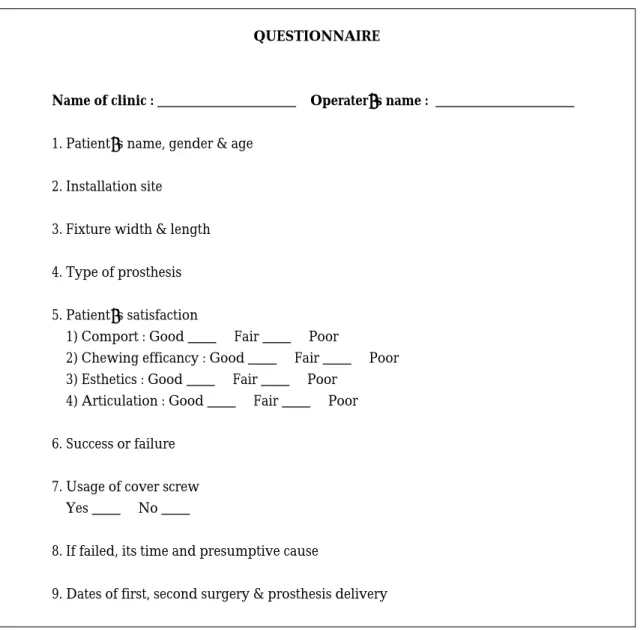
The questionnaires(Fig. 2) were given out in 5 dental clinic centers containing dental prosthodontic department, Kyungpook National University Hospital, where CSM implants had been used, and the datas were collected and statistically analysed.
Fisher’s exact test was used.
The success criteria, proposed by Albrektsson et al.12in 1986 and accepted by the American Academy of Periodontology13in 1989, were used during this study for the clinical evaluation of the implants.
Fig. 1. Illustrations of CSM implant system(CSM company, Daegu, Korea).
A. Standard fixture. B. Full-tap fixture. C. Root form fixture. D. Internal fixture.
A B C D
RESULTS
1. Distribution of patients
The patient populations consist of 11 males and 24 females and varied from 15 to 72 years, 45 mean years, in age(Fig. 3).
2. Installation site
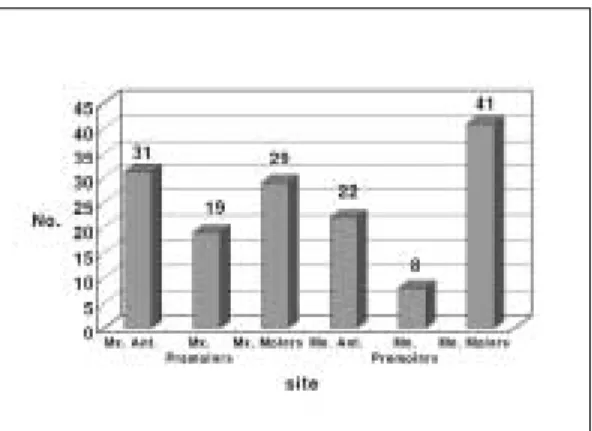
The location of implants are given in Fig. 4.
3. Fixture width and length
Fig. 5 and 6 show diameters and lengths of implants placed. The majority of implants was QUESTIONNAIRE
Name of clinic : Operater’’s name : 1. Patient’s name, gender & age
2. Installation site
3. Fixture width & length 4. Type of prosthesis
5. Patient’s satisfaction
1) Comport : Good Fair Poor
2) Chewing efficancy : Good Fair Poor 3) Esthetics : Good Fair Poor
4) Articulation : Good Fair Poor 6. Success or failure
7. Usage of cover screw
Yes No
8. If failed, its time and presumptive cause
9. Dates of first, second surgery & prosthesis delivery Fig. 2. The contents of questionnaires.
3.75mm(46%) and 4.0mm(37%) in diameter and 13mm(64%) in length.
4. Type of prosthesis
Among the osseointegrated implants, 131 sup- pocted fixed prosthese containing single crowns and 13 supported overdentures(Fig. 7).
5. Patients’’subjective post-treatment evaluation
Every patients reported considerable satisfaction with the prosthetic result achieved(Table I).
Fig. 3.The distribution of the patient. Fig. 4.Installation site.
Fig. 5.Fixture width. Fig. 6.Fixture length.
Fig. 7.Type of prosthesis.
Table II. Total success rate
implants placed Success 144(96.0%)
Failure 6(4.0%)
Total 150
Table I. Patients’satisfaction
Good Fair Poor
Comport 35 - -
Chewing efficacy 35 - -
Esthetics 24 9 -
Articulation 35 - -
Table III. Patient gender and success rate
Gender Implant placed Success implant Success rate
Female 89 86 96.6%
Male 61 58 95.1%
Total 150 144 96.0%
Table IV. Location of implants and success rate
Locaion Implant placed Success implant Success rate
Mx. ant. 31 30 96.8%
Mx. post. 48 45 93.5%
Mn. ant. 22 22 100%
Mn. post. 49 47 95.9%
Total 150 144 96.0%
Table V. Usage of cover screw and success rate
Implants placed Success implants Success rate
Yes 59(39%) 57 96.6%
No 91(61%) 87 95.6%
Total 150 14 96.0%
Table VI. Causes of failure
Use of cover screw
Etiology Yes No
Failure of primary fixation - 1
Peri-implantitis 1 1
Mobility of implant 1 1
Impossibility of prosthesis - 1
6. Success rate
Among the 150 implants placed, 6 implants failed during the healing period(Table II). However an additional implant has not failed during the follow-up period after prosthetic connection.
The success rate was higher among females (96.6%) than among males(95.1%)(Table III).
The highest rate of success is found in the mandibular anterior area(100%) and the lowest rate of success is in the maxillary posterior area (93.5%)(Table IV).
Cover screws were used in thirty-nine percent and were not used in sixty-one percent. CSM Titanium fixtures can obtain slightly higher suc- cess rate when a cover screw was not used for implant installation than when used(Table V).
However it doesn′t show significant differ- ence(p=.7615, Fisher’s Exact test).
There were 6 implant failures before the abut- ment connection. Its causes have been shown on the following Table VI.
DISCUSSION
Dental implants have revolutionized treatment for patients suffering from tooth loss. Although introduced initially for the treatment of fully edentulous patients, this technique has been suc- cessfully used for the treatment of partially eden- tulous situations and single-tooth replacement.
Despite broadening of the indications, the same basic surgical principles initially applied to eden- tulous patients appear to be related to long-term success in all applications. Gentle surgical tech- niques so that the host bone site is not overin- strumented use of copious irrigation to control the temperature and a non-loaded period to facilitate osseointegration are essential for successful treat- ment with endosseous implants.
A review of relevant literature reveals similar suc-
cess rates as found in this retrospective study.
Albrektsson et al. reported on the results of a 5- to 8-year multicenter study in Sweden of Nobelpharma pure-titanium threaded implants.
The success rate were 84.9% for the maxilla and 99.1% for the mandible.14 In another study of partially edentulous patients, a 97.2% success rate over an observation period of 5 years was reported using Nobelpharma implants.15 Similarly, Zarb & Schmitt, using Nobelpharma implants, found a success rate of 94.3% in the posterior partially edentulous patients and 91.5% in ante- rial partially edentulous patients, respective- ly.16,17Another long-term study on Nobelpharma implants in posterial areas described a 95.5%
success rate in the mandible and 95.2% in the max- illa.11In 5-year study of IMZ titanium-plasma sprayed cylindrical implants, a success rate of 92.9%
in the maxilla and 95.8% in the mandible were reported.10In 5-year multicenter study on 3i implants by Lazzara et al. the success rate were 93.8% for the maxilla and 97% for the mandible.
And they emphasized that confirmed bone anchorage was considered essential for success, its determination was based on clinical signs of per- sistent pain, mobility, discomfort, infection and/or inflammation.18
Lee et al. reported on the results of retrospective multicenter study in AVANA implant system- Korea. The success rates were 96.2%.19In anoth- er retrospective study of domestic implants, a 95.3%
success rate was reported using Neoplant implant system-Korea.20
The results of the present study with success rates of 96.0%, are similar to the above-cited pub- lished data. The high degree of success may be attributed to careful patient selection, gentle sur- gical technique, strict oral hygiene protocol with regular recall appointments, avoidance of exces- sive cantilevering, especially in posterior areas with suboptimal bone quality and avoidance of con-
nections between implants and natural teeth.
The success rate was higher among women (96.6%) than among men(95.1%). A few greater suc- cess rate among women may be explained as follows;
1. Women generally have a more positive attitute with respect to general health care ; they con- sult medical and dental professionals more readily and more often.
2. Women have the desire to maintain their looks and their youthful appearance.
3. Dental hygiene is more evident among women.
4. Occlusal forces are not as great among women.
5. The women in this study were found to smoke less than the men.21
The highest rate of success is found in the mandibular anterior area(100%) and the lowest rate of success is in the maxillary posterior area(93.5%).
The quantity and, especially, the quality of bone appear to be determining factors for success of osseointegration.22
We compared the probability of implant success between the cases of using cover screws and the cases of not-using cover screws. CSM Titanium fix- tures can obtain slightly higher success rate when a cover screw was not used for implant installa- tion than when used. However it dosen′t show significant difference (p=.7615). The results of this study demonstrates that CSM Titanium fix- tures can be achieved proper osseointegration as when a cover screw was not used as when used.
It appears that loss of integration was the major cause of implant failure and occurred in early heal- ing period before loading.
Most of patients had no complaints. The lists of complication and failures appeared to be similar to those reported in other studies.5,6
CONCLUSION
We analysed the clinical data accumulated from 5 dental clinical centers, where CSM implants had been used, and got the following results.
1. Every patients were satisfied considerably with the prosthetic results.
2. A total success rate of CSM implants was 96.0%. That showed little difference which reported other papers.
3. There were no significant difference(p=.7615) in the success rate between when a cover screw was not used for implant installation and when used.
This multicenter retrospective study demon- strated the efficacy of the CSM implant system, which is one of domestic implants, in the treatment of variety of clinical manifestation of tooth loss.
And within the limits of this study, it can be assumed that whether a cover screw is used or not should no influence on the osseointegration.
However, this study was conducted in rela- tively short-term follow-up patients. Thus further study should have continued for longer period.
REFERENCES
1. Agerberg G, Carsson GE. Chewing ability in relation to dental and general health. Analyses of data obtained from a questionnaire. Acta Odotol Scand 1981;39:147-53.
2. Bra�nemark PI, Breine U, Adell R, Hansson BO, Lindstrom J, Olsson Å. Intra-osseous anchorage of dental prostheses. I. Experimental studies. Scand J Plast Reconstr Surg 1969;3:81-100.
3. Bra�nemark PI, Hansson BO, Adell R, Breine U, Lindstrom J, Hallen O, Ollson Å Osseointegrated implants in the treatment of edentulous jaw.
Experience from a 10 year period. Scand J Plast Reconstr Surg 1977;11(suppl.16)1-132.
4. Zarb GA, Schmitt A. A longitudinal clinical ef- fectiveness of osseointegrated dental implants.
The Toronto study. Part I : Surgical results. J Prosthet Dent 1989;62:451-7.
5. Zarb GA, Schmitt A. A longitudinal clinical ef- fectiveness of osseointegrated dental implants.
The Toronto study. Part II : The prosthetic re- sults. J Prosthet Dent 1990;64:53-61.
6. Zarb GA, Schmitt A. A longitudinal clinical ef- fectiveness of osseointegrated dental implants.
The Toronto study. Part III : Problems and com- plications encountered. J Prosthet Dent 1990;64:185- 194.
7. Adell R, Lekholm U, Rockler B, Bra�nemark PI. A 15-year study of osseointegrated implants in the treatment of the edentulous jaw. Int J Oral Surg 1981;10:387-416.
8. Adell R, Ericsson B, Lekholm U,Bra�nemark PI, Jemt T. A long term follow-up study of osseoin- tegrated implants in the reatment of totally eden- tulous jaws. Int J Oral Maxillofac Implants 1990;5:347-59.
9. Sullivan DY, Sherwood RL. Consideration for successful single tooth implant restoration. J Esthet Dentistry 1993;5(3):118-123.
10. Fugazzotto PA, Gulbransen HJ, Wheeler SL, Lindsay JA. The use of IMZ osseointegrated implant in partially edentulous patients : success and fail- ure rates of 2023 implants cylinders up to 60+
months in function. Int J Oral Maxillofac Implants 1993;8(6) 617-621.
11. Nevins M, Langer B. The successful application of osseointegrated implants to the posterior jaws : a long term retrospective study. Int J Oral Maxillofac Implants 1993;8(4):428-432.
12. Albrektsson T, Zarb GA, Worthington P, Eriksson AR. The long term efficacy of currently used den- tal implants : a review and proposed criteria of suc- cess. Int J Oral Maxillofac Implants 1986;1(1):11-25.
13. American Academy of Periodontology. Proceedings of World Workshop in clinical Periodontics.
Chicago, American Academy of Periodontics 1989 14. Albrektsson T, Dahl E, Enbom L, Engevall S, Engquist B, Eriksson AR, et al. Osseointegrated oral implants. A Swedish multicenter study of 8139 con- secutively inserted Nobelpharma implants. J
Periodontol 1988;59:287-296.
15. Jemt T, Lekholm U. Oral implant treatment in posterior partially edentulous jaws:a 5 year follow- up report. Int J Oral Maxillofac Implants 1993;8(3):635-640.
16. Zarb GA, Schmitt A. The longitudinal clinical ef- fectiveness of osseointegrated dental implants in posterior partially edentulous patients. Int J peri- odont. 1993;6(2):189-196.
17. Zarb GA, Schmitt A. The longitudinal clinical ef- fectiveness of osseointegrated dental implants in anterior partially edentulous patients. Int J Oral Maxillofac Implants 1993;6(2)180-188.
18. Lazzara R, Siddiqul AA, Binon Pud, Feldman S, Weiner R, Phillios RM, Gonshor. A Retrospective multicenter analysis of 3i endosseus dental implants placed over a five-year period. Clin Oral Implant Res 1996;7:73-83.
19. Lee JB, Wang YS, Shin KH, Hwang BN.
Retrospective multicenter study of AVANA en- dosseous dental implant. J Kor Dent Ass 2000;38:558- 566.
20. Nam KY, Chang BS, Um HS. A Two-year Retrospective Study on the Clinical Success of the Korean implant Systems. J Korean Academy Periodontol 2003;33:37-46.
21. Saadoun AP, Legall ML. Clinical results and guidelines on Steri-Oss endosseus implant. Int J pe- riodont Rest Dent 1992;12:487-499.
22. Jaffin R, Berman C. The excessive loss of Bra�nemark fixtures in type IV bone : A 5 year analysis. J Periodontol 1991;62:2-4.
Reprint request to:
EUNYOUNGPARK, D.D.S., M.S.D.
DEPARTMENT OFDENTISTRY,COLLEGE OFMEDICINE, YOUNGNAMUNIVERSITY
317-1, DAEMYUNG-5-DONG,NAM-GU, DAEGU,705-717, THEREPUBLIC OFKOREA