DOI:10.4047/jap.2009.1.3.136
136
*Corresponding author: In-Sung Yeo
Department of Prosthodontics, Section of Dentistry, Seoul National University Bundang Hospital
300 Gumi-dong, Bundang-gu, Seongnam-si, Gyeonggi-do, Korea Tel, +82 31 787 2780: e-mail, [email protected]
Received October 23, 2009 / Last Revison November 4, 2009 / Accepted November 9, 2009
ORIGINAL ARTICLE J Adv Prosthodont 2009;1:136-9
INTRODUCTION
Traditionally, implant treatment is based on a 2-stage pro- tocol with a healing period of 3-6 months during which the implants are submerged to achieve osseointegration.1Recently, this clinical suggestion has been challenged. Numerous prac- titioners now advocate immediate or early loading of implants.2 The advantages of immediately loaded implants are clear: they require shorter treatment periods and allow immediate recov- ery of function and esthetics.3
High success rate of immediately loaded implants in humans was first documented in the middle 1980s. The 88% cumula- tive success rate on 1739 immediately loading implants was sug- gested.4The clinical performance and prognosis of the single- stage surgical protocol are known to be comparable to the tra- ditional 2-stage method.5There are some articles reporting a cumulative survival rate of 95%, which investigated immediately loaded single implants.6,7Results from these studies suggest that immediate loading could achieve equal success rates as those found in delayed loading.
It is also known as a common claim that treatment with imme- diate loading improved patient satisfaction and was cost
effective although no scientific evidence was presented to support.8However, advantages of early or immediate loading as mentioned may be offset by an increased risk of implant fail- ure. It was reported that immediately loaded implants were approximately 3 times more likely to fail within 1 year of placement.3Furthermore, there have been few clinical studies investigating the success or failure rates of immediate loading based on Korean implant systems.
The aim of this preliminary prospective study was to eval- uate the outcome of immediate functional loading in partial eden- tulism, using SinusQuickTMEB (Neobiotech Co., Seoul, Korea) implant system.
MATERIAL AND METHODS
Four subjects (2 smokers and 2 non-smokers) recruited from a population of patients under routine care at Seoul National Bundang Hospital were enrolled in the study. The patients were selected according to the following inclusion cri- teria: they were in normal general health with sufficient bone to allow the placement of implants at least 7 mm length.
Patients with high masticatory or parafunctional forces were
Results of immediate loading for implant restoration in partially edentulous patients: a 6-month preliminary prospective study using SinusQuick TM EB implant system
Jong-Hwa Kim1, DDS, Young-Kyun Kim2, DDS, MSD, PhD, Yang-Jin Yi3, DDS, MSD, PhD,
Pil-Young Yun4, DDS, MSD, PhD, Hyo-Jung Lee5, DDS, MSD, Myung-Jin Kim6, DDS, MSD, In-Sung Yeo7, DDS, MSD, PhD
1Resident, 2Associate Professor, 4Assistant Professor, Department of Oral and Maxillofacial Surgery,
3Associate Professor, 7Assistant Professor, Department of Prosthodontics,
5Assistant Professor, 6Clinical Instructor, Department of Periodontology, Section of Dentistry, Seoul National University Bundang Hospital, Seongnam, Korea
STATEMENT OF PROBLEM. Many dental clinicians are concerned about immediate loading of inserted implants. However, there have been few clinical studies surveying the success rates of immediate loading, based on Korean implant systems. PURPOSE. The aim of this study was to evaluate the outcome of immediate functional loading of the implant (SinusQuickTMEB, Neobiotech Co., Seoul, Korea) in partially eden- tulous maxilla or mandible. MATERIAL AND METHODS. Total 15 implants were placed. Within 2 weeks after implant insertion, provisional implant-supported fixed partial dentures were delivered to the patients. Quantitatively, marginal bone loss was measured at the time of imme- diate loading, after 3-months of continued loading and at the last follow-up. The mean follow-up period was 4.8 months. RESULTS. Mean mar- ginal bone loss from implant surgery to early loading, 3-months follow-up and last follow-up was 0.03 ± 0.07 mm, 0.16 ± 0.17 mm and 0.29
± 0.19 mm. No implant failed up to 6 months after insertion, resulting in a 100% survival rate. CONCLUSION. Immediate loading exhibited high success rate in partial edentulism for up to 6 months. Well-controlled long term clinical studies with large sample size are necessary to confirm this finding. KEY WORDS. Immediate loading, Partially edentulous, Dental implant, Prospective clinical study, Marginal bone loss [J Adv Prosthodont 2009;1:136-9]
ⓒ 2009 The Korean Academy of Prosthodontics
This is an Open Access article distributed under the terms of the Creative Commons Attribution Non-Commercial License (http://creativecommons.org/licenses/by- nc/3.0) which permits unrestricted non-commercial use, distribution, and reproduction in any medium, provided the original work is properly cited.
137
J Adv Prosthodont 2009;1:136-9
excluded. The mean age of the subjects was 50.3 years (range from 39 to 65 years), with a gender distribution of 100% men.
Informed written consent was obtained from all subjects fol- lowing approved institutional review board guidelines for clin- ical research.
Surgery was performed under local anesthesia (1 : 100,000 Epinephrine) or conscious intravenous sedation with 1%
Propofol solution and Midazolam. After a crestal incision, a mucoperiosteal flap was elevated. Implants were inserted according to the procedures recommended by manufacturers.
During the period from April to October 2009 (range from 2 to 6 months), 15 SinusQuickTMEB implants were installed in patients’jaws. Immediate loading was applied to the implants showing implant stability quotient (ISQ) and insertion torque values that were more than 60 and 35 Ncm, respectively.
Immediate loading is defined as provisional or final implant- supported restoration delivered within 2 weeks.9Therefore, pro- visional implant-supported fixed partial dentures were deliv- ered within 2 weeks (Fig. 1). The patients were instructed in
soft diet and thorough oral hygiene care. The definite restora- tion was performed approximately 12 weeks after implant insertion.
Periapical radiographs were taken using commercially available film holders and a paralleling imaging technique dur- ing the investigating period. In each patient, peri-implant marginal bone level was evaluated by IMPAX�(Agfa Co., Mortsel, Belgium) system of periapical radiographs.
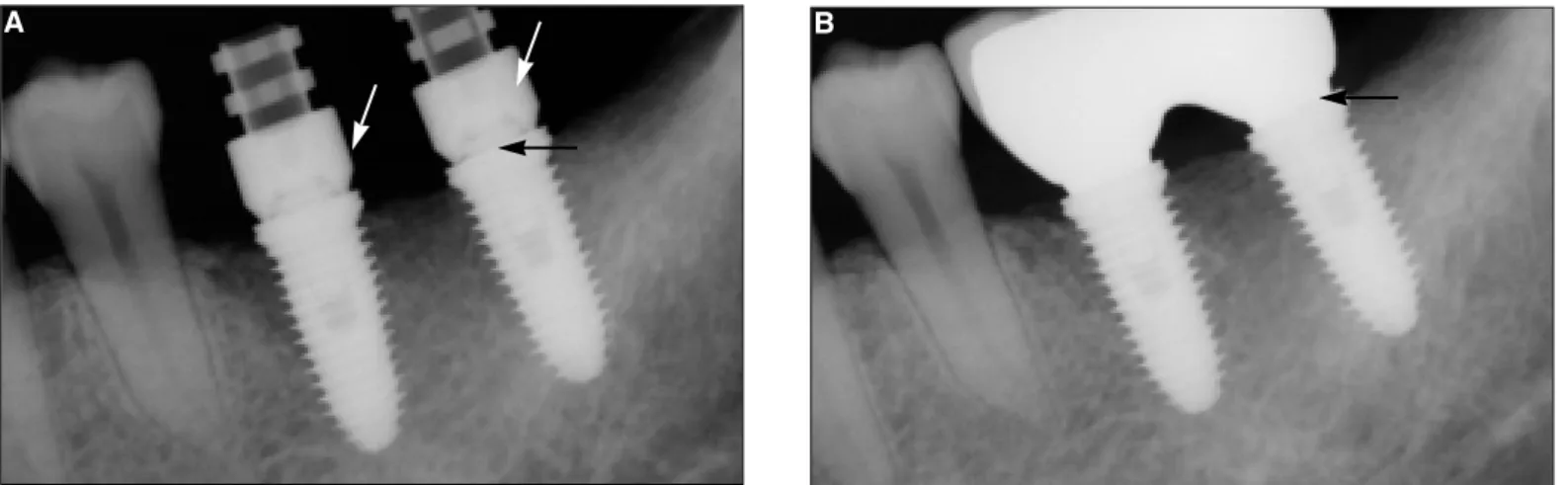
Measurements were recorded at the time of surgery, immediate loading, after 3-months of continued loading, and at the last follow-up (Fig. 2). Marginal bone height was determined on these images by measuring the distance from a reference point, defined as the platform of the implant (Fig. 2), to the most coronal point of bone-to-implant contact on both the mesial and distal sides of the implant. A single value for marginal bone height was then calculated by obtaining the mean of these two measurements for each implant.
The definition of implant success was based on the follow- ing clinical and radiologic criteria: 1) absence of clinically
Results of immediate loading for implant restoration in partially edentulous patients: a 6-month preliminary prospective study using SinusQuickTMEB implant system Kim JH et al.
Fig. 2.Periapical radiograph was taken at the time of (A) immediate loading and (B) 3-months after continued loading. The platform (black arrows) was a reference point to measure marginal bone loss. Provsional resin restoration was made by polymethylmethacrylate that is radiolucent.
Therefore, only temporary cylinders are seen (white arrows).
Fig. 1.(A) Two implants (SinusQuickTMEB, Neobiotech Co., Seoul, Korea) were inserted at #36 and #37 area (black arrows). (B) Provsional restoration (white arrows) was delivered 14 days after implant placement.
A B
A B
138 J Adv Prosthodont 2009;1:136-9
detectable implant mobility, 2) absence of pain or any subjective sensation, 3) absence of recurrent peri-implant infection, and 4) absence of continuous radiolucency around the implant.10 RESULTS
Total 15 implants were placed and were loaded immediately.
Table I shows the details of distribution of inserted implants.
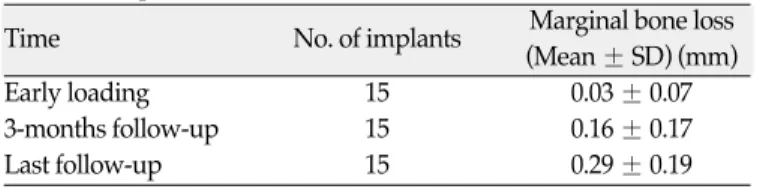
Marked variability was noted in the implant sizes selected for placement, although implants 11.5 mm length and 5.0 mm diam- eter were most commonly used. The mean follow-up period was 4.8 months (range, 2 to 6 months). Mean marginal bone loss from implant surgery to immediate loading, 3-months follow- up and last follow-up was found to be 0.03 mm, 0.16 mm and 0.29 mm respectively (Table II). No implant failed up to 6 months after insertion, resulting in a 100% survival rate.
DISCUSSION
All the inserted implants showed successful integration and stable peri-implant condition up to six months. Primary stability was reported to be the most important determining factor on immediate implant loading.6Micromovements of more than 100 μm were sufficient to jeopardize healing with direct bone-to-implant contact.6Szmukler-Moncler et al. indicated that micromotions at the bone-implant interface beyond 150 μm resulted in fibrous encapsulation instead of osseointegra- tion.11If the primary implant stability could not be achieved or was questionable, it was strongly recommended to follow a con- ventional treatment protocol.6Most agreed that an insertion torque of at least 32 Nm and a resonance frequency analysis of at least 60 ISQ was required to achieve a high level of sta- bility.12In this study, mean ISQ of 15 early loaded implants was
64.9 ± 4.9.
Generally, clinicians agreed that the quality of bone was sig- nificant for success in immediate loading. The initial stability of the implant reduces in the first 3-6 weeks after placement due to remodeling and an increased ratio of woven to lamel- lar bone.12 Barewal et al. indicated that implants placed in areas of high bone quality are relatively stable over the early healing periods.13However, we reported that both maxillary and mandibular arches showed no failure of implants although the sample size was too small to analyze the data. Horiuchi et al. also reported about no difference in the success rate between arches in immediate loading.14Further studies are required about the relationship between bone quality and the success rate of immediate loading.
It has been established that there are no absolute con- traindications to implant placement although a number of con- ditions exist, which are associated with an increased risk of fail- ure.12Tobacco was reported to be only a risk factor for the implant failure.3However, the results of this investigation showed there was no implant failure in the participating patients who were smokers. Long-term studies about relevance of smoking to early loading are necessary.
There were some limitations associated with this study.
The number of investigated implants was insufficient to ana- lyze the data using proper statistics. The follow-up period was also short. Therefore, we could not assess the long-term out- come of immediate loading. Further controlled clinical stud- ies are needed to evaluate the long-term success of early loaded implants.
CONCLUSION
Within the limitation of this clinical study the preliminary results indicate that immediate loading of the implants in partial edentulism, based on SinusQuickTMEB implant system, may be successful for short period up to six months. Well-con- trolled long term clinical studies with large sample size are nec- essary.
ACKNOWLEDGEMENTS
The authors appreciate the financial help for this clinical research from Neobiotech Co., Korea.
REFERENCES
1. Adell R, Lekholm U, Rockler B, Bra�nemark P. A 15-year study of osseointegrated implants in the treatment of the edentulous jaw. Int J Oral Surg 1981;10:387-416.
2. Chiapasco M, Gatti C, Rossi E, Haefliger W, Markwalder TH.
Implant-retained mandibular overdentures with immediate loading. A retrospective multicenter study on 226 consecutive cas- es. Clin Oral Implants Res 1997;8:48-57.
3. Susarla SM, Chuang SK, DodsonTB. Delayed versus immediate loading of implants: survival analysis and risk factors for dental Results of immediate loading for implant restoration in partially edentulous patients: a 6-month preliminary prospective study using SinusQuickTMEB implant system Kim JH et al.
Table I.Distribution of implant dimensions
Diameter (mm) Length (mm)
No. of Implants
7 8.5 10.0 11.5 13
3.5 0 0 1 3 0 4
4.0 1 0 0 0 0 1
5.0 3 1 0 2 4 10
No. of implants 4 1 1 5 4 15
Table II.Marginal bone loss at early loading, 3-months follow-up and last follow-up
Time No. of implants Marginal bone loss
(Mean ± SD) (mm)
Early loading 15 0.03 ± 0.07
3-months follow-up 15 0.16 ± 0.17
Last follow-up 15 0.29 ± 0.19
139
J Adv Prosthodont 2009;1:136-9
implant failure. J Oral Maxillofac Surg 2008;66:251-5.
4. Babbush CA, Kent JN, Misiek DJ. Titanium plasma-sprayed (TPS) screw implants for the reconstruction of the edentulous mandible. J Oral Maxillofac Surg 1986;44:274-82.
5. Henry P, Rosenberg I. Single-stage surgery for rehabilitation of the edentulous mandible: preliminary results. Pract Periodontics Aesthet Dent 1994;6:15-22.
6. Calandriello R, Tomatis M. Immediate Occlusal Loading of Single Lower Molars Using Bra�nemark System(R) Wide Platform TiUnite Implants: A 5-Year Follow-Up Report of a Prospective Clinical Multicenter Study. Clin Implant Dent Relat Res 2009. [Epub ahead of print].
7. Malo′P, Rangert B, Dva¨rsa¨ter L. Immediate function of Bra�nemark implants in the esthetic zone: a retrospective clinical study with 6 months to 4 years of follow-up. Clin Implant Dent Relat Res 2000;2:138-46.
8. Attard NJ, Zarb GA. Immediate and early implant loading pro- tocols: a literature review of clinical studies. J Prosthet Dent 2005;94:242-58.
9. Misch CE, Wang HL, Misch CM, Sharawy M, Lemons J, Judy KW.
Rationale for the application of immediated load in implant dentistry: Part I. Implant Dent 2004;13:207-17.
10. Hobo S, Ichida E, Garcia LT. Osseointegration and occlusal re- habilitation. Tokyo: Quintessence Publishing Co., Ltd.; 1989.
11. Szmukler-Moncler S, Salama H, Reingewirtz Y, Dubruille JH.
Timing of loading and effect of micromotion on bone-dental im- plant interface: review of experimental literature. J Biomed Mater Res 1998;43:192-203.
12. Henry PJ, Liddelow GJ. Immediate loading of dental implants.
Aust Dent J 2008;53:S69-81.
13. Barewal RM, Oates TW, Meredith N, Cochran DL. Resonance fre- quency measurement of implant stability in vivo on implants with a sandblasted and acid-etched surface. Int J Oral Maxillofac Implants 2003;18:641-51.
14. Horiuchi K, Uchida H, Yamamoto K, Sugimura M. Immediate load- ing of Bra�nemark system implants following placement in eden- tulous patients: a clinical report. Int J Oral Maxillofac Implants 2000;15:824-30.
Results of immediate loading for implant restoration in partially edentulous patients: a 6-month preliminary prospective study using SinusQuickTMEB implant system Kim JH et al.