Korean J Environ Agric. 2014;33(3):178-183. Korean Online ISSN: 2233-4173 Published online 2014 June 25. http://dx.doi.org/10.5338/KJEA.2014.33.3.178 Print ISSN: 1225-3537
포도흰얼룩증상의 발생생태적 특성
오소영,1 남기웅,2 윤덕훈1*
1국립한경대학교 국제농업기술정보연구소, 2국립한경대학교 원예학과
Ecological Characteristics of White Stain Symptom on the Grape in Korea
Soh-Young Oh,
1Ki-Woong Nam
2and Deok-Hoon Yoon
1*(
1Research Institute of international Agriculture, Technology and Information, Hankyong National University, 456-749, Korea,
2Department of Horticulture, Hankyong National University, 456-749, Korea)
Received: 10 April 2014 / Revised: 19 June 2014 / Accepted: 25 June 2014 Copyright ⓒ 2014 The Korean Society of Environmental Agriculture
This is an Open-Access article distributed under the terms of the Creative Commons Attribution Non-Commercial License (http://creativecommons.org/licenses/by-nc/3.0) which permits unrestricted non-commercial use, distribution, and reproduction in any medium, provided the original work is properly cited.
*교신저자(Corresponding author): Deok-Hoon Yoon Phone : +82-31-678-4643; Fax : +82-31-678-4644;
E-mail : [email protected]
178
Abstract
BACKGROUND: The white stain symptom of grape clusters and canes by dust-like particles occurred in many vineyards recently. This study was conducted to investigate the ecological characteristics of white stain symptom in grapevines and vineyards.
METHODS AND RESULTS: Optimal climate condition for white stain symptom was 25℃∼30℃ with 60% of humidity. Moreover, closed condition with same humidity showed higher incidence rate of white stain symptom than ventilation condition. Grape varieties with black berry skin such as Campbell-Early and Kyoho were more sensitive to white stain symptom compare to varieties with green and red berry skin. Although the pathogens were not detected until March, they increased from April, and increased sharply from mid of July. The pathogens may overwinter in the infected stems and/or on the bark as a mycelium.
According to the increase of sugar content of grape from August to September, the mycelium which was parasitic on the bark grew to move to the fruits through the stems, and finally reached the fruit stalk to detach berries from the
clusters.
CONCLUSION: Well ventilation is recommended inside the vineyard since mid-July with roll up an insect net. In addition, infected stems and fruits should be removed out from grapevines infected with pathogens in the vineyards.
Key words: Acremonium acutatum, Ecology, Grape, Trichothecium roseum, White stain symptom
서 론
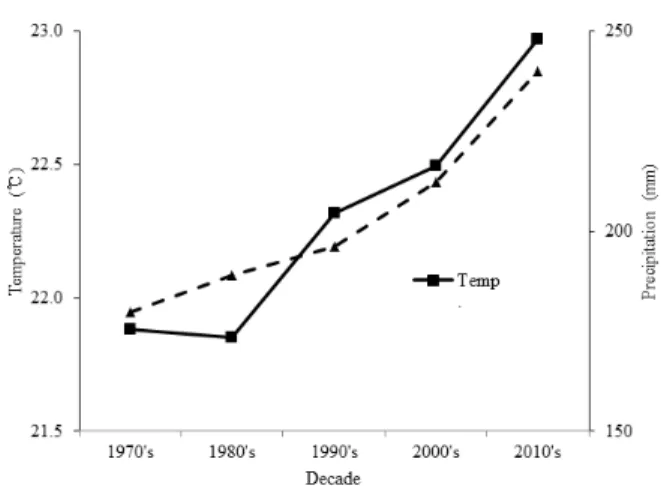
포도는 비가 적고 온난한 지역에 적합한 과수로 우리나라 처럼 여름철 강수량이 많으면 병해충의 발생도 많다. 포도 생 육기인 5월부터 9월까지의 우리나라 평균기온 및 강수량은 1970년에 비하여 2010년대에 각각 1.2℃와 60.4 mm가 높 아졌다(기상청 기상자료)(Fig. 1). 이에 따라 포도생육기간의 기상조건이 고온다습해지면서 포도의 병해충 밀도가 증가하 고 있으며, 그 중 병해에 의한 피해가 더 심각하다. Cha 등 (2000)은 농가 조사결과 병해에 의한 수량 감소는 시설재배 에서 응답자의 30% 이상, 노지비가림재배에서 응답자의 50%
이상이 10% 이상 수량이 감소하였다고 하였다.
우리나라에서 포도는 주로 생식을 목적으로 소비되기 때 문에 품질과 외관이 모두 중요하다(Park et al. , 2013). 최근 포도 과실표면에 흰색 가루가 묻은 것처럼 보이는 포도흰얼 룩증상이 크게 발생하여 소득저하의 원인이 되고 있다. 포도
Research Article Open Access
Fig. 1. The change of climate factors in precipitation and temperature to 1970’s and 2010’s in Korea. Modified from Korea Meteorological Administration.
흰얼룩증상은 1999년 발생하기 시작한 병해로 수확기에 급격 히 발생하여 포도의 과피가 지저분해서 품질과 상품성을 하 락시켜 경제적 손실을 주고 있다(Park et al. , 2013). 또한 수 확기의 강우로 인하여 포도흰얼룩증상이 대발생하여도 합성 농약을 살포하지 못하기 때문에 방제가 어려울 뿐만 아니라 수출을 위한 물량 조달에 많은 문제점을 유발하고 있다.
포도흰얼룩증상을 일으키는 병원균은 Acremonium acutatum 과 Trichothecium roseum 이 보고되어 있다(계 간포도 2014년 봄호). Acremonium spp. 에는 100여종이 있는데 대부분 부생성으로 죽은 식물체나 토양에서 분리된다 (Gams, 1975). 최근 딸기의 잎과 과경에서 갈색반점이 진행 되면서 잎자루를 고사시키고 식물체를 시들게 하는 병의 원 인균으로 A. strictum 이 동정되어 보고(Racedo et al. , 2013) 된 바 있으나, 국내⋅외에서 A. acutatum 에 의한 식물병이 보고된 바는 없다. T. roseum 은 감귤(Kwon et al. , 2013), 배(Kwon et al. , 2013), 멜론(Kwon et al. , 1998), 토마토 (Han et al. , 2012) 등의 과실에서 분홍빛썩음병(Pink Mold Rot)을 발생하는 원인균으로 보고되어 있다. 그러나 A.
acutatum 과 T. roseum 의 발생생태적 특성에 대해서는 밝 혀진 바가 없어 방제 방법에 대한 연구결과가 없는 실정이다.
따라서 본 연구에서는 포도흰얼룩증상을 일으키는 원인균 인 A. acutatum 과 T. roseum 의 생태적 특성을 구명하여 효과적인 방제체계 수립을 위한 기초자료로 활용하고자 수행 하였다.
재료 및 방법
배양조건에 따른 균사생장 특성 조사
포도흰얼룩증상을 일으키는 병원균에 대하여 온도 조건에 따른 생장 특성을 조사하기 위해 분리균을 PDA(potato dextrose agar)에 치상한 후, 배양기의 온도를 25℃ 부터 4 0℃ 까지 5℃ 간격으로 달리하여 균사의 생장을 조사하였다.
또한 포도흰얼룩증상의 발병과 온도 및 습도와의 관계를 알
하여 공기 흐름이 없는 밀폐조건과 공기가 순환되는 통풍조 건을 조성한 Growth Chamber(VS-8111H-350, Vision Scientific, Korea)에 접종한 과실을 보관하면서 병발생율을 조사하였다.
포도 품종별 발병도 조사
포도 품종별 포도흰얼룩증상의 저항성 정도를 알아보기 위하여 흑색계통인 Campbell-Early와 Kyoho 등 2개 품종, 적색계통인 Muscat Hamburg, Steuben, King De La, Delaware, Red Nehelescol, Rizamat, Benibarado 등 7 개 품종, 청색계통인 Seneca, Italia, Himrod seedless, Rosario bianco 등 4개 품종으로 총 13개 품종의 포도를 경 기도 안성시 소재 포도 과수원에서 수확적기에 수집하였다.
각각의 수집한 품종을 세척하고 물기가 마른 후에 포자현탁 액(10
4spore/mL)을 분무 접종하였으며, 접종한 과실은 습 도 90%, 온도 25℃ 조건의 배양기(DA-1H-150, DongA Science, Korea)에서 73시간 동안 보관하면서 발병율을 조 사하였다.
발생생태 조사
포도흰얼룩증상의 병발생 특성을 조사하기 위하여 안성의 2농가, 화성의 3농가를 대상으로 3월부터 수확기까지 일주일 간격으로 발생 생태를 조사하였다. 우선 포도나무의 가지, 잎 그리고 과실에서 발생하는 포도흰얼룩증상을 육안으로 관찰하 였으며, 포도나무의 수피, 가지, 잎 그리고 과실을 채집하였다.
채집한 시료는 멸균된 인산완충용액으로 세척한 후 세척액을 tetracyclin이 포함된 water agar에 희석평판법을 이용하여 25℃ 배양기에 48시간 배양한 후 colony 수를 측정하였으며, 전체 colony 중 포도흰얼룩증상 원인균인 A. acutatum 과 T.
roseum 균의 colony를 조사하였다.
결과 및 고찰
배양조건에 따른 균사생장 특성
경기도 화성과 안성의 포도 과수원에서 포도흰얼룩증상의 발생양상을 조사한 결과, 전년도에 포도흰얼룩증상이 발생했 던 이병가지에서 균사가 육안으로 관찰 되었으며, 이 균사를 배양, 동정한 결과 Trichothecium roseum 과 Acremonium acutatum 이었다.
포도흰얼룩증상의 원인균인 T. roseum 과 A. acutatum 의 균사생장과 온도와의 관계를 조사한 결과, 두 원인균 모두 35℃ 이상의 온도에서는 균사생장이 억제되었다(Fig. 2). A.
acutatum 의 경우, 25℃와 30℃에서의 균사생장 속도는 거
의 차이가 없이 배양 9일째까지 평균 44.8 mm까지 생장하였
다. 그러나 T. roseum 은 25℃에서 균사생장이 급격하게 빨
Fig. 2. Delay or inhibition of mycelial growth of
Acremonium acutatum
(left) andTrichothecium roseum
(right) on PDA plates by the four temperature 25℃, 3 0℃, 35℃ and 40℃. The mycelial growth was investigated by measuring the colony diameter of pathogens incubated for 3, 6, 9 days. Data points were the averages of 10 replicates.Fig. 3. Occurrence of white stain symptom on the grape cluster artificially infected with
Acremonium acutatum
andTrichothecium roseum
at RH (60% and 100%) and temperature (25℃, 30℃, 35℃ and 40℃) conditions.라져(Kwon et al. , 1998; Han et al. , 2012; Kwon et al. , 2013) 배양 9일 후에 88.0 mm까지 생장하였으며, 30℃에서 도 69.3 mm까지 지속적으로 생장하였다.
T. roseum 과 A. acutatum 의 포자현탁액을 과실 표면에 분무접종하여 항온항습기에서 온도를 25℃, 30℃, 35℃ 그 리고 40℃로 다르게 설정하고, 습도(RH)는 60%와 100%로 다르게 하여 조사한 결과, 포자현탁액의 접종 3일 후, 25℃와 30℃의 온도에서 전형적인 병징이 관찰되었다(Fig. 3). 포도 흰얼룩증상은 습도 60%인 조건에서는 온도 25℃와 30℃에 서 100% 발생하였으며 온도가 35℃와 40℃로 높아질수록 발생율은 70%와 50%로 점차 낮아졌다(Fig. 4a). 습도 100%
조건에서도 습도 60%인 조건과 비슷한 발생 경향을 보였는 데, 온도 25℃와 30℃에서 포도흰얼룩증상의 발생율은 85%
에서 84%로 약간 낮아졌으나 두 처리온도간 통계적 유의차 이는 없었고, 35℃와 40℃에서는 65%와 46%로 크게 낮아 졌다(Fig. 4b). 두가지 습도조건에 따라 25℃와 30℃사이의 포도흰얼룩증상 발생율에서는 통계적인 유의차이를 보이지
(a) RH 60%
(b) RH 100%
Fig. 4. Incidence of white stain symptom on the grape cluster artificially infected with
Acremonium acutatum
andTrichothecium roseum
at various RH and temperature conditions. Duncan’s multiple range test at the 0.05 level of confidence.않았다. 따라서 포도흰얼룩증상의 최적발병조건은 온도 25∼
30℃, 상대습도 60%의 조건인 것으로 판단된다.
(a) RH 60%
(b) RH 100%
Fig. 6. Incidence of white stain symptom on the grape cluster artificially infected with
Acremonium acutatum
andTrichothecium roseum
at 25℃, various RH and ventilation conditions. Duncan’s multiple range test at the 0.05 level of confidence.및 밀폐 여부와 상관없이 모든 처리구에서 포도흰얼룩증상이 발생되었는데(Fig. 5), 특히, 동일한 습도 조건에서는 밀폐상태 에서의 발생율이 더 높았다. 상대습도 60%인 통풍조건에서는 57.5%의 발병율을 보인 반면, 밀폐조건에서는 82.5%의 발병 율을 보여 유의한 차이를 보였다(Fig. 6a). 또한 상대습도 100%인 조건에서도 비슷한 경향으로 발생되었으나 상대습도 60%보다는 다소 낮아 통풍시 37.5%, 밀폐시 67.5%의 발병율 을 보여 이 역시 유의한 차이를 보였다(Fig. 6b). 포도흰얼룩증 상은 착색기 이후 습한 날씨가 계속되는 해에 많이 발생하는데 (Park et al. , 2008), 포도 착색기 이후에는 꽃매미( Lycorma delicatula ) 등의 방제를 위하여 과원 주위에 설치한 방충망을 걷어 환기를 충분히 시켜주어야 할 것으로 판단된다.
Fig. 5. Occurrence of white stain symptom on the grape cluster artificially infected with
Acremonium acutatum
andTrichothecium roseum
at 25℃, various RH and ventilation conditions.포도의 품종별 발병도
포자 현탁액을 인위적으로 접종하여 포도 품종별 포도흰 얼룩증상의 발병 정도를 조사한 결과(Table 1), 흑색계통인 거봉(Kyoho)에서는 100%, 캠벨얼리(Campbell-Early)에서 는 82.8%가 발병되어 평균 91.4%의 발병율을 보였다. 적색 계통인 Muscat Hamburg 등 7개 품종에서는 평균 11.9%
의 발병율을 보였는데 그 중 Steuben이 20.8%로 가장 높았 고 Red Nehelescol은 4.4%로 가장 낮았다. 녹색계통의 4개 품종에서는 평균 5.5%의 발병율을 나타내었는데, Seneca 품 종에서는 발병되지 않았다. 또한 품종별 당도와 발병율간의 관계를 보면, 흑색계통의 평균 당도는 17.0 Brix, 적색계통은 평균 19.3 Brix, 녹색계통은 평균 18.3 Brix로 조사되어 당도 와 포도흰얼룩증상간의 상관관계(R
2=0.1196)는 낮았다. 따라 서 포도흰얼룩증상이 흑색계통의 품종에서 발병이 잘되는 원 인은 품종별 당도의 차이는 아닌 것으로 생각된다. 우리나라 는 거봉과 캠벨얼리의 재배면적이 85%에 이르고 있으며 거
봉의 면적 비중이 점차 증가하고 있다(농업전망 2014). 우리 나라의 기후변화 양상에 따라 포도 착색기 이후의 기상은 고 온다습한 조건이 잦아질 것으로 추정되는 바, 포도흰얼룩증 상의 발병에 따른 피해를 줄이기 위하여 흑색계통 보다는 적 색 또는 녹색 계통의 포도 재배로 다양화해야 할 것으로 판단 된다.
포도흰얼룩증상의 발생생태
거봉과 캠벨얼리의 과원에서 포도흰얼룩증상을 유발하는
원인균의 밀도를 시기별로 조사한 결과, 3월까지의 동절기에
는 거의 검출되지 않았으나 4월초부터 점차 증가하기 시작하
여 7월 중순 이후 급격히 증가하였다(Fig. 7). 거봉은 7월 중
순부터 8월 초까지 2주간 병원균의 밀도가 크게 증가하였으
나 그 이후 증가폭이 둔화된 반면, 캠벨얼리는 7월 중순부터
8월 중순까지 3주간 병원균의 밀도가 급격히 증가하였다. 8
월 하순에 캠벨얼리에서의 병원균 밀도는 거봉보다 2배 정도
높게 나타났다.
Lines Variety Incidence rate (%)
Average (%)
Sugar Content (Brix)
Average (Brix)
Black Campbell-Early 82.8
91.4 16.0
Kyoho 100 18.0 17.0
Red
Muscat Hamburg 6.6
11.9
19.5
19.3
Steuben 20.8 20.5
King De La 17.6 20.0
Delaware 10.4 17.5
Red Nehelescol 4.4 22.4
Rizamat 11.9 17.0
Benibarado 11.7 18.0
Green
Seneca 0
5.5
18.5
Italia 8.5 19.0 18.3
Himrod seedless 7 16.0
Rosario bianco 6.3 19.5
Table 1. White stain symptom on the grape fruits artificially infected with isolates of
Acremonium acutatum
andTrichothecium roseum
Fig. 7. Areal distribution ratio of white stain symptom on ‘Kyoho’ and ‘Campbell-Early’ grape.
Fig. 8. Ecology cycle of white stain symptom by
Trichothecium roseum
andAcremonium acutatum
on‘Kyoho’ and ‘Campbell-Early’ grape.
3월부터 수확기까지 포도흰얼룩증상의 발생 양상을 관찰하 여 종합한 결과(Fig. 8), 포도흰얼룩증상의 원인균들은 이병가 지 및 수피에서 균사로 월동하며, 8월부터 9월까지 과실의 당 도가 증가함에 따라 수피에 기생하던 균사들이 과실쪽으로 생 장하여 과경부까지 도달하는 것으로 조사되었다. 포도 가지의 표면에 만연된 균사로부터 포자가 과실로 비산되어 만연하게 되고, 과실의 당도가 높아지는 수확기에 급격하게 증가하며 심 하면 과경부를 침입하여 탈립을 조장하기도 하였다.
결 론
본 연구는 포도흰얼룩증상의 발생생태적 특성을 구명하기 위하여 2010년부터 2012년까지 3년간 경기도 일원의 포도농장 에서 수행하였다. 포도흰얼룩증상의 최적발병조건은 온도 25∼
30℃, 상대습도 60%의 조건이었으며, 동일한 습도 조건에서는 밀폐상태에서의 발생율이 더 높았다. 포도흰얼룩증상은 적색 및 녹색계통의 품종보다는 캠벨얼리와 거봉과 같은 흑색계통의 품종에서 발병율이 월등히 높았다. 포도흰얼룩증상을 유발하는 원인균의 밀도를 시기별로 조사한 결과, 3월까지의 동절기에는 거의 검출되지 않았으나 4월초부터 점차 증가하기 시작하여 7 월중순 이후 급격히 증가하였다. 포도흰얼룩증상의 원인균들은 이병가지 및 수피에서 균사로 월동하며, 8월부터 9월까지 과실 의 당도가 증가함에 따라 수피에 기생하던 균사들이 과실쪽으 로 생장하여 과경부까지 도달하는 것으로 조사되었다.
Acknowledgement