• 검색 결과가 없습니다.

Repair of the Complete Radial Tear of the Anterior Horn of the Medial Meniscus in Rabbits: A Comparison between Simple Pullout Repair and Pullout Repair with Human Bone Marrow Stem Cell Implantation

N/A
N/A
Protected

Academic year: 2021

Share "Repair of the Complete Radial Tear of the Anterior Horn of the Medial Meniscus in Rabbits: A Comparison between Simple Pullout Repair and Pullout Repair with Human Bone Marrow Stem Cell Implantation"

Copied!
7
0
0

로드 중.... (전체 텍스트 보기)

전체 글

(1)

Repair of the Complete Radial Tear of the Anterior

Horn of the Medial Meniscus in Rabbits: A Comparison between Simple Pullout Repair and Pullout Repair with Human Bone Marrow Stem Cell Implantation

Jang-Hee Hong, MD, PhD 1 , Jong-Il Park, MD 2 , Kyung-Hee Kim, MD 3 , Young-Mo Kim, MD, PhD 4 , Yong-Bum Joo, MD 4 and Yoo-Sun Jeon, MD 4

Departments of

1

Pharmacology,

2

Biochemistry, Chungnam National University School of Medicine;

3

Department of Pathology, Cancer Research Institute;

4

Department of Orthopedic Surgery, Chungnam National University School of Medicine, Daejeon, Korea

Th is is an Open Access article distributed under the terms of the Creative Commons Attribution Non-Commercial License (http://creativecommons.org/licenses/by-nc/3.0/) which permits unrestricted non-commercial use, distribution, and reproduction in any medium, provided the original work is properly cited.

Copyright © 2011. THE KOREAN KNEE SOCIETY

www.jksrr.org

http://dx.doi.org/10.5792/ksrr.2011.23.3.164 pISSN 2234-0726 · eISSN 2234-2451

Knee Surgery & Related Research

Purpose: To evaluate the degree of biological healing response that occurs between the anterior horn of the medial meniscus (MM) and the tibial plateau and investigate the biological healing response aft er injection of human bone marrow stem cells (hBMSCs) in a rabbit model.

Materials and Methods: Twenty-fi ve rabbits with a mean body weight of 2.5 kg were chosen for this study. On the left knee, a complete radial tear was made at the anterior tibial attachment site of MM and aft er removal of tibial cartilage, pullout repair of the torn MM was performed on the tibial plateau. On the right knee, the same procedure was performed, and a scaff old (matrix gel) that contained human bone marrow stem cell was implanted between MM and the tibial plateau. A biopsy was performed at 2 (group 1), 4 (group 2), and 8 (group 3) weeks postoperatively. Th e authors compared the diff erences in the degree of biological healing of each group and investigated the degree of biologic healing aft er hBMSC implantation by comparing the left knee with the right knee.

Results: On the biopsy of 40 knees of 20 rabbits that survived aft er operation, all groups did not show the healing response between the undersurface of MM and the tibial plateau. Th ere was no signifi cant diff erence in terms of the pathological criteria such as fi broblasts and fi brochondrocytes etc., with and without hBMSC implantation.

Conclusions: Th ere was no attachment between the repaired MM and the tibial plateau aft er complete radial tear on MM and the authors could not identify the eff ect of hBMSC.

Key words: Medial meniscus, Meniscal root ligament tear, Pullout repair, Human bone marrow stem cell, Biologic response.

Received April 27, 2011; Revised (1st) May 31, 2011; (2nd) July 13, 2011;

Accepted July 18, 2011.

Correspondence to: Young-Mo Kim, MD.

Department of Orthopedic Surgery, Chungnam National University School of Medicine, 33 Munhwa-ro, Jung-gu, Daejeon 301-721, Korea.

Tel: +82-42-280-7352, Fax: +82-42-252-7098 Email: [email protected]

Co-corresponding to: Kyung-Hee Kim, MD.

Department of Pathology, Cancer Research Institute, Chungnam National University School of Medicine, 33 Munwha-ro, Jung-gu, Daejeon 301-721, Korea.

Tel: +82-42-280-7195, Fax: +82-42-252-7098 Email: [email protected]

*Th is study was fi nancially supported by research fund of Chungnam National University Hospital in 2009.

Introduction

Th e meniscus is a fi brocartilaginous tissue composed of cartilage cells and a collagen fiber network of extracellular matrix. It is responsible for weight distribution, shock absorption, stability of the knee, joint lubrication, and proprioceptive sensation.

A meniscal tear can lead to degenerative knee arthritis

1)

. The anterior and posterior horns of the medial meniscus (MM) are attached to the tibia by root ligaments whose tears and subsequent loss of meniscal function can lead to degenerative changes of the knee

2,3)

. Allaire et al.

4)

noted that root ligament tears resulted in changes in the tibiofemoral joint contact stress and biomechanics that could be comparable to total menisectomy in their cadaver study and suggested the need for root ligament tear repairs to restore the joint biomechanics. Th eir study provides a rationale for arthroscopic repair of root ligament tear of the MM posterior horn

5-9)

. However, the outcomes of

164

(2)

arthroscopic repair of root ligament tear of the MM posterior horn that is common in Asians still remain controversial. We believe there are two prerequisites for successful healing after arthroscopic meniscus repair. First, the repaired posterior horn should be fi rmly attached to the tibia. Second, complete healing should be obtained between the undersurface of the meniscus and the tibial plateau. Th ere have been some animal and cadaver studies regarding the pullout strength of the MM posterior horn

10-12)

. In contrast, to our knowledge, the biological process of healing between the undersurface of the repaired meniscus and the tibial plateau has rarely been addressed

13)

. In addition, the impact of stem cell injection on healing between the undersurface of the repaired meniscus and the tibial plateau appeared to have not been described in any study although mesenchymal stem cells were reported to differentiate into meniscal cells

14)

. Studies on the root ligament tears of the MM posterior horn dealt with operative techniques providing only level IV scientifi c evidence

4,15-17)

. In this study, we investigated the biological healing process after modified pullout repair of a complete radial tear made at the anterior tibial attachment site of MM in rabbits to assess whether the repaired meniscus was attached to the tibial plateau. In addition, the eff ect of human bone marrow stem cell (hBMSC) implantation in meniscal repair was also evaluated.

Materials and Methods

Th is study was approved by our institutional review board for animal research. There were twenty-five New Zealand rabbits under the age of 1 year with a mean body weight of 2.5 kg (range, 2.4 to 2.6 kg) at the start of the study. However, 5 of them were lost to follow-up due to death and data from the remaining 20 subjects were used for analysis. A biopsy was randomly carried out at the 2

nd

postoperative week in 6 rabbits, 4

th

week in another 6, and 8

th

week in the remaining 8. Th e subjects were classifi ed into 3 groups according to the time of biopsy: 6 in group I, another 6 in group II, and 8 in group III. All of the experiments were performed in an animal operating room at our institution.

1. Preparation of Human Bone Marrow Stem Cells (hBMSCs) Th e hBMSCs were prepared using the same procedure described by Heo et al.

18)

. Bone marrow was obtained from the hip bones of healthy donors. Th e mononuclear cells (MNCs) were isolated by centrifugation and cultured in Iscove’s modified Dulbecco’s medium (IMDM) with 20% heat inactivated bovine serum, 2 mM L-glutamine, penicillin (100 unit/mL), and streptomycin (100 μg/mL). After 7-10 days, the cells were trypsinized and

harvested in a new flask at 37

o

C under 5% CO

2

in air. The medium was replaced every 3-4 days. At 80% confluence, cells were removed with 0.025% Trypsin-EDTA and placed in fresh culture plates. Characterization of the cells was confi rmed using a mesenchymal stem cell kit (Chemicon, Temecula, CA, USA).

Diff erentiation into mesodermal lineage was confi rmed using the method described by Yoo et al.

19)

.

2. Anesthesia

Solid food was withdrawn for 6 hours before surgery and acepromazine (35 mg/kg) was administered intramuscularly.

Ten minutes aft er the administration, Ketamin (50 mg/kg) was administered intramuscularly. The anesthesia was maintained with 2.5% isofl urane during surgery. Anesthesia was successfully induced and maintained in all cases. Th ere was no intraoperative death.

3. Surgical Technique

Surgery was performed on both knees in all cases. On the left knee, the meniscal tear was repaired with sutures. On the right knee, a scaffold (matrix gel) containing human bone marrow stem cells was implanted between MM and the plateau before sutures.

1) Left knee

A medial parapatellar longitudinal incision was made, subcutaneous soft tissue was dissected, and the patella was dislocated laterally. The joint capsule was opened and with the knee in flexion, the meniscus was exposed from the anterior

Fig. 1. Th e anterior horn of medial meniscus in a rabbit was cut from

the tibial plateau (white arrow) and cartilage of the tibial plateau was

removed by a curette (black arrow).

(3)

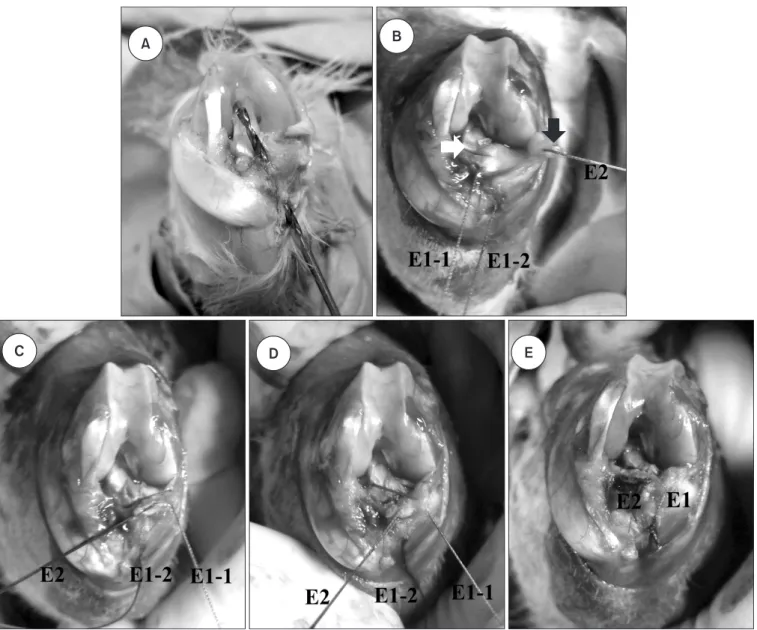
horn to the mid portion, not the posterior horn. The anterior intermeniscal ligament was cut at a site where the anterior cruciate ligament (ACL) is attached to MM using a #15 scalpel blade. Th e joint capsule and the MM anterior horn were medially translated to expose its attachment to the tibial plateau. Cartilage of the tibial plateau was removed with a curette until bleeding occurred (Fig. 1). A transtibial tunnel extending from a point 5mm medial to the proximal tibial tuberosity to immediately above the site of ACL attachment to the tibia was created using a 2mm-thick drill (Fig. 2A). A 3-0 Ethibond (Ethicon, Somerville, NJ, USA) (E1) was passed through the tunnel (Fig. 2B). The needle end of the suture (E1-1) was pulled out of the joint

between the MM and the joint capsule attachment site while applying pressure on the mid portion of MM (Fig. 2C). Th e E1-1 was introduced back into the joint through MM and the joint capsule attachment site at a point 2mm anterior to the suture exit, advanced medially from lateral to the site of ACL attachment to the tibia with tension to form an X-shaped suture over MM, pulled out of the joint immediately superior to the insertion site (Fig. 2D) for a pull out suture with the free end of E1 (E1-2) (Fig.

2E). Th e posteriorly protruded MM anterior horn was brought to its original place and fixed to the tibia by making a hole in the tibia using another 3-0 Ethibond (E2). In this way, MM was sutured with tension applied on the tibial plateau. Aft er irrigation

Fig. 2. Th e torn anterior horn of medial meniscus (MM) was reattached by a pullout suture technique. (A) A tibial tunnel was drilled for pullout suture. (B) Ethibond (E1) was inserted through the tibial tunnel and another Ethibond (E2) was sutured for anterior horn of MM (black arrow).

Anterior cruciate ligament (white arrow). (C, D) MM was attached to tibial plateau by an X-shaped pullout suture and the root ligament of MM was

reattached to its origin site. (E) Th e Ethibond (E1) was tied and anterior horn of MM was reattached to origin site (E2).

(4)

with saline water, interrupted suture was done with 4-0 Nylon for skin closure. Th e area created by the central and peripheral margins of MM, the anterior intermeniscal ligament attachment site to the MM anterior horn and the most posterior aspect of the exposed MM with the knee in full fl exion was chosen as the surgical site.

2) Right knee

Th e joint was opened and the tibial cartilage was removed in the same way. One hundred μg (2×10

6

cells/mL) hBMSCs was mixed with the same amount of Matrigel at 4

o

C, to which 10 μL cell suspension was pipetted (Gilson P20 pipette). Th e mixture was incubated at 37

o

C for 30 seconds and then injected between the MM and the removed cartilage. Suture closure was performed as was done on the left knee.

4. Postoperative Treatment

Proper wound dressing was performed and long leg cast

immobilization was applied. A biopsy was carried out at 2 weeks aft er surgery in group I, 4 weeks aft er surgery in group II, and 8 weeks aft er surgery in group III. During the biopsy, all biological events were recorded by a digital camera. Th e meniscus samples were examined with the naked eye by a histopathologist and were fi xed with 10% formalin, embedded in paraffi n, and stained with hematoxilin-eosin. Inflammatory reaction and tissue response were evaluated with biopsy. Pathological criteria including infl ammatory infi ltration, connective tissue volume, macrophage, fibroblast, and fibrocartilage were used to assess the efficacy of hBMSC implantation.

5. Euthanasia

After sample collection, the rabbits were euthanized under anesthesia with an intravenous injection of a combination of embutramide (0.1 mg/kg), mebezone (0.1 mg/kg), and tetracaine (0.1 mg/kg).

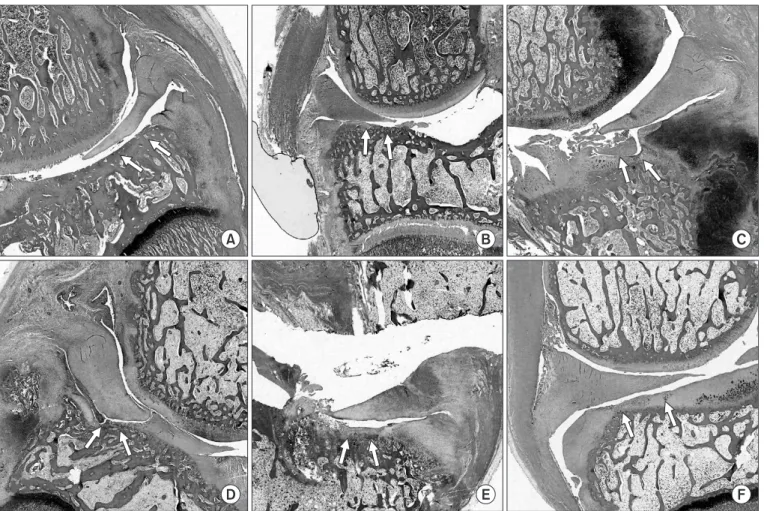
Fig. 3. Th e pathologic features were observed using optical microscope. Attachment between the undersurface of medial meniscus and tibial plateau

was not identifi ed in all cases. Th ere is some gap (black arrows) between the meniscus and tibial plateau in H&E stain (×40 times). (A) Postoperative

2 weeks controlled group. (B) Postoperative 2 weeks stem cell inserted group. (C) Postoperative 4 weeks controlled group. (D) Postoperative 4 weeks

stem cell inserted group. (E) Postoperative 8 weeks controlled group. (F) Postoperative 8 weeks stem cell inserted group.

(5)

Results

Two in group I and 3 in group II died aft er surgery. Th e cause of death was infl ammation at the surgery site in 3 and food refusal in 2. Th e biopsy samples of the remaining 20 rabbits (40 knees) were observed under optical microscope. In all knees, a gap was observed between the undersurface of the MM anterior horn and the tibial plateau (Fig. 3), indicating that the undersurface of the MM anterior horn was not attached to the tibial plateau. Two cases of meniscus atrophy were observed in group II.

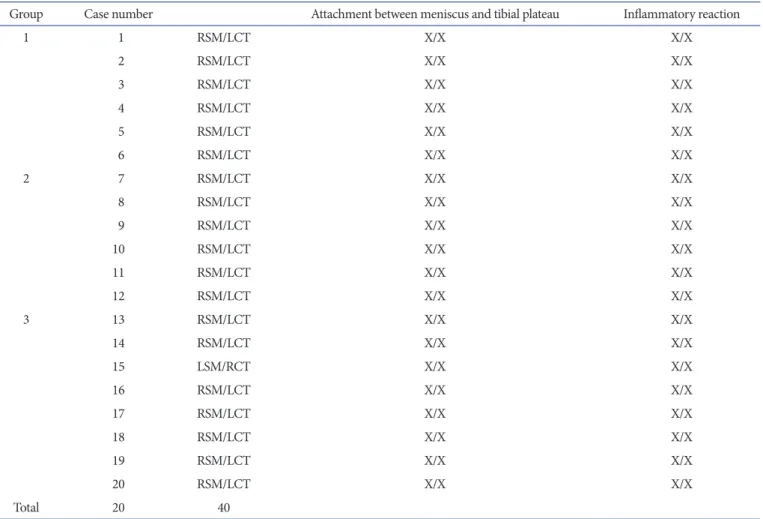
Th ere were no histopathological diff erences regarding the use of hBMSCs because the gap between the undersurface of the MM anterior horn and the tibial plateau was observed in both the left knee and right knee in all cases. Attachment between the meniscus and the tibial plateau and distinctive inflammatory reaction were not observed in all cases (Table 1). Th e quantity of fibroblasts and fibrocartilage cells were similar in the left knee and the right knee, indicating no signifi cant biological diff erence

with and without hBMSC injection (Fig. 3).

Discussion

The biomechanical properties of the meniscus have been addressed in many studies. In contrast, there is a paucity of studies in the literature on biological changes of the meniscus after root ligament repair

13)

, especially those involving hBMSC injection. Richmond and Sarno

17)

reported that the meniscus was reattached to the tibia aft er treatment of medial meniscal avulsion fractures via progression of the fi brocartilage calcifi cation in the cancellous bone attached to the meniscus. However, considering that avulsion fracture treatments are about bone-to-bone healing, their study does not provide the basis for “bone-to-meniscus healing” aft er arthroscopic repair of the root ligament of the MM posterior horn. Th erefore, we designed this study to investigate the healing process of a complete radial tear at the posterior tibial attachment site of MM in an animal model. Before study,

Table 1. Results in Stem Cell Inserted Group Versus Control Group

Group Case number Attachment between meniscus and tibial plateau Infl ammatory reaction

1 1 RSM/LCT X/X X/X

2 RSM/LCT X/X X/X

3 RSM/LCT X/X X/X

4 RSM/LCT X/X X/X

5 RSM/LCT X/X X/X

6 RSM/LCT X/X X/X

2 7 RSM/LCT X/X X/X

8 RSM/LCT X/X X/X

9 RSM/LCT X/X X/X

10 RSM/LCT X/X X/X

11 RSM/LCT X/X X/X

12 RSM/LCT X/X X/X

3 13 RSM/LCT X/X X/X

14 RSM/LCT X/X X/X

15 LSM/RCT X/X X/X

16 RSM/LCT X/X X/X

17 RSM/LCT X/X X/X

18 RSM/LCT X/X X/X

19 RSM/LCT X/X X/X

20 RSM/LCT X/X X/X

Total 20 40

RSM: stem cell inserted group of right knee, LCT: control group of left knee.

(6)

we performed preliminary examinations on the anatomical structures of the meniscus and the surrounding areas in rabbits and determined to use the MM anterior horn because it was easier to perform surgery on. When an intermeniscal ligament is injured, the MM anterior horn extrudes posteriorly in rabbits, which we assumed equivalent to meniscal extrusion in humans with root tears. We also assumed that the area immediately posterior to the intermeniscal ligament attachment site in rabbits was equivalent to the posterior tibial attachment site of MM in humans. There was no attachment between MM and the tibial plateau in all knees (Fig. 3). Unlike the successful MM anterior horn repair results in a rabbit model reported by Gao et al.

13)

, we could not observe reattachment of the MM anterior horn to the tibia after pullout repair. This was thought to be attributable to the fact that MM was sutured on the tibial plateau in our study.

Unfortunately, it was impossible to remove the cartilage at the periphery of the tibia due to the small size of the knee joint of rabbits. We think that studies using animals with the knee joint similar in size with that of humans should be conducted to eliminate the possibility of errors caused by the knee joint size diff erence.

Stem cells are harvested from early stage embryos and can be grown in large quantities, differentiate into almost all types of cells in the body, and be transplanted without immune rejection to other patients and species

14)

. There have been many reports on the effects of the intraarticular injection of hBMSCs, but its function has yet to be established. According to Caplan and Dennis

14)

, mesenchymal stem cells (MSCs) appeared to enhance regeneration of the meniscus, although the MSCs observed in the meniscus were too few to account for the regeneration. In this study, we performed pullout repair alone on one knee and pullout repair with hBMSC injection on the other knee and compared the postoperative histological changes to evaluate the effi cacy of hBMSCs. With the development of tissue engineering, absorbable polymer scaffolds have been developed, which enables intraarticular injections of growth factors and stem cells

20,21)

. However, we could not find statistically significant histopathological differences between the knees with stem cell injection and those without. We could not assess the impact of the intermeniscal ligament on the stability of the meniscus and identify whether the implanted stem cells were placed at the exact surgical site although we used a matrix gel scaff old to promote cell preservation. Th e limitations of this study include:

1) the knee joint of rabbits was too small to perform surgery at the exact site aft er proper tabial cartilage removal; 2) the surgery was performed on the MM anterior horn, not the posterior horn;

and 3) the follow-up period was not long enough for a long-term histological evaluation aft er meniscal attachment. Th erefore, we think these limitations should be addressed in future prospective studies.

Conclusions

Th ere was no attachment between the MM anterior horn and the tibial plateau after complete radial tear repair using a pull out suture technique. In addition, we could not fi nd statistically signifi cant histopathological diff erences between the knees with hBMSC injection and those without.

References

1. Arnoczky Sp, McDevitt CA. The meniscus: structure, function, repair and replacement. In: Buckwalter JA, Einhorn TA, Simon SR, eds. Orthopaedic basic science. 2nd ed. Rosemont: American Academy of Orthopaedic Srugeon;

2000. p531-45.

2. Gale DR, Chaisson CE, Totterman SM, Schwartz RK, Gale ME, Felson D. Meniscal subluxation: association with osteoarthritis and joint space narrowing. Osteoarthritis Cartilage. 1999;7:526-32.

3. Lerer DB, Umans HR, Hu MX, Jones MH. The role of meniscal root pathology and radial meniscal tear in medial meniscal extrusion. Skeletal Radiol. 2004;33:569-74.

4. Allaire R, Muriuki M, Gilbertson L, Harner CD. Bio- mechanical consequences of a tear of the posterior root of the medial meniscus. Similar to total meniscectomy. J Bone Joint Surg Am. 2008;90:1922-31.

5. Ahn JH, Wang JH, Yoo JC, Noh HK, Park JH. A pull out suture for transection of the posterior horn of the medial meniscus: using a posterior trans-septal portal. Knee Surg Sports Traumatol Arthrosc. 2007;15:1510-3.

6. Choi NH, Son KM, Victoroff BN. Arthroscopic all-inside repair for a tear of posterior root of the medial meniscus:

a technical note. Knee Surg Sports Traumatol Arthrosc.

2008;16:891-3.

7. Kim YM, Rhee KJ, Lee JK, Hwang DS, Yang JY, Kim SJ.

Arthroscopic pullout repair of a complete radial tear of the tibial attachment site of the medial meniscus posterior horn.

Arthroscopy. 2006;22:795.e1-4.

8. Nicholas SJ, Golant A, Schachter AK, Lee SJ. A new surgical technique for arthroscopic repair of the meniscus root tear.

Knee Surg Sports Traumatol Arthrosc. 2009;17:1433-6.

(7)

9. Ozkoc G, Circi E, Gonc U, Irgit K, Pourbagher A, Tandogan RN. Radial tears in the root of the posterior horn of the medial meniscus. Knee Surg Sports Traumatol Arthrosc.

2008;16:849-54.

10. Aros BC, Pedroza A, Vasileff WK, Litsky AS, Flanigan DC.

Mechanical comparison of meniscal repair devices with mattress suture devices in vitro. Knee Surg Sports Traumatol Arthrosc. 2010;18:1594-8.

11. Kocabey Y, Taser O, Nyland J, Doral MN, Demirhan M, Caborn DN, Sarban S. Pullout strength of meniscal repair aft er cyclic loading: comparison of vertical, horizontal, and oblique suture techniques. Knee Surg Sports Trauma tol Arthrosc. 2006;14:998-1003.

12. Kohn D, Siebert W. Meniscus suture techniques: a comparative biomechanical cadaver study. Arthroscopy.

1989;5:324-7.

13. Gao J, Wei X, Messner K. Healing of the anterior attachment of the rabbit meniscus to bone. Clin Orthop Relat Res.

1998;(348):246-58.

14. Caplan AI, Dennis JE. Mesenchymal stem cells as trophic mediators. J Cell Biochem. 2006;98:1076-84.

15. Griffi th CJ, LaPrade RF, Fritts HM, Morgan PM. Posterior

root avulsion fracture of the medial meniscus in an adolescent female patient with surgical reattachment. Am J Sports Med. 2008;36:789-92.

16. Marzo JM, Kumar BA. Primary repair of medial meniscal avulsions: 2 case studies. Am J Sports Med. 2007;35:1380-3.

17. Richmond JC, Sarno RC. Arthroscopic treatment of medial meniscal avulsion fractures. Arthroscopy. 1988;4:117-20.

18. Heo JY, Jing K, Song KS, Seo KS, Park JH, Kim JS, Jung YJ, Hur GM, Jo DY, Kweon GR, Yoon WH, Lim K, Hwang BD, Jeon BH, Park JI. Downregulation of APE1/Ref-1 is involved in the senescence of mesenchymal stem cells. Stem Cells.

2009;27:1455-62.

19. Yoo SW, Kim SS, Lee SY, Lee HS, Kim HS, Lee YD, Suh- Kim H. Mesenchymal stem cells promote proliferation of endogenous neural stem cells and survival of newborn cells in a rat stroke model. Exp Mol Med. 2008;40:387-97.

20. Peretti GM, Caruso EM, Randolph MA, Zaleske DJ.

Meniscal repair using engineered tissue. J Orthop Res.

2001;19:278-85.

21. Stone KR, Steadman JR, Rodkey WG, Li ST. Regeneration of

meniscal cartilage with use of a collagen scaff old. Analysis of

preliminary data. J Bone Joint Surg Am. 1997;79:1770-7.

수치

Fig. 1. Th e anterior horn of medial meniscus in a rabbit was cut from  the tibial plateau (white arrow) and cartilage of the tibial plateau was  removed by a curette (black arrow).
Fig. 2. Th e torn anterior horn of medial meniscus (MM) was reattached by a pullout suture technique
Fig. 3. Th e pathologic features were observed using optical microscope. Attachment between the undersurface of medial meniscus and tibial plateau  was not identifi ed in all cases
Table 1. Results in Stem Cell Inserted Group Versus Control Group

참조

관련 문서

After choosing the type of bike, the next step is the right bike size. the right size for you from

44 글의 첫 번째 문장인 The most important thing in the Boat Race is harmony and teamwork.을 통해 Boat Race에서 가장 중요한 것은 조 화와 팀워크임을

Now that you have the right bike for you, it is important to learn the right riding position.. A poor riding position can lead to injuries

44 글의 첫 번째 문장인 The most important thing in the Boat Race is harmony and teamwork.을 통해 Boat Race에서 가장 중요한 것은 조 화와 팀워크임을

Nonlinear Optics Lab...

12 that절 내의 주어를 문장의 주어로 쓰고 that절 내의 동사를 to부정사로 써 서 수동태 문장을 만들 수 있다... 13 반복되는 the reason을 관계대명사 which로 바꿔주고

The proposal of the cell theory as the birth of contemporary cell biology Microscopic studies of plant tissues by Schleiden and of animal tissues by Microscopic studies of

웹 표준을 지원하는 플랫폼에서 큰 수정없이 실행 가능함 패키징을 통해 다양한 기기를 위한 앱을 작성할 수 있음 네이티브 앱과