Identification and Genetic Diversity of Korean Tomato Cultivars by RAPD Markers
Man Kyu Huh
1*, Sun Joo Youn
2and Sun Chul Kang
31
Department of Molecular Biology, Dong-eui University, Busan 614-714, Korea
2
Biofamer Co. Ltd., Kyoungsan, Kyoungbook 712-714, Korea
3
Department of Biotechnology, Daegu University, Kyoungsan 712-714, Korea
Received August 31, 2010 /Accepted November 11, 2010Cultivated tomato, Lycopersicum esculentum, is a very important crop. We selected 36 cultivars and stud- ied them for identification and polymorphism by employing random amplified DNA (RAPD) analysis with 80 oligonucleotide primers. Of the 80 primers, 36 primers (45.0%) were polymorphic. Detection of polymorphism in cultivated tomato opens up the possibility of development of its molecular map by judicious selection of genotypes. Molecular markers can also be used for cultivar identification and protection of the plant breeder’s intellectual property rights (plant breeders’ rights, PBRs). As an exam- ple, DNA polymorphism using OPC-13 primer that did not produce the OPC-13-01 band was only found in Junk Pink and Ailsa Craighp cultivars. OPA-12-03 and OPB-15-07 were fragments specific to the TK-70 cultivar and were absent in other cultivars. DNA polymorphism in cultivated tomato in this study was correlated with a type of inflorescence, although some cultivars had exceptions. These approaches will be useful for developing marker-assisted selection tools for genetic enhancement of the tomato plant for desirable traits.
Key words : Tomato, Lycopersicum esculentum, cultivar, random amplified DNA (RAPD)
*Corresponding author
*Tel:+82-51-890-1529, Fax:+82-51-890-1521
*E-mail : [email protected]
Introduction
Progress in plant breeding, genetics, and molecular biology combined with an enhanced concern for both ex-situ and in-situ preservation of biodiversity [7]. The progression has greatly in- creased the responsibility and visibility of those charged with long-term conservation and the use of plant genetic resources [2]. It is very important to define identity, purity, and stability of varieties for breeder’s rights protection as well as for an effec- tive seed quality control program [11,13]. Part of the solution to this challenge may lie in the use of powerful, yet relatively simple and inexpensive, molecular techniques to generate in- formation to better organize the useful genetic variation present within a collection or cultivars [5].
Cultivated tomato,
Lycopersicum esculentum
Miller (Solanaceae), is a very important crop due to high value of its fruits for fresh consumption. The tomato is a herbaceous, usu- ally sprawling plant in the Solanaceae or nightshade family that is typically cultivated for the purpose of harvesting its fruit for human consumption. The taxonomy keys, interior of ripe fruit red, fruit diameter, leaves subdivided, internodes short, densely pubescent, and large accresant calyx are a revision to that for-mulated by Rick
et al
. [18] and published in the Tomato Genetics Cooperative. Genotypic differences within tomato cultivars de- tected by molecular markers can also be used for cultivar identi- fication and protection of the plant breeder’s intellectual prop- erty rights (plant breeders’ rights, PBRs). Data reported in all the studies dealing with the application of DNA markers in to- mato cultivar identification are useful and provide important background information to address the issue of PBRs [4,14].In this study thirty-six cultivars of tomato from Korea were analyzed for RAPD (random amplified polymorphic DNA) markers. RAPD assay has been useful in determining genetic relationships among closely related species [5]. RAPD analysis is quick, robust, requires minimal preliminary work [12,15].
We expected that the RAPD analyses assess the amount and structure of genetic diversity among cultivars of tomato in Korea. Lee
et al
. [9] studied the relationships of some cultivars of cherry tomato in Korea. However, the genetic diversity and characteristics of many cultivars of tomato in Korea has not been studied [8]. The basic question is it possible to detect the identi- fication of cultivars using RAPD makers.Materials and Methods Plant materials and preparation of DNA
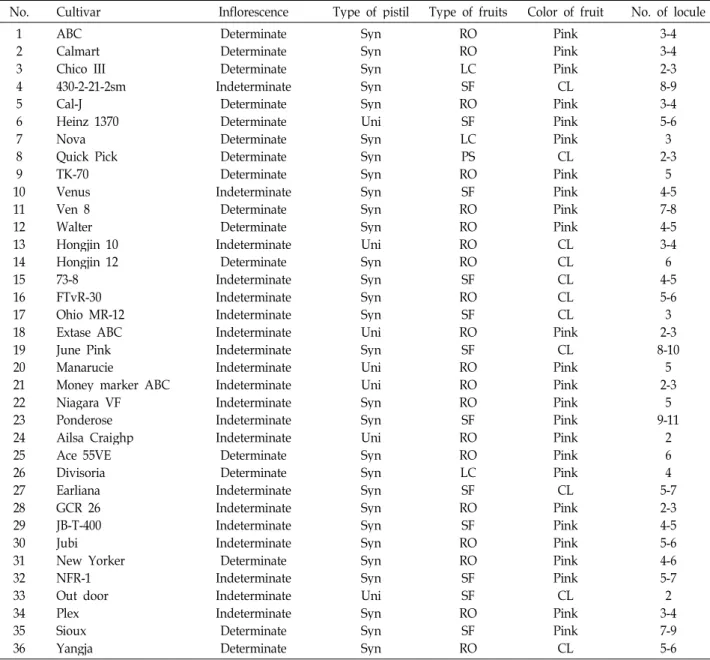
A collection of tomato cultivars was showed in Table 1. Total
Table 1. Characteristics of 36 selected tomato cultivars used in this study
No. Cultivar Inflorescence Type of pistil Type of fruits Color of fruit No. of locule 1
23 45 6 78 109 1112 13 1415 1617 1819 20 2122 2324 2526 2728 29 3031 3233 3435 36
ABC Calmart Chico III 430-2-21-2sm Cal-J Heinz 1370 NovaQuick Pick TK-70 Venus Ven 8 Walter Hongjin 10 Hongjin 12 73-8 FTvR-30 Ohio MR-12 Extase ABC June Pink Manarucie
Money marker ABC Niagara VF Ponderose Ailsa Craighp Ace 55VE Divisoria Earliana GCR 26 JB-T-400 JubiNew Yorker NFR-1 Out door PlexSioux Yangja
Determinate Determinate Determinate Indeterminate
Determinate Determinate Determinate Determinate Determinate Indeterminate
Determinate Determinate Indeterminate
Determinate Indeterminate Indeterminate Indeterminate Indeterminate Indeterminate Indeterminate Indeterminate Indeterminate Indeterminate Indeterminate Determinate Determinate Indeterminate Indeterminate Indeterminate Indeterminate Determinate Indeterminate Indeterminate Indeterminate Determinate Determinate
Syn SynSyn SynSyn Uni SynSyn SynSyn SynSyn Uni SynSyn SynSyn UniSyn Uni UniSyn SynUni SynSyn SynSyn Syn SynSyn SynUni SynSyn Syn
RO ROLC ROSF SF LCPS ROSF RORO RO ROSF ROSF ROSF RO RORO ROSF ROLC ROSF SF RORO
SFSF ROSF RO
Pink PinkPink PinkCL Pink PinkCL PinkPink PinkPink CL CLCL CLCL PinkCL Pink PinkPink PinkPink PinkPink PinkCL Pink PinkPink PinkCL PinkPink CL
3-4 3-42-3 8-93-4 5-6 2-33 4-55 7-84-5 3-4 4-56 5-63 8-102-3
5 2-35 9-112
64 5-72-3 4-5 5-64-6 5-72 3-47-9 5-6 Syn: Syncarpous, Uni: Unicarpellate, RO: Round, LC: Lentgthened cylindrical, SF: Slightly flattened, CL: Colorless.
genomic DNA was extracted from approximately 1.0 g of young leaves using the plant DNA Zol Kit (Life Technologies Inc., GrandIsland, New York, U.S.A.) according to the manu- facturer’s protocol. DNA was suspended in TE buffer and stor- ed at -20oC.
RAPD analysis
RAPD analysis was performed using 80 different 10-base oli- gonucleotide primers (OPA-01~20, OPB-01~20, OPC-01~20, and OPD-01~20, series) purchased from Operon Technologies (Alameda, CA). A mixture contained 20 ng of template DNA, 0.5 pmol of a random primer, 10x PCR buffer (20 mM Tris-HCl pH 8.4, 50 mM KCl), 3.0 mM MgCl2, 2.5 μM each dNTP, and
1.0 U
Taq
DNA polymerase. Amplification was performed in a Gene Amp PCR System 9700 (Perkin Elmer-Applied Biosystems), which was programmed for initially denatured at 94oC for 30 sec, followed by 40 cycles of 40 sec of denaturation at 94oC, 40 sec of annealing at 40oC and 60 sec of primer ex- tension at 72oC, then finally incubated at 72oC for 7 min. The amplification products were separated by electrophoresis on 1.5% agarose gels, stained with ethidium bromide, and photo- graphed under UV light using Polaroid 667 film. A 100 bp lad- der DNA marker (Pharmacia) was used in the end of gels for the estimation of fragment size. Because RAPD markers had a disadvantage of reproduction, all experiments were done twice.Table 2. List of decamer oligonucleotide utilized as primers, their sequences, and associated fragments
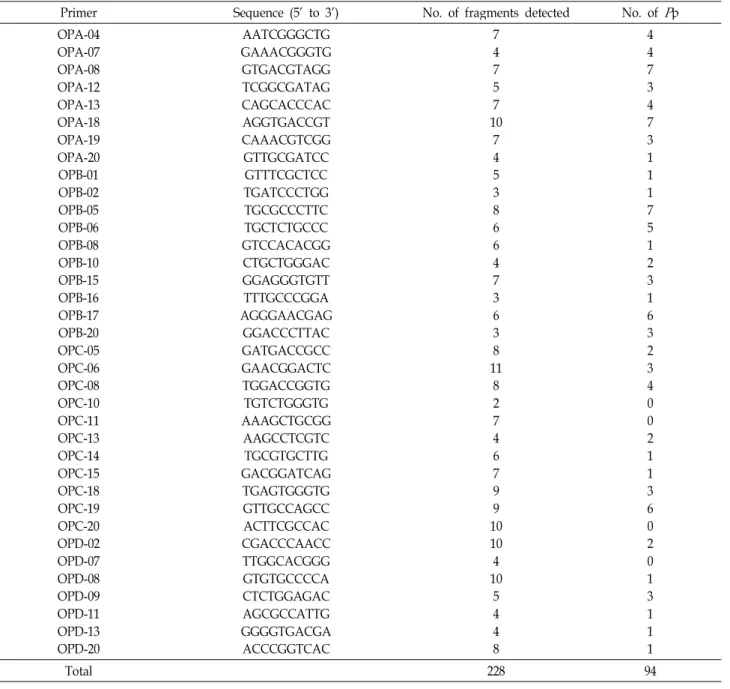
Primer Sequence (5’ to 3’) No. of fragments detected No. of
P
pOPA-04 OPA-07 OPA-08 OPA-12 OPA-13 OPA-18 OPA-19 OPA-20 OPB-01 OPB-02 OPB-05 OPB-06 OPB-08 OPB-10 OPB-15 OPB-16 OPB-17 OPB-20 OPC-05 OPC-06 OPC-08 OPC-10 OPC-11 OPC-13 OPC-14 OPC-15 OPC-18 OPC-19 OPC-20 OPD-02 OPD-07 OPD-08 OPD-09 OPD-11 OPD-13 OPD-20
AATCGGGCTG GAAACGGGTG GTGACGTAGG TCGGCGATAG CAGCACCCAC AGGTGACCGT CAAACGTCGG GTTGCGATCC GTTTCGCTCC TGATCCCTGG TGCGCCCTTC TGCTCTGCCC GTCCACACGG CTGCTGGGAC GGAGGGTGTT TTTGCCCGGA AGGGAACGAG
GGACCCTTAC GATGACCGCC GAACGGACTC TGGACCGGTG TGTCTGGGTG AAAGCTGCGG AAGCCTCGTC
TGCGTGCTTG GACGGATCAG TGAGTGGGTG GTTGCCAGCC ACTTCGCCAC CGACCCAACC TTGGCACGGG GTGTGCCCCA CTCTGGAGAC AGCGCCATTG GGGGTGACGA ACCCGGTCAC
7 47 57 10
74 53 86 6 47 36 38 118
2 74 67 99 1010
4 105
44 8
4 47 34 7 31 11 75 1 23 16 32 34 0 02 11 36 02 0 13 11 1
Total 228 94
Statistical analyses
All RAPD bands were scored manually and only un- ambiguously scored bands were used in the analyses. In addi- tion, replicate cultivars were assayed in separate experiments to verify repeatability of results. Because RAPD bands are domi- nant markers, it was assumed that each band corresponded to a single character with two alleles, presence (1) and absence (0) of the band.
The following genetic parameters were calculated using a POPGENE computer program (ver. 1.31) developed by Yeh
et al
. [22]: the percentage of polymorphic loci (P
p) mean numbers of alleles per locus (A
), effective number of alleles per locus (A
E), and gene diversity (H
) [16].A phenetic relationship was constructed by the neighborjoin- ing (NJ) method [19] using the NEIGHBOR program in PHYLIP version 3.57 [6].
Results
The 36 tomato cultivars were studied using 80 oligonecleo- tide primers for RAPD analysis. From a number of 80 primers, 44 primers did not give any clear-cut bands, or showed only smeared bands. The results with these primers were omitted from the analyses, and RAPD markers amplified 36 primers (45.0%) were analyzed. The number of bands generated by each primer varied from 2 (OPC-10) to 11 (OPC-06), with an average
Table 3. Measurements of genetic variation for cultivars of 36 selected tomato cultivars
Cultivar
N
pP
pA A
EH I
ABC Calmart Chico III 430-2-21-2sm Cal-J Heinz 1370 Nova Quick Pick TK-70 Venus Ven 8 Walter Hongjin 10 Hongjin 12 73-8FTvR-30 Ohio MR-12 Extase ABC June Pink Manarucie
Money marker ABC Niagara VF Ponderose Ailsa Craighp Ace 55VE Divisoria Earliana GCR 26 JB-T-400 JubiNew Yorker NFR-1 Out door Plex Sioux Yangja Mean
60 58 59 70 7242 57 79 83 4248 44 52 55 6147 49 54 33 4041 36 26 38 3834 19 21 34 3224 38 31 29 2834 44.7
27.3 26.1 26.7 31.5 32.418.9 25.7 35.6 37.4 18.921.6 19.8 23.4 24.8 27.521.2 22.1 24.3 14.9 18.018.5 16.2 11.7 17.1 17.115.3 8.6 9.5 15.3 14.410.8 17.1 14.0 13.1 12.615.3 20.1
1.270 1.261 1.266 1.315 1.324 1.189 1.257 1.356 1.374 1.189 1.216 1.198 1.234 1.248 1.275 1.212 1.221 1.243 1.149 1.180 1.185 1.162 1.117 1.171 1.171 1.153 1.086 1.095 1.153 1.144 1.108 1.171 1.140 1.131 1.126 1.153 1.201
1.215 1.216 1.211 1.256 1.267 1.131 1.226 1.311 1.335 1.134 1.153 1.156 1.166 1.215 1.196 1.190 1.180 1.192 1.109 1.132 1.126 1.119 1.083 1.118 1.121 1.099 1.056 1.059 1.103 1.097 1.082 1.114 1.093 1.094 1.078 1.106 1.154
0.117 0.116 0.114 0.137 0.143 0.075 0.119 0.164 0.175 0.078 0.090 0.085 0.097 0.113 0.110 0.099 0.097 0.104 0.061 0.074 0.072 0.066 0.049 0.067 0.068 0.058 0.032 0.035 0.060 0.056 0.045 0.066 0.054 0.053 0.046 0.060 0.085
0.168 0.165 0.164 0.197 0.204 0.110 0.168 0.231 0.246 0.114 0.131 0.122 0.142 0.161 0.161 0.140 0.138 0.150 0.088 0.107 0.107 0.097 0.071 0.099 0.100 0.086 0.048 0.053 0.088 0.083 0.065 0.097 0.080 0.077 0.069 0.089 0.123 The number of polymorphic loci (
N
p), percentage of polymorphism (P
p), mean number of alleles per locus (A
), effective number of alleles per locus (A
E), gene diversity (H
), and Shannon's information index (I
).of 6.3 bands per primer. The size of the amplified DNA frag- ments varied from 340 bp to 3.0 kbp. Totally 228 DNA frag- ments (bands) were found among 36 cultivars. Among of these 228 bands, 92 (40.4%) bands were polymorphic. In a simple measure of intracultivars variability by the percentage of poly- morphic bands, the Earliana accession exhibited the lowest var- iation (8.6%). Otherwise the TK-70 cultivar showed the highest (37.4%) (Table 3). Statistical analysis showed that mean number of alleles per locus (
A
) ranged from 1.086 to 1.374 with a mean of 1.201, while the effective number of alleles per locus (A
E) ranged from 1.056 to 1.335. The phenotypic frequency of eachband was calculated and used for estimating genetic diversity (
H
) with in cultivars. The cultivated tomato cultivars maintained a low level of genetic diversity for polymorphic primers. The totalH
was 0.085 across cultivars. Shannon’s index of pheno- typic diversity (I
) of Korean tomato cultivars ranged from 0.048 to 0.204 with a mean of 0.123.The amplification products observed of 36 cultivars using primer OPC-11 (Fig. 1), exhibited the monomorphic pattern of lack of DNA polymorphism in cultivated tomato. On the other hand OPA-08, OPA-12, and OPB-17 exhibited the useful pat- terns of polymorphism in cultivars.
Fig. 1. DNA bands obtained from a collection of 36 tomato cultivars amplified with OPC-11 primer. M: Molecular weight of standard.
Fig. 2. Ideogram of cultivar-specific DNA fragments obtained by RAPD OPA-12 primer. The arrow indicates the unique band that was produced a 1500 bp DNA frag- ment in the Ohio MR-12.
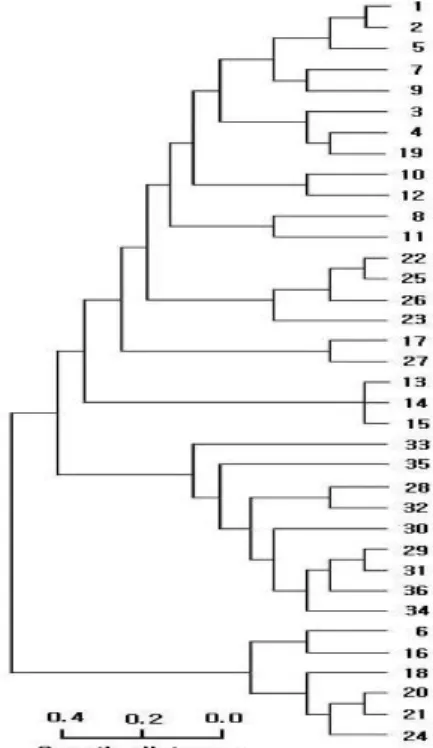
Fig. 3. Dendrogram of the 36 Korean tomato cultivars listed in Table 1, based on RAPD analysis.
As an example, the presence of DNA polymorphism using OPC-13 primer that did not produced the OPC-13-01 band only in Junk Pink and Ailsa Craighp cultivars.
OPA-20-03 and OPB-15-07 fragments are specific for TK-70 cultivar, whereas no products were detected in individuals from other cultivars. OPA-12-01 was specific for Ohio MR-12 cultivar (Fig. 2), OPB-08-03 and OPD-08-06 for Niagara VF, OPC-08-02
for Ponderose, and OPC-14-04 for Ven 8. These specific DNA fragments seemed to be useful to discriminate among cultivars and were used to develop the SCAR (sequence-characterized amplified region) markers.
Some cultivars could not be differentiated and twelve out of 34 nodes in the dendrogram were supported by bootstrap values of less than 50% (Fig. 3). However, three cultivars, Honggjin 10, Honggjin 12, and 73-8 were not separated by RARD primers in this study.
Discussion
Among 228 bands were obtained, a number of 92 (40.4%) bands of 36 tomato cultivars were polymorphic. The levels of genetic variation found within Korean cultivars of tomato were low in relation to the mean value of results in same species.
Some workers reported similar results in cultivated tomato [10,14]. The lack of polymorphism has also been reported in other self-pollinated crops such as soybean, potato, and ground nut [7,11,20]. Such insufficient variability in DNA poly- morphism makes it difficult to construct a genetic map, if using populations derived from across between cultivars [2]. A low level DNA polymorphism in cultivated tomato was also re- ported using AFLP (amplified fragment length polymorphisms) and SSR (simple sequence repeats) primer pairs [14].
RAPDs are a convenient and effective marker system for to- mato species identification [2]. The RAPD analysis was chosen for the present study since the procedures involved were sim- ple, not requiring probes or Southern-blot hybridization, as in the case of RFLP (restriction fragment length polymorphism).
The amplification is reproducible by sticky adhering to the spe- cific protocols though RAPD marker system has certain dis- advantages such as reproducibility [21].
Out of the 228 bands, only seven fragments are specific for one cultivar. The efficiency to find a RAPD marker useful for purity determination was 3.1%. This value is very low than those of in pepper, tomato hybrids, and Sonanaceous species [1,17]. It is proposed that similar lineages from parents and bulks are used to our experiments.
The 36 tomato cultivars were chosen for the present study
a broad spectrum of variation for several morphological and agricultural traits. The characteristics of 36 cultivars that show greater diversity for inflorescence, type of pistil, color of fruits, and numbers of locules for tomato are given in Table 1. For example the demonstration of DNA polymorphism in many cultivated tomato in this study is correlated with type of in- florescence, although some cultivars have exceptions. The ob- servation of polymorphism could be attributed in selection of cultivars with diverse characteristics including hybridization lines, as well as to specific primers used in the RAPD analysis.
These bands will be useful for developing mapping cultivars.
However, dendrograms obtained with RAPD marker systems did not indicate group of cultivars according to their morpho- logical types. Thus, associating polymorphic DNA fragments with different traits requires further study using the selected trait-specific cultivars and their progenies.
In conclusion, the present study indicated the presence of DNA polymorphism in cultivated tomato using RAPDs. This open up a possibility for developing a molecular genetic map that will lead to the application of marker-assisted selection tools in genetic enhancement of cultivated tomato.
References
1. Ballester, J. and M. C. de Vicente. 1998. Determination of F1hybrid seed purity in pepper using PCR-based markers.
Euphytica
103, 223-226.2. Carelli, B. P., L. T. S. Gerald, F. G. Grazziotin, and S.
Echeverrigaray. 2006. Genetic diversity among Brazilian cul- tivars and land laces of tomato Lycopersicon esculentum Mill. revealed by RAPD markers.
Genet. Res. Crop. Evol.
53, 395-400.3. Ciccarese, F., M. Amenduni, D. Schiavone, and M. Cirulli.
1998. Occurrence and inheritance of resistance to powdery mildew (
Oidium lycopersici
) inLycopersicon
species.Plant Pathology
47, 417-419.4. Cooke, R. J., G. M. M. Bredemeifer, M. W. Ganal, R. Peeters, P. Isaac, and S. Rendell. 2003. Assessment of the uniformity of wheat and tomato varieties at DNA microsattellite loci.
Euphytica
132, 331-341.5. Demeke, T., R. P. Adams, and R. Chibbar. 1992. Potential taxonomic use of random amplified polymorphic DNA (RAPD): a case study in
Brassica
.Theor. Appl. Genet.
84, 990-994.6. Felsenstein, J. 1993. PHYLIP (Phylogeny Inference Package) Version 3.5s. Distributed by the Author. Department of Genetics, Univ. of Washington, Seattle.
7. Ghislain, M., D. Zhang, D. Fajardo, Z. Huaman, and R. J.
Hijmans. 1999. Marker-associated sampling of the cultivated Andean potato
Solanum phureja
collection using RAPD markers.Genet. Res. Crop. Evol.
46, 547-555.8. Huang, C. C., Y. Y. Cui, C. R. Weng, P. Zabel, and P.
Lindhout. 2000. Development of diagnostic PCR markers closely linked to the tomato powdery mildew resistance gene Ol-1 on chromosome 6 of tomato.
Theor. Appl. Genet.
101, 918-924.
9. Lee, W. S., B. S. Kim, and H. Y. Lee. 2002. Horticultural characteristics of valuable strains in cherry tomato.
Korean J. Hort. Sci. Techol.
20, 74.10. Helentjaris, T., G. King, M. Slocum, C. Siedenstrang, and S. Wegman. 1985. Restriction fragment polymorphisms as probes for plant diversity and their development as tools for applied breeding.
Plant Mol. Biol.
5, 109-118.11. Ilbi, H. 2003. RAPD markers assisted varietal identification and genetic purity test in pepper,
Capsicum annuum
.SciHort.
97, 211-218.
12. Kresovich, S., J. G. K. Williams, J. R. McFerson, E. J.
Routman, and B. A. Schaal. 1992. Characterization of genetic identities and relationships of
Brassica oleraceae
L. via a ran- dom amplified polymorphic DNA assay.Theor. Appl. Genet.
85, 190-196.
13. Macko, A. and D. Grzebelus. 2008. DcMater trasposon dis- play markers as a tool for diversity evaluation of carrot breeding materials and for hybrid seed purity testing.
J.
Appl. Genet.
49, 33-39.14. Martinez, S. G., L. Andreani, M. G. Gusano, F. Geuna, and J. J. Ruiz. 2006. Evaluation of amplified fragment length polymorphism and simple sequence repeats for tomato germplasm fingerprinting: utility for grouping closely re- lated traditional cultivars.
Genome
49, 648-656.15. Molnar, S. J., L. E. James, and K. J. Kasha. 2000. Inheritance and RAPD tagging of multiple genes for resistance to net blotch in barley.
Genome
43, 224-231.16. Nei, M. 1973. Analysis of gene diversity in subdivided populations.
Proc. Natl. Acad. Sci. U.S.A.
70I, 3321-3323.17. Paran, I., M. Horowitz, D Zamir, and S. Wolf. 1995. Random amplified polymorphic DNA markers are useful for purity determination of tomato hybrids.
HortScience
30, 377.18. Rick, C. M. 1990. J. W. de Verna, and R. T. Chetelet. 1990.
Experimental ingression to the cultivated tomato from re- lated wild nightshades, pp. 19-30, In Bennett, A. B. and S.
D. O'Neill (eds.),
Horticultural biotechology
. New York.19. Saitou, N. and M. Nei. 1987. The neighbor-joining method:
A new method for reconstructing phylogenetic trees.
Mol.
Biol. Evol.
4, 406-425.20. Subramanian, V., S. Gurtu, R. C. Nageswara, and S. H.
Higam. 2000. Identification of DNA polymorphism in culti- vated groundnut using random amplified polymorphic DNA (RAPD) assay.
Genome
43, 646-660.21. Williams, J. G. K, A. R. Kubelik, K. J. Livak, J. A. Rafalski, and S. V. Tingey. 1990. DNA polymorphisms amplified by arbitrary primers are useful as genetic markers.
Nucleic Acids Res.
18, 6531-6535.22. Yeh, F. C., R. C. Yang, and T. Boyle. 1999. POPGENE Version 1.31, Microsoft Windows-based Freeware for Population Genetic Analysis. University of Alberta, Alberta.