원예과학기술지 19(2):159-162. 2001
RAPD를 이용한 자생 바위솔속(
Orostachys
) 식물의 유연관계 분석이병애1*․김학현1․조용구2․이철희1
1충북대학교 원예학과, 2충북대학교 식물자원학과
Analysis of Genetic Relationship among Korean Native Orostachys Species Using RAPD
Byoung Ae Lee1*, Hag Hyun Kim1, Yong Gu Cho2, and Cheol Hee Lee1
1Dept. of Horticulture, Chungbuk National University, Cheongju, 361-763, Korea,
2Dept. of Agronomy, Chungbuk National University, Cheongju, 361-763, Korea
*corresponding author
ABSTRACT The genetic relationships of Korean native Orostachys species collected from various regions were analysed using random amplified polymorphic DNA (RAPD) method. Eighteen Orostachys species analysed with UPGMA were clustered into three groups A, B, and C. However, four species were not clustered into any group. O.
iwarenge species in group A (No. 18 No. 22) showed low similarity with 66.3 73.9% according to the cluster analysis. O. malacophyllus species in group B (No. 12 No. 17) showed low similarity with 66.7 83.7% according to the cluster analysis. The similarity coefficient value of O. japonicus (No. 3 No. 8) except Anmyeondo collected variety (No. 9) showed higher level with 84.2 92.3% than O. iwarenge or O. malacophyllus. Therefore, O. japonicus is thought to be genetically stable, and have less regional variation.
Additional key words: polymerase chain reaction, regional variation
※ Received for publication 5 March 2001. Accepted for publication 22 March 2001. This research was supported by Research Center for the Development of Advanced Horticultural Technology.
서 언
우리나라에 자생하는 바위솔속 식물은 CAM식물로서 환경에 대 한 적응이 대단히 강하여 비옥도가 낮은 곳에서 자생하며, 내건성 및 내한성이 강하고 번식이 잘된다(Chang과 Lee, 1983; Kim, 1996). 또한 바위솔속 식물은 지형, 토양조건, 미기상 등 자생지의 환경조건에 의한 생태적 차이 때문에 종간뿐만 아니라 같은 종내에 서도 엽형, 엽색, 엽내에 붉은색의 점과 붉은색의 테두리가 생기는 등 자생지마다 다양한 변이를 가지고 있다.
식물의 종․속간 및 품종간 특성이나 계통을 분류하는데 형태적 특성에 의한 식물학적분류 방법 이외 단백질, 동위효소 분석 등이 이용되어 왔다. 최근에는 분자생물학적 표지인자를 이용하는 방법 으로 RFLP(restriction fragment length polymorphism)와 RAPD (random amplified polymorphic DNA)가 널리 이용되고 있다 (Stiles 등, 1993; Murray와 Thompson, 1980). RAPD방법은 PCR 증폭에 의해 만들어진 DNA 단편이 길이에 따라 변화하는 현상을 나타내기 때문에 주로 작물의 종간 분류군 또는, 지리적으 로 격리분포하고 있는 종내 분류군들의 집단간 개체의 유전적 유사
성을 밝힐 수 있는 방법으로 종내 분류군들의 변이정도를 파악하는 데 매우 유용한 방법으로 알려져 있다(Lin, 1994). 우리 나라에서 도 RAPD법을 이용하여 제비꽃 식물의 유전적 다양성의 구명(Oh 등, 1998a, b), 계열별 표시 개발(Ko 등, 1997, 1998), 취나물류의 생태형 등을 RAPD marker로 지역간 변이정도를 확인(Yoo 등, 1996) 하는 등 자생식물의 분류학적 연구들이 활발하게 이루어지 고 있다.
우리나라의 각 지역에서 다양한 형태와 엽색의 바위솔속 식물들 이 발견되고 있으나, 단지 지역명으로만 불릴 뿐 식물분류학적 연 구가 미미한 실정이다. 그러므로 본 연구는 RAPD법을 이용하여 바위솔속 식물의 지역적으로 나타나는 유전적 다양성을 분석하기 위하여 실시하였다.
재료 및 방법
1. 공시재료
1998 1999년의 2년 동안 우리나라의 22개 지역에서 자생하는 난쟁이바위솔(Orostachys sikokiana) 1종, 좀바위솔(O. minutus)
KOR. J. HORT. SCI. & TECHNOL. 19(2), JUNE 2001 160
Sample no. Scientific name Locality
1 O. sikokiana Sobaeksan
2 O. minutus Kangwhado
3 O. japonicus Pyeongchang
4 Yeongdong
5 Cheontaesan
6 Haenam
7 Jejudo
8 Ullungdo
9 Anmyeondo
10 Unidentified Maemuldo
11 Pocheon
12 O. malacophyllus Soraksan
13 Ulsan
14 Yeosoo
15 Taebaek
16 Sokcho
17 Paekdoosan
18 O. iwarenge Jinboo
19 Ullungdo
20 Sobaeksan
21 Jejudo
22 Paekdoosan
Table 1. Korean native Orostachy species used in this study.
Primer Sequence (5’-3’) GC content (%) No. of total bands No. of polymorphic bands
OPA-7 GAAACGGGTG 60 4 1
OPA-15 TTCCGAACCC 60 5 4
OPA-19 CAAACGTCGG 60 2 1
OPC-1 TTCGAGCCAG 60 3 3
OPC-3 GGGGGTCTTT 60 3 2
OPC-13 AAGCCTCGTC 60 13 13
OPC-20 ACTTCGCCAC 60 7 6
OPAB-1 CCGTCGGTAG 70 6 5
OPAB-2 GGAAACCCCT 60 4 3
OPAB-20 CTTCTCGGAC 60 5 5
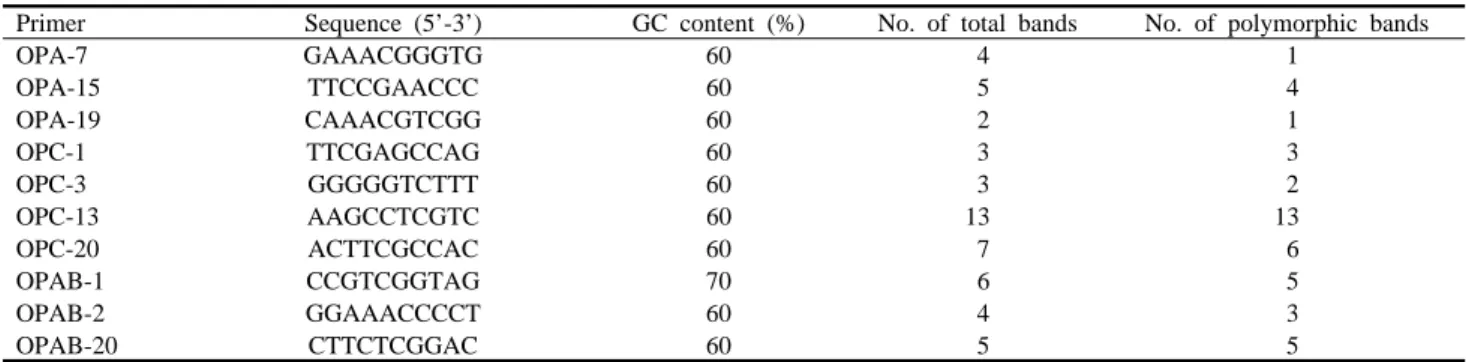
Table 2. Nucleotide sequence of primers and number of informative RAPD markers amplified with the genomic DNA of 22 Orostachys species.
1종, 바위솔(O. japonicus) 7종, 둥근바위솔(O. malacophyllus) 6 종, 연화바위솔(O. iwarenge) 5종 및 아직 명명되지 않은 2종(매 물도, 포천에서 수집)등 22종의 바위솔속(Orostachys) 식물을 수 집, 공시재료로 하였으며(Table 1), 온실에서 1년 이상 재배한 후 RAPD분석을 실시하였다.
2. DNA 추출 및 정제
Genomic DNA의 추출은 식물체의 어린 잎 300mg을 액체질소로 급속 냉동시킨 상태에서 마쇄한 후, 추출 용액[Tris-HCl(pH 8.0) 100mM, EDTA 50mM, NaCl 500mM, SDS 1.25%(w/v), sodium bisulfite 3.8g․L-1]를 처리하여 65℃ 항온수조에서 20 30분간 반 응시켰으며 Chloroform:isoamylalcohol(24:1)용액을 혼합 후 상징 액을 분리시켰다. 분리한 상징액에 RNase(10μg·mL-1) 1μl를 처 리하여 37℃ 항온기에서 10분간 반응시켰다. 상징액에 isopropanol 로 DNA를 응축한 후 TE buffer에 녹여 2% CTAB buffer를 동일 한 양으로 넣어 혼합하여 65℃의 항온수조에서 10분간 반응 시켰
다. Chloroform:isoamylalcohol(24:1)과 isopropanol을 재처리하고 70% ethanol로 세척한 후 풍건하였다. 풍건한 DNA를 TE buffer에 녹인 후 12,000rpm에서 5분간 원심분리하여 불순물을 제거하여 사 용하였다.
3. DNA 증폭
PCR 반응의 기본 조건은 주형 DNA 20ng, dNTPs 200μM, random primer 15pM, Taq polymerase 0.5unit, 10×PCR buffer [Tris-HCl(pH 8.3) 100mM, KCl 500mM, MgCl2 15mM, gelatin 0.1%]를 혼합하여 총 반응액은 25μl로 하였다.
Primer는 Operon사에서 구입한 10-mer로 구성된 OPA, OPC 및 OPAB 60개중 10개를 선발하여 사용하였다(Table 2). DNA의 증폭은 MJ Rearsch사의 Thermal Cycler(PTC-100, USA)을 이용 하여 94℃에서 5분간 전처리하고, 94℃에서 1분, 35℃에서 1분, 7 2℃에서 2분 반응시켜 총 40 cycle을 반복한 다음 72℃에서 10분 간 처리하고 마지막에 4℃에서 유지시켜 주었다.
4. RAPD 분석
증폭된 PCR 산물은 0.5×TAE buffer를 사용하여 1.5% agarose gel상에서 50V로 전기영동하여 ethidium bromide로 염색 후 UV transilluminator을 이용하여 밴드를 확인하고 폴라로이드 카메라로 촬영하였다. 밴드의 재현성 유무를 확인하기 위하여 실험은 2회 반 복적으로 수행하였으며, 재현성이 있는 밴드만을 조사하여 분석에 이용하였다. 증폭된 밴드의 분자량 크기는 1kb DNA ladder (Takara, Japan)를 사용하여 추정하였다.
RAPD-PCR 결과 데이터 분석은 NTSYS program(version 1.70; Rohlf, 1993)을 이용하여 Dice’s coefficient로 유사도 값을 구했으며, 비가중 산술방식(UPGMA; unweighted pair group methed with arithmetic mean)으로 집괴분석을 하여 dendrogram 을 작성하였다.
결과 및 고찰
우리나라의 22개 지역에서 자생하는 바위솔속 식물의 유전적 근 연관계를 구명하기 위하여 RAPD분석을 실시하였다. 증폭된 DNA
161 KOR. J. HORT. SCI. & TECHNOL. 19(2), JUNE 2001 k b
3 .1 2 .0
1 .0 k b
3 .1 2 .0
1 .0
Fig. 1. RAPD profiles generated from 22 genomic DNA of Orostachys species using primer OPC-13. Lane numbers corresponded to the sample number in Table 1. M indicates size marker of 1kb DNA ladders.
100 90 80 70 60
19 21 18 22 20 14 16 12 15 13 17 6 8 4 3 5 7 9 11 10 1 2
O. iwarenge Ullungdo O. iwarenge Jejudo
O. iwarenge Jinboo A
O. iwarenge Paekdoosan O. iwarenge Sobaeksan O. malacophyllus Yeosoo O. malacophyllus Sokcho O. malacophyllus Soraksan B O. malacophyllus Taebaek O. malacophyllus Ulsan O. malacophyllus Paekdoosan O. japonicus Haenam O. japonicus Ullungdo O. japonicus Yeongdong O. japonicus Pyeongchang C O. japonicus Cheontaesan O. japonicus Jejudo O. japonicus Anmyeondo Unidentified Pocheon Unidentified Maemuldo O. sikokiana Sobaeksan O. minutus Kangwhado
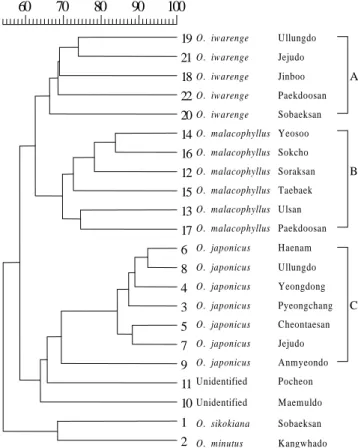
Fig. 2. Dendrogram obtained from UPGMA cluster analysis based on RAPDs of 22 Orostachys species.
단편들의 크기는 300 1,700bp 사이의 범위에서 나타났으며, 선발 된 10개의 primer를 사용하여 얻은 총 밴드의 수는 52개였다. 그 중 다형성을 보인 밴드가 43개로 82.7%의 polymorphism을 보였 으며, 각각의 primer에 의해 증폭된 밴드의 수는 1개(pimer OPA-19)에서 13개(primer OPC-13)로 밴드의 수가 다양하게 나 타났다(Table 2).
OPC-13 primer에 의해 DNA를 증폭시킨 후 전기영동으로 밴드 를 분리한 결과를 Fig. 1에 나타냈다. 바위솔(No. 3 No. 9)의 경 우 440 800bp 크기에서 종내에 균일한 밴드를 나타냈던 반면, 둥 근바위솔(No.12 No.17)과 연화바위솔(No. 18 No. 22)은 각각 330 1,700bp와 380 1,700bp의 범위에서 다형성 밴드를 나타냈 다. 그러나 매물도 수집종(No. 10)과 포천 수집종(No. 11)은 520bp에서 하나의 밴드를 나타내 계통간의 차이가 비교적 명확하 게 나타났다.
10개의 primer에 의해 증폭된 밴드를 Dice’s coefficient로 계산 하여 UPGMA 분석방법을 이용하여 dendrogram을 작성한 결과 18종의 바위솔속 식물은 3개의 분류군으로 분류되었다(Fig. 2). A 군은 연화바위솔, B군은 둥근바위솔 그리고 C군은 바위솔로 분류 되었다. 바위솔(No. 3 No. 9)은 안면도 수집종(No. 9; 69.8%)을 제외한 모든 지역에서 84.2 92.3%로 높은 유사도를 나타내어 지 역 간에 유전적 변이가 없는 비교적 안정된 종으로 생각되었다. 반 면 연화바위솔(No. 18 No.22)로 분류된 것은 유사도가 66.3 73.9%로 바위솔군에 비하여 매우 낮은 유사도를 보여, 종내의 상 당한 지역적 변이가 일어나고 있음을 알 수 있었다. 둥근바위솔 (No. 12 No. 17)은 유사도가 74.5 83.7%로 바위솔과 연화바위 솔의 중간정도의 유사도를 보였다. 소백산에서 수집한 난쟁이바위 솔(No. 1)과 강화도에서 수집한 좀바위솔(No. 2)은 한 분류군으로 분류되기는 하였지만 68.4%의 낮은 유사도를 보였고, 바위솔속 식 물들과 58.4%로 매우 낮은 유사도를 나타내었다. 또한 집괴화하지 않은 미명명된 매물도 수집종(No. 10)과 포천 수집종(No. 11)의 경우 바위솔군과의 유사도가 각각 65.7%와 63.9%로 유연관계가 멀었으며, 형태적 특성 또한 바위솔과 많은 차이점을 보여 더욱 많
은 연구에 의해 새로운 종으로의 명명 작업이 이루어져야 할 것으 로 생각되었다.
초 록
한국에 자생하는 22지역의 바위솔속 식물들의 유전적 근연관계 를 구명하기 위하여 RAPD분석을 실시하였다. 18종의 바위솔속 식물은 3개의 군(A, B, C 군)으로 집괴되었으며, 나머지 4종은 어 M 1 2 3 4 5 6 7 8 9 10 11 12 13 14 15 16 17 18 19 20 21 22
kb
3.1 2.0
1.0
KOR. J. HORT. SCI. & TECHNOL. 19(2), JUNE 2001 162
떤 분류군에도 속하지 않았다. A군인 연화바위솔(No.18 No.22) 은 유사도가 66.3 73.9%로 낮게 나타났으며, B군인 둥근바위솔 (No.12 No.17)도 유사도 지수가 69.7 83.7%로 비교적 낮게 나 타났다. C군인 바위솔(No.3 No.9)은 안면도 수집종(No.9)을 제 외한 유사도 지수가 84.2 92.3%로 높아, 지역종 간에 변이가 적 은 비교적 유전적으로 안정된 종으로 생각되었다.
추가 주요어:polymerase chain reaction, 지역적 변이
인용문헌
Chang, N.K and S.K. Lee. 1983. Studies on the classification, pro- ductivity distribution of C3, C4 and CAM plant in vegetations of Korea. Kor. J. Ecology 6(1):62-69.
Heo, K.O., I.K. Chung, and S.J. Hahn. 1998. Analysis of phylo- genetic relationship among Korean Landraces of Allium grayi by RAPD. Kor. J. Hort. Sci. 39:273-277.
Kim, T.J. 1996. Korean resources of plants. p.67-68. Seoul National University Publishing Department. Seoul.
Ko, M.K., B.J. Oh, Y.H. Jin, and C.H. Lee. 1997. Genetic diversity of and development of series-specific markers for Viola species in the subsection Patellares with random amplified polymorphic DNA analysis. Proc. of the 8th Sabrao general congress and annual meeting of the Korean Breeding Society:219-220.
Ko, M.K., J. Yang, Y.H. Jin, C.H. Lee, and B.J. Oh. 1998. Genetic
relationship of Viola species evaluated by random amplified polymorphic DNA analysis. The Journal of Horticultural Science & Biotechnology 73(5):601-605.
Lin, Z.W., R.L. Jarret, R.R. Duncan, and S. Kresovich. 1994.
Genetic relationships and variation among ecotypes of seashore paspalum (Paspalum vaginatum) determined by random ampli- fied polymorphic DNA markers. Genome 37:1011-1017.
Murryay, M.G. and W.F. Thompson. 1980. Rapid isolation of high molecular weight plant DNA. Nucleic Acid Res. 8:4321-4325.
Oh, B.J., M.K. Ko, and C.H. Lee. 1998a. Evaluation of genetic diversity among the genus Viola by RAPD markers. Kor. J.
Hort. Sci. & Tech. 16:409.
Oh, B.J., M.K. Ko, and C.H. Lee. 1998b. Identification of the series-specific random amplified polymorphic DNA markers of Viola species. Plant Breeding 117:295-296.
Rohlf, F.J. 1993. Numerical taxonomy and multivariate analysis system (NTSYS-pc. version 1.70). Exeter Software, Setauket, New York.
Stiles, J.I., C. Lemme, S. Sondur, M.B. Morshildi, and R.
Manshardt. 1993. Using randomly amplified polymorphic DNA for evaluating genetic relationships among papaya cultivars.
Theor. Appl. Genet. 85:697-701.
Yoo, K,O., S.K. Ahn, I.J. Chun, J.K. Hong, C.Y. Yoo, J.H. Kim, S.H. Kim, and H.T. Lim. 1996. Comparative studies of the five edible mountain vegetables by DNA marker fingerprinting. Kor.
J. Plant. Res 9:305-310.