• 검색 결과가 없습니다.

Analysis of Genetic Variability Using RAPD Markers in Paeonia spp. Grown in Korea

N/A
N/A
Protected

Academic year: 2021

Share "Analysis of Genetic Variability Using RAPD Markers in Paeonia spp. Grown in Korea"

Copied!
6
0
0

로드 중.... (전체 텍스트 보기)

전체 글

(1)

Kor. J. Hort. Sci. Technol. 31(3):322-327, 2013 DOI http://dx.doi.org/10.7235/hort.2013.12210

Analysis of Genetic Variability Using RAPD Markers in Paeonia spp. Grown in Korea

Mi Young Lim

1,2

, Sonali Jana

3

, Iyyakkannu Sivanesan

2

, Hyun Rho Park

4

, Ji Hyun Hwang

5

, Young Hoon Park

5

, and Byoung Ryong Jeong

1,2,3*

1

Division of Applied Life Science (BK21 Program), Graduate School, Gyeongsang National University, Jinju 660-701, Korea

2

Institute of Agriculture & Life Science, Gyeongsang National University, Jinju 660-701, Korea

3

Research Institute of Life Science, Gyeongsang National University, Jinju 660-701, Korea

4

Institute for Natural Products, Gyeongsangbuk-do Agricultural Research & Extension Services, Uiseong 769-803, Korea

5
Department of Horticultural Bioscience, Pusan National University, Miryang 627-706, Korea

Abstract. The genetic diversity and phylogenetic relationships of eleven herbaceous peonies grown in Korea were analyzed by random amplified polymorphic DNA (RAPD). Twenty-four decamer RAPD primers were used in a comparative analysis of these Korean peony species. Of the 142 total RAPD fragments amplified, 124 (87.3%) were found to be polymorphic. The remaining 18 fragments were found to be monomorphic (12.7%) shared by individuals of all 11 peony species. Cluster analysis based on the presence or absence of bands was performed by Jaccard’s similarity coefficient, based on Unweighted Pair Group Method with Arithmetic Averages. Genetic similarity range was 0.39 to 0.90 with a mean of 0.64. This study offered a rapid and reliable method for the estimation of variability among different peony species which could be utilized by the breeders for further improvement of the local peony species. Also, the results propose that the RAPD marker technique is a useful tool for evaluation of genetic diversity and relationship amongst different peony species.

Additional key words: cluster analysis, genetic diversity, peony, polymerase chain reaction, primers

*Corresponding author: [email protected]

※ Received 8 November 2012; Revised 25 January 2013; Accepted 30 January 2013. This research was supported by Technology Development Program for Agriculture and Forestry, Ministry for Food, Agriculture, Forestry and Fisheries, Republic of Korea (Project No. 109096-5). Mi Young Lim was supported by a scholarship from the BK21 program, the Ministry of Education and Human Resources Development, Korea.

Introduction

Peonies are popular not only as garden flowers, potted flowers, and cut flowers, but also as medicinal plants. The Paeoniaceae family embraces the genus Paeonia, including 33 species which are further divided into herbs and trees (Barzilay et al., 2002). Species in this genus are hardy perennials and ornamental plants that are popular as beautiful garden peonies. Peony species are widespread over a range of the Northern hemisphere, including Morocco, Spain, the mountainous regions of Europe, and the Mediterranean through the Caucasus mountains to Central Asia, China, Japan, and the Western United states (Rogers, 1995). The herbaceous peony is one of New Zealand’s more recent export cut flowers (Fulton et al., 2001). Herbaceous peony (Paeonia lactiflora Pallas) has been cultivated in China for more than 3,900 years (Wang and Zhang, 2005). Currently, herbaceous peonies

are back in fashion, since they are easy to nurture and also due to their diverse flower forms and colors. Peony also holds its place in Korean traditional medicine, since roots are very important for medicinal purposes (WHO, 1998).

The root of P. lactiflora is mainly used for the treatment of muscular spasm, chest pains, diarrhea, blood and liver disorders, and as a general analgesic (Guo et al., 2006).

The utilization of plant genetic resources requires an

acquaintance with the quantity of genetic variation that exists

among the species (Vaughan, 1994). The random amplified

polymorphic DNA (RAPD) fingerprinting method uses decamer

(10 nucleotide length) primers for polymerase chain reaction

amplification (PCR) of random segments of genomic DNA to

analyze genetic diversity and phylogeny. The RAPD technique

is highly favored as no prior knowledge on the genotype

is required. Moreover, conclusions derived by RAPD are

parallel to those of other methods, such as amplified fragment

(2)

Table 1. Peony accessions used in the evaluation of their genetic diversity.

Code Scientific name Species name

Flower form Flower color

English Korean

A Paeonia japonica Miyabe et Takeda White Peony 백작약 Single White

B Paeonia obovata Max Mountain Peony 산작약 Single Pink

C Paeonia lactiflora Pall. Jol Peony 졸작약 Crown Pink and deep pink

D Paeonia lactiflora Pall. ‘Euiseong’ ‘의성’ Single Red

E Paeonia lactiflora Pall. ‘Sagok’ ‘사곡’ Single Pink

F Paeonia lactiflora Pall. ‘Taebaek’ ‘태백’ Crown Pink and white

G Paeonia lactiflora Pall. ‘Migang’ ‘미강’ Rose Red

H Paeonia lactiflora Pall. ‘Geopoong’ ‘거풍’ Crown Red

I Paeonia lactiflora Pall. ‘Daecheong’ ‘대청’ Rose Red

J Paeonia lactiflora Pall. ‘Kansas’ - Rose Deep red

K Paeonia lactiflora Pall. ‘Lilini Warrior’ - Single Deep red

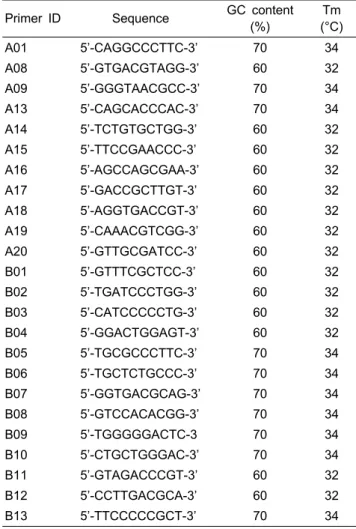
Table 2. Random decamer primers used for RAPD with GC content (%) and melting temperature (Tm).

Primer ID Sequence GC content (%)

Tm (°C) A01

A08 A09 A13 A14 A15 A16 A17 A18 A19 A20 B01 B02 B03 B04 B05 B06 B07 B08 B09 B10 B11 B12 B13

5’-CAGGCCCTTC-3’

5’-GTGACGTAGG-3’

5’-GGGTAACGCC-3’

5’-CAGCACCCAC-3’

5’-TCTGTGCTGG-3’

5’-TTCCGAACCC-3’

5’-AGCCAGCGAA-3’

5’-GACCGCTTGT-3’

5’-AGGTGACCGT-3’

5’-CAAACGTCGG-3’

5’-GTTGCGATCC-3’

5’-GTTTCGCTCC-3’

5’-TGATCCCTGG-3’

5’-CATCCCCCTG-3’

5’-GGACTGGAGT-3’

5’-TGCGCCCTTC-3’

5’-TGCTCTGCCC-3’

5’-GGTGACGCAG-3’

5’-GTCCACACGG-3’

5’-TGGGGGACTC-3 5’-CTGCTGGGAC-3’

5’-GTAGACCCGT-3’

5’-CCTTGACGCA-3’

5’-TTCCCCCGCT-3’

70 60 70 70 60 60 60 60 60 60 60 60 60 60 60 70 70 70 70 70 70 60 60 70

34 32 34 34 32 32 32 32 32 32 32 32 32 32 32 34 34 34 34 34 34 32 32 34

length polymorphism (AFLP) and inter simple sequence repeats (ISSR), and may be directly comparable (Nybom et al., 2004).

The present work was undertaken to estimate genetic variation in 11 peony accessions of three species using the RAPD technique for potential future use in selection, hybridi- zation, and biodiversity assessment. There are no reports on the comparison of the genetic variations using RAPD markers in the 11 herbaceous peony species which we report in the present study.

Materials and Methods

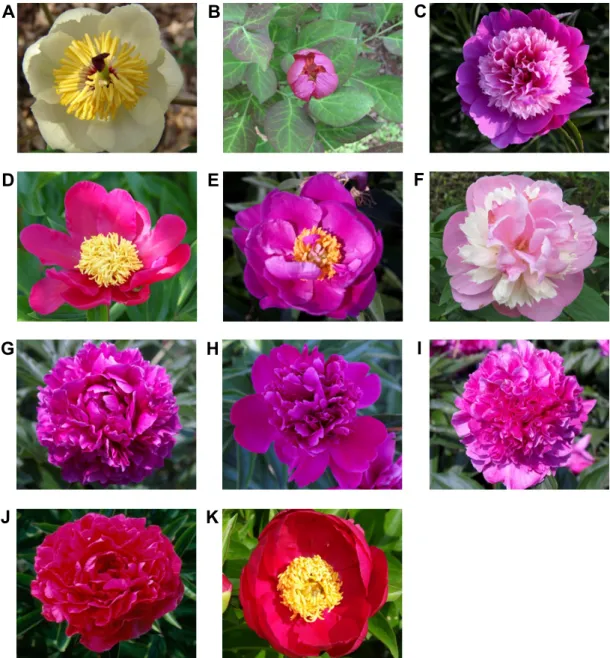
In the present study, 9 species or cultivars of Paeonia lactiflora which are commonly grown in Korea and two wild species (Paeonia japonica and Paeonia obovata) were used (Table 1 and Fig. 1). Genomic DNA was isolated from the leaf sample of each peony species using Gene-All spin-column kit (Gene All Biotechnology Co., Ltd., Seoul, Korea). A spectro- photometer (Nanodrop 1000, Thermo Scientific, Wilmington, DE, U.S.A.) was used to check the purity of DNA by recording the absorbance at 260 nm. Polymorphism detection was performed using the PCR-RAPD assay. The RAPD assay was carried out by using the 24 random decamer primers (Bioneer Co., Dejeon, Korea) listed in Table 2. For all PCR reactions, the reaction mixture consisted of a total volume of 20 µL, with 20 ng genomic DNA, 0.5 μM decamer primer, 1X PCR buffer, 0.2 mM deoxynucleotide triphosphates (dNTP’s), and 0.6 U Thermus aquaticus (Taq) DNA polymerase (Solgent, Daejeon, Korea). The PCR amplification was performed in a thermal cycler (Gene Amp PCR system 9700, Applied Biosystems, Foster City, CA, U.S.A.). The amplifi- cation profile consisted of 1 min at 95°C for preheating, followed by 40 cycles of 15 seconds at 95°C for denaturation,

30 seconds at 45°C for annealing, and 1 minute at 72°C for extension, with a final extension for 1 minute at 72°C.

Amplified PCR products were separated on 2.5% agarose

gel in a Tris borate EDTA buffer at 80 V for two hours,

stained by ethidium bromide, and photographed under the

(3)

A B C

D E F

G H I

J K

Fig. 1. Peony species used in the evaluation of their genetic diversity. A, White Peony; B, Mountain Peony; C, Jol Peony; D,

‘Euiseong’; E, ‘Sagok’; F, ‘Taebaek’; G, ‘Migang’; H, ‘Geopoong’; I, ‘Daecheong’; J, ‘Kansas’; and K, ‘Lilini Warrior’.

UV light in a gel documentation system.

Data Analysis

The DNA marker (100 bp) applied along with RAPD samples helped to determine the molecular sizes of the DNA fractions of the peony species samples. Reproducible RAPD products were scored as the presence (1) or absence (0) of a fragment by writing the data matrix NTSYS-pc software (version 2.20k, Exeter Software, Setauket, NY, U.S.A.). The genetic distances were assessed with Nei’s unbiased Jaccard similarity coefficient of genetic distance measure and converted to a dendrogram based on arithmetic averages by unweighted pair group method (UPGMA) and written by using the SHAN clustering (Nei and Li, 1979).

Results

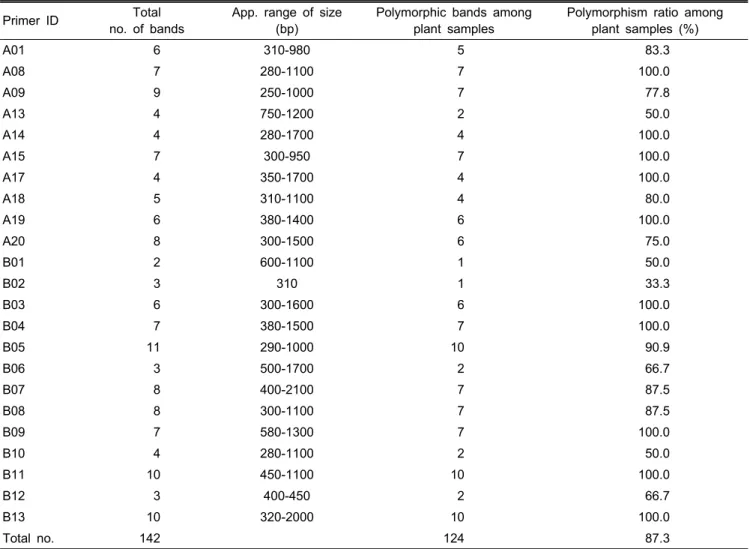
The genetic variation pattern of different peony species with primers A18, A19, and A20 are shown in Fig. 2. Genetic relationships among 11 peony species analyzed using 24 random RAPD primers showed highly reproducible, polymorphic RAPD fingerprints for discrimination of genetic variation in these peony species (Table 2). There were 10 primers with 70% GC content and 14 primers with 60% GC content.

Each primer produced 1-11 fragments (average 6 per primer) with a total of 142 reproducible DNA bands (Table 3).

Fragment sizes ranged between 250-2100 base pairs. Of the

total amplicons (142) generated, 124 (87.3%) were found

to be polymorphic, the rest 18 (12.7%) were found to be

(4)

A B C

Fig. 2. RAPD banding pattern of three selected primers. Sample order from the left lane corresponds to peony species A-K shown in Table 1. A, primer A18; B, primer A19; and C, primer A20.

Table 3. Total number of amplicons, number of polymorphic fragments, and percent polymorphism assayed by PCR using 24 random decamer primers in eleven peony species.

Primer ID Total

no. of bands

App. range of size (bp)

Polymorphic bands among plant samples

Polymorphism ratio among plant samples (%)

A01 6 310-980 5 83.3

A08 7 280-1100 7 100.0

A09 9 250-1000 7 77.8

A13 4 750-1200 2 50.0

A14 4 280-1700 4 100.0

A15 7 300-950 7 100.0

A17 4 350-1700 4 100.0

A18 5 310-1100 4 80.0

A19 6 380-1400 6 100.0

A20 8 300-1500 6 75.0

B01 2 600-1100 1 50.0

B02 3 310 1 33.3

B03 6 300-1600 6 100.0

B04 7 380-1500 7 100.0

B05 11 290-1000 10 90.9

B06 3 500-1700 2 66.7

B07 8 400-2100 7 87.5

B08 8 300-1100 7 87.5

B09 7 580-1300 7 100.0

B10 4 280-1100 2 50.0

B11 10 450-1100 10 100.0

B12 3 400-450 2 66.7

B13 10 320-2000 10 100.0

Total no. 142 124 87.3

shared by individuals of all 11 species. The maximum number (11) and minimum number (2) of amplicons were generated by primer B05 and primer B01, respectively. The percentage of polymorphism varied with each primer ranged from 33.38 to 100%. All primers studied exhibited polymorphism (Table 3).

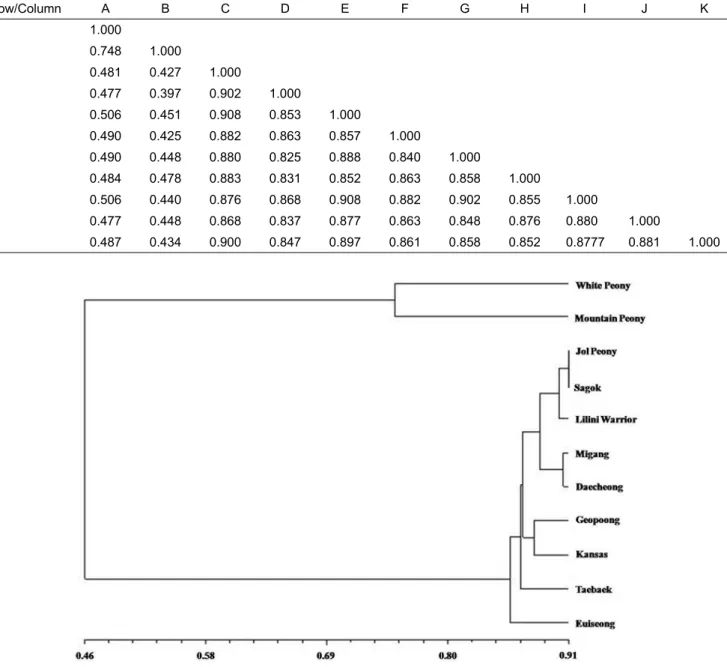
Similarity matrices of 11 species obtained using the Jaccards coefficient revealed the relationships among them (Table 4).

Similarity coefficient ranged from 0.39 between species 2 and 4 to 0.91 (between species 5 and 9) among the species evaluated.

The UPGMA dendrogram (Fig. 3) based on genetic distance

grouped the 11 accessions into two clusters 1 and 2. In case

of cluster 1, White Peony (Paeonia japonica) and Mountain

Peony (Paeonia obovata) showed a similarity level of 0.75,

and occupied a distinct place as revealed in the dendrogram

(5)

Table 4. Similarity matrix of peony species analyzed using Nei’s original measures of genetic identity.

Row/Column A B C D E F G H I J K

A 1.000

B 0.748 1.000

C 0.481 0.427 1.000

D 0.477 0.397 0.902 1.000

E 0.506 0.451 0.908 0.853 1.000

F 0.490 0.425 0.882 0.863 0.857 1.000

G 0.490 0.448 0.880 0.825 0.888 0.840 1.000

H 0.484 0.478 0.883 0.831 0.852 0.863 0.858 1.000

I 0.506 0.440 0.876 0.868 0.908 0.882 0.902 0.855 1.000

J 0.477 0.448 0.868 0.837 0.877 0.863 0.848 0.876 0.880 1.000

K 0.487 0.434 0.900 0.847 0.897 0.861 0.858 0.852 0.8777 0.881 1.000

Fig. 3. Dendrogram (UPGMA) patterns showing genetic relationships in 11 species of peony analyzed in this study.

constructed (Fig. 3). The cluster 2 was composed of all 9 cultivars of Paeonia lactiflora, and differentiated into many sub-clusters according to their similarities. The highest value of similarity coefficient 0.902 was observed between ‘Jol Peony’ and ‘Sagok’. A similar level of similarity coefficient 0.91 has been found in ‘Jol Peony’ and ‘Lilini Warrior’, and 0.91 by ‘Lilini Warrior’ and ‘Kansas’.

These RAPD markers demonstrated striking genetic differen- tiations among the peony species examined.

Discussion

Paeonia lactiflora is widely distributed in Korea. Extensive

studies have been carried out on the morphological diversity and horticultural attributes of peonies (Hosoki et al., 1997).

However, differentiation of peony species through morphological features is ineffectual and imprecise. Morphological characters are often limited in number, usually have complex inheritance patterns, and are vulnerable to environmental conditions.

Thus, molecular markers, which portray a fraction of the genome sequence composition, are highly useful to assess and to utilize the genetic variability for breeding programs.

Researchers have studied genetic variation in peony species

collections using various molecular techniques including,

sequence related amplified polymorphism (SRAP), AFLP,

RAPD, and simple sequence repeats (SSR) markers (Cheng

(6)

et al., 2011; Hao et al., 2008; Hosoki et al., 1997; Hou et al., 2006).

In the present study, we tried to draw a relationship among the herbaceous peonies. White Peony and Mountain Peony have been originated from Arietina-Officinalis group × unknown extinct species, they share same parents and thus have been grouped into sister groups (Sang, 1995). They show distinctive morphological characteristics in comparison to other peony cultivars (Fig. 1). Classification based on DNA sequence variation revealed by RAPD clearly showed that these two wild species had undergone evolutionary diversification from the domesticated Paeonia lactiflora. Genetic diversity was also found within the commercial cultivars of Paeonia lactiflora.

Nine peony cultivars in the cluster 2 have similarities among them, and the similarity coefficient ranged between 0.82 and 0.91. Relatively high similarity coefficients imply that Korean peony cultivars have a narrow genetic base and might shared common parentages in breeding process. However, it is difficult to make this conclusion, since reliable information for breeding pedigree of these cultivars is not available.

Nevertheless, the fact that cultivars with similar flower colour tended to group under the same node indicates that peony breeding materials have been possibly inter-hybridized with the flower colour as a major commercial trait.

The results of our study proved the usefulness of RAPD for DNA fingerprinting of Peony plants. The study revealed that RAPD primers which are often reported to be unreliably reproducible produced appreciable amplicons, sufficient to demarcate all peony accessions. The dendrogram also established genetic relatedness among different peony accessions (Fig.

3). The study confirms the suitability of RAPD as a reliable, simple, easy to handle, and elegant tool in molecular diagnosis of different peony plants. It has also been reported by Haw (2000) that this method of RAPD technique using immature leaves has provided a great deal of new information on the taxonomy, geographical distribution, and ecological habitats of wild tree peonies. Besides, Hao et al. (2008) have demonstrated that SRAP markers were effective on identifying peony species, section Moutan, section Paeonia, and intersectional and intrasectional hybrids of peony.

To summarize, the RAPD marker technique was found to be an informative tool to analyze the genetic structure of different species and cultivars of peony. In spite of their morphological identity, a substantial polymorphism was observed among the peony species under study. This study

revealed the average genetic variation among the peony cultivars in Korea and usefulness of RAPD for cultivar identification. A narrow genetic background also indicated the necessity to introduce more diverse breeding germplasm for new cultivar development in peony.

Literature Cited

Barzilay, A., H. Zemah, and R. Kamenetsky. 2002. Annual life cycle and floral development of ‘Sarah Bernhardt’ peony in Israel. HortScience 37:300-303.

Cheng, Y., C.H. Kim, D. Shin, S.M. Kim, H.M. Koo, and Y.J.

Park. 2011. Development of simple sequence repeats (SSR) markers to study diversity in the herbaceous peony (Paeonia lactiflora). J. Med. Plant Res. 5:6744-6751.

Fulton, T.A., A.J. Hall, and J.L. Catley. 2001. Chilling requirements of Paeonia cultivar. Sci. Hort. 89:237-248.

Guo, D., Y. Guan, and H. Guo. 2006. A new phenolic glycoside from Paeonia lactiflora. Fitoterapia 77:613-614.

Hao, Q., Z.A. Liu, Q.Y. Shu, R. Zhang, J.D. Rick, and L.S. Wang.

2008. Studies on Paeonia cultivar and hybrids identification based on SRAP analysis. Hereditas 145:38-47.

Haw, S.G. 2000. Paeonia ostii in Britain. New Plantsman 7:160-163.

Hosoki, T., D. Kimura, R. Hasegawa, T. Nagasako, K. Nishimoto, K. Ohta, M. Sugiyama, and K. Haruki. 1997. Comparative study of Chinese tree peony cultivar by random amplified polymorphic DNA (RAPD) analysis. Sci. Hort. 70:67-72.

Hou, X.G., W.L. Yin, J.J. Li, and H.F. Wang. 2006. AFLP analysis of genetic diversity of 30 tree peony (Paeonia suffruticosa Andr.) cultivar. Sci. Agric. Sin. 39:1709-1715.

Nei, M. and W.H. Li. 1979. Mathematical model for studying genetic variation in terms of restriction endonucleases. Proc.

Natl Acad. Sci. USA 79:5269-5273.

Nybom, H., G. Esselink, and G. Werlemark. 2004. Microsatellite DNA marker inheritance indicates preferential pairing between two highly homologous genomes in polyploidy and hemisexual dog roses, Rosa L. sect Caninae DC. Hereditas 92:139-150.

Rogers, A. 1995. Paeonies. Timber Press Inc., Portland, OR, USA.

Sang, T. 1995. Phylogeny and biogeography of Paeonia (Paeoniaceae).

Ph.D Diss., Ohio State University, Columbus, OH.

Vaughan, D.A. 1994. The wild relatives of rice: A genetic resource handbook. International Rice Research Institute, Los Banos, Philippines.

Wang, J.G. and Z.S. Zhang. 2005. Cultivation and propagation, p. 17. In: J.G. Wang and Z.S. Zhang (eds.). Herbaceous peonies of China. China Forestry Publishing House, Beijing, China.

World Health Organization (WHO). 1998. Paeonia lactiflora var.

hortensis Makino; Paeonia suffruticosa Andrews, p. 188-191.

In: Medicinal plants in the Republic of Korea. WHO Regional

Office for the Western Pacific, Manila, Philippines.

수치

Table 2. Random decamer primers used for RAPD with GC  content (%) and melting temperature (Tm).
Fig. 1. Peony species used in the evaluation of their genetic diversity. A, White Peony; B, Mountain Peony; C, Jol Peony; D,
Table 3. Total number of amplicons, number of polymorphic fragments, and percent polymorphism assayed by PCR using 24  random decamer primers in eleven peony species.
Table 4. Similarity matrix of peony species analyzed using Nei’s original measures of genetic identity

참조

관련 문서

Background : The E133K genetic variation of AGGF1 gene that is a potent angiogenetic factor have been assumed genetic susceptible factor for Klippel-Trenaunay

consumer's behavior behavior behavior behavior of of of of using using using using nail nail nail nail shop shop shop for shop for for women for women

Tullio Scovazzi, “Open Questions on the Exploitation of Genetic Resources in Areas Beyond National Jurisdiction”, Am. Nagoya Protocol on Access to Genetic Resources and the

For the association study, I analyzed the correlation of each SNP for Alzheimer's disease by logistic regression models using Additive genetic model after adjustment of

Data were analyzed using independent-sample t tests for checking the equivalency between the experimental and control groups at pretest and three-way analysis

This paper also analyzed the current status of the competitive power of 10 major ports in China using efficiency and SWOT analysis and sought the

 Manipulation of protein’s amino acid sequence to change its function or properties.

Therefore, in this study, genetic tests were performed to investigate and identify the infections of Orientia tsutsugamushi, Ricekttsia genus, Anaplasma phagocytophilum ,