http://dx.doi.org/10.12925/jkocs.2017.34.2.296
구아바 잎 추출물의 항산화 및 미백 활성 효과
유선희
✝ 건국대학교 생물공학과✝(2017년 5월 16일 접수: 2017년 6월 8일 수정: 2017년 6월 19일 채택)
Antioxidant Activity and Whitening activity of Psidium guajava leaf extract
Seon-hee You✝
Department of Bioengineering, Konkuk University, 120, Neungdong-ro, Gwangjin-gu, Seoul, 05029, Korea
(Received May 16, 2017; Revised June 8, 2017; Accepted June 19, 2017)
요 약 : 구아바 잎 추출물이 미백 기능성 화장품 소재로써의 활용 가능성을 확인하고자 하였다.
DPPH radical 소거 활성, 세포 내 ROS 측정, B16F10 melanoma cell 에서의 세포 독성 및 자외선A에 대한 세포 보호효과, 시험관 내 tyrosinase 억제 효과, 멜라닌 생합성 억제 효과를 측정하였다. 구아바 잎 추출물의 높은 DPPH radical 소거 활성과, 세포 내 ROS 활성 억제 측정을 통해 항산화 효과를 확 인하였다. B16F10 melanoma cell 에서의 세포 생존율이 모든 농도에서 98% 이상의 생존율을 나타냈으 며, UVA로부터의 세포 보호효과가 농도 의존적으로 높아지는 것을 확인하였다. 또한 10%의 시험관 내 tyrosinase 활성 억제 효과와 20%의 멜라닌 생합성 억제 효과를 확인되었다. 구아바 잎 추출물은 B16F10 melanoma cell에 대한 독성이 적고, 높은 항산화 활성과 tyrosinase 활성 억제 및 멜라닌 생합 성 억제 효과를 통해 안전하고 우수한 미백 효과를 가진 미백 기능성 화장품 소재로써의 개발 가능성을 확인하였다.
주제어 : 항산화, 멜라닌, 구아바 잎, 활성산소, 자외선 A
Abstract : The purpose of this study was to investigate the applicability of the
Psidium guajava
leaf extract as a whitening functional cosmetic material. We measured DPPH radical scavenging activity, intracellular ROS, cytotoxicity in B16F10 melanoma cells and cytoprotective effect on ultraviolet A, in vitro tyrosinase inhibitory effect and melanin biosynthesis inhibitory effect. The antioxidative effect was confirmed through high DPPH radical scavenging activity and intracellular ROS activity inhibition measurement of thePsidium guajava
leaf extract. The survival rate of B16F10 melanoma cells was more than 98% at all concentrations, and the cytoprotective effect from ultraviolet ray A was found to increase in a concentration-dependent manner. In addition, in vitro tyrosinase activity inhibitory effect of 10% and melanin biosynthesis inhibitory effect of 20%
✝
Corresponding author
(E-mail: [email protected])
were observed. Through less toxicity for B16F10 melanoma cell, high antioxidant activity, inhibition of tyrosinase activity and melanin biosynthesis inhibitory effect, we confirmed the possibility of developing the
Psidium guajava
leaf extract as a whitening functional cosmetic material with a safe and excellent whitening effectKeywords :
Anti-oxidant, Melanin,Psidium guajava
leaf, ROS, UV-A1. 서 론
멜라닌(melanin)은 피부색을 결정하는 색소 세 포로써, 자외선에 의한 피부 손상과 활성산소를 제거하여 피부 보호 역할을 하는 것으로 알려져 있으나 과도한 생성은 기미, 주근깨, 검버섯, 점 등을 유발하고, 멜라닌 전구 물질의 독성으로 인 하여 세포의 사멸과 피부 암 생성이 촉진되기도 한다[1,2]. 피부에서의 멜라닌 생 합성은 멜라닌 세포의 멜라닌 소체에서 L-tyrosine으로부터 일 련의 반응 단계를 거쳐 생성 되어[3-7], 세포질 돌기를 통하여 표피의 기저층과 유극층의 각질화 세포로 운반되어 진다[8]. 이때 멜라닌의 합성은 tyrosine을 기질로 하여 tyrosinase에 의해 3,4-dihydroxyphenylalanine (DOPA)와 DOPA quinone으로 대사된 후 DOPA quinone의 반응 에 따라 pheomelanin과 eumelanin 생성의 2가지 로 나누어 지게 된다[9]. tyrosinase는 멜라닌 중 합체를 생성하는 중요한 효소로 세포 내에서 활 성화 되어 멜라닌이 과잉 생산되면 피부의 기미, 주근깨, 검버섯, 점 등의 색소 침착이 일어나 tyrosinase 활성 억제 실험은 미백 원료 개발의 1 차 screening 단계에서 필수적인 요소로 보고되고 있다[10]. 현재까지 알려진 멜라닌 생성 억제 물 질로는 arbutin, kojic acid, hydroquinone, oxyresveratrol, deroxybenzyl alcohol 등이 멜라 닌 생성 억제 활성은 높은 것으로 보고되고 있으 나, 세포 독성이 강하고, 잠재적인 돌연변이의 원 인이 될 수 있다고 보고되고 있다[11-13]. 이에 따라 최근 독성이 적고, 다양한 생리활성 효능을 가진 천연물질에 대한 관심도가 증가하면서 천연 물질 탐색에 대한 연구가 진행되고 있는 실정이 다.
구아바(
Psidium guajava
)는 도금양과 (Myrtaceae
)에 속하는 아열대성 식물로써 Guava 혹은 Kuawa로 불려지고 있으며, 전 세계적으로 아열대성 기후대에 널리 분포 하고 있다[14]. 구아바는 예로부터 나무 껍질이나 잎, 열매 등을 약용으로 사용하였으며, 특히 위장의 기능을 활성 화시켜 급성 위장염이나 설사, 당뇨의 치료, 감기 나 폐결핵, 항염증과 지혈제로도 사용하고 있다 [15-18]. 구아바의 주요 성분으로는 과실에는 페 놀성 화합물인 myricetin, apigenin, ellagic acid, anthocyanin 등과 비타민 C, 카로티노이드가 높 은 함량으로 함유되어 있으며[19-21], 잎에는 sesquiterpene, triterpenoid, flavonoid, coumarin, alkaloid, tannin 등이 함유되어 있는 것으로 여 러 선행 연구를 통해 보고되고 있다[22-26]. 구 아바와 관련한 주요 생리활성 연구로는 구아바 잎 추출물의 항산화 및 항균활성[27], 구아바 추 출물의 항산화 활성[28], 발효 구아바 잎 추출물 의 고혈당 억제 효과[29], 항 당뇨 효과[30], 식 중독 세균에 대한 항균 특성[31], 신경세포에 대 한 보호 효과[32]등이 보고되고 있다. 또한 현재 국내 식약처에서는 구아바 잎 열수 추출물이 건 강기능식품으로 개별 인증되어 있으며, 일본에서 는 구아바가 함유된 음료를 ‘특정보건용 식품’ 으 로 표시 허가하였고, 미국 FDA에서는 2003년도 EAFUS(Everything Added to Food in the United Stated) 리스트에 구아바 잎 추출물을 안 전하게 사용할 수 있는 식품으로서 정식 등재가 되어 있다[33]. 이렇듯 구아바 잎은 기능성 소재 로써 활용가치가 매우 높은 고부가가치 식물로써 현재까지 기능성 화장품 소재로써의 활용 연구는 미비한 실정이다.
따라서 본 연구에는 구아바 잎 추출물이 항산 화 활성과 미백 효과를 가진 화장품 소재로써의 가능성을 확인하고자 구아바 잎 추출물에 대한 항산화 활성을 살펴보고, B16F10 melanoma 세 포를 이용하여 세포에 대한 독성 및 UVA에 대 한 세포 보호 효과, 멜라닌 생 합성 억제 및 tyrosinase 저해 활성을 측정하여 미백 효과를 검 증하고, 구아바 잎 추출물의 미백 화장품 소재로 써의 가능성을 확인하고자 하였다.
2. 준비 및 방법
2.1. 시료 준비
본 실험에 사용된 구아바 잎은 건조하여 70%
ethanol용액에 10배의 무게를 가한 후 37℃ 인큐 베이터안에서 72 h 추출하였다. 72 h 후 침전물 을 여과하여 Rotary evaporator (EYELA, Japan) 를 사용하여 감압 농축한 후 ethanol을 제거한 뒤 최종 extract를 얻어 본 실험에 사용하였다.
2.2. 실험 방법
2.2.1. DPPH radical 소거 활성 측정
구아바 잎 추출물의 항산화 활성은
1,1-diphenyl-2-picryl-hydrazyl (DPPH;
Sigma-Aldrich, USA)용액을 사용하여 라디칼 소 거 활성을 측정하는 blois의 방법[34]을 이용하여 측정하였다. 시료를 각 농도별로 희석한 다음 96 well plate에 10 mM DPPH 용액 180 μL와 시 료액 20 μL를 혼합하여 차광 상태에서 37℃, 30 min 동안 반응시킨 후 517 nm에서 흡광도를 측정하였다. 본 실험은 동일한 조건으로 3회 반 복적으로 실험하여 평균값을 측정하였으며, 양성 대조군으로는 Ascorbic acid (Sigma-Aldrich, USA)를 실험군과 동일하게 사용하였다.
DPPH radical 소거 활성(%) =
100-{(첨가군 흡광도/무첨가군 흡광도)×100}
2.2.2. 세포 배양
한국세포주은행(Korean Cell Line Bank, Korea)에서 B16F10 melanoma Cell을 구입하여, 10% fetal bovine serum (FBS; Sigma-Aldrich, USA)과 1% penicillin (100 IU/mL, GE Healthcare Life Sciences, USA), 1%
streptomycin (50 μg/mL, GE Healthcare Life Sciences)를 High glucose Dulbecco’s modified Eagle’s medium (DMEM; Sigma-Aldrich, USA) 배지에 첨가하여 37℃, 5%의 CO2인큐베이터 안 에서 배양하였으며, 세포 주기는 36∼48 h으로 유지하며 계대배양 하였다.
2.2.3. 세포내 Reactive oxygen species (ROS) 측정
Dichlorofluorescein diacetate (DCF-DA) 방 법을 이용하여 세포 내 ROS 농도 변화를 측정하
였다. B16F10 melanoma 세포를 이용하여 3 × 10⁴ cells/well의 농도로 분주 한 후 24 h 배양하 였다. DCF-DA 10 μM 첨가하여 30 min 어두 운 곳에서 배양 한 후 Fluorescence plate reader (Synergy HT; BioTek Instruments, USA)을 이 용하여 485 nm excitation 530 nm emission wavelength에서 ROS의 변화량을 측정하였다.
2.2.4. 세포 생존율 및 UVA에 대한 B16F10 melanoma cell 보호 효과
Moon & you(2016)의 방법에 따라 neutral red (NR) assay를 B10F10 melanoma 세포에 대 한 세포 생존율 측정하고자 96 well plate에 well 당 3 × 10⁴ cells/well의 세포를 24 h 동안 배양 기에서 부착하였다. 24 h 후 구아바 잎 추출물을 농도별로 처리한 다음 각 96 well plate에 UVA 100 mJ/cm2를 10분간 조사 후 37℃에서 CO2
배양기에서 48 h 동안 배양하였다[35]. 48 h 후 NR solution (Sigma-Aldrich, USA)이 1% 포함 된 무 혈청배지로 교환하여 3 h 동안 배양한 다 음 세포 고정액으로 10% formaldehyde 용액이 첨가된 phosphate buffered saline (PBS)을 각 well에 100 mL로 20 min 처리하여 고정하였다.
NR desorb solution (1% glacial acetic acid, 49% ethanol, 50% distilled water)을 각 well에 100 mL을 가하여 세포 내의 NR을 추출하고 microplate reader (Synergy HT; BioTek Instruments, USA)를 이용하여 540 nm에서 흡광 도를 측정하였다. 동일한 조건으로 3회 반복적으 로 실험하여 평균값을 측정하였다.
2.2.5. 시험관 내에서 Tyrosinase 활성 억제 측정
구아바 잎 추출물의 Tyrosinase 활성 억제 효 과를 확인하기 위하여 L-DOPA를 사용하였다.
potassium phosphate buffer (0.5 M, pH 6.8)로 완전히 녹인 25 mM L-DOPA와 M-tyrosianse 1mg/20mL 농도로 준비하였다. 각 농도별로 희 석한 구아바 잎 추출물 10 μL, tyrosinase 140 μL, L-DOPA 30 μL를 넣고 37℃에서 30 min 반응시킨 후 475 nm에서 흡광도를 측정하였다.
동일한 조건으로 3회 반복적으로 실험하여 평균 값을 측정하였다. 양성 대조군으로는 구아바 잎 추출물과 동일한 조건으로 추출한 상백피(
Morus
alba L.
) 추출물을 실험군과 동일하게 사용하였 다.2.2.6. 멜라닌 생성 억제능 측정
구아바 잎 추출물의 미백 효과를 확인하기 위 하여 멜라닌 생성 억제능을 측정하였다. B16F10 melanoma 세포를 96 well plate에 세포수가 2×10³ cells/well이 되도록 접종하여 24 h 동안 37℃, 5% CO2 배양기에서 배양하였다. 24 h 후 5% FBS와 100 nM α-MSH(Sigma-Aldrich, USA)로 배지로 교환 후 구아바 잎 추출물을 각 농도별로 희석하여 72 h 배양하였다. well plate 에 분비된 멜라닌 양은 microplate reader를 이용 하여 490 nm에서 흡광도를 측정하였다. 양성 대 조군으로는 100 μg/mL Arbutin을 사용하였다.
2.3. 통계 처리
본 실험은 동일한 조건하에 독립적으로 3회 이 상 측정하여 실험 결과를 얻어 사용하였다. 평균
± 표준편차(Mean±SD)로 표기하였으며, 통계 처리는 SPSS Window Version 17.0 (SPSS Inc., Illinois, USA)을 이용하여 분석하였고, 유의성 검 증은 Student t-test로 실시하였다. 실험 결과 p 값이 0.05 미만을 때 통계적으로 유의한 차이가 있는 것으로 판정하였다.
3. 결과 및 고찰
3.1. DPPH radical 소거 활성 측정
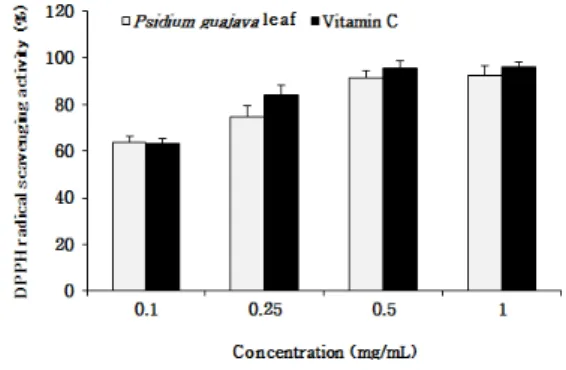
구아바 잎 추출물의 항산화 활성을 알아보기 위하여 DPPH radical 소거 활성을 통한 항산화 작용을 Fig. 1에 나타내었다. 본 연구 결과 구아 바 잎 추출물을 0.1, 0.25, 0,5 1 mg/mL 농도로 처리하였을 때 DPPH radical 소거능을 확인한 결과 63.5%, 74.4%, 91.2%, 92.4%로 확인되었 으며, 양성 대조군으로는 항산화 작용이 뛰어난 것으로 알려진 ascorbic acid을 이용하여 구아바 잎 추출물과 항산화 효과를 비교하였을 때 1 mg/mL 농도에서 ascorbic acid는 96.9%, 구아바 잎 추출물은 92.4%의 DPPH racical 소거 활성 이 나타나 ascorbic acid과 비슷한 radical 소거 활성을 확인하였다. Park
et al.,
(2008)은 구아바 잎 메탄올 추출물에 대한 radical 소거의 강한 활 성과 SOD 유사 활성도 저 농도에서도 강한 활성 을 나타내고 있다고 보고되고 있는데[36], 이러한 결과는 caffeic aicd, quercetin, gallic acid, ferulic acid, chlorogenic aicd 등의 페놀성 화합 물들의 함량이 높을수록 radical 소거 활성과SOD 유사 활성이 높아지는 상관관계가 나타난다 고 보고되는 것과 같이[37,38], 구아바 잎에는 플 라보노이드(flavonoid), 탄닌(tannin)계의 페놀성 화합물들이 다량 함유되어 있어서[39], 이와 같이 항산화 활성이 나타난 것으로 사료되어 진다.
Fig. 1. DPPH radical scavenging activity of
Psidium guajava
leaf extract.
Anti-oxidant effect was measured by DPPH radical scavenging activity. The results are presented as the mean ± S.D. of three independent experiments.
3.2. 세포 생존율
Fig. 2. Cytotoxicity in B16F10 melanoma cells.
The cytotoxicity of
Psidium guajava
leaf extract was measured in B16F10 melanoma cell. The results are presented as the mean±S.D. of three independent experiments.구아바 잎 추출물이 B16F10 melanoma cell에 서의 세포 생존율을 통한 세포 독성을 확인하고 자 5, 10, 25, 50, 100 μg/mL의 각 농도별로 처리하여 세포 독성 평가 결과를 Fig. 2에 나타내
었다. 세포 생존율은 control 100% 대비 99.6%, 98.9%, 98.5%, 98.4%, 97.9%의 생존율로 B16F10 melanoma cell에 대한 세포 독성이 거의 나타나지 않은 것으로 확인되었다. 이와 같은 결 과를 통해 100 μg/mL 농도에서 다음 시험을 진 행을 진행하였다.
3.3. UVA 조사에 의한 세포 생존율
자외선에 의한 세포 보호 효과를 측정하기 위 하여 UVA 100 mJ/cm2로 유도된 B16F10 melanoma cell 에 대한 구아바 잎 추출물의 세 포 보호 효과를 측정한 결과는 Fig. 3에 나타내었 다. 세포 생존율은 control 100% 대비 무 처리군 에 UVA 조사 후 65.5%의 세포 보호 효과가 나 타났으며, 구아바 잎 추출물의 경우 5, 10, 25, 50, 100 μg/mL 농도에서 87.7%, 88.8%, 93%, 97%, 99.2%로 농도 의존적으로 세포 보호 효과 가 증가하는 것을 볼 수 있었다. 이와 같은 결과 는 구아바 잎의 높은 항산화 활성이 자외선에 의 한 활성산소의 생성을 억제하면서 UVA로 부터의 B16F10 melanoma cell에 대한 세포 보호 효과를 나타낸 것으로 사료된다.
Fig. 3. Cytoprotective effect on ultraviolet A in
Psidium guajava
leaf extract.Cytoprotective effect from ultraviolet ray A was found to increase in a concentration-dependent manner. The results are presented as the mean±S.D.
of three independent
experiments(*
p
<.05, **p
<.01).3.4. 세포내 ROS 측정
인체에서 발생하는 노화의 발생과 진행 과정은 산화적 스트레스와 활성산소가 관여하며, 특히 피 부 세포의 유전적 변형에 중요한 병리적 요소로
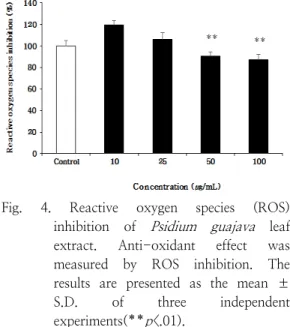
도 알려져 있다[40]. 본 실험에서는 구아바 잎 추 출물이 세포 내 활성산소 억제 효과를 측정하기 위하여 세포내 ROS를 측정한 결과를 Fig. 4에 나타내었다. 본 실험 결과 농도 의존적인 ROS 생성 억제 효과를 확인하였으며, 특히 50, 100 μg/mL 농도에서 유의하게 억제됨을 확인하였다 (p<0.01**). 이와 같은 결과는 구아바 잎 추출물 이 피부 탄력 감소나 주름, 기미, 주근깨 등의 각 종 피부 질환을 유발하는 활성산소를 억제함으로 써 미백, 주름 기능성 화장품 소재로써의 가능성 을 확인하였다.
Fig. 4. Reactive oxygen species (ROS) inhibition of
Psidium guajava
leaf extract. Anti-oxidant effect was measured by ROS inhibition. The results are presented as the mean ± S.D. of three independent experiments(**p
<.01).3.5. 시험관 내에서 Tyrosinase 활성 억제 측정 Tyrosinase는 멜라닌 합성 과정에서 속도 제한 (ratelimiting) 효소로써, 멜라닌 합성의 중요한 조 절 단계에 관여하는 효소로 알려져 있다[41]. 본 연구에서는 시험관 내에서 구아바 잎 추출물이 0.1, 0.25, 0.5, 1 mg/mL 농도에서 tyrosinase 활
성에 영향을 미치는지 확인하기 위하여
L-DOPA를 사용하여 tyrosinase 활성 억제 효과 를 Fig. 5에 나타내었다. 양성 대조군으로는 tyrosinase 저해 활성이 우수한 것으로 알려진 상 백피 추출물[42,43]을 실험군과 동일한 농도로 사용하였다. 상백피 추출물과 구아바 잎 추출물은 농도 의존적으로 tyrosinase 활성이 억제됨이 확 인 되었으며, 특히 0.5 mg/mL 농도에서 상백피 추출물과 구아바 잎 추출물은 30.8%, 18%의
tyrosinase 활성이 억제 되어 control과 비슷한 tyrosinase 활성 억제 효과가 나타남에 따라 구아 바 잎 추출물이 멜라닌 합성 과정의 중요한 조절 단계에 영향을 미치는 것을 확인할 수 있었다.
Fig. 5. Effect of
Psidium guajava
leaf extract on Tyrosinase inhibition activity in mushroom tyrosinase. The results are presented as the mean±S.D. of three independent experiments (**p
<.01,***
p
<.001).3.6. 멜라닌 생성 억제능 측정
Fig. 6. Ability of
Psidium guajava
leaf extract to suppress melanin production in B16F10 melanoma cells. B16F10 melanoma cell was treated with α -MSH. And activity to inhibit melanin synthesis ofPsidium guajava
leaf extract was measured. Arbutin (100 µg/mL) was used as positive control group. The results are presented as the mean±S.D. of three independent experiments. And statistical significance was shown (*p
<.05, **p
<.01).구아바 잎 추출물을 10, 25, 50, 100 μg/mL 농도로 처리하여 B16F10 melanoma cell에서 멜 라닌 생합성 억제 효과를 측정한 결과는 Fig. 6에 나타내었다. 대조군인 Control에 비해 멜라닌 생 성을 촉진 시키는 것으로 알려진 a-MSH를 처리 하여 멜라닌 생성을 유의하게 증가 시켰으며, 양 성 대조군으로 사용된 알부틴은 100 μg/mL 농 도에서 30.5% 유의하게 감소하였다(p<0.01**).
본 실험에 사용된 구아바 잎 추출물을 각 농도에 서 11.3%, 14.7%, 15.7%, 20%의 감소 효과를 확인하였다. 이와 같은 결과는 본 연구에 사용된 구아바 잎 추출물이 멜라닌 생합성 과정에 직접 적으로 영향을 미치는 것을 확인 할 수 있었으 며, 세포에 대한 독성이 거의 없고, 안전하게 멜 라닌 생성을 효과적으로 억제하는 물질로써의 활 용 가능성을 확인하였다.
4. 결 론
본 연구에서 구아바 잎 추출물이 미백 기능성 화장품 소재로써의 활용 가능성을 확인하고자 DPPH radical 소거 활성을 통한 항산화 효과와 B16F10 melanoma 세포에서의 자외선으로 부터 의 피부 세포 보호 및 멜라닌 생성 저해 효과를 연구하였다. 실험 결과 구아바 잎 추출물의 DPPH radical 소거 활성은 92.4%의 높은 radical 소거 활성을 나타내었으며, 우수한 항산 화 활성을 나타내었다. 피부 세포인 melanoma cell에 대한 세포 독성은 거의 나타나지 않았으 며, UVA에 대해 농도 의존적인 세포 보호 효과 를 확인하였다. 또한 시험관 내에서 tyrosinase 활성을 0.5 mg/mL 농도에서 control과 비슷한 tyrosinase 활성을 저해 하였으며, 멜라닌 생합성 억제 효과도 100 μg/mL 농도에서 20%의 멜라 닌 생합성 억제 효과를 확인하였다. 이와 같은 결과를 종합해 볼 때 구아바 잎 추출물의 함유되 어 있는 페놀성 화합물들의 높은 radical 소거 활 성과 세포 내 ROS 생성 억제를 통한 항산화 효 과를 나타내고 있으며, B16F10 melanoma cell 에서의 세포 독성이 낮고, 멜라닌 합성에 있어서 중요한 효소인 tyrosinase 활성 억제 및 멜라닌 생합성 억제를 통해 우수한 미백 기능 효과를 가 진 화장품 소재로써의 개발 가능성이 있을 것으 로 사료되어 진다.
References
1. Choi SY, Kim YC, Chang BS. Inhibitory efficacy of black tea water extract on melanogenesis in melan-a cells and its action mechanisms.
Korean J Microscopy.
41, 169–77 (2011).
2. Urabe K, Aroca P, Tsukamoto K, Mascagna D, Palumbo A, Prota G. The inherent cytotoxicity of melanin precursors: a revision.
Biochim Biophys Acta.
1221, 272 –278 (1994).3. Kobayashi T, Urabe K, Winder, A, Jimenez-Cervantes C, Imokawa G, Brewington T, Solano F, Garcia-Borron JC, Hearing VJ. Tyrosinase related protein(TRP-1) functions as a DHICA oxidase activity in melanin biosynthesis.
EMBO J.
13, 5818, (1994).4. Curo EV, Kwong C, Hermersdorfer H, Glatt H, Santis C, Virador V, Hearing VJ, Dooley P. Inhibitors of mamalian melanocytes tyrosinase: In vitro comparisons of alkyl esters of gentisic acid with other putative inhibitors.
Biochemical Pharmacology
. 57, 663-672 (1999).5. No JK, Soung DY, Kim YJ, Shim KH, Jun YS, Rhee SH, Yokizawa T, Chung HY.
Inhibition of tyrosinase by green tea components.
Life Science
. 65, 241-246 (1999).6. Prota G. Recent advances in the chemistry of melanogenesis in mammals.
J. Invest.
Dermatol
. 75, 122-129 (1990).7. Lee SH, Park JS. Kim SY, Kim JJ, Chung SR. Isolation of inhibitory components of tyrosinase activity from the bark of Paeonia moutan.
Yakhak Hoeji.
42, 353 (1998).8. Bloom W, Fawcett DW. A Textbook of Histology,
11th ed., W.B. Saunders Company
. USA, p. 543 (1986).9. Del Marmol V, Ito S, Jackson I, Vachtenheim J, Berr P, Ghanem G, Morandini R, Wakamatsu K, Huez G.
TRP-1 expression correlates with
eumelanogenesis in human pigment cells in culture.
FEBS Lett
. 327, 307-310 (1993).10. Lee SH, Kim SY, Kim JJ, Jang TS, Chung SY. The isolation of the inhibitory constituents on melanin polymer formation from the leaves of Cercis chinensis
. Korean J. Pharmacogn
. 30, 397-403 (1999).11. Chakraborty AK, Funasaka Y, Komoto M, Ichihashi M. Effect of arbutin on melanogenic proteins in human melanocytes.
Pigment Cell Res
. 11, 206 (1998).12. Liu SJ, Pan IH, Chu IM. Inhibitory effect of p-hydroxybenzyl alcohol on tyrosinase activity and melanogenesis.
Biol. Pharm.
Bull
. 30, 1135-1139 (2007).13. Shin NH, Ryu SY, Choi EJ, kANG SH, Chang IM, Min KR, Kim Y.
Oxyresveratrol as the potent inhibitor on dopa oxidase activity of mushroom tyrosinase.
Biochem. Biophys. Res.
Commun
. 243, 801-803 (1998).14. Begum S, Hassa SI, Siddiqui BS, Shaheen F, Ghayur MN, Gilani AH. Triterpenoids from the leaves of
Psidium
guajava.Phytochemistry.
61, 399-403 (2002).15. Fransworth NR, Bunyaprapatsara N. 1990.
Thai medicinal plants recommended for primary health care in Thailand.
Mahidol University, Bangkok, Thailand,
202-207 (1990).16. Lozoya X, Reyes-Morales H, Chacez-Soto MA, Martinez- Garcia MC, Soto- Gonzalex Y, Doubova SV. Intestinal anti-spasmodic effect of a phytodrug of
Psidium
guajava folia in the treatment of acute diarrheic disease.J Ethenopharmacol
. 83, 19-24 (2002).17. Hong NL. Chinese Medicinal Herbs of Hong Kong. 2.
Hand Chiewing Sa Kwang
, Hong Kong. 104-105 (1998).18. Misra K, Seshadri TR. Chemical components of the fruits of
Psidium
guajava
.Phytochemistry.
7, 641-645 (1968).19. Mercadante AZ, Steck A, Pfander H.
Carotenoids from guava (
Psidium guajava
L.) : isolation and structure elucidation.J Agric Food Chem
. 47, 145-151 (1999).20. Miean KH, Mohamed S. Flavonoid (myricetin, quercetin kaempferol, luteolin, and apigenin) content of edible tropical plants.
J Agric Food Chem
. 49, 3106-3112 (2001).21. Meckes M, Calzada F, Tortoriello J, Gonzalez JL, Martinez M. Terpenoids isolated from
Psidium guajava
hexane extract with depressant activity on central nervous system.Phytother Res
. 10, 600-603 (1996).22. Lozoya X, Meckes M, Abou-Zaid M, Tortoriello J, Nozzolillo J, Arnason JT.
Quercetin glycosides in
Psidium guajava
L.leaves and determination of spasmolytic principle.
Arch. Med. Res
. 25, 11-15 (1994).23. Jaiarj P, Wongkrajang Y, Thongpraditchote S, Peungvicha P, Bunyapraphatsara N, Opartkiattikul N. Guava leaf extract and topical haemostasis.
Phytother Res
. 14, 388-391 (2000).24. Tanaka T, Ishida N, Ishimatsu M, Nonaka G, Nishioka I. Tannins and related compounds. CXVI. Six new complex tannins, guajavins, psidinins and psiguavin from the bark of
Psidium guajava
L.Chem. Pharm. Bull
. 40, 2092-2098 (1992).25. Kim MJ, Choi HY, Kim SI. Quality Characteristics and Antioxidative Activities of Guavapyun Added Korean Guava Fruit Extract.
Korean J. Food Cookery sci.
26, 246-251 (2010).26. Jeong SA. Antioxidant and Antimicrobial Activities of Guajava Leaf (
Psidium guajava
) depending on Extract Solvent.International university
of Korea, 2012.27. Heo YJ, Sim KH, Choi HY, Kim SI.
Antioxidative Activity of Crackers Made with a Guava(
Psidium guajava
Linn.) Leaf Extract Harvested in Korea.Korean J.
Food Cookery sci.
26, 171-179, 2010.28. Park SY, Kwon HJ. The beauty effects of cosmetics made from Guava leaf extract.
Journal of the Korean Beauty Art Society
. 6, 8-12 (2012).29. Jin YJ, Kang SH, Choi SY, Park SY, Park JG, Moon SW, Park DB, Kim SJ. Effect of Fermented Guava (
Psidium guajava
L.) Leaf Extract on Hyperglycemia in Low Dose Streptozotocin-induced Diabetic Mice.Korean J. Food sci. Techno
l, 38, 679-683, 2006.31. Roh SG, Kim KH, Choi WC. Antidiabetic effects of leaves extracts of
psidium guajava
L. and Lagerstroemia speciosa L.in STZ-induced Rats.
J. Life Sci.
, 19, 40-45 (2009).31. Jo YH, Ok DL, Lee SC. Antiicrobial Characteristics of Different Parts of Guava against Food-Borne Bacteria.
J Korean Soc Food Sci Nutr.
38, 1773-1778, 2009.32. Jeong CH, JeonG HR, Choi GN, Kwak JH, Kim JH, Park SJ, Kim DO, Shim KH, Choi SG, Heo HJ. Neuronal Cell Protective Effects of Hot Water Extracts from Guava (
Psidiu guajava
L.) Fruit and Leaf.Korean J Food Preserv,
18, 124-129, 2011.33. Jo YH, Ok DL, Lee SC. Antimicrobial Characteristics of Different Parts of Guava against Food-Borne Bacteria.
J Korean Soc Food Sci Nutr
, 38, 1773-1778 (2009).34. Blois MS. Antioxidant determinations by the use of a stable free radical.
Nature
, 181, 1199-1200 (1958).35. You SH, Moon JS. A study on anti-oxidative, anti-inflammatory, and melanin inhibitory effects of chrysanthemum sibiricum extract.
36 Park BJ, Onjo M. Antioxidant activities and tyrosinase inhibitory effects of guava (
Psidium guajava
L.) leaf.Korean J. Plant Res.
21, 408-412 (2008).37. Chen H.Y. and G.C. Yen. Antioxidant activity and free radical-scavenging capacity of extracts from guava leaves.
Food Chemistry
. 101, 686-694 (2007).38. Choi SY, Lim SH, Kim JS, Ha TY, Kim SR, Kang KS, Hwang IK. Evaluation of the estrogenic and antioxidant activity of some edible and medicinal plants.
Korean J. Food Sci.Technol
. 37, 549-556 (2005).39. Fransworth NR, Bunyapraphatsara N. Thia Medicinal Plants Recommended for Primary Health Care in Thailand.
Mahidol University, Bangkok
. 202-207 (1990).40. Sander CS, Chang H, Salzmann S, Muller CS, Ekanayake-Mudiyanselage S, Elsner P, Thiele JJ. Phothoaging is associated with protein oxidation in human skin in vivo.
J Invest Dermatol
. 118, 618-625 (2002).41. Lee BC, Kim JH, Sim GS, Zhang YH, Pyo HB. The Inhibitiory Effects of the Scirpi rhizoma ON Melanogenesis,
J. Soc.
Cosmet. Scientists Korea
, 31, 305-310 (2005).42. Sun ok jee Antioxidant Activities and Whitening Effect of the Mulberry (
Morus alba
L.) Root Bark Extracts. 韓資植誌Korean J. Plant Res
. 22, 145-151 (2009).43. You MJ. Inhibitory Effect of Morus alba Extracts on Tyrosinase Activity and Melanogenesis in SK-MEL-2 cells.