B16 Melanoma 세포에서 Arctigenin이 Tyrosinase 활성과 Melanin 생성에 미치는 영향
이동자·심상수*,#
삼육대학교 보건복지대학원 보건학과, *중앙대학교 약학대학
(Received November 19, 2012; Revised December 21, 2012; Accepted December 24, 2012)
Effect of Arctigenin on Tyrosinase Activity and Melanin Production in B16 Melanoma Cells
Dong Ja Lee and Sang Soo Sim*,#
Graduate School of Health and Welfare, Sahmyook University, Hwarangro-815, Nowon-gu, Seoul 139-742. Korea
*College of Pharmacy, Chung-Ang University, 221 Huksuk-dong, Dongjak-gu, Seoul 156-756, Korea
Abstract — To investigate the possibility of development as a whitening agent using arctigenin, we measured DPPH assay, NBT/XO assay, intracellular ROS scavenging assay, tyrosinase assay and MSH-induced melanin production in B16 mel- anoma cells. Arctigenin dose-dependently had anti-oxidant activity in DPPH, NBT/XO and intracellular ROS assay. Although arctigenin did not inhibit purified tyrosinase activity, it dose-dependently inhibited tyrosinase activity and melanin production in B16 melanoma cells stimulated by 1µM α-MSH. In particular, arctigenin at a concentration 100 µM inhibited α-MSH- stimulated tyrosinase activity and melanin production by 50.9±2.9% and 69.0±6.5% respectively. And typical tyrosinase inhibitor, arbutin, inhibited 57.7±2.9% and 65.1±5.0% respectively. Such an similar inhibitory effect of arctigenin and arb- utin in B16 melanoma cells may be due to the inhibition of MSH signal pathway rather than the direct inhibition of tyro- sinase. Therefore, these results suggest that arctigenin may be useful for the development as whitening agents.
Keywords □ arctigenin, anti-oxidant, tyrosinase, melanin
Arctigenin은 phenylpropanoid dibenzylbutyrolactone lignan 의 일종으로 arctin이 가수 분해되어 얻어지는 비당체이다.1) Arctigenin을 많이 함유하고 있는 생약으로는 Bardanae fructus, Saussurea medusa, Arctium lappa, Torreya nucifera, Ipomea cairica, Forsythia intermedia 등으로 국화과에 속하는 생약들이 주를 이룬다.2) Arctigenin은 과거 중국에서 감기, 후두 부종, 기 침, 홍역 매독 등의 염증을 치료하는데 주로 사용되었다.2) 최근 연구를 통해 밝혀진 arctigenin의 효능은 항염증,3)항암,4)항바 이러스,5)항HIV,6)항인플루엔자7)에 대한 활성이 밝혀졌으며, 또 한, 신경보호효과8)도 입증되었다.
Arctigenin 단일 성분의 항산화 작용에 대한 연구는 아직 미비 한 상태이다. 많은 연구자들이 arctigenin을 함유하는 생약의 추 출물이 DPPH 정량과,9) DCF-DA를 이용한 hydrogen peroxide scavenging activity를 관찰한 실험에서 항산화 작용이 있다고 보
고되었다.2,5)
Melanogenesis는 dark macromolecular pigments의 일종인 melanin을 형성하는 전체적인 과정을 말하며, tyrosinase가 tyrosine을 dopaquinone으로 산화시키면서 그 반응이 시작된다.10) 현재 arctigenin의 미백작용에 대한 연구는 전무한 상태이다. 하 지만 arctigenin을 함유하는 연교 추출물에서 tyrosinase 활성 저 해 효과 및 멜라닌 합성 저해 효과 등이 나타나 현재 미백화장 품 소재로서도 주목을 받고 있는11)사실을 보면 arctigenin의 미 백 작용 가능성을 엿볼 수 있다. 그러므로 이 실험에서는 arctigenin의 시험관내와 세포 수준에서 항산화 효과를 측정하고, B16 melanoma cell을 이용하여 tyrosinase 활성과 melanin 생 성을 관찰하였다.
실험방법
시약
Arctigenin, hypoxanthine, mushroom tyrosinase, α-melanocyte stimulating hormone, melanin, allopurinol, arbutin, xanthine
#본 논문에 관한 문의는 저자에게로
(전화) 02-820-5615 (팩스) 02-816-7338 (E-mail) [email protected]
종설
CO2배양기에서 배양하였다. B16 melanoma 세포(1×10⁴ cells/ml) 200µl를 96-well plate에 가하고 arctigenin을 처치하여 72시간 배 양하였다. 사용하기 30분 전에 제조한 500 µg/ml MTT를 각 well 에 200 µl씩 가하고, 어두운 곳에서 4시간 배양하였다. 배양이 끝 난 후 상층액은 버리고, DMSO를 200 µl 가하여 생성된 MTT formazan을 완전히 용해시킨 후 570 nm에서 흡광도 측정하였다.12)
DPPH 라디칼 정량
96 well plate에 ethanol에 녹인 100 µM DPPH 용액 180 µl와 arctigenin을 최종 농도가 1, 3, 10, 30, 100 µM 농도로 각각 20µl씩 가하고 차광 상태에서 37oC에서 20분간 배양한 후 FL 600 spectrofluorometer(Bio-Tek, U.S.A.)를 이용하여 517 nm에 서 흡광도를 측정하였다.13)
NBT/XO에 의한 superoxide 생성
Hypoxathine이 요산으로 전환되는 과정에서 생성되는 superoxide를 nitroblue tetrazolium(NBT)이 소거하는 반응을 이 용하여 항산화 작용을 측정하였다. 0.6 mM hypoxanthine, 1 mM EDTA, 0.2 mM NBT를 함유하는 50 mM potassium phosphate 용액(pH 7.4) 400 µl에 arctigenin을 5 µl를 가하여(최종 1, 3, 10 µM) 잘 혼합하였다. 반응은 xanthine oxidase(100 mU/ml)를 100µl를 가하면서 시작하였다. 반응 혼합액을 37oC에서 20분간 배양한 후 96 well plate에 200 µl씩 소분하고 FL 600 spectro- fluorometer를 이용하여 590 nm에서 흡광도를 측정하였다.14)
세포 내 ROS 생성 측정
세포내에서 항산화 작용을 확인하기 위하여 2',7'-dichloro- fluorescin diacetate(DCF-DA)를 이용하여 B16 melanoma 세포 내에서 생성되는 산소라디칼(reactive oxygen species, ROS)을 측정하였다. 세포를 15 ml의 Krebs 용액(mM: NaCl 137, KCl 2.7, Na2HPO4 0.4, MgCl2 0.5, HEPES[pH 7.4] 10, CaCl2 1.8, glucose 5)에 suspend 시킨 후 20 µM DCF-DA를 가하고 1시간
125 units/ml과 25 units/ml 두 농도로 준비하였다. L-tyrosine (0.3 mg/ml)과 L-DOPA(2 mg/ml)를 eppendorf tube에 450 µl를 가하고 arctigenin을 5 µl를 가하여 최종 농도를 조절하였다.
Tyrosinase(기질이 L-tyrosine일 경우 125 units/ml, 기질이 L- DOPA일 경우 25 units/ml) 50 µl를 처치한 후 37oC에서 각각 30 분, 1시간 반응시킨 후 475 nm에서 흡광도를 측정하였다.16)
B16 melanoma 세포 내에서 tyrosinase 활성과 melanin 생성 B16 세포에 약물 처치 후 배양이 끝나면 1%(w/v) triton X- 100을 함유한 10 mM phosphate buffer(pH 6.8)를 100 µl를 가 하고 5분간 shaking 한 후에 세포와 용액을 모두 eppendorf tube 로 이전시키고 원심 분리하여 상층액은 tyrosinase 활성과 단백 질 정량에 이용하고, cell pellet은 멜라닌 정량에 사용하였다. 96 well plate에 약물 처치 후 얻은 상층액 40 µl를 분주하고 0.1 M sodium phosphate buffer(pH 7.2)에 녹인 2 mg/ml L-DOPA 200µl를 가하여 37oC에서 30분 동안 배양하였다. tyrosinase에 의해 생성된 DOPA chrome은 475 nm에서 흡광도를 측정하였다.17) Cell pellet은 1 N NaOH 100 µl와 증류수 200 µl를 가하고 60oC 에서 1시간 방치하여 melanin을 완전히 녹인 후 96 well plate 에 200 µl를 옮긴 후 405 nm에서 흡광도를 측정하였다. Melanin 표준품으로 얻은 표준 검량 선을 이용하여 각 well에서 생성된 melanin 양을 산출하였다.
자료 분석 및 통계적 검정
실험 결과는 평균±표준편차로 표기하였으며, 실험 성적은 non- paired Student's t test로 검정하였고 P 값이 5% 미만일 때 통 계적으로 유의하다고 간주하였다.
실험결과 및 고찰
Arctigenin의 세포 독성
Arctigenin의 미백 효과를 관찰하기 위해서는 B16 melanoma
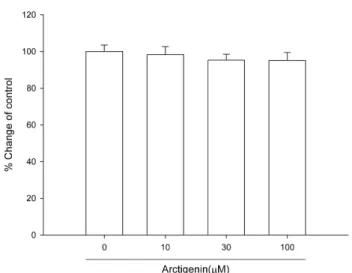
세포에 72시간 노출을 시켜야 되는데 arctigenin이 세포 독성을 나타내는 경우에는 미백 효과를 관찰할 수가 없기 때문에 우선 적으로 MTT 정량법을 이용하여 arctigenin의 세포 독성을 측정 하였다. arctigenin을 B16 melanoma 세포에 72시간 노출시 100 µM에서도 세포 생존율이 95.1%를 나타내고 있다(Fig. 1). 최근 에 arctigenin이 암세포에 특이적으로 세포 독성을 나타내고 정 상 세포에서 세포 독성을 나타내는 농도(ED50)는 100 µg/ml 이 상에서 나타난다고 보고되었다.18)이 실험에서 사용한 arctigenin 의 최고 농도는 100 µM로서 37.2 µg/ml에 해당된다. 이러한 결 과로 미루어 볼 때 arctigenin에 의해 나타나는 미백 효과에서 세 포 독성에 의한 영향은 배제 할 수 있다.
시험관내에서 arctigenin의 항산화 활성
시험관내에서 arctigenin의 항산화 활성을 측정하기 위해 DPPH 유리 라디칼 소거 반응과 NBT/XO superoxide scavenging assay을 사용하였다. DPPH 라디칼 소거 반응에서 arctigenin(1~
100µM)은 농도 의존적인 항산화 작용을 나타내었다(Fig. 2). 하 지만 대조 약물인 ascorbic acid(100 µM)에서는 78.7%의 억제효 과를 보인 반면 arctigenin의 최고 농도인 100 µM에서는 47.3%
억제 효과를 보여 대조 약물보다는 항산화 작용이 낮게 나타났 다. Xanthine oxidase에 의해 생성된 superoxide를 NBT(nitroblue tetrazolium chloride)와 반응시켜 항산화 정도를 측정하는 NBT/
XO superoxide scavenging assay에서도 arctigenin은 농도 의존 적으로 superoxide의 소거반응을 보였다(Fig. 3). 마찬가지로, 대 조약물로 사용한 XO억제제인 10 µM allopurinol에서는 53%의 항산화 효과를 보였지만 arctigenin의 최고 농도인 10 µM에서는 이보다 작은 31%의 항산화 효과를 보여 대조 약물보다는 항산
화 효과가 작은 것으로 나타났다.
세포에서 ROS 생성에 미치는 arctigenin의 효과
Arctigenin의 항산화 작용이 세포내에서 발생하는 ROS (reactive oxygen species)생성에서도 항산화 작용이 있는 지를 확인하기 위하여 B16 melanoma 세포를 이용하여 측정하였다.
다양한 세포에서 silica는 ROS 생성을 증가시키는 물질로 알려 져 있다.19) Silica(1 mg/ml)는 B16 melanoma 세포에서 ROS 생 Fig. 1− The cytotoxicity of arctigenin in B16 melanoma cells. The
cells were incubated with arctigenin (10~100µM) for 72 h.
The amount of living cells was measured using MTT.
Results are expressed as percentage of control and each value represents means±SD from 4 separate experiments.
Fig. 3− Anti-oxidant activity of arctigenin in NBT/Xanthine oxidase assay. The scavenging potential for superoxide radicals was analyzed via a hypoxanthine/xanthine oxidase generating system coupled with nitroblue tetrazolium. Results are means±SD from 4 separate experiments. AP: allopurinol 10µM. *: significantly different from Control (P<0.05).
Fig. 2− Anti-oxidant activity of arctigenin in the DPPH radical scavenging activity assay. A solution of 180µl of 100 µM DPPH solution in ethanol was gently mixed with 20µl of arctigenin or ascorbic acid (100µM) for 20 min and the absorbance was measured at 517 nm. Results are means±
SD from 4 separate experiments. *: significantly different from Control (P<0.05).
성을 342% 증가시켰다. 이러한 silica에 의한 ROS 생성은 arctigenin 30µM 및 100 µM에서 각각 210%와 184%의 농도 의존적 억제 효과를 보였다(Fig. 4). Arctigenin은 시험관 뿐만 아 니라 세포 수준에서도 항산화 작용을 나타내는데 이러한 항산화 작용은 노화 방지 및 미백 효과와 밀접한 연관성이 있는 것으로 알려져 있다.20,21)
정제된 mushroom tyrosinase 활성에 미치는 arctigenin의 영향
Arctigenin의 미백 작용을 확인하기 위하여 melanin 생성에 중
제로 작용하는 것으로 알려져 있다.24)이러한 결과로 미루어 볼 때 arctigenin은 tyrosinase를 직접적으로 억제하지 않는 것으로 사료된다.
B16 melanoma 세포에서 arctigenin이 MSH에 의한 melanin 합성에 미치는 영향
Arctigenin이 melanin을 생성하는 세포 수준에서 미백효과가 있는 지를 확인하기 위하여 α-melanocyte stimulating hormone (α-MSH)로 자극한 B16 melanoma 세포에서 tyrosinase 활성과 melanin 생성을 관찰하였다. B16 melanoma 세포에서 MSH는 tyrosinase 활성과 melanin 생성을 유의하게 증가시켰다(Fig. 6).
이러한 MSH에 의한 tyrosinase 활성과 melanin 생성 증가는 arctigenin에 의해 농도 의존적으로 억제되었다(Fig. 6). 특히 arctigenin 100µM에서는 MSH 자극에 의한 tyrosinase 활성과 melanin 생성을 각각 50.9%와 69.0%의 억제 효과를 보였다.
Fig. 4− Inhibitory activity of arctigenin on 1 mg/ml silica-induced intracellular ROS generation in B16 melanoma cells.
Results are means±SD from 4 separate experiments. *:
significantly different from Silica (P<0.05).
Fig. 5− Effects of arctigenin on mushroom tyrosinase activity. Purified tyrosinase was mixed with arctigenin or arbutin (1 mM) and incubated with 2 mg/ml L-DOPA (A) or 0.3 mg/ml L-tyrosine (B) for 30 min and 1 hr at 37oC, respectively. Results are means±SD from 4 separate experiments. *: significantly different from Control (P<0.05).
Arctigenin이 tyrosinase에 직접적인 영향은 주지 않지만 세포 수 준에서 MSH 자극에 의한 tyrosinase 활성과 melanin 생성을 억 제하는 것은 MSH의 신호전달경로에 영향을 주는 것으로 사료 된다. 이러한 현상은 acteoside의 미백 효과에서도 유사한 결과 를 나타내고 있다.16)이상의 결과를 종합하여 볼 때 arctigenin은 MSH에 의한 melanin 생성을 억제하는 효과는 1 mM arbutin에 의한 미백효과와 유사한 정도로 나타나는 것으로 볼 때 arctigenin 의 미백 효과는 우수한 것으로 사료되며 앞으로 미백제로서의 개 발 가능성이 있는 것으로 사료된다.
결 론
Arctigenin이 미백제로의 개발 가능성 여부를 관찰하기 위하여 항산화작용과 melanin 생성에 미치는 영향을 관찰하였다.
Arctigenin은 DPPH radical 소거작용과 xanthine oxidase에 의 한 superoxide 소거작용 뿐만 아니라 B16 세포에서 silica에 의 해 생성된 세포내 ROS 생성을 유의하게 억제하였다. 이러한 결 과로 보아 arctigenin은 시험관내에서 free radical을 소거하는 항 산화 작용뿐만 아니라 세포내에서 ROS 생성을 억제하는 작용도 있는 것으로 여겨진다. Arctigenin은 L-DOPA를 기질로 사용한 경우 tyrosinase 활성에 직접적인 영향을 주지 않았으나 L- tyrosine을 기질로 사용하였을 때 약간 억제하는 경향을 보였다.
그러나 B16 melanoma 세포에서 arctigenin은 MSH에 의한 tyrosinase 활성과 melanin 생성 증가는 농도 의존적으로 억제하 였다. Arctigenin이 tyrosinase에 직접적인 영향은 주지 않지만 세포 수준에서 MSH 자극에 의한 tyrosinase 활성과 melanin 생 성을 억제하는 것은 MSH의 신호전달경로에 영향을 주는 것으
로 사료된다. 이상의 결과를 종합하여 볼 때 arctigenin은 MSH 에 의한 melanin 생성을 억제하는 효과는 1 mM arbutin에 의한 미백효과와 유사한 정도로 나타나는 것으로 볼 때 arctigenin의 미백 효과는 우수한 것으로 사료되며 앞으로 미백제로서의 개발 가능성이 있는 것으로 사료된다.
참고문헌
1) Swarup, V., Ghosh, J., Mishra, M. K. and Basu, A. : Novel strategy for treatment of Japanese encephalitis using arctigenin, a plant lignan. J. Antimicrob. Chemother. 61, 679 (2008).
2) Kou, X., Qi, S., Dai, W., Luo, L. and Yin, Z. : Arctigenin inhibits lipopolysaccharide-induced iNOS expression in RAW264.7 cells through suppressing JAK-STAT signal pathway. Int.
Immunopharmacol. 11, 1095 (2011).
3) Kang, H. S., Lee, J. Y. and Kim, C. J. : Anti-inflammatory activity of arctigenin from Forsythiae Fructus. J. Ethnopharmacol.
116, 305 (2008).
4) Kim, J. Y., Hwang, J. H., Cha, M. R., Yoon, M. Y., Son, E. S., Tomida, A., Ko, B., Song, S. W., Shin-ya, K., Hwang, Y. I. and Park, H. R. : Arctigenin blocks the unfolded protein response and shows therapeutic antitumor activity. J. Cell. Physiol. 224, 33 (2010).
5) Charlton, J. L. : Antiviral activity of lignans. J. Nat. Prod. 61, 1447 (1998).
6) Schroder, H. C., Merz, H., Steffen, R., Muller, W. E., Sarin, P. S., Trumm, S., Schulz, J. and Eich, E. : Differential in vitro anti-HIV activity of natural lignans. Z Naturforsch C. 45, 1215 (1990).
Fig. 6− Effect of arctigenin on tyrosinase activity (A) and melanin production (B) in B16 melanoma cells stimulated by 1 µM a-melanocyte stimulating hormone (MSH). Results are means±SD from 4 separate experiments. Arbutin: 1 mM. *: significantly different from MSH (P<0.05).
Mol. Sci. 10, 2440 (2009).
11) 김미진, 김자영, 정택규, 최상원 그리고 윤경섭 : 연교추출물의 피부 항노화 효과. 한국생물공학회지 21, 444 (2006).
12) Mosmann, T. : Rapid colorimetric assay for cellular growth and survival: application to proliferation and cytotoxicity assays. J.
Immunol. Methods 65, 55 (1983).
13) Perez, G. R., Vargas, S. R., Martinez, M. F. and Cordova, R. I. : Antioxidant and free radical scavenging activities of 5,7,3'- trihydroxy-3,6,4'-trimethoxyflavone from Brickellia veronicaefolia.
Phytother. Res. 18, 428 (2004).
14) Parejo, I., Viladomat, F., Bastida, J., Rosas-Romero, A., Flerlage, N., Burillo, J. and Codina, C. : Comparison between the radical scavenging activity and antioxidant activity of six distilled and nondistilled mediterranean herbs and aromatic plants. J. Agric. Food Chem. 50, 6882 (2002).
15) Boland, A., Delapierre, D., Mossay, D., Hans, P. and Dresse, A. : Propofol protects cultured brain cells from iron ion-induced death: comparison with trolox. Eur. J. Pharmacol. 404, 21 (2000).
16) Song, H. S. and Sim, S. S. : Acteoside inhibits alpha-MSH-
species in Rat2 fibroblast: role in activation of mitogen- activated protein kinase. Biochem. Biophys Res. Commun. 262, 708 (1999).
20) Valverde, P., Manning, P., Todd, C., McNeil, C. J. and Thody, A. J. : Tyrosinase may protect human melanocytes from the cytotoxic effects of the superoxide anion. Exp. Dermatol. 5, 247 (1996).
21) Wood, J. M. and Schallreuter, K. U. : Studies on the reactions between human tyrosinase, superoxide anion, hydrogen peroxide and thiols. Biochim. Biophys Acta. 1074, 378 (1991).
22) Hearing, V. J. and Jimenez, M. : Mammalian tyrosinase--the critical regulatory control point in melanocyte pigmentation.
Int. J. Biochem. 19, 1141 (1987).
23) Hearing, V. J. and Jimenez, M. : Analysis of mammalian pigmentation at the molecular level. Pigment Cell. Res. 2, 75 (1989).
24) Maeda, K. and Fukuda, M. : Arbutin: mechanism of its depigmenting action in human melanocyte culture. J. Pharmacol.
Exp. Ther. 276, 765 (1996).