566
JOURNAL OF KOREAN FOREST SOCIETY
정금나무 열매의 총 페놀 함량 및 항산화활성 분석
김혜수1·김문섭1·김세현1·윤경원2·송정호1*
1국립산림과학원 특용자원연구과, 2국립순천대학교 한약자원학과
Analysis of Total Phenolic Content and Antioxidant Activity from Fruits of Vaccinium oldhamii Miq.
Hyeusoo Kim
1, Moon Sup Kim
1, Sea Hyun Kim
1, Kyeong Won Yun
2and Jeong Ho Song
1*1Division of Special Purpose Trees, Korea Forest Research Institute, Suwon 441-847, Korea
2Department of Oriental Medicine Resources, Sunchon National University, Suncheon 540-950, Korea
요 약: 정금나무의 기능성 품종을 육성하기 위하여 정금나무 선발 5개체의 열매에 대한 항산화 활성을 측정하였으 며, 항산화 성분인 총 페놀 함량을 측정하였다. 총 페놀 함량은 gallic acid를 기준물질로 하여 분석한 결과 15.8~19.9 mg/g 범위로 전체 평균 17.9 mg/g을 나타냈으며, DPPH free radical 소거활성은 400 ppm의 농도에서 69.1~91.4% 범 위로 전체평균 84.2%를 나타내었다. 환원력은 0.56~0.96 범위로 전체 평균 0.79를 나타내었다. 상관분석 결과 DPPH free radical 소거활성과 환원력에서 상관계수가 0.969로 매우 높은 정의 상관관계를 나타내었다.
Abstract: Vaccinium oldhamii Miq. is a Korean native tree, which is deciduous and shrub tree with broad leaf.
To develop superior cultivars for edible or medicinal purposes, we evaluated total phenolic content and antioxidant activity. Total phenolic content was measured by folin-denis method and antioxidant activity was measured by DPPH free radical scavenging activity (DPPH method) and reducing power (potassium ferricyanide method). Total phenolic content, DPPH free radical scavenging activity (at 400 ppm) and reducing power (at 700 ppm) were 15.8~19.9 mg/g, 69.1~91.4% and 0.56~0.96, respectively. A linear correlation was shown between DPPH-radical scavenging activity and reducing power (r=0969).
Key words : DPPH free radical scavenging activity, reducing power, total phenolic content, Vaccinium oldhamii
서 론
신체 내부에서는 수많은 생리적, 생화학적 과정을 통해 안정상태의 산소에서 수퍼옥사이드라디칼, 하이드록시 라 디칼, 과산화수소와 같은 반응성이 큰 활성산소(Reactive Oxygen Species, ROS)로 전환한다(Ames, 1998). 이 같은 자유라디칼은 생체분자에 산화적 손상을 야기하여 결국 동맥경화, 암, 노화, 퇴행성 질병과 같은 만성 질병을 유발 한다(Finkel and Holbrook, 2000). 이와 같은 질병은 항산 화제로 발생률을 최소화 시킬 수 있으며, 또한 항산화제 는 많은 음식에서 지방의 산패를 막는데 유용하게 쓰인다 (Yoo et al., 2005; Kim et al., 2012). 지금까지는 천연항 산화제보다 값싸고 효과적인 이유 때문에 BHA (butylated hydroxy anisole), BHT (butylated hydroxy toluene) 등과
같은 합성항산화제를 널리 사용해왔으나, 합성항산화제의 안전과 독성에 대한 관심이 급증하고 부작용 사례가 밝혀 지면서 소비자들의 기피현상이 나타나고 있다(Branen, 1975; Pokorný, 2007). 자연에서 유래된 천연물 특히 식용 가능한 천연물의 경우, 부작용 없이 사용할 수 있을 것이 라 사료되며 추가적으로 인체에 이로운 효과까지 얻을 수 있을 것으로 여겨져 천연항산화제 연구가 급증하고 있다 (Kwon et al., 2008; Shin et al., 2012).
산앵도나무속(Vaccinium)은 진달래과(Ericaceae)에 속하 며 전세계에 약 300종이 있으며, 국내에는 5종이 분포하 고 있다(Lee, 1997). 산앵도나무속에 속하는 열매는 식용 또는 상업적으로 이용 가능한 종들이 많고(Kim et al., 2003; Jeon and Lee, 2011; Lee and Lee, 2012), 특히 그 중 블루베리는 세계 10대 장수식품의 하나로 알려지면서 국내에서 2000년 이후부터 상업적 목적으로 재배되기 시 작하였다(Kim et al., 2005). 이와 같은 상황에서 정금나무
*Corresponding author
E-mail: [email protected]
(Vaccinium oldhamii Miq.)는 우리나라의 자생식물임에도 불구하고 널리 사용되고 있지 않고 있다.
진달래과 산앵도나무속에 속하는 정금나무는 높이 1~4 m의 낙엽활엽관목으로서 계룡산 이남에 주로 분포하지 만 서해안을 따라 안면도까지 자생한다. 묵은 가지는 짙 은 갈색이고, 햇가지는 회갈색을 띠며, 잎은 호생으로 타 원형 또는 난형이다. 꽃은 5~7월에 햇가지 끝에 총상화 서로 붙게 되며, 수술은 10개이고 씨방은 10실이다. 열 매는 장과로 지름 6~8 mm로 9월에 검은색으로 익고 흰 가루로 덮여 있다(Lee, 1997). 열매는 한국과 중국 등지 에서 방부, 수렴, 건위, 이뇨 등의 효능이 있어 방광염, 구토, 임질, 하리, 발진 등의 치료에 사용하였다(Kim, 1996).
최근에는 정금나무의 잎에서 비만과 당뇨병 예방을 위 한 생리활성 물질조사로 α-amylase 저해활성이 있음을 밝 혔으며, 가지에서는 acetylcholinesterase 저해활성 성분인 taraxerol, scopoletin과 lignan화합물인 lyoniside, ssioride 을 분리 보고 된 바 있다(Lee et al., 2004; Kim et al., 2007; Oh and Koh, 2009). 또한 일본에서 자란 정금나무 열매에 대해 항산화활성과 항암효과를(Hirotoshi, 2013), 국내 정금나무 열매의 70% 아세톤 추출물의 생리활성과 항균활성이 연구 된 바 있다(Chae et al., 2012).
본 연구에서는 열매특성으로 선발된 정금나무 5개체의 항산화활성을 평가하고 이와 관련된 기능성 성분인 총 페 놀 함량을 조사하여 정금나무 열매의 기능성을 탐구하고 유용성분 함량이 높은 정금나무의 고품질 신품종 육성을 위한 기초 자료로 활용하는데 목적이 있다.
재료 및 방법
1. 재료 및 시약
정금나무 선발 5개체의 열매를 2012년 9월에 채취하여 공시재료로 사용하였다. 본 실험에 사용된 folin and ciocalteu’s phenol reagent, Na2CO3, gallic acid, 2,2-diphenyl- 1-picryhydrazyl (DPPH), sodium phosphate monobasic monohydrate, sodium phosphate dibasic heptahydrate, potassium ferricyanide, trichloroacetic acid는 Sigma Chemical Co. 제품을 구입하여 사용하였다.
2. 형태적 특성 조사
정금나무 열매의 형태적 특성 조사는 개체별로 정상적 인 생장을 보인 10개 결실지의 송이에서 2개씩 총 20개의 열매를 선정하여 횡경(Fruit width, FW), 종경(Fruit length, FL), 무게(Weight of fruit, WF)를 디지털 캘리퍼스 (NA500-150S, Bluebird, Korea), 디지털 저울(92SM- 202A, Precisa, Switzerland)로 측정하였다.
3. 추출 및 시료조제
동결 건조한 열매를 분쇄하여 분말화 한 후 시료 5 g을 실온에서 3일간 80% 에탄올 150 mL로 추출한 다음 농축 하여 이를 80% 에탄올 30 mL로 정용하여 분석 실험에 사 용하였으며, 모든 실험은 개체별로 3회 반복 실시하였다.
4. 총 페놀 함량
총 페놀 함량은 Folin-Denis법에 의해 측정하였다. 추출 물 용액 0.2 mL에 Folin and Ciocalteu’s phenol reagent 를 0.2 mL 첨가하였다. 정확히 3분후 10% Na2CO3 0.4 mL 를 첨가하고 다시 증류수를 1.4 mL 첨가하였다. 혼합액은 암실에서 1시간 반응시킨 후 UV-vis spectrophotometer (852A Diode Array Spectrophotometer, Agilent Techno- logies, Seoul, Korea)를 이용하여 725 nm에서 흡광도를 측 정하였다. 서로 다른 농도(50~400 ppm)의 gallic acid를 이 용하여 검량선을 작성하였고, 검량선을 기준으로 시료 중 량 당 총 페놀 함량을 구하였다.
5. DPPH 자유라디칼(free radical) 소거활성
항산화 활성측정법 중 하나인 DPPH법에 의한 free radical 소거능은 Blois의 방법을 본 실험에 맞게 변형하여 측정하였다. 즉, 농도별로 제조한 각 시료용액 1 mL를 0.15 mM의 DPPH용액 1.5 mL에 첨가하였다. 반응액을 완전히 섞은 후에 실온에서 30분간 반응시켰다. 남아 있 는 DPPH의 양을 측정하기 위해서 517 nm에서 흡광도를 측정하였다. 소거능에 의한 항산화활성은 시료용액의 첨 가군과 무첨가군의 흡광도 감소율로 나타냈으며 다음의 식에 의해 구하였다.
6. 환원력
환원력은 Potassium ferricyanide법을 본 실험에 맞게 변형 하여 측정하였다. 시료용액 250 µL에 0.2 mM sodium phosphate buffer (pH 6.6) 250 µL와 1% potassium ferricyanide 250 µL를 첨가하였다. 혼합액은 50oC에서 20 분간 반응시켰다. 반응이 끝난 후에는 10% trichloroacetic acid (w/v) 250 µL를 첨가한 후 650 rpm으로 10분간 원 심분리를 하였다. 상등액 500 µL에 증류수 500 µL를 혼 합 한 후 0.1% ferric chloride 100 µL를 첨가하여 700 nm에서 흡광도를 측정하였다.
7. 통계처리
모든 실험은 3회 반복 실시하였으며 여기서 얻은 실험 결과는 SPSS 통계프로그램(ver. 18.0, SPSS Inc., USA)
Free radical scavenging activity (%) = (1 − Absorbance of sample (1)
) × 100 Absorbance of control
Duncan’s multiple test를 통해 유의적인 차이(p < 0.05)를 확인하였다. 각 조사항목별 상관관계(p < 0.05)를 알아보 고자 총 페놀 함량, DPPH 자유라디칼 소거활성, 환원력 에 있어서 각 항목 양자 간의 상관계수(Simple correlation coefficients)를 도출하여 비교하였다.
결과 및 고찰
1. 형태적 특성
정금나무 열매의 형태적 특성을 조사한 결과는 Table 1 과 같다. 열매 횡경의 전체 평균은 7.60 mm를 나타내었다.
광주1개체가 8.07 mm로 가장 큰 값을 나타냈으며, 무주1 개체는 6.80 mm로 가장 작은 값을 나타내었다. 열매 종경 의 전체 평균은 7.31 mm를 나타내었다. 남해1개체가 7.68 mm로 가장 큰 값을 나타냈으나, 무주1개체는 6.66 mm로 가장 작은 값을 나타내었다. 또한 열매 무게 특성을 살펴 보면, 전체 평균 무게는 0.27 g을 나타내었다. 광주1개체 와 태안1개체가 0.303 g으로 가장 높은 수치를 나타냈으 나, 반면 횡경과 종경에서 낮은 수치를 나타낸 무주1개체 가 0.216 g으로 가장 낮은 수치를 나타내었다.
2. 총 페놀 함량
총 페놀 함량은 Folin-Ciocalteu reagent가 추출물의 페 놀성 화합물에 의해 환원된 결과 몰리브덴이 청색으로 발
색하는 원리로 측정하였다. 정금나무 과실의 개체별 추출 액의 total phenolic함량은 Figure 1과 같다. Total phenolic 함량은 15.8~19.9 mg/g 범위로 전체 평균 17.9 mg/g을 나 타내었다. 그 중 태안1 개체가 19.8 mg/g으로 가장 높은 함량을 보였으며 변이계수 값은 9.5%로 나타났다. 정금나 무 70% acetone 추출물에서 17.4±0.3 mg/g의 phenolic 함량이 보고된바 있으며, 블루베리 재배종의 80% 에탄올 추출물과 wild blackberry(Rubus ulmifolius)에서 각각 264.1~528.2 mg/100 g과 644.7 mg/L의 총 페놀성분이 보 고된 바 있다(Dragovic-Uzelac, 2010; Guerrero et al., 2010; Chae et al., 2012). 이와 비교하여 본 연구의 정금 나무 80% ethanol 추출액의 총 페놀함량은 유사하거나 높 은 경향을 나타내었다. 페놀 성분은 자유라디칼과 관련 된 다양한 질병의 예방과 치료에 쓰이는 항산화활성 물 질로 알려져 있으며, 특히 식물에 함유된 페놀 성분은 항 산화활성이 매우 높은 것으로 알려져 있다(Shahidi and Wanasundara, 1992; Sofowora, 1993).
3. DPPH 자유라디칼(free radical) 소거활성
자유라디칼은 세포가 에너지 생성을 위해 산화환원반응 을 일으킬 때 super oxide anion, hydroxyl radical, hydrogen peroxide와 같은 반응성이 높은 활성산소에서 생성되는 결 과물이다(Yildirim et al., 2000). DPPH 자유라디칼을 통한 활성도 측정 방법은 전자이동을 통해 항산화활성을 분석 하는 방법으로 분광광도계를 이용하여 빠르고 쉽게 활성 을 측정 할 수 있다(Huang et al., 2005). 정금나무 과실의 개체별 추출액의 DPPH 자유라디칼 소거능을 분석한 결 과는 Figure 2와 같다. DPPH 자유라디칼소거활성은 400 ppm의 농도에서 69.1~91.4% 범위로 전체평균 84.2%로 높 은 활성을 나타내었다. 그 중 태안1개체가 91.4%로 가장 높게 나타났으며 변이계수 값은 10.3%로 개체간 변이를 나타내었다. 같은 산앵도나무속에 식물에 대하여 V.
myrtillus L. (bilberry)의 에탄올추출물과 V. arctostaphylos Table 1. Average values for fruit characteristics of Vaccinium
oldhamii.
Individuals Fruit width (mm)
Fruit Length (mm)
Weight of Fruit (g) Gwangju1 8.07±0.32a* 7.56±0.58ab 0.30±0.04a Namhae1 7.56±0.64c 7.68±0.75a 0.30±0.07b Nonsan1 7.93±0.60ab 7.26±0.49b 0.25±0.04b Muju1 6.80±0.33d 6.66±0.31c 0.22±0.02c Taean1 7.64±0.28bc 7.38±0.26ab 0.30±0.03a
*Different letters indicate significant differences according to Duncan’s multiple range test at p<0.05.
Figure 1. Total phenolic content from fruits of V. oldhamii.
Bars indicate the mean ± SD of the three replication (n=3).
Figure 2. DPPH free radical scavenging activities from fruits of V. oldhamii. Bars indicate the mean ± SD of the three replication (n=3). Samples are experimented in 400 ppm concentration.
의 메탄올추출물의 IC50값이 3.99 µg/mL, 7.9 µg/mL라 보 고한 결과(Valentová et al., 2007; Salehi et al., 2013)와 비교하여 정금나무 열매의 DPPH 자유라디칼소거활성이 우수함을 알 수 있다. 식물에서의 항산화활성은 주로 플 라보노이드, 폴리페놀, 탄닌, 페놀릭 테르펜과 같은 페놀 릭 성분의 라디칼 소거반응을 의미하며, 이러한 페놀릭 성 분의 항산화활성은 자유라디칼의 흡착과 중화, 과산화수 소의 분해 등에서 중요한 역할을 할 수 있다(Rahman and Moon, 2007; Hasan et al., 2008).
4. 환원력
환원력은 항산화활성과 밀접한 관련이 있는 중요한 인 자로 알려져있으며, 항산화제와 같은 환원력을 가지는 물 질이 Fe3-ferricyanide복합체를 Fe2형태로 환원시키게 되는 데, 이 때 시료의 환원력을 흡광도의 수치로 판단한다. 즉 환원력이 강할수록 청색에 가깝게 발색되어 흡광도가 높 게 나타나며, 항산화활성이 큰 물질일수록 높은 흡광도를 나타내게 된다(Osawa, 1994; Kim et al., 2005).
Potassium ferricyanide법을 이용한 정금나무 열매 추출 물의 환원력 분석 결과는 Figure 3과 같다. 환원력은 700 ppm에서 0.56~0.96 범위로 전체 평균 0.79를 나타내었다.
변이계수는 18.3%로 높은 개체간 변이를 나타냈으며 이 중 태안1 개체가 0.96으로 가장 높은 환원력을 나타내었다.
Kang(2009)은 오디 열매 에탄올 추출물의 환원력을 측 정한 결과 5000 µg/mL에서 1.24로, Jeong et al.(2008)은 블루베리와 복분자의 에탄올 추출물을 측정한 결과 20 mg/ml에서 모두 1.0 이상의 결과를 나타낸다고 보고한 바 있어 본 연구 결과와 유사한 경향을 나타내었다.
5. 상관분석
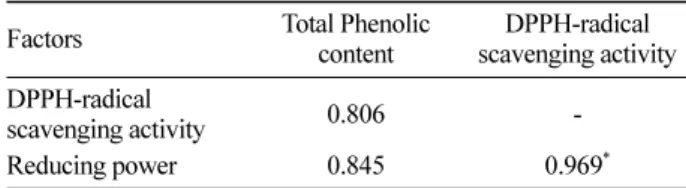
총 페놀 함량, DPPH 자유라디칼소거활성 및 환원력 특 성들에 대한 상관분석 결과는 Table 2와 같다. 총 페놀 함 량은 DPPH 자유라디칼 소거활성과 환원력에서 각각 0.806, 0.845로 매우 높은 정의 상관관계를 나타냈으며, 환
원력은 DPPH 자유라디칼 소거활성과 매우 높은 정의 상 관관계를 나타내었다(r=0.969).
페놀성 물질은 항산화활성을 포함한 다양한 생리적 효 능을 나타내는 것으로 보고되고 있으며, 이와 관련하여 항 산화활성과 페놀성 성분간에 높은 상관관계를 보여준다 는 결과도 다수 보고된 바 있다(Rice-Evans et al., 1996;
Velioglu et al., 1998; Gulcin et al., 2002,). 또한, 환원력 과 DPPH 자유라디칼소거활성법이 항산화활성 정도를 판 단하는 방법으로 쓰이고 있으나 시료에 함유된 환원물질 의 종류에 따라 각기 다른 라디칼에 작용하기 때문에 항 산화 측정법 간의 상관연관성을 평가하는 것은 중요하다.
이러한 결과를 토대로 정금나무의 이용을 증대시키기 위해서는 항산화활성이나 항균활성 등과 같은 건강 기능 성 효능이 우수한 품종 육성은 물론 유용활성과 관련된 성분인 페놀, 비타민C 등이 다량 함유된 품종을 개발하여 야 한다.
인용문헌
Ames, B.N. 1998. Micronutrients prevent cancer and delay aging. Toxicology letters 102: 5-18.
Branen, A.L. 1975. Toxicological and biochemistry of buty- lated hydroxyanisol and butylated hydroxytoluene. Jour- nal of the American Oil Chemists’ Society 52: 59-63.
Chae, J.W., Jo, B.S., Joo, S.H., Ahn, D.H., Chun, S.S., and Cho, Y.J. 2012. Biological and antimicrobial activity of Vaccinium oldhami fruit. Journal of the Korean Society of Food Science and Nutrition 41:1-6.
Finkel, T. and Holbrook, N. 2000. Oxidants, oxidative stress and biology of aging. Nature 408: 239-247.
Guerrero, J.C., Ciampi, L.P., Castilla, A.C., Medel, F.S., Schal- chli, H.S., Hormazabal, E.U., Bensch, E.T., and Alberdi, M.L.
2010. Antioxidant capacity, anthocyanins, and total phe- nols of wild and cultivated berries in Chile. Chilean Jour- nal of Agricultural Research 70: 537–544.
Gulcin, I., Oktay, M., Kufrevioglu, O.I., and Aslan, N.A.
2002. Determination of antioxidant activity of lichen Chtraria islandica (L.) Ach. Journal of Ethnopharmacology 79:
325-329.
Hasan, S.M., Hossain, M.M., Faruque, A., Mazumder, M.E.H., Figure 3. Reducing power from fruits of V. oldhamii. Bars
indicate the mean ± SD of the three replication (n=3). Samples are experimented in 700 ppm concentration.
Table 2. Simple correlation coefficients among total phenolic content, antioxidant activity and reducing power from fruits of V. oldhamii.
Factors Total Phenolic
content
DPPH-radical scavenging activity DPPH-radical
scavenging activity 0.806 -
Reducing power 0.845 0.969*
*Significant at p<0.05.
Rana, M.S., Akter, R., and Alam, M.A. 2008. Comparison of antioxidant potential of different fractions of Commelina benghalensis Linn. Bangladesh Journal of Life Sciences 20: 9-16.
Hirotoshi, T., Hisato, K., Ryoko, K.T., Kazuo, N., Masao, Y., Haruki, K., and Chizuko, Y. 2013. Antioxidant activities and anti-cancer cell proliferation properties of Natsuhaze (Vaccinium oldhamii Miq.), Shashanbo (V. bracteatum Thunb.) and Blueberry cultivars. Plants 2: 57-71.
Huang, D.J., Ou, B.X., and Prior, R.L. 2005. The chemistry behind antioxidant capacity assays. Journal of Agricul- tural and Food Chemistry 53: 1841-1856.
Jeon, M.H. and Lee, W.J. 2011. Characteristics of blueberry added Makgeolli. Journal of the Korean Society of Food Science and Nutrition 40: 444-449.
Jeong, C.H., Choi, S.G., and Heo, H.J. 2008. Analysis of nutri- tional compositions and antioxidative activities of Korean commercial blueberry and raspberry. Journal of the Korean Society of Food Science and Nutrition 37: 1375-1381.
Kang. H.H. 2009. Determination of biological activities of Korean berries and their anthocyanin identification. PhD Diss., Gyeongsang National Univ., Korea.
Kim, K.H., Kim, N.Y., Kim, S.H., Han, I.A. and Yook, H.S.
2012. Study on antioxidant effects of fractional extracts from Ligularia stenocephala Leaves. Journal of the Korean Society of Food Science and Nutrition 41: 1220-1225.
Kim, M.H., Lee, Y.J., Kim, D.S., and Kim, D.H. 2003. Qual- ity characteristics of fruits dressing. Korean Journal of Food and Cookery Science 19:165-173.
Kim, S.J., Lee, J.J., Lee, S.I., Park, H.W., Lee, J.H., Park, J.S., Kim, S.H., Baek, N.I., Kwon, Y.E., Yang, J.H., Chae, B.S., Lim, J.P., Shin, T.Y., Jeaon, H., Eun, J.S., and Kim, D.K.
2007. Lignan Glycosides of Vaccinium oldhami Miquel.
Korean Journal of Pharmacognosy 38: 296-298.
Kim, T.C., Bae, K.S., Kim, I.K., and Chun, H.J. 2005. Anti- oxidative activities of solvent extracts from blueberry. Korean Journal of Oriental Physiology & Pathology 19: 179-183.
Kim, T.J. 1996. Korean resources plants III. Seoul National Univ. Korea. pp. 230.
Kwon, J.W., Lee, E.J., Kim, Y.C., Lee, H.S., and Kwon, T.O.
2008. Screening of antioxidant activity from medicinal plant extracts. Korean Journal of Pharmacognosy 39: 155- 163.
Lee, J.H., Lee, K.T., Yang, J.H., Baek, N.I., and Kim, D.K. 2004.
Acetylcholinesterase inhibitors from the Twigs of Vaccinium oldhami Miquel. Archives of Pharmacal Research 27: 53-56.
Lee, W.G. and Lee, J.A. 2012. Quality characteristics of yogurt dressing prepared with Blueberry juice. The Korean Journal of Culinary Research 18: 255-265.
Lee, Y.N. 1997. Flora of Korea. Kyo-Hak Publoshig Co, Seoul, Korea. pp. 590-592.
Oh, S. and Koh, S.C. 2009. Screening of antioxidative activ- ity and α-amylase inhibitory activity in angiosperm plants native to Jeju island. Korean Journal of Plant Resources 22: 71-77.
Osawa, T. 1994. Novel natural antioxidant for utilization in food and biological system. In Postharvest Biochemistry of Plant Food Material in the Tropics. Uritani I, Garcia VV, Mendoza EM, eds. Japan Scientific Societies Press, Tokyo, Japan. pp. 241-251.
Pokorný, J. 2007. Are natural antioxidant better – and safer – than synthetic antioxidnats? European Journal of Lipid Science and Technology 109: 629-642.
Rahman, M.A.A. and Moon, S.S. 2007. Antioxidant polyphe- nol glycosides from the plant Draba nemorosa. Bulletin of the Korean Chemical Society 28: 827-831.
Rice-Evans, C., Miller, N. and Paganga, G. 1996. Structure- antioxidant activity relationships of flavonoids and phe- nolic acids. Free Radical Biology and Medicine 20: 933- 956.
Salehi, P., Asghari, B., Asghari, M.A., Dehghan, H., and Ghazi, I.
2013. α-Glucosidase and a-amylase inhibitory effect and antioxidant activity of ten plant extracts traditionally used in Iran for diabetes. Journal of Medicinal Plants Research 7: 257-266.
Shahidi, F. and Ghazi, J.P.D. 1992. Phenolic antioxidants. Crit- ical Reviews in Food Science and Nutrition 32: 67-103.
Shin, S.W., Lee, J.H., and Soo, B.K. 2012. Antioxidant and anti- microbial activities of Xanthium sibiricum. Korean Jour- nal of Plant Resources 25:372-378.
Sofowara, A. 1993. Medicinal plants and Traditional medicine in Africa. Spectrum Books Ltd, Ibadan, Nigeria. pp. 289.
Valentová, K., Ulrichová, J., Cvak, L. and Simánek, V. 2007.
Cytoprotective effect of a bilberry extract against oxida- tive damage of rat hepatocytes. Food Chemistry 101: 912-917.
Velioglu, Y.S., Mazza, G., Gao, L., and Oomah, B.D. 1998. Anti- oxidant activity and total phenolics in selected fruits, veg- etables and grain products. Journal of Agricultural and Food Chemistry 26: 4113-4117.
Yildirim, A., Mavi, A., Oktay, M., Kara, A.A., Algur, O.F., and Bilaloglu, V. 2000. Comparison of antioxidant and antimicrobial activities of tilia (Tilia argenta DesfEx DC), sage (Salvia triloba L.) and black tea (Camellia sinensis) extracts. Journal of Agricultural and Food Chemistry 48:
5030-5034.
Yoo, M.Y., Park, S.H., Kang, Y.M., and Yang, J.Y. 2005.
Characterization of antioxidants extracted from leaves of Sanjook (Sasa voreails var. chiisanensis). Journal of Life Science 15: 796-801.
(2013년 8월 14일 접수; 2013년 9월 27일 채택)