http://www.culinary.re.kr
INTRODUCTION
It is commonly recognized that reactive oxygen species (ROS) are involved in a variety of physiological and pathological pro- cessed, including cellular signal transduction, cell proliferation, differentitation and apotosis, as well as ischemia - reperfusion, inflammation, and many neurodegenerative disorders (Ames BN et al.,1993; Bland JS, 1995). In healthy individuals, ROS production is continuously balanced by natural antioxidative defence systems.
Oxidative stress is a proess where the physiological balance bet- ween pro-oxidants and antioxidants is disrupted in favour of the former, ensuing in potential damage for the organism (Halliwell B &
Gutteridge JMC, 1990). ROS production can induce DNA damages, protein carbonylation, and lipid peroxidation, leading to a variety of chronic health problems, such as cancer, aging, Parkinson’s disease, Alzheimer’s disease and amyotrophic lateral sclerosis (Collin AR, 1999; Floyd RA, 1999). There is increasing evidence that consumption of a variety of phenolic compounds present in na- tural foods may lower the risk of serious health disorders because of the antioxidants activity of these compounds (Hertog ML et al.,1993; Surh YJ, 2002; Surh YJ et al.,1999). When added to foods, antioxidants minimize rancidity, retard the formation of toxic oxidation products, maintain nutritional quality, and increase shelf life (Jaghav SJ et al.,1996). The antioxidant activity of extract of several plants, including their leaves, bark, roots (Mariod AA et al., 2008), fruits, seeds (Liyana-Pathirana CM & Shahidi, F 2006; Ma- lencic D et al., 2008) and seedcake(Mariod AA et al., 2006; Mattha- űs B 2002) has been extensively studies. Tocopherol, tertiary- butylhydroquinone (TBHQ), butylated hydroxytoluene (BHT) and
butylated hydroxyanisol (BHA) are the most commonly used pri- mary antioxidant in oils. However, many researchers reported the adverse effects of synthetic antioxidants such as toxicity and car- cinogenicity (Williams GM et al., 1999). Due to safety and limitation of synthetic antioxidant usage, natural antioxidants obtained from edible materials, edible by-products and residual sources have be- come alternately interesting (Moure A et al., 2000). Dietary antio- xidant intake may be an important strategy for inhibiting or de- laying the oxidation of susceptible cellular substrates, and is thus relevant to disease prevention in many paradigms. Phenolic com- pounds such as flavonoids, phenolic acids, diterpenes and tannins have received attention for their high antioxidative activity (Rice- Evans CA et al., 1996). Converging evidence from both experiment- tal and epidemiological studies have demonstrated that cereals, vegetables, and fruits contain a myriad of phenolic compounds.
Medicinal herbs continue to provide valuable therapeutic agents in both modern and traditional medicine. Traditional medicines have been used for improving the quality of human life(Park SJ & Rha YA, 2013) and its complications in many countries because plant drugs are often less toxic and have fewer side effects than synthetic drugs (Pari L & Umamaheswari J, 2000). In Asian countries, including Korea, China, and Japan, many herbal drugs are combined in the form of multiherbal formulas to enhance their functions (Son DW et al., 2011; jeong SH et al., 2012). The herbal constituents are selected to emphasize the therapeutic actions or to reduce the toxicity or side effects of compounds from other herbal species in the mixture (Bansky D & Barolet R, 1999). A wide variety of the traditional herbal remedies may present new avenues in the search for alternative drugs. Antioxidants posses the ability to protect the
Antioxidant Activities of Naturaceuticals Extract In Vitro
Sung-Jin Park
1, Woo-Taeg Kwon
2and Young-Ah Rha
3,¶1Dept. of Tourism & Food Service, Hallym Polytechnic University, Chuncheon 200-711, Korea
2Dept. of Environmental Health & Safety, Eulji University, Seongnam 461-713, Korea
3Dept. of Food Technology and Services , Eulji University, Seongnam 461-713, Korea
ABSTRACT: In this study, we examined the antioxidant activity of the naturaceutical extract in vitro using total phenolic contents,
total flavonoids contents, DPPH radical scavenging activity, reducing power assay, and phenolic acid contents. The total phenolic and total flavonoids contents of naturaceutical extract were 5.46 mg/g, 2.21 mg/g, respectively. The DPPH radical scavenging activity of natraceutical extract varied from 18.77 (200 μg/mL) to 3.44 (1,000 μg/mL). The reducing power of the natraceutical extract absor- bance varied from 1.07 (0.78 mg/mL) to 3.44 (12.5 mg/mL), and reducing power of extract presented a concentration-dependent activity increase. The highest amounts of trans-ferulic acid, p-hydroxybenzoic acid, p-coumaric acid, vanillin, vanillic acid, p-hydro- xybenzaldehyde, and trans-cinnamic acid were observed in the naturaceutical extract at the levels of 750.79, 619.75, 531.34, 222.04, 219.28, 107.40, and 89.56 μg/g, respectively. The results imply that this antioxidant effect of the naturaceuticals extract could be harnessed in the management and prevention of degenerative diseases associated with oxidative stress.
Keywords: Naturaceuticals Extracts, Antioxidant, Total Phenolics, Total Flavonoids, High-Performance Liquid Chromatograpy
§ Corresponding Author: Young-Ah Rha, Ph.D., Professor, Dept. of Food Technology and Services, Eulji University, Seongnam 461-713, Korea, Tel. +82-10-7758- 7088, Fax. +82-31-740-7349, E-mail: [email protected]
Received: 3 August, 2014, Revised: 14 October, 2014, Accepted: 20 October, 2014.
cellular organelles from damages caused by free radicals induced oxidative stress. Free radicals include hydroxyl radical, superoxide anion radical and hydrogen peroxide. Highly reactive free radicals which are formed by exogenous chemicals, stress or in the food system are capable of oxidizing biomolecules, resulting in cancer, coronary heart disease and hypertension (Tomson MJ, 1995). There, the objective of the present study was to evaluate the antioxidant activities of naturaceuticals extract. This study can help the food industry use it as a natural compound for antioxidant activities.
MATERIALS AND METHODS Plant Materials
Sample is composed of seven medicinal herbs. This formula was organized to maximize the pharmacological effect in theoretical basis of traditional Oriental medicine. The ingredients of sample include sprout buckwheat, Chrysanthemum indicum L., Akebia cau- lis., lxeris dentate Nakai, Plantago asiatica L., Sasamorpha purpuras- cens(Hackel) Nakai var. borealis(Hackel) Nakai., Oenanthe stolonifera DC. at the ratio of400:20:20:150:30:50:400.The mixing ration was based on a herbal medicine text (Shin MK, 1997). All herbs used in this study were purchased from Daekwangherb Co. (Chuncheon, Republic of Korea) and authenticated. These mixtures were boiled in water for 4 hours. The extracted solution was filtered, concen- trated under reduced pressure (CCA-1100, Eyela, Tokyo, Japan), and finally freeze-dried (PVTFA 10AT, Ilsin, Korea). The yield of natu- raceuticals extract was 40.5%. The powdered naturaceuticals ex- tract was stored at – 20℃ until used. The voucher specimen has been deposited in the same laboratory.
Chemicals and Reagents
Phenolic compounds(vanillic acid, vanillin, p-coumaric acid, p- hydroxybenzoic, trans-cinnamic acid, p-hydroxybenzaldehyde, tr- ans-ferulic acid), Folin-Ciocalteu reagent, 2,2-diphenyl-1-picrylhy- drazyl (DPPH), ethanol, methanol, and trifluoroacetic acid were- purchased from Sigma Chemical Co. (St. Louis, MO, USA). Aceto- notrile was purchased from Merck KGaA (Darmstadt, Germany).
HPLC grade water was purchased from Mallinckrodt Baker Inc.
(Phillipsburg, NJ, USA). All chemicals and solvents were HPLC or analytical grade.
Total Phenolics and Total Flavonoids Contents.
Total phenolic compounds of extracts were determined using Folin-Ciocalteu reagent described by Singleton (Singleton VL &
Rossi JA, 1965) with slight modifications. Each extract (0.1 g) was diluted to 1 mL with distilled water. The diluted samples were mixed with 1 mL of diluted (1:10) Folin-Ciocalteu reagent and incubated at 22℃ for 5 min. The mixtures were reacted with 1 mL of 10% sodium carbonate solution and allowed to stand at 22 ℃ for 1h. The absorbance was measured using a microplate reader at 760 nm. A standard curve was prepared at 0.5, 1.0, 1.5, 2.5, 5.0, 7.5, and 10.0 mg/mL of gallic acid in the same manner as described for the extracted samples. Total phenolic concentrations were ex- pressed as mg of gallic acid equivalent (GAE) per g of extract. Total flavonoid content was determined using a spectrometric method (Moreno MIN et al., 2000). Each extract (0.5 mL) was serially mixed with 0.1 mL of 10% aluminum nitrate, 0.1 mL of 1 M aqueous
potassium acetate, and 4.3 mL of ethanol. The mixture was allowed to stand at room temperature for 40 min, and then the absorbance was measured spectrophotometrically at 415 nm. A standard curve was prepared at 0, 2, 4, 6, 8, and 10 mg/mL of quercetin as des- cribed above. Flavonoid contents were expressed as mg of quer- cetin equivalent (QE) per g of extract.
DPPH Radical Scavenging Activity
The antioxidant activity of the fermented samples and control was determined by 2,2-diphenyl-1-picrylhydrazyl (DPPH) radical scavenging assay (Shimada K et al.,1992). Two mL of the extracted sample (1%, w/v) was mixed with 1 mL of 0.2 mM DPPH radical solution in 95% ethanol. The mixture was incubated at 25℃ for 30 min and measured the absorbance at 517 nm. The scavenging activity of DPPH radical was calculated by the following equation:
DPPH scavenging activity (%)=[1−(A
t/A
c)]×100
Where A
cis the absorbance of the control reaction and A
tis the absorbance of the extract.
Reducing Power
The reducing power was determined by the method of Oyaizu (Oyaizu M, 1986). About 1 mL of extract of varying concentrations was mixed with 0.2 M sodium phosphate buffer (1 mL, pH 6.6) and 1% aqueous potassium ferricyanide (1 mL, K
3Fe(CN)
6). The mixture was incubated at 50℃ for 20 min, immediately cooled to room temperature, and mixed with 1 mL of 15% trichloroacetic acid, which was centrifuged at 3,000 ×g for 10 min. The upper layer was mixed with deionized water and FeCl
3, then
,the absorbance was measured at 700 nm. Increased absorbance of the reaction mixture indicated increased reducing power.
HPLC Analysis of Phenolic Acids
Phenolic monomers and dimers were analyzed using the high- performance liquid chromatography (HPLC, Waters M600E; Milfold, MA, USA) system equipped with a UV absorbance detector (280 nm, 0.05 AUFS). The separations of free phenolic acids were achieved in the reverse phase mode using Waters Spherisorb ODS2 column (250 mm × 4.6 mm I.D., 5 m). The mobile phases were solvent A, 1 mM trifluoroacetic acid (TFA) in 10% (v/v) acetonitrile;
solvent B, 1 mM TFA in 40% (v/v) methanol and 40% (v/v) acetonitrile. The gradient profile was used as follows (Waldron KW et al.,1996) : A 90%, B 10% (initial); A 90%, B 10% (0~10 min); A 60%, B 40% (10~15 min); A 60%, B 40% (15~24 min); A 0%, B 5%, C 100%,(24~40 min); A 90%, B 10%, C 100%,(40~45 min); A 90%, B 10%, C 100%,(45~50 min) at a flow rate of 1mL/min. Peaks were identified by retention times established from standard solutions.
Pure phenolic acid standards (p-hydroxybenzoic acid, p-hydroxy- benzaldehyde, vanillic acid, vanillin, coumaric acid, trans-ferulic acid, and trans-cinnamic acid) were dissolved in methanol and serially diluted to 10, 50, 100 mg/ml. Dilutions and peak areas were used to establish standard curves.
Statistical Analysis
The experimental results are expressed as means
±standard
deviation (SD) of three measurements at least. Statistical Package
for Social Science (SPSS 13) was used to analyses the variance
Table 1. Total phenols (mg GAE/g) and flavonoids (mg QE/g) in the natraceuticals extracts
Total phenols Flavonoids
Extract 5.46±0.56
a2.21±0.23
aa
Each value is the mean±SD of triplicate measurements.
(AVONA).
RESULTS AND DISCUSSION
The total phenolic content and total flavonoids content in natraceutical extracts is presented Table 1. The total phenolic contentsin extract was 5.46 mg GAE/g, and total flavonoids con- tent was 2.21 mg QE/g. It is reported that intense heat from hot water was able to release cell wall phenolics or bound phenolic due to the breakdown of celluar consistuents, thus casuing poly- phenols to be extracted (Lim YY & Murtijaya J, 2007). Free radicals are involved in a number of diseases involving the failure of cellular function due to oxidative damage to DNA, lipids, and proteins (Chen FA et al., 2006).
The effect of antioxidants on DPPH radical scavenging was thoughtto be due to their hydrogen-donating ability. DPPH has been used extensively as a free radical to evaluate reducing substances (Leong LP & Shui G, 2002). As evidenced in Table 2, the extract presented a concentration-dependent activity increase. The DPPH radical scavenging activity of natraceutical extract varied from 18.77 (200 μg/mL) to 3.44 (1,000 μg/mL). This variation of free radical scavenging activity in the extracts may be due to the differences in the total phenolic contents. Such observation agreed with several previous findings (Zheng W & Wang SY, 2001; Ma- lenciæ D et al., 2008).
The reducing power is associated with antioxidant activity and may serve as a significant reflection of the antioxidant activity (Meir S et al.,1995). Fe
3+reduction is often used as indicator of electron- donating activity, which is an important mechanism of phenolic antioxidant action that is strongly correlated with other antioxidant properties (Koear M et al., 2005). In this assay system, the presence of antioxidants causes the reduction of the Fe
3+/ferricyanate complex to the ferrous form (Fe
2+) monitored at 700 nm. As evi- denced in Fig. 1, the reducing power of extract presented a con- centration-dependent activity increase. The natraceutical extract absorbance varied from 1.07 (0.78 mg/mL) to 3.44 (12.5 mg/mL).
Indeed, some phenolic compounds such as flavonoids and phe- nolic acids exhibited antioxidant activity through their reductive capacity in a Fe
3+-Fe
2+system (Zhao HF et al., 2006). Antioxidant activity is primarily associated with the content of polyphenolic components, glycosides, and flavonoids(Merken HM et al., 2001).
Fig. 1. Reducing power of natraceutical extract.
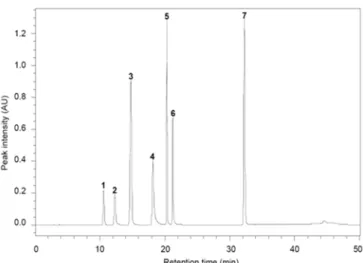
Fig. 2. Typical HPLC chromatogram of phenolic acid standards.
Peak identification: (1) p-hydroxybenzoic acid; (2) vanillic acid; (3) p-hydroxybenzaldehyde; (4) vanillin; (5) trans-p-coumaric acid; (6) trans-ferulic acid; (7) trans-cinnamic acid.
Phenolic compounds are classified as primary or chain-breaking antioxidants based on their mechanisms of antioxidant activities, including electron- or hydrogen-donating, metal-chelating, free radical scavenging, lipoxygenase-inhibiting abilities (Decker EA, 1997).
The radical scavenging capacity and reducing power potential of extracts were positively correlated with the content of total phe- nolic compounds. Vanillic acid, p-hydroxybenzoic, p-hydroxyben- zaldehyde, vanillin, trans-p-coumaric acid, trans-ferulic acid, and trans-cinnamic acid were used for phenolic acid quantification. The representative HPLC profile of selected phenolic standards is sh- own in Fig. 2.
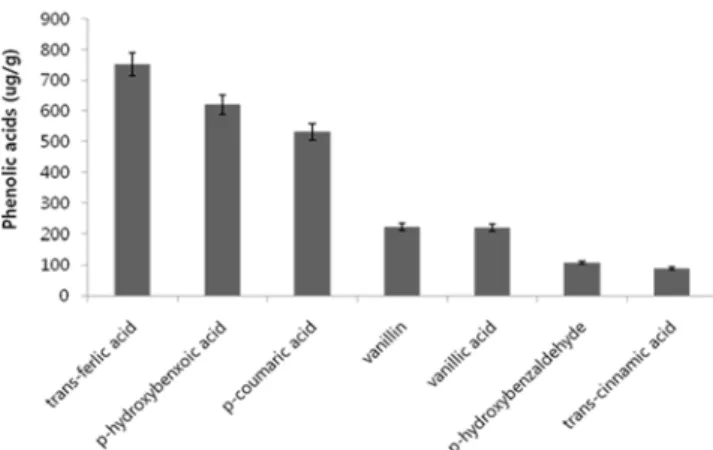
The contents of phenolic acids in natraceutical extracts are sh- own in Fig. 3. The highest amounts of trans-ferulic acid, p-hy- droxybenzoic acid, p-coumaric acid, vanillin, vanillic acid, p- hydroxybenzaldehyde, and trans-cinnamic acid were observed in the naturaceutical extract at the levels of 750.79, 619.75, 531.34, 222.04, 219.28, 107.40, and 89.56 g/g, respectively. Phenolic acids are classified as hydroxybenzoic acids (salicylic, gallic, and vanillic Table 2. DPPH radical scavenging activity of the natraceuticals extracts
Concentration(μg/mL)
200 400 600 800 1,000
DPPH radical
scavenging activity(%)
a18.77±0.68
a30.58±0.47
a57.32±0.17
a76.27±0.31
a82.35±0.5
a