Startup Engineering Education Programs in Niigata University: How to Integrate Knowledge to Solve Engineering Problems
Kazuaki Yamagiwa*,†․ Yuji Tanabe**․ Shuji Harada***․ Tadaaki Shimizu*․ Tetsuo Oka****
****Department of Chemistry and Chemical Engineering, Niigata University
****Department of Mechanical and Production Engineering, Niigata University
****Department of Material Science and Technology, Niigata University
****Education Center for Engineering and Technology, Niigata University
ABSTRACT
Faculty of engineering, Niigata University has been executing start-up engineering education programs for the first-year students to educate his or her ability to solve engineering problems. They are divided into teams and tackle a task that they expect to easily accomplish. The expected results are hardly obtained. Then they try to seek the gap between the results and their knowledge.
They analyze the phenomena and improve the approach. They evaluate the results of second trial and the effectiveness of the measures. That is, the project requires so-called PDCA cycles for students to solve engineering problems. The start-up engineering project is one of the compulsory subjects and seven departments have given the students several tasks based on their technicality.
The students exchange their knowledge, ideas and learn how to use knowledge to solve the problems. Their reports and questionnaire survey proved that the projects are highly effective to improve his or her ability to solve engineering problems and give them strong motivation to learn engineering. We introduce the some tasks and the outcomes of the projects set by seven departments; mechanical and production engineering, electrical and electronic engineering, information engineering, biocybernetics, chemistry and chemical engineering, civil engineering and architecture, and material science and engineering.
Keywords: Start-up engineering education, Engineering design, Self-evaluation
I. Introduction
1)First-year students begin their study in their university after successfully passing the entrance exams in Japan.
Through their study from primary school, they have been trained to answer or select a correct answer. Machine- graded exams they had to take to enter a university tends to engraft in their mind that there always is one correct answer and all they have to learn is how to properly select the correct answer. Most of the students seem to recognize that learning is memorizing the easiest way to select a correct answer. In addition, high school students learn science such as mathematics, physics and chemistry, and are trained to solve scientific problems or calculations
Received 4 October, 2011; Revised 12 June, 2012 Accepted 10 September, 2012
† Corresponding Author: [email protected]
using formulas. Science is essential disciplinary field, of course, but many assumptions and simplifications are not dispensable to solve scientific problems. In the motion of a body, for an example, the size and shape of the body and the friction with the surrounding air are ignored to calculate the trajectory of the body. The simplified con- ditions are essential in science, but mean that the problems are not realistic. In this sense, first-year students have been studied in idealized virtual reality.
Engineering is the application of scientific and mathe- matical principles to practical ends such as the design, manufacture, and operation of materials, products, machines, production processes and systems. Students in the faculty of engineering begin their study in their university to apply scientific and mathematical principles to practical ends, that is, to real world. In other words, students learn how to solve problems from engineering point of view in addition
to scientific point of view. Experiences and technical skills are essential to implement thoughts and ideas to the real world. It may not be difficult those students who have various experiences in making something or hammer out some real problems leaving from textbook knowledge and formulas. But it will be difficult to those students who try to understand through memorizing textbook knowledge and formulas in heart. There are gaps between the memorized textbook knowledge and formulas and their application to the real world. Most engineering education programs in Japan seem found the difficulties in education of their students, which seemed to be arisen from these gaps. The increase in such students, lots of memorized knowledge but less of real experience, may be one of the reasons why engineering education become difficult.
The key point would be the dissociation of knowledge and experience. Thus, start-up engineering education that connect knowledge and experience, connect physically idealized and the real worlds will be effective for the whole engineering education not only in the university but in his or her engineering career.
Faculty of Engineering, Niigata University has been executing start-up engineering education programs for the students to educate his or her ability to solve engineering problems [1]. The first-year students tackle with some tasks, from which they recognize the real restrictions and conditions to be taken into account to attain their goals.
The 2nd- and 3rd-year students develop their engineering skills through their seminars and experimentations. The 4th-year students help the first-year students by advising them, and then perform their research project as a capstone engineering project. The outcomes and problems in the first year projects are presented and discussed.
II. Start-up Engineering Projects in Niigata University
1. Introductory Project for First-Year Students
Each department prepares compulsory subjects
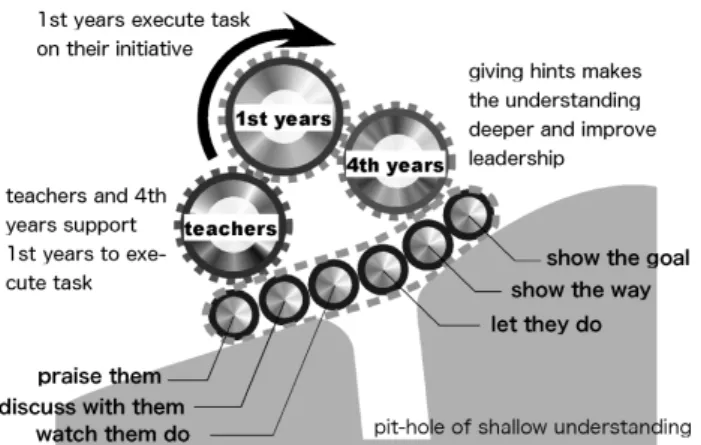
“Introduction to Engineering Literacy”. The feature of first years’ project is conceptually illustrated in Fig. 1.
Fig. 1 Conceptual presentation of first years’ project
First-year students play the leading role, but their skills are insufficient to accomplish the task. Teachers and 4th-year students support the first-years to execute the project. The Caterpillar shown in the figure symbolizes the guiding principle: show the goal, show the way, and let them do, watch them do, discuss with them, and praise them. The Caterpillar also supports the first-years to solve the engineering tasks, and prevent the first-years not to fall into gaps between the scientifically simplified and real worlds.
The tasks set by the departments are the first en- gineering project, and are based on the knowledge and skills they learned in his or her high school. In the be- ginning of projects, teachers show the goals and that the task goals are attainable. The first-year students tackle the tasks on their own initiative. Teachers watch the students do and are not supposed to show the neither correct answer nor procedure. The 4th-year students are also not supposed to give the first-years direct answers of their questions. Instead, they give the first-year students hints such as what is to be taken into account, how to find the reference books, and so on. Teachers select the tasks that seem easy to be done but contain some critical conditions that are simplified or ignored in high-school textbooks and are taken into account to attain the goals.
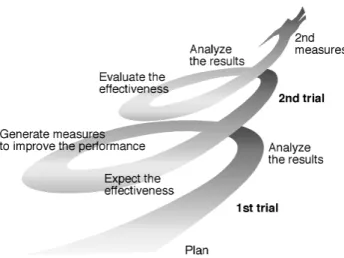
The first-year students hardly get the results they expected in the first trials. They discuss the reason with other students and generate some measures to improve their results. Most projects or experimentations in other uni- versities and high schools end at this stage. But they are
Fig. 2 Two PDCA cycles in the project.
insufficient because the measures the students made for the improvement of the results are not experimentally verified. The first-year students perform the second trials and quantitatively evaluate the effectiveness of the measures. Then, they can generate more effective measures to attain much better results or goals. Thus, the first-year students notice the simplified or ignored conditions in the textbook, and restrictions in the real situations. They share the viewpoints, ideas, and skills with others during the projects. In other words, they use their knowledge to overcome the difficulties to attain the goals. They perform two or more trials. This means that they perform ca-called PDCA cycle twice or more, as shown in Fig. 2. They will realize that the important point is not memorize knowledge in hart but integrate knowledge to solve the problems. This is large paradigm shift for the first-year students. Teachers encourage them with praise during the project. The most important point of the project is that first-year students can evaluate their measures to improve the first results and generate second measures based on the evaluation. This engraft in the students’ mind that engineering approach is repetitive improvement rather than nonce measure.
2. Evaluation of Problem-Solving Ability from Engineering Point of View
For first-year students, key factors to solve engineering
problems are analysis, synthesis and evaluation. Analysis breaks complex engineering problems down to elementary parts, and indicates what is the main problem and what field of knowledge can be applied to. Synthesis means the integration of knowledge to generate options to solve an engineering problem. Evaluation means rating the causes and options based on logical reasoning. The en- gineering ability of students can be assessed with these three factors.
We propose PPP evaluation to assess problem-solving ability from engineering point of view. The PPP evaluation consists of three elements: Purpose, Process, and Performance.
- ‘Purpose’ means the appropriateness of targets set by students to solve engineering problems. Appropriate targets can be derived from the analysis of problem they faced, and can deduce effective approaches. The ability to set purpose may be assessed by the process through which students identify the key points of the problem.
- ‘Process’ consists of following steps: generation of options or measures to meet the targets, characterization of options that is done by listing up advantages and disadvantages, prioritize the conditions or restrictions applied to the engineering solution, rating the expected effectiveness of the options and screening the most effective options.
- ‘Performance’ means the rational evaluation of the measures applied and the approach itself. Rational reasoning of unexpected results and generation of countermeasures to cope the unexpected problems are also significant factors of ‘Performance.’
III. Tasks Set by the Departments
Faculty of Engineering, Niigata University has seven departments: mechanical and production engineering (M), electrical and electronic engineering (E), information en- gineering (I), biocybernetics (F), chemistry and chemical engineering, civil engineering and architecture (K), and material science and engineering (S). Some examples of
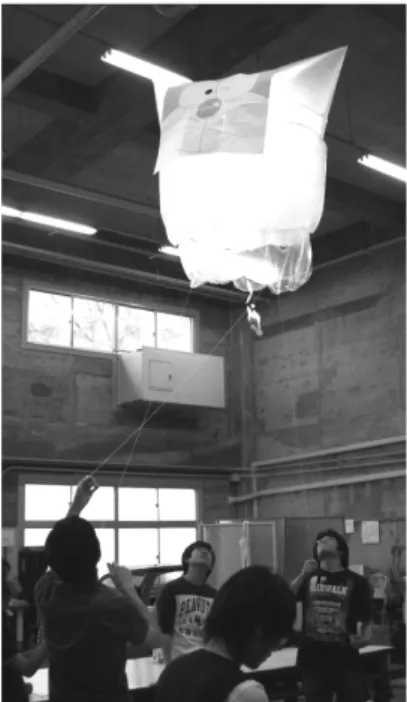
Fig. 3 Handmade balloon
the subject “Introduction to Engineering Literacy” set by each department are as follows:
- Handmade hot-air balloon Fig. 3 (M)
- Energy-conversion from mechanical output of pedaling a bicycle into frictional heat to boil water (M)
- Measurement of Lorentz force (E) - Making up a circuit tester (E)
- Embedded software practice using Lego NXT (I) - Manufacture of “voice output communication aids” (F) - Design and making up of paper bridges (K)
- Remedial design of traffic and transit in downtown Niigata (K)
- Mechanism of handmade brush motors (S)
- How to measure oxygen concentration in water (S)
IV. Experiences in the Department of Chemistry and Chemical Engineering
1. Tasks and Results
The number of first-year students is about 80. They are divided into 20 teams. Two teams executed the same projects. Ten projects are listed as follows:
Projects in applied chemistry field - Synthesis of fluorescent material - of ferrite
- of acid concentration of commercial vinegar - of drug compound by chromatography - of polyethylene terephthalate
Projects in chemical engineering field - of osmotic pressure with handmade cell - of temperature with various thermometers - of alum crystal
- hydrogen-oxygen fuel cell - of thickening agent
Each team executed one of the applied chemistry projects and one of the chemical engineering ones. Each project consisted on 5 classes: 1st class) demonstration and explanation, 2nd) first trial, 3rd) first evaluation, 4th) second trial, 5th) second evaluation and report making.
The experimentations are designed to be done within one class (90 min). In the case of fuel cell project, however, one trial is possible because three classes are needed to construct an electrolysis cell. The outlines of two projects are described below.
A. Formation of Alum Crystal
The goal is to make a ‘beautiful’ alum crystal. Beautiful photographs of alum crystal may give the students the impression that the crystal shape is universal and beau- tiful crystals are spontaneously formed. But they usually have aggregations of small crystals. They realize that crystallization is not spontaneous process but influenced with various conditions such as concentration, temperature, existence of impurities and so on. They will learn crys- tallization in the subject “Diffusional Operation III” at the first semester of 3rd-grade.
B. Measurement of Temperature with Various Ther- mometers
Students believe that accurate temperature can readily be measured only if they immerse an alcohol thermometer into a liquid to be measured, and also that only one
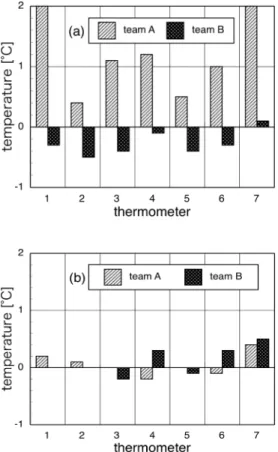
measured value is obtained regardless of what kind to thermometer he or she used. However, they find that the measured values are different depending not only on the types of thermometer but also on themselves when they use the same alcohol thermometer. Some students dis- closed that the task seemed very easy to done but the results confused them. Students discuss why the results differed from what they expected with each other and with the other team. Many causes are thought of, discussed, evaluated to give major possible causes. They try to get more accurate measured value in the second trial. Fig. 4 shows an example of measurement results of temperature of ice-cooled water. The temperatures measured by team A were above 0°C and differed depending on thermometer type while those by team B were below 0°C and less
Fig. 4 Temperature of ice-cooled water. (a) 1st trial, (b) 2nd trial. (1. alcohol thermometer, 2. Mercury-in- glass thermometer, 3. standard thermometer, 4.
thermocouple type K (diam. 1.6 mm), 5. thermocouple type K (diam. 3.2 mm), 6. resistance thermometer, 7. thermistor)
scattered in the first trial. After the discussion, both teams got little difference in measured value regardless of the type of thermometers and team. All measured values were fallen within very narrow range. The students learned that many real conditions, such as heat transfer to or from the thermometer, should be taken into account to give accurate results.
C. Outcomes and Problems
Questionnaire survey was carried out after the final class, in which presentations of the all tasks were held.
“The experimentations held in the high school days were to verify what the textbook described. Good performance meant how close the results were to the written knowl- edge,” from comments on the tasks, “But the present tasks require us to consider the causes and measures to improve the results. It was quite interesting in using knowledge. I actually felt that I was doing research, not doing instructed work just like experimentations at high school.” The key point is to select tasks that the students think they can do without requiring unlearned advanced knowledge, and that some unsolved problems are left after the second trial. Moderate incomprehensibility is essential for strong motivation for the future study. Another key point is to shear ideas and knowledge among the team members during discussions. Group discussions can com- pensate the shortage in experience and skills of the student to solve engineering problems to a certain extent. Thus, our new projects are proved effective to start up engineering education of students with less engineering experiences and skills.
The first open-ended project “Introduction to Engineering Literacy” is effective to shift the first-year students’
paradigm from “answer is what is to be properly selected from given options” to “optimal solution is what is to be properly selected from generated measures.” But, they still want to know immediately that their selected measure is correct or incorrect. And they believe that a study-aid book or a reference book will give them the correct answer immediately. They should undergo training in keeping consideration to solve the problems. The paradigm will be shifted during exercises and experimentations in
2nd and 3rd years, and finally through project research in 4th year. The startup engineering education was proven effective. Successive engineering education is also important in 2nd-, 3rd- and 4th-year students to integrate technical knowledge to solve engineering problem.
V. Conclusion
Some teachers say that problem-solving ability of first- year students is gradually getting worse in recent years.
But this project has proved that this comment is not true.
First-year students have been trained to memorize knowl- edge and to solve questions for their entrance examinations, but not trained to integrate knowledge of various fields to solve open-ended problems. They are not less talented but only less trained to solve engineering problem. The startup engineering education programs in Niigata University are quite effective in making their eyes open to ‘engineering’
- knowledge integration to synthesize various solutions to meet practical problems. The following professional education should be properly designed to keep their mo- tivation high for engineering and to skill up their en- gineering ability.
Reference
1. K. Yamagiwa, Y. Tanabe, S. Harada, T. Shimizu and T.
Oka, Start-up engineering programs for first year students, Proc. 12th WCCEE, Singapore, 345-352 (2010).
Yamagiwa, Kazuaki Phone: +81-25-262-6785 Fax: +81-25-262-6785
E-mail: [email protected]