• 검색 결과가 없습니다.

Stress-induced Cardiomyopathy during Pulmonary Resection (Takotsubo Syndrome)

N/A
N/A
Protected

Academic year: 2021

Share "Stress-induced Cardiomyopathy during Pulmonary Resection (Takotsubo Syndrome)"

Copied!
4
0
0

로드 중.... (전체 텍스트 보기)

전체 글

(1)

Korean J Thorac Cardiovasc Surg 2011;44:294-297 □ Case Report □ DOI:10.5090/kjtcs.2011.44.4.294 ISSN: 2233-601X (Print) ISSN: 2093-6516 (Online)

− 294 −

*Department of Thoracic and Cardiovascular Surgery, College of Medicine, Chungnam National University Hospital Received: September 30, 2010, Revised: April 11, 2011, Accepted: May 31, 2011

Corresponding author: Seung Pyung Lim, Department of Thoracic and Cardiovascular Surgery, College of Medicine, Chungnam National University Hospital, 282, Munhwa-ro, Jung-gu, Daejeon 301-721, Korea

(Tel) 82-42-280-7374 (Fax) 82-42-280-7373 (E-mail) [email protected]

C

The Korean Society for Thoracic and Cardiovascular Surgery. 2011. All right reserved.

CC
This is an open access article distributed under the terms of the Creative Commons Attribution Non-Commercial License (http://creative- commons.org/licenses/by-nc/3.0) which permits unrestricted non-commercial use, distribution, and reproduction in any medium, provided the original work is properly cited.

Stress-induced Cardiomyopathy during Pulmonary Resection (Takotsubo Syndrome)

− A case report −

Seokkee Lee, M.D.*, Seung Pyung Lim, M.D., Ph.D.*, Jae-Hyeon Yu, M.D., Ph.D.*, Myung Hoon Na, M.D., Ph.D.*, Shin-Kwang Kang, M.D.*,

Min-Woong Kang, M.D., Ph.D.*, Hyun Kong Oh, M.D.*

Stress-induced cardiomyopathy is caused by emotional or physical stressors and mimics acute myocardial infarction, though Stress-induced cardiomyopathy is characterized by reversible left ventricular (LV) apical ballooning in the ab- sence of significant coronary artery disease. We describe a 51-year-old male who underwent left upper lobectomy for non-small cell lung cancer, and during which cardiogenic arrest occurred due to stress-induced cardiomyopathy, successfully managed by intra-aortic balloon pumping and extracorporeal membrane oxygenation.

Key words: 1. Cardiomyopathy

2. Extracorporeal membrane oxygenation 3. Lobectomy

CASE REPORT

A 51-year-old male patient had been diagnosed with squ- amous carcinoma, stage IIIa, two months prior, had twice been treated with cisplatin and gemcitabine combination che- motherapy, and was admitted for left upper lobe resection.

Diabetes and hypertension were not detected in the medical history. At the time of admission, the blood pressure was 125/70 mmHg, heart rate was 64 beats/minute, respiration rate was 20 breaths/minute, and body temperature was 36

o

C.

Plain chest radiography and chest computed tomography re- vealed a 2.9-cm tumor in the left upper lobe. An electro- cardiogram was normal, and no abnormal findings were de- tected in blood tests. The thoracic cavity was approached via left posterolateral thoracotomy. Since adhesion of the pleura

was severe, the adhesion was removed. Cardiac arrest oc- curred while dissecting the adhesion of the left lower lobe, immediately after the increase of the ST segment on electro- cardiogram as well as the development of hypotension (60/40 mmHg) and bradycardia (40 beats/minute), after separating the vein and artery branching as well as the bronchus.

Inotropics were used, and an intra-aortic balloon pump (Datascope

®

) was inserted via the left femoral artery while performing cardiac massage by pericardiotomy. After the in- sertion of an intra-aortic balloon pump, the heart rate recov- ered to a normal sinus rhythm, the blood pressure was 100/60 mmHg, and the arterial oxygen saturation level was 100%.

After wound closure, surgery was completed, and the pa-

tient was transferred to the intensive care unit. After trans-

ferring to the intensive care unit, the patient remained stable

(2)

Stress-induced Cardiomyopathy during Pulmonary Resection (Takotsubo Syndrome)

− 295 −

Fig. 2. (A) Postoperative echocardiography shows apical ballooning (arrow). (B) Normalized echocardiography at discharge.

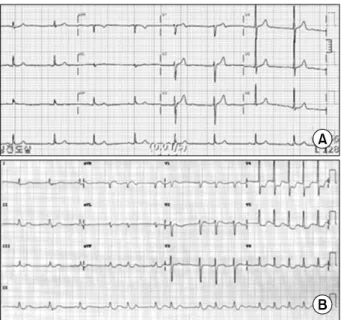
Fig. 1. (A) Preoperative normal electrocardiography. (B) Postopera- tive electrocardiography shows ST-segment depression in V4, V5, V6, lead II, lead III.

for 10 minutes, cardiac arrest occurred simultaneously with a decrease in the ST segment on the electrocardiogram (Fig. 1).

Thus, while performing cardiopulmonary resuscitation, an ex- tracorporeal membrane oxygenator (Medtronic centrifugal Bio-pump

®

) was inserted into the right femoral artery and the vein by the Seldinger technique using a 17 Fr catheter and a 21 Fr catheter, and vital signs were stabilized. Afterward, echocardiography was performed, revealing apical ballooning

and severe dysfunction of the left ventricle (Fig. 2A). An emergency coronary artery angiogram was performed, and it was normal with the exception of 30% stenosis in the left an- terior descending coronary artery (Fig. 3A, B). The creatine kinase (CK) level was 2,976 U/L, creatine kinase MB (CK-MB) was 174 ng/mL, and troponin I was elevated to 26 ng/mL. Stress induced cardiomyopathy was diagnosed. Once vital signs were stabilized, catecholamine was terminated. 26 hours after surgery, the extracorporeal membrane oxygenator was removed. 48 hours after surgery, the intra-aortic balloon pump was removed. 3 days after surgery, blebs, edema, and discoloration were detected in the right extremities, and thus a peripheral angiogram was performed (Fig. 3C). Compart- ment syndrome was diagnosed and a fasciotomy was perfor- med. 4 days after the surgery, CK was 18,000 U/L, CK-MB was 73 ng/mL, and troponin I was reduced to 4.5 ng/mL.

The artificial ventilator was removed 6 days after surgery.

The patient was transferred to a general ward 11 days after surgery. The fasciotomy wound was sutured and the patient was discharged 20 days after surgery. At the time of dis- charge, echocardiography showed normal findings (Fig. 2B).

Currently, the patient has received follow-up care for one year and six months without significant complications.

DISCUSSION

Stress-induced cardiomyopathy was first reported by Dote

(3)

Seokkee Lee, et al

− 296 −

Fig. 3. (A) Coronary angiography shows the normal right coronary artery. (B) Coronary angiography shows minimal stenosis of the left an- terior descending artery. (C) Peripheral angiography shows the patent’s posterior tibial artery and peroneal artery.

et al. in Japan in 1990. It is an idiopathic disease which de- velops symptoms similar to acute coronary artery syndrome, such as chest pain, dyspnea, hypotension, and abnormal elec- trocardiogram, and is a reversible disease without significant stenosis on coronary artery angiogram [1].

Since the apical area of the left ventricle is characteristi- cally balloon-shaped and similar to the Takotsubo, a jar used for catching octopus in Japan, it is also referred to as Takotsubo cardiomyopathy. It is also referred to by other terms such as neurogenic myocardial stunning, stress car- diomyopathy, stress-induced cardiomyopathy, transient left ventricular apical ballooning, ampulla cardiomyopathy, and broken heart syndrome.

Although its causes have not been elucidated, considering that in cases in which catecholamine is elevated due to se- vere psychological or physical stress or pheochromocytoma, deterioration of myocardial function may be associated, and an association with the elevation of catecholamine has been suspected [2,3].

Takotsubo cardiopathy is diagnosed by echocardiography and coronary artery angiography. It may be diagnosed if the deterioration of left ventricular function such as severe hypo- kinesia, akinesia, dyskinesia, apical ballooning in the middle ventricle and the apex of the heart is detected by echo- cardiography, and the coronary artery angiogram is normal [2]. The cardiac enzymes CK and CK-MB are temporarily elevated, the CK-MB/total CK ratio is not higher than 10%, and cardiac enzyme levels return to normal within 1 week.

There may be an associated elevation of troponin I. In our case, cardiac enzymes were elevated, and 2 weeks after sur- gery, the value of CK-MB and troponin I became normal [4].

Takotsubo cardiopathy can be completely cured by con- servative treatment. Our patient was a severe case associated with cardiac arrest, and thus an extracorporeal membrane oxygenator as well as an intra-aortic balloon pump were required. In addition, in patients with left ventricular outflow track obstruction, elevation of catecholamine, an insufficient volume of body fluid, and vascular relaxation may cause con- ditions to deteriorate, and thus the maintenance of the appro- priate volume of body fluid and the proper use of pure alpha agents should be considered [4,5].

It has been reported that most patients show good prog- nosis, the recurrence rate is 3.1%, and the in-hospital mortal- ity rate is 1.7% [1]. Left ventricular function returns to nor- mal within 1 to 4 weeks, and the risk for sudden death has not been identified [4,5].

We reported a case of stress-induced cardiomyopathy de-

veloped during pulmonary resection in a lung cancer patient

who showed severe clinical features and developed cardiac

arrest. The patient was treated with an extracorporeal mem-

brane oxygenator and an intra-aortic pump in the early

period.

(4)

Stress-induced Cardiomyopathy during Pulmonary Resection (Takotsubo Syndrome)

− 297 − REFERENCES

1. Pilgrim TM, Wyss TR. Takotsubo cardiomyopathy or tran- sient left ventricular apical ballooning syndrome: a system- atic review. Int J Cardiol 2008;124:283-92.

2. Mishra AK, Agarwal G, Kapoor A, Agarwal A, Bhatia E, Mishra SK. Catecholamine cardiomyopathy in bilateral ma- lignant pheochromocytoma: successful reversal after surgery.

Int J Cardiol 2000;76:89-90.

3. Wittstein IS, Thiemann DR, Lima JA, et al. Neurohumoral

features of myocardial stunning due to sudden emotional stress. N Engl J Med 2005;352:539-48.

4. Akashi YJ, Nakazawa K, Sakakibara M, Miyake F, Koike H, Sasaka K. The clinical features of takotsubo cardiomyopathy.

QJM 2003;96:563-73.

5. Tsuchihashi K, Ueshima K, Uchida T, et al. Transient left

ventricular apical ballooning without coronary artery steno-

sis: a novel heart syndrome mimicking acute myocardial in-

farction. Angina Pectoris-Myocardial Infarction Investigati-

ons in Japan. J Am Coll Cardiol 2001;38:11-8.

수치

Fig. 1. (A) Preoperative normal electrocardiography. (B) Postopera- Postopera-tive electrocardiography shows ST-segment depression in V4, V5,  V6, lead II, lead III.
Fig. 3. (A) Coronary angiography shows the normal right coronary artery. (B) Coronary angiography shows minimal stenosis of the left an- an-terior descending artery

참조

관련 문서

T2 mapping sequences are useful for the detection of myocardial edema in patients with acute myocardial infarction (AMI) (22), myocarditis (23, 24), stress cardiomyopathy

Stress induced cardiomyopathy (SC) is characterized by transient left ventricular (LV) dysfunction in the absence of coronary artery disease.. We report on a

Stress Induced Cardiomyopathy Requiring Ventricular Assist Device Support in an 8-Year-Old Girl with Acute Leukemia.. Sang Hee Park 1 , Mi Kyoung Song 1, *, Gi Beom Kim 1 , Eun

Takotsubo cardiomyopathy, which is also known as “tran- sient apical ballooning”, is a cardiac syndrome associated with emotional and physical stress that occurs in postmenopausal

To our knowledge, this is the first Korean case of acute CO poisoning induced acute heart failure complicated with LV thrombus. However, stress induced cardiomyopathy associated

To date, the true incidence and clinical significance of LV thrombus and the related embolic outcomes in patients with stress-induced cardiomyopathy have not been fully estab-

Tako-Tsubo cardiomyopathy (TTC), also known as transient left ventricular apical ballooning syndrome or stress-induced cardiomyopathy, is a novel reversible cardiomyopathy

Atypical forms of stress-induced cardiomyopathy (as in the present case) cannot be adequately interpreted in the context of this theory, although individual variations in terms