• 검색 결과가 없습니다.

Tako-Tsubo Cardiomyopathy Triggered by MisdirectionZiad Dahdouh, MD

N/A
N/A
Protected

Academic year: 2022

Share "Tako-Tsubo Cardiomyopathy Triggered by MisdirectionZiad Dahdouh, MD"

Copied!
3
0
0

로드 중.... (전체 텍스트 보기)

전체 글

(1)

479

Print ISSN 1738-5520 / On-line ISSN 1738-5555 Copyright © 2011 The Korean Society of Cardiology CASE REPORT

http://dx.doi.org/10.4070/kcj.2011.41.8.479

Open Access

Tako-Tsubo Cardiomyopathy Triggered by Misdirection

Ziad Dahdouh, MD

1

, Julien Wain-Hobson, MD

1

, Vincent Roule, MD

1

, Houaida Dahdouh, MD

2

, Fabien Labombarda, MD

1

, Tony Abdel-Massih, MD

3

, Antoine Sarkis, MD

3

, and Gilles Grollier, MD

1

1

Cardiology Department, University Hospital of Caen, Caen, France

2

Pediatric Department and

3

Cardiology Department, Hôtel Dieu de France Hospital, Achrafieh, Beirut, Lebanon

ABSTRACT

Tako-Tsubo cardiomyopathy (TTC), also known as transient left ventricular apical ballooning syndrome or stress-induced cardiomyopathy, is a novel reversible cardiomyopathy mimicking acute myocardial infarction without epicardial coronary ar- tery disease. The exact physiopathology of TTC remains unclear. It is usually precipitated by acute physical or emotional stress and it most commonly affects postmenopausal women. The growing number of clinical cases of TTC have demonstrat- ed a wide field of possible etiologies beyond the emotional stress. We report a case of a 67-year-old postmenopausal woman who was being supplemented by enteral feeding via a nasogastric tube and who developed TTC due to misdirection, probably favored by the mechanical blockade by the nasogastric tube, while swallowing the drug pills. (Korean Circ J 2011;41:479-481) KEY WORDS: Tako-tsubo cardiomyopathy; Misdirection; Malnurition.

Received: February 22, 2011 Revision Received: March 30, 2011 Accepted: March 31, 2011

Correspondence: Ziad Dahdouh, MD, Cardiology Department, Univer- sity Hospital of Caen, Avenue Cote de Nacre 14033 Caen, France Tel: 33 6 29 36 22 32, Fax: 33 9 57 20 80 76

E-mail: [email protected]

• The authors have no financial conflicts of interest.

cc
This is an Open Access article distributed under the terms of the Cre- ative Commons Attribution Non-Commercial License (http://creativecom- mons.org/licenses/by-nc/3.0) which permits unrestricted non-commer- cial use, distribution, and reproduction in any medium, provided the origi- nal work is properly cited.

Introduction

Tako-Tsubo cardiomyopathy (TTC) is a reversible cardio- myopathy mimicking acute myocardial infarction. It most commonly affects postmenopausal women and is characteriz- ed by a transient left ventricular (LV) apical ballooning with- out epicardial coronary artery disease.

1)

It is clinically charac- terized by acute chest pain or dyspnea in most cases and tr- ansient ST elevation in the acute phase. Troponin level is often slightly elevated.

The prognosis is generally good.

2)

Severe emotional stress is the most common trigger for this syndrome in the publish- ed cases, but it can also be precipitated by other possible eti- ologies. We present a case of a patient with TTC triggered by misdirection while swallowing the drug pills.

Case

We report the case of a 67-year-old woman with hyperten- sion and no history of coronary disease hospitalized in the Gas- tro-Intestinal department for treatment of severe malnutrition.

Her past medical history was significant for a total gastrecto- my for gastric neoplasia 5 years ago with complete remission.

She was being supplemented by enteral feeding via a naso- gastric tube. She had no history of recent emotional stress.

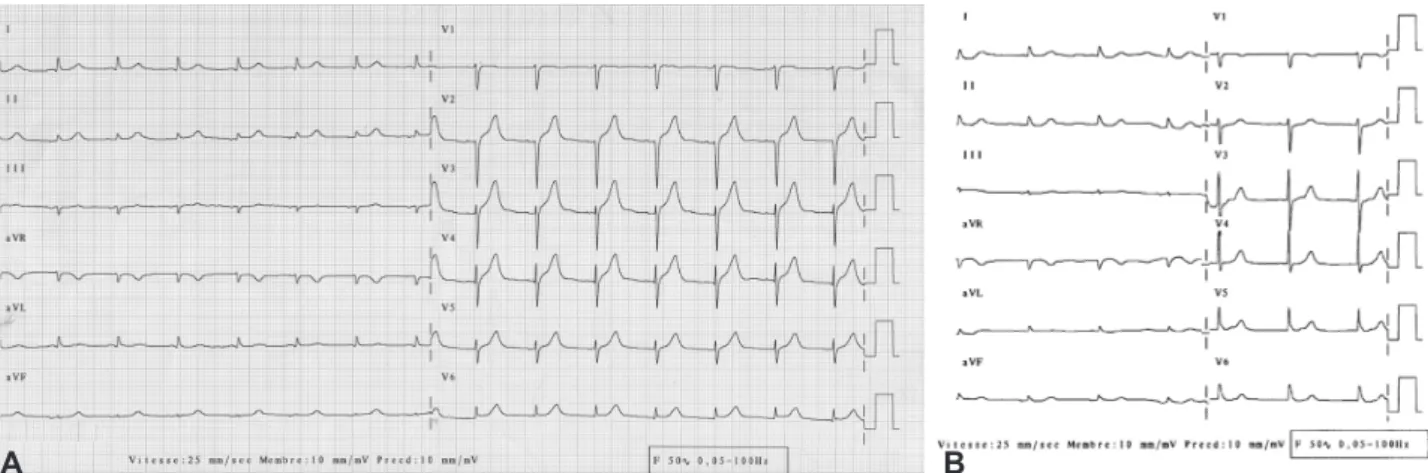
While swallowing the drug pills during hospitalization, she suffered overnight from a misdirection (false route), but due to a hacking cough an inhalation pneumonia was avoided and later she complained of constrictive chest pain. The per-criti- cal electrocardiography (ECG) showed sinus rhythm with an anterior ST-segment elevation (Fig. 1). A diagnosis of an acute myocardial infarction was made and she was taken to the car- diac catheterization laboratory for primary percutaneous coro- nary intervention. The coronary angiography demonstrated a non-obstructive coronary atheroma. The LV angiography confirmed an impaired LV systolic function with akinetic mid and apical segments and hyperkinetic basal segments (Fig. 2).

The cardiac ultrasound showed typical apical ballooning (Fig.

3). The troponin level was elevated to 3 mg/L. An optimal me-

dical treatment including beta-blockers and angiotensin con-

verting enzyme-inhibitors were initiated. The patient evolved

well clinically, the ECG normalized with disappearance of

ischemic ECG changes and the control cardiac ultrasound at

(2)

480 TTC and Misdirection

day six showed a total recovery with a normal LV function.

Discussion

TTC, also known as transient LV apical ballooning syn- drome or stress-induced cardiomyopathy, is a reversible car- diomyopathy mimicking acute myocardial infarction, usually

precipitated by acute physical or emotional stress and most commonly affects postmenopausal women.

1)

The exact phys- iopathology of TTC remains unclear. Catecholamine-mediat- ed cardiotoxicity is the most widely proposed mechanism gi- ven that patients typically present with a preceding history of extreme psychological and/or physical distress implying in- creased sympathetic activity with a direct catecholamine toxic

A B

Fig. 1. A: a per-critical electrocardiogram showing anterior ST-segment elevation. B: normal initial electrocardiogram.

A B

Fig. 2. Left ventricular angiography showing apical ballooning in systole (A) and diastole (B).

A B

Fig. 3. Cardiac ultrasound showing apical ballooning in systole (A) and diastole (B).

(3)

Ziad Dahdouh, et al. 481

effect on the cardiac myocytes.

3)4)

Furthermore, the syndrome is usually self limited and complete recovery can be achieved in two to three weeks. The growing number of clinical cases of TTC have demonstrated a wide field of possible etiologies beyond the emotional stress.

We report a case of a 67-year-old postmenopausal woman who was being supplemented by enteral feeding via a naso- gastric tube and who developed TTC due to misdirection, pro- bably favored by the mechanical blockade by the nasogastric tube, while swallowing the drug pills. It can be argued that misdirection in predisposed individuals may cause an acute stress resulting in increased sympathetic activity leading to this syndrome. In our patient, another potential causal mech- anism could be cough-induced stress cardiomyopathy which

has been previously reported.

5)

REFERENCES

1) Kurisu S, Sato H, Kawagoe T, et al. Tako-tsubo-like left ventricular dysfunction with ST-segment elevation: a novel cardiac syndrome mi- micking acute myocardial infarction. Am Heart J 2002;143:448-55.

2) Madhavan M, Prasad A. Proposed Mayo Clinic criteria for the diagno- sis of Tako-Tsubo cardiomyopathy and long-term prognosis. Herz 2010.

3) Wittstein IS, Thiemann DR, Lima JA, et al. Neurohumoral features of myocardial stunning due to sudden emotional stress. N Engl J Med 2005;352:539-48.

4) Nef HM, Möllmann H, Hilpert P, et al. Sympathoadrenergic over- stimulation in Tako-Tsubo cardiomyopathy triggered by physical and emotional stress. Int J Cardiol 2008;130:266-8.

5) Butman SM. Coughing-induced stress cardiomyopathy. Catheter

Cardiovasc Interv 2010;76:388-90.

수치

Fig. 1. A: a per-critical electrocardiogram showing anterior ST-segment elevation. B: normal initial electrocardiogram.

참조

관련 문서

The definition of CO-induced CMP is: (1) transient hypokinesia, akinesia, or dyskinesia of the left ventricular (LV) mid-segments with or without apical involvement after

A case of takotsubo cardiomyopathy caused by severe hyponatremia with underlying coronary artery-left ventricular fistulae.. Department of Cardiology, Kyung Hee

Stress induced cardiomyopathy (SC) is characterized by transient left ventricular (LV) dysfunction in the absence of coronary artery disease.. We report on a

Takotsubo cardiomyopathy (TTC) is characterized by transient wall-motion abnormalities which are completely recovered within 1 month in usual. 1)2) Although there have been several

Takotsubo cardiomyopathy, which is also known as “tran- sient apical ballooning”, is a cardiac syndrome associated with emotional and physical stress that occurs in postmenopausal

Stereotactic Cardiac Radiation to Control Ventricular Tachycardia and Fibrillation Storm in a Patient with Apical Hypertrophic Cardiomyopathy at Burnout Stage: Case

end-diastolic echocardiogram, showing flow acceleration in the left ventricular outflow tract. C: continuous wave Doppler ultra- sound showing a left ventricular outflow tract

Occurrence of late gadolinium enhancement is associated with increased left ventricular wall stress and mass in patients with non-ischaemic dilated cardiomyopathy.. Alter P, Rupp