우리나라 도심지에서의 저장열 산출에 관한 연구
이다래*, 김홍희*, 이상현**, 이두일**, 홍진규***, 홍제우***, 이근민***, 이경상*, 서민지*, 한경수*†
*부경대학교 지구환경시스템과학부 공간정보시스템공학과, **공주대학교 자연과학대학 대기과학과,
***연세대학교 대기과학과
A Study on Retrieval of Storage Heat Flux in Urban Area
Darae Lee*, Honghee Kim*, Sang-Hyun Lee**, Doo-Il Lee**, Jinkyu Hong***, Je-Woo Hong***, Keunmin Lee***, Kyeong-sang Lee*, Minji Seo* and Kyung-Soo Han*†
*Division of Earth Environmental System Science (Major of Spatial Information Engineering), Pukyong National University
**Department of Atmospheric Science, Kongju National University, Gongju, Korea
***Ecosystem-Atmosphere Process Laboratory, Department of Atmospheric Sciences, Yonsei University, Seoul, South Korea
Abstract : Urbanization causes urban floods and urban heat island in the summer, so it is necessary to understanding the changes of the thermal environment through urban climate and energy balance. This can be explained by the energy balance, but in urban areas, unlike the typical energy balance, the storage heat flux saved in the building or artificial land cover should be considered. Since the environment of each city is different, there is a difficulty in applying the method of retrieving the storage heat flux of the previous research. Especially, most of the previous studies are focused on the overseas cities, so it is necessary to study the storage heat retrieval suitable for various land cover and building characteristics of the urban areas in Korea. Therefore, the object of this study, it is to derive the regression formula which can quantitatively retrieve the storage heat using the data of the area where various surface types exist.
To this end, nonlinear regression analysis was performed using net radiation and surface temperature data as independent variables and flux tower based storage heat estimates as dependent variables. The retrieved regression coefficients were applied to each independent variable to derive the storage heat retrieval regression formula. As a result of time series analysis with flux tower based storage heat estimates, it was well simulated high peak at day time and the value at night. Moreover storage heat retrieved in this study was possible continuous retrieval than flux tower based storage heat estimates. As a result of scatter plot analysis, accuracy of retrieved storage heat was found to be significant at 50.14 Wm-2and bias -0.94 Wm-2.
Key Words : Storage heat flux, Net radiation, Land surface temperature, Energy balance
Korean Journal of Remote Sensing, Vol.34, No.2-1, 2018, pp.301~306
http://dx.doi.org/10.7780/kjrs.2018.34.2.1.12 ISSN 1225-6161 ( Print )
ISSN 2287-9307 (Online)
Letter
Received December 22, 2017; Revised December 27, 2017; Accepted December 28, 2017; Published online March 5, 2018
†Corresponding Author: Kyung-Soo Han ([email protected])
This is an Open-Access article distributed under the terms of the Creative Commons Attribution Non-Commercial License (http://creativecommons. org/licenses/by-nc/3.0) which permits unrestricted non-commercial use, distribution, and reproduction in any medium, provided the original work is properly cited.
1. 서 론
전 세계적으로 도시화 율은50%에 육박하고 있으며, 우리나라는80% 이상의 매우 높은 도시화를 보여 준다 (Kim et al., 2016). 또한 높은 도시화는 여름철 도시형 홍수, 도시 열섬 등을 야기 시키기 때문에 이러한 문제를 해 결하기 위해서는 도시의 기후 및 에너지 균형을 통한 열 환경 변화의 정확한 파악이 필요하다(Kim et al., 2016).
일반적인 에너지 균형의 변화는 에너지 수지를 통해 설 명될 수 있으며, 에너지 수지는 식 (1)로 정의된다.
Rn= H + G0+ LE (Wm-2) (1) 여기서Rn은 순복사, H은 현열, G0은 지열, LE은 잠열 을 의미한다. 하지만 도심지의 경우 도시화가 진행됨에 따라 도로나 건물 등으로 인해 불투수성 인공 피복으로 변화하기 때문에 비도심지에 비해 지표에 저장되는 열 에너지의 양이 증가하게 되며, 밀집된 건물의 영향으로 장·단파 복사 에너지 갇힘 현상에 의한 흡수·방출되는 열에너지의 양이 증가한다(Ryu and Baik, 2010). 이러한 현상은 최근 도시지역에서 많이 발생하고 있는 도시 열 섬 현상의 중요한 원인이 되고 있다. 따라서 도심지에 서의 에너지 수지 식은 인간의 활동 및 인위적인 원인 에 의해 발생되는 열에너지를 고려할 수 있는 항이 추 가된 식(2)와 같이 정의될 수 있다.
Rn+ Qf= H + LE + ΔQs+ Qa(Wm-2) (2) Qf는 인간활동에 의한 열 배출 플럭스이며, Qa는 수
평으로 유입/유출되는 열 이류 플럭스, ΔQs는 저장열을 의미한다. 여기서 저장열은 순복사가 아침에 분해되어 밀집되어 있는 고층 건물이나 도로에 저장된 후 오후에 다시 방출되는 에너지를 말하며, Hwang et al.(2010)에 따 르면 도심지에서는 현열의2배이상의 높은 저장열이 관측된 바 있다. 따라서 도심지에서의 에너지 수지 균 형을 설명하기 위해서는 현열과 잠열 뿐만 아니라 저장 열을 고려하는 것이 중요하다. 특히 우리나라 대도시의 경우 도시 열섬 현상이나 열대야 등의 심각한 열 환경 변화가 발생하고 있기 때문에 이러한 현상의 원인으로 지목되고 있는 저장열을 모니터링 하는 것이 필수적이 라고 할 수 있다. 하지만 저장열은 도시 표면의 복잡한 3차원 구조와 피복의 다양성을 고려하여 산출되어야 하기 때문에 측정이나 모델링의 어려움이 따른다 (Grimmond and Oke, 1999). 다양한 도심지를 대상으로 저장열 산출에 대한 연구가 진행되었음에도 불구하고 (Oliphant et al., 2004; Meyn et al., 2009; Taha, 1999), 도시마 다 환경이 다르기 때문에 선행연구의 방법을 타 도심지 에 적용시키는 데는 어려움이 존재한다. 특히 대부분의 선행연구는 국외 도시를 중심으로 이루어졌기 때문에 국내 도심지의 다양한 토지피복과 건물 특성에 적합한 저장열 산출 연구가 필요한 실정이다. 따라서 본 연구 에서는 우리나라의 다양한 지표타입이 존재하는 서울 은평구 지역의 자료를 이용하여 정량적인 저장열 산출 이 가능한 회귀 식 도출을 목적으로 한다.
요약 : 도시화는 여름철 도시형 홍수, 도시 열섬 등의 문제를 야기시킨다. 이러한 현상을 해결하기 위해서는 도시 열환경 변화의 정확한 파악이 필요하다. 이는 에너지 수지를 통해 설명될 수 있지만, 도심지의 경우 일반적 인 에너지 수지와 달리 건물이나 인공토지피복에 의해 저장된 열에너지인 저장열을 고려하여야 한다. 하지만 저 장열은 도시 표면의 복잡한3차원 구조와 피복의 다양성 때문에 그 산출이 어려우며, 도시마다 다른 환경으로 인 해 선행연구의 저장열 산출 방법을 타 도심지에 적용시키는 데는 어려움이 존재한다. 특히 대부분의 선행연구 는 국외 도시를 중심으로 이루어졌기 때문에 국내 도심지의 다양한 토지피복과 건물 특성에 적합한 저장열 산 출 연구가 필요하다. 따라서 본 연구에서는 국내 도심지의 다양한 지표타입이 존재하는 지역의 자료를 이용하 여 저장열의 정량적인 산출이 가능한 회귀 식 도출을 목적으로 한다. 이를 위해 순복사와 지표면 온도 자료를 독 립변수로, 플럭스 타워 기반 저장열 추정치를 종속변수로 사용하여 비선형 회귀분석을 수행하였으며, 산출된 회 귀계수를 각 독립변수에 적용하여 저장열 산출 회귀 식을 도출하였다. 플럭스 타워 기반 저장열 추정치의 시계 열 분석 결과 본 연구에서 산출한 저장열이 주간의high peak와 야간에서의 값의 분포와 경향을 잘 모의하고 있 었고, 플럭스 타워 기반 저장열 추정치에 비해 연속적인 저장열 산출이 가능하였다. 또한 산점도 분석 결과 Root Mean Square Error (RMSE) 50.14 Wm-2, bias -0.94 Wm-2로 유의한 수준의 정확도를 보였다.
2. 연구 자료
본 연구의 연구기간은2014년 9월로 선정하였으며, 연구지역은 서울특별시 은평구로 선정하였다. 이 지역 은 주택가와 소규모의 산지로 이루어져 다양한 지표타 입이 존재하며, 플럭스 타워가 설치되어 있어 실측자료 수집에 용이하다.
본 연구에서는 저장열 산출 회귀 식을 도출하기 위하 여 순복사와 지표면 온도 자료를 사용하였다. 저장열은 순복사가 분해되어 생겨나는 에너지로서, 순복사 변화 와 밀접한 관련이 있으며, 지표면 온도의 경우 도심지 내에서 열에너지가 발생할 시 가장 민감하게 변화하는 인자로서 저장열의 변화를 관측할 수 있는 인자이다.
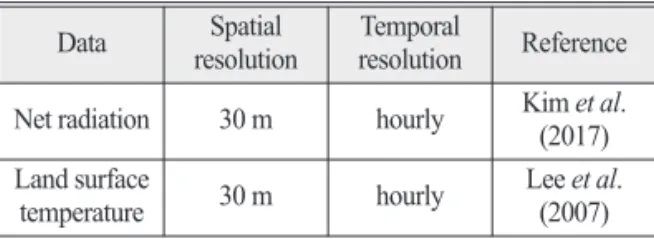
순복사 자료는 다중 위성과 전산유체역학(CFD)모델 의 융합을 통해 산출된 자료를 사용하였으며(Kim et al., 2017), 지표면 온도 자료는 Vegetated Urban Canopy Model(VUCM) 모형을 통해 산출된 자료를 사용하였다 (Lee et al., 2007). 사용된 자료의 정보는 Table 1과 같다.
저장열 산출 및 평가를 위한 자료는 서울특별시 은평 구 플럭스 타워에서 관측된 자료인 순복사, 현열, 잠열 자료를 이용하였다. 이 자료는 20 m 높이의 건물 위에 설치된10 m 플럭스 타워의 CNR1 복사계(Kipp & Zonen B.V.)를 통해 관측되었다(Hong et al., 2016).
3. 연구 방법 및 결과
본 연구에서는 순복사 및 지표면 온도 자료를 이용한 비선형 회귀분석을 통해 은평구의 저장열 추정치를 산 출하였다. 전체 연구 기간 중 강수 등 다양한 기상상태 가 존재하는9월 16일부터 19일의 자료를 훈련 자료로 사용하였으며, 표본 자료로 사용한 저장열 추정치는 플
럭스 타워 관측 자료를 이용하여 식(3)을 통해 구축되 었다. 식 (2)에서 Qf는 순복사 관측값에 포함되어 있으며, Qa는 일반적으로 무시 가능한 정도라고 알려져 있다 (Hong et al., 2016).
ΔQs= Rn– H – LE (Wm-2) (3) 플럭스 타워 기반 저장열 추정치를 종속변수로, 순복 사 및 지표면 온도 자료를 독립변수로 사용하여 비 선 형 회귀 분석을 수행하였으며, 이를 통해 도출된 저장 열 산출 식은 식(4)와 같다. 회귀 분석의 결과는 Table 2 와 같으며 산출된 표준추정오차가10.12 Wm-2로 통계적 으로 유의한 결과를 보였다.
ΔQs= 7.2999LST + 0.6696Rn – 0.2951LST2 + 0.0003Rn2– 78.4454 (4)
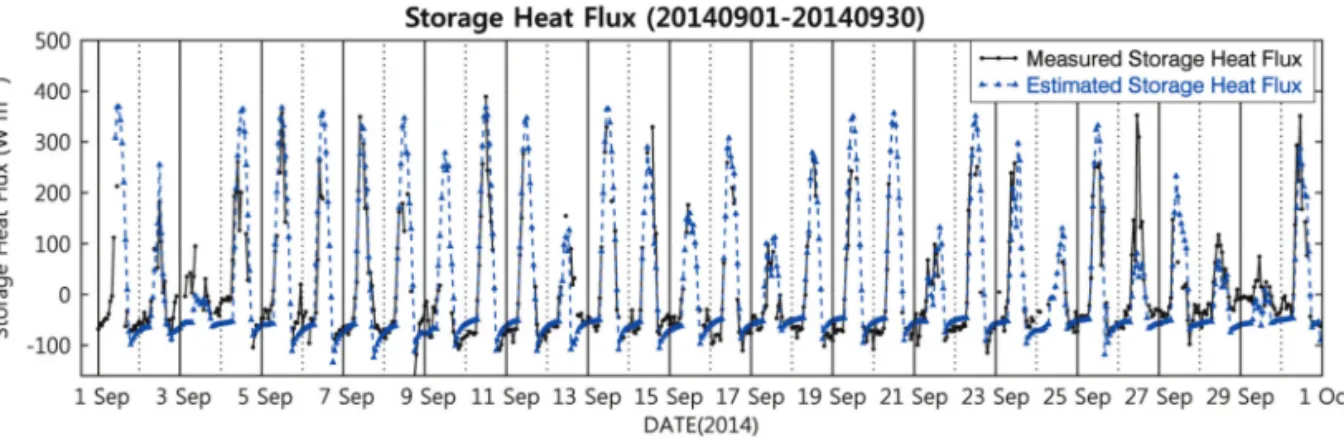
Fig. 1은 식 (4)를 전체 연구기간에 적용하여 산출된 저장열 자료와 플럭스 타워 기반 저장열 추정치의 시계 열 분포를 나타낸 그림이다. 주간에는 본 연구에서 산 출한 저장열 자료가high peak를 잘 반영하며 플럭스 타 워 기반 저장열 추정치와 유사한 경향을 보이고 있었으 나 야간에는 값의 범위는 유사하나 플럭스 타워 기반 저 장열 추정치의 비해 변동성이 적은 패턴을 보이고 있다. 이는 독립변수로 사용된 순복사 자료가 플럭스 타워 기 반 저장열 추정치와의 검증 시 야간에서 과소모의하며, 값의 변동성이 적은 결과를 보여 이에 영향을 받은 것 으로 판단된다(Kim et al., 2017). 또한 9월 26일의 경우 다 른 날과 달리 플럭스 타워 기반 저장열 추정치와 큰 차 이를 보이고 있다. 이 날은 구름이 존재하지 않았지만 순복사 산출 시 구름 판단의 오류로 인해 낮은 값의 순 복사가 산출되어 저장열 산출에도 영향을 준 것으로 판 단된다.
Table 1. Information of the data used for retrieving of storage heat flux
Data Spatial
resolution Temporal
resolution Reference Net radiation 30 m hourly Kim et al.
(2017) Land surface
temperature 30 m hourly Lee et al.
(2007)
Table 2. Statistic figures of fitting result using net radiation and land surface temperature at Eunpyeong-gu site Coefficient Standard
Error R Standard Error of Estimate (Constant) -78.4454 16.8906
0.99 10.1287 LST 7.2999 1.7763
Rn 0.6696 0.0531 LST2 -0.2951 0.0425 Rn2 0.0003 0.0001
또한 전체 연구기간의 플럭스 타워 기반 저장열 추정 치와 본 연구에서 산출한 저장열 자료의 산점도 분석 결 과R 0.712 Wm-2, RMSE 50.14 Wm-2, bias -0.94 Wm-2의 정 확도를 보였다(Fig. 2). 이는 선행연구(Grimmond and Oke, 1999)에서 제시한 저장열의 오차범위인 RMSE 30- 80 Wm-2이내의 정확도이며, Ferreira(2013) (RMSE 74.11 Wm-2)와 Offerle(2005) (RMSE 48.2 Wm-2)의 연구에서의 정확도와 유사한 결과이다.
Fig. 3은 전체 연구기간의 일 변동을 분석하기 위하 여 시간별 평균을 실시한 자료의 시계열 분포를 나타내 었다. 야간에는 값의 분포와 경향이 비교적 정확하게 모 의된 반면, 주간의 경우 본 연구에서 산출한 저장열이 과대 모의하는 경향을 보였다. 플럭스 타워 기반 저장 열 추정치는 평균20%의 부재율을 가지지만 주간에는
Fig. 3. Time series comparison with storage heat flux retrieved in this study (blue dash line) and measured by flux tower (Eunpyeong-gu site, black solid line) using hourly averages from this study period (Sep., 2014).
Fig. 2. The scatter plot of validation result about storage heat flux retrieved in this study and measured by flux tower (Eunpyeong-gu site) during of this study period (Sep., 2014).
Fig. 1. Time series comparison with storage heat flux retrieved in this study (blue dash line) and measured by flux tower (Eunpyeong-gu site, black solid line) during of this study period (Sep., 2014).
35%~55%의 높은 부재율을 보였다. 이로 인해 주간에 서의 플럭스 타워 기반 저장열 추정치의high peak가 제 대로 반영되지 못해 시간별 평균 자료가 낮게 계산되 었다. 하지만 본 연구에서 산출한 저장열의 경우 자료 의 부재 없이high peak가 잘 반영되었기 때문에 주간에 서 상대적으로 높은 값을 산출하게 되어 발생한 차이로 판단된다.
4. 요약 및 결론
본 연구에서는 국내 도심지의 다양한 토지피복과 건 물 특성에 적합한 저장열의 산출을 위해 고해상도 순복 사와 도시지역의 다양한 환경이 반영된 지표면 온도 자 료를 사용하여 회귀 식을 도출하였다. 산출된 회귀 식 의 표준추정오차가10.12 Wm-2로 통계적으로 유의한 결 과를 보이고 있었으며, 2014년 9월 한 달 간 저장열을 산 출하여 플럭스 타워 기반 저장열 추정치와 검증한 결과, RMSE 50.14 Wm-2, bias -0.94 Wm-2로 선행연구와 유사한 정확도의 산출이 가능하였다. 또한 시계열 분석을 통해 주간의high peak와 야간에서의 저장열을 잘 모의하고 있음을 확인하였다. 이를 통해 본 연구에서는 도심지에 서의 순복사와 지표면 온도 자료를 이용하여 저장열의 정량적인 산출이 가능하다는 가능성을 확인하였다. 이 는 향후 도시의 에너지 균형을 규명하기 위한 연구에 유 용할 것이며, 또한 연속적인 저장열 변화패턴 파악에 용 이할 것으로 판단된다. 더불어 본 연구에서 제시한 저 장열 산출 회귀식을 통한 저장열의 정량적인 산출은 도 심지에서의 증발산량 및 현열속 추정에 활용될 수 있을 것으로 사료된다. 본 연구는 서울특별시 은평구에서의 제한적인 범위에서 산출 및 검증이 수행되었으며, 향후 장기간의 자료와 연구지역을 확장한 심층적인 연구가 필요하다.
사 사
본 연구는 기상청 기상See-At 기술개발 사업(KMIPA 2015-5041)의 지원으로 수행되었습니다.
References
Ferreira, M. J., A. P. Oliveira, and J. Soares, 2013.
Diurnal Variation in Stored Energy Flux in São Paulo city, Brazil, Urban Climate, 5: 36-51.
Grimmond, C. S. B. and T. R. Oke, 1999. Heat Storage in Urban Areas: Local-Scale Observations and Evaluation of a Simple Model, Journal of Applied Meteorology, 38(7): 922-940.
Hong, J. and J. Hong, 2016. Changes in the Seoul Metropolitan Area Urban Heat Environment with Residential Redevelopment, Journal of Applied Meteorology and Climatology, 55(5):
1091-1106.
Hwang, M., Y. Kim, I. Oh, and Y. Kang, 2010. High- resolution Simulation of Meteorological Fields over the Coastal Area with Urban Buildings, Journal of Korea Society for Atmospheric Environment, 26(2): 137-150 (in Korean with English abstract).
Kim, H. H., D. R. Lee, J. J. Kim, M. R. Huh, J. Hong, J. W. Hong, K. M. Lee, and K. S. Han, 2017.
Retrieval of High Resolution Surface Net Radiation Using Satellite Data and CFD Model Data, Proc. of 2017 Korean Meteorological Society Fall Meeting, Busan, Oct. 25-Oct. 27, pp. 625-626 (in Korean with English abstract).
Kim, S., B. Kim, and H. Kim, 2016. Diurnal Variations in the Horizontal Temperature Distribution using the High Density Urban Climate Observation Network of Daegu in Summer, Journal of Environmental Science International, 25(2): 259- 265 (in Korean with English abstract).
Lee, S. H. and S. U. Park, 2008. A vegetated urban canopy model for meteorological and environmental modelling, Boundary-Layer Meteorology, 126(1):
73-102.
Meyn, S. K. and T. R. Oke, 2009. Heat fluxes through roofs and their relevance to estimates of urban heat storage, Energy and Buildings, 41(7): 745-752.
Oliphant, A. J., C. S. B. Grimmond, H. N. Zutter, H.
P. Schmid, H.-B. Su, S. L. Scott, B. Offerle, J.
C. Randolph, and J. Ehman, 2004. Heat storage and energy balance fluxes for a temperate deciduous forest, Agricultural and Forest Meteorology, 126(3-4): 185-201.
Offerle, B., C. S. B. Grimmond, and K. Fortuniak, 2005. Heat Storage and Anthropogenic Hear Flux in Relation to the Energy Balance of a Central European city centre, International Journal of Climatology, 25: 1405-1491.
Ryu, Y. H. and J. J. Baik, 2010. A Study of Urban Heat Island Using Combined WRF-Urban Canopy Model, Proc. of 2010 Korean Meteorological Society Spring Meeting, Gangneung, May 13- May 14, pp. 353-354 (in Korean with English abstract).
Taha, H., 1999. Modifying a mesoscale meteorological model to better incorporate urban heat storage:
A bulk-parameterization approach, Journal of Applied Meteorology, 38(4): 466-473.