154 서 론
마비성패류독소는 Alexandrium sp., Gymnodinium sp., Pyrodinium sp. 등편모조류에속하는식물성플랑크톤이생 산하는독소로(Hall et al., 1990), 독소가축적된패류를사람 이섭취하고중독되면마비를유발하게된다(Mortensen et al., 1985; Bricelj and Shumway, 1998). 중독원인물질은플랑크 톤이생산하지만패류독소라는명칭이붙여진것은독소를생 성하는원인생물이밝혀지기전에이매패류에서주로검출되 었기때문이다. 마비성패류독소는특정한한성분으로되어있 는것이아니라약 20종의유독성분의복합체로구성되어있다 (Luckas et al., 2003). Saxitoxin (STX)은마비성패류독소의구 성성분중가장잘알려진독소로(Fig. 1) 다른화합물들의독성
은 saxitoxin 기준으로개별독소성분의상대독성을고려하여
saxitoxin 당량으로변환후얻어진다(Oshima, 1995) (Table 1).
Article history;
Received 16 October 2012; Revised 8 March 2013; Accepted 18 March 2013
*Corresponding author: Tel: +82. 32. 745. 0750 Fax: +82. 32. 745. 0619 E-mail address: [email protected]
Kor J Fish Aquat Sci 46(2) 154-159, April 2013 http://dx.doi.org/10.5657/KFAS.2013.0154 pISSN:0374-8111, eISSN:2287-8815
ⓒ The Korean Society of Fishereis and Aquatic Science. All rights reserved
The AOAC Mouse Bioassay method (MBA) has been widely used for routine monitoring of paralytic shellfish poi- soning (PSP) for more than 50 years. However, this method has low sensitivity and experiences interference from other components in the extract. Also, ethical issues have been raised against the continued use of this live-mouse assay. To establish an alternative method for PSP analysis, we attempted to develop PSP analysis conditions us- ing liquid chromatography-tandem mass spectrometry (LC-MS/MS). The LC-MS/MS analysis of reference material showed very reasonable accuracy, and the analysis time was just 15 min. However, the recovery rate of toxin spike samples using the LC-MS/MS analysis was 59.4-91.0%. We also attempted to remove the matrix effect using shellfish extracts, but recoveries of C1 and C2 did not improve. A comparison between the results of MBA and LC-MS/MS analysis revealed good correlations, with values of 0.8878 and 0.9211 for oyster and mussel matrices, respectively.
Key words: Paralytic Shellfish Poisoning (PSP), LC-MS/MS, MBA (Mouse Bioassay)
LC-MS/MS를 이용한 마비성패류독소 분석조건 검토
국립수산과학원 서해수산연구소 해역산업과, 1국립수산과학원 식품안전과, 2국립수산과학원 남동해수산연구소
Ki Cheol Song*, Ka Jeong Lee1, Hong Sik Yu1, Jong Soo Mok2,Ji Hoe Kim1, Keun Sik Lim1 and Mi Ae Lee1
송기철*ㆍ이가정1ㆍ유홍식1ㆍ목종수2ㆍ김지회1ㆍ임근식1ㆍ이미애1
Paralytic Shellfish Poisoning (PSP) Analysis using Liquid Chromatography-Tandem Mass Spectrometry
West Sea Fisheries Research Institute, National Fisheries Research & Development Institute, Incheon 400-420, Korea
1Food Safety Research Division, National Fisheries Research & Development Institute, Busan 619-705, Korea
2Southeast Sea Fisheries Institute, National Fisheries Research & Development Institute, Tongyeong 650-943, Korea
마비성패류독소의 분석은 AOAC 959.08 official method (OM)에 근거한 마우스 시험법(Mouse Bioassay)을 표준법
(AOAC, 2005)으로하여전세계적으로이루어지고있는데이
방법은패류균질액에서묽은염산을이용하여독소를추출하 고추출액을마우스의복강에주사하여사망에이르는시간을 측정하여그농도를추정하는것이다. 이방법의검출한계는 40 μg STX eqivalent/100 g으로알려져있다(Hall, 1991). 마우스 시험법의높은검출한계에도불구하고시료중총독소량분석 에는신뢰성있는방법으로지난 50여년간지속적으로이용되 어오고있다. 그러나최근전세계적으로시험동물의사용을억 제하거나금지하고자하는여론이확산되고있으며독성프로 파일에대한정보를얻을수없는단점이부각되고있다. 그래 서동물시험법의사용범위축소나배제를위한대체법개발이 필요한실정이다. 지금까지동물시험법을대체하기위하여기 기를이용한여러다양한시도가이루어졌으나액체크로마토그
료는경남진해만의굴(Crassostrea gigas)과진주담치(Mytilus galloprovincialis) 어장에서직접채취하여사용하였다. 채취한 패류시료는외부를세척하고패각근을잘라패각을열고내부 를수돗물로헹구어모래와기타이물질을제거한다음체에담 아물을빼고패육을균질화하였다.
마비성패류독소 표준물질은 C1, C2, dcGTX2, dcGTX3, dcSTX, GTX1, GTX2, GTX3, GTX4, GTX5, NEO 및 STX (National Research Council Institute for Marine Bioscienc- es, Halifax, NS)를 사용하였고, 추출에사용한 hydrochloric acid (analytical grade)는 Merck (Darmstadt, Germany)에서, trichloroacetic acid (analytical grade)와 sodium hydroxide (analytical grade)는 Sigma (St. Louis, MO, USA)에서구입하 여사용하였다. 이동상제조에는 ammonium formate (Fluka, Buchs, Germany) 및 formic acid (Fluka, Buchs, Germany), acetonitrile (Merck, Darmstadt, Germany)을사용하였으며, 탈 이온수는 Milli-Q system (Millipore, Bedford, MA, USA)에서 정제하여사용하였다.
추출
마우스시험으로독이없는것이확인된굴(C. gigas)과진주담 치(M. galloprovincialis)를 blank로사용하고, 거기에일정량의 표준물질을첨가한시료를시험법검증에사용하였다.
균질화한시료 5 g을칭량하여 50 mL 폴리프로필렌시험관 에담고, 5 mL 0.1 N HCl을가한후혼합하여 pH 2.0-4.0이 되도록조정한후 5분간중탕하였다. 중탕한시료를실온까지 냉각하고 pH 2.0-4.0 범위에있는지확인하였으며, 5,000 rpm 에서 5분간원심분리하여여액은따로모으고, 500 μL를취하 여 30% trichloroacetic acid 25 μL를가하고혼합하여 8,000 rpm에서 5분간원심분리하였다. 상등액을모아 1.0 M sodium hydroxide를 30 μL 가하여 trichloroacetic acid를중화한다음 다시 8,000 rpm에서 5분간원심분리한다음상등액은 0.2 μm syringe fileter (MFS-25; Advantec, Dublin, CA, USA)로여과 하여기기분석에사용하였다.
또한, 마우스시험법과의비교를위하여마비성패류독소가검 출되었던굴과진주담치각각 50개의시료를선별하여위와동 일한전처리과정을거쳐 LC-MS/MS 분석에사용하였다. 래피를응용하여 pre-column oxidation (Lawrence et al., 1991;
2005) 또는 post-column oxidation (Franco and Fernández-Vi- la, 1993; Oshima, 1995; Asp et al., 2004; Thomas et al., 2006) 과형광검출을조합한방법이알려져있다. 그러나이방법들
은독소함량이높은시료의분석에긴시간이소요되며(Ben-
Gigirey et al., 2007), 한번에모든독소를분석할수없다는단 점이있다. 짧은분석시간은규제를목적으로한시험환경에서 는매우중요한요소이다.
한편, 마비성패류독소는강한염기성을 가지는물질로강력 한 [M+H]+이온을발생시켜 liquid chromatography-tandem mass spectrometry (LC-MS/MS)에서효과적으로검출될수 있다(Quilliam et al., 1989). 또한 LC-MS/MS를이용한분석법 은분석시간이상대적으로짧고대부분의마비성패류독소구성 성분을동시에분석할수있는장점이있다.
따라서본연구에서는 LC-MS/MS를이용한시험방법을검 토하고우리나라시료특성에부합되는분석조건을수립한후 동시험법에대한유효성확인및마우스시험법과의비교를실 시하여모니터링과규제를목적으로한분석환경에사용될수 있는지그타당성을검토하고자하였다.
재료 및 방법 시료 및 시약
LC-MS/MS를이용한마비성패류독소의분석을위한패류시
Table 1. PSP (Paralytic shellfish poisoning) toxins and their relative toxicities (see Fig. 1 for structures)
Toxin ReTx Toxin ReTx Toxin ReTx R1 R2 R3
STX 1.0000 GTX5 0.0644 dcSTX 0.5131 -H -H -OSO3-
GTX2 0.3592 C1 0.0060 dcGTX2 0.1538 -H -H -H
GTX3 0.6379 C2 0.0963 dcGTX3 0.3766 -H -OSO3- -H
NEO 0.9243 GTX6 0.0644 dcNEO - -OH -H -OSO3-
GTX1 0.9940 C3 0.0133 dcGTX1 - -OH -H -H
GTX4 0.7261 C4 0.0576 dcGTX4 - -OH -OSO3- -OH
ReTx, Relative toxicity; STX, saxitoxin; NEO, neosaxitoxin; GTX, gonyautoxin; C, protogonyautoxin.
R4
R1
NH+2 H
N NH
N NH
OH OH H2N+
R2 R3
STX = saxitoxin NEO = neosaxitoxin GTX = gonyautoxins
Fig. 1. Structure of PSP toxins.
LC-MS/MS 분석조건
LC-MS/MS를이용한마비성패류독소분석법확립을위하여
TSQ Quantum discovery triple-quadrupole mass spectrometer (Thermo electron, Finnigan, San Jose, CA, USA)와 Surveyor MS Pump plus (Thermo electron, Finnigan, San Jose, CA, USA)를사용하였고, column은 TSK Gel-amide-80 column (5 μm, 0.2×25 cm; Tosoh Bioscience, Tokyo, Japan)을사용하 였다.
LC분리를위한이동상 A와 B는 ammonium formate와 for- mic acid의최종농도가각각 2.0 mM과 3.6 mM이되도록탈이 온수및 95% acetonitrile에 95:5 비율로희석한용액을사용하 였다. A용액과 B용액의비율 75 : 25로조정한이동상을 flow rate 0.2 mL/min으로흘리면서총분석시간을 15분으로유지하 였다. 질량분석은 electrospray ionization (ESI)법으로하였다. 마비성패류독소검출을위한 MS/MS parameters는 Table 2 에나타내었다. Quadrupole type의 mass에서 SRM (Selected Reaction Monitoring)법 및 positive mode를 사용하였으며, spray voltage는 5.0 kv, capillary temperature는 350℃, sheath gas 17 (Arb) 및 aux gas는 19 (Arb)로설정하였고, collision energy는모든독소가 20 eV로동일하였다.
분석법 유효성 시험
분석조건의 유효성시험은최적의분석조건에서각 독소의 농도가 0.1, 0.5, 1.0 μg/g이되도록표준용액을각각조제하고 LC-MS/MS로분석하였다.
분석기기의검출한계(LOD; limit of detection)는신호대잡 음비(S/N)가 >3으로하였으며, 정량한계(LOQ; limit of quan- tification)는 LOD×3일때의농도로구하였다.
시험방법의 정확도(accuracy)와 정밀성(precision)는 3가지 농도로조제한표준물질을 이용하여일내(intra-day) 및 일간 Table 2. Mass spectrometry (MS/MS) parameters
Toxins Parent ion(m/z) Fragment ion
(m/z) Mode Collision Energy
STX 300 282 ESI+ 20 eV
NEO 316 298 ESI+ 20 eV
GTX1 412 332 ESI+ 20 eV
GTX2 396 316 ESI+ 20 eV
GTX3 396 298 ESI+ 20 eV
GTX4 412 314 ESI+ 20 eV
GTX5 380 300 ESI+ 20 eV
dcSTX 257 196 ESI+ 20 eV
dcGTX2 353 273 ESI+ 20 eV
dcGTX3 353 335 ESI+ 20 eV
C1 396 316 ESI+ 20 eV
C2 396 298 ESI+ 20 eV
ESI, Electrospray ionization; STX, saxitoxin; NEO, neosaxitoxin;
GTX, gonyautoxin; C, protogonyautoxin.
(inter-day) 반복시험을 1일 5회및 5일간 1회/1일로실시하였 다.
또한, 회수율측정을위하여독이없는것으로확인된굴및진 주담치시료에 12종의표준물질을최종 1.0 μg/g 농도가되도 록첨가하여위의방법과동일한방법으로추출한뒤기기분석 에사용하였다.
결과 및 고찰 독소의 분리 및 분석법 유효성 시험결과
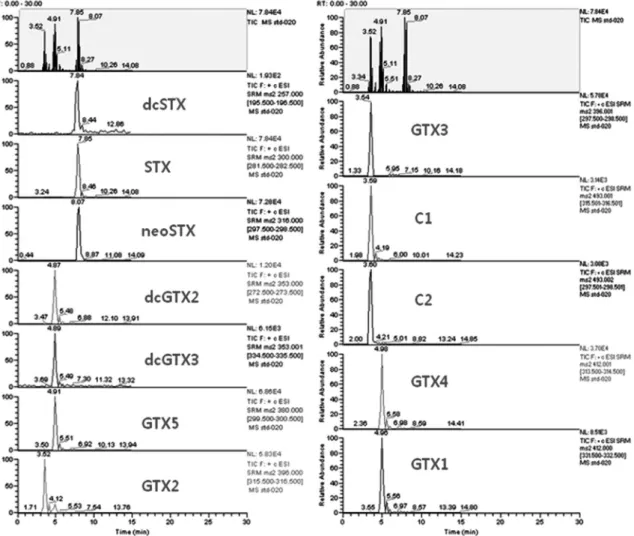
LC-MS/MS법을이용하여마비성패류독소를구성하는성분
중 12종의표준물질혼합용액을분석한결과모든독소가 8분 이내에서분리되었다(Fig. 2).
대부분의액체크로마토그래피와형광검출법을조합한분석 에서는이동상에서전하를가진마비성패류독소성분의유지 를 위하여 heptanesulfonic acid, heptafluorobutyric acid 및 tetrabutylammonium sulfate등의이온쌍시약이사용된다(Os- hima, 1995). 이와같은시약들은 MS/MS 시스템의이온소스 (ion source)를오염시키고, 이온화를억제시키는등의방해작 용을한다. 또한 C toxins은 STXs 그룹이나 GTXs 그룹과다 른전하를가지기때문에다른조건에서따로분리하여야하 는단점이있다. 본연구에서는 MS/MS와 HILIC (Hydrophilic interaction liquid chromatograpy)를결합하여분석에사용하
였으며, HILIC은극성화합물의분리에매우유용한방법이다
(Alpert, 1990). 이방법에서는친수성인컬럼과이동상의상호 작용에의해 물질이분리되기때문에이온쌍시약이포함된이 동상을사용하지않아이온화효율을감소시키지않고, 빠른시 간안에선택적으로마비성패류독소성분들을동시에분석할 수있다는장점이있다(Dell’Aversano et al., 2005).
시험방법의검증을위하여 0.1-1.0 μg/g 범위의표준물질을 사용하여 5회 반복측정 후구한검량선의 직선성은 12종의 표준물질 모두 r2=0.9993 이상이었다. 각표준물질의검출한 계(detection limit) 는독소마다차이가있었는데, S/N (signal to noise)비가 3:1인표준물질의 peak를기준으로측정하였다. STX, GTX1, GTX3, GTX4, GTX5, dcSTX, C1 등의독소는 0.001 μg/g이었으며, NEO, GTX2, dcGTX2, dcGTX3, C2 등 의독소는 0.01 μg/g이었다. 또한, 정량한계는검출한계의 3배 로계산하였다(Table 3).
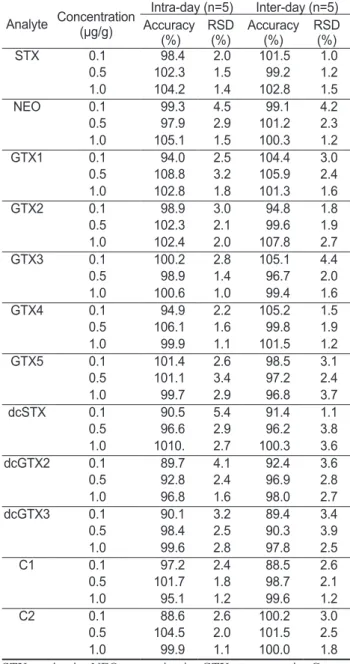
또한본분석법의정확성(accuracy)와정밀성(precision)를확 인하기위하여일내(intra-day) 및일간(inter-day) 반복시험을 실시하였다.
3가지농도의각독소성분표준물질에대하여 1일 5회및 5일 간 1회/1일로반복시험을실시한결과, 분석법의일내정확성 및정밀성은각각 88.6%-106.1%의정확성과 1.0-5.4%의정밀 성을나타내었다. 또한, 일간정확성및정밀성은 5일간반복하 여구하였으며, 각각 88.5%-105.9%의정확성과 1.0%-4.4%의
정밀성을나타내었다(Table 4).
Codex (2008)에서는첨가한표준물질의농도가 0.1-10 μg/g 범위에서는 80-110%, 0.01 μg/g에서는 60-115% 및 0.001 μg/
g에서는 40-120%의정확성을요구하고있으며, 본시험방법 은이에부합되는것으로확인되었다.
마비성패류독소에오염되지않은굴과진주담치시료에각독 소를일정농도첨가한시료를각각 5개씩제조한후, 분석하였 을때의회수율은 Table 5에나타내었다. 품종에따른회수율은 굴에서는 59.4%-91.0%, 진주담치에서는 60.2%-90.2%의범 위를보였다. 굴및진주담치에서는특히 C1, C2등의 C toxins 이다른독소들에비해낮은비율로나타났는데, 이것은전처리 과정에서미처제거되지않은염에의한방해때문인것으로사 료된다. Dell’Aversano et al. (2005)는 LC-MS/MS를이용하여 진주담치시료에서마비성패류독소를분석한결과 C toxins이 다른독소들에비하여낮게검출되었다고하였다. 조추출물에 포함된염은부분적으로 C toxins의이온화를억제할수있다 Fig. 2. Chromatogram of working solution (0.1 μg/g); STX, saxitoxin; NEO, neosaxitoxin; GTX, gonyautoxin; C, protogonyautoxin.
Table 3. Estimated limit of detection (LOD) and limit of quantifi- cation (LOQ) for individual toxin (n=5)
Linearity (r2) LOD (μg/g)1 LOQ (μg/g)2
STX 0.9998 0.001 0.003
NEO 1.0000 0.010 0.030
GTX1 0.9999 0.001 0.003
GTX2 0.9999 0.010 0.030
GTX3 1.0000 0.001 0.003
GTX4 0.9998 0.001 0.003
GTX5 1.0000 0.001 0.003
dcSTX 0.9996 0.001 0.003
dcGTX2 0.9999 0.010 0.030
dcGTX3 0.9993 0.010 0.030
C1 0.9993 0.001 0.003
C2 0.9999 0.010 0.030
1LOD=3×S/N; 2LOQ=3×LOD; STX, saxitoxin; NEO, neosaxi- toxin; GTX, gonyautoxin; C, protogonyautoxin.
(Dell’Aversano et al., 2005). 그러나, C toxins 이외의다른성 분들은굴과진주담치에서모두양호한수준으로확인되었다. 본연구에서낮은회수율을보인독소들에대하여는향후이를 개선하는연구가필요할것으로사료된다.
마우스 시험법과 LC-MS/MS에 의한 분석결과 비교 마비성패류독소의 허용기준치인 80 μg/100 g의 농도가포 함되도록 마우스시험법에서 불검출부터 200 μg/100 g STX equiv.로검출되었던굴과진주담치시료를각각 50개씩선별 Table 4. Intra-day and inter-day accuracy and precision for STXs
& GTXs and C toxins analyzed by LC-MS/MS method
Analyte Concentration(μg/g)
Intra-day (n=5) Inter-day (n=5) Accuracy
(%) RSD
(%) Accuracy
(%) RSD
STX 0.1 98.4 2.0 101.5 (%)1.0
0.5 102.3 1.5 99.2 1.2
1.0 104.2 1.4 102.8 1.5
NEO 0.1 99.3 4.5 99.1 4.2
0.5 97.9 2.9 101.2 2.3
1.0 105.1 1.5 100.3 1.2
GTX1 0.1 94.0 2.5 104.4 3.0
0.5 108.8 3.2 105.9 2.4
1.0 102.8 1.8 101.3 1.6
GTX2 0.1 98.9 3.0 94.8 1.8
0.5 102.3 2.1 99.6 1.9
1.0 102.4 2.0 107.8 2.7
GTX3 0.1 100.2 2.8 105.1 4.4
0.5 98.9 1.4 96.7 2.0
1.0 100.6 1.0 99.4 1.6
GTX4 0.1 94.9 2.2 105.2 1.5
0.5 106.1 1.6 99.8 1.9
1.0 99.9 1.1 101.5 1.2
GTX5 0.1 101.4 2.6 98.5 3.1
0.5 101.1 3.4 97.2 2.4
1.0 99.7 2.9 96.8 3.7
dcSTX 0.1 90.5 5.4 91.4 1.1
0.5 96.6 2.9 96.2 3.8
1.0 1010. 2.7 100.3 3.6
dcGTX2 0.1 89.7 4.1 92.4 3.6
0.5 92.8 2.4 96.9 2.8
1.0 96.8 1.6 98.0 2.7
dcGTX3 0.1 90.1 3.2 89.4 3.4
0.5 98.4 2.5 90.3 3.9
1.0 99.6 2.8 97.8 2.5
C1 0.1 97.2 2.4 88.5 2.6
0.5 101.7 1.8 98.7 2.1
1.0 95.1 1.2 99.6 1.2
C2 0.1 88.6 2.6 100.2 3.0
0.5 104.5 2.0 101.5 2.5
1.0 99.9 1.1 100.0 1.8
STX, saxitoxin; NEO, neosaxitoxin; GTX, gonyautoxin; C, pro- togonyautoxin; RSD, Relative standard deviation.
Table 5. Recovery (%) of toxins in the different matrix by the ex- traction and purification method (n=5, 1.0 μg/g)
Analyte Oyster Mussel
STX 80.2±1.5 80.7±2.6
NEO 75.6±2.1 80.3±3.3
GTX1 89.8±3.3 81.3±1.8
GTX2 82.3±2.6 86.5±3.0
GTX3 79.8±0.8 86.0±2.7
GTX4 87.5±3.1 90.1±2.4
GTX5 91.0±3.6 90.2±3.0
dcSTX 73.5±2.2 72.2±2.5
dcGTX2 72.6±2.4 78.9±2.1
dcGTX3 71.4±1.1 77.5±1.5
C1 59.4±2.0 60.2±1.2
C2 62.5±3.4 61.4±1.6
Range (%) 59.4-91.0 60.2-90.2
STX, saxitoxin; NEO, neosaxitoxin; GTX, gonyautoxin; C, pro- togonyautoxin.
Fig. 3. Correlation between MBA and LC-MS/MS analysis of PSP toxins in oyster (n=50) and mussel (n=50).
0 50 100 150 200 200
150 100 50
MBA (µg/100 g STX equiv) 0
HPLC (µg/100 g STX equiv) Mussel
y =0.8459x + 9.5148 R2= 0.8878 200
150 100 50
00 50 100 150 200
MBA (µg/100 g STX equiv)
HPLC (µg/100 g STX equiv) Oyster
y =1.9506x + 5.2879 R2= 0.9211
하여위의방법으로전처리하고 LC-MS/MS로 12종의개별독
소를분석한후독량을 saxitoxin당량으로변환시켜상관관계
를확인하였다. 본연구에서상관계수(r2)는굴에서는 0.9211, 진주담치에서 0.8878로의미있는상관관계를나타내었다(Fig.
3). 기기를사용한분석법은동물시험법에서방해물질로작용
하는 carbamate와같은신경독소와유기인계살충제에영향을
받지않는점과 blank 시료에대한 false positive 결과를배제할
수있는점등의특이성을가지고있다(Van de Riet et al., 2009).
LC-MS/MS를이용한마비성패류독소의분석은동물시험법
으로는알아낼수없는시료중마비성패류독소구성성분을밝 힐수있고, 많은독소를동시에분석할수있다는장점이있다. 본연구에서의결과는마비성패류독소의원인플랑크톤과패류 중독소구성성분의비교에적용하여독성프로파일을밝히고, 나아가우리나라마비성패류독소관리를위한대안으로활용될 수있을것이라판단된다.
사 사
본연구는국립수산과학원(수출패류생산해역및수산물위생 조사, RP-2013-FS-001)의지원에의해수행되었습니다.
참고문헌
Alpert AJ. 1990. The term HILIC(Hydrophilic interaction liquid chromatograpy) was introduced by Alpert in 1990. J Chro- matogra A 499, 177-196. http://dx.doi.org/10.1016/s0021- 9673(00)96972-3.
Asp TN, Larsen S and Aune T. 2004. Analysis of PSP toxins in Norwegian mussels by a post-column derivatization HPLC method. Toxicon 43, 319-327. http://dx.doi.org/10.1021/j.
toxicon.2004.01.004.
AOAC. 2005. AOAC Official Method 959.08. Paralytic Shell- fish Poison. Biological method. Final action. In: AOAC Of- ficial methods for analysis, 18th Edition Chapter 49: Natural toxins (Chapter ed. Truckses MW), AOAC International, Gaithersburs, MD, USA, 79-80.
Ben-Gigirey B, Rodríguez-Velasco ML, Villar-González A and Botana LM. 2007. Influence of the sample toxic profile on the suitability of a high performance liquid chromatography method for official paralytic shellfish toxins control. J Chro- matogra A 1140, 78-87. http://dx.doi.org/ 10.1016/j.chroma.
2006.11.048.
Bricelj VM and Shumway SE. 1998. Paralytic shellfish toxins in bivalve mollusks. Occurrence, transfer kinetics and bio- transformation. Rev Fish Sci 6, 315-383.
Carmela DA, Hess P and Quilliam MA. 2005. Hydrophilic interaction liquid chromatography-mass spectrometry for the analysis of paralytic shellfish poisoning(PSP) toxins. J Chromatogra A 1081, 190-201. http://dx.doi.org/10.1016/j.
chroma.2005.05.056.
Codex Alimentarius Commission. 2008. Report of the Thirty- first session, ALINORM 08/31/REP. Geneva, Switzerland.
Franco JM and Fernández-Villa P. 1993. Separation of paralytic shellfish toxins by reversed phase high performance liquid
chromatography with postcolumn reaction and fluorometric detection. Chromatographia 35, 613-620.
Hall S, Strichartz G, Moczydlowski E, Ravindran A and Reich- ardt PB. 1990. Marine Toxins: Origin, Structure, and Mo- lecular Pharmacology. In: Hall S and Strichartz G.(Eds.), American Chemical Society, Washington D.C., USA, 29-65.
Hall S. 1991. Natural toxins. In: Ward DR and Hackney CR.(Eds.), Microbiology of Marine Food Products. Van Nostrand Reinhold, New York, USA, 301-330.
Lawrence JF and Menard C. 1991. Liquid chromatographic de- termination of paralytic shellfish poisons in shellfish after prechromatographic oxidation. J Assoc Off Anal Chem 74, 1006-1012.
Lawrence JF, Niedzwiadek B and Menard C. 2005. Quantita- tive determination of paralytic shellfish poisoning toxins in shellfish using prechromatographic oxidation and liquid chromatography with fluorescence detection: collaborative study. J AOAC Int 88, 1714-1732.
Luckas B, Hummert C and Oshima Y. 2003. Analytical methods for paralytic shellfish poisons. In: Hallegfaeff GM., Ander- son DM, Cembella DA, Enevoldsen HO. (Eds.), Manual on Harmful Marine Microalgae. UNESCO, Paris, France, 191-209.
Mortensen AM. 1985. Massive fish mortalities in the Faroe Is- lands caused by a Gonyaulax excavate red tide. In: Ander- sen DM, White AW and Baden DG. (Eds.), Toxic Dinofla- gellates. Elsevier, New York, USA, 165-170.
Oshima Y. 1995. Post-column derivatization liquid-chro- matograpic method for paralytic shellfish toxins. J AOAC Int 78, 528-532.
Quilliam MA, Thomson BA, Scott GJ and Siu KW. 1989. Ion- spray mass spectrometry of marine neurotoxins. Rapid Commun Mass Spectrom 3, 145-150.
Thomas K, Chung S, Ku J, Reeves K and Quilliam MA. 2006.
Analysis of PSP toxins by liquid chromatography with post column oxidation and fluorescence detection. In: Molluscan Shellfish Safety. Henshilwood K, Deegan B, McMahon T, Cusack C, Keaveney S, Silke J, O’'Cinneide M, Lyons D and Hess P. eds. The Marine Institute, Galway, Ireland. 132 -138.
Van de Riet JM, Gibbs RS, Chou FW, Muggah PM, Rourke WA, Burns G, Thomas K and Quilliam MA. 2009. Liquid chromatographic post-column oxidation method for analy- sis of paralytic shellfish toxins in mussels, clams, scallops, and oysters: single-laboratory validation. J AOAC Int 92, 1690-1704.