* Corresponding author: (E-mail) [email protected]
※Advance in Forest Management and Inventory-selected papers from the international conference of IUFRO (Div. 4.01, 4.02, 4.04), Chuncheon, Korea, Oct. 13-17, 2008.
Forestry Education Support by a Forest Research Institute:
Development of Forestry Educational Programs for Vocational High Schools
Mariko Inoue1*, Yasuhiko Oishi1, Tomoyuki Fujii2, and Hiroyuki Kobayashi3
1Tama Forest Science Garden, Forestry and Forest Products Research Institute, Japan
2Kansai Research Center, Forestry and Forest Products Research Institute, Japan
3Toyama Prefectural Forest and Fisheries Research Center, Forestry Research Laboratory, Japan
ABSTRACT : Forestry education in vocational high schools is one of the fundamental keys for achieving sustainable forest management. However, support systems for forestry education have not been well developed in Japan. Forest research institutes, which have accumulated relevant information, should have sufficient ability to develop new educational programs in this field.
This study examined the possibility of support systems for forestry technical education by a research institute. Educational programs for vocational high schools were developed, and the programs were examined for their practical applications through a workshop for these teachers. We set the following five requirements for the programs: They should 1) incorporate new contents related to sustainable forest management, 2) be based on forestry education textbooks, 3) meet recent demands of the schools and society, 4) allow participants to learn through actual practice and experience, and 5) utilize readily available teaching materials.
With these criteria, we developed the following two educational programs: (a) Forest management program to teach advanced techniques, (b) A timber-program to teach about biomass resources. The workshop was held on July 28th, 2007 with ten teachers attending. The programs were very interesting, who gave them high average evaluation of 4.6 on a scale of 1 to 5. Only a few issues need to be resolved before classroom instruction can begin, such as making wood structure easier to understanding for some teachers, and obtaining base maps of school forests. In conclusion, forest research institutes can effectively support forestry education by providing and implementing programs based on scientific information.
Keywords : Forestry education, Forest management, High school, Technology transfer, Japan
INTRODUCTION
In recent years, sustainable forest management and effective use of wood as a renewable resource have been attracting attention as means of establishing a sustainable society. One of the fundamental keys for achieving sustain- able forest management is forestry education in vocational high schools. During this United Nations Decade of Education for Sustainable Development (2005 to 2014), demand is increasing for environmental education and education for sustainable development (ESD) (Inoue, 2007).
The Ministry of Education, Culture, Sports, Science and
Technology in Japan implemented the “Law for Enhancing Motivation for Environmental Conservation and Promoting Environmental Education” in 2003, and then revised the official guidelines for advancing environmental education in 2007 (Inoue et. al., 2008). Article 12 of the revised Forest and Forestry Basic Act of 2001 includes provisions for “promoting the use of forests for education in order to enhance public understanding and awareness of forest and forestry”. The Forestry Agency started to advocate
“forest environmental education” for the advancement of environmental education in 1999 (Inoue, 2007). Forestry education is required for effective management of forests,
which is one of the fundamental keys to establishing a sustainable society.
Unlike the active promotion of environmental educa- tion related to forests, technical education in forestry has been seriously decreasing in Japan. Today, technical forestry classes are offered at only 73 vocational high schools in Japan (Forestry Agency, 2007). Among the primary reasons for the striking decline of such classes in vocational high schools are the decline of the forest and forest products industries, the declining birth-rate, and increasing demands for higher academic qualifications (Inoue et al., 2007). In this context, recent school textbooks for forestry education in vocational high schools are lagging far behind today’s environmental age, since they are only revised every 10 years by the Ministry of Education, Culture, Sports, Science and Technology.
Forestry education are now facing drastic changes, but unfortunately, support systems for forestry education have not been well developed in Japan. Forestry education has been mainly focused on wood products, but now forestry education is needed for various other functions, because forests are an indispensable resource for a sustainable society. To include new educational functions, it is neces- sary to establish training institutions staffed by profes- sional foresters.
Forest research institutes, which have both acquired new scientific and technical knowledge by themselves and accumulated relevant information from around the world, should have sufficient ability to develop new educational programs in this field.
This study examined the possibility of research institutes developing systems for forestry technical education. Educa- tional programs directed toward sustainable forest manage- ment were developed for forestry courses in vocational high schools, and the programs were examined for their practical applications through a workshop for the teachers.
METHODS
In this study, we examined the possibility of implemen-
ting a system for forestry technical education, through a training workshop for teachers of forestry courses in voca- tional high schools held by the Forestry and Forest Pro- ducts Research Institute (FFPRI). FFPRI is the only national research institute involved with general forest subjects in Japan. We participated in the planning, management and lectures in the training workshop.
1. The educational programs for forestry education in vocational high schools
(1) Examination of the forestry educational programs
Forestry educational programs were developed for a workshop. First, indices necessary for the development of the educational programs were considered. Then the in- dices of teaching materials, practical methods and volume of the contents of the programs were examined for their applicability to forestry education in vocational high schools.
With these indices, we developed two educational pro- grams directed toward sustainable forest management; i.e., a forest management program, and a timber-program. The goal of the programs is for participants to acquire new scientific and technical knowledge and achieve a better understanding of sustainable forest management. The actual time of each program was designed to be at least around one hour.
(2) Planning and implementation of the training workshop for teachers
The training workshop was held on July 28th, 2007 at Tama Forest Science Garden, FFPRI, in Hachioji, Tokyo, which has facilities open to the public (i.e. a pavilion and a ca. 15 ha arboretum), and is a center for disseminating the results of FFPRI research activities. It was supported as part of the “Support for Study of Science & Tech- nology: Science Teacher Training” project of the Japan Science and Technology Agency (Japan Sci. and Tech.
Agency, 2008). It was planned jointly with the Research Council of Forest and Forestry Education in High Schools, which assisted in publicizing and preparing invitations for
participation. This council is composed of 42 high schools which offer forest-related courses or classes and 9 indi- vidual teachers from 8 schools, representing 50 schools in total, or ca. 70% of all high schools involved with forest vocational education. Ten teachers from six of the voca- tional high schools participated in the practical workshop.
2. Utility of the educational programs
During the workshop, we discussed the utility of the programs and the effectiveness of the support system with the 10 teacher participants, and asked them to fill out a questionnaire just after the workshop (100% response rate).
The questionnaires included the following items: evalua- tion of each program, practical applications for actual lessons in high schools, problems in practice, and training experience of teachers.
3. Examination of the availability of research institutes develop- ing support systems for forestry education
The ability of research institutes to develop systems for forestry technical education was examined.
RESULTS
1. The educational programs for forestry education in vocational high schools
(1) Examination of forestry education programs
First, we established indices of the educational pro- grams for forestry education in vocational high schools.
The main purpose of these programs is for trainees to acquire new scientific and technical knowledge and achieve a better understanding of sustainable forest management.
Then, new programs were developed based on the follow- ing five criteria, that is, the programs should:
1) Incorporate new materials related to sustainable forest management.
2) Be based on current forestry education textbooks and the official guidelines for school teaching.
3) Meet recent demands of schools and society.
4) Allow participants to learn through actual practice and experience.
5) Utilize teaching materials that are easily available.
With these criteria as well as considering the incorpo- ration of new scientific and technical knowledge in forestry, especially as it pertains to sustainable forest management, wood-based biomass resources and forest management using new skills were selected as the subjects of the follow- ing two programs.
(a) Forest management program for learning advanced techniques
This program taught participants how to manage forests by using new techniques, i.e. remote sensing, GPS and GIS. Teaching materials were pocket PCs with GPS to use in the field, free software of three-dimensional maps and GPS (KASHIMIR 3D; Sugimoto, 2002) and base maps of the forests showing longitude and latitude. This program was used to search for the routes to be taken by the participants in forests. This program was composed of the following four sections: 1) a lecture about GIS, RS and GIS, 2) a demonstration of GPS using KASHIMIR 3D, 3) practical training for searching trails in a forest environment, which took about one hour, and 4) data processing. It should be noted that remote sensing and GIS techniques are used in forest measurements, and are applicable to the specialized classes of Forest Mana- gement.
(b) Wood learning program
This program, which is part of environmental educa- tion, taught participants about how wood is a sustainable biomass resource and functions as a carbon-stock (Inoue et. al., 2008). Participants learned how the differences in wood anatomical structure affect wood properties by observ- ing wood blocks with a magnifying glass, and making
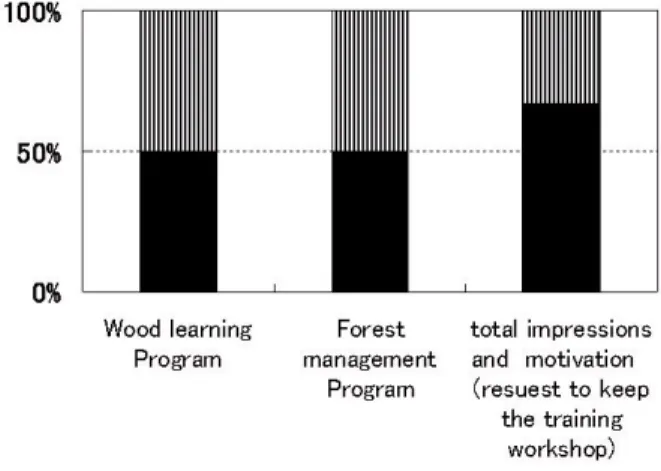
Fig. 1. Evaluation of training programs and training workshop out of a possible 5 points.
models of dice using microphotographs printed on paper (Fujii et al., 2008; Karube, 2006). It should be noted that wood anatomy is one of the specialized subjects in “Forest Products and Processing”.
(2) Planning and implementing the training workshop for teachers.
In the workshop, two kinds of programs and discus- sions were held, which took about six hours in total.
First training program: Forest management program for learning advanced techniques, i.e., remote sensing, GPS and GIS. It took about four hours, including one hour for training in the forest and 30 minutes for a question and answer session.
Second training program: This was a one-hour indoor wood learning program that included training in obser- vation and handicraft.
Discussion time: In this one-hour indoor program, all staff and participants took part in discussions on the utility evaluation of each program, practical applications for actual lessons in high schools, problems in practical use, training experience of teachers, and the effectiveness of the support system.
2. Utility of the educational programs
The programs aroused the interest of most of the teachers who attended and received a high average evaluation of 4.6 on a scale of 1 to 5. Figure 1 shows the results of evaluation of the programs. Both of these programs received an overall evaluation of 4.5, and total impressions and motivation of this training workshop received an evalua- tion of 4.7.
Such a high evaluation may have been due to the substantial lack of other opportunities for the teachers to improve their teaching ability in this specialized field.
None of the participants had ever visited Tama Forest Science Garden before and had almost no chance to receive training in forest education. Nonetheless, it can be said that the utility of these programs was proved in
actual applications just after this workshop by some of the teachers.
As a result of the evaluation, some problems were identified that need to be resolved before full implemen- tation. For example, it was found that the wood learning program had been a little difficult for some of the teachers, because they did not have sufficient basic knowledge of wood anatomical structure or an adequate background in forests and forestry. In the forest management programs, one of the problems was a lack of data on longitude and latitude, which is indispensable for GPI and GIS analyses, in the base maps of school forests in many schools.
3. Examination of the possibility of research institutes develop- ing support systems for forestry education
The findings in this study that the educational programs were effective and highly evaluated demonstrated that forest research institutes could effectively support forest technical education by providing and implementing pro- grams based on scientific information. Furthermore, hold- ing training workshops for forestry education was found to be effective for supplementing the substantial lack of study training for the forestry teachers to help them im- prove their teaching ability and acquire new knowledge in this specialized field.
At the same time, effects and problems for the research institute were also identified. It is hoped that scientific in- formation and the results of research works will be pub- licized and applied widely to classroom instruction by such teachers. However, this will require a great deal of effort by forest research institutes to increase opportu- nities for teachers engaged in forestry education to acquire new scientific and technical knowledge.
CONCLUSION
In this study, it was found that forest research institutes can effectively support forest technical education by pro- viding and implementing programs based on scientific information. Furthermore, it is hoped that scientific infor- mation and the results of research works will be pub- licized and applied through such activities by these research institutes.
However, there are still some problems that remain.
Forestry courses in vocational high schools need assistance from specialists, because some of the teachers did not major in forestry and are lacking in specialized infor- mation and tools. At the same time, a great deal of effort needs to be made by forest research institutes by, for example, establishing a system for supporting and develop- ing training programs. If this can be accomplished, it will bring mutual benefits to both the institutes and the teachers.
LITERATURE CITED
Forestry Agency. 2001. The Forest and Forestry Basic Act. Avail- able online at www.cas.go.jp/jp/seisaku/hourei/data/ffba_2.pdf ; last accessed Oct. 6, 2008.
Forestry Agency. 2007. Annual Report on trends in Forests and Forestry. Japan forestry association, Attached reference lists p7, Japan.
Fujii, T., Inoue, M., Oishi, Y., and M. Karube. 2008. Development of education materials and the program to learn wood anatomical structure. The 58th Anural meeting of the Japan Wood Research Society: PR002 (in Japanese).
Inoue, M. 2007. The historical transition of forest education in Japan.
Siring-Kagaku 49: 28-32. (in Japanese with English summary).
Inoue, M., Oishi, Y. 2007. Forestry Education in Japanese Voca- tional High Schools - Historical outlook and present status. Conf.
proc. on Sustainable Forest Management and Carbon Sequestra- tion in Taiwan and Japan, National Chung Hsing Univ., Taiwan, pp. 200-208.
Inoue, M., Oishi, Y., and T. Fujii. 2008. Development of wood learning programs for environmental education. Proc. of Inter- national Symposium on Toward the Establishment of the Multi- purpose and Long-term Forest Management Plans by Japan and Taiwan. Japan Society of Forest Planning Press, Japan, pp, 89- 97.
Japan Sci. and Tech. Agency. 2008. Wood anatomical structure.
Available online at www.jst.go.jp; last accessed Oct. 6, 2008.
Karube, M. 2006. Laboratory of Engineered Timber and joints.
Available online at www.ffpri.affrc.go.jp/labs/etj/Covers/20071003/
index.html; last accessed Oct. 6, 2008.
Ministry of Educ., Cult., Sports, Sci. and Tech., 2003. The law for Enhancing Motivation on Environmental Conservation and Pro- moting of Environmental Education. Available online at www.
env.go.jp/en/laws/policy/edu_tt.pdf ; last accessed Oct. 6, 2008.
National institute for educational policy research. 2007. The official guidelines for advancement of environmental education. Avail- able online at www.edu.pref.kagoshima.jp/kari/kannkyou/kannk youkyouikusidousiryou.pdf;Last accessed Oct. 13, 2008. (in Japanese) Sugimoto, T. 2002. Kashimir 3D for 3DCG Maps and GPS. Avail- able online at www.kashmir3d.com/index-e.html; last accessed Oct. 6, 2008.