* Corresponding author: (E-mail) [email protected]
Evaluation of Co-Management Impact in Protected Area:
Field Experience from Rema-Kalenga Wildlife Sanctuary, Bangladesh
Md. Shawkat Islam Sohel*, Md. Parvez Rana, Sayma Akhter, Sheikh Md. Fazlul Karim, and Md. Mostafijur Rahman Khan
Department of Forestry and Environmental Science, Shahjalal University of Science and Technology, Sylhet-3114, Bangladesh
ABSTRACT : Forests render both a home and a livelihood for people living in and around them. To reconcile the need of local communities with conservation, the Nishorgo Support Project (NSP or Nishorgo) is supporting co-management in five protected areas of Bangladesh, including Rema-Kalenga Wildlife Sanctuary. The main focus of this study is to assess the effectiveness of alternate income generating activities (AIGAs) which is provided by the Nishorgo Support Project. It is a tool for reducing dependence on forest resources by people living in and around Rema-Kalenga Wildlife Sanctuary and also play effective role in forest conservation. This study compares the socioeconomic condition (income, living style etc.) and forest dependency before and after implementation of co-management activities in Rema-Kalenga Wildlife Sanctuary. A total of 11 villages (sampling intensity was 31%) namely Kalibari, Mongoliabari, Chokidarbari, Chonbari, kalenga, Krishnochura, Hatimara, Himalia, Rashidpur, Goramchori and Horinmara were studied. We surveyed 272 households in these villages (Incase of households survey, sampling intensity was 100%). Data analysis shows that the major income generating livelihood activities were agro farming (30%), followed by fuelwood collection (22.50%), nursery raising (12.5%), cattle rearing (10%), fisheries (7.50%) and others. Study also reveals that after being implementation of the co-management activities the average income levels of the studied villages have rises on 578 Tk/households (1US$ = 70 Taka, Taka means Bangladeshi currency). Further more, many of the illegal loggers became forest protector, which make their life more secured. It was also found that peoples of the study villages are now actively engaging in forest management activities and it is the only hope for conservation and restoration of forest resources not only in Rema-Kalenga Wildlife Sanctuary but also in other protected area’s of our country.
Keywords : Co-management, Alternative income generation, Livelihoods, Forest conservation, Bangladesh
INTRODUCTION
Protected areas have long been the most effective and widespread measure for conserving forest and biodiversity (Mulongoy and Chape, 2004; Lewis, 1996). Protected areas (PAs) cover nearly 12% of the worlds land surface (Scherr et al., 2004; Chape et al., 2003; Tuxill and Nabhan, 2001).
But half of these protected areas are heavily used for agriculture and forest product extraction (Mcneely and Scherr, 2003). In such areas Collaborative management is the main way to enhanced conservation. Collaborative management (co-management) is “A situation in which two
or more social actors negotiate, define and guarantee amongst themselves a fair sharing of the management functions, entitlements and responsibilities for a given territory, area or set of natural resources” (Borrini-Feyerbund, 1996; IUCN, 2000). Co-management promotes more effec- tive management as a consequence of harnessing the capacities (Gadgil et al., 1993) and comparative advan- tages of various social actors (e.g. local knowledge and skills for monitoring the status of natural resources, pro- ximity for surveying the protected area’s borders, main- tenance of natural resources uses that are beneficial to the local ecology) (Kothari et al., 1996). Co-management of
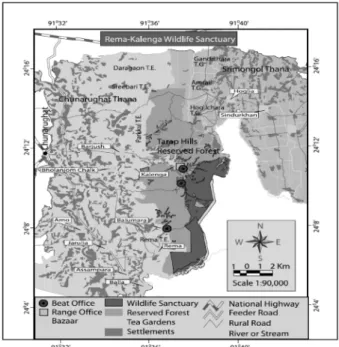
Fig. 1. Map Showing the Study Area (Source: NSP, 2007).
protected areas is a participatory approach to environ- mental conservation that seeks to enhance both natural resource conservation and local livelihoods. This approach gives local residents both the responsibility to manage their natural resources effectively and the opportunity to enjoy the benefits derived from them. Without the active involvement of local people, there is little chance for reducing their dependence on forests and guaranteeing the success of protected area initiatives. A great number of environmentalists, non-governmental organizations and national governments worldwide have begun to empha- size the importance of local people’s participation in decision- making and management of protected areas (Svarstad et al., 2006).
Bangladesh has faced significant losses in natural resources and biodiversity over the last few decades. A major reason for this environmental degradation is that many people have been left out of the conservation process (Roy, 2004).
Not surprisingly, these people have decided not to cooperate with conservation efforts that they may adversely affect their own livelihoods. To address this issue, and to engage local stakeholders as partners in the management of pro- tected areas (PAs), the Forest Department has initiated a nationwide co-management initiative called the Nishorgo Support Project (NSP). NSP has been working in five PA pilot sites since 2004 to involve local stakeholders that are directly or indirectly dependent on forest resources in activities to improve their livelihoods. The primary goal of NSP is to promote the conservation of biodiversity within the PAs of Bangladesh. In addition, one of the project’s five key objectives is to “strengthen the local economy and to better the living standard of local stakeholders”
(NSP, 2007).
In Rema-Kalenga Wildlife Sanctuary, NSP provide oppor- tunities for alternative income generating activities and simultaneously promote forest protection. This study examines how co-management improves their livelihoods by enhanc- ing their participation, their income-generating potential and playing role in forest conservation. The goal of this study is to influence policy-makers to give more emphasis to manage the rest of the protected areas by co-manage-
ment and thereby enhance the forest conservation process and quality of livelihoods for all people living in and around the PAs of Bangladesh.
MATERIALS AND METHODS Study area
Rema-Kalenga Wildlife Sanctuary (RKWS) is located approximately 130 km east-northeast of Dhaka and 80 km south-southeast of Sylhet in Chunarughat Thana, a sub- district of Habiganj District, Sylhet. The sanctuary is bounded by Tripura State (India) to the south and east, and Kalenga Forest Range to the north and west. Geographically, the area lies between 24°06'-24°14' N latitude and 91°34'- 91°41' E longitude (Figure 1). The area falls under the Sylhet Hills zones (IUCN, 2002) and the administrative area is known as the Rema-Kalenga Forest Range. The sanctuary is located in the Tarap Hill Reserve Forest, which was established under a declaration of the Forest Act of 1927. In 1982, the government designated 1,095 hectares of the Reserve Forest as the Rema-Kalenga Wildlife Sanctuary. There are about 7 species of amphibians, 18 species of reptiles, 167 species of birds, 37 species of
0 5 10 15 20 25 30 35
Agro farming
fuelw ood collection
nursery raising
cattle rearing
fisheries Day labour
others Livelihood activities
Percentage
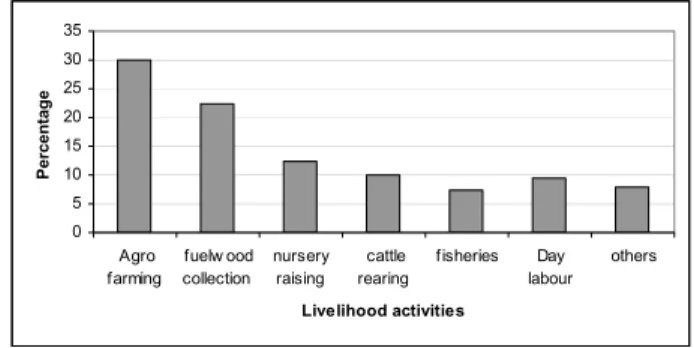
Fig. 2. Livelihood activities in the area.
1% 9%
23%
67%
Building w ith RCC roof Tin shed
Mud w all w ith tin
Sun grass thatched cottage w ith mud
Fig. 3. Housing pattern of Rema-Kalenga Wildlife Sanctuary.
mammals in the WS (NACOM, 2003). The vegetation of the sanctuary is described as tropical evergreen and semi evergreen forest dominated by Chapalish (Artocarpus chaplasha), Garjon (Dipterocarpus turbinatus), Bonak (Schima wallichii), Hargoja (Dillenia pentagyna) and Kakra (Aporusa dioica) and characterized by many giant climbers (Uddin, 2002). There are eight small indigenous groups (ethnic) living inside and outside the sanctuary. They are the Tripura (or Deb-Barma), Santal, Urang, Kharia, Kurmi, Goala, Munda, and Bunargi.
Required Data
Regarding livelihood activities, the study was focused on collecting the following data from each household viz.
demographic information, forest dependent livelihood activi- ties, resource collected from the Rema-Kalenga Wildlife Sanctuary, dependency level of the forest poor. We classi- fied households into three forest dependency classes: “highly dependent”, “moderately dependent”, and “less dependent”.
To calculate a household's level of forest dependency we considered the contribution of forest to the household's annual cash income i.e., the direct cash derived from sell- ing of forest products, and the cash value of products they consume from forest which they may have otherwise pur- chased from the market. We also considered local people’s perceptions regarding their dependency on forest. Besides this for impact of co-management studies the following data from each household were collected: people’s response under various beneficial schemes such as Changes in income level, Changes in forest dependency and consumption level
Data collection
In Rema-Kalenga Wildlife Sanctuary, Out of 36 villages we selected 11 villages randomly (sampling intensity was 31%). These villages are Kalibari, Mongoliabari, Chokidarbari, Chonbari, kalenga, Krishnochura, Hatimara, Himalia, Rashidpur, Goramchori, Horinmara. We surveyed 272 house- holds in these villages (Incase of households survey, sampl-
ing intensity was 100%). We then collected primary in- formation from key informants and engaged in focus group interviews. We conducted 11 Focus Group Discus- sions (FGDs) to learn about the livelihoods, impact of co-management and forest conservation. We also use semi- structured questionnaire.
RESULTS
Community livelihoods of Rema-Kalenga Wildlife Sanctuary
Local propels of RKWS depend substantially on the park for maintaining their livelihoods. The major income generating livelihood activities were agro farming (30%), followed by fuelwood collection (22.50%), nursery raising (12.5%), cattle rearing (10%), fisheries (7.50%) and others (Figure 2).
The people are live in their own houses in the villages;
they are not tenant. Four categories of houses were identi- fied in our study area. Among these four housing pattern Sun grass thatched cottage with mud represent the highest percentage (67%) (Figure 3). The tribal people are pre-
91%
8% 1%
Highly dependent Moderately dependent less dependent
Fig. 4. Forest dependency level of respondents in the study areas of RKWS
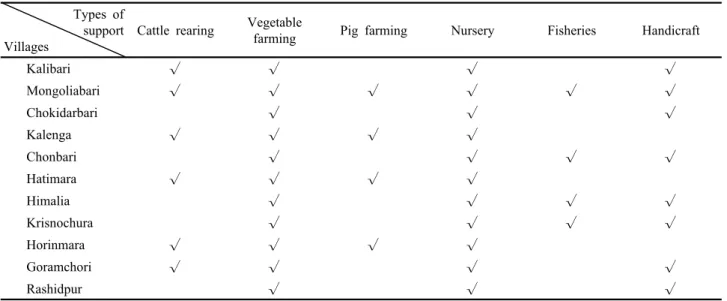
Table 1. Nishorgo field of support to generate alternative income of the study area Types of
support Villages
Cattle rearing Vegetable
farming Pig farming Nursery Fisheries Handicraft
Kalibari √ √ √ √
Mongoliabari √ √ √ √ √ √
Chokidarbari √ √ √
Kalenga √ √ √ √
Chonbari √ √ √ √
Hatimara √ √ √ √
Himalia √ √ √ √
Krisnochura √ √ √ √
Horinmara √ √ √ √
Goramchori √ √ √ √
Rashidpur √ √ √
ferred to live in this type of house because of low con- struction cost, locally available materials.
Dependency of Households on Forest
Considering the livelihood dependency level on Rema- Kalenga Wildlife Sanctuary, study revealed that, about 91% of the respondents were highly dependent (such as food, fodder, fuelwood, medicine, building materials and these are mainly NTFPs) for their livelihoods whereas the remaining households were found to be moderately (8%) and less (1%) dependent (Figure 4). In Satchari National Park Bangladesh 13% respondents were fully dependent for their livelihoods followed by 16% moderately and 71% are less dependent (Mukul, 2007) which is opposite scenario from these study findings.
Impact of co-management: A Nishorgo initiatives in Rema- Kalenga Wildlife Sanctuary
Nishorgo have launched various motivational programs in the study area. These supports include capacity building of local inhabitants (i. e. decision making, tourist guiding, home gardening, different rearing etc.), infrastructure develop- ment and creating alternative income generating sources in the area. Nishorgo has formed some co-management committee involving members from grass root level. The members represent their communities (as they are selected by election process) and are now actively contributing park management meetings. Again, Nishorgo have formed some forest-patrolling group in the Wildlife Sanctuary. People who formerly were engaged in illegal logging activities in Wildlife Sanctuary are now protecting the forest by a monthly salary basis (2000 Tk/ month). Nishorgo have facil- itated development of eco tourism as an enterprise. They arrange some hiking trial in the Park, identify and develop some picnic spot, develop public facilities such as toilet, building eco cottage, and trained local educated youths as eco tour guide. To create alternative income opportunities they trained local people for cattle farming, fisheries, vege- table farming, nursery management, pig farming, handi- craft training etc. They also give financial assistance to local villagers to start these activities. Table 1 lists the
Incime level of the villages
0 2000 4000 6000 8000
Kalibari Mongoliabari
Chokidarbari Kalenga
Chonbari Hatima
ra Hima
lia Krisnochura
Horinmara Goramchori
Rashidpu r
Villages
Past average income Present average income
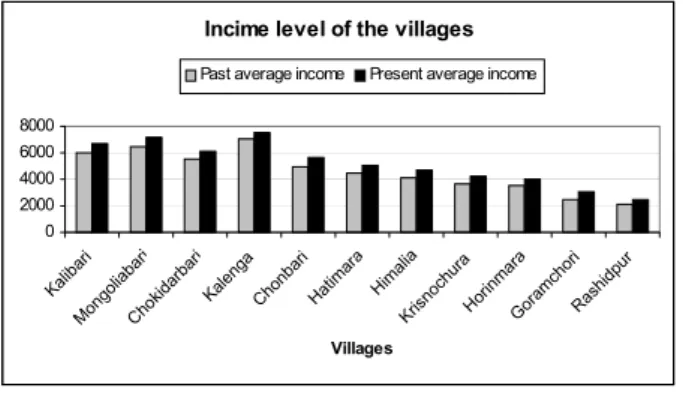
Fig. 5. Changes in income level.
0 50 100 150 200 250
Kalibar i
Mongol iabar
i
Chokidarbari Kalenga
Chonba ri
Hatimara Himalia
Krisnochur a
Hor inmara
Gor amchori
Rashi dpur
Villages
Kg/month
Last year (Kg/month) Present year (Kg/month)
Fig. 6. Changes in forest dependency and consumption level.
name of some AIG supports in our selected villages
Some qualitative and quantitative outcome of the area:
A comparative analysis
Changes in income level:
In the wildlife Sanctuary households (HHs) have diverse occupational pattern. After the co-management activities being implemented the average income level of our studied villages have increased on average 578Tk/household. Their past and present average monthly incomes were 4581 and 5159 Tk/household respectively (Figure 5).
Changes in forest dependency and consumption level:
People of the study area depend traditionally on forest for fuelwood, fodder, fruits, timber and other minor forest product. After the co-management activities being imple- mented the dependency level of the study areas have re- duced significantly. Due to higher earning from non- forest
sources people are now lastly dependent on various forest products. Figure 6 compares the average consumption level of major forest produce in our studied villages.
DISCUSSION
Our results paint an interesting picture of the role of co-management for livelihoods and forest conservation by the communities under study (Figure 5 and Figure 6). In the 1980s, conservation organizations tried to develop new PA management approaches (i.e., participatory management) that would support local people through alternative income generating activities to compensate them for their loss of access to PA resources. The economic benefits from these activities are intended to reduce people’s dependency and therefore their negative impacts on PAs (Svartad et al., 2006). In Rema-Kalenga Wildlife Sanctuary, the Forest Department has initiated co-management initiative (Table 1) called the Nishorgo Support Project (NSP) which give support to the local people through alternative income generating activities which ultimate reduce dependency on forest and also give economic benefits. In this way co- management approach improve livelihood condition and conserve forest by reducing forest dependency.
CONCLUSION
Forest and adjacent peoples are scrupulously related.
No initiatives towards conserving forests, throughout the world, have been successful without the active participation of the local people. The result of our study indicates a slow change in the local peoples living style and forest dependency but it surely it indicates a change in the over-all situation of the area, i.e. local livelihood pattern, forest dependence and forest conservation. In addition, the approach is still in its initial stage, there is a lot of a thing still to work. Although local peoples are now actively involve in decision-making process but for an efficient and lasting co-management system it requires more con- sideration on local demands.
ACKNOWLEDGEMENTS
The authors deem their heartfelt gratitude to Mr. Md.
Sharif Ahmed Mukul, Department of Forestry and Environ- mental Sciences, Shahjalal University of Sciences and Tech- nology, Sylhet, Bangladesh for providing necessary litera- tures during manuscript preparation. Finally, we appreciated the hearty cooperation of the residents of Rema-Kalenga area during the time of our field data collection.
LITERATURE CITED
Borrini-Feyerabend, G. 1996. Collaborative Management of Protected Areas. Tailoring the approach to the context, IUCN, Gland, Switzerland, 85 pp.
Chape, S., Blyth, S., Fish, L., Fox, P. and M. Spalding. 2003. United Nations List of Protected Areas, IUCN, Gland, Switzerland and Cambridge, UK and UNEPWCMC,Cambridge, UK. ix + 44pp.
Gadgil, M., Berkes, F. and C. Folke. 1993. Indigenous Knowledge and Biodiversity Consrvatio. Amb 22(2/3):151-156.
IUCN. 2002. Bioecological Zones of Bangladesh. IUCN, Dhaka, Bangladesh, 144 pp.
IUCN. 2000. Program on Protected Areas. Annual Report IUCN, Gland, Switzerland and Cambridge, UK, 12 pp.
Kothari, A., Singh, N. and S. Suri. 1996. People and Protected Areas: Toward participatory Conservation in India. Sage Publica- tion, New Delhi, India.
Lewis, C. 1996, Managing conflicts in Protected Areas. Keystone Center and IUCN, Gland, Switzerland, 100 pp.
Mukul, S. A. (2008). Bridging Livelihoods and Forest Conservation in Protected Areas: Exploring the role and scope of non-timber forest products. Field experience from Satchari National Park, Habigong, Bangladesh. B.Sc. (Hons.) Project paper, Department of Forestry, Shahjalal University of Science and Technology, Sylhet. Bangladesh. 95 pp.
Mulongoy, K. J. and S. P. Chape. 2004. Protected Areas and Biodi- versity: An overview of key issues. CBD Secretariat, Montreal and UNEP-WCMC, Cambridge, UK, 52 pp.
NACOM. (Nature Conservation Management) 2003. Site Level Appraisal for Protected Area Co-Management, Rema-Kalenga Wildlife Sanc- tuary. Prepared for International Resources Group, Dhaka press, Dhaka Bangladesh.
NSP. 2007. Making Conservation Work: Linking Rural Livelihoods and Protected Area Management in Bangladesh. Nishorgo Support Project, east west center, Dhaka, Bangladesh. 176 pp.
Roy, M. K. 2004. Designing a Co-management Model for Protected Areas in Bangladesh. International Seminar on Protected Area Management, University of Montana, USA, pp. 9-22.
Scherr, S. J., White, A. and D. Kaimowitz. 2004. A New Agenda for Forest Conservation and Poverty Reduction- making markets work for low-income producers. Forest Trends, Washington, D.
C., CIFOR, Bogor and IUCN, Cambridge, UK. 35 pp.
Svarstad, H., Daugstad, K., Vistad, O. I. and I. Guldvik. 2006. New protected areas in Norway: Local participation without gender equity. Mount Res and Deve 26(1):48-54.
Tuxill, J. and G. P. Nabhan. 2001. People, Plants and Protected Areas:
A Guide to In Situ Management. Earthscan press, London, UK, 248pp.
Uddin, M. Z. (2002). Exploration, Documentation and Germplasm Collection of Plant Genetic Resources of Rema-Kalenga Wildlife Sanctuary (Habigong) in Bangladesh. Ph. D. Thesis, Univ. of Dhaka, Bangladesh. 250 pp.