* Corresponding author: (E-mail) [email protected]
Usufruct Rights Conflicts during the Exploitation and Management of Forest Parks in China
Hao Zhang1* and Bong-woo Park2
1Law Department, Beijing Forestry University, P.O. Box 637, No.35 East Tsinghua Road, Haidian District, Beijing, 100083, P.R.China
2Landscape Architecture Program, College of Forest & Environmental Science, Kangwon National University, Chuncheon, 200-701, KOREA
ABSTRACT : Forest parks are regarded as one of the scientific ways to keep the forest sustainably developed, meanwhile deliver the benefits to the general public. The development of forest parks in China has experienced simply more than 20 years and both the exploitation and management institutions haven’t been set up systematically, which, in reality, reflects as inadequate legislative and policy framework. Without the regulatory guidance and collaborating assistance of environment relating governmental sectors at both national and local levels, it’s inevitable that the development of forest parks in the country would face constant problems and conflicts. Therefore, it might be helpful to sort out this conflicts and problems and further more to work out how to solve the barriers. The research in this report started with introducing the IUCN Protected Areas Categories, the overall current situations in China and compared the definition of forest parks in the country and that in international experience. It is to aim to find out the real usufruct rights conflicts during the exploitation and management of forest parks and the method used in this report is field visit, previous investigation, collecting secondary materials, interview, analysis and comparison. The research result in this report couldn’t cover all the conflict situations during the forest parks’ exploitation and management in China but will provide the analysis of this problem from the legal perspective. Practical application and concerning suggestion will be fully discussed in Part 5 in terms of legislative, social and environmental effects.
Keywords : Forest park, Usufruct right, Exploitation and management, Conflict
Abbreviations: IUCN: The World Conservation Union; SEPA: State Environment Protection Administration; SFA: State Forestry Administration; EIA: Environmental Impact Assessment
RESEARCH INTRODUCTION
China has made rapid progress in establishing forest parks. In 1982, the first forest park, known as Zhang Jia Jie National Forest Park, was licensed to be established in Hu Nan Province (Zhang, 2003). Till 2004, there are a total of 1540 forest parks in China, 503 of which are National Forest Parks. The total number then increase to 1928 by the year 2005 which takes the land size of 15,134, 200 hm2. The annual number of tourists in all over the forest parks reaches 174, 000, 000, which is up to 14.3% of all the tourists in the country. The numbers above are deeply stimulating while the exploitation and
management of forest parks are quite the opposite. An increasing number of experts are now studying the area of forest parks establishment. However, comparing to that of foreign countries, like USA, UK and other developed areas, the development of forest parks in the country still leaves much to be desired. The direct indication is that the legal framework and other affiliated institutions haven’t been fully set up to follow the steps of the fast boosting forest eco-tourism industry. Thereby, analyzing the current of legislations and sorting out the real conflicts in this area would be worthwhile from the study of legal effect- iveness and perspective.
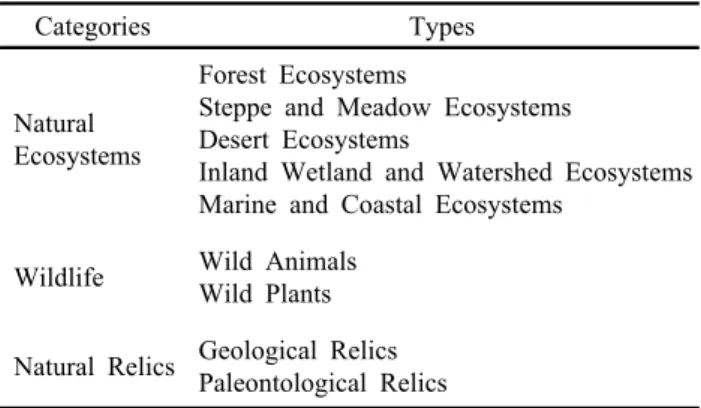
Table 1. Categories and types of natural reserves in China.
Categories Types
Natural Ecosystems
Forest Ecosystems
Steppe and Meadow Ecosystems Desert Ecosystems
Inland Wetland and Watershed Ecosystems Marine and Coastal Ecosystems
Wildlife Wild Animals Wild Plants
Natural Relics Geological Relics Paleontological Relics
FOREST PARK IN CHINA AND THE GENERAL BACKGROUND
China is now working hard to maintain the healthy ecosystem with various kinds of methods, one of which is known as Forest Parks. Lots of scientists and experts proclaim that the future of China depends on the consistent maintaining of the balanced ecosystem. Forests, as the main composition of the land ecology, ensure China’s supply of wood, forestry, fresh air and reducing the carbon. Recognizing all the importance, China has made great progress in constructing the Forest Parks since the first one Zhang Jia Jie National Forest Park came into being in 1982. Comparing to the first National Park in the world, the Yellow Stone National Park in USA which was established in 1872, China still has a long way to keep the conservation of the natural resources rationally and scientifically.
1. IUCN standard categories relating to forest parks
IUCN now complies six protected area management categories. The protected area could be defined as “An area of land and/or sea especially dedicated to the pro- tection and maintenance of biological diversity, and of natural and associated cultural resources, and managed through legal or other effective means.” As long as a site belongs to the above definition, it could be then classified by its primary management objective into one of the six categories, of which the category II defines the content of National Park and the category VI defines the Managed Resource Protected Area. National park is the protection area managed mainly for ecosystem protection and recreation – natural area of land and/or sea designated to (a) Protect the ecological integrity of one or more ecosystems for present and future generations, (b) exclude exploitation or occupation inimical to the purpose of designation of the area and (c) provide a foundation for spiritual, scientific, educational, recreational and visitor opportunities, all of which must be environmentally and culturally compatible. Managed Resource Protected Area
is the protected area managed mainly for the sustainable use of natural resources – area containing predominantly unmodified natural systems, managed to ensure long-term protection and maintenance of biological diversity, while also providing a sustainable flow of natural products and services to meet community needs (IUCN, 1994).
Since assignment to a category is determined by its management objective, it is not a comment on management effectiveness. The IUCN category is standardized for inter- national use which is therefore general rather than specific and could be applied flexibly (Phillips, 2002). According to the functions of Forest Parks mentioned in the Inter- national Experience, the multiple functions of forest parks could be somehow related to the Category II. There arises the question on how to apply the categories in China, especially how to definite the Forest Parkat different levels, which has its own meaning for further analysis of the administration, ownership, usufruct and their current conflicts.
2. Forest parks in China and the national standards
According to the national standards (GB/T 14529-93, 1994)issued by the SEPA in 1993, protected areas can be divided into three categories and nice types. Nevertheless, the establishment and management legislation on this issue hasn’t been updated. In other words, the applicable regulations are not distinguishable on the basis of their objectives of establishment and therefore, there is a great gap between the current situations and legislative requirements. The three categories and nine types are drafted in Table 1 below:
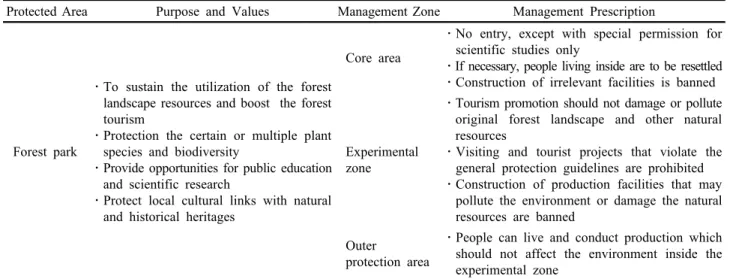
Table 2. Purpose, values and management prescription of forest parks.
Protected Area Purpose and Values Management Zone Management Prescription
Forest park
・To sustain the utilization of the forest landscape resources and boost the forest tourism
・Protection the certain or multiple plant species and biodiversity
・Provide opportunities for public education and scientific research
・Protect local cultural links with natural and historical heritages
Core area
・No entry, except with special permission for scientific studies only
・If necessary, people living inside are to be resettled
・Construction of irrelevant facilities is banned
Experimental zone
・Tourism promotion should not damage or pollute original forest landscape and other natural resources
・Visiting and tourist projects that violate the general protection guidelines are prohibited
・Construction of production facilities that may pollute the environment or damage the natural resources are banned
Outer protection area
・People can live and conduct production which should not affect the environment inside the experimental zone
3. Management divisions
Clause 18 of the 1994Regulation on natural reserves which is applicable to all types of “protected areas” in China specifies that three parts should be composed of in a protected site: the “core area”, the “buffer zone” and the “experimental zone”, which indicates the truth that the zoning system under the Man and Biosphere (MAB) Programme exerts the influence on the zoning planning in the country. In addition, it also mentions that if necessary, certain amount area surrounding the natural reserves can be designated as the “outer protection area” which is not obligatory thus could be used as an optional zone lying outside the natural reserves.
In the real practice it’s not always the case that all natural reserves have the “three zones” which mentioned above. Article 30 of the 1994 regulation on natural reserves set its target by regulating the sites which are not divided into the required three parts to apply the terms governing either the core area or buffer zone, making them as strictly protected natural reserves. In most cases, the natural reserves (forest parks and other forest ecosystems) established by the SFA and its units in provinces are only divided into the core area and the experimental zone and they do not use the buffer zone in reality. (Xie, Y., 2004)
The forest parks are obviously intended to promote
visitors enjoy the beautiful natural forest sights and use the corresponding facilities and infrastructure within the sites. In addition to the recreation and tourism, the forest parks play the role of protecting biodiversity, natural resources and the environment in general. The values, purpose and management prescription could be easily noticed in the table 2, which provides the clear and full view of thecontext of forest parks in the country.
Based on the outlines mentioned in table 2, the two places of the field visit in Beijing could be categorized as follows.
Fragrant Hill Park is the typical site known as “Outer protection area” which is only the outskirt of the dramatic West Mountain National Forest Park in Beijing. It’s famous for the red leaves in autumn and attracts thousands of Beijing citizens and tourists from other places. One of the serious problems in that area is the natural resources management and protection during the peak time of tourism and its sustainable development. Jiu Feng National Forest Park is the integrated site for all the three management zones even though the boundaries are not that clear. The existing problem in that area is the relationship between the local communities and the forest park.
From the above analysis and integrating the table 2, the conclusion could be easily drawn that the forest park in China would qualify to be category II as National Parks.
Nonetheless, due to the prevailing of land use in the most
forest parks in the country, it could also be categorized to the category VI. Thus forest parks in China could refer to the Category II and Category VI in the IUCN system and then have the own content of meaning.
The definition of forest park could also be found in the official regulation as below: Forest Parks in China are the sites to protect forestry areas of national or international significance for spiritual, scientific, educational, recreational or tourism purposes and take into account the needs of local residents without adversely affecting the other objectives of the establishment and management.
USUFRUCT RIGHT CONFLICTS DURING THE PROCESS OF FOREST PARK EXPLOITATION
AND MANAGEMENT
Forest parks are regarded as the one of the most potential developing sites in China. According to the marvelous increase of forest parks quantity and annual soaring of tourists, central authority and forestry administration pay more attention to the area and the earliest forest park management office was established in SFA (previously called MOF – Ministry of Forestry) in 1992 (Jiang, 2003).
After more than ten years’ development, the framework of systematic management (including establishment and manage- ment) is still undergoing. At present, the important role of forest parks and other protected areas in our economic and social prosperity hasn’t been fully recognized. Comparing to other tasks of national development, the establishment and management of forest parks are still inferior to other parts. In the legislation aspect, the current legislations and rules are not feasibly enforced for the simple reason that some of the legislations and rules are merely concerning the principles and not very applicable. There is no such kind of legislations concerning the forest parks particularly at the national level. The only existing guidelines are the administrative rules of State Council and orders of SFA, which also reflects the weak, inadequate and non-effective means of legal framework for the forest parks in the country based on the current circumstances.
The significant multiple importance of forest parks have
been recognized by SFA, while the establishment and management of forest parks are still facing lots of barriers and difficulties, which result from the current lack of relating systematic policy, legislative and regulatory frame- work during the process of forest park exploitation and its management. The following questions could lead us to analyze theproblems and conflicts in the real practice in China.
1. Who has the right to exploit the forest park?
Based on the Order 16 of SFA (On the license and management of establishment, cancellation, merge and modifying categories of Forest Parks at the national level, 2005), owners or users of forest or forest land have the privilege of applying for the establishment of national forest parks (Zhang, 2002). The licensing power of forest parks at three levels could be referred to the corresponding forest administrative sectors at national, provincial, city and county level. Most forest parks have the vast lands within the area, except for those only established on the state owned forest lands managed by national forest farm belonging to the SFA and its local units. It’s inevidf that nearly all other forest parks’ exploitations involve the usage of collectivity owned land or the land on which individuals have the use right for the establishment and plan should keep the integrated forest scenic sights and other resources as a whole. Thus the solution to the conflicts of ownership and use right would be regarded as the prerequisite, nonetheless, in reality, the situation is quite different.
Under the Constitution of China, all land belongs to the state, but different individuals, organizations and communities may have various rights and privileges over land use to make decisions on how to use land and its resources. The core reason of this problem is the conceptual definition of
“state ownership”which is not concretely regulated on how to enforce such description in different legislations, regulations and policies at national, provincial and local levels. The present complexion is that the sectors of central government at different levels represent the state to enforce the state ownership and enjoy the land-use right. Therefore
most forest parks in the country do not have control over land use and could be easily affected by the commercial or public oriented activities around or even within the forest parks.
The exploitation of forest parks hasn’t been directly connected with the overall plan of land useat the national, provincial, city and county levels. Some of the local units have the overall plan for the establishment of forest parks, while these plans merely serve for the attracting of the national investment and neglect formulating of the regional regulations or policies on the protection of biodiversity and their target of conservation and management remains unidentified. This is often regarded as the first conflict to the chief objective of forest parks - the area of land is dedicated to the protection and maintenance of biological diversity and to the protection and maintenance of natural and cultural resources.
2. How is the relationship between the forest parks and local communities?
The principle guidance of establishing forest parks is the so called “isolating management” which could be refer to the forbidden to the general public to enter some certain areas (core area & experimental area) and the tourists should follow some general guidance as well during the forest park recreation. Nearly all the forest parks in China are developed based on the foundation of the original forest farms which are mainly situated in the relatively sparsely populated areas where poverty remains a vital issue (Zhao, 2006).
The relationship between local people and forest parks is subtle. On one hand, one important aspect of the relationship between local people and forest parks is that forest parks can reduce assets and opportunities ofrural people through excluding them from getting access to previously used resources. On the other hand, for instance, in some of the less developed areas, community rights are strong enough and traditional land use may have been adopted long before the land use institution established, even
though the use rights have never been certified by the land administrative sectors of local governments. Many farmers extended their farm lands unconsciously which beyond the certified limit of their land use, doing harm to the land use of forest parks. Yet history has shown that even if various methods have been used to prevent such kind of behavior, rural people are remarkably resilient and will find ways to acquire the resources they need. The overlapping use rights of land and resource is a source of considerable management limitation and sometimes conflicts of the interests between forest parks management and local communities (Wang, 2004).
3. If it’s always the case that the objectives of local government and the forest parks keep nearly the same, how to judge the influence exerted from the government sectors?
Many government sectors have influence over land use and development within and around forest parks, and they have various missions and programmes, all designed for the public welfare. In real practice, problems and conflicts are created for forest parks development when sectors in local governments always have priority over land use and sometimes powers in different sectors are overlappedwhich conflicts with the objectives of forest parks. For example, the policy of reforestation, while apparently beneficial to forest parks, may have unexpected effects when it involves planting exotic species or makes the monocultures inside the forest parks that should devoted to diverse natural forests.
Major development projects often have negative impacts upon existing forest parks, and powerful departments are able to ride roughshod over the legislation with impunity, inflicting damage on forest parks and the surrounding environment in general. There are also a few examples of forest parks over-ride the national policy, but these are exceptions. The overall pattern is that large infrastructure projects often go ahead regardless of forest parks. At this time, EIA is often used merely to design for mitigation measure, which isnot as a tool to decide whether the project will be carried out or not.
4. Is it an effective way to resolve the existing conflicts and con- tradictions by commercializing the exploitationand anagement of forest parks?
In the social economic development, there is a new trend to recognize that the core reason for the conflicts and contradictions is that the developments of forest parks are far below commercialization. The operation and management right of forest resources refers to the right to operate forest tourism resources during a certain period of time and have the rights of possession, use and derive profits, which is a legal usufruct right. The generalized rights to operate and manage the development of forest parks could be expressed in two forms: one is called the management right of forest parks which have been fully exploited and developed; the other is indicated to the usufruct right of forest resources which have not been exploited. Both the forms of usufruct rights should follow the state-owned principle as their prerequisite and rights of use, making profits and disposition should be strictly restricted by the contracts and regulations (Chen, 2006).
Transference of the usufructuary rights of forest parks have been adopted by many provinces as an encouragement of forest parks development and several provinces have already made regulations and policies at provincial levels to regulate the transfer of the sites. The first transfer which could be traced back by the official documents happened in 1999. The transference then becomes increasingly more while facing lots of problems which could be listed as below.
4.1 Illegal transfer
According to the Forest Law, the forests could be classified into the following five categories based on article 4 as the shelter forests, timber forests, economic forests, fuel forests and special-purpose forests. Forest parks could be categorized into the category of special- purpose forests as its functions servefor the protection, scientific approaches and other multiple eco-functions.
But this deduction couldn’t be supported by law until 2002. Article 15 further regulates the forests transfer in
details.
Where there is transfer and equity participation in terms of evaluation or those treated as conditions of contribution and cooperation of joint venture, cooperative afforestation and timber management pursuant to the provisions of the preceding paragraph, the timber felling permits obtained may be simultaneously transferred, meanwhile parties to the transfer must abide by the provisions of this Law concerning forests, timber felling and renewal of afforestation. Except for the circumstances specified in the first paragraph of this article, the right of use of other forests, woods and other forest lands must not be transferred. Another administrative announcement by SFA (Announcement on protection and management of forest scenic sites, 2002) further indicates that the forests, forest lands and woods inside the forest scenic sites belong to the category 5 of special-purpose forests. The transfer of usufruct rights of forest parks thus couldn’t be supported by the current legislation while have been adopted and carried out by many provinces (Yang, 2005).
4.2 Ultra vires disposition
Most of forest parks in China are established on the basis of the former state-owned forest farms (Zhang, 2006).SFA and its local units are the main sectors which take the responsibility to manage and maintain the forests withinthe stated-owned forests sites for more than 10 years. However, the decisions of developing forest parks which involves using the forestland and forest resources within the forest farms are mainly made by the local governments or other powerful bodies. This is the most common ultra vires disposition of national forest land without permission by the admission sectors of forest farms. The local governments, even though play the role of representing the country to enforce the usufruct rights, ought to let the forest administrative sectors know the transfer which is their basic civil right of learning the truth.
Another ultra vires power may refer to the rent-seeking power which could be derived from the non-public bidding behavior. One of the commercializing ways of forest parks is to put the exploitation and management into
contract and attract the public tenders. However, in the real practice the transfer of forest parks often unable to follow the general market rules of voluntary and mutually benefi- cial, but in order to successfully transfer, the transferee has already been identified in secret. There is no open tendering and bidding, or even the tendering and bidding is held, it is a mere formality.
4.3 Inappropriate compensation system
Most areas valuable for biodiversity are mainly located in remote regions where poverty is the headache for most of the local governments. In establishing and managing of forest parks, the relationship between resources protection and the needs of local residents should be fully recognized.
It’s inevitable that the local communities would suffer from the development of forest parks for the simple reason that their traditional access to natural resources would have been cut off since the forest parks came into development. All decisions taken by local authorities and developers need to consider the socio-economic context of the forest parks and the plans of forest parks should be prepared on the basis of giving particular attention to income sources of local people. The compensation system hasn’t been appropriately set up in China (Cao, 2006). Recently, the central government made its commitment to increase the Ecological Compensation Fund. Nevertheless, existing implementation of the fund mostly ignores the compensation of the local communities. The role of forest parks in the poverty alleviation should be treated according to sur- rounding circumstances, there is no panacea or universal solutions. Two possible ways to mitigate the current conflicts is either to seek for any forms of rural employment, such as cleaning work and other manual work, or provide direct compensation to the local residents (Chen, 2006).
4.4 Lack of supervision
The SEPA and SFA are responsible for coordinating and resolving conflicts among relevant environment related sectors and supervising conservation management effect- iveness. However, units at all levels in the environment protection sectors are facing the serious problem of a lack
of institutional and staff capacities on ecological con- servation, which has led to poor coordination among sectors on supervision of forest parks establishments. The lack of supervision exits in the transfer process as well, such as how the terms of contracts came into being, how long the transfer will last, no statutory provisions are available right now to refer to this problem (Xu, 2005).
Make the transfer duration as an example, due to the common practice, most of the transfer lasts around 50 years and some up to 70 years. The only possible regula- tion which could be seeking for guidance is the Interim regulation on remising and transfer on national lands in cities and towns, which setthe duration of land used for tourism of no more than 40 years. The transfer of forest parks would also change the original affiliation of forestry management system. Moreover, without the sufficient support of the legal framework, it’s becoming increasingly hard for the local forestry administration sectors to enforce the management rights. At the meantime, some local governments set barriers to the oversights of outsiders in order to maintain the investment environment and makethe forestry administration sectors incapable of supervising the forest sites, which results in that forest parks would become the blind spot of the management and supervision within the forestry system.
4.5 Insufficient evaluation standard
As to the transfer of forest parks, it’s necessary to have the forest sight assets evaluated and then propose the furthertransferring price. Technical Specifications of Forest Resources Assets Assessment (Interim) put forward by the SFA and the State-owned Assets Supervision and Administration Commission in 1996 brought forth the technical evaluation of forest resources assets, including existing market value method, estimating future profit method and resetting cost method. These methods have separately own characters, but still insufficient to fulfill the need of evaluating the forest parks. Thus, there is no generally acknowledged standard available to set the market price of forest resource assets and it’s difficult to establish a general-use market price either.
CONCLUSION
Many of the underlying of these immediate conflicts indicates the situations which activities that provide short term profit at the expense of long term sustainable de- velopment can be carried out within the current policy, legislative and regulatory framework, especially in the rush for economic development. Different departments and governmental sectors at different levels often pursue their work plan separately without taking into account the full impacts of their work and integrated development of forest parks. Legal ambiguities and weak law enforcement are large- ly responsible for much of this. Government departments’
failure to comply with regulations and policies has destruc- tive consequences for forest parks, therefore improving each level of government’s administrative competency, ensuring transparency of government actions for public understanding and scrutiny, is crucial for forest parks. Those conflicts and problems reflect the potential flaws of the development of our country. Solving the problems would be useful for the healthy progress and bring positive impacts to the es- tablishment of forest parks.
With the clearance of the different responsibilities of each level,the national level, the local government level and the community level. The conflicts during the exploit- ation and management of forest parks would be largely constrained and solved with the appropriate approaches.
The current situations are simply based on the backward of the legislations and lack of the relevant of the responsible institutions. It could be reasonably concluded that the future development of forest parks in China will be largely depending on the perfect of the applicable regulations and the corresponding institutions.
REFERENCE
Cao, Z. T. 2006. Original Research on Perfecting of Legislation Relating to Forest Right in China. Scientia Silvae Sinicae. 42(6):
94-97. (In Chinese).
Chen, B. L. 2006. Study on Implementing the Managerial Right of Forest Parks. East China Forest Management. 20(2): 60-62. (In Chinese).
Chen, D. H. and Yan, J.Y. 2006. On Exploitation Management of Eco-tourism in the Forest Park. Journal of Hunan Environment-
Biological Polytechnic. 12(2): 188-190. (In Chinese).
Available online at:
http://www.iucn.org/themes/wcpa/pubs/pdfs/iucncategories.pdf last accessed Mar.13th, 2009.
IUCN. 1994. Guidelines for Protected Area Management Categories.
IUCN and the World Conservation Monitoring Centre. Cambridge.
United Kingdom.
Jiang, Y. P. 2003. Study on the Development of Forest Parks and the Forest Resources Protection. Forestry Survey and Design (Fujian). (2): 51-53. (In Chinese).
Kaufman, H. 2003. The Forest Ranger: A Study in Administrative Behavior. Resources for the Future. Inc. New York. USA.
Principles for Classifying the Categories and Grades of Nature Reserves.
GB/T 14529-93.1993. SEPA. Beijing. China. (In Chinese).
Available online at: http://www.sepa.gov.cn/image20010518/4593.
pdf;last accessed Mar. 13th, 2009.
SFA Wildlife Protection Department. Fifty Years of Chinese Wildlife Protection. 2000. China Forestry Press. Beijing. China.
(In Chinese).
Wang, S. 1999. Conserving China’s Biodiversity. Chinese Environ- mental Sciences Press. Beijing. China.
Wang, S., Schei, P. and Xie, Y. 2001. Conserving China’s Biodi- versity (II). Chinese Environmental Sciences Press. Beijing, China. (In Chinese).
Wang, X. G. 2004. Study on the Forest Park Development and the Eco-tourism Management. China Forest Industry. (1): 33-35. (In Chinese).
Xie, Y., Wang, S. and Schei, P. 2004. China’s Protected Areas.
Tsinghua University Press. Beijing. China
Xu, J. 2005. Discussion on the Operation of Managerial Authority Transfer for Forest Parks. Green China. (14): 59-61. (In Chinese).
Yang, M., Yang, Y. F., Zhang, Q. and Song, B. P.2006. Research on the Management System and Organization of Forest Park.
Problems of Forestry Economics. 26(1): 12-17. (In Chinese).
Yang, Q. 2005. Thinking about the Managerial Rights in the Marketing of the Forest Tour Resources. Hebei Law Science.
23(4): 45-57. (In Chinese).
Zhang, C. H. 2006. On Managerial Rights Transfer of Forest Park.
Central South Forest Inventory and Planning. 25(4): 10-13. (In Chinese).
Zhang, L., Ke, J. H. and Wu, H. L.2002. Study on the Forest Ownership Problem. Forestry Survey and Design. 124(4): 11-12.
(In Chinese).
Zhang, Y. 2003. Research on Problems and Measures Faced in the Development of Forest Park. Problems of Forestry Economics.
23(4): 242-248. (In Chinese).
Zhang, Y. 2006. Study on Forest Right in National Key Forest Farms.
Forestry Science & Technology. 31(1): 62-65. (In Chinese).
Zhao, J. Y. 2006. On Sustainable Development of Ecological Tourism. Journal of Chengde Petroleum College. 8(2): 88-92. (In Chinese).
(Received January 21, 2009; Accepted October 19, 2009)