Environmental Science
Vol. 36, No. 2, pp. 163-172, June, 2020 https://doi.org/10.7747/JFES.2020.36.2.163
Development of Evaluation Criteria for Forest Education Using the CIPP Model
Soyeon Kim and Jungkee Choi*
Department of Forest Management, College of Forest and Environmental Sciences, Kangwon National University, Chuncheon 24345, Republic of Korea
Abstract
The objective of this study was to develop evaluation criteria for forest education using the Context, Input, Process, and Product (CIPP) model. To this end, we designed a survey based on expert advice and content analysis of previous studies on the CIPP model and forest education. The survey was conducted on 393 forest education specialists, and Cronbach’s coefficient was set as 0.6 or higher to verify reliability and validity, and to determine reliability by factor.
Eventually, 52 out of 57 evaluation items were extracted, and the evaluation indexes were selected through factor analysis as follows: four evaluation indexes for the context dimension, namely “Clarity of goal setting,” “Developing conditions for education,” “Meeting of requirements,” and “Institutional drive”; three evaluation indexes for the input dimension, namely “Acquisition of education infrastructure,” “Establishment of operational support,” and “Adequacy of assigned manpower”; four evaluation indexes for the process dimension, which were “Adequacy of budget allocation,”
“Expertise of forest education instructors,” “Diversity of programs,” and “Public-private academic partnership”; and five evaluation indexes for the product dimension, namely “Effectiveness of perception change,” “Influence over the society,”
“Continuity of improvement in evaluation,” “Continuity of education,” and “Verification of the effects of education.”
Key Words: forest education, CIPP model, evaluation criteria, evaluation index
Received: November 15, 2019. Revised: December 30, 2019. Accepted: January 5, 2020.
Corresponding author: Jungkee Choi
Department of Forest Management, College of Forest and Environmental Sciences, Kangwon National University, Chuncheon 24345, Republic of Korea
Tel: 82-33-250-8337, Fax: 82-33-259-5617, E-mail: [email protected]
Introduction
Forest education in Korea first began in 1990 under the leadership of the Korea Forest Service and targeted families and children via forest commentary. Currently, it is the era of forest education in the actual forest environment. Forest education is changing into lifelong education for adoles- cents in association with school education via interventions such as the Free Semester Program and creative activities (Korea Forest Service 2015). Moreover, the Forest Education Promotion Act was established to ensure that citizens ac- quire the right knowledge about forests and develop a prop-
er sense of their value, and to preserve forests in a sustain- able manner, thereby contributing to the development of the State and society and the improvement in the quality of life of citizens. This Act defines forest education as “education for experiencing, exploring, and learning about the various functions of forests to understand their importance, acquire knowledge about forests, and develop a proper sense of their value” (Korea Forest Service 2011). Among previous studies on the positive effects of forest education, Schreyer and Driver (1990) stated that forest experience helps re- duce stress, strengthen willpower, increase confidence and self-awareness, establish a sense of value, improve aesthetic
skills and leadership, develop a spirit of challenge and social skills, and improve physical health. Shin (1999) argued that forest education helps people overcome stress, feel a sense of accomplishment, and improve their self-esteem, self- concept, social adaptability, and self-control. Kim and Choi (2018) demonstrated the positive effects of forest education on elementary school students, whose attitudes toward for- ests and their own personality improved. Lee and Choi (2004) sought directions for various forest education pro- grams through recreational forests and Inoue et al. (2008) studied practical application review for forestry education in sustainable vocational high schools.
There is a growing demand for forest education, and the number of recipients is increasing every year. Continuous forest education must be accompanied by an evaluation process that reflects a comprehensive inspection and deci- sion-making process so that forest education can properly establish itself in the present situation. Without evaluation, the success of a plan or policy implementation cannot be de- termined, and there will be difficulties in establishing forest education plans in the future. Thus far, there has been in- sufficient research on evaluation criteria for forest educa- tion compared to other fields. Therefore, it is necessary to develop such criteria to increase the effectiveness of forest education and find ways to improve its functioning. The CIPP model was used to develop the evaluation criteria (Stufflebeam 1971). The CIPP model has been used worldwide since the 1970s, and its benefits are that it is more comprehensive than other evaluation models in terms of the scope of the evaluation target and capability in evalu- ating programs in various contexts, while it also allows a systematic approach between decision-making and evalua- tion (Bae 1994). The CIPP model is named after the first letters of four concepts, i.e., Context, Input, Process, and Product.
Research on the CIPP model has been conducted since the 1990s in Korea, and studies in the field of education policy have developed policy evaluation models for techni- cal and vocational education, and proposed evaluation cri- teria and index models (Cho 1992). Koo and Nam (2019) conducted research to develop a rating scale for the Free Semester Program in middle schools, Lee (2009) studied education and welfare policy evaluation, and Min (2002) studied evaluation of education policy and school
administration. Hecht (1975) established an evaluation pattern and system using the CIPP model to assess voca- tional education programs. Previous studies have mostly been related to education, and currently, many studies are being conducted in the field of education using the CIPP model. Developing evaluation criteria for forest education using the CIPP model may include overall evaluation fac- tors related to forest education and enable comprehensive assessment of various contexts in the educational setting, which is why this study selected the CIPP model as the evaluation model for forest education. Moreover, develop- ing evaluation criteria for forest education will not only help assess the implementation of forest education, but also en- able forest education operators to improve the quality of for- est education by providing a perspective on implementation.
Therefore, this study developed objective evaluation cri- teria for forest education by adopting the CIPP model to determine the key factors that affect forest education and use them in the decision-making process, while also im- proving the effectiveness of forest education and solving re- lated problems.
Materials and Methods
Research design
To develop the evaluation criteria for forest education, this study selected the evaluation factors and items based on literature review and expert judgment, and ultimately came up with evaluation indexes. In Step 1, we used the content analysis method to come up with the evaluation factors and items for forest education based on previous studies on the CIPP model conducted in Korea and overseas, as well as literature review on forest education. We reviewed and ana- lyzed the existing theories and studies to reduce errors in key factors that may arise from our subjective judgments, and the results were used as the basic data for the develop- ment of the evaluation questionnaire. In Step 2, we used the basic data from Step 1 to construct objective items with the help of five specialists, and verified the content validity to improve intelligibility and concreteness. In this process, we eliminated and modified items with unclear content based on multiple reviews. We also developed evaluation factors and items by modifying and improving the CIPP factors and items considering conformance with the research ob-
jectives, redundant items, adequacy of evaluation items, elimination or integration, shift to another category, gram- matical errors, etc. The context, input, process, and product components of the CIPP model were set up as evaluation dimensions. We came up with evaluation factors suitable for forest education based on the items that passed through Step 2 of the research design, and selected the evaluation items. These evaluation items were rated on a 5-point Likert scale (1: Strongly disagree, 2: Disagree, 3. Neutral, 4: Agree, 5: Strongly agree). In Step 3, a survey of forest education specialists was conducted, and we classified the survey items into factors through validity and reliability analysis to select evaluation indexes. Each of the classified factors was labeled to come up with the evaluation indexes that represented the evaluation items. The goal of applying the CIPP model to forest education was to improve and promote the growth of certain systems or programs, rather than demonstrate an important purpose, by providing in- formation and systematic feedback to responsible stake- holders of the system. It is a useful evaluation model for ful- filling major needs or maximizing utility, as well as im- plementing policies or making improvements.
Research subjects and data collection
Subjects of this study were forest education specialists (forest commentators, infant forest advisors, and forest trekking guides) with expertise in forest education. The survey was conducted on March 20-29, 2019, and an on- line questionnaire was prepared and sent to participants in a different region. A total of 309 copies of the questionnaire, 222 offline and 87 online, were collected. To obtain accurate results, we analyzed 293 questionnaire copies (95%) after excluding non-responses and insincere responses.
The basic survey comprised six items that investigated gender, age, career, field, main recipients of education, and main region of education. The main survey, which was structured using the CIPP model framework, comprised 13 items in the context dimension, 12 in the input di- mension, 16 in the process dimension, and 18 items in the product dimension. The results of the basic survey showed that 69% of the respondents were women and 31% were men, most of whom were in their 40s (14%), 50s (48%), or 60s and older (36%). As for career, 26% of the subjects had less than 2 years of experience, 31% had 2 to less than 5
years, 28% had 5 to less than 10 years, and 16% had at least 10 years of experience. The forest education specialists con- sisted of forest commentators (69%), infant forest advisors (26%), and forest trekking guides (5%). Recipients of for- est education were preschool children (53%), elementary school students (5.5%), middle school students (0.7%), high school students (0.3%), adults (7.2%), and everyone (from preschool children to adults) (33%).
Method of analysis
Development of evaluation criteria using content analysis In addition, the term “evaluation criteria” is also referred to as evaluation indicators, evaluation standards, evaluation fields, evaluation dimensions, evaluation categories, evalua- tion items, etc., and they may be used interchangeably or with hierarchical relevance (Choi et al. 2007; Lim 2007).
It is also referred to as a desirable scale or standard of value that must be followed in a policy decision or evalua- tion (Seo 1987). In some cases, it is defined as a goal that must be achieved, or the anticipated level of desirable be- havior or achievement (Korean Council for University Education 1995). To sum up, establishing evaluation cri- teria in forest education means to design evaluation items by systemizing and clarifying the standard factors of evalu- ation for forest education. Establishing the evaluation cri- teria is a basic task in evaluation, and concrete and specific evaluation criteria facilitate systematic judgments by pro- moting communication. In this study, the definition of eval- uation criteria is used as a concept that represents all of the following: evaluation dimensions, evaluation factors, evalu- ation items, and evaluation indexes.
Development of evaluation indexes using validity and reliability analysis
The data were coded to verify empirical data using the SPSS 23.0 program. Frequency analysis was conducted on the questionnaire completed through content analysis and preliminary survey to obtain descriptive statistics. Factor analysis and reliability analysis were used to determine the validity and reliability of the forest education evaluation cri- teria for the questionnaire evaluation items. The purpose of factor analysis is to summarize the data by integrating mul- tiple variables into a few groups. The results of factor analy- sis on a total of 293 copies of the questionnaire showed a
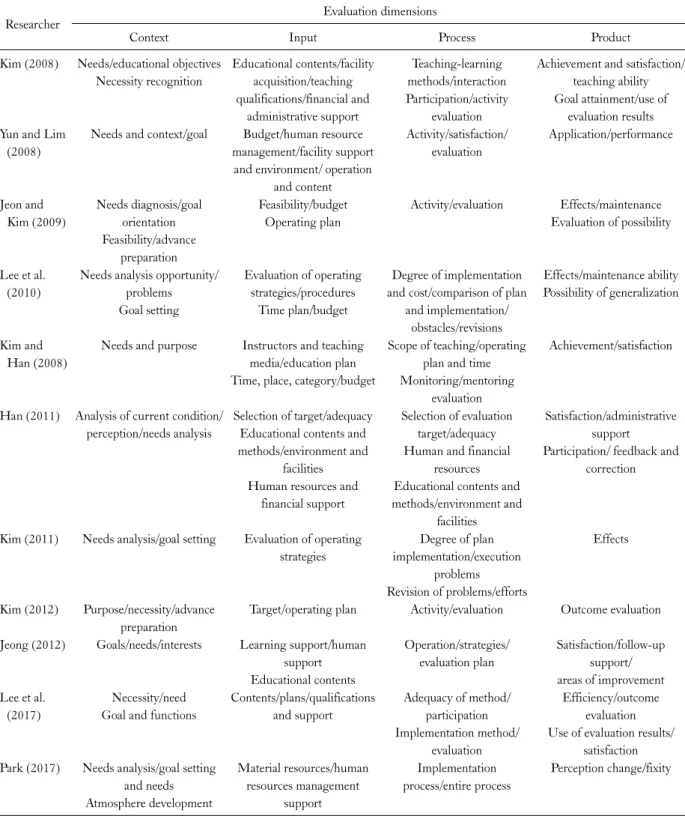
Table 1. Evaluation dimensions of the CIPP model
Researcher Evaluation dimensions
Context Input Process Product
Kim (2008) Needs/educational objectives Necessity recognition
Educational contents/facility acquisition/teaching qualifications/financial and
administrative support
Teaching-learning methods/interaction Participation/activity
evaluation
Achievement and satisfaction/
teaching ability Goal attainment/use of
evaluation results Yun and Lim
(2008)
Needs and context/goal Budget/human resource management/facility support
and environment/ operation and content
Activity/satisfaction/
evaluation
Application/performance
Jeon and Kim (2009)
Needs diagnosis/goal orientation Feasibility/advance
preparation
Feasibility/budget Operating plan
Activity/evaluation Effects/maintenance Evaluation of possibility
Lee et al.
(2010)
Needs analysis opportunity/
problems Goal setting
Evaluation of operating strategies/procedures
Time plan/budget
Degree of implementation and cost/comparison of plan
and implementation/
obstacles/revisions
Effects/maintenance ability Possibility of generalization
Kim and Han (2008)
Needs and purpose Instructors and teaching media/education plan Time, place, category/budget
Scope of teaching/operating plan and time Monitoring/mentoring
evaluation
Achievement/satisfaction
Han (2011) Analysis of current condition/
perception/needs analysis
Selection of target/adequacy Educational contents and methods/environment and
facilities Human resources and
financial support
Selection of evaluation target/adequacy Human and financial
resources Educational contents and methods/environment and
facilities
Satisfaction/administrative support
Participation/ feedback and correction
Kim (2011) Needs analysis/goal setting Evaluation of operating strategies
Degree of plan implementation/execution
problems Revision of problems/efforts
Effects
Kim (2012) Purpose/necessity/advance preparation
Target/operating plan Activity/evaluation Outcome evaluation
Jeong (2012) Goals/needs/interests Learning support/human support Educational contents
Operation/strategies/
evaluation plan
Satisfaction/follow-up support/
areas of improvement Lee et al.
(2017)
Necessity/need Goal and functions
Contents/plans/qualifications and support
Adequacy of method/
participation Implementation method/
evaluation
Efficiency/outcome evaluation Use of evaluation results/
satisfaction Park (2017) Needs analysis/goal setting
and needs Atmosphere development
Material resources/human resources management
support
Implementation process/entire process
Perception change/fixity
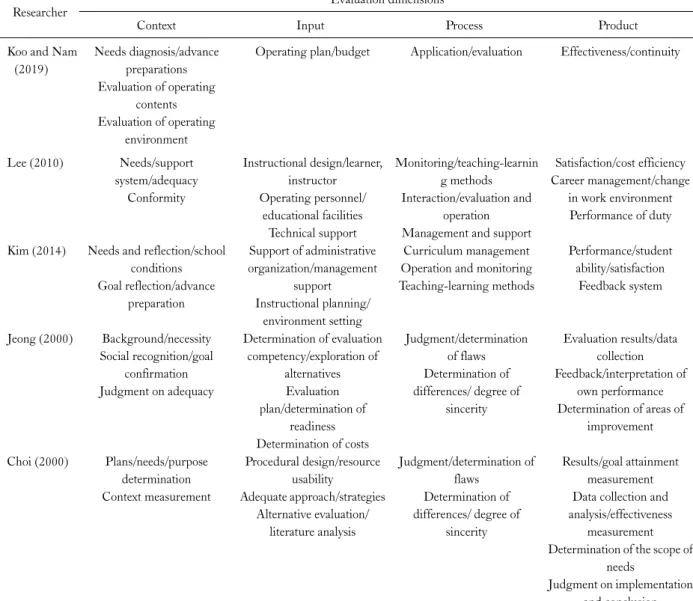
Table 1. Continued
Researcher Evaluation dimensions
Context Input Process Product
Koo and Nam (2019)
Needs diagnosis/advance preparations Evaluation of operating
contents Evaluation of operating
environment
Operating plan/budget Application/evaluation Effectiveness/continuity
Lee (2010) Needs/support system/adequacy Conformity
Instructional design/learner, instructor Operating personnel/
educational facilities Technical support
Monitoring/teaching-learnin g methods Interaction/evaluation and
operation Management and support
Satisfaction/cost efficiency Career management/change
in work environment Performance of duty
Kim (2014) Needs and reflection/school conditions Goal reflection/advance
preparation
Support of administrative organization/management
support Instructional planning/
environment setting
Curriculum management Operation and monitoring Teaching-learning methods
Performance/student ability/satisfaction
Feedback system
Jeong (2000) Background/necessity Social recognition/goal
confirmation Judgment on adequacy
Determination of evaluation competency/exploration of
alternatives Evaluation plan/determination of
readiness Determination of costs
Judgment/determination of flaws Determination of differences/ degree of
sincerity
Evaluation results/data collection Feedback/interpretation of
own performance Determination of areas of
improvement
Choi (2000) Plans/needs/purpose determination Context measurement
Procedural design/resource usability Adequate approach/strategies
Alternative evaluation/
literature analysis
Judgment/determination of flaws
Determination of differences/ degree of
sincerity
Results/goal attainment measurement Data collection and analysis/effectiveness
measurement Determination of the scope of
needs
Judgment on implementation and conclusion
significant p-value of less than 0.001 for all evaluation dimensions. The results were considered reliable as there was internal consistency among variables classified into fac- tors, while items with a factor loading of 0.5 or lower were considered to lack validity and thus eliminated. In addition, Cronbach’s was used to determine the consistency of var- iables placed in the same group in factor analysis. Cronbach’s
was used as the reliability coefficient whose value was set as 0.6 or higher. Principal axis factoring was used for factor analysis, and the Varimax method of orthogonal rotation was used. We developed the evaluation indexes for forest
education after verifying the reliability of the responses and the validity through factor analysis.
Results
Selection and development of evaluation criteria for forest education using the CIPP model
The evaluation dimensions and items were selected through the content analysis method of literature review to develop the evaluation criteria for forest education. There is insufficient research on the development of evaluation cri-
teria in forest education, so we reviewed literature on evalu- ation indexes using the CIPP model in other fields (Choi 2000; Jeong 2000; Kim 2008; Kim and Han 2008; Yun and Lim 2008; Jeon and Kim 2009; Lee 2010; Lee et al. 2010;
Kim 2011; Jeong 2012; Kim 2012; Kim 2014; Lee et al.
2017; Park 2017; Koo and Nam 2019). Previous studies applying the CIPP model were analyzed in terms of con- text, input, process, and product. The results showed that the context aspect consists of necessity, demand, educational objectives, feasibility, problems, prior systems, analysis of current condition, atmosphere development, etc.; the input aspect consists of educational content, facility acquisition, budget, selection of target, human resources support, finan- cial support, educational methods, environment and facili- ties, time plan, etc.; the process aspect consists of teach- ing-learning methods, participation, satisfaction, evalua- tion, degree of implementation, scope of teaching, monitor- ing, human resources, financial resources, adequacy of method, revision of problems, evaluation plan, etc.; and the product dimension consists of satisfaction, effects, achieve- ment, follow-up support, possibility of generalization, feed- back and correction, areas of improvement, perception change, fixity, change in work environment, etc. (Table 1).
The process of developing the evaluation factors and items of forest education applying the CIPP model is as fol- lows: First, we examined existing studies that used the CIPP model, and carried out a literature review using the content analysis method on previous studies related to for- est education from 2000 to 2018, when forest education was actively promoted. These studies were classified according to the dimensions of the CIPP model, namely context, in- put, process, and product, which were categorized into the evaluation dimensions, evaluation factors, and evaluation items, where similar contents were grouped together. To prevent errors caused by subjective judgments of the re- searchers, we increased the accuracy of the evaluation items by adding or modifying the opinions of five specialists and verifying the content validity. Through this process, we re- viewed unclear parts, redundant items, adequacy of evalua- tion items, and grammatical errors, which were modified and improved (Cho 2015). Moreover, to develop a survey questionnaire with universal validity and objectivity, we added new evaluation items that reflected advice from spe- cialists and opinions based on field service experience. We
ultimately revised the items by conducting a preliminary survey with 50 copies and improved the completeness of the questionnaire.
Development of evaluation indexes
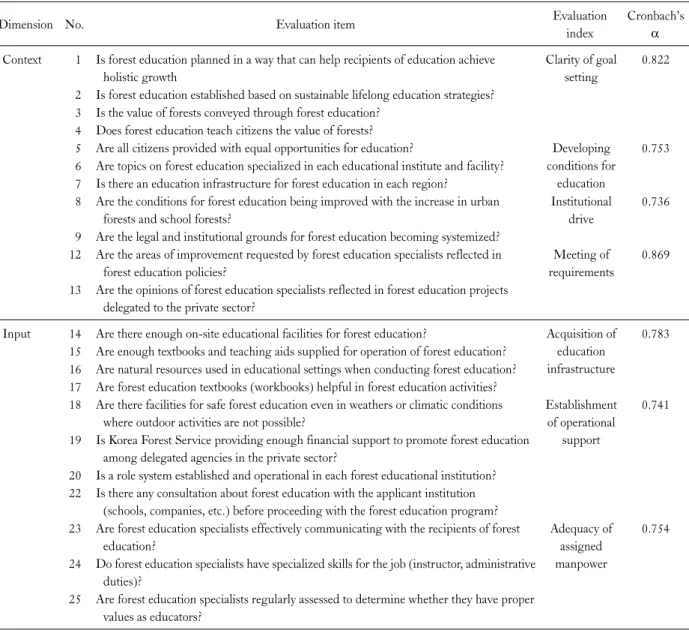
To develop the evaluation indexes, we collected 293 cop- ies of the questionnaire from forest education specialists (forest commentators, infant forest advisors, and forest trekking guides). We conducted factor analysis and reli- ability analysis to determine the validity and reliability of the evaluation items. The results of the factor analysis showed that 13 items of the context dimension were classified into four factors labeled as “Clarity of goal setting,” “Developing conditions for education,” “Meeting of requirements,” and
“Institutional drive” (Table 2). Twelve items of the input di- mension were classified into three factors labeled as
“Acquisition of education infrastructure,” “Establishment of operational support,” and “Adequacy of assigned man- power,” which represented the evaluation indexes (Table 2).
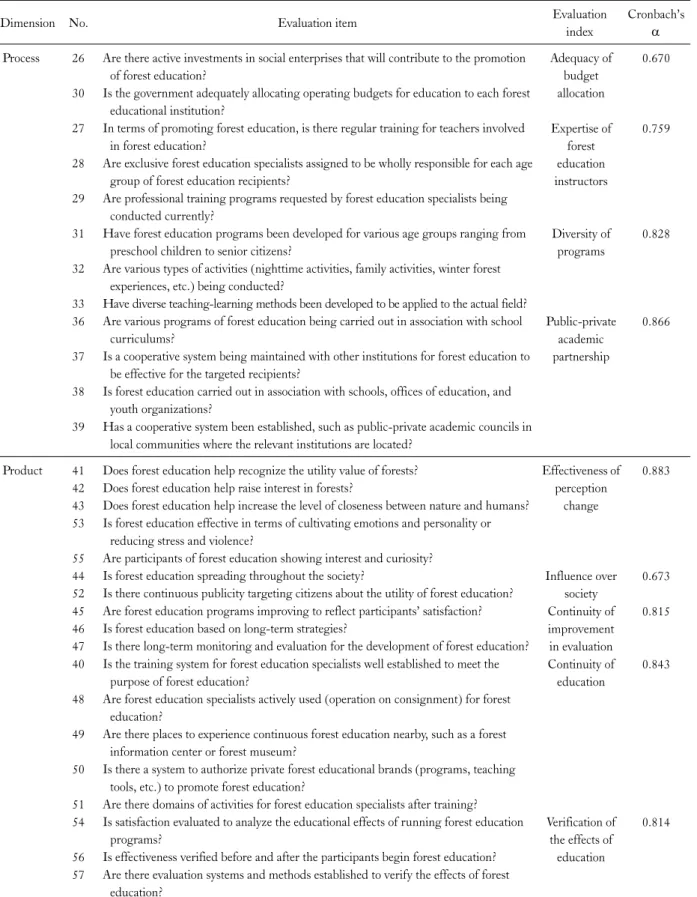
Sixteen items of the process dimension were classified into four factors labeled as “Adequacy of budget allocation,”
“Expertise of forest education instructors,” “Diversity of programs,” and “Public-private academic partnership”
(Table 3). Eighteen items of the product dimension were classified into five factors that were labeled as “Effectiveness of perception change,” “Influence over society,” “Continuity of improvement in evaluation,” “Continuity of education,”
and “Verification of the effects of education,” which repre- sented the evaluation indexes (Table 3).
Conclusion
This study aimed to develop evaluation criteria for forest education by applying the CIPP model. The scope of eval- uation criteria was used to embrace evaluation dimensions, evaluation items, and evaluation indexes. We developed the evaluation criteria for forest education using content analy- sis based on cases applying the CIPP model and a review of literature on forest education. A survey was conducted on 309 forest education specialists, and we verified the reli- ability and validity of 293 responses. We eliminated items with a factor loading of 0.5 or lower, and set Cronbach’s as 0.6 or higher to determine the reliability of each factor.
Out of 57 evaluation items, 52 were eventually selected.
Table 2. Evaluation indexes of context and input dimensions
Dimension No. Evaluation item Evaluation
index
Cronbach’s
Context 1 Is forest education planned in a way that can help recipients of education achieve
holistic growth
Clarity of goal setting
0.822
2 Is forest education established based on sustainable lifelong education strategies?
3 Is the value of forests conveyed through forest education?
4 Does forest education teach citizens the value of forests?
5 Are all citizens provided with equal opportunities for education? Developing conditions for
education
0.753 6 Are topics on forest education specialized in each educational institute and facility?
7 Is there an education infrastructure for forest education in each region?
8 Are the conditions for forest education being improved with the increase in urban forests and school forests?
Institutional drive
0.736
9 Are the legal and institutional grounds for forest education becoming systemized?
12 Are the areas of improvement requested by forest education specialists reflected in forest education policies?
Meeting of requirements
0.869
13 Are the opinions of forest education specialists reflected in forest education projects delegated to the private sector?
Input 14 Are there enough on-site educational facilities for forest education? Acquisition of education infrastructure
0.783 15 Are enough textbooks and teaching aids supplied for operation of forest education?
16 Are natural resources used in educational settings when conducting forest education?
17 Are forest education textbooks (workbooks) helpful in forest education activities?
18 Are there facilities for safe forest education even in weathers or climatic conditions where outdoor activities are not possible?
Establishment of operational
support
0.741
19 Is Korea Forest Service providing enough financial support to promote forest education among delegated agencies in the private sector?
20 Is a role system established and operational in each forest educational institution?
22 Is there any consultation about forest education with the applicant institution (schools, companies, etc.) before proceeding with the forest education program?
23 Are forest education specialists effectively communicating with the recipients of forest education?
Adequacy of assigned manpower
0.754
24 Do forest education specialists have specialized skills for the job (instructor, administrative duties)?
25 Are forest education specialists regularly assessed to determine whether they have proper values as educators?
Moreover, through factor analysis, we selected four evalua- tion indexes for the dimension of context, namely “Clarity of goal setting,” “Developing conditions for education,”
“Meeting of requirements,” and “Institutional drive”; three evaluation indexes for the dimension of input, namely
“Acquisition of education infrastructure,” “Establishment of operational support,” and “Adequacy of assigned man- power”; four evaluation indexes for the process dimension, namely “Adequacy of budget allocation,” “Expertise of for- est education instructors,” “Diversity of programs,” and
“Public-private academic partnership”; and five evaluation
indexes for the product dimension, namely “Effectiveness of perception change,” “Influence over society,” “Continuity of improvement in evaluation,” “Continuity of education,”
and “Verification of the effects of education.”
These evaluation indexes represent the overall evaluation factors of forest education and may have some insufficiencies in research as it was attempted for the first time. However, this study was conducted to provide indexes that will lay the groundwork for forest education in the future. In addition, we will evaluate the priority of groups of experts by using AHP analysis for forest education experts with evaluation
Table 3. Evaluation indexes of process and product dimensions
Dimension No. Evaluation item Evaluation
index
Cronbach’s
Process 26 Are there active investments in social enterprises that will contribute to the promotion
of forest education?
Adequacy of budget allocation
0.670
30 Is the government adequately allocating operating budgets for education to each forest educational institution?
27 In terms of promoting forest education, is there regular training for teachers involved in forest education?
Expertise of forest education instructors
0.759
28 Are exclusive forest education specialists assigned to be wholly responsible for each age group of forest education recipients?
29 Are professional training programs requested by forest education specialists being conducted currently?
31 Have forest education programs been developed for various age groups ranging from preschool children to senior citizens?
Diversity of programs
0.828
32 Are various types of activities (nighttime activities, family activities, winter forest experiences, etc.) being conducted?
33 Have diverse teaching-learning methods been developed to be applied to the actual field?
36 Are various programs of forest education being carried out in association with school curriculums?
Public-private academic partnership
0.866
37 Is a cooperative system being maintained with other institutions for forest education to be effective for the targeted recipients?
38 Is forest education carried out in association with schools, offices of education, and youth organizations?
39 Has a cooperative system been established, such as public-private academic councils in local communities where the relevant institutions are located?
Product 41 Does forest education help recognize the utility value of forests? Effectiveness of perception
change
0.883 42 Does forest education help raise interest in forests?
43 Does forest education help increase the level of closeness between nature and humans?
53 Is forest education effective in terms of cultivating emotions and personality or reducing stress and violence?
55 Are participants of forest education showing interest and curiosity?
44 Is forest education spreading throughout the society? Influence over society
0.673 52 Is there continuous publicity targeting citizens about the utility of forest education?
45 Are forest education programs improving to reflect participants’ satisfaction? Continuity of improvement in evaluation
0.815 46 Is forest education based on long-term strategies?
47 Is there long-term monitoring and evaluation for the development of forest education?
40 Is the training system for forest education specialists well established to meet the purpose of forest education?
Continuity of education
0.843
48 Are forest education specialists actively used (operation on consignment) for forest education?
49 Are there places to experience continuous forest education nearby, such as a forest information center or forest museum?
50 Is there a system to authorize private forest educational brands (programs, teaching tools, etc.) to promote forest education?
51 Are there domains of activities for forest education specialists after training?
54 Is satisfaction evaluated to analyze the educational effects of running forest education programs?
Verification of the effects of
education
0.814
56 Is effectiveness verified before and after the participants begin forest education?
57 Are there evaluation systems and methods established to verify the effects of forest education?
indexes.
The following suggestions can be made based on the re- sults of this study: First, the evaluation criteria for forest ed- ucation developed in this study were developed based on a narrow analysis of previous studies and limited literature review, and thus have limitations in that they cannot em- brace all dimensions of forest education. Therefore, we se- lected forest education specialists as participants to obtain accuracy in evaluation items, and developed the evaluation criteria by applying the CIPP model for effective research.
Second, this study could not secure extensive feedback on survey items due to the limited questionnaire items devel- oped by a few researchers. Moreover, data on forest educa- tion established for research purposes may vary depending on the application scope, intended use, and purpose. Third, the components of the evaluation criteria developed in this study were adopted from educational policies in other fields, as there were almost no cases involving the applica- tion of the CIPP model to forest education. Fourth, even though the evaluation indexes were developed in the course of testing the validity and reliability of the evaluation items to develop the criteria, they do not clearly represent all for- est education specialists who participated in the study.
Hence, we wanted to sample a large group of forest educa- tion specialists for effective verification. Therefore, we ex- amined the evaluation criteria for forest education required in the field with the intention of providing relevant data to forest education specialists or institutions to promote forest education in the future.
Acknowledgements
This study was supported by 2017 Research Grant from Kangwon National University (No. 520170353).
References
Bae HS. 1994. Program evaluation. Wonmisa, Seoul, pp 457.
Cho SH. 1992. Korea’s Technical and Vocational Education Policy Evaluation. Doctoral dissertation. Hongik University, Seoul, Korea. (in Korean)
Cho YS. 2015. The Development of Evaluation Criteria for School Consulting Based on the CIPP Evaluation Model. Doctoral dissertation. Incheon National University, Incheon, Korea. (in Korean)
Choi JC, Kim YH, Jeon DG. 2007. Criteria for evaluating the quality of lifelongeducation lecturer. J Korean Educ 34: 155-186.
Choi JY. 2000. Criteria development of educational practice pro- gram evaluation by CIPP evaluation model. MS thesis.
Sungkyunkwan University, Seoul, Korea. (in Korean)
Han HR. 2011. (The) development of the evaluation indicators based upon CIPP model for after school program. Doctoral dissertation. Pusan National University, Pusan, Korea. (in Korean)
Hecht AR. 1975. Utility of the Cipp Model for Evaluating an Established Career Programin a Community College. Washington, ERIC Clearinghouse, pp 6.
Inoue M, Oishi Y, Fujii T, Kobayashi H. 2008. Forestry Education Support by a Forest Research Institute: Development of Forestry Educational Programs for Vocational High Schools. J For Environ Sci 24: 175-179.
Jeon HC, Kim SW. 2009. Development of the evaluation scale for elementary school special supplemental program : applying the CIPP evaluation model. Doctoral dissertation. Elem Educ Res 22: 83-111. (in Korean with English abstract)
Jeong AY. 2012. Effectiveness Analysis on Middle School Cyber Home Study based on the CIPP Evaluation Model. MS thesis.
Ajou University, Suwon, Korea. (in Korean)
Jeong JG. 2000. An Application of CIPP Evaluation Model for the Improvement of Korean Accreditation System. Doctoral dissertation. Daegu Catholic University, Daegu, Korea. (in Korean)
Kim AJ. 2008. Criteria Development for Evaluating Traditional Nursery Song Programs by CIPP Evaluation Model and Applying to Early Childhood Educational Institutions. Doctoral dissertation. Keimyung University, Daego, Korea. (in Korean) Kim HS. 2012. An Evaluation of Peer Counseling Program in
Middle Schools based on CIPP Model. MS thesis. Sookmyung Women's University, Seoul, Korea. (in Korean)
Kim SC. 2014. Evaluation criteria development for the subject classroom system curriculum in the school level. Doctoral dissertation. Konkuk University. Seoul, Korea. (in Korean) Kim SW, Han HR. 2008. An Evaluation on After School Program
in Middle Schools. J Educ Eval 21: 27-53.
Kim SY, Choi JK. 2018. Effects of Forest Experience Activity on the Attitude toward Forest and Personality of Primary School Students. J For Environ Sci 34: 490-496.
Kim WJ. 2011. Evaluation of consulting supervision by CIPP evaluation model. MS thesis. Sogang University, Seoul, Korea.
(in Korean)
Koo KH, Nam SM. 2019. The Development of Evaluation Scale for Middle School Free Semester Activity Program Based on CIPP Evaluation Model. Stud Korean Youth Activity 5: 31-35.
Korea Forest Service. 2011. Forest Education Promotion Act.
https://www.forest.go.kr/kfsweb/kfs/idx/Index.do. Accessed 11 Oct 2019.
Korea Forest Service. 2015. Establishment of the Korean forest ed-
ucation systems and program development for sustainable development. https://www.forest.go.kr/kfsweb/kfs/idx/Index.do.
Accessed 13 Nov 2019.
Korean Council for University Education. 1995. Comprehensive University Evaluation Report, 1995. Korean Council for University Education, Seoul.
Lee JH, Kim SH, Kim JM. 2010. Evaluation Study on Policy of Teacher Evaluation for Professional Development Using CIPP Evaluation Model. Korea Educ Rev 16: 183-213.
Lee KN. 2010. The Development of the Process-oriented Evaluation Criteria for the Cyber Education Program of Human Resource Development. Chungnam National University, Daejeon, Korea. (in Korean)
Lee KY. 2009. A Study on The Evaluation of Education Welfare Policies: Supportive Project for the Priority Region of Educational Welfare Investment. Doctoral dissertation.
Kyungpook National University, Daegu, Korea. (in Korean) Lee SH, Yun MH, Cho CH. 2017. Development of Evaluation
Scale at Long-Term Facilities based on CIPP Evaluation Model. J Korean Soc Qual Manag 2017: 119-120.
Lee YG, Choi JK. 2004. New Perspective of Forest Recreation Program in Gangwon-do. J For Environ Sci 20: 28-39.
Lim JY. 2007. Conceptual Framework of Theory-Driven Evaluative Criteria Set: Choosing Youth Activity Program. J Youth Stud 14: 47-70.
Min BJ. 2002. A study on the construction of comprehensive edu- cational policy evaluation model. Doctoral dissertation.
Chung-Ang University, Seoul, Korea. (in Korean)
Park JH. 2017. The Comparison of Perceptions between School Consulting Managers, Clients, and School Consultants on School Consulting: Focusing on the CIPP Evaluation Model.
Doctoral dissertation. Pukyong National University, Busan, Korea. (in Korean)
Schreyer R, Driver BL. 1990. The benefits of wildland recreation participation: what we know and where we need to go. RM Gen Tech Rep 196: 20-35.
Seo JH. 1987. Evaluation of Education Policies in Korea. CNU J Educ Stud 41-66. (in Korean)
Shin WS. 1999. Forest Experience and Environmental Education.
For Cult 8: 28-30. (in Korean)
Stufflebeam DL; Phi Delta Kappa. 1971. Educational evaluation and decision making. Phi Delta Kappa, Bloomington, Indiana.
Yun MH, Lim HS. 2008. Development of Inventories for After-School Program Evaluation. Educ Eval Res 21: 1-19.