Vol. 28, No. 1, pp. 30-36, February, 2012
Establishment of Optimal Timber Harvesting Model by Using Goal Programming
Jae-Young Jang, Sang-Hyun Choi and Jong-Choon Woo*
Department of Forest Management, Kangwon National University, Chuncheon 200-701, Republic of Korea
Abstract
The total yield of Pinus koraiensis stands was reviewed along forest function by using goal programming, which is one of the operations research techniques. The 4 kinds of management goals are set to identify timber production in the Research Forest of Kangwon National University. As a result, scenario 1 was estimated the best timber production over 2,073 ha area and also 588 ha in the third quarter was showed the most timber harvest. The rate of timber harvest was separated by 10 to 50 percent in non-timber forest function in the scenario 1 and that model was applied to the Research Forest of Kangwon National University. The structure of the area and volume is showed to be balanced quarterly when rate of timber harvest at 10 to 20 percent.
Key Words: goal programming, forest functions, Pinus koraiensis, timber harvesting, forest management
Received: January 25, 2012. Revised: February 10, 2012. Accepted: February 13, 2012.
Corresponding author: Jong-Choon Woo
Department of Forest Management, Kangwon National University, Chuncheon 200-701, Korea Tel: 82-33-250-8335, Fax: 82-33-243-4484, E-mail: [email protected]
Introduction
The forest functions in Korea are divided into six func- tions according to the sustainable forest management prin- ciple. These functions are timber production, watershed forest, protection of forest disaster, natural environment conservation, forest recreation and living environment con- servation. The forest management plan was set up accord- ing to the forest function for sustainable forest management but substantial forest management act is incomplete.
Korea is occupied mostly of trees with age-class III and IV, therefore forest management plans must consider vari- ous forest functions and that is reflected on decision making.
In the past, the purpose of forest management plans were concentrated on timber harvesting, but recently, multiple forest plans have been established for covering environ- mental problems.
Development of forest information system with the ap-
plication of geographic information system and forest man- agement plan for multiple forest management was studied by Eun-Sik Park (1998).
In this study, goal programming (GP) was used that is usually used as methodology for multiple forest management.
The work of Mitchell and Bare (1981) is composed of 6 main factors and 50 detailed factors for the New Mexico area and it determines the priority of management by apply- ing GP.
Mendoza (1987) studied the applicability and the theo- retical verification of GP. Howard (1991) configured the GP model and mathematical algorithm to consider eco- logical problem, and environmental problem, timber pro- duction which were faced with forestry aspect. Romero and Rehmen (1989) applied GP on multiple forest manage- ment and afforestation plan.
In the case of Korea, Cheol Soo Jang (1991) first applied GP to solve the decision making problem and to establish
Table 1. The area and stock of the Research Forest of Kangwon National University
Forest type Species Area (ha) Stock (m3) Stock/ha (m3)
Natural forest
Artificial forest
Total Total area
Pinus densiflora forest Broadleaved forest Total
Pinus koraiensis Larix leptolepis Pinus rigida Abies holophylla Larix gmelini Total
32 2,236 2,268 (74%)
522 210 3 10 12 757 3,061 (100%)
10,307 409,166 419,473 115,665 57,212 501 412 2,078 175,868 584,529
322 183 505 222 272 167 41 173 875 191 3,146 ha the resource management method.
The ultimate goal of the establishment of systematic and scientific forest management plan to moves away from past forest management pattern and to achieve sustainable forest management by targeting on the Research Forest of Kang- won National University.
Materials and Methods
Study site
The site of the study is the Research Forest of Kangwon National University. It is located between Chuncheon-si Dongsan-myeon and Hongcheon-gun Bukbang-myeon, Republic of Korea. The total area is 3,146 ha (Table 1). It is not only a natural deciduous forest and Pinus koraiensis but also has good quality forest.
This site has 635 species of plant resource and 172 spe- cies of woody plants (Research Forest of Kangwon National University, 2010), the coniferous forest is 789 ha (26%), while the deciduous forest is 2,236 ha (73%). Total volume of 584,529m3 is composed of the coniferous 175,166m3 (30%) and the deciduous is 409,166m3 (70%).
Forest function division in the Research Forest of Kangwon National University
The Research Forest of Kangwon National University was divided into each functions for sustainable forest man- agement and optimal timber harvesting.
The factors about external and internal is set by func- tional through a survey of experts. Weights each functions
were applied then forest functions are divided.
Goal programming
GP was introduced by A. Charnes and W.W. Cooper.
Decision making can be applied in many conflicting goals, sub-goals and one goal and a number of sub-goals. But if many conflicting goals exist, achieving all of the goals at the same times are impossible.
In this case, GP can get the most reasonable solution ac- cording to importance priority of the goals. GP model used by Hyun-gyu Won in 2009 was used in this study for opti- mal decision making.
Methods
Setting management goals for optimal regulated timber harvesting
Four types of management goals were set for finding out timber production according to goals of the Research Forest of Kangwon National University.
Goal 1. Timber production forest induces sustainable age structures. Goal is set to minimize size variation of each age class.
Goal 2. Change in timber production of each business quarter shouldn’t exceed 10 percent. Goals are set so that timber harvesting is not concentrated in one quarter.
Goal 3. Non timber forest keeps 30% of harvesting area.
The other forest function goals are not timber production, so the other forest function goals are set to optimize each functional parts.
Goal 4. Optimization of timber harvesting. Setting tim-
Table 2. Weights corresponding to each management goal in management scenarios
Management goals Management scenarios
1 2 3 4 5 6
Goal 1 Goal 2 Goal 3 Goal 4
W1a W2 W3 W4
W1a W3 W2 W4
W2 W3 W1a
W4
W3 W2 W1a
W4
W2 W1a
W3 W4
W3 W1a
W2 W4 W1a (=1000)>W2 (=100)>W3 (=10)>W4 (=1).
ber production goal to minimize deviation of the timber production in each harvesting quarter.
Establishment of optimal timber harvesting model for GP
Each management scenarios has weight about 4 goals (Table 2). Each management scenarios has to set from end of 2010 to 2059 (total 50 years). Second, every 10 years is one business quarter so it constitute a total of 5 quarter.
Third, harvesting is possible from III age class. Fourth, 5types of harvesting plan and non harvesting plan was set in goal 4.
Scenarios were set with different weight from goal 1 to goal 4. As seen in Table 1, alternative 1 and 2 are set with most weight on goal 1, alternative 3 and 4 on goal 2, alter- native 5 and 6 on goal 3. Weight was applied to show dis- tinct differences according to priority. The ranking system (1 ranking=1,000>2 ranking=100>3 ranking=10>4 ranking=1), used in de Oliveira’s (2003) work is used in this study.
Establishment of GP model
There are 6 total constraints, which are objective func- tion constraint, area constraint, age class of timber pro- duction constraint, harvesting area each forest function constrain, harvesting change constraint and non-negativity constraint.
Minimize Z=
) ( ) ( ) ( ) (
1 4 1
3 1
2 1
1 +
=
− +
=
− +
=
− +
=
−
∑ ∑ ∑
∑
d +d +W e +e +W a +a +W q +qW M
m i M
m i
m M
m m
m M
m m
Constraints
0 , , , , , , , , ,
0 (
) 1 (
..., 2 , 1 ,
..., 2 , 1
} )
(
) {(
)}
{(
} {
1 1
1 1 1
1 1 1 1
1 1 1 1
1 1 1
4
1 1 1 1
,
1 1 1 1
≥
=
− +
−
−
= + +
=
− +
=
∀
=
=
∀
=
− +
− +
− +
− +
− +
+
−
= =
+ +
=
= = = =
= = =
+
−
=
= =
+
−
=
= = = =
+
−
= = = =
∑ ∑ ∑
∑ ∑ ∑ ∑
∑ ∑ ∑ ∑
∑ ∑ ∑
∑ ∑ ∑ ∑
∑ ∑ ∑ ∑
ijkm ijkm i
i m m m m
m m I
i J j
ijkm K
k ijkm M
m I i
J j
ijkm K
k ijkm I
i J j
i i K
k
i i M
m ijkm
m M
m J
j m m
K k
jkm I
i J j
t K
k M m
ijkm
t ijkm
I i
J j
K k
M m
ijkm
c c q q a a e e d d
e e X
C
X C
A a
a X
N d d X
T t
A X
T t
H q q X C
α β
Z: Objective function
: weights about deviation of goals
: (+) deviation of management objectives
: (-) deviation of management objectives
: harvesting volume per unit area (contributing fac- tors)
: operation areas (decision variables)
: forest function devision (i=watershed forest, recrea- tional forest, disaster prevent forest, Timber pro- duction forest)
j: age class (j=1...5)
k: forest types (k=coniferous, broadleaves, mixed for- est)
m: management plan (m=1...6)
t: business quarterly/functions/age class/any combina- tion of forest types (∈)
Table 3. Area and rate of each forest functions on the Research Forest of Kangwon National University
Division Total Watershed function Timber product function Forest recreation function Disaster prevent function Area (ha)
Rate (%)
3,155.8 100
1,158.6 36.7
767.0 24.3
478.0 15.1
752.2 23.8
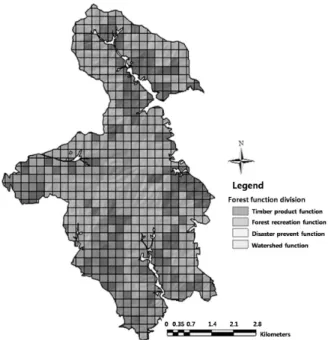
Fig. 1. Forest function division of Research Forest of Kangwon National University.
Table 4. Harvesting area for each quarter management scenarios (unit: ha)
Scenario 1 Scenario 2 Scenario 3 Scenario 4 Scenario 5 Scenario 6
1 Quarter 2 Quarter 3 Quarter 4 Quarter 5 Quarter Total
506 538 588 539 532 2,703
377 588 221 377 135 1,698
125 677 342 288 88 1,520
377 288 677 322 186 1,850
408 498 285 488 377 2,056
205 538 348 256 126 1,472
: total timber production
: total area
: harvesting area of timber production forest
: limited percentage of harvesting area of each func- tions (=0.3, 0.3, 0.3, 1.0,)
: area of each functions
: allow rate of quarterly timber production change (
=0.1)
The first formula of constraints calculates total harvested production when harvested during total management plan- ning period by using harvested area , volume per unit area . The second formula concerns the pres- ent area; the total area that takes decision making for harvested management, including non management, is the same as the real area . The third formula is for in- ducing sustainable age class of timber production. Timber production forest area that is managed on planning period has to be maintained the same each quarter.
The fourth formula shows the harvested area based on forest function. It is applied rate of limit =0.3 about non-timber forest functions area.
The fifth formula is applied rate of change (=0.1) for limit 10% of change of harvest on quarterly. The last for- mula is non-negativity constraint (all variables are same or bigger than 0). LINGO6.0 was used for analysis of Optimization Model.
Results and Discussion
As a result of forest function division, Pinus koraiensis and Larix leptolepis are applied on timber production function. Another sites are divided into forest recreation function, Disaster Prevention function and Watershed function (Fig. 1). Priority of function is selected 250 m Grid unit. Also weights are applied in function. Then it is
Fig. 2. Harvesting area each quarter scenarios.
Fig. 3. Harvesting volume each quarter scenarios.
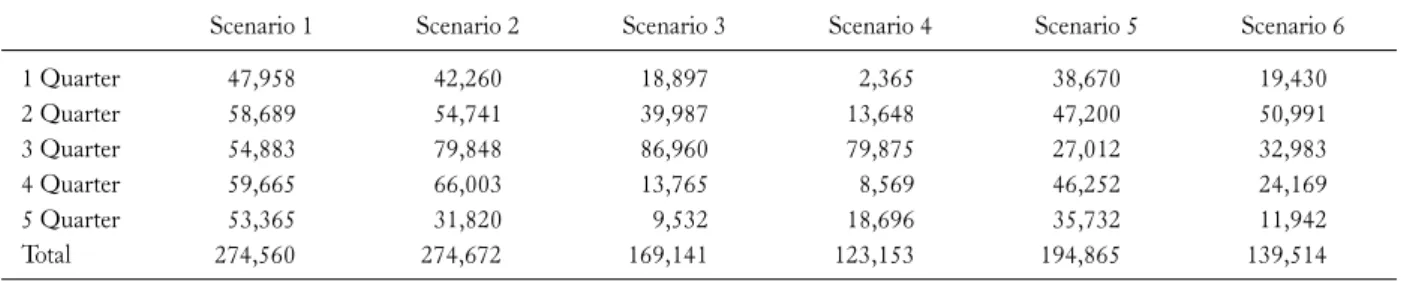
Table 5. Harvesting volume for each quarter scenarios (unit: m3)
Scenario 1 Scenario 2 Scenario 3 Scenario 4 Scenario 5 Scenario 6 1 Quarter
2 Quarter 3 Quarter 4 Quarter 5 Quarter Total
47,958 58,689 54,883 59,665 53,365 274,560
42,260 54,741 79,848 66,003 31,820 274,672
18,897 39,987 86,960 13,765 9,532 169,141
2,365 13,648 79,875 8,569 18,696 123,153
38,670 47,200 27,012 46,252 35,732 194,865
19,430 50,991 32,983 24,169 11,942 139,514
Fig. 4. Harvested total volume through goal programming.
possible to estimate about relevance and potential or resist- ance and risk of functions.
A shown in Table 3, Watershed function is 36.7% of total area, timber production function is 24.3% of total area, dis- aster prevent function is 23.8% of total area and forest rec- reation function is 15.1% of total area.
As shown in the results of the GP model analysis, most of the total area of 2,073 ha was harvested in scenario 1 (Table 4), and in the third quarter, a total area of 588 ha was harvested. A total of 1,698 ha, 1,520 ha, 1,850 ha, 2,056 ha and 1,472 ha was harvested in scenarios 2, 3, 4, 5 and 6, respectively. In all scenarios except for scenario 1, the quar-
terly harvest areas are random (Fig. 2).
Also, based on the results of quarterly harvested volume, scenario 2 harvested the most volume with 274,672 m3 (Table 5, Fig. 3).
Through the GP model, we concluded that the most suitable scenario is scenario 1 (Fig. 4).
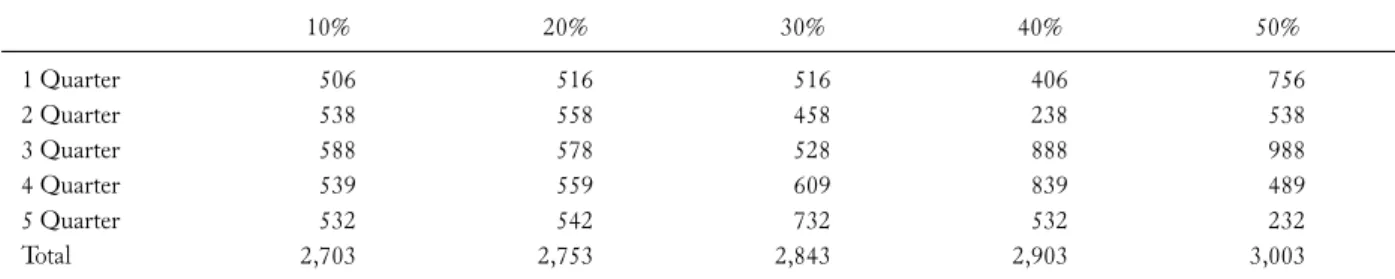
As a result of comparison in the non-timber forest func- tion, the broad total harvest area is 3,003 ha at 50% rate of timber harvest (Table 6). However, the structure of the area and volume showed a balanced quarter when the rate of timber harvest is 10 to 20 percent (Fig. 5).
Conclusions
This study established the optimized forest regulation plans and set the required management goals of forest functions. The Research Forest of Kangwon National University is divided into each functions for sustainable forest management. In addition, non-timber forest function is ex- erted maximum and the change of timber harvest is not over 10% each quarterly.
According to Kangwon National University goal on for- est timber production, we set to identify the four kinds of
Table 6. Harvested area according to the harvest rate of non-timber forest function (unit: ha)
10% 20% 30% 40% 50%
1 Quarter 2 Quarter 3 Quarter 4 Quarter 5 Quarter Total
506 538 588 539 532 2,703
516 558 578 559 542 2,753
516 458 528 609 732 2,843
406 238 888 839 532 2,903
756 538 988 489 232 3,003
Fig. 5. Quater harvest area according to harvest rate.
management objective. As a result, the most of the total area of 2,073 ha was harvested in scenario 1, and in the third quarter, a total area of 588 ha was harvested.
The harvest volume stock in each quarter for sustainable forest management was 54,912m3 in every quarter (10 years). Using the averaged stock of 191m3 in the Research Forest of Kangwon National University that is shown as af- forestation and harvesting has to run in 278 ha area on ev- ery years.
The Korea Forest Service has planned about forest re- source in 170 ha of whole country. However the Research Forest of Kangwon National University is need extend management 1.6 times by the management plan of forest resource which is operated in Korea Forest Service.
However, finding the suitable regulation timber harvesting plan is difficult because many hypotheses are put in and constraints are predicted.
But, in this study the established optimal timber harvest model even if functions needs were different and this paper is possible to establish relative management plan which was noticed in this paper.
References
Carey AB, Lippke BR, Sessions J. 1999. Intentional Systems man- Agement: Managing Forests for Biodiversity. Journal of Sustainable Forestry 9: 83-125.
Checkland P. 1999. Systems Thinking, Systems Practice. John Wiley and Sons, New York, pp 330.
Choi JK. 1998. Simulation of the development and restoration of old-growth Northern Hardwood forest. PhD dissertation.
University of Wisconsin, Madison, USA.
Hunter ML Jr. 1990. A tree based forest yield projection system for the North Coast Region of California. PhD dissertation.
University of California, Berkeley, USA.
Jang KM, Won HK, Seol AR, Chung JS. 2009. A Case Study for Applying Linear Programming to Analyze the Effects of the Desired Future Conditions for Forest Functions on Forest Man- agement. Journal of Korean Forestry Society 98: 247-254.
Kwon SD, Jang KM, Seol AR, Chung JS. 2008. Evaluation of Forest Functions Considering the Distribution Patterns of Communal Forests at the Watershed Level. Journal of Korean Forestry Society 97: 71-76.
Kwon SD, Kim HH, Chung JS. 2007. Estimation of Merchantable Volume and Yield Using a Stem Shape Simulation. Journal of Korean Forestry Society 96: 362-368.
Lee WK, Dokko SJ, Woo HB. 1998. Development Forest Infor- mation Analysis System (FIAS1.5) for location-dependent for- est inventory. J Kor Soc For Measurements 1: 37-49.
McCarter JB, Wilson JS, Baker PJ, Moffett JL, Oliver CD. 1998.
Landscape Management through Integration of Existing Tools and Emerging Technologies. Journal of Forestry 96: 17-23.
Ministry for Food, Agriculture, Forestry and Fisheries. 2007.
Development of Integrated Management System for Sustainable Forest Resources Management. Goyang, pp 24-32.
Oliver CD. 1999. The Future of the Forest Management Industry:
Highly Mechanized Plantations and Reserves or a Knowledge-Inten- sive Integrated Approach? Forestry Chronicle 75: 229-245.
Park ES, Chung SJ. 1999. Application of Forest Management for Multipurpose Forest Management Plan. Journal of Korean Forestry Society 88: 273-281.
Shin MY, Han WS. 2006. Development of a Forest Inventory System for the Sustainable Forest Management. Journal of
Korean Forestry Society 95: 370-377.
Won HK, Kim YH, Kwon SD. 2009. Estimation of Optimal Harvest Volume for the Long-term Forest Management Planning using GP. Journal of Korean Forestry Society 98:
125-131.
Woo JC. 1999. Construction Information System for Forest Resource Management Plan in Research forest of Kangwon National University: The 6th Centered with Computerized Forest Management. Kangwon National University, Chun- cheon, pp 1031-1057.