Environmental Science
Vol. 34, No. 2, pp. 101-107, April, 2018 https://doi.org/10.7747/JFES.2018.34.2.101
Environmental Damages in the Atlantic Forest Biome
Michele Santa Catarina Brodt1, Melissa Bergmann2,*, Eli Natáli Broman1, Gabriela Sanfelice1, Juliana Duarte Ferreira1, Larissa Lunardi1, Alexandre Hüller2 and Lenice De Carli2
1Federal Institute of Education, Science and Technology Farroupilha, Rio Grande do Sul, Brazil
2Department of Biodiversity, Environment and Sustainable Development, Santa Rosa, Rio Grande do Sul, Brazil
Abstract
We identified the main impacts, drivers, and restoration projects for Atlantic Forest in Northwest of the Rio Grande do Sul State, Brazil. The objective was to analyze the quantity, distribution, and causes of the environmental crimes in 2000-2014. To verify differences between degraded and restored areas, we performed a t-test; ANOVA for the municipal- ities with more quantity of crimes, simple linear regression analysis for the relationship between sizes of degraded areas and quantity of seedlings planted, and Principal Component Analysis (PCA) for environmental damages categories and population of the municipalities. The main environmental damages found were deforestation outside permanent preservation area (20%) and those related to Permanent Preservation Area (37%). Environmental crimes in these areas fall into two categories: native and exotic vegetation removal (17%), and impediment to natural regeneration (20%).
The average size of the degraded areas was 5,359±526 m2, while for restored areas was 3,337±255 m2. The sizes of the degraded fragments were similar among the five municipalities with the higher number of environmental crimes (ANOVA: p>0.05, F=1.24; df=241). The number of seedlings planted was positively related to the sizes of the degraded fragments (p<0.001, R2=0.53). Segregation between the less and the most populous municipalities was found with the PCA analysis along PC1 (51.7%), while PC2 represented 19.2% of the total variation. The most populous municipalities showed the highest number of environmental crimes, and the majority of degraded areas were recovered by planting native seedlings. Atlantic Forest fragments need to be recognized and preserved as an ecosystem with a unique ecological function by the population and public administration.
Key Words: environmental degradation, forest ecosystem, permanent preservation areas, forest management
Received: April 12, 2016. Revised: February 27, 2018. Accepted: February 28, 2018.
Corresponding author: Melissa Bergmann
Department of Biodiversity, Environment and Sustainable Development, 175 Buriti Street, Postal code 98900-000, Santa Rosa, Rio Grande do Sul, Brazil
Tel: +55 55 3512 6573, Fax: +55 55 3512 5699, E-mail: [email protected]
Introduction
Among the environmental damages caused by human over-exploitation are deforestation and forest degradation.
Causes of deforestation are land clearing for agriculture, logging, fuelwood collection, population growth, and world timber trade (Kamlun et al. 2016). Forest fires and selective logging destroy capacity carbon stocks, contribute to the
greenhouse gasses emissions, have impacts on forest func- tion, change freshwater biodiversity, stream flow and nu- trient retention on watersheds, and cause vulnerability to human populations (Dolný et al. 2012; Valiela et al. 2013;
Valente-Neto et al. 2015; Fugère et al. 2016; Morris et al.
2016; Osone et al. 2016; Tsujino et al. 2016). In subtropical forest, logging disturbance changes the diversity and dy- namics throughout time, while undisturbed areas can re-
Fig. 1. Categories of environmental damages found in the Northwest Rio Grande do Sul State/Brazil from 2000 to 2014. *Other (tree felling without a licence in urban areas, improper waste disposal).
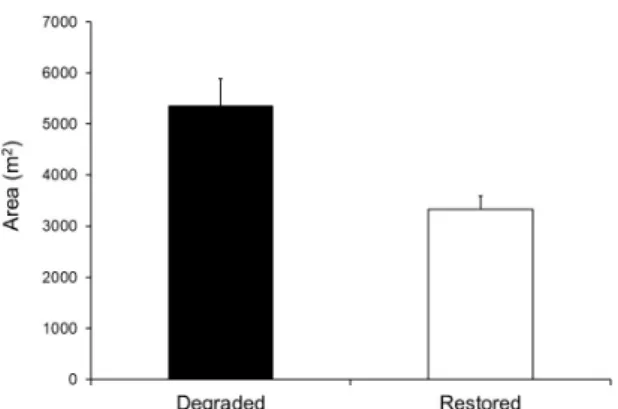
Fig. 2. Degraded and restored areas (mean±SE, n=441) recorded in the processes analyzed.
main steady for decades (Aukema et al. 2017). In Brazil, the Atlantic Forest is considered a hotspot of biodiversity, showing 48% of endemism for vascular plants (Duarte et al.
2014). The forest stretches along the coast of Brazil and ex- tends to Paraguay and Argentina, but due to deforestation, it is currently distributed in ∼245,000 fragments in the Brazilian states (Ribeiro et al. 2009). The remnant forests fragments continue to be degraded by illegal land use in protected areas leading to loss of biodiversity and nutrient stock (Tabarelli et al. 2005; Villela et al. 2006; Oliveira et al.
2017). Proposed activities for sustainable land use in the Atlantic Forest include rural tourism, natural regeneration or matrix restoration with structural and functional con- nectivity (Uriarte and Chazdon 2016; Wheeler et al. 2016;
Alves-Pinto et al. 2017). The aim of this study was to iden- tify the impacts, drivers, and restoration projects for Atlantic Forest in the last 14 years. Two research questions were defined: 1) Is the number of environmental crimes re- lated to population of the municipalities?; 2) Are the sizes of the degraded fragments related to the restored areas? We hypothesized that the most populous municipalities have more records of environmental crimes, and that degraded forest fragments have been recovered through restoration projects.
Materials and Methods
Study area
This work was carried out in the Biodiversity Department of the Rio Grande do Sul State/Brazil. It encompasses 44 municipalities located in the Uruguay River Basin (±348 m altitude), with a population of ∼384,000 inhabitants and more than 48,000 rural establishments (Table S1). The sea- sonal deciduous forest is characteristic of the upper Uruguay River in the North Rio Grande do Sul. Among dominant species are Peltophorum dubium, Ateleia gla- zioviana, Parapiptadenia sp. (IBGE 1992). The average an- nual precipitation ranges from 1,500-2,000 mm/year (INMET 2016).
Data and statistical analyses
We analyzed environmental crimes from 2000 to 2014 from fines/infractions of administrative processes. To verify differences between degraded and restored areas, we per- formed a paired t-test; and to verify differences in environ- mental damage for the five municipalities with more quan- tity of crimes we performed an analysis of variance (ANOVA), using log transformed data. The relationship between sizes of degraded areas and quantity of seedlings planted to recover them was investigated by simple linear regression analysis on log transformed data. A Principal Component Analysis (PCA) was performed on the main environmental damages categories and the population of the municipalities. All statistical analyses were performed with Statistica Statsoft 7 and Canoco 4.5 for Windows.
Fig. 4. Principal Component Analysis (PCA) of environmental damages and population of the municipalities of the Northwest Rio Grande do Sul State: dark circles - Municipalities with up to 10,000 inhabitants; white cir- cles -Municipalities with more than 10,000 inhabitants.
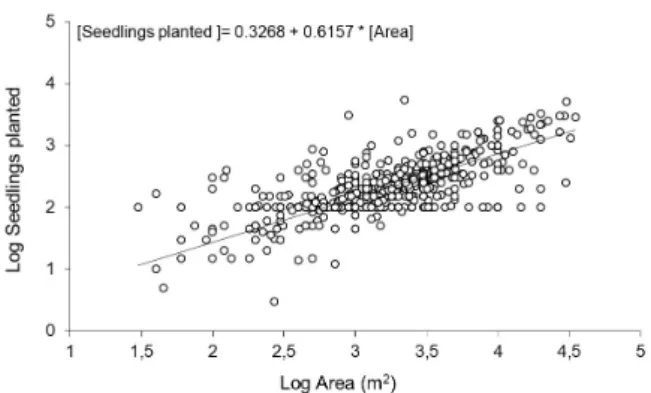
Fig. 3. Relationship between the number of native seedlings planted and sizes of areas to be recovered.
Results
We analyzed 915 processes containing 1,314 environ- mental damages. Data were distributed into eight catego- ries (Fig. 1). Thirty-eight percent of the environmental damage occurred inside a permanent preservation area (PPA), vs. 62% that was outside of a PPA. The main envi- ronmental damage found were deforestation outside of a PPA (20%) and those related to a PPA (37%). Environmen- tal crimes inside PPAs fall into two categories: native and exotic vegetation removal (17%), and impediment to natu- ral regeneration (20%). The latter includes livestock graz- ing in the riparian forest, crops in riverbanks and wetlands, buildings, and dams. Most of the environmental crimes oc- curred in 2012 (11%), followed by 2008, 2010, and 2013.
The average size of the degraded areas was 5,359±526 m2, while for restored areas was 3,337±255 m2 (mean±SE).
The sizes of degraded areas were higher than that for re- stored areas (t-test, t=2.67, df=440, p=0.008, Fig. 2). A total of 682 environmental processes were associated with environmental restoration projects, while 230 did not. The sizes of the degraded fragments were similar among the five municipalities with the higher number of environmental crimes (ANOVA: p>0.05, F=1.24; df=241). The num- ber of seedlings planted was positively related to the sizes of the degraded fragments (p<0.001, R2=0.53, Fig. 3).
Segregation between the less and the most populous munic- ipalities was found with the PCA analysis along PC1 (51.7%), while PC2 represented 19.2 % of the total variation (Fig. 4).
Discussion
Environmental damages
Deforestation drivers both inside and outside of perma- nent preservation areas can be related to urbanization and agriculture. The majority of rural properties in Northwest Rio Grande do Sul State comprise household farmers and subsistence agriculture, while 8% of the rural properties are non-family farming and are responsible for the production of larger amounts of soybean, wheat, and corn (IBGE 2010). One of the main environmental damages inside of PPAs was removing native and exotic vegetation (Eucalyptus sp.) in riparian zones. In the case of protected areas, a li- censing is necessary to remove eucalyptus trees, and the area must be recovered by native plants. Watercourses and hilltops up to 1100 m are the most affected permanent pres- ervation areas by interest conflicts and illegal land-use (Ferrari et al. 2015; Santos et al. 2016). Eucalyptus planta- tions replaced native vegetation in the past decades not only in Brazil, but in some European countries leading to forest degradation and landscapes changes mainly in watercourses (Costa et al. 2014).
Impediment to natural regeneration by native vegetation removal or camping in permanent preservation areas lead to an increase in riverbank erosion and channel destabilization during the rainfalls. Riparian vegetation is the main factor for controlling riverbanks stability, but it depends also of particles sizes of the sediment and biogeomorphologics fac- tors (Corenblit et al. 2007; McMahon et al. 2017).
Uruguay River basins have intense irregular rainfalls and
frequently floods affect cities and rural populations (Fernández Bou et al. 2015). Furthermore, streams dis- charges increase solid load fluxes and modify water quality parameters such as turbidity and pH (Colombo et al.
2015). In 2014, 165 rural properties along Uruguay River were surveyed, and in 34% of them was implemented some kind of forest regeneration. Species such as Croton urucur- ana, Parapiptadenia rigida and Helieta apiculata were the most common from natural regeneration (Bergmann et al.
2011).
Illegal timber trade was related to fuelwood harvesting for biomass burning. People of the region consume fuel- wood from native forest remnants (dry wood or green wood) and often commercialize it without licensing. Studies found that fuelwood harvesting from Atlantic Forest was asso- ciated with poverty, education level, family income and knowledge of the forest species (Ramos et al. 2008;
Medeiros et al. 2012). Overall, this forest product con- sumption was related to impediment of natural re- generation, since forests remnants at early successional re- generation are the most affected (Specht et al. 2015). Illegal timber trade is related also to selective logging, the most common cause of forest degradation at variable levels of de- struction of species of plants, which felling of larger trees can be accompanied by the extraction of smaller wood trees (Burivalova et al. 2015). The area of the vegetation dam- aged, tree fall gaps and edge effects increase in the forest fragments due to higher harvest intensity, reducing biomass and species richness (Panfil and Gullison 1998; Martin et al. 2015). Consequently, the illegal selective tree removal and plantation expansion within (and outside) protected areas lead to natural habitats fragmentations (Zhai et al.
2015). Although the degraded areas in the region analyzed were smaller (∼0.10 ha) than those from Cerrado ecosys- tem (∼5.0 ha) (Cintra et al. 2006), rural exodus and urban- ization have been following a worldwide trend with great pressures for deforestation and forest degradation (DeFries et al. 2010). Among municipalities with more environ- mental crimes, Santa Rosa was the most urbanized (IBGE 2010), showing that forest cover loss could be associated negatively with population densities and urban settlements, besides agriculture and global market (Alexander et al.
2015; Hailemariam et al. 2016; Ryan et al. 2017;
Tapia-Armijos et al. 2017). Atlantic Forest reserves have
shown a trend in change of land use related to human pop- ulation densities (Marques et al. 2016). Moreover, pop- ulation growth and densities have experienced changes due to climate conditions and consequences to food production, protected areas, and forest cover at global and regional scales (Aukema et al. 2017). But the urbanization must be seen as a multidimensional process rather than density measurement only, considering lifestyles and social organ- izations (Clement et al. 2015).
Forest restoration projects
After verification of the damages by environmental agents, land owners or managers should submit a restoration proj- ect to the Biodiversity Department of the Rio Grande do Sul State. Overall, forest restoration projects were based on the native seedling plantation, which objective was the re- covery of degraded areas considering different species of plants and the functionality of the system. However, the dif- ferences between sizes of degraded and restored areas in this work indicated that not all deforested areas were recovered. On the other hand, areas that were recovered showed sufficient number of native tree seedlings (with spacing between the plants of 3×2 or 3×3 m). This seems a good practice regarding to small areas, showing that the efforts of the projects in the Northwest of RS State are ef- fective in areas with vegetation removal. Besides planting of native trees, a common practice in the region is the natural regeneration implementation, even where Eucalyptus sp.
trees were removed from permanent preservation areas (APPs). We did not measure the compositional levels of di- versity of species from this method, but other studies showed that species richness increases with the progress of succession (Adenesky-filho et al. 2017). On the other hand, the mean time for recovery can last 24 years for passive re- storation and 15 years for actively restored areas, depending on past land use and type of forest (Meli et al. 2017). In general, the projects at the Biodiversity Department are monitored for at least 3 years, provided there are early in- dicators of effective recovery. The main indicators em- ployed in the region are related to composition and diversity (richness, similarity) and structure (changes in height, di- ameter, and vegetation cover), but with little information for function (soil parameters, trophic interactions or functional diversity) (Gatica-Saavedra et al. 2017). Although the role
of legal instruments in ecological restoration is controversial for compensation of environmental damages and natural capital losses in Brazil (Aronson et al. 2011), the quality of the assessment of restoration projects in South America tends to increase by use of functional indicators to achieve high levels of effectiveness of forest restoration (Gatica- Saavedra et al. 2017). Nevertheless, a minimum number of species richness as well as priority areas for compensation are not established. Strategies for forest restoration include the cultivation of plants resistant to environmental stresses and to allow connectivity and dispersion of forest fragments (Jacobs et al. 2015). Furthermore, larger areas to be re- stored require different methods of recovering such as pas- sive (natural regeneration), intermediate (natural succes- sion with applied nucleation and control of fire and invasive species) and active (planting) techniques (Corbin and Holl 2012; Oliveira et al. 2017). At regional scale, restoration projects in the Uruguay River basin should consider the ir- regular flooding of the streams, adaptation of the trees spe- cies to the new climate conditions, the socio-economic con- ditions of the local populations and industrialization levels of the region. Moreover, a monitoring in the recovery areas could be enhanced to verify functional attributes in the ecosystems.
Conclusions
Deforestation and forest degradation have direct or in- direct drivers. The most populous municipalities showed the highest number of environmental crimes, and most of the degraded areas were recovered by planting native seedlings. Our results contribute to the debate on forest degradation at small and regional scales, where an efficient enforcement by forest authorities together with projects of environmental awareness can minimize and prevent these harmful effects on the environment. Atlantic Forest frag- ments need be recognized and preserved as an ecosystem with a unique ecological function by the population and public administration.
Acknowledgements
We are grateful to the Biodiversity Department/
Santa Rosa coordinators for allowing access to the environ-
mental processes.
References
Adenesky-filho E, Maçaneiro JP, Vitorino MD. 2017. How to se- lect potential species for ecological restoration of rain forest - Southern Brazil. Appl Ecol Env Res 15: 1671-1684.
Alexander P, Rounsevell MDA, Dislich C, Dodson JR, Engström K, Moran D. 2015. Drivers for global agricultural land use change: The nexus of diet, population, yield and bioenergy. Glob Environ Chang 35: 138-147.
Alves-Pinto HN, Latawiec AE, Strassburg BBN, Barros FSM, Sansevero JBB, Iribarrem A, Crouzeilles R, Lemgruber L, Rangel MC, Silva ACP. 2017. Reconciling rural development and ecological restoration: Strategies and policy recom- mendations for the Brazilian Atlantic Forest. Land Use Policy 60: 419-426.
Aronson J, Brancalion PHS, Durigan G, Rodrigues RR, Engel VL, Tabarelli M, Torezan JMD, Gandolfi S, de Melo ACG, Kageyama PY, Marques MCM, Nave AG, Martins SV, Gandara FB, Reis A, Barbosa LM, Scarano FR. 2011. What Role Should Government Regulation Play in Ecological Restoration? Ongoing Debate in São Paulo State, Brazil. Restor Ecol 19: 690-695.
Aukema JE, Pricope NG, Husak GJ, Lopez-Carr D. 2017.
Biodiversity areas under threat: overlap of climate change and population pressures on the world's biodiversity priorities. PLoS One 12: e0170615.
Bergmann M, Hüller A, Linauer ED, Motta LI, dos Padilha JAS, Horn EG, Camargo AR. 2011. Anais do III Simpósio de Biodiversidade. In: Restauração florestal das Áreas de Preservação Permanente do Rio Uruguai no município de Porto Vera Cruz.
pp 152. (in Portuguese).
Burivalova Z, Bauert MR, Hassold S, Fatroandrianjafinonjasolo- miovazo NT, Koh LP. 2015. Relevance of global forest change data set to local conservation: case study of forest degradation in Masoala National Park, Madagascar. Biotropica 47: 267-274.
Clement MT, Chi G, Ho HC. 2015. Urbanization and land‐use change: a human ecology of deforestation across the United States, 2001-2006. Sociol Inq 85: 628-653.
Colombo JC, Skorupka CN, Bilos C, Tatone L, Cappelletti N, Migoya MC, Astoviza M, Speranza E. 2015. Seasonal and in- ter-annual variability of water quality in the Uruguay River, Argentina. Hydrolog Sci J 60: 1155-1163.
Corbin JD, Holl KD. 2012. Applied nucleation as a forest restora- tion strategy. Forest Ecol Manag 265: 37-46.
Corenblit D, Tabacchi E, Steiger J, Gurnell AM. 2007. Reciprocal interactions and adjustments between fluvial landforms and veg- etation dynamics in river corridors: a review of complementary approaches. Earth Sci Rev 84: 56-86.
Costa A, Madeira M, Santos JL. 2014. Is cork oak (Quercus suber L.) woodland loss driven by eucalyptus plantation? A case study
in southwestern Portugal. iForest 7: 193-203.
de Marques AA, Schneider M, Peres CA. 2016. Human pop- ulation and socioeconomic modulators of conservation perform- ance in 788 Amazonian and Atlantic Forest reserves. PeerJ Jul 4:
e2206.
de Medeiros PM, da Silva TC, de Almeida ALS. 2012. Socio-eco- nomic predictors of domestic wood use in an Atlantic forest area (north-east Brazil): a tool for directing conservation efforts. Int J Sust Dev World Ecol 19: 189-195.
de Oliveira SN, de Carvalho Júnior OA, Gomes RAT, Guimarães RF, McManus CM. 2017. Deforestation analysis in protected areas and scenario simulation for structural corridors in the agri- cultural frontier of Western Bahia, Brazil. Land Use Policy 61:
40-52.
de Sylos Cintra RH, dos Santos JE, Moschini LE, Pires JSR, Henke-Oliveira C. 2006. Qualitative and quantitative analysis of environmental damages through instauration and registers of lawful documents. Braz Arch Biol Techn 49: 989-999.
DeFries RS, Rudel T, Uriarte M, Hansen M. 2010. Deforestation driven by urban population growth and agricultural trade in the twenty-first century. Nat Geosci 3: 178-181.
Dolný A, Harabiš F, Bárta D, Lhota S, Drozd P. 2012. Aquatic in- sects indicate terrestrial habitat degradation: changes in tax- onomical structure and functional diversity of dragonflies in tropical rainforest of East Kalimantan. Trop Zool 25: 141-157.
Dos Santos AR, Chimalli T, Peluzio JBE, da Silva AG, Dos Santos GMADA, Lorenzon AS, Teixeira TR, de Castro NLM, Soares Ribeiro CAA. 2016. Influence of relief on permanent preserva- tion areas. Sci Total Environ 541: 1296-1302.
Duarte Lda S, Bergamin RS, Marcilio-Silva V, Seger GD, Marques MC. 2014. Phylobetadiversity among forest types in the Brazilian Atlantic Forest complex. PLoS 9: e105043.
Fernández Bou AS, De Sá RV, Cataldi M. 2015. Flood forecasting in the upper Uruguay River basin. Nat Hazards 79: 1239-1256.
Ferrari JL, dos Santos AR, Garcia RF, do Amaral AA, Pereira LR.
2015. Conflict analysis of land use and land cover in the perma- nent preservation areas of Ifes - Alegre Campus. Floresta e Ambiente 22: 307-321. (in Portuguese with English abstract).
Fugère V, Kasangaki A, Chapman LJ. 2016. Land use changes in an afrotropical biodiversity hotspot affect stream alpha and beta diversity. Ecosphere 7: 1-18.
Gatica-Saavedra P, Echeverría C, Nelson CR. 2017. Ecological in- dicators for assessing ecological success of forest restoration: a world review. Restor Ecol 25: 850-857.
Hailemariam S, Soromessa T, Teketay D. 2016. Land use and land cover change in the Bale Mountain eco-region of Ethiopia dur- ing 1985 to 2015. Land 5: 41.
IBGE, Instituto Brasileiro de Geografia e Estatística. 1992.
Manual técnico da vegetação brasileira. Secretaria de Planeja- mento, orçamento e coordenação, Rio de Janeiro. (in Portuguese).
IBGE, Instituto Brasileiro de Geografia e Estatística. 2010.
Technical information. http://www.ibge.gov.br. Accessed 7 Apr 2016. (in Portuguese).
Instituto Nacional de Meteorologia. 2016. Ministério da Agricultura, Pecuária e Abastecimento. http://www.inmet.gov.br/ portal.
Accessed 6 Mar 2016. (in Portuguese).
Jacobs DF, Oliet JA, Aronson J, Bolte A, Bullock JM, Donoso PJ, Landhäusser SM, Madsen P, Peng S, Rey-Benayas JM, Weber JC. 2015. Restoring forests: what constitutes success in the twenty-first century? New Forest 46: 601-614.
Kamlun KU, Arndt RB, Phua MH. 2016. Monitoring defor- estation in Malaysia between 1985 and 2013: Insight from South-Western Sabah and its protected peat swamp area. Land Use Policy 57: 418-430.
Martin PA, Newton AC, Pfeifer M, Khoo MS, Bullock JM. 2015.
Impacts of tropical selective logging on carbon storage and tree species richness: a meta-analysis. Forest Ecol Manag 356:
224-233.
McMahon JM, Olley JM, Brooks AP, Smart JCR, Rose CW, Curwen G, Spencer J, Stewart-Koster B. 2017. An investigation of controlling variables of riverbank erosion in sub-tropical Australia. Environ Modell Softw 97: 1-15.
Meli P, Holl KD, Rey Benayas JM, Jones HP, Jones PC, Montoya D, Moreno Mateos D. 2017. A global review of past land use, climate, and active vs. passive restoration effects on forest recovery. PLoS One 12: e0171368.
Morris AL, Guégan JF, Andreou D, Marsollier L, Carolan K, Le Croller M, Sanhueza D, Gozlan RE. 2016. Deforestation-driv- en food-web collapse linked to emerging tropical infectious dis- ease, Mycobacterium ulcerans. Sci Adv 2: e1600387.
Osone Y, Toma T, Warsudi, Sutedjo, Sato T. 2016. High stocks of coarse woody debris in a tropical rainforest, East Kalimantan:
Coupled impact of forest fires and selective logging. Forest Ecol Manag 374: 93-101.
Panfil SN, Gullison RE. 1998. Short term impacts of experimental timber harvest intensity on forest structure and composition in the Chimanes Forest, Bolivia. Forest Ecol. Manag 102:
235-243.
Ramos MA, de Medeiros PM, de Almeida ALS, Feliciano ALP, de Albuquerque UP. 2008. Use and knowledge of fuelwood in an area of Caatinga vegetation in NE Brazil. Biomass Bioenerg 32: 510-517.
Ribeiro MC, Metzger JP, Martensen AC, Ponzoni FJ, Hirota MM. 2009. The Brazilian Atlantic Forest: How much is left, and how is the remaining forest distributed? Implications for conservation. Biol Conserv 142: 1141-1153.
Ryan SJ, Palace MW, Hartter J, Diem JE, Chapman CA, Southworth J. 2017. Population pressure and global markets drive a decade of forest cover change in Africa’s Albertine Rift.
Appl Geogr 81: 52-59.
Specht MJ, Pinto SRR, Albuqueque UP, Tabarelli M, Melo FPL.
2015. Burning biodiversity: Fuelwood harvesting causes forest degradation in human-dominated tropical landscapes. Glob
Ecol Conserv 3: 200-209.
Tabarelli M, Pinto LP, Silva JMC, Hirota M, Bede L. 2005.
Challenges and opportunities for Biodiversity conservation in the Brazilian Atlantic forest. Conserv Biol 19: 695-700.
Tapia-Armijos MF, Homeier J, Munt DD. 2017. Spatio-temporal analysis of the human footprint in South Ecuador: Influence of human pressure on ecosystems and effectiveness of protected areas. Appl Geogr 78: 22-32.
Tsujino R, Yumoto T, Kitamura S, Djamaluddin I, Darnaedi D.
2016. History of forest loss and degradation in Indonesia. Land Use Policy 57: 335-347.
Uriarte M, Chazdon RL. 2016. Incorporating natural re- generation in forest landscape restoration in tropical regions:
synthesis and key research gaps. Biotropica 48: 915-924.
Valente-Neto F, Koroiva R, Fonseca-Gessner AA, de Oliveira Roque F. 2015. The effect of riparian deforestation on macro- invertebrates associated with submerged woody debris. Aquat
Ecol 49: 115-125.
Valiela I, Barth-Jensen C, Stone T, Crusius J, Fox S, Bartholomew M. 2013. Deforestation of watersheds of Panama: nutrient re- tention and export to streams. Biogeochemistry 115: 299-315.
Villela DM, Nascimento MT, De Aragão LEOC, Da Gama DM.
2006. Effect of selective logging on forest structure and nutrient cycling in a seasonally dry Brazilian Atlantic forest. J Biogeogr 33: 506-516.
Wheeler CE, Omeja PA, Chapman CA, Glipin M, Tumwesigye C, Lewis SL. 2016. Carbon sequestration and biodiversity fol- lowing 18 years of active tropical forest restoration. Forest Ecol Manag 373: 44-55.
Zhai DL, Cannon CH, Dai ZC, Zhang CP, Xu JC. 2015.
Deforestation and fragmentation of natural forests in the upper Changhua watershed, Hainan, China: implications for bio- diversity conservation. Environ Monit Assess 187: 4137.