Environmental Science
Vol. 33, No. 4, pp. 355-360, November, 2017 https://doi.org/10.7747/JFES.2017.33.4.355
Combining Timber Production and Wood Processing for Increasing Forestry Income:
A Case Study of 6th Industrialization in Korean Forestry
Hyun Kyu Won, Hyon Sun Jeon, Hee Han, Seung Jung Lee and Byung Heon Jung*
Division of Forest Industry Research, National Institute of Forest Science, Seoul 02455, Republic of Korea
Abstract
This study was aimed to analyze the increased forestry incomes by combining timber production and wood processing, which is one of 6th industrialization types in Korean forestry. The selected household has been engaged in forestry for two generations and they produce timber and associated wood products in their own facility. The wood products include dimension lumber, interior wood material, cutting board, and cube chips, the household also utilize logging and sawmill residues as well as seed and seedlings as by-products. Incomes and expenses that have been incurred on individual processes of the sequential timber production and wood processing were surveyed, and we analyzed the economic outcomes of entire business. The results of this study indicate that the gross income of the household is 122.3 million Korean won and the net income is 93.6 million Korean won. The net income of the household is approximately 2.8 times higher than the average net income of whole households in the forestry of Korea in 2016, which is approximately 4.3 times higher than that of households that have been particularly engaged in timber production over the country.
We found that the 6th industrialization by combining the two sequential processes creates approximately 3.2 times as much added value compared to the case relying on timber production only.
Key Words: timber production, wood processing, 6th Industrialization, added value, Korean forestry
Received: October 30, 2017. Revised: November 21, 2017. Accepted: November 23, 2017.
Corresponding author: Byung Heon Jung
Division of Forest Industry Research, National Institute of Forest Science, Seoul 02455, Republic of Korea Tel: 82-2-961-2815, Fax: 82-2-961-2839, E-mail: [email protected]
Introduction
According to the national statistics of Korea (Korea Forest Service 2016), the current forest stock per hectare (146 m3 per ha in 2015) in South Korea is higher than the average forest stock of the OECD countries (FAO 2015).
The forest area over 20 years old is 5.3 million ha, which ac- counts for 84% of entire forests in the country. Within the next 20 years, more than 70% of entire forests are estimated to be reached to rotation age. The Korean forestry has been
moved toward to a timber production era out of the tree plantation and growing period (Korea Forest Service 2014).
Average income of forestry household particularly en- gaged in timber production, such as tree growing or timber logging, is 21.9 million Korean won, it is lower than the average income of agricultural households (37.2 million Korean won) but lower than the average income of whole households in forestry (33.6 million Korean won). Low in- come of timber production contributes to decrease the amount of timber supply in the country as well as forest
Table 1. General information of the study household
General information Status of the study household Organization type Individual owner
Forester type Forest successor
6th industrialization type Timber production and wood processing (primary indu- stry+secondary industry) Owner experience on business 4 years
Forest area owned 78 ha Japanese cypress stands owned 50 ha
Table 2. Status of Japanese cypress stands of the study household available for timber harvesting
Stand info Unit Average Min-Max
Total area available ha 20 -
Stand age age 47 45-55
Tree Height m 18 13-20
DBH* cm 31 26-34
Standing stock m3 per ha 278 23-31 Tree per ha no. of trees per ha 475 320-500
*Diameter at breast height.
owner’s willingness to manage their forest actively.
Agroforestry has become a popular alternative in Korean forestry (Lee 2013; Kim et al. 2014; Min and Kim 2014).
It produces short-term income forest products and other non-timber forest products on mountainous forestlands.
The agroforestry enhances forest associated incomes op- portunities (Garrett 2009; Lee 2013) and diversify forest management (University of Minnesota Extension 2017).
However, successful agroforestry requires high-level of skills in cultivation and a long experience of growing in- dividual crops on the mountains: thus diversifying the type of product would not be an alternative for increasing eco- nomic outcomes of the business. Also, there is a limit in cre- ating added-value through the cultivation of forest primary products itself.
Recently a 6th industrialization is being promoted as one of important issues to overcome the limitations of intrinsic competitiveness in a primary industry (Kobayasi and Lee 2012). The 6th industrialization is combining the primary products of agriculture, forestry and fisheries with the sec- ondary industries that manufacture and process those pri- mary products, or the tertiary industries that are based on the primary products (Park 2015). In forestry, the 6th in- dustrialization could be achieved by management activities that process high value-added products with producing pri- mary products in forests and offers various goods and serv- ices related to forest therapy, recreation, and tourism, which are involved in the tertiary industry in forestry (Jung and Won 2017). The objective of this study was to analyze the increased forestry incomes by combining timber pro- duction and wood processing, which is one of 6th in- dustrialization types in Korean forestry.
Materials and Methods
Study household
The selected household as a case study has been engaged in forestry for two generations. As one of 6th industrializa- tion types in Korean forestry, the household integrates the primary and secondary industries, producing timber and associated wood products sequentially in their own facility.
The wood products include dimension lumber, interior wood material, cutting board, and cube chips. The house- hold also utilizes logging and sawmill residues as well as seed and seedlings as by-products.
The household owns total 78ha of forests but manages a 50 ha of forests for Japanese cypress timber production (Table 1). The household annually harvests 50 m3 of timber for timber production and wood processing. Table 2 shows the status of Japanese cypress stands of the household avail- able for timber harvesting.
Management outcome analysis
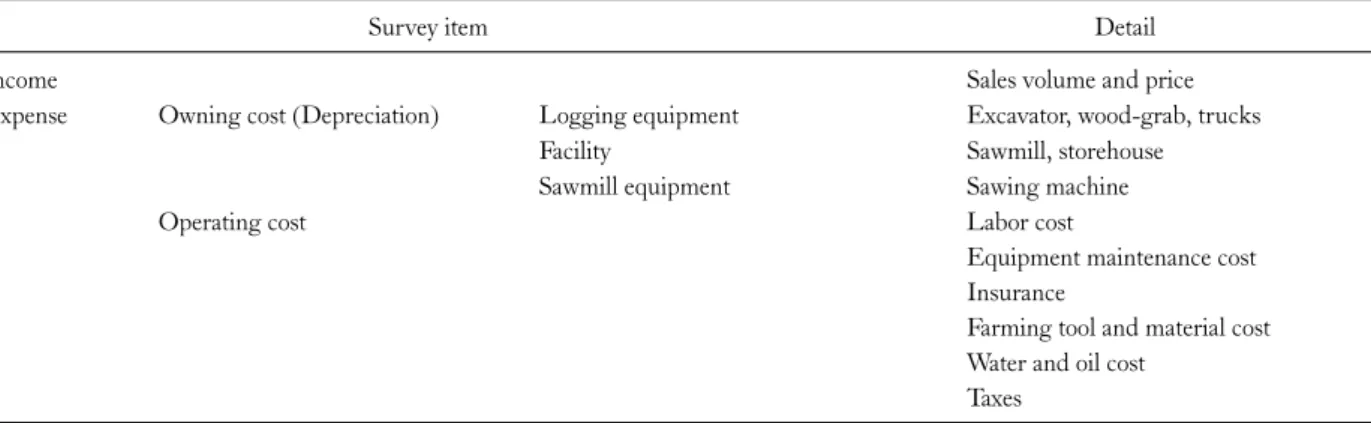
Incomes and expenses that have been incurred on in- dividual processes of the sequential timber production and wood processing were surveyed (Table 3). Income was cal- culated by applying the unit price to the sales volume of each product including logging residues (foliage and branch) and seed and seedlings as the products of the pri- mary industry, wood products (board, luba, cutting board, and chip) and sawdust as the goods of the secondary industry.
The expenses of the household consist of owning and op- erating costs. The owning cost was calculated considering the depreciation of equipment and facility the study house-
Fig. 1. Primary and secondary prod- ucts as well as their associated con- sumers of the study household.
The numbers indicate the propor- tions of individual sales on revenue from the entire business.
Table 3. Survey items for investigating incomes and expenses on individual processes ofthe sequential timber production and wood processing
Survey item Detail
Income Sales volume and price
Expense Owning cost (Depreciation) Logging equipment Excavator, wood-grab, trucks
Facility Sawmill, storehouse
Sawmill equipment Sawing machine
Operating cost Labor cost
Equipment maintenance cost Insurance
Farming tool and material cost Water and oil cost
Taxes hold owned. The sum of the purchase prices of individual
items was divided by their useful life, which is 15 years. The operating cost was calculated considering labor and equip- ment maintenance cost, insurance, farming tool and materi- al costs, water and oil costs, and taxes. Labor was self-pro- vided thus we assumed there was no paid salaried in their business.
The economic outcomes of entire business were analyzed.
The created added value of the 6th industrialization by combining the two sequential processes was also examined compared to the case relying on timber production only.
Results and Discussion
The 6th industrialization business model of the study household
Fig. 1 shows the primary and secondary products as well as their associated market consumers of the study house- hold. Most of the manufactured products are sold by direct dealing. Logging residues, such as foliage and branch, are sold to oil processing companies and furniture companies.
Seedlings and seeds are sold to seed dealers. Most of di- mension lumbers and interior wood materials are sold to the furniture company, but cutting boards, cube chips, and sawdust are directly sold to consumers. The timber pro- duced from the forests was used for wood processing, the
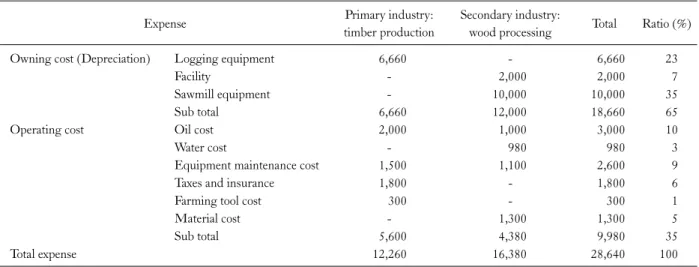
Table 4. Annual expense on timber production and wood processing of the study household (unit: Korean thousand won)
Expense Primary industry:
timber production
Secondary industry:
wood processing Total Ratio (%)
Owning cost (Depreciation) Logging equipment 6,660 - 6,660 23
Facility - 2,000 2,000 7
Sawmill equipment - 10,000 10,000 35
Sub total 6,660 12,000 18,660 65
Operating cost Oil cost 2,000 1,000 3,000 10
Water cost - 980 980 3
Equipment maintenance cost 1,500 1,100 2,600 9
Taxes and insurance 1,800 - 1,800 6
Farming tool cost 300 - 300 1
Material cost - 1,300 1,300 5
Sub total 5,600 4,380 9,980 35
Total expense 12,260 16,380 28,640 100
Table 5. Sales of individual products and gross income of the study household
Product Unit Unit price
(Korean won)
Sales Revenue
(Korean thousand won) Ratio (%) Primary industry:
timber production
Foliage* kg 600 18,000 15
Branch* kg 1,500 1,500 1
Seed kg 108,000 5,400 4
Seeding 2 m 20,000 2,000 2
Sub total 26,900 22
Secondary industry:
wood processing
Dimension lumber (board) 30×125×3,600 mm 3,200 48,000 39
Wood interior material (luba) 15×105×2,400 mm 2,400 28,800 24
Cutting board ea 20,000 12,000 10
Chip kg 5,000 5,000 4
Sawdust kg 1,000 1,600 1
Sub total 95,400 78
Gross income in total 122,300 100
*Logging residues.
order of wood processing is dependent on the sales value of products. The numbers in Fig. 1 indicate the proportions of individual sales on the revenue of the household from the entire business.
Production expenses
Table 4 shows the annual expense on timber production and wood processing of the study household. The annual expenses was calculated as 28,640 thousand won for the en- tire production process (i.e. timber production and wood
processing). Owing costs amounted to 18,660 thousand won, which is accounting for 65% of the total expense. The reminder of the total expense was the operating cost, which was 9,980 thousand won. The calculated annual expense to produce the primary products of Japanese cypress was 12,260 thousand won. The annual production expense of secondary goods was relatively higher than that of the primary products. Among the all expense items, sawmill equipment cost was the highest, accounting for 35% out of total cost, followed by logging equipment costs by 23% and oil cost by
Table 6. Results of management outcome analysis for the study household (unit: Korean thousand won)
Primary industry: timber production Secondary industry: wood processing Total
Gross income (A) 26,900 (100) 95,400 (100) 122,300 (100)
Total expense (B) 12,260 (46) 16,380 (17) 28,640 (23)
Net income (A-B) 14,640 (54) 79,020 (83) 93,660 (77)
Table 7. Created added value on net income by combining timber production and wood processing compared to the case relying on timber production only (unit: Korean thousand won)
Timber production only (C) Timber production and wood processing (D) Ratio (D/C)
Gross income (A) 41,900 122,300 2.9
Total expense (B) 12,260 28,640 -
Net income (A-B) 29,640 93,660 3.2
10%, respectively. Labor cost was not required in pro- duction since it is considered as family labor.
Product sales and income
Table 5 shows the sales of individual products and gross income of the study household. The price of individual products was obtained through an interview with the owner of the household. The unit price of foliage was 600 won per kilogram and branches were sold at 1,500 won per kilogram. Those materials are traded at high values com- pared to typical logging residues since they are supposed to be utilized in oil and lumber production, respectively. Seeds were sold at 108,000 won per kilogram and seedlings were sold at 20,000 won per 2 m of tree height. The dimension lumbers were sold at 48,000 won for 30×125×3,600 mm and at 28,800 won for 15×105×2,400 mm. The cutting boards were sold at an average 20,000 won per ea. Cube chips were sold at 5,000 won per kilogram and sawdust at 1,000 won per kilogram.
The gross income in primary industry of the household was 26,900 thousand won while that of secondary industry was 95,400 thousand won. The gross income in total was estimated to be 122,300 thousand won. The two largest sales of the household were the dimension lumber and in- terior wood material. They are accounted for 39% and 24%
of the total gross income, respectively. The sales of secon- dary products were higher than the sales of primary products.
Management outcomes and created added value of the 6th industrialization
The results of management outcome analysis indicate that the net income of the household was 93,660 thousand won through the combining timber production and wood processing (Table 6). The net income of the household is approximately 2.8 times higher than the average net income of whole households in the forestry of Korea in 2016 (Korea Forest Service 2017), which is approximately 4.3 times higher than that of households that have been particularly engaged in timber production over the country (Korea Forest Service 2017).
In the case of the primary industry that produce timbers for wood processing, the income of the primary production was 26,900 thousand won and the expense was 12,260 thousand won, respectively. The net income that subtracts the expense against from the gross income was estimated to be 14,640 thousand won. In the case of secondary process- ing, the expense was 16,380 thousand won and the net in- come was calculated as 79,020 thousand won. By compar- ison, the expense of the secondary production was 34%
higher than that of the primary production while the net in- come of secondary production increased to 540% of the net income of the primary production: the secondary pro- duction is more cost-effective than the primary production in the case study.
Table 7 shows that the created added value on net income by combining timber production and wood processing
compared to the case relying on timber production only. If the household produce timbers but does not operate a saw- mill for wood processing, the net income of the household would be 29,640 thousand won, subtracting associated ex- pense from the gross income that is obtainable by timber production. Thus we convinced that the 6th industrializa- tion by combining the two sequential processes creates ap- proximately 3.2 times as much added value compared to the case relying on timber production only.
Hwang and Lee (2016) reported that the integration of industries between primary and secondary or primary and tertiary is appropriate to promote farm household income in agriculture. Lee (2013) also found that several cases of agroforestry in the United States to increase forestry house- hold income and suggested economic potential of agro- forestry to Korean forestry. Although the estimated amounts of the economic benefits are different in individual studies, the both confirm that the increase in income and the crea- tion of added value can be achieved through the 6th in- dustrialization in forestry.
Conclusion
The objective of this study was to analyze the increased forestry incomes by combining timber production and wood processing, which is one of 6th industrialization types in Korean forestry. We examined the incomes and expenses of the case household that successfully manages their forest and conducts business in forestry through 6th industriali- zation.
With combining the timber production and wood proc- essing, the income of the study household has increased. It is possible to earn more than 3 times of income by process- ing self-supplied timbers and selling wood products rather than producing timbers only: it can be a good alternative to increase the income of the forest household and increase the participation rate of forest owners in forest management.
However, the results of this study cannot generalize the 6th industrialization of forestry because it is a case in partic- ular condition where 6th industrialization is applicable with the existing assets the household already owned. If a house- hold needs an investment to operate a sawmill for wood processing, the new investment may hinder the household’s decision for 6th industrialization due to their concerns
about failure.
In order to make appropriate decisions on investment or business expansion to the 6th industrialization in forestry, it is necessary to consider additional cost items, such as value of time and costs for planting and silvicultural practices, in- stallation of equipment and facility required for timber har- vesting and wood processing, etc. In addition, general for- est household is difficult to acquire wood processing tech- nology in a short period and to invest capital in processing facilities. Therefore, various research approaches and out- puts that make policy more reasonable for the 6th indus- trialization in forestry is necessary.
References
FAO. 2015. Global Forest Resource Assessment 2015. Food and Agricultural Organizations of United Nations, Rome, 244 pp.
Garrett HE. 2009. North American Agroforestry: an integrated science and practice. 2nd ed. American Society of Agronomy, Inc., Madison, Wisconsin, 379 pp.
Hwang JH, Lee SW. 2016. Type of integration of the 6th in- dustrialization in agriculture and its effects on income growth of farm household. Agr Econ 39: 1-28.
Jung BH, Won HK. 2017. Analyzing the status of 6th indus- trialization and model development in Korean forestry. NIFoS Forest Policy Issue 85, Seoul, 23 pp.
Kim HJ, Kim HS, Lee SH. 2014. Presnet situations and direction of improvement of agro-forestry in private forests of Korea. J Agr Life Sci 48: 35-45.
Kobayasi S, Lee BO. 2012. The current direction and challenges of 6th Industrialization in Japan. World Agri 143: 211-232 Korea Forest Service. 2014. The comprehensive plan for sustain-
able timber utilization in 2015-2019. Korea Forest Service, Daejeon, 44 pp.
Korea Forest Service. 2016. 2016 Statistical Yearbook of Forestry.
Korea Forest Service, Daejeon, 414 pp.
Korea Forest Service. 2017. 2016 forest household economy survey report. Korea Forest Service, Daejeon, 217 pp.
Lee YH. 2013. Economic potential and policy implications of agroforestry form US agroforestry cases. Korean J For Econ 20:
47-58.
Min KT, Kim ME. 2014. Current status and policy implication of agroforestry in South Korea. Kor J For Econ 103: 122-128.
Park SH. 2015. Business model of 6th industry of agriculture for rural tourism. J Rural Tourism 22: 1-17.
University of Minnesota. 2017. Forest farming. Agroforestry in Minnesota factsheet series #2. University of Minnesota, Min- nesota, 4 pp.