• 검색 결과가 없습니다.

Fibro-Fatty Component is Important for the Long-Term Clinical Events in Patients Who Have Undergone Primary Percutaneous Coronary Intervention

N/A
N/A
Protected

Academic year: 2022

Share "Fibro-Fatty Component is Important for the Long-Term Clinical Events in Patients Who Have Undergone Primary Percutaneous Coronary Intervention"

Copied!
7
0
0

로드 중.... (전체 텍스트 보기)

전체 글

(1)

Korean Circulation Journal

Introduction

Virtual histology-intravascular ultrasound (VH-IVUS) has the po- tential to provide detailed qualitative and quantitative information of coronary artery disease and can identify four specific coronary pla-

Print ISSN 1738-5520 • On-line ISSN 1738-5555

Fibro-Fatty Component is Important for the Long-Term Clinical Events in Patients Who Have Undergone Primary

Percutaneous Coronary Intervention

Wan Ho Kim, MD, Hyun Woong Park, MD, Ki Hong Kim, MD, In Girl Song, MD, Dong Ju Yang, MD, Chung Seop Lee, MD, Young Hoon Seo, MD, Taek Geun Kwon, MD, and Jang-Ho Bae, MD

Division of Cardiology, Konyang University College of Medicine, Daejeon, Korea

Background and Objectives: We evaluated which plaque components are associated with long-term clinical events in patients who un- derwent primary percutaneous coronary intervention (PCI).

Subjects and Methods: The study subjects consisted of 57 consecutive patients (mean age, 58.5±14.5 years; 45 males) who underwent primary PCI and a virtual histology-intravascular ultrasound examination. Major adverse cardiac events (MACEs) including death, acute myocardial infarction, stroke, and revascularization were evaluated during the mean 28 month follow-up period.

Results: Patients with high fibro-fatty volume (FFV >13.4 mm

3

, n=29; mean age, 61.3 years) had a lower ejection fraction (52.7% vs. 59.4%, p=0.022), a higher incidence of multi-vessel disease (69.0% vs. 28.6%, p=0.002), larger plaque area (25.7 mm

2

vs. 15.9 mm

2

, p<0.001), and larger plaque volume (315 mm

3

vs. 142 mm

3

, p<0.001) than those with a low FFV (≤13.4 mm

3

, n=28; mean age, 55.6 years). Patients with high FFV had a significantly higher incidence (32.1% vs. 8.3%, p=0.036) of MACE than those with low FFV. When we divided the study pop- ulation according to the necrotic core volume (NCV), fibrous volume, or dense calcified volume, no significant findings in terms of demo- graphics and MACE rates were observed. A Cox regression analysis revealed that the independent factor for MACE was FFV (hazard ratio, 6.748; 95% confidence interval, 1.168-38.971, p=0.033) in this study population.

Conclusion: The coronary plaque component, particularly FFV, but not NCV, was important in long-term clinical outcomes in patients who underwent primary PCI. (Korean Circ J 2012;42:33-39)

KEY WORDS: Intravascular ultrasonography; Myocardial infarction; Disease-free survival.

Received: August 1, 2011 Accepted: September 2, 2011

Correspondence: Jang-Ho Bae, MD, Division of Cardiology, Konyang Uni- versity College of Medicine, 685 Gasuwon-dong, Seo-gu, Daejeon 302- 718, Korea

Tel: 82-42-600-9400, Fax: 82-42-600-9420 E-mail: [email protected]

• The authors have no financial conflicts of interest.

This is an Open Access article distributed under the terms of the Creative Commons Attribution Non-Commercial License (http://creativecommons.

org/licenses/by-nc/3.0) which permits unrestricted non-commercial use, distribution, and reproduction in any medium, provided the original work is properly cited.

que components, such as fibrous (FT), fibro-fatty (FF), dense calcified (DC), and necrotic core (NC) regions using tissue mapping.

1)

Necrotic core regions are important in vulnerable plaque

2-4)

and the number of NC regions is larger in patients with acute coronary syndrome (ACS) than patients with stable angina.

5-7)

Furthermore, NC is associated with positive remodeling.

8)9)

However, these findings have not always been consistent in previous studies.

10)11)

A controversy exists as to whether NC or FF is associated with slow/

no reflow after percutaneous coronary intervention (PCI).

4)5)12-15)

We previously found that fibro-fatty volume (FFV) is associated with slow flow in patients with acute myocardial infarction (AMI) who underwent primary PCI.

12)

But, other investigators have reported that NC is associated with slow flow in patients with ACS who under- went PCI.

4)5)14)15)

Some differences existed between the study popu- lations in these studies. However, no study has reported which com- ponent is associated with long-term clinical outcomes.

Therefore, we evaluated which coronary plaque components are

(2)

associated with long-term clinical outcomes using a post-hoc an- alysis from our previous study that showed a relationship between slow flow and plaque composition in patients with AMI who under- went primary PCI.

12)

Subjects and Methods

Study patients and clinical follow-up

The study subjects consisted of 57 consecutive patients who un- derwent primary PCI for AMI and a VH-IVUS examination from July 2006 to July 2007. Exclusion criteria included vessel tortuosity, whi- ch precluded the VH-IVUS examination, a history of PCI or coronary artery bypass surgery, and refusal of patient consent. Patient demo- graphics and laboratory data, including fasting lipid profiles, serum glucose, etc were obtained before primary PCI. Written informed con- sent was obtained from all patients, and the study was approved by the hospital ethics committee of Konyang University Hospital.

The primary endpoint was major adverse cardiac events (MACEs).

Clinical follow-up was performed for a mean of 27.5±18.3 months, and follow-up data were obtained from all patients. MACE were do- cumented by making phone calls (four patients) and by reviewing the hospital records (53 patients). MACE was defined as death, AMI, stroke, and revascularization. Death was defined as cardiac death due to ACS, intractable heart failure, malignant arrhythmia, and sud- den cardiac death. AMI was defined based on the criteria of clinical presentation, electrocardiogram findings, and cardiac enzyme studi- es (new ST-segment elevation or depression, development of Q waves or left bundle branch block on electrocardiogram, or biochemical evi- dence of necrosis such as total creatine kinase >twice the normal upper limit with an elevated creatine kinase-MB isoenzyme or a positive troponin). Stroke was defined as a loss of neurological function caused by an ischemic event, and this loss persisted for more than 24 hours, left residual signs, or was shown by an imag- ing study. Revascularization was defined as target lesion revascu- larization (TLR) or PCI for a native, de novo coronary lesion. TLR was defined as ischemia-driven PCI of the target lesion due to resteno- sis or re-occlusion within the stent or in the adjacent 5 mm of the distal or proximal segments.

Primary percutaneous coronary intervention

All patients were taking 200 mg/day aspirin plus 75 mg/day clo- pidogrel (after a 300 mg of clopidogrel loading dose) and received intravenous doses of unfractionated heparin during PCI titrated to maintain a therapeutic activated coagulation time.

Percutaneous coronary intervention was performed with a fem- oral or radial approach using a 6 Fr or 7 Fr guiding catheter and 0.014- inch standard or extra-support coronary guidewires. Balloon-ex-

pandable stents were successfully implanted in all patients after predilation with ballooning.

Intravascular ultrasound examination and analysis

The IVUS examination methods were described previously.

16)

The VH-IVUS examination was performed with a dedicated VH-IVUS console (Volcano Therapeutics, Rancho Cordova, CA, USA) during the primary PCI after an intracoronary administration of 100 to 200 µg nitroglycerin. A 20-MHz, 2.9 F monorail, electronic Eagle Eye Gold IVUS catheter (Volcano Therapeutics) was advanced into the target lesion after wiring (n=36, 63.2%) or small sized (1.5 mm diameter) ballooning (n=21, 36.8%) to minimize the effect of ballooning on plaque morphology, and an automatic pullback at 0.5 mm/s was performed to the aorto-ostial junction. The VH-IVUS image was re- corded on a DVD-ROM for later offline analysis. VH-IVUS uses a spec- tral analysis of IVUS radiofrequency data to construct a tissue map.

The grey-scale IVUS images were qualitatively and quantitatively analyzed according to the criteria of the American College of Cardio- logy Clinical Expert Consensus Document on IVUS.

17)

Reference seg- ments were analyzed in a similar manner to the target site. The proxi- mal and distal reference segments were the most normal-looking cross sections ≤10 mm distal and proximal to the lesion. The edges of the lesion for determining lesion length were defined as the near- est point of the most normal-looking cross sections ≤10 mm distal and proximal to the lesion. Reference data were the average of the proximal and distal reference segments. Plaque rupture was defined as an ulcerated ruptured plaque contained in a cavity that commu- nicated with the lumen and an overlying residual fibrous cap frag- ment. The ruptured cavity area was measured using manual interro- gation by tracing the leading edge of the cavity and the presumptive border with the lumen in a single image slice with the largest cavity size.

12)

The volume of the ruptured cavity was measured by multi- plying 0.05 mm by the sum of all the cavity areas in the image slices showing a ruptured cavity.

Spectral analysis of the intravascular ultrasound radiofrequency data

These analyses were conducted on the target lesion of the infarct-

related artery using customized software (IVUSLab; Volcano Thera-

peutics) by either examiner (Bae JH and Kwon TG) who was un-

aware of the patient clinical characteristics. The border was auto-

matically detected at the predefined lesion segment for both the

lumen and the media-adventitia interface. Then, border detection

was manually corrected in the lesion again after automatically de-

tecting the border. After confirming border detection, the software

automatically calculated and presented the results. For each frame,

histological findings were expressed in colors, as previously described

(3)

(green for FT, green-yellow for FF, white for DC, and red for NC). Ad- ditionally, the area (mm

2

) and percentage of each plaque tissue com- ponent was expressed as well as the volumetric analysis (mm

3

).

The predictive accuracy of this method with tissue mapping has been validated.

1)

Statistical analysis

All analyses were performed with Statistical Package for the So- cial Sciences (SPSS) version 18.0 (SPSS Inc., Chicago, IL, USA). Values are expressed as mean±SD. We used the Student’s t-test and chi- square test to compare the groups according to the variables. Rele- vant baseline clinical and VH-IVUS characteristics showing a sig- nificant difference (p<0.05) were included in the multivariate an- alysis. Forward-stepwise Cox regression analysis was performed to evaluate the independent factors of long-term clinical outcomes in

study patients. The Kaplan-Meier method was used to analyze event- free survival. Statistical significance was inferred at p<0.05.

Results

Study population

The study subjects were divided into two groups based on the me- dian value of each coronary plaque component; patients with high FFV (>13.4 mm

3

, n=29; 24 males; mean age, 61.3±15.1 years) and pa- tients with low FFV (≤13.4 mm

3

, n=28; 21 males; mean age, 55.6±

13.5 years) by the median FFV value. Baseline characteristics are summarized in Table 1. No significant differences were observed for age, gender, coronary artery disease risk factors, clinical presenta- tion, medications, lipid profile, or cardiac enzymes. The group with a higher FFV had a lower left ventricular ejection fraction (52.7±

10.4% vs. 59.4±10.3%, p=0.022). When we divided the study pop- ulation according to median value of the necrotic core volume (NCV), FV, or dense calcified volume (DCV), no significant findings were ob- served in terms of demographics and MACE rate (data not shown).

Table 1. Study subject clinical characteristics Low FFV

(n=28)

High FFV

(n=29) p

Male, n (%) 21 (75.0) 24 (82.8) 0.473

Age (years) 055.6±13.5 61.3±15.1 0.139

Hypertension, n (%) 11 (39.3) 11 (37.9) 0.916

Diabetes, n (%) 05 (17.9) 05 (17.2) 0.951

Hyperlipidemia, n (%) 07 (25.9) 10 (34.5) 0.487

Smoking, n (%) 17 (60.7) 14 (48.3) 0.346

Cardiogenic shock, n (%) 1 (3.6) 2 (6.9) 0.574

Old MI, n (%) 1 (3.6) 03 (10.3) 0.317

Peak TnI (ng/mL) 17.6±8.5 16.4±8.70 0.601

hs-CRP (mg/dL) 00.36±0.37 0.45±0.39 0.432

Diagnosis, n (%) 0.449

STEMI 22 (78.6) 25 (86.2)

NSTEMI 06 (21.4) 04 (13.8)

Ejection fraction (%) 059.4±10.3 52.7±10.4 0.022

Uric acid (mg/dL) 5.74±1.7 5.24±1.30 0.358

FBS (mg/dL) 126.9±47.8 146.6±51.00 0.142

TC (mg/dL) 183.3±33.6 171.6±44.50 0.278

TG (mg/dL) 127.3±64.8 149.0±108.9 0.384

HDL-C (mg/dL) 045.1±13.9 43.6±9.70 0.645

LDL-C (mg/dL) 118.3±27.9 114.6±29.60 0.647

Fibrinogen (mg/dL) 03.53±1.22 3.73±1.43 0.622

Creatinine (mg/dL) 00.95±0.20 1.26±0.85 0.064

Use of aspiration catheter, n (%) 04 (14.3) 04 (13.8) 0.957 Use of GP IIb/IIIa inhibitor, n (%) 04 (14.3) 2 (6.9) 0.363 Low FFV ≤13.4 mm

3

; high FFV >13.4 mm

3

. FFV: fibrofatty volume, TnI: tropo- nine I, hs-CRP: high sensitivity C-reactive protein, STEMI: ST elevation myo- cardial infarction, NSTEMI: non-ST elevation myocardial infarction, FBS:

fasting blood sugar, TC: total cholesterol, TG: triglyceride, HDL-C: high den- sity lipoprotein-cholesterol, LDL-C: low density lipoprotein-cholesterol, GP IIb/IIIa inhibitor: glycoprotein IIb/IIIa inhibitor, MI: myocardial infarction

Table 2. Long-term clinical outcomes according to fibrofatty volume

MACE Low FFV

(n=28)

High FFV

(n=29) p

Death (%) 0 (0.0) 3 (10.7) 0.099

AMI (%) 0 (0.0) 2 (6.9)0 0.157

Stroke (%) 0 (0.0) 0 (0.0)0

PCI (%) 2 (8.3) 6 (21.4) 0.192

de novo lesion (%) 0 (0.0) 3 (10.7) 0.099

TLR (%) 2 (8.3) 3 (10.7) 0.772

Total (%) 2 (8.3) 9 (32.1) 0.036

Mean follow-up duration, 27.5±18.3 months, low FFV ≤13.4 mm

3

; high FFV >13.4 mm

3

. MACE: major adverse cardiac events, FFV: fibrofatty vol- ume, AMI: acute myocardial infarction, PCI: percutaneous coronary inter- vention, TLR: target lesion revascularization

Fig. 1. Kaplan-Meier survival curve. Low FFV ≤13.4 mm3; high FFV >13.4 mm3. MACE: major adverse cardiac events, FFV: fibrofatty volume, AMI:

acute myocardial infarction, PCI: percutaneous coronary intervention, TLR:

target lesion revascularization.

1.0 0.8 0.6 0.4 0.2 0.0

Follow up duration (months)

M AC E- fr ee s ur vi va l r at e

0 6 12 18 24 30 36 Low FFV (n=28)

High FFV (n=29)

Mean follow up duration

27.5±18.3 months

Log rank p=0.036

(4)

Clinical outcomes

Major adverse cardiac event rates are listed in Table 2. MACE rates tended to be higher in the high FFV group, but the result was not sta- tistically significant. However, patients with a high FFV had a sig- nificantly higher incidence (32.1% vs. 8.3%, p=0.036) of total MACE (death, AMI, stroke, revascularization) than those in the low FFV gr- oup. The Kaplan-Meier survival estimates showed worse outcomes in the high FFV group than those in the low FFV group (log-rank p=

0.036) (Fig. 1). No stent thrombosis was noted in either group during the follow-up. The univariate Cox regression analysis showed that significant predictors for total MACE were FFV and plaque burden.

The multivariate Cox regression analysis, including all significant variables as covariates, revealed that FFV was the only significantly

independent predictor for MACE (hazard ratio, 6.748; 95% confid- ence interval, 1.168-38.971, p=0.033) (Table 3).

When we divided the study population according to the abso- lute and relative FV, NCV, and DCV, no significant findings were observed in terms of demographics or MACE rate.

Coronary angiography findings

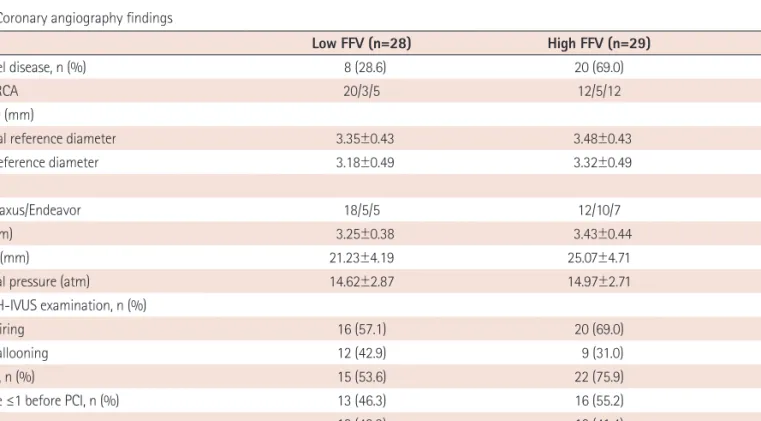
The coronary angiography findings are summarized in Table 4.

No significant differences were observed in terms of lesion loca- tion, reference diameter, type and size of stent, inflation pressure, time of VH-IVUS examination, prevalence of thrombus, or Throm- bolysis in Myocardial Infarction flow grade. However, multi-vessel disease was encountered more often in patients with high FFV than those with low FFV (69% vs. 28%, p=0.002). Stent length was sig- nificantly longer in the high FFV group compared with that in the low FFV group (25.07±4.71 mm vs. 21.23±4.19 mm, p=0.002). When we compared the angiography findings according to the median value of FV, DCV, and NCV, we found no significant differences be- tween the groups.

Virtual histology-intravascular ultrasound findings

The VH-IVUS findings are summarized in Table 5. IVUS lesion le- ngth was significantly longer in the high FFV group compared with that in the low FFV group (25.71±8.33 mm vs. 15.97±6.02 mm, p<

Table 3. Hazard ratio for major adverse cardiovascular events Hazard ratio 95% confidence interval p

Ejection fraction 0.801 0.202-3.171 0.751

Multivessel disease 2.419 0.523-11.192 0.259

Plaque area 1.149 0.233-5.658 0.864

Plaque volume 0.268 00.55-1.304 0.103

Fibrofatty volume 6.748 1.168-38.971 0.033

The variables in this model included age, gender, smoking, hypertension, diabetes, dyslipidemia, ejection fraction, multi-vessel disease, plaque area, plaque volume, plaque burden, fibrous volume, fibrofatty volume, dense calcified volume, and necrotic core volume

Table 4. Coronary angiography findings

Low FFV (n=28) High FFV (n=29) p

Multivessel disease, n (%) 08 (28.6) 20 (69.0) 0.002

LAD/LCX/RCA 20/3/5 12/5/12 0.068

Vessel size (mm)

Proximal reference diameter 03.35±0.43 03.48±0.43 0.280

Distal reference diameter 03.18±0.49 03.32±0.49 0.283

Stent

Cyper/Taxus/Endeavor 18/5/5 12/10/7 0.204

Size (mm) 03.25±0.38 03.43±0.44 0.110

Length (mm) 21.23±4.19 25.07±4.71 0.002

Maximal pressure (atm) 14.62±2.87 14.97±2.71 0.644

Time of VH-IVUS examination, n (%) 0.355

After wiring 16 (57.1) 20 (69.0)

After ballooning 12 (42.9) 09 (31.0)

Thrombus, n (%) 15 (53.6) 22 (75.9) 0.078

TIMI grade ≤1 before PCI, n (%) 13 (46.3) 16 (55.2) 0.509

0 12 (42.9) 12 (41.4)

1 1 (3.6) 04 (13.8)

2 09 (32.1) 08 (27.6)

3 06 (21.4) 05 (17.2)

Low FFV ≤13.4 mm

3

; high FFV >13.4 mm

3

. FFV: fibrofatty volume, LAD: left anterior descending artery, LCX: left circumflex artery, RCA: right coronary artery,

VH-IVUS: intravascular ultrasound-virtual histology, TIMI: Thrombolysis in Myocardial Infarction, PCI: percutaneous coronary intervention

(5)

0.05).

A lesion analysis at the minimal lumen area site revealed that patients with high FFV had larger vessel area (17.91±5.37 mm

2

vs.

12.19±3.89 mm

2

, p<0.001), larger lumen area (4.10±1.16 mm

2

vs.

3.78±1.25 mm

2

, p=0.017), larger plaque area (15.90±4.65 mm

2

vs.

10.61±4.30 mm

2

, p<0.05), and a larger fibrous area (7.43±3.00 mm

2

vs. 4.45±2.73 mm

2

, p<0.05) than those in the low FFV group.

Patients with high FFV had larger vessel volume (380.9±172.9 mm

3

vs. 197.3±86.9 mm

3

, p<0.001), larger plaque volume (314.5±

141.4 mm

3

vs. 141.6±71.6 mm

3

, p<0.05), larger plaque burden (61.7±

5.1% vs. 57.5±8.1%, p=0.021), larger FV (131.3±69.3 mm

3

vs. 49.9±

28.4 mm

3

, p<0.05), and larger NCV (35.2±29.2 mm

3

vs. 21.1±17.3 mm

3

, p=0.032) over the entire lesion length than those in the low- er FFV group.

The VH volumetric data of each plaque constituent were divided by the length of the examined vessel segment to compensate for the different lesion length in each examined vessel. The FV, FFV, plaque volume, and vessel volume after adjustment for the differ- ent examined vessel segments were larger in the high FFV group (4.97±1.67 mm

3

/mm vs. 3.11±1.63 mm

3

/mm, p<0.001; 1.53±0.99

mm

3

/mm vs. 0.54±0.62 mm

3

/mm, p<0.001; 12.14±3.27 mm

3

/mm vs. 8.77±2.95 mm

3

/ mm, p<0.001; 19.62±4.87% vs. 15.03±4.16%, p<0.001, respectively). However, no significant difference in the NCV and DCV was observed between the groups after adjusting for lesion length (1.33±0.98 mm

3

/mm vs. 1.20±0.78 mm

3

/mm, p=

Table 5. Virtual histology-intravascular ultrasound (VH-IVUS) findings

Low FFV (n=28) High FFV (n=29) p

IVUS lesion length (mm) 15.97±6.02 25.71±8.33 <0.001

Lesion analysis

Lumen area (mm

2

) 3.78±1.25 04.10±1.16 0.017

Vessel area (mm

2

) 12.19±3.890 17.91±5.37 <0.001

Plaque area (mm

2

) 10.61±4.300 15.90±4.65 <0.001

Plaque burden (%) 70.57±10.58 79.34±5.17 <0.001

Fibrous area (mm

2

) 4.45±2.73 07.43±3.00 <0.001

Fibrofatty area (mm

2

) 0.72±0.85 02.43±2.09 <0.001

Dense calcified area (mm

2

) 0.66±0.67 00.54±0.44 0.439

Necrotic core volume (mm

2

) 1.61±1.21 01.89±1.34 0.419

Volumetric analysis (mm

3

)

Plaque volume, mm

3

(mm

3

/mm) 141.6±71.6 (8.77±2.95) 314.5±141.4 (12.14±3.27) <0.001 (<0.001) Vessel volume, mm

3

(mm

3

/mm) 197.3±86.9 (15.03±4.16) 380.9±172.9 (19.62±4.87) <0.001 (<0.001)

Plaque burden (%) 57.5±8.10 61.7±5.1 0.021

Fibrous volume, mm

3

(mm

3

/mm) 49.9±28.4 (3.11±1.63) 131.3±69.3 (4.97±1.67) <0.001 (<0.001) Fibrofatty volume, mm

3

(mm

3

/mm) 6.9±4.2 (0.54±0.62) 36.4±21.4 (1.53±0.99) <0.001 (<0.001) Dense calcified volume, mm

3

(mm

3

/mm) 9.9±11.2 (0.56±0.59) 13.9±14.5 (0.53±0.52) 0.245 (0.795) Necrotic core volume, mm

3

(mm

3

/mm) 21.1±17.3 (1.20±0.78) 35.2±29.2 (1.33±0.98) 0.032 (0.591)

Remodeling index 0.98±0.18 01.04±0.15 0.161

Plaque rupture or ulceration, n (%) 25 (89) 29 (100) 0.078

Reference vessel CSA (mm

2

)

Proximal Ref. CSA 16.86±5.170 21.31±5.25 0.002

Distal Ref. CSA 12.99±3.890 17.18±330 0.001

Low FFV ≤13.4 mm

3

; high FFV >13.4 mm

3

. FFV: fibrofatty volume, Ref: reference, CSA: cross sectional area

Fig. 2. Area under the curve. FFV: fibrofatty volume.

1.0

0.8

0.6

0.4

0.2

0.0

1-specificity

Se ns iti vi ty

0.0 0.2 0.4 0.6 0.8 1.0

FFV=12.3 mm

3

(6)

0.591). No significant difference was observed for the remodeling index, the prevalence of plaque rupture, or ulceration between the two groups.

Finally, we performed an receiver-operating characteristic curve analysis to calculate an FFV cutoff value for future MACE in these patients. The absolute FFV optimal cut-off point to predict future MACE was 12.3 mm

3

. As shown in Fig. 2, this cut-off point had a sen- sitivity of 90.9% and a specificity of 48.8% (area under the curve, 0.704, p=0.038, 95% confidence interval, 0.526-0.882) (Fig. 2).

Discussion

The main finding of our study was that high FFV over the entire le- sion length was an important predictor of long-term clinical out- come in patients with AMI who underwent primary PCI, although it is still unclear whether FFV or NCV is associated with slow/no-re- flow in previous cross-sectional studies.

4)5)12-15)

The slow/no reflow phenomenon during PCI is associated with in- creased in-hospital mortality, post-procedural myocardial infarction, and poor mid-term clinical outcomes.

18-20)

However, controversies exist for the association between plaque components and slow/no reflow phenomenon after PCI in patients with ACS.

5)12-15)21)

Kawagu- chi et al.

5)

reported that NC volume clearly predicts distal emboli- zation after stent deployment in patients with an ST-segment eleva- tion MI, as compared with FT, FF, DC, and total plaque volume. Bae et al.

12)

reported that patients with slow flow had more FT and FF vol- umes, but not NC volume, at the time of primary PCI for AMI. Naka- mura et al.

13)

reported that VH-IVUS showed a trend towards a larger percentage of FF plaque volume in a no-reflow group than that in a normal-reflow group. Hong et al.

15)

also reported that NC is associ- ated with slow flow after PCI in patients with ACS. Thus, no consen- sus exists regarding plaque composition associated with slow flow.

Several studies have demonstrated that NC is larger in patients with ACS than in patients with stable angina.

5-7)

Three studies

5-7)

reported that the amount of NC or the percentage of NC and its ra- tio to DC are larger in patients with ACS compared to those with stable angina. There is also discrepancy with regards to vascular re- modeling. That is, positive remodeling, which is an adverse prog- nostic factor, is associated with NC,

8)9)

whereas others have report- ed it is associated with FFV.

10)11)

Therefore, it is still unclear whether NCV or FFV is associated with ACS, positive remodeling, and slow flow in several cross-sectional studies.

2-11)

Few studies have investigated the impact of coronary plaque components on long-term clinical events in patients who under- went PCI. Therefore, this study was conducted to evaluate the im- pact of plaque components on long-term clinical events in a ho- mogenous study population, particularly in patients who under-

went primary PCI. Our study showed that FFV rather than NCV was associated with long-term clinical outcome. The reason why FFV, not NCV, was associated with total MACE in our study was the greater chance for an NCV artifact, particularly by calcium. That is, there was a greater chance to be read as NCV behind calcium. The second reason was that there was a larger number of already ruptured plaque cavities, which precluded true measurement of NCV in the lesion. A fresh thrombus is composed of a layered pattern of plate- let fibrin, erythrocytes, and intact granulocytes, and an old throm- bus shows in-grown smooth muscle cells with or without deposi- tion of connective tissue and capillary vessel in-growth, which is similar to a fibrous plaque.

22)23)

The current study had some limitations. This study was based on a small number of patients, and was a single-center study. Howev- er, our study was based on consecutive patients with AMI who un- derwent primary PCI, although we did not reflect the whole spec- trum of patients with ACS. The other limitation considers thrombi.

Actually, VH-IVUS cannot identify a thrombus that commonly fol- lows a plaque rupture. Most lesions (53 of 57, 94.7%) in the cur- rent study had already ruptured or became ulcerated plaques, whose cavity was linked to the lumen. Nasu et al.

24)

have shown that th- rombi are colored as FT and FF by VH-IVUS. Therefore, we analyzed the lesions, excluding the plaque cavity to avoid any possible th- rombus; thus, a larger amount of NCV may have migrated into the distal coronary bed before or during primary PCI in the patients with AMI. Thus, there was possibility of failing to detect a higher NCV and of underestimating NCV. Finally, we arbitrarily divided the study population into two groups according to the median value of pla- que components, because we focused only on the clinical outcomes according to coronary plaque components, and there was no cutoff value or appropriate value for absolute plaque components until now.

Conclusion

Our results suggest that plaque components, particularly FFV, but not NCV, are important in the long-term clinical outcomes of pa- tients who underwent primary PCI, although further studies are ne- eded to evaluate the relationship between coronary plaque com- ponents and long-term clinical outcomes. A VH-IVUS analysis for plaque components over the entire lesion may be useful to predict the risk of long-term clinical outcomes in patients with AMI who underwent primary PCI. Lesions with high FFV should trigger more aggressive secondary prevention in patients with AMI who under- went primary PCI.

REFERENCES

1. Nair A, Kuban BD, Tuzcu EM, et al. Coronary plaque classification

(7)

with intravascular ultrasound radiofrequency data analysis. Cir- culation 2002;106:2200-6.

2. Virmani R, Burke AP, Kolodgie FD, Farb A. Vulnerable plaque: the pathology of unstable coronary lesions. J Interv Cardiol 2002;

15:439-46.

3. Rodriguez-Granillo GA, McFadden EP, Valgimigli M, et al. Coro- nary plaque composition of nonculprit lesions, assessed by in vivo intracoronary ultrasound radio frequency data analysis, is relat- ed to clinical presentation. Am Heart J 2006;151:1020-4.

4. Böse D, von Birgelen C, Zhou XY, et al. Impact of atherosclerotic plaque composition on coronary microembolization during per- cutaneous coronary interventions. Basic Res Cardiol 2008;103:

587-97.

5. Kawaguchi R, Oshima S, Jingu M, et al. Usefulness of virtual his- tology intravascular ultrasound to predict distal embolization for ST-segment elevation myocardial infarction. J Am Coll Cardiol 2007;50:1641-6.

6. Missel E, Mintz GS, Carlier SG, et al. Necrotic core and its ratio to dense calcium are predictors of high-risk non-ST-elevation acute coronary syndrome. Am J Cardiol 2008;101:573-8.

7. Hong MK, Mintz GS, Lee CW, et al. Comparison of virtual histolo- gy to intravascular ultrasound of culprit coronary lesions in acute coronary syndrome and target coronary lesions in stable angina pectoris. Am J Cardiol 2007;100:953-9.

8. Rodriguez-Granillo GA, Serruys PW, Garcia-Garcia HM, et al. Co- ronary artery remodelling is related to plaque composition. Heart 2006;92:388-91.

9. Kataoka T, Mathew V, Rubinshtein R, et al. Association of plaque composition and vessel remodeling in atherosclerotic renal artery stenosis: a comparison with coronary artery disease. JACC Car- diovasc Imaging 2009;2:327-38.

10. Fujii K, Carlier SG, Mintz GS, et al. Association of plaque charac- terization by intravascular ultrasound virtual histology and arteri- al remodeling. Am J Cardiol 2005;96:1476-83.

11. Surmely JF, Nasu K, Fujita H, et al. Association of coronary plaque composition and arterial remodelling: a virtual histology analy- sis by intravascular ultrasound. Heart 2007;93:928-32.

12. Bae JH, Kwon TG, Hyun DW, Rihal CS, Lerman A. Predictors of slow flow during primary percutaneous coronary intervention: an in- travascular ultrasound-virtual histology study. Heart 2008;94:

1559-64.

13. Nakamura T, Kubo N, Ako J, Momomura S. Angiographic no-re- flow phenomenon and plaque characteristics by virtual histology intravascular ultrasound in patients with acute myocardial in- farction. J Interv Cardiol 2007;20:335-9.

14. Higashikuni Y, Tanabe K, Tanimoto S, et al. Impact of culprit pla- que composition on the no-reflow phenomenon in patients with acute coronary syndrome: an intravascular ultrasound radiofre- quency analysis. Circ J 2008;72:1235-41.

15. Hong YJ, Jeong MH, Choi YH, et al. Impact of plaque components on no-reflow phenomenon after stent deployment in patients with acute coronary syndrome: a virtual histology-intravascular ultrasound analysis. Eur Heart J 2009, doi: 10.1093/eurheartj/

ehp034.

16. Tobis JM, Mallery J, Mahon D, et al. Intravascular ultrasound im- aging of human coronary arteries in vivo: analysis of tissue char- acterizations with comparison to in vitro histological specimens.

Circulation 1991;83:913-26.

17. Mintz GS, Nissen SE, Anderson WD, et al. American College of Cardiology Clinical Expert Consensus Document on Standards for Acquisition, Measurement and Reporting of Intravascluar Ultra- sound Studies (IVUS): a report of the American College of Cardi- ology Task Force on Clinical Expert Consensus Documents. J Am Coll Cardiol 2001;37:1478-92.

18. Resnic FS, Wainstein M, Lee MK, et al. No-reflow is an indepen- dent predictor of death and myocardial infarction after percuta- neous coronary intervention. Am Heart J 2003;145:42-6.

19. Ramírez-Moreno A, Cardenal R, Pera C, et al. Predictors and prog- nostic value of myocardial injury following stent implantation.

Int J Cardiol 2004;97:193-8.

20. Yip HK, Chen MC, Chang HW, et al. Angiographic morphologic fe- atures of infarct-related arteries and timely reperfusion in acute myocardial infarction: predictors of slow-flow and no-reflow phenomenon. Chest 2002;122:1322-32.

21. Kawamoto T, Okura H, Koyama Y, et al. The relationship between coronary plaque characteristics and small embolic particles dur- ing coronary stent implantation. J Am Coll Cardiol 2007;50:

1635-40.

22. Henriques de Gouveia R, van der Wal AC, van der Loos CM, Beck- er AE. Sudden unexpected death in young adults: discrepancies between initiation of acute plaque complications and the onset of acute coronary death. Eur Heart J 2002;23:1433-40.

23. Murakami T, Mizuno S, Takahashi Y, et al. Intracoronary aspiration thrombectomy for acute myocardial infarction. Am J Cardiol 1998;

82:839-44.

24. Nasu K, Tsuchikane E, Katoh O, et al. Accuracy of in vivo coronary

plaque morphology assessment: a validation study of in vivo vir-

tual histology compared with in vitro histopathology. J Am Coll

Cardiol 2006;47:2405-12.

수치

Table 1. Study subject clinical characteristics Low FFV (n=28) High FFV(n=29) p Male, n (%) 21 (75.0) 24 (82.8) 0.473 Age (years) 055.6±13.5 61.3±15.1 0.139 Hypertension, n (%) 11 (39.3) 11 (37.9) 0.916 Diabetes, n (%) 05 (17.9) 05 (17.2) 0.951 Hyperlipide
Table 4. Coronary angiography findings
Table 5. Virtual histology-intravascular ultrasound (VH-IVUS) findings

참조

관련 문서

In matter of business scale, it is no surprise that general logistics company with asset fits more than small business, which has limitation in

Long-term outcomes of short dental implants supporting single crowns in posterior region: a clinical retrospective study of 5-10 years.. Osteotome sinus

Therefore, cTnT is a recommended biomarker for use in the detection of myocardial infarction (MI) and in acute coronary syndromes.[8] Indeed, several authors

approval but there is no limit for the amount of national bonds and.. public bonds in scale with GDP. 3) maturity for national bonds and public bonds is making a long-term.

The associations of hepatic steatosis and fibrosis using fatty liver index and BARD score with cardiovascular outcomes and mortality in patients with new‑onset type 2

Incident major cardiovascular events (coronary artery disease, ischemic stroke, hemorrhagic stroke and cardiovascular mortality) were set as primary end points.

In Table 4, for the problems with 10, 20, and 30 nodes, the computational results of tabu search are shown with a recency based short term memory, a frequency based long term

Although visceral fat adiposity has known to be associated with clinical, pathologic, and oncologic outcomes in patients with colorectal cancer (CRC), the