• 검색 결과가 없습니다.

Effect of High Dose Rosuvastatin Loading before Percutaneous Coronary Intervention on Contrast-Induced Nephropathy

N/A
N/A
Protected

Academic year: 2022

Share "Effect of High Dose Rosuvastatin Loading before Percutaneous Coronary Intervention on Contrast-Induced Nephropathy"

Copied!
6
0
0

로드 중.... (전체 텍스트 보기)

전체 글

(1)

Korean Circulation Journal

Introduction

With an increasing number of patients undergoing coronary an- giography and percutaneous coronary intervention (PCI), the preva-

Print ISSN 1738-5520 • On-line ISSN 1738-5555

Effect of High Dose Rosuvastatin Loading before Percutaneous Coronary Intervention on Contrast-Induced Nephropathy

Kyeong Ho Yun, MD, Jae Hong Lim, MD, Kyo Bum Hwang, MD, Sun Ho Woo, MD, Jin Woo Jeong, MD,

Yong Cheol Kim, MD, Dai-Yeol Joe, MD, Jum Suk Ko, MD, Sang Jae Rhee, MD, Eun Mi Lee, MD, and Seok Kyu Oh, MD

Department of Cardiovascular Medicine, Regional Cardiocerebrovascular Center, Wonkwang University Hospital, Iksan, Korea

Background and Objectives: Contrast-induced nephropathy (CIN) is associated with increased morbidity and mortality. This observational, non-randomized study evaluated the effect of rosuvastatin loading before percutaneous coronary intervention (PCI) on the incidence of CIN in patients with acute coronary syndrome (ACS).

Subjects and Methods: A total of 824 patients who underwent PCI for ACS were studied (408 patients in the statin group=40 mg rosuv- astatin loading before PCI; 416 patients of control group=no statin pretreatment). Serum creatinine concentrations were measured before and 24 and 48 hours after PCI. The primary endpoint was development of CIN defined as an increase in serum creatinine concentration of

≥0.5 mg/dL or ≥25% above baseline within 72 hours after PCI.

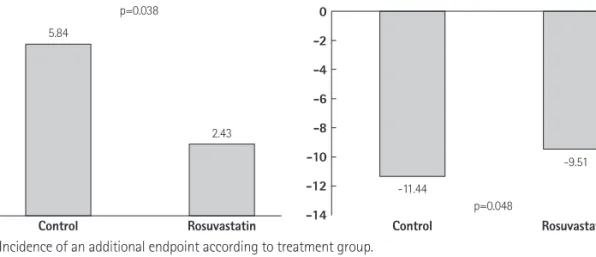
Results: The incidence of CIN was significantly lower in the statin group than that in the control group (18.8% vs. 13.5%, p=0.040). The maximum percent changes in serum creatinine and estimated glomerular filtration rate in the statin group within 48 hours were signifi- cantly lower than those in the control group (5.84±22.59% vs. 2.43±24.49%, p=0.038; -11.44±14.00 vs. -9.51±13.89, p=0.048, respective- ly). The effect of rosuvastatin on preventing CIN was greater in the subgroups of patients with diabetes, high-dose contrast medium, multi- vessel stents, high baseline C-reactive protein, and myocardial infarction. A multivariate analysis revealed that rosuvastatin loading was independently associated with a decreased risk for CIN (odds ratio, 0.64; 95% confidence interval, 0.43–0.95, p=0.026).

Conclusion: High-dose rosuvastatin loading before PCI was associated with a significantly lower incidence of CIN in patients with ACS.

(Korean Circ J 2014;44(5):301-306) KEY WORDS: Contrast media; Kidney; Statins.

Received: June 2, 2014

Revision Received: June 30, 2014 Accepted: July 18, 2014

Correspondence: Kyeong Ho Yun, MD, Department of Cardiovascular Medicine, Regional Cardiocerebrovascular Center, Wonkwang University Hospital, 895 Muwang-ro, Iksan 570-711, Korea

Tel: 82-63-859-2524, Fax: 82-63-852-8480 E-mail: [email protected]

• The authors have no financial conflicts of interest.

This is an Open Access article distributed under the terms of the Creative Commons Attribution Non-Commercial License (http://creativecommons.

org/licenses/by-nc/3.0) which permits unrestricted non-commercial use, distribution, and reproduction in any medium, provided the original work is properly cited.

lence of contrast-induced nephropathy (CIN) is also increasing. Pa- tients with acute coronary syndrome (ACS) have a three-fold higher risk of developing CIN, and CIN is associated with prolonged hospi- talization, increased costs, and increased short- and long-term mor- bidity and mortality.

1)

Although the underlying mechanism of CIN is not fully understood, the pathophysiology may be related to direct renal tubular toxicity, vasoconstriction, and high oxidative stress.

2)3)

Several studies have suggested that statins may reduce the inci- dence of CIN through their beneficial effects on endothelial func- tion, nitric oxide production, and oxidative stress.

1)3)

However, the re- sults of clinical studies are inconsistent.

4)

Therefore, we conducted an observational study involving consec-

utive patients with ACS who underwent PCI. The purpose of this

study was to evaluate the effect of pretreatment with rosuvastatin

loading before PCI on the incidence of CIN in patients with ACS.

(2)

Subjects and Methods

Study population

We analyzed a single center, consecutive ACS and PCI cohort from December 2009 to December 2012. During the study period, 1037 consecutive patients were recruited and followed-up during their clinical course to document patient characteristics, acute therapy, PCI data, and hospital outcomes. Exclusion criteria were current statin treatment, high-risk features warranting emergency coronary angiography (within 2 hours), acute renal failure or end-stage re- nal disease requiring dialysis, serum creatinine >3 mg/dL, contrast medium administration within the past 10 days, or lack of laboratory data including serum creatinine. As a result, 824 patients were an- alyzed: 408 patients received 40 mg rosuvastatin loading before PCI (statin group) and 416 patients did not receive the statin pretreat- ment (control group). Rosuvastatin loading was performed at the on-call physician’s discretion. All patients gave informed consent for processing of their anonymous data, according to a protocol ap- proved by the Institutional Review Board of Wonkwang University Hospital.

Percutaneous coronary intervention

Aspirin (300 mg/day) and clopidogrel (300 mg/day) were loaded in all patients before the procedure. An intravenous bolus of 5000 U unfractionated heparin was given, and additional heparin boluses were given to maintain activated clotting time >300 seconds dur- ing the procedure. Coronary angiography and stent implantation were performed using standard interventional techniques. Platelet glycoprotein IIb/IIIa inhibitors were administered according to op- erator preference. Aspirin (100 mg/day), clopidogrel (75 mg/day), and statins were prescribed to all patients after the procedure.

Hydration therapy (0.9% sodium chloride, 1 mL/kg/h) was per- formed during the pre- and post-PCI periods at the physician’s dis- cretion. Hydration rate was reduced to 0.5 mL/kg/h for patients with a left ventricular ejection fraction (EF) <40%.

Data collection and analyses

Blood samples were taken to measure serum creatinine concen- trations before rosuvastatin loading and at 24 and 48 hours after contrast media administration. Additional samples were obtained if a patient showed signs or symptoms of CIN. The peak post-proce- dural serum creatinine value was used for the primary endpoint eval- uation. Renal function was measured using estimated glomerular filtration rate (eGFR), calculated with the Modification of Diet in Re- nal Disease formula, in all patients.

5)

Levels of high-sensitivity C-re- active protein (hsCRP) and lipid profiles were also measured using commercial kits.

The primary endpoint was development of CIN, defined as an in- crease in serum creatinine concentration ≥0.5 mg/dL or ≥25%

above baseline within 72 hours after contrast agent administration.

6)

Additional endpoints included maximal increases in serum creatinine levels and maximal decreases in eGFR within 48 hours after the procedure.

Statistical analysis

Based on a previous study, the incidence of CIN was approximate- ly 15% in the control group.

7)

Sample size was selected to demon- strate an incidence reduction of 2% in the statin group. Accordingly, a minimal sample size of 135 patients was required in each group to provide 80% power with a two-sided alpha of 0.05.

All measurements are represented as means±standard deviations or absolute numbers (percentages). The inter-group analysis was performed using the independent t-test and χ

2

test, which were conducted using SPSS 19.0 for Windows (SPSS Inc., Chicago, IL, USA). A multivariate logistic regression model was constructed to predict the development of CIN. The following variables, selected according to a significant univariate analysis (p<0.1), were inserted into the logistic regression analysis; rosuvastatin loading, age, dia- betes, levels of hemoglobin and hsCRP, contrast volume, myocardial infarction presentation, baseline eGFR, and EF. The efficacy of rosu- vastatin was also evaluated in pre-specified subgroups (age, gen- der, EF, diabetes, contrast dose, multivessel stent, myocardial infarc- tion presentation, and baseline hsCRP and eGFR levels). The first or third tertile of the continuous variables was used as a cut-off point in the logistic regression analysis. The adjust effect was controlled for the same prognostic and confounding factors, but the specific variable related to each individual subgroup was excluded from the model for that subgroup. Statistical significance was set at p<0.05.

Results

Baseline characteristics

The baseline clinical characteristics of the patients in the control and statin groups are shown in Table 1. Risk factors, baseline labo- ratory findings, and angiographic and procedural data were similar between the groups. However, the control group showed lower EF (51.4±12.9% vs. 54.4±11.9%, p=0.001), higher levels of low density lipoprotein-cholesterol (118.3±37.0 mg/dL vs. 109.4±35.0 mg/dL, p=0.001), and a lower incidence of myocardial infarction (42.1% vs.

51.7%, p=0.006) than those in the statin group.

Incidence of contrast-induced nephropathy

Contrast-induced nephropathy occurred in 133 patients (16.1%).

The incidence of CIN was significantly lower in the statin group than

(3)

that in the control group (18.8% vs. 13.5%, p=0.040) (Fig. 1). The incidence of increased serum creatinine concentrations ≥0.5 mg/dL and an increase ≥25% above baseline within 72 hours was also

lower in the statin group (8.2% vs. 4.7%, p=0.040; 18.5% vs. 13.5%, p=0.049, respectively) than those in the control group. When the patients were divided into three groups according to baseline hsCRP

<1.0 mg/L, 1.0–3.0 mg/L, and >3.0 mg/L, the incidence rates of CIN were 10.7%, 16.1%, and 21.6%, respectively (p=0.002).

The maximal percent changes in serum creatinine concentration and eGFR in the statin group within 48 hours were significantly low- er than those in the control group (5.84±22.59% vs. 2.43±24.49%, p=0.038; -11.44±14.00 vs. -9.51±13.89, p=0.048, respectively) (Fig. 2).

Multivariate analysis

The multivariate analysis revealed that rosuvastatin loading was independently associated with a decreased risk for CIN (odds ratio, 0.64; 95% confidence interval, 0.43–0.95, p=0.026) (Table 2). The independent predictors of CIN included low EF, diabetes, age, and a decreased baseline eGFR.

The benefit of rosuvastatin loading therapy was not different according to age, gender, EF, or hemoglobin level. However, the effect Table 1. Baseline characteristics

Characteristics Control (n=416) Statin (n=408) p

Age (years) 63.6±12.5 64.3±11.7 0.415

Male (%) 286 (68.8) 254 (62.3) 0.050

Hypertension (%) 229 (55.0) 244 (59.8) 0.167

Diabetes mellitus (%) 120 (28.8) 118 (28.9) 0.981

Current smoker (%) 162 (38.9) 128 (31.4) 0.023

MI presentation (%) 175 (42.1) 211 (51.7) 0.006

Previous PCI (%) 31 (7.5) 30 (7.4) 0.957

Ejection fraction (%) 51.4±12.9 54.4±11.9 0.001

Baseline laboratory variables

Serum creatinine (mg/dL) 0.99±0.44 0.94±0.40 0.109

eGFR (mL/min/1.73 m

2

) 79.2±23.4 81.2±23.1 0.217

Cystatin C (mg/L) 0.76±0.34 0.74±0.29 0.467

Hemoglobin (g/dL) 13.6±2.1 13.5±2.0 0.350

hsCRP (mg/L) 11.1±34.3 9.1±24.2 0.351

Triglyceride (mg/dL) 159.7±122.0 155.4±104.1 0.582

HDL-C (mg/dL) 41.9±10.0 43.2±10.2 0.063

LDL-C (mg/dL) 118.3±37.0 109.4±35.0 0.001

Angiography and intervention variables

Multivessel disease (%) 205 (49.3) 205 (50.2) 0.782

ACC/AHA B2/C lesion (%) 302 (72.6) 287 (70.3) 0.474

Glycoprotein IIb/IIIa inhibitor (%) 94 (22.6) 76 (18.6) 0.159

Contrast agent Iodixanol (%) 120 (28.8) 98 (24.0) 0.116

Contrast agent Iomeprol (%) 296 (71.2) 310 (76.0)

Contrast volume (mL) 226.5±86.4 216.5±76.0 0.080

MI: myocardial infarction, PCI: percutaneous coronary intervention, eGFR: estimated glomerular filtration rate, hsCRP: high-sensitivity C-reactive protein, HDL: high density lipoprotein-cholesterol, LDL-C: low density lipoprotein-cholesterol, ACC/AHA: American College of Cardiology/American Heart Association lesion classification

Fig. 1. Incidence of contrast-induced nephropathy. The incidence of the primary endpoint was significantly lower in the rosuvastatin group than that in the control group (13.5% vs. 18.8%, p=0.040). OR: odds ratio, CI: confi- dence interval.

20

15

10

5

0 Control Rosuvastatin

Unadjusted OR 0.68 (95% CI 0.45–0.98, p=0.041)

13.5 p=0.040

18.8

(%)

(4)

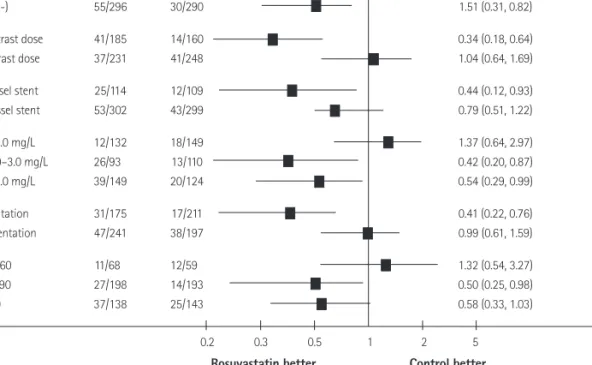
of rosuvastatin on preventing CIN was augmented in the subgroups of patients with diabetes, high contrast doses, multivessel stents, high baseline hsCRP levels, and myocardial infarction. In contrast, the effect of the statin was attenuated in the subgroup with a low baseline eGFR (Fig. 3).

Discussion

We demonstrated that rosuvastatin loading before PCI was asso- ciated with a significantly lower incidence of CIN in patients with ACS. This result is of clinical significance because CIN is an indepen- dent risk for adverse short- and long-term outcomes.

The benefits of statins in cardiovascular diseases can be explained not only by their lipid-lowering potential but also by non-lipid-re- lated mechanisms or so-called pleiotropic effects.

8)

The pleiotropic effects encompass non-lipid-related mechanisms that modify en- dothelial function, inflammatory responses, and thrombus forma- tion.

9)

Given their pleiotropic effects, statins could reduce acute iat- rogenic renal injury, following iodinated contrast medium admi- nistration.

1)

However, the results of studies and meta-analyses of

short-term high-dose statin administration before contrast injec- tion have been disappointing.

4)10)11)

Although the pathogenesis of CIN is unclear, inflammation plays an important role. In our results, the incidence of CIN increased strikingly with increasing baseline hsCRP level. Therefore, a potent statin with potent anti-inflammatory effects may be more benefi- cial than one with less potent anti-inflammatory effects. However, the results of lipophilic statin use on preventing CIN are inconsis- tent. Xinwei et al.

12)

reported that high-dose simvastatin (80 mg) was more effective than low-dose simvastatin (20 mg) in protect- ing against renal dysfunction after PCI. Similarly, Quintavalle et al.

13)

reported that high-dose atorvastatin (80 mg) administered within 24 hours before contrast injection was effective for reducing the in- cidence of CIN. However, other studies using simvastatin and atorv- astatin failed to demonstrate a beneficial effect on preventing CIN.

4)11)

Two prospective trials showed the protective effects of rosuvas- tatin on CIN. Leoncini et al.

14)

reported that high-dose rosuvastatin (40 mg) administered before PCI prevented CIN in patients with non-ST-segment elevation ACS. Han et al.

15)

also reported that a 5-day rosuvastatin treatment significantly reduced the risk of CIN Table 2. Predictive factors for contrast-induced nephropathy after percutaneous coronary intervention according to a multivariate analysis

Variables Odds ratio 95% confidence interval p

Ejection fraction <50% 2.31 1.47–3.63 <0.001

Diabetes 1.76 1.15–2.69 0.009

Baseline eGFR <60 mL/min/1.73 m

2

2.30 1.29–4.13 0.005

Rosuvastatin loading 0.64 0.43–0.95 0.026

Baseline hsCRP >3mg/L 1.79 1.07–3.00 0.027

Age >65 years 1.63 1.02–2.59 0.040

MI presentation 1.22 0.78–1.90 0.391

Hemoglobin <12.0 g/dL 1.14 0.73–1.77 0.556

Contrast dose >200 mL 1.07 0.72–1.60 0.731

The median value for continuous variables was used as a cut-off point to define the two subgroups in the logistic regression analysis. eGFR: estimated glo- merular filtration rate, hsCRP: high-sensitivity C-reactive protein, MI: myocardial infarction

Fig. 2. Incidence of an additional endpoint according to treatment group.

0 -2 -4 -6 -8 -10 -12

-14 Control Rosuvastatin

-9.51

p=0.048 Percent changes of eGFR within 48 hours

-11.44 (%)

7 6 5 4 3 2 1

0 Control Rosuvastatin

2.43 p=0.038

Percent changes of serum creatinine within 48 hours

5.84

(%)

(5)

in patients with diabetes and chronic kidney disease undergoing contrast medium injection. Our results confirm and extend these data on the beneficial effect of rosuvastatin.

Rosuvastatin is a potent hydrophilic statin with acute pleiotrophic effects.

16)

Rosuvastatin loading therapy before PCI shows several beneficial effects, including reduced periprocedural myonecrosis, improved clinical outcome, and reduced infarct size.

17-19)

This statin also has beneficial clinical effects in patients with eGFR <60 mL/

min/1.73 m

2

.

20)

Short-term treatment with rosuvastatin may im- prove eGFR, independent of lipid changes, suggesting a pleiotropic mechanism of action that provides beneficial renal effects.

21)

Fur- thermore, rosuvastatin has particularly potent inhibitory activity against 3-hydroxy-3-methylglutaryl-coenzyme A reductase, reduc- ing renal tubular protein reabsorption and preventing lipid accumu- lation in renal tubules.

22)23)

In the present study, high-dose rosuvas- tatin loading reduced the incidence of CIN by 36%, with an absolute reduction of 5.3%. However, the effect of the statin was attenuated in the subgroup with a low baseline eGFR, particularly in patients with eGFR <60 mL/min/1.73 m

2

who showed poorer outcomes than those with a higher eGFR. Therefore, use of high-dose rosuvastatin in patients with chronic kidney disease should be considered.

In our results, the benefit of a statin on CIN prevention was dis- tinct in patients with evidence of high inflammatory status such as myocardial infarction or high baseline hsCRP levels. Statins decrease the inflammatory response during PCI, as reflected by decreased hsCRP levels.

18)24)

As inflammation is a pathogenic factor of kidney injury, decreasing systemic inflammation and hsCRP levels might

be part of the mechanism explaining the reduced CIN incidence af- ter rosuvastatin loading. However, we could not conclude this be- cause hsCRP was not measured serially after PCI. Further study is needed to clarify the mechanism.

Our study had several limitations. This study was not randomized, and the sample size was small. We may have underestimated the in- cidence of CIN because we did not check routine serum creatinine 72 hours after PCI. Moreover, routine hydration could not be carried out. These discrepancies should be considered in future investiga- tions. We did not address other important variables related to CIN, such as hydration volume, urine output, hemodynamic parameters, and nephrotoxic medications. This is a major limitation of our study.

In conclusion, high-dose rosuvastatin loading before PCI was associated with a significantly lower incidence of CIN in patients with ACS. The protective effect of this statin seems be prominent in patients with high inflammatory status.

References

1. McCullough PA. Contrast-induced acute kidney injury. J Am Coll Car- diol 2008;51:1419-28.

2. Giusti-Paiva A, Martinez MR, Felix JV, et al. Simvastatin decreases ni- tric oxide overproduction and reverts the impaired vascular respon- siveness induced by endotoxic shock in rats. Shock 2004;21:271-5.

3. Wong PC, Li Z, Guo J, Zhang A. Pathophysiology of contrast-induced nephropathy. Int J Cardiol 2012;158:186-92.

4. Jo SH, Koo BK, Park JS, et al. Prevention of radiocontrast medium-in- duced nephropathy using short-term high-dose simvastatin in pa- tients with renal insufficiency undergoing coronary angiography

Control (n/N) Statin (n/N) OR 95% CI OR 95% CI p

Diabetes (+) 23/120 25/118 1.13 (0.60, 2.14) 0.698

Diabetes (-) 55/296 30/290 1.51 (0.31, 0.82) 0.005

High contrast dose 41/185 14/160 0.34 (0.18, 0.64) 0.001

Low contrast dose 37/231 41/248 1.04 (0.64, 1.69) 0.879

Multi-vessel stent 25/114 12/109 0.44 (0.12, 0.93) 0.031

Single vessel stent 53/302 43/299 0.79 (0.51, 1.22) 0.290

hsCRP <1.0 mg/L 12/132 18/149 1.37 (0.64, 2.97) 0.419

hsCRP 1.0–3.0 mg/L 26/93 13/110 0.42 (0.20, 0.87) 0.019

hsCRP >3.0 mg/L 39/149 20/124 0.54 (0.29, 0.99) 0.046

MI presentation 31/175 17/211 0.41 (0.22, 0.76) 0.005

UAP presentation 47/241 38/197 0.99 (0.61, 1.59) 0.986

eGFR 30–60 11/68 12/59 1.32 (0.54, 3.27) 0.544

eGFR 61–90 27/198 14/193 0.50 (0.25, 0.98) 0.042

eGFR >90 37/138 25/143 0.58 (0.33, 1.03) 0061

0.2 0.3 0.5 1 2 5 Rosuvastatin better Control better

Fig. 3. Odds ratios (OR) for the occurrence of contrast-induced nephropathy in specific risk subgroups. CI: confidence interval, hsCRP: high-sensitivity C-

reactive protein, MI: myocardial infarction, UAP: unstable angina pectoris, eGFR: estimated glomerular filtration rate.

(6)

(PROMISS) trial--a randomized controlled study. Am Heart J 2008;

155:499.e1-8.

5. Levey AS, Coresh J, Balk E, et al. National Kidney Foundation practice guidelines for chronic kidney disease: evaluation, classification, and stratification. Ann Intern Med 2003;139:137-47.

6. Budano C, Levis M, D’Amico M, et al. Impact of contrast-induced acute kidney injury definition on clinical outcomes. Am Heart J 2011;161:

963-71.

7. Dangas G, Iakovou I, Nikolsky E, et al. Contrast-induced nephropathy after percutaneous coronary interventions in relation to chronic kid- ney disease and hemodynamic variables. Am J Cardiol 2005;95:13-9.

8. Takemoto M, Liao JK. Pleiotropic effects of 3-hydroxy-3-methylglu- taryl coenzyme a reductase inhibitors. Arterioscler Thromb Vasc Biol 2001;21:1712-9.

9. Sposito AC, Chapman MJ. Statin therapy in acute coronary syndromes:

mechanistic insight into clinical benefit. Arterioscler Thromb Vasc Biol 2002;22:1524-34.

10. Pappy R, Stavrakis S, Hennebry TA, Abu-Fadel MS. Effect of statin ther- apy on contrast-induced nephropathy after coronary angiography: a meta-analysis. Int J Cardiol 2011;151:348-53.

11. Toso A, Maioli M, Leoncini M, et al. Usefulness of atorvastatin (80 mg) in prevention of contrast-induced nephropathy in patients with chronic renal disease. Am J Cardiol 2010;105:288-92.

12. Xinwei J, Xianghua F, Jing Z, et al. Comparison of usefulness of simvas- tatin 20 mg versus 80 mg in preventing contrast-induced nephropathy in patients with acute coronary syndrome undergoing percutaneous coronary intervention. Am J Cardiol 2009;104:519-24.

13. Quintavalle C, Fiore D, De Micco F, et al. Impact of a high loading dose of atorvastatin on contrast-induced acute kidney injury. Circulation 2012;

126:3008-16.

14. Leoncini M, Toso A, Maioli M, Tropeano F, Villani S, Bellandi F. Early high-dose rosuvastatin for contrast-induced nephropathy prevention in acute coronary syndrome: results from the PRATO-ACS Study (Pro- tective Effect of Rosuvastatin and Antiplatelet Therapy On contrast- induced acute kidney injury and myocardial damage in patients with Acute Coronary Syndrome). J Am Coll Cardiol 2014;63:71-9.

15. Han Y, Zhu G, Han L, et al. Short-term rosuvastatin therapy for preven- tion of contrast-induced acute kidney injury in patients with diabetes and chronic kidney disease. J Am Coll Cardiol 2014;63:62-70.

16. Liuni A, Luca MC, Gori T, Parker JD. Rosuvastatin prevents conduit ar- tery endothelial dysfunction induced by ischemia and reperfusion by a cyclooxygenase-2-dependent mechanism. J Am Coll Cardiol 2010;

55:1002-6.

17. Yun KH, Jeong MH, Oh SK, et al. The beneficial effect of high loading dose of rosuvastatin before percutaneous coronary intervention in pa- tients with acute coronary syndrome. Int J Cardiol 2009;137:246-51.

18. Yun KH, Oh SK, Rhee SJ, Yoo NJ, Kim NH, Jeong JW. 12-month follow- up results of high dose rosuvastatin loading before percutaneous cor- onary intervention in patients with acute coronary syndrome. Int J Cardiol 2011;146:68-72.

19. Kim JW, Yun KH, Kim EK, et al. Effect of high dose rosuvastatin loading before primary percutaneous coronary intervention on infarct size in patients with ST-segment elevation myocardial infarction. Korean Circ J 2014;44:76-81.

20. Ridker PM, MacFadyen J, Cressman M, Glynn RJ. Efficacy of rosuvas- tatin among men and women with moderate chronic kidney disease and elevated high-sensitivity C-reactive protein: a secondary analysis from the JUPITER (Justification for the Use of Statins in Prevention-an Intervention Trial Evaluating Rosuvastatin) trial. J Am Coll Cardiol 2010;

55:1266-73.

21. Vidt DG, Harris S, McTaggart F, Ditmarsch M, Sager PT, Sorof JM. Effect of short-term rosuvastatin treatment on estimated glomerular filtra- tion rate. Am J Cardiol 2006;97:1602-6.

22. Agarwal R. Statin induced proteinuria: renal injury or renoprotection? J Am Soc Nephrol 2004;15:2502-3.

23. Gotoh K, Masaki T, Chiba S, et al. Effects of hydrophilic statins on renal tubular lipid accumulation in diet-induced obese mice. Obes Res Clin Pract 2013;7:e342-52.

24. Yun KH, Shin IS, Shin SN, et al. Effect of previous statin therapy in pa-

tients with acute coronary syndrome and percutaneous coronary in-

tervention. Korean Circ J 2011;41:458-63.

수치

Fig. 1. Incidence of contrast-induced nephropathy. The incidence of the  primary endpoint was significantly lower in the rosuvastatin group than that  in the control group (13.5% vs
Fig. 2. Incidence of an additional endpoint according to treatment group.
Fig. 3. Odds ratios (OR) for the occurrence of contrast-induced nephropathy in specific risk subgroups

참조

관련 문서

Contrast-induced nephropathy (CIN) is a common complication of primary percutaneous coronary intervention (pPCI) and is associated with high mortality and morbidity, long

Purpose: The optimum loading dose of clopidogrel has not been established in Asian patients with ST-segment elevation myocardial infarction (STEMI) under- going primary

This study aimed to evaluate the effects of percutaneous coronary intervention (PCI) on short- and long-term major adverse cardiac events (MACE) in elderly ( &gt; 75 yr old) acute

It is uncertain that atorvastatin pretreatment can reduce myocardial damage in patients undergoing primary percutaneous coronary intervention (PCI) for ST-segment elevation