Effects of 600 mg versus 300 mg Loading Dose of Clopidogrel in Asian Patients with ST-Segment Elevation Myocardial
Infarction Undergoing Primary Percutaneous Coronary Intervention: Long-Term Follow-Up Study
Pil Sang Song,1,2 Joo-Yong Hahn,1 Young Bin Song,1 Jin-Ho Choi,1 Seung-Hyuk Choi,1 Gu Hyun Kang,3 Kye Taek Ahn,4 Woo-Hyun Lim,5 Kyung Woo Park,5
Hyo-Soo Kim,5 and Hyeon-Cheol Gwon1
1Division of Cardiology, Department of Medicine, Samsung Medical Center, Sungkyunkwan University School of Medicine, Seoul;
2Division of Cardiology, Department of Internal Medicine, Inje University Haeundae Paik Hospital, Busan;
3Division of Cardiology, Samsung Changwon Hospital, Sungkyunkwan University School of Medicine, Changwon;
4Division of Cardiology, Department of Internal Medicine, School of Medicine, Chungnam National University, Chungnam National University Hospital, Daejeon;
5Department of Internal Medicine, Cardiovascular Center, Seoul National University Hospital, Seoul, Korea.
Received: July 8, 2011 Revised: September 23, 2011 Accepted: October 27, 2011
Corresponding author: Dr. Joo-Yong Hahn, Division of Cardiology, Department of Medicine, Samsung Medical Center, Sungkyunkwan University School of Medicine, 81 Irwon-ro, Gangnam-gu,
Seoul 135-710, Korea.
Tel: 82-2-3410-6653, Fax: 82-2-3410-6278 E-mail: [email protected]
∙ The authors have no financial conflicts of interest.
© Copyright:
Yonsei University College of Medicine 2012 This is an Open Access article distributed under the terms of the Creative Commons Attribution Non- Commercial License (http://creativecommons.org/
licenses/by-nc/3.0) which permits unrestricted non- commercial use, distribution, and reproduction in any medium, provided the original work is properly cited.
Purpose: The optimum loading dose of clopidogrel has not been established in Asian patients with ST-segment elevation myocardial infarction (STEMI) under- going primary percutaneous coronary intervention (PCI). Our aim was to evaluate the impact of different clopidogrel loading doses on short- and long-term clinical outcomes in Asian STEMI patients undergoing primary PCI. Materials and Methods: We studied 691 STEMI patients undergoing primary PCI, loaded with 600 mg (n=381) or 300 mg (n=310) of clopidogrel. The primary outcome was ma- jor adverse cardiac events (MACEs), defined as a composite of all-cause death, re- infarction, or target vessel revascularization (TVR). Results: Baseline clinical and peri-procedural characteristics were mostly comparable between the 600 mg and 300 mg groups. There were no differences in 1 month MACEs as well as all-cause death, reinfarction, TVR, and stent thrombosis between the two groups. After a median follow-up of 921 days, MACEs [adjusted hazard ratio (HR) for the 600 mg group 1.79, 95% confidence interval (CI): 0.80-3.97, p=0.153], all-cause death (adjusted HR for the 600 mg group 0.97, 95% CI: 0.50-1.88, p=0.928), reinfarc- tion (adjusted HR for the 600 mg group 1.03, 95% CI: 0.55-1.91, p=0.937), and TVR (adjusted HR for the 600 mg group 1.36, 95% CI: 0.68-2.69, p=0.388) did not differ between the two groups. These results were reliable even after analysis of propensity score-matched population, and were also constant among various subgroups. Conclusion: A 600 mg loading dose of clopidogrel did not result in better short- and long-term clinical outcomes in Asian STEMI patients undergoing primary PCI.
Key Words: Clopidogrel, myocardial infarction, percutaneous transluminal coro- nary angioplasty
with 300 mg of aspirin along with 600 mg or 300 mg of clopidogrel as early as possible before PCI. The initial load- ing dose of clopidogrel was left to the physician’s judgment.
Coronary angiography and stent implantation were per- formed by standard interventional techniques. Use of glyco- protein IIb/IIIa receptor inhibitors, selection of stent type, pre-dilatation and post-stent adjunctive ballooning were also left to the operator’s discretion. In patients with multi-vessel coronary artery disease, primary PCI was recommended only on the infarct related artery. The medical treatments such as β-blockers, angiotensin-converting enzyme inhibi- tors, angiotensin II receptor blockers, calcium-channel blockers, or statins were started during in-hospital period.
All patients were prescribed lifelong aspirin (100-200 mg/
day) and clopidogrel (75 mg/day) for at least 6 months.
Endpoints and definition
The primary outcome was major adverse cardiac events (MACEs) during follow-up, defined as a composite of all- cause death, reinfarction, or target vessel revascularization (TVR). Clinical events were defined based on the recom- mendations of the Academic Research Consortium.7 All deaths were considered cardiac, unless a definite non-cardi- ac cause could be established. A reinfarction was defined as elevated cardiac enzymes (troponin or myocardial band fraction of creatine kinase) greater than the upper limit of the normal value with ischemic symptoms or electrocardio- graphic findings indicative of ischemia that were not related to the index procedure. TVR was defined as repeat revascu- larization of the target vessel by PCI or bypass graft sur- gery. Definite, probable, or possible stent thrombosis was defined according to the Academic Research Consortium recommendations.
Statistical analysis
Continuous variables were expressed as medians (interquar- tile range) or mean±standard deviations and were compared using Student’s t-test if the data followed a normal distribu- tion and Wilcoxon rank sum test if the data were skewed.
Categorical variables were compared with the chi-square test or Fisher exact test. Adjusted hazard ratio and corre- sponding 95% confidence intervals were compared with multivariate Cox hazard models in order to adjust for differ- ences between patients in the 600 mg and 300 mg clopido- grel groups. To reduce selection bias of treatment for clopi- dogrel loading doses and potential confoundings, we performed strict adjustment for baseline characteristics of
INTRODUCTION
The loading of clopidogrel before percutaneous coronary intervention (PCI) has become a standard procedure since several randomized trials demonstrated the efficacy of clop- idogrel loading.1,2 Several studies have shown that the stan- dard 300 mg loading dose of clopidogrel is inadequate to optimally inhibit platelet reactivity, and a 600 mg dose of clopidogrel has been reported to show superior outcomes in patients with stable angina3 or non ST-segment elevation acute coronary syndrome,4 undergoing PCI. Although re- cent studies reported that a 600 mg loading dose of clopido- grel reduced adverse ischemic events in patients undergo- ing primary PCI for ST-segment elevation myocardial infarction (STEMI),5,6 there are incomplete data on long- term clinical outcomes beyond 1 year and few studies have targeted Asian populations. Therefore, we evaluated the short- and long-term effects of 600 mg versus 300 mg clop- idogrel loading doses on clinical outcomes in Asian STEMI patients undergoing primary PCI.
MATERIALS AND METHODS
Study population
We recruited 1107 consecutive patients who were admitted for STEMI and underwent primary PCI with drug-eluting stents (DES) at three major cardiology centers in Korea be- tween August 2003 and January 2009. STEMI was defined as presence of typical chest pain for ≥30 minutes, and the presence of ST-segment elevation ≥1 mm in at least two contiguous leads, or presumably new left bundle branch block. Patients were excluded, if they presented with car- diogenic shock or did not undergo primary PCI within 12 hours after symptom onset. Since 416 patients did not fulfill the selection criteria, 691 STEMI patients were included in this study. Baseline clinical, peri-procedural characteristics, use of medications, and outcome data were recorded pro- spectively by research coordinators of the dedicated PCI registry of each hospital. The institutional review board of each hospital approved this study, and waived requirements for informed consent for this database analysis.
Percutaneous coronary intervention and medical treatment
All patients received loading of dual oral antiplatelet agents
covariates between the two groups in a propensity score- matched population. Covariates statistically significant on univariate analysis and/or those clinically relevant were re- garded as candidate variables in multivariate models (sex, age, Body Mass Index, diabetes mellitus, initial left ventric- ular systolic ejection fraction by echocardiography, left ante- rior descending coronary artery as culprit vessel, multi-ves- sel coronary artery disease, types of DES, glycoprotein IIb/
patients in the 600 mg and the 300 mg clopidogrel groups using propensity score. The propensity scores were calculat- ed using binary logistic-regression analysis. A full non-parsi- monious model was developed and included all variables listed in Table 1. The discrimination and calibration abilities of the propensity-score model were reviewed through the c- statistic and the Hosmer-Lemeshow statistic. The c-statistic in our study was 0.629. We evaluated the balance in baseline
Table 1. Baseline Clinical, Peri-Procedural Characteristics, and In-Hospital Medications according to Clopidogrel Loading Doses
Total population Propensity-matched population
Clopidogrel
600 mg (n=381) Clopidogrel
300 mg (n=310) p value Clopidogrel
600 mg (n=274) Clopidogrel
300 mg (n=274) p value
Age (yrs) 61 (52-70) 62 (52-70) 0.581 61 (51-69) 61 (51-70) 0.749
Male 291 (76.4) 239 (77.1) 0.819 218 (79.6) 211 (77.0) 0.468
Body Mass Index (kg/m2) 24 (22-27) 24 (22-28) 0.513 24 (23-26) 24 (22-27) 0.934
Diabetes mellitus 95 (24.9) 88 (28.4) 0.314 69 (25.2) 72 (26.3) 0.769
Hypertension 198 (52.1) 156 (50.3) 0.636 138 (50.4) 138 (50.4) >0.99
Dyslipidemia 166 (43.8) 127 (41.1) 0.481 113 (41.2) 117 (42.7) 0.729
Current smoking 179 (47.1) 145 (46.8) 0.932 127 (46.4) 129 (47.1) 0.864
History of prior MI 5 (1.3) 10 (3.3) 0.139 4 (1.5) 0 (0.0) 0.124
History of prior PCI 14 (3.8) 18 (5.7) 0.279 9 (3.3) 6 (2.2) 0.602
Initial LVEF by echocardiography (%) 52 (44-60) 50 (43-59) 0.410 51 (44-60) 51 (44-58) 0.642
Hospital 0.360 0.307
1 86 (22.6) 74 (23.9) 65 (23.7) 61 (22.3)
2 178 (46.7) 156 (50.3) 133 (48.5) 150 (54.7)
3 117 (30.7) 80 (25.8) 76 (27.7) 63 (23.0)
Culprit vessel 0.069 0.687
Left anterior descending coronary artery 213 (55.9) 197 (63.5) 167 (60.9) 170 (62.0)
Left circumflex coronary artery 40 (10.5) 22 (7.1) 18 (6.6) 21 (7.7)
Right coronary artery 124 (32.5) 89 (28.7) 86 (31.4) 81 (29.6)
Left main coronary artery 4 (1.0) 2 (0.6) 3 (1.1) 2 (0.7)
No. of narrowed coronary arteries 0.372 0.816
1 170 (44.6) 129 (41.6) 117 (42.7) 114 (41.6)
2 128 (33.6) 106 (34.2) 97 (35.4) 99 (36.1)
3 83 (21.8) 75 (24.2) 60 (21.9) 61 (22.3)
Intravascular ultrasound 69 (18.1) 61 (19.7) 0.599 215 (78.5) 222 (81.0) 0.457
Total stent length, implanted (mm) 24 (22-32) 28 (23-33) 0.661 24 (23-32) 28 (23-33) 0.919
Types of drug-eluting stent, used 0.011 0.698
Sirolimus-eluting stent 204 (53.5) 193 (62.3) 169 (61.7) 163 (59.5)
Paclitaxel-eluting stent 90 (23.6) 68 (21.9) 56 (20.4) 63 (23.0)
Zotarolimus-eluting stent 87 (22.8) 49 (15.8) 49 (17.9) 48 (17.5)
Peak creatine kinase-myocardial band (ng/mL) 198 (80-340) 192 (85-292) 0.498 197 (76-347) 198 (92-313) 0.984 Glycoprotein IIb/IIIa receptor inhibitor 78 (21) 38 (12) 0.004 236 (86.1) 237 (86.5) 0.901
Aspirin 371 (97.3) 307 (99.0) 0.201 272 (99.3) 274 (100.0) 0.499
Angiotensin-converting enzyme inhibitor 207 (55.8) 183 (59.6) 0.319 156 (56.9) 166 (60.6) 0.386 Angiotensin II receptor blocker 98 (26.4) 85 (27.7) 0.714 74 (27.0) 71 (25.9) 0.771
β-Blocker 241 (65.0) 187 (60.9) 0.282 175 (63.9) 170 (62.0) 0.658
Statin 332 (86.8) 241 (78.5) 0.004 228 (83.2) 225 (82.1) 0.735
LVEF, left ventricular ejection fraction; MI, myocardial infarction; PCI, percutaneous coronary intervention.
Data are presented as median (interquartile range) or n (%).
in the 600 mg group were more likely to be treated with Zo- tarolimus-eluting stents and less likely to be treated with Si- rolimus-eluting stents. The medications administered to the patients during in-hospital period are listed in Table 1. The 600 mg loading dose group patients received more glyco- protein IIb/IIIa receptor inhibitors during the procedure and more statins than the 300 mg loading dose group patients.
Propensity-matched population
A total of 548 matched cases, 274 in each of the clopidogrel groups, were found. There were no significant differences in baseline clinical, peri-procedural characteristics and in- hospital medications (Table 1), including glycoprotein IIb/
IIIa receptor inhibitors during the procedure.
Clinical outcomes Overall population
There were no differences in 1 month MACEs (3.2% ver- sus 2.3%, p=0.481), all-cause death (2.1% versus 1.3%, IIIa inhibitor, and clopidogrel 600 mg loading dose). All p-
values were 2-tailed and p<0.05 was considered significant.
Data management and analysis were performed using Sta- tistical Package for the Social Sciences (SPSS) software, version 17.0 (SPSS Inc., Chicago, IL, USA).
RESULTS
Baseline characteristics Overall population
Of 691 patients, 381 patients received a 600 mg loading dose and 310 patients received a 300 mg loading dose of clopi- dogrel before PCI. Baseline clinical characteristics (Table 1) were not significantly different between the two groups, except for higher baseline hemoglobin levels in patients loaded with 600 mg compared with the 300 mg group. Pro- cedural indexes (Table 1) were also mostly comparable, ex- cept for differences in the types of DES implanted. Patients
Fig. 1. Long-term clinical outcomes in the overall population. Kaplan-Meier curves for the long-term clinical outcomes according to the clopidogrel loading doses in the overall population. (A) Cumulative rate of MACEs (major adverse cardiac events). (B) Cumulative rate of all-cause death. (C) Cumulative rate of reinfarction. (D) Cumulative rate of TVR (target vessel revascularization). HR, hazard ratio; CI, confidence interval.
0
0
0
0 5
3
3
3 10
6
6 15
6
9 20
9
9
12
Cumulative rate of MACE (%)Cumulative rate of reinforction (%) Cumulative rate of death (%)Cumulative rate of TVR (%)
0
0
0
0 250
250
250
250 500
500
500
500 750
750
750
750 1000
1000
1000
1000 No. at risk
No. at risk
No. at risk
No. at risk 381310
381310
381310
381310 333275
343285
349288
336275 248245
257256
262260
250246 181211
186219
193224
184211 141151
145158
152163
144153 600 mg
300 mg
600 mg 300 mg
600 mg 300 mg
600 mg 300 mg Time (days)
Time (days)
Time (days)
Time (days) Adjusted HR for the 600 mg 1.79, 95% CI 0.80-3.97, p=0.15
Adjusted HR for the 600 mg 1.03, 95% CI 0.55-1.91, p=0.94
Adjusted HR for the 600 mg 0.97, 95% CI 0.50-1.88, p=0.93
Adjusted HR for the 600 mg 1.36, 95% CI 0.68-2.69, p=0.39 600 mg
300 mg
600 mg 300 mg
600 mg 300 mg
600 mg 300 mg
A
C
B
D
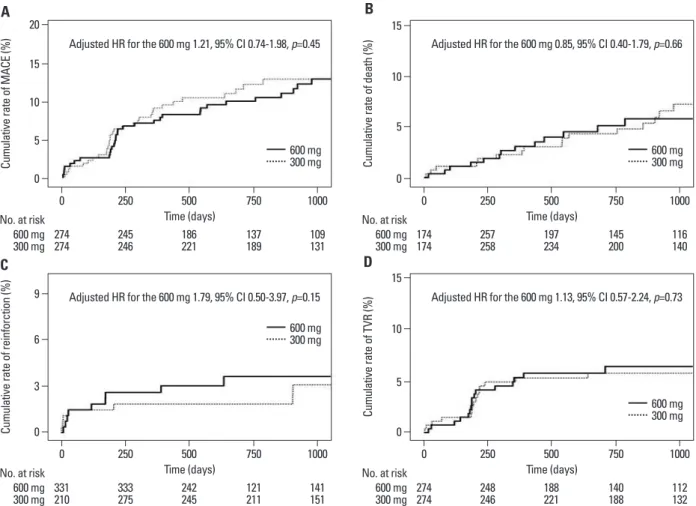
among propensity score-matched patients. There were 24 MACEs with a median follow-up of 928 (interquartile range 542-1237) days in the matched patients. Also, there were no differences in long-term clinical outcomes between 600 mg and 300 mg loading dose of clopidogrel groups (Fig. 2).
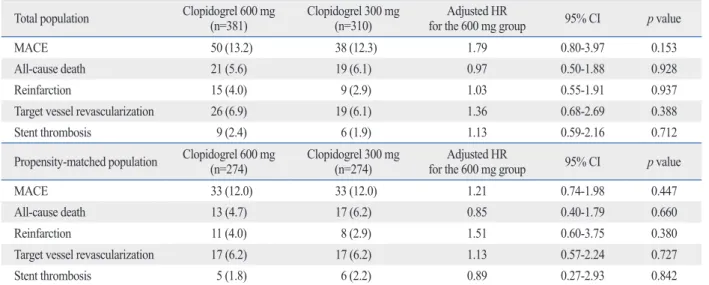
Loading dose of clopidogrel was not an independent predic- tor of MACEs, all-cause death, reinfarction, TVR, and defi- nite and/or probable stent thrombosis even after propensity score matching, as well (Table 2).
Analysis according to tertiles of propensity score
We compared and analyzed baseline characteristics and clinical outcomes for clopidogrel loading doses within the tertiles of propensity score (Table 3). Patients in the highest tertile of propensity score were more likely to have hyper- tension, higher initial left ventricular ejection fraction by 2D-echocardiography, and to use glycoprotein IIb/IIIa re- ceptor inhibitors. The frequency of diabetes mellitus and prior myocardial infarction were higher in the lowest tertile compared with other tertiles. Patients in the intermediate p=0.429), reinfarction (1.3% versus 1.3%, p=0.984), TVR
(0.8% versus 1.0%, p=0.799), and definite and/or probable stent thrombosis (0.8% versus 1.0%, p=0.799) between the two clopidogrel groups. Long-term clinical follow-up was successfully completed in 96% of the subjects. After a me- dian follow-up of 921 (interquartile range 542-1223) days, clinical outcomes were similar between the two groups (Fig. 1). Clopidogrel loading dose was not an independent predictor of MACEs, all-cause death, reinfarction, TVR, and definite and/or probable stent thrombosis (Table 2).
Propensity-matched population
The results of propensity score-matched analysis were com- parable to those of the main analysis in the overall popula- tion. There were no differences in 1 month clinical outcomes (for MACE 1.5% versus 1.8%, p=0.751, for all-cause death 0.4% versus 0.7%, p>0.99, for reinfarction 1.5% versus 1.5%, p>0.99, for TVR 0.7% versus 1.1%, p>0.99, and for definite and/or probable stent thrombosis 0.7% versus 1.1%, p>0.99, respectively) between the clopidogrel two groups
0
0
0
0 5
3
5
5 10
15 10
6 10
20
9
15
15
Cumulative rate of MACE (%)Cumulative rate of reinforction (%) Cumulative rate of death (%)Cumulative rate of TVR (%)
0
0
0
0 250
250
250
250 500
500
500
500 750
750
750
750 1000
1000
1000
1000 No. at risk
No. at risk
No. at risk
No. at risk 274274
331210
174174
274274 245246
333275
257258
248246 186221
242245
197234
188221 137189
121211
145200
140188 109131
141151
116140
112132 600 mg
300 mg
600 mg 300 mg
600 mg 300 mg
600 mg 300 mg Time (days)
Time (days)
Time (days)
Time (days) Adjusted HR for the 600 mg 1.21, 95% CI 0.74-1.98, p=0.45
Adjusted HR for the 600 mg 1.79, 95% CI 0.50-3.97, p=0.15
Adjusted HR for the 600 mg 0.85, 95% CI 0.40-1.79, p=0.66
Adjusted HR for the 600 mg 1.13, 95% CI 0.57-2.24, p=0.73
Fig. 2. Long-term clinical outcomes in the propensity-matched population. Kaplan-Meier curves for the long-term clinical outcomes according to the clopi- dogrel loading doses in the propensity-matched population. (A) Cumulative rate of MACEs (major adverse cardiac events). (B) Cumulative rate of all-cause death. (C) Cumulative rate of reinfarction. (D) Cumulative rate of TVR (target vessel revascularization). HR, hazard ratio; CI, confidence interval.
600 mg 300 mg
600 mg 300 mg
600 mg 300 mg
600 mg 300 mg
A
C
B
D
Table 3. Baseline Characteristics and Clinical Outcomes for Clopidogrel Loading Doses within the Tertile of Propensity Score Characteristics
Lowest tertile (n=230) Intermediate tertile (n=230) Highest tertile (n=231) Overall (n=691) 600 mg
(n=92) 300 mg
(n=138) p value 600 mg
(n=126) 300 mg
(n=104) p value 600 mg
(n=163) 300 mg
(n=68) p value p value between tertiles
Interaction p value
Age (yrs) 60±11 63±12 0.071 61±13 61±13 0.759 60±12 59±13 0.273 0.351
Men 70 (76.1) 106 (77.4) 0.824 97 (77.6) 82 (78.8) 0.821 122 (75.3) 50 (73.5) 0.783 0.688
BMI (kg/m2) 25±3 25±3 0.419 24±3 24±3 0.662 24±3 24±3 0.139 0.134
Hypertension 40 (43.5) 63 (46.0) 0.705 64 (51.2) 54 (51.9) 0.909 94 (58.0) 38 (55.9) 0.755 0.029 Diabetes 32 (34.8) 50 (36.5) 0.787 30 (24.0) 28 (26.9) 0.612 32 (19.8) 10 (14.7) 0.369 <0.001 Dyslipidemia 28 (30.4) 46 (33.6) 0.623 62 (49.6) 50 (48.1) 0.818 76 (46.9) 31 (45.6) 0.891 0.001 Current smoker 43 (46.7) 60 (43.8) 0.663 58 (46.4) 51 (49.0) 0.688 76 (46.9) 33 (48.5) 0.823 0.824
Prior MI 2 (2.2) 8 (5.8) 0.179 0 (0.0) 0 (0.0) 2 (1.2) 0 (0.0) >0.99 0.001
Prior PCI 4 (4.3) 8 (5.8) 0.766 2 (1.6) 3 (2.9) 0.664 6 (3.7) 3 (4.4) 0.732 0.228
LVEF (%) 50±12 49±12 0.401 50±11 52±11 0.332 53±11 53±8 0.956 0.012
IVUS 14 (15.2) 31 (22.6) 0.167 22 (17.6) 19 (18.3) 0.901 33 (20.4) 11 (16.2) 0.458 0.887 GP IIb/IIIa 2 (2.2) 8 (5.8) 0.319 11 (8.8) 10 (9.6) 0.828 65 (40.1) 20 (29.4) 0.131 0.001 Stent length (mm) 28.6±11.2 29.3±12.1 0.651 27.5±10.1 28.4±9.0 0.485 28.0±11.1 26.2±8.0 0.231 0.464
Stent 0.400 0.214 0.110 <0.001
SES 66 (71.7) 108 (78.8) 72 (57.6) 56 (53.8) 65 (40.1) 28 (41.2) PES 19 (20.7) 23 (16.8) 32 (25.6) 21 (20.2) 39 (24.1) 24 (35.3) ZES 7 (7.6) 6 (4.4) 21 (16.8) 27 (26.0) 58 (35.8) 16 (23.5)
Death 3 (3.3) 5 (3.6) >0.99 7 (5.6) 7 (6.7) 0.721 11 (6.8) 7 (10.3) 0.370 0.129 0.982 Reinfarction 4 (4.3) 3 (2.2) 0.443 6 (4.8) 4 (3.8) >0.99 5 (3.1) 2 (2.9) >0.99 0.681 0.876
TVR 3 (3.3) 10 (7.3) 0.254 10 (8.0) 4 (3.8) 0.269 13 (8.0) 5 (7.4) 0.857 0.624 0.237
ST 1 (1.1) 2 (1.5) >0.99 4 (3.2) 2 (1.9) 0.688 4 (2.5) 2 (2.9) >0.99 0.539 0.834 MACE 8 (8.7) 16 (11.7) 0.471 19 (15.2) 10 (9.6) 0.214 23 (14.2) 12 (17.6) 0.507 0.316 0.341 BMI, body mass index; GP IIb/IIIa, glycoprotein IIb/IIIa receptor inhibitor; IVUS, intravascular ultrasound; LVEF, left ventricular ejection fraction; MACE, ma- jor adverse cardiovascular event; MI, myocardial infarction; PCI, percutaneous coronary intervention; PES, paclitaxel-eluting stent; SES, sirolimus-eluting stent; ST, stent thrombosis; TVR, target vessel revascularization; ZES, zotarolimus-eluting stent.
Values are mean±SD or n (%).
Table 2. Long-Term Clinical Outcomes for the Clopidogrel Dose Comparison
Total population Clopidogrel 600 mg
(n=381) Clopidogrel 300 mg
(n=310) Adjusted HR
for the 600 mg group 95% CI p value
MACE 50 (13.2) 38 (12.3) 1.79 0.80-3.97 0.153
All-cause death 21 (5.6) 19 (6.1) 0.97 0.50-1.88 0.928
Reinfarction 15 (4.0) 9 (2.9) 1.03 0.55-1.91 0.937
Target vessel revascularization 26 (6.9) 19 (6.1) 1.36 0.68-2.69 0.388
Stent thrombosis 9 (2.4) 6 (1.9) 1.13 0.59-2.16 0.712
Propensity-matched population Clopidogrel 600 mg
(n=274) Clopidogrel 300 mg
(n=274) Adjusted HR
for the 600 mg group 95% CI p value
MACE 33 (12.0) 33 (12.0) 1.21 0.74-1.98 0.447
All-cause death 13 (4.7) 17 (6.2) 0.85 0.40-1.79 0.660
Reinfarction 11 (4.0) 8 (2.9) 1.51 0.60-3.75 0.380
Target vessel revascularization 17 (6.2) 17 (6.2) 1.13 0.57-2.24 0.727
Stent thrombosis 5 (1.8) 6 (2.2) 0.89 0.27-2.93 0.842
CI, confidence interval; HR, hazard ratio; MACE, major adverse cardiovascular event.
Data are presented as n (%).
clinical outcomes for Asian patients who received either a 600 mg or 300 mg loading dose of clopidogrel and under- went primary PCI for STEMI. The major finding was that a 600 mg loading dose of clopidogrel was not associated with better long-term clinical outcomes compared with the conservative 300 mg loading dose.
According to the 2009 Focused Updates, ACC/AHA STEMI and PCI Guidelines recommended that at least 300 to 600 mg of clopidogrel should be given as early as possi- ble (Class I/level of evidence A), instead of describing a specific loading dose of clopidogrel.8 Consequently, the op- timal loading dose of clopidogrel has not been established yet. Moreover, there was no long-term data comparing clin- ical outcomes of a 600 mg with 300 mg loading dose of clopidogrel beyond 1 year, and there are incomplete data on comparison of the effectiveness of loading doses of clopi- dogrel for primary PCI in Asian STEMI patients.
Our results are different from those of previously con- ducted large-scale clinical trials, the HORIZONS-AMI tri- al5 and the CURRENT-OASIS 7 trial.6 We considered that there are several reasons why our results were different from those of the two above trials. First, the benefits of high dose clopidogrel in the HORIZONS-AMI trial and double dose clopidogrel in the CURRENT-OASIS 7 trial were mainly attributable to a lower rate of myocardial infarction and stent thrombosis. However, the rates of reinfarction and stent thrombosis of both the 600 mg and 300 mg groups in tertile of propensity score were more likely to have dyslip-
idemia. There was a significant difference in stent types im- planted between the tertiles. However, no significant differ- ences in baseline characteristics were observed between 600 mg and 300 mg groups within each tertile. Regarding clinical outcomes, patients in the highest tertile of propensi- ty score demonstrated a tendency to have a higher rate of death. However, there were no significant differences in death rate between 600 mg and 300 mg groups within the highest tertile. And also, no significant differences in rein- farction, TVR, stent thrombosis, and MACEs were observed, according to the tertiles of propensity score. There were no significant interactions between the loading doses of clopido- grel and tertiles of propensity score for each endpoint.
Subgroup analysis
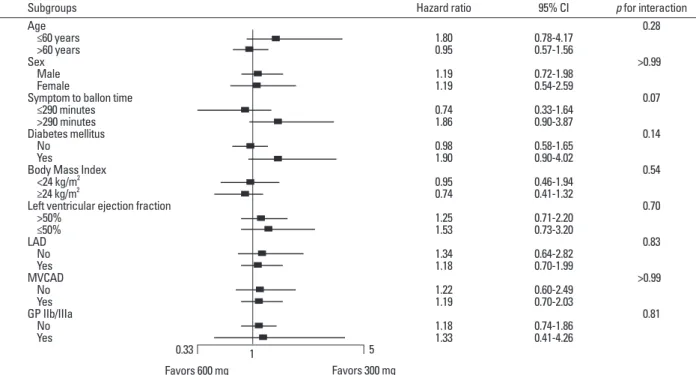
To determine whether similar outcomes between the two groups were consistent in the various subgroups, we per- formed subgroup analyses (Fig. 3). The rates of MACEs were not different between the two groups in various subgroups, and there were no significant interactions between the loading doses of clopidogrel and MACEs among the nine subgroups.
DISCUSSION
The present study reports a current evaluation of long-term
Fig. 3. Subgroup analyses for major adverse cardiac events in nine various subgroups for clopidogrel doses comparison. CI, confidence interval; GP IIb/IIIa, glycoprotein IIb/IIIa receptor inhibitor; LAD, left anterior descending coronary artery as culprit vessel; MVCAD, multi-vessel coronary artery disease.
Subgroups Age ≤60 years >60 years Sex Male Female
Symptom to ballon time ≤290 minutes >290 minutes Diabetes mellitus No
Yes
Body Mass Index <24 kg/m2 ≥24 kg/m2
Left ventricular ejection fraction >50%
≤50%
LAD No Yes MVCAD No Yes GP IIb/IIIa No Yes
p for interaction 0.28
>0.99 0.07 0.14 0.54 0.70 0.83
>0.99 0.81 95% CI
0.78-4.17 0.57-1.56 0.72-1.98 0.54-2.59 0.33-1.64 0.90-3.87 0.58-1.65 0.90-4.02 0.46-1.94 0.41-1.32 0.71-2.20 0.73-3.20 0.64-2.82 0.70-1.99 0.60-2.49 0.70-2.03 0.74-1.86 0.41-4.26 Hazard ratio
1.800.95 1.191.19 0.741.86 0.981.90 0.950.74 1.251.53 1.341.18 1.221.19
1.181.33
0.33 1 5
Favors 600 mg Favors 300 mg
cian. Despite our effort to adjust for potential confounders by using multivariable models and propensity score match analysis, it is likely that unmeasured covariates could have contributed to the observed differences in clinical outcomes.
Third, our evaluation of clinical outcomes was limited by the fact that bleeding events were not included in our analy- sis. Bleeding events have been known to play a role in the mortality of STEMI patients.19
In conclusion, in Asian patients undergoing primary PCI for STEMI, the use of a 600 mg loading dose compared with a 300 mg loading dose of clopidogrel did not reduce the incidence of MACEs, all-cause death, reinfarction, tar- get vessel revascularization, or stent thrombosis. Further study for clopidogrel loading doses in this subset of patients is needed to improve clinical outcomes.
REFERENCES
1. Mehta SR, Yusuf S, Peters RJ, Bertrand ME, Lewis BS, Natarajan MK, et al. Effects of pretreatment with clopidogrel and aspirin fol- lowed by long-term therapy in patients undergoing percutaneous coronary intervention: the PCI-CURE study. Lancet 2001;358:
527-33.
2. Steinhubl SR, Berger PB, Mann JT 3rd, Fry ET, DeLago A, Wilmer C, et al. Early and sustained dual oral antiplatelet therapy following percutaneous coronary intervention: a randomized con- trolled trial. JAMA 2002;288:2411-20.
3. Patti G, Colonna G, Pasceri V, Pepe LL, Montinaro A, Di Sciascio G. Randomized trial of high loading dose of clopidogrel for reduc- tion of periprocedural myocardial infarction in patients undergo- ing coronary intervention: results from the ARMYDA-2 (Anti- platelet therapy for Reduction of MYocardial Damage during Angioplasty) study. Circulation 2005;111:2099-106.
4. Cuisset T, Frere C, Quilici J, Morange PE, Nait-Saidi L, Carvajal J, et al. Benefit of a 600-mg loading dose of clopidogrel on platelet reactivity and clinical outcomes in patients with non-ST-segment elevation acute coronary syndrome undergoing coronary stenting.
J Am Coll Cardiol 2006;48:1339-45.
5. Dangas G, Mehran R, Guagliumi G, Caixeta A, Witzenbichler B, Aoki J, et al. Role of clopidogrel loading dose in patients with ST- segment elevation myocardial infarction undergoing primary an- gioplasty: results from the HORIZONS-AMI (harmonizing out- comes with revascularization and stents in acute myocardial infarction) trial. J Am Coll Cardiol 2009;54:1438-46.
6. Mehta SR, Tanguay JF, Eikelboom JW, Jolly SS, Joyner CD, Granger CB, et al. Double-dose versus standard-dose clopidogrel and high-dose versus low-dose aspirin in individuals undergoing percutaneous coronary intervention for acute coronary syndromes (CURRENT-OASIS 7): a randomised factorial trial. Lancet 2010;376:1233-43.
7. Cutlip DE, Windecker S, Mehran R, Boam A, Cohen DJ, van Es GA, et al. Clinical end points in coronary stent trials: a case for standardized definitions. Circulation 2007;115:2344-51.
8. Kushner FG, Hand M, Smith SC Jr, King SB 3rd, Anderson JL,
our study were lower than that of the high dose group in the HORIZONS-AMI trial or double dose group in the CUR- RENT-OASIS 7 trial. Therefore, there might be little room to improve with 600 mg loading dose of clopidogrel. Sec- ond, the ethnic differences in platelet aggregation or in clop- idogrel responsiveness may be thinkable. A recent study re- ported that clopidogrel low-responsiveness evaluated by the VerifynowTM P2Y12 assay is an independent predictor of stent thrombosis and composite end point of stent throm- bosis or cardiac death in patients with acute coronary syn- drome within 6 months after DES implantation.9 Previous studies have also showed that carriers of the reduced func- tion CYP2C19 allele have significantly lower levels of the active metabolite of clopidogrel, reduced platelet inhibition, and an increased rate of cardiovascular events,10,11 even with higher doses of clopidogrel.12 This polymorphism has been observed in a higher rate of East Asians compared with Cau- casions.13 So, the efficacy of high or double dose clopidogrel shown in Western people may not equal in Asian people. In- stead, triple anti-platelet therapy including cilostazol may be superior to dual anti-platelet therapy, including higher doses of clopidogrel in Asian patients.14-16 Finally, it is not clear whether the beneficial effects were a result of the double loading, double maintenance dose or both in the CURRENT- OASIS 7 trial. Additionally, other acute coronary syndrome patients were enrolled as well as those with STEMI in the CURRENT-OASIS 7 trial. Therefore, these could be the reasons for the differing results of the present study.
On the other hand, results of the present study correspond with the results of a recently published trial, in which there were no differences in 1 and 12 month clinical outcomes be- tween the two clopidogrel groups in STEMI patients under- going primary PCI, from a large acute myocardial infarction registry.17 Similarly, the GRAVITA trial showed that among patients with high on-treatment reactivity after coronary in- tervention with drug-eluting stents, the use of high-dose clopidogrel compared with conventional-dose clopidogrel did not improve the clinical outcomes, such as death from cardiovascular causes, nonfatal myocardial infarction, or stent thrombosis.18
Study limitations
There are several limitations to our study. First, the sample size of the present study was relatively small, and therefore would not allow for drawing a definite conclusion. Second, this study was not a randomized study. The clopidogrel load- ing dosage was left to the discretion of the treating physi-
14. Chen KY, Rha SW, Li YJ, Poddar KL, Jin Z, Minami Y, et al. Tri- ple versus dual antiplatelet therapy in patients with acute ST-seg- ment elevation myocardial infarction undergoing primary percuta- neous coronary intervention. Circulation 2009;119:3207-14.
15. Jeong YH, Lee SW, Choi BR, Kim IS, Seo MK, Kwak CH, et al.
Randomized comparison of adjunctive cilostazol versus high maintenance dose clopidogrel in patients with high post-treatment platelet reactivity: results of the ACCEL-RESISTANCE (Adjunc- tive Cilostazol Versus High Maintenance Dose Clopidogrel in Pa- tients With Clopidogrel Resistance) randomized study. J Am Coll Cardiol 2009;53:1101-9.
16. Park KH, Jeong MH, Lee MG, Ko JS, Lee SE, Kang WY, et al.
Efficacy of triple anti-platelet therapy including cilostazol in acute myocardial infarction patients undergoing drug-eluting stent im- plantation. Korean Circ J 2009;39:190-7.
17. Choi CU, Rha SW, Oh DJ, Poddar KL, Na JO, Kim JW, et al.
Standard versus high loading doses of clopidogrel in Asian ST- segment elevation myocardial infarction patients undergoing per- cutaneous coronary intervention: insights from the Korea Acute Myocardial Infarction Registry. Am Heart J 2011;161:373-82.
18. Price MJ, Berger PB, Teirstein PS, Tanguay JF, Angiolillo DJ, Spriggs D, et al. Standard- vs high-dose clopidogrel based on platelet function testing after percutaneous coronary intervention:
the GRAVITAS randomized trial. JAMA 2011;305:1097-105.
19. Manoukian SV, Feit F, Mehran R, Voeltz MD, Ebrahimi R, Ham- on M, et al. Impact of major bleeding on 30-day mortality and clinical outcomes in patients with acute coronary syndromes: an analysis from the ACUITY Trial. J Am Coll Cardiol 2007;49:
1362-8.
Antman EM, et al. 2009 Focused Updates: ACC/AHA Guidelines for the Management of Patients With ST-Elevation Myocardial Infarction (updating the 2004 Guideline and 2007 Focused Up- date) and ACC/AHA/SCAI Guidelines on Percutaneous Coronary Intervention (updating the 2005 Guideline and 2007 Focused Up- date): a report of the American College of Cardiology Foundation/
American Heart Association Task Force on Practice Guidelines.
Circulation 2009;120:2271-306.
9. Lee K, Lee SW, Lee JW, Kim SY, Youn YJ, Ahn MS, et al. The significance of clopidogrel low-responsiveness on stent thrombo- sis and cardiac death assessed by the verifynow p(2)y(12) assay in patients with acute coronary syndrome within 6 months after drug-eluting stent implantation. Korean Circ J 2009;39:512-8.
10. Simon T, Verstuyft C, Mary-Krause M, Quteineh L, Drouet E, Méneveau N, et al. Genetic determinants of response to clopido- grel and cardiovascular events. N Engl J Med 2009;360:363-75.
11. Brandt JT, Close SL, Iturria SJ, Payne CD, Farid NA, Ernest CS 2nd, et al. Common polymorphisms of CYP2C19 and CYP2C9 affect the pharmacokinetic and pharmacodynamic response to clopidogrel but not prasugrel. J Thromb Haemost 2007;5:2429-36.
12. Jeong YH, Kim IS, Park Y, Kang MK, Koh JS, Hwang SJ, et al.
Carriage of cytochrome 2C19 polymorphism is associated with risk of high post-treatment platelet reactivity on high maintenance- dose clopidogrel of 150 mg/day: results of the ACCEL-DOUBLE (Accelerated Platelet Inhibition by a Double Dose of Clopidogrel According to Gene Polymorphism) study. JACC Cardiovasc In- terv 2010;3:731-41.
13. Desta Z, Zhao X, Shin JG, Flockhart DA. Clinical significance of the cytochrome P450 2C19 genetic polymorphism. Clin Pharma- cokinet 2002;41:913-58.