• 검색 결과가 없습니다.

Effect of Previous Statin Therapy in Patients With Acute Coronary Syndrome and Percutaneous Coronary Intervention

N/A
N/A
Protected

Academic year: 2022

Share "Effect of Previous Statin Therapy in Patients With Acute Coronary Syndrome and Percutaneous Coronary Intervention"

Copied!
6
0
0

로드 중.... (전체 텍스트 보기)

전체 글

(1)

458

Open Access

Effect of Previous Statin Therapy in Patients With Acute Coronary Syndrome and Percutaneous Coronary Intervention

Kyeong Ho Yun, MD, Ik-Sang Shin, MD, Seoung-Nam Shin, MD, Jun-Ho Choi, MD, Seung Hwan Kim, MD,

Sang Jae Rhee, MD, Eun Mi Lee, MD, Nam Jin Yoo, MD, Nam-Ho Kim, MD, Seok Kyu Oh, MD, and Jin-Won Jeong, MD Department of Cardiovascular Medicine, Regional Cardiocerebrovascular Center, Wonkwang University Hospital, Iksan, Korea ABSTRACT

Background and Objectives: Statin therapy after percutaneous coronary intervention (PCI) has been associated with re- duced major adverse cardiovascular events (MACE). However, it has been less clear as to whether statin therapy before acute coronary syndrome (ACS) is beneficial. We studied the effect of previous statin therapy, initiated ≥1 month before PCI, on the outcome of patients with ACS who had undergone early invasive strategies. Subjects and Methods: We stratified 479 consecutive patients with ACS who had undergone PCI, according to preprocedural statin administration as follows: previ- ous statin-treated patients (statin group, n=237) and statin-naive patients (control group, n=242). The incidence of periproce- dural myocardial infarction (MI) and in-hospital MACE was assessed. Results: The incidence of Braunwald class III angina and MI presentation were significantly lower in the statin group than in the control group. Angiographic and procedural characteristics were similar between the two groups; however, slow/no reflow phenomenon occurred more frequently in the control group. After PCI, the incidence of periprocedural MI was higher in the control group than in the statin group (6.6% vs.

2.1%, p=0.016). Multivariate analysis revealed that no prior use of statin {odds ratio (OR)=2.8; 95% confidence interval (CI)=

1.1-7.2; p=0.038), procedural complication (OR=4.0; 95% CI=1.5-10.5; p=0.004), stent overlap (OR=4.7; 95% CI=1.3-16.4;

p=0.015), and old age (OR=3.2; 95% CI=1.2-8.0; p=0.016) were independent predictors for in-hospital MACE. Conclu- sion: Previous statin therapy before ACS was associated with milder clinical presentation and lower incidence of in-hospital MACE after early invasive strategies. The beneficial outcome is attributable to a significant reduction in periprocedural MI after PCI. (Korean Circ J 2011;41:458-463)

KEY WORDS: Angioplasty; Myocardial infarction; Stents; Hydroxymethylglutaryl-coenzyme A reductase inhibitors;

Treatment outcome.

Received: October 12, 2010

Revision Received: December 7, 2010 Accepted: December 28, 2010

Correspondence: Kyeong Ho Yun, MD, Department of Cardiovascular Medicine, Regional Cardiocerebrovascular Center, Wonkwang University Hospital, 344-2 Sinyong-dong, Iksan 570-711, Korea

Tel: 82-63-859-2524, Fax: 82-63-852-8480 E-mail: [email protected]

• The authors have no financial conflicts of interest.

cc
This is an Open Access article distributed under the terms of the Cre- ative Commons Attribution Non-Commercial License (http://creativecom- mons.org/licenses/by-nc/3.0) which permits unrestricted non-commer- cial use, distribution, and reproduction in any medium, provided the origi- nal work is properly cited.

Introduction

Statins have been known to significantly reduce cardiovas- cular clinical events in a variety of patients, ranging from th- ose with established cardiovascular disease to those who are

at risk for cardiovascular disease.

1-6)

The role of statins in pa- tients with acute coronary syndrome (ACS) also has been cl- arified. Large scaled randomized trials have shown that early and high doses of statin therapy significantly improve the prognosis in patients with ACS.

7)8)

Since an early invasive strategy has been the standard ther-

apy for ACS, several studies have been conducted to deter-

mine whether periprocedural use of statins is beneficial in

these cases. Some reports have suggested that statin loading

prior to percutaneous coronary intervention (PCI) is associ-

ated with reduced mortality and decreased periprocedural

myocardial injury after PCI in patients with ACS.

9)10)

Another

study demonstrated that pretreatment with statin for three

to seven days in patients with ACS was associated with a re-

duction of myocardial necrosis and late cardiac events after

PCI.

11)12)

However, it has been less clear as to whether statin

(2)

therapy before a coronary event is beneficial.

Therefore, we designed a retrospective study involving con- secutive ACS patients who underwent PCI. We compared the hospital course and mortality between those patients who had undergone previous statin treatment for more than one mon- th, which was set to avoid statin therapy after the occurrence of ACS and to enroll patients showing the lipid lowering effect of statin, as well as patients without statin pretreatment.

Subjects and Methods

Study population

We analyzed a single center ACS and PCI cohort from De- cember 2008 to December 2009. During the study period, 479 consecutive patients were recruited and followed-up during their clinical course to document patient characteristics, acu- te therapy, PCI data, and hospital outcome. According to the patient’s past medication history, we divided the patients into two groups, and compared their hospital course. Two hundr- ed thirty-seven patients had previously undergone statin tr- eatment for more than one month prior to PCI (statin group) and 242 patients were statin-naive patients (control group).

All patients gave informed consent for processing their an- onymous data according to a protocol approved by the Insti- tutional Review Board of Wonkwang University Hospital.

Percutaneous coronary intervention

PCI was performed according to the current clinical prac- tice at the physician’s discretion and within 48 hours after ad- mission. In all patients, aspirin (300 mg/day) and clopidogrel (300 mg/day) were loaded before the procedure. An intrave- nous bolus of 5,000 U of unfractionated heparin was given, and then additional heparin was given to maintain an activat- ed clotting time greater than 300 s during the procedure. Pl- atelet glycoprotein IIb/IIIa inhibitors (GPI) were administer- ed according to operator preference.

Post-procedural management

Aspirin (100 mg/day), clopidogrel (75 mg/day) and statins were prescribed to all patients following the procedure. Cre- atine kinase MB fraction (CK-MB) and troponin T were mea- sured before (at admission, mean 18±4 hours before PCI), and at 8, 16, and 24 hours after PCI. High-sensitivity C-reac- tive protein (hsCRP) and fibrinogen were also assessed be- fore PCI and at 24 hours after PCI.

Definitions

Periprocedural myocardial infarction (MI) was defined as a postprocedural increase of CK-MB more than three times higher than the normal upper limit in patients with a normal baseline level of enzyme. In patients with elevated baseline levels of CK-MB, MI was defined as a subsequent increase of

more than 3-fold in CK-MB from baseline values.

13)

Non- periprocedural MI was defined as spontaneous MI occurr- ing for more than 24 hours after PCI. Further, MACE includ- ed a composite of death, periprocedural, and non-periproce- dural non-fatal MI, ischemic stroke, and target vessel revas- cularization.

Statistical analysis

All measurements were represented as means±standard deviation or absolute numbers (percentage). The inter-group analysis was done by independent t-test and χ

2

test, using St- atistical Package for the Social Sciences (SPSS) 12.0 for Win- dows (SPSS Inc., Chicago, IL, USA). To compare changes in cardiac and inflammatory biomarkers before and after PCI, we used a paired t-test. A multivariable logistic regression model was constructed to predict in-hospital MACE. The fol- lowing variables, selected according to significance in a uni- variate analysis, were inserted into the logistic regression an- alysis: no prior use of statin, procedural complication, age more than 65 years, thrombus lesion, stent overlap, MI present- ation on admission, and use of glycoprotein IIb/IIIa receptor antagonist. Statistical significance was set at p<0.05.

Results

Baseline characteristics

The baseline clinical characteristics of patients in the con- trol and statin groups have been provided in Table 1. In the statin group, 63.5% of patients received atorvastatin, 12.9%

rosuvastatin, 11.4% ezetimibe/simvastatin, 5.2% simvastatin, 3.0% pravastatin, 2.5% pitavastatin, and 1.5% fluvastatin. The duration of statin therapy was as follows; 22.1% of the pa- tients, more than 1 year; 53.5%, 6 months to 1 year; and 24.4%, 1 to 6 months. Further, the statin group had lower baseline low density lipoprotein (LDL) cholesterol levels (124±40 mg/dL vs. 113±42 mg/dL, p=0.002) and incidences of Braunwald cl- ass III angina and MI presentation were also significantly lo- wer in the statin group than in the control group.

Coronary angiography and revascularization

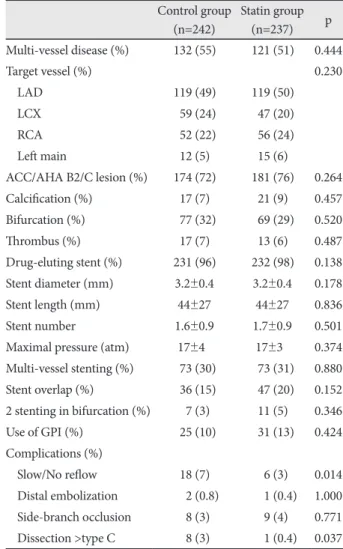
Most patients (97%) received drug-eluting stents, and over 30% of the patients received multi-vessel stenting (Table 2).

Angiographic and procedural characteristics were similar be- tween the two groups; however, slow/no reflow phenomenon was more frequent in the control group (7% vs. 3%, p=0.014).

Changes of cardiac biomarker and inflammatory marker

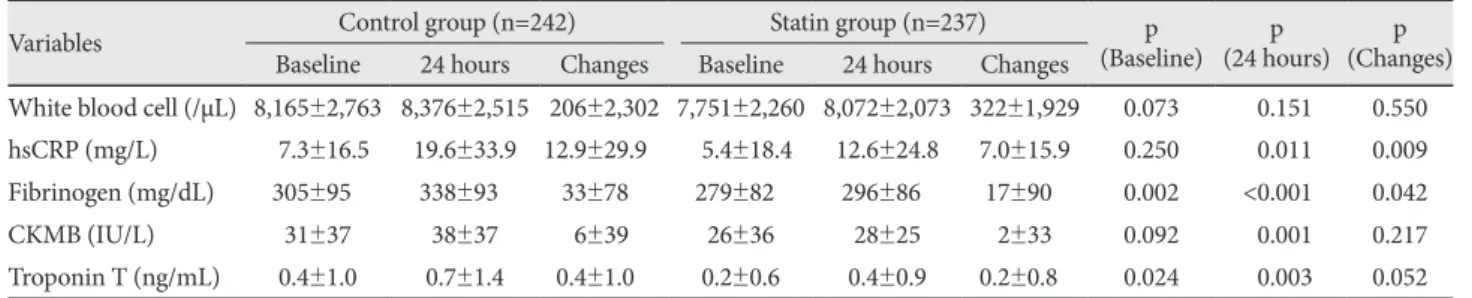
The statin group revealed lower baseline serum troponin

T and fibrinogen levels (Table 3) and less elevation of both

markers after PCI. Mean baseline hsCRP levels were similar

between the two groups; however, after PCI, the peak value

(3)

of hsCRP were elevated significantly higher in the control gr- oup. That is, hsCRP increased from 7.3±16.5 to 19.6±33.9 mg/L in the control group, and from 5.4±18.4 to 12.6±24.8 mg/L in the statin group (p=0.009).

Periprocedural myocardial injury

Myocardial infarction, defined as a postprocedural eleva- tion of CK-MB >3 times the upper normal limit or baseline level, was detected in 16 (6.6%) of patients in the control group and in 5 (2.1%) patients in the statin group (p=0.016). More- over, the incidences of a >5 fold elevation in postprocedural CK-MB levels (4.1% vs. 1.3%, p=0.048), and a >1 fold eleva- tion (37.2% vs. 21.5%, p<0.001), was higher in the control gr- oup than in the statin group (Fig. 1).

Troponin T elevation after PCI was also higher in the con- trol group than in the statin group. The instances of overall elevation in troponin T levels (43.4% vs. 31.2%, p=0.006), >3 times elevation in troponin T levels (24.0% vs. 15.2%, p=0.016), and >5 times elevation in troponin T levels (13.6% vs. 8.4%, p=0.070) after PCI occurred more frequently in the control group than in the statin group.

In-hospital major adverse cardiovascular events The patients in the statin group had a lower incidence of in-hospital MACE compared to the patients in the control gr- oup (8.3% vs. 3.0%, p=0.012). The different outcomes mainly

resulted from a higher incidence of periprocedural MI in the control group (Table 4).

A multivariate analysis revealed that no prior use of statin {odds ratio (OR)=2.8; 95% confidence interval (CI)=1.1-7.2;

p=0.038), procedural complication (OR=4.0; 95% CI=1.5- 10.5; p=0.004), stent overlap (OR=4.7; 95% CI=1.3-16.4; p=

0.015), and old age (OR=3.2; 95% CI=1.2-8.0; p=0.016) were independent predictors for in-hospital MACE (Table 5).

Discussion

In this study, we showed that previous statin therapy be- fore ACS was associated with milder clinical presentation and lower incidence of MACE after an early invasive strategy.

The beneficial outcomes observed in the statin group can be attributed to a reduction in the inflammatory response and periprocedural MI after PCI.

Statin therapy before PCI has been shown to reduce the in- cidence of periprocedural MI and improve outcomes in pa- Table 1. Baseline clinical characteristics

  Control group

(n=242)

Statin group

(n=237) p

Age (years) 63±11 63±11 0.961

Male (%) 153 (63) 130 (55) 0.062

Hypertension (%) 136 (56) 152 (64) 0.076

Diabetes (%) 073 (30) 087 (37) 0.129

Smoker (%) 104 (43) 095 (40) 0.521

Previous PCI (%) 14 (6) 20 (8) 0.258

Clinical presentation (%) <0.001

Unstable angina 160 (66) 195 (82)

NSTEMI 082 (34) 042 (18)

Braunwald class (%) <0.001

I 096 (40) 133 (56)

II 052 (21) 060 (25)

III 094 (39) 044 (19)

Total cholesterol (mg/dL) 202±460 189±480 0.003 Triglyceride (mg/dL) 172±128 166±101 0.545

HDL-C (mg/dL) 45±12 44±11 0.465

LDL-C (mg/dL) 124±400 113±420 0.002

Lipoprotein (a) (mg/dL) 40±43 40±34 0.960 PCI: percutaneous coronary intervention, NSTEMI: non-ST-seg- ment elevation myocardial infarction, HDL-C: high density lipo- protein-cholesterol, LDL-C: low density lipoprotein-cholesterol

Table 2. Coronary angiographic and procedural characteristics

  Control group

(n=242)

Statin group

(n=237) p

Multi-vessel disease (%) 132 (55) 121 (51) 0.444

Target vessel (%) 0.230

LAD 119 (49) 119 (50)

LCX 059 (24) 047 (20)

RCA 052 (22) 056 (24)

Left main 012 (5) 015 (6)

ACC/AHA B2/C lesion (%) 174 (72) 181 (76) 0.264

Calcification (%) 017 (7) 021 (9) 0.457

Bifurcation (%) 077 (32) 069 (29) 0.520

Thrombus (%) 017 (7) 013 (6) 0.487

Drug-eluting stent (%) 231 (96) 232 (98) 0.138 Stent diameter (mm) 3.2±0.4 3.2±0.4 0.178

Stent length (mm) 44±27 44±27 0.836

Stent number 1.6±0.9 1.7±0.9 0.501

Maximal pressure (atm) 17±40 17±30 0.374

Multi-vessel stenting (%) 073 (30) 073 (31) 0.880 Stent overlap (%) 036 (15) 047 (20) 0.152 2 stenting in bifurcation (%) 007 (3) 011 (5) 0.346

Use of GPI (%) 025 (10) 031 (13) 0.424

Complications (%)

Slow/No reflow 018 (7) 006 (3) 0.014

Distal embolization 002 (0.8) 001 (0.4) 1.000

Side-branch occlusion 008 (3) 009 (4) 0.771

Dissection >type C 008 (3) 001 (0.4) 0.037

LAD: left anterior descending artery, LCX: left circumflex artery,

RCA: right coronary artery, ACC/AHA: American College of Car-

diology/American Heart Association lesion classification, GPI: gly-

coprotein IIb/IIIa inhibitor

(4)

tients with stable angina. Briguori et al.

14)

reported that the incidence of CK-MB elevation greater than five times the upper normal limit after PCI was approximately 50% lower in statin-treated angina patients as compared to the statin- naïve patients. In addition, the CK-MB peak after stenting was shown to be significantly lower in the statin group than in the control group. Another study demonstrated that ch- ronic statin therapy before PCI reduced CK-MB by greater than three times the elevation after PCI and decreased the incidence of 6-12 months MACE.

12)15)

Further, a meta-anal- ysis showed that statin pretreatment in patients with stable angina resulted in a 59.3% reduction of relative risk of pro- cedural MI and a 20.5% overall reduction in MACE.

16)

How-

ever, there was a limitation on data regarding the clinical be- nefits of chronic pretreatment with statins in patients with ACS undergoing PCI.

Previous studies have also shown that statin therapy im- proves the prognosis of patients with ACS. The Pravastatin or Atorvastatin Evaluation and Infection Therapy study report- ed that intensive statin therapy within 10 days after ACS re- sults in 28% and 6% risk reduction at 30 days and two years, respectively.

8)

Further, the Myocardial Ischemia Reduction with Aggressive Cholesterol Lowering study reported that 80 mg atorvastatin within 24-96 hours after hospital admission reduced the risk of the composite primary end point of death, MI, cardiac arrest, and recurrent ischemia by 16% compared Table 4. In-hospital major adverse cardiovascular events in con-

trol and statin-treated groups

  Control group

(n=242)

Statin group

(n=237) p

Death 03 (1.2) 1 (0.4) 0.624

Non-periprocedural QMI 00 (0) 2 (0.8) 0.244 Periprocedural MI 16 (6.6) 5 (2.1) 0.016

Revascularization 00 (0) 0 (0) -

Ischemic stroke 01 (0.4) 1 (0.4) 1.000

Total 20 (8.3) 7 (3.0)* 0.012

*Two patients with periprocedural myocardial infarction experi- enced re-infarction on a subsequent hospital day. QMI: Q wave myocardial infarction, MI: myocardial infarction

Table 5. Multivariate analysis for the prediction of in-hospital ma- jor adverse cardiovascular events

OR 95% CI p

Procedural complication 4.0 1.5-10.5 0.004

Stent overlap 4.7 1.3-16.4 0.015

Age >65 years 3.2 1.2-8.00 0.016

No use of statin 2.8 1.1-7.20 0.038

NSTEMI 2.0 0.8-5.00 0.139

Thrombus lesion 2.4 0.6-9.10 0.210

Use of GPI 0.9 0.2-3.00 0.806

OR: odds ratio, CI: confidence interval, NSTEMI: non-ST-segment elevation myocardial infarction, GPI: glycoprotein IIb/IIIa inhibitor Table 3. Changes of inflammatory and myocardial biomarker after percutaneous coronary intervention

Variables Control group (n=242) Statin group (n=237) p

(Baseline) p

(24 hours) p (Changes) Baseline 24 hours Changes Baseline 24 hours Changes

White blood cell (/µL) 8,165±2,763 8,376±2,515 206±2,302 7,751±2,260 8,072±2,073 322±1,929 0.073 0.151 0.550 hsCRP (mg/L) 07.3±16.5 19.6±33.9 12.9±29.90. 05.4±18.4 12.6±24.8 7.0±15.9 0.250 0.011 0.009 Fibrinogen (mg/dL) 305±950 338±930 33±780. 279±820 296±860 17±900 0.002 <0.001 0.042

CKMB (IU/L) 31±37 38±37 6±39. 26±36 28±25 2±33 0.092 0.001 0.217

Troponin T (ng/mL) 0.4±1.0 0.7±1.4 0.4±1.00. 0.2±0.6 0.4±0.9 0.2±0.80 0.024 0.003 0.052 hsCRP: high sensitivity C-reactive protein, CK-MB: creatine kinase MB

Fig. 1. Incidence of cardiac biomarker elevation after percutaneous coronary intervention. A: incidences of any CK-MB elevation (37.2% vs.

21.5%, p<0.001), >3 times elevation (6.6% vs. 2.1%, p=0.016), and >5 times elevation (4.1% vs. 1.3%, p=0.054) were higher in the control group than in the statin group. B: incidences of any troponin elevation (43.4% vs. 31.2%, p=0.006), >3 times elevation (24.0% vs. 15.2%, p=0.016), and >5 times elevation (13.6% vs. 8.4%, p=0.070) were higher in the control group than in the statin group.

50 40 30 20 10 0

50 40 30 20 10

>1x elevation >3x elevation >5x elevation 0 >1x elevation >3x elevation >5x elevation 37.2%

43.4%

(%) (%)

21.5%

31.2%

6.6%

24.0%

2.1%

15.2%

4.1%

13.6%

1.3%

8.4%

Control group Statin group

Control group Statin group

A B

(5)

to placebo.

7)

In addition, we previously reported that high dose statin loading approximately 16 hours before PCI re- sulted in a 53% reduction in the risk of periprocedural MI and a 63% reduction in the risk of 30-day MACE, compared to no statin pretreatment.

10)

These studies indicate that early statin therapy significantly improves the prognosis of patients with ACS. In the current study, we demonstrated that previous st- atin therapy prior to the onset of ACS also has beneficial ef- fects on the reduction of periprocedural MI and improvement of the in-hospital clinical course after PCI.

Previous statin therapy seems to attenuate the severity and extent of MI. In an analysis of the Global Registry of Acute Coronary Events registry, patients receiving statins had a lo- wer incidence of MI and cardiogenic shock. Size of infarcted myocardium was significantly smaller because ST-segment elevation MI occurred less often, and CK levels were lower among patients with chronic statin therapy.

17)

Previous statin therapy also has been demonstrated to favorably affect the hospital outcome in patients with MI. Bauer et al.

18)

reported that pretreatment with statins was associated with smaller MI size and a 35% reduction of hospital mortality in patients with non-ST-segment elevation MI. The results of the current study were similar to those of the aforementioned studies, de- spite differences in the study population. Overall, patients with previous statin therapy revealed lower levels of baseline and peak troponin and a lower incidence of in-hospital MACE.

The benefits of statins in cardiovascular diseases can be explained not only by their lipid-lowering potential but also by mechanisms unrelated to lipids, or the so called pleiotropic effects.

19)

Such pleiotropic effects encompass non-lipid mech- anisms that modify endothelial function, inflammatory re- sponses, plaque stability, and thrombus formation.

20)

Thus, they may potentially improve outcomes after PCI. Our study showed a lower elevation of hsCRP levels after PCI in patients undergoing previous statin therapy. Previous studies have sh- own that elevation of hsCRP levels after PCI to be associated with troponin elevation, and periprocedural myocardial in- jury has been shown to be correlated with vascular inflam- mation.

21)22)

Moreover, the CRP elevation after PCI has been associated with a higher incidence of MACE in patients with ACS.

23)

In the current study, the hsCRP peak after stenting was significantly lower in the statin group than in the control gr- oup, supporting the notion that prevention of myocardial in- jury via lipid lowering and pleiotrophic effects of statins is im- portant in improving the clinical outcomes in patients with ACS.

Our study has several limitations. The study was not ran- domized, and the sample size was small. It was difficult to ran- domize because the study group was classified by long-term treatment status. Furthermore, the clinical outcomes accord- ing to the type and dose of statins and the exact duration of the therapy were not identified due to the small sample size.

A large registry study is needed to generalize our results.

In conclusion, previous statin therapy before PCI attenu- ated the clinical presentation of ACS and was associated with a lower incidence of MACE after an early invasive strategy.

Inflammatory responses after PCI were also inhibited by a reduction of myocardial injury during the intervention in patients who had previously received statin therapy.

REFERENCES

1) Sacandinavian Simvastatin Survival Study (4S). Randomized trial of cholesterol lowering in 4444 patients with coronary heart disease.

Lancet 1994;344:1383-9.

2) Shepherd J, Cobbe SM, Ford I, et al. Prevention of coronary heart disease with pravastatin in men with hypercholesterolemia. West of Scotland Coronary Prevention Study Group. N Engl J Med 1995;333:

1301-7.

3) Sacks FM, Pfeffer MA, Moye LA, et al. The effect of pravastatin on coronary events after myocardial infarction in patients with average cholesterol levels. Cholesterol and Recurrent Events Trial investiga- tors. N Engl J Med 1996;335:1001-9.

4) Long-Term Intervention with Pravastatin in Ischemic Disease (LIPID) Study Group. Prevention of cardiovascular events and death with pravastatin in patients of coronary heart disease and a board range of initial cholesterol levels. N Engl J Med 1998;339:1349-57.

5) Hong YJ, Jeong MH, Lim JH, et al. The prognostic significance of statin therapy according to the level of C-reactive protein in acute myocardial infarction patients who underwent percutaneous coronary intervention. Korean Circ J 2003;33:891-900.

6) Ridker PM, Danielson E, Fonseca FA, et al. Reduction in C-reactive protein and LDL cholesterol and cardiovascular event rates after in- itiation of rosuvastatin: a prospective study of the JUPITER trial.

Lancet 2009;373:1175-82.

7) Schwartz GG, Olsson AG, Ezekowitz MD, et al. Effects of atorvasta- tin on early recurrent ischemic events in acute coronary syndromes: the MIRACL study: a randomized controlled trial. JAMA 2001;285:

1711-8.

8) Ray KK, Cannon CP, McCabe CH, et al. Early and late benefits of high-dose atorvastatin in patients with acute coronary syndromes:

results from the PROVE IT-TIMI 22 trial. J Am Coll Cardiol 2005;

46:1405-10.

9) Patti G, Pasceri V, Colonna G, et al. Atorvastatin pretreatment im- proves outcomes in patients with acute coronary syndromes undergo- ing early percutaneous coronary intervention: results of the ARMYDA- ACS randomized trial. J Am Coll Cardiol 2007;49:1272-8.

10) Yun KH, Jeong MH, Oh SK, et al. The beneficial effect of high loading dose of rosuvastatin before percutaneous coronary intervention in pa- tients with acute coronary syndrome. Int J Cardiol 2009;137:246-51.

11) Ishii H, Ichimiya S, Kanashiro M, et al. Effects of receipt of chronic statin therapy before the onset of acute myocardial infarction: a ret- rospective study in patients undergoing primary percutaneous coro- nary intervention. Clin Ther 2006;28:1812-9.

12) Chang SM, Yazbek N, Lakkis NM. Use of statins prior to percutane- ous coronary intervention reduces myonecrosis and improves clinical outcome. Catheter Cardiovasc Interv 2004;62:193-7.

13) Di Sciascio G, Patti G, Pasceri V, Gaspardone A, Colonna G, Montin- aro A. Efficacy of atorvastatin reload in patients on chronic statin th- erapy undergoing percutaneous coronary intervention: results of the ARMYDA-RECAPTURE (Atorvastatin for Reduction of Myocardial Da- mage During Angioplasty) Randomized Trial. J Am Coll Cardiol 2009;

54:558-65.

14) Briguori C, Colombo A, Airoldi F, et al. Statin administration before percutaneous coronary intervention: impact on periprocedural myocar- dial infarction. Eur Heart J 2004;25:1822-8.

15) Chan AW, Bhatt DL, Chew DP, et al. Relation of inflammation and be-

(6)

nefit of statins after percutaneous coronary interventions. Circulation 2003;107:1750-6.

16) Ebrahimi R, Saleh J, Toggart E, et al. Effect of preprocedural statin use on procedural myocardial infarction and major cardiac adverse events in percutaneous coronary intervention: a meta-analysis. J Inva- sive Cardiol 2008;20:292-5.

17) Spencer FA, Allegrone J, Goldberg RJ, et al. Association of statin th- erapy with outcomes of acute coronary syndromes: the GRACE study.

Ann Intern Med 2004;140:857-66.

18) Bauer T, Bohm M, Zahn R, et al. Effect of chronic statin pretreatment on hospital outcome in patients with acute non-ST-elevation myocardi- al infarction. J Cardiovasc Pharmacol 2009;53:132-6.

19) Takemoto M, Liao JK. Pleiotropic effects of 3-hydroxy-3-methylglu- taryl coenzyme a reductase inhibitors. Arterioscler Thromb Vasc Biol

2001;21:1712-9.

20) Sposito AC, Chapman MJ. Statin therapy in acute coronary syndr- omes: mechanistic insight into clinical benefit. Arterioscler Thromb Vasc Biol 2002;22:1524-34.

21) Rhee SJ, Yun KH, Oh SK, et al. Changes of C-reactive protein are as- sociated with myocardial injury after successful percutaneous coro- nary intervention. Korean Circ J 2008;38:135-9.

22) Choi SY, Yang HM, Tahk SJ, et al. Preprocedural hs-CRP level serves as a marker for procedure-related myocardial injury during coronary stenting. Korean Circ J 2005;35:140-8.

23) Yun KH, Jeong MH, Oh SK, et al. Response of high-sensitivity C-reac-

tive protein to percutaneous coronary intervention in patients with

acute coronary syndrome. Heart Vessels 2009;24:175-80.

수치

Table 2. Coronary angiographic and procedural characteristics
Table 5. Multivariate analysis for the prediction of in-hospital ma- ma-jor adverse cardiovascular events

참조

관련 문서

Conclusions: Transradial approach in patient with high risk acute coronary syndrome treated with abciximab is associated with better in-hospital clinical outcomes and lower

Early versus delayed treatment with ticagrelor on residual thrombus after percutaneous cor- onary intervention in patients presenting with non-ST-elevation acute

This study was designed to show the association between treatment with statins or RAS blockers and clinical outcomes and the efficacy of two drug combination therapies in

Statin users were defined as those who used any of the following statins for at least 30 consecutive days during the period ranging from 1 year prior to the cohort entry date to the

of the eligible patients received statin therapy, whereas no benefit was seen in two recently conducted landmark trials, i.e. the ORIGIN and the OMEGA trials, 8)9) in which more

Rosuvastatin is a potent hydrophilic statin with acute pleiotrophic effects. 16) Rosuvastatin loading therapy before PCI shows several beneficial effects, including

Propensity score for the likelihood of receiving statin therapy was calculated by forward logistic regression analysis including 63 variables of clinical and

Antiplatelet therapies are as important as anticoagulation therapy for the prevention of acute thrombosis in an implant- ed stent; 9) hemophilia is not associated with