ABSTRACT
Background and Objectives: Contrast-induced nephropathy (CIN) is a common
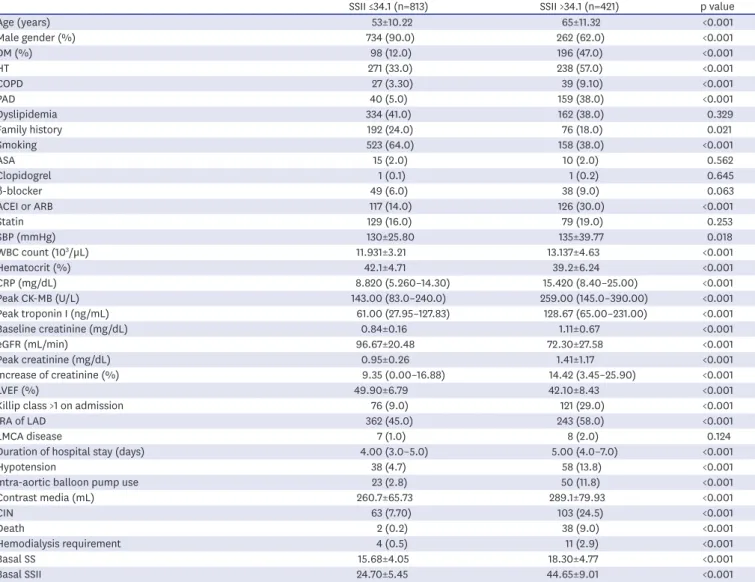
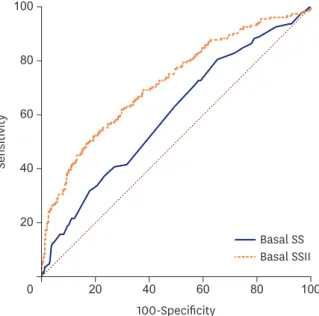
complication of primary percutaneous coronary intervention (pPCI) and is associated with high mortality and morbidity and long hospital stay in patients with ST elevation myocardial infarction (STEMI). The Syntax Score (SS) has previously been studied in STEMI patients, and it was associated with increased CIN development and long-term mortality. This study investigates a possible relationship between CIN development and Syntax Score II (SSII) and compares SS and SSII by assessing CIN risk in STEMI patients treated with pPCI.
Methods: A total of 1,234 patients who underwent pPCI were divided into 2 groups according to CIN development. Patients with CIN were further divided into 2 groups according to whether or not they required hemodialysis. Reclassification tables, net reclassification improvement, and integrated discriminative improvement methods were used to assess the additive predictive value of SSII for predicting CIN.
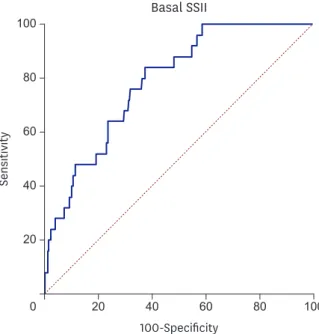
Results: In the present study, 166 patients (13.5%) had CIN. Although both SS and SSII were significantly higher in CIN patients, only SSII was an independent predictor of CIN (odds ratio [OR], 1.031; 95% confidence interval [CI], 1.012–1.051; p<0.001) and hemodialysis requirement (OR, 1.078; 95% CI, 1.046–1.078; p<0.001). When comparing SSII and SS in their ability to determine CIN risk, we found SSII to have a reclassification improvement of 27.59% (p<0.001) and an integrated discrimination improvement of 9.1% (p<0.001).
Conclusions: The combination of clinical and anatomic variables can more accurately identify patients who are at high risk for CIN after pPCI. While SSII is harder to calculate than SS, it provides better prediction for CIN and hemodialysis requirement than SS.
Keywords: Syntax score II; ST segment elevation myocardial infarction;
Contrast induced nephropathy.
Original Article
Ibrahim Rencuzogullari 1 , Metin Çağdaş 1 , Süleyman Karakoyun 1 , Yavuz Karabağ , MD 1 , Mahmut Yesin , MD 2 , Mustafa Ozan Gürsoy , MD 3 , İnanç Artaç, MD 1 , Doğan İliş, MD 1 , Süleyman Çağan Efe , MD 4 ,
Kevser Tural , MD 5 , and Ibrahim Halil Tanboğa, MD 6
1
Department of Cardiology, Kafkas University Medical Faculty, Kars, Turkey
2
Department of Cardiology, Kars Harakani State Hospital, Kars, Turkey
3
Department of Cardiology, Gaziemir State Hospital, İzmir, Turkey
4
Department of Cardiology, Ağrı State Hospital, Ağrı, Turkey
5
Department of Cardiovascular Surgery, Kafkas University Medical Faculty, Kars, Turkey
6