서 론
노년기는 많은 변화를 경험하는 시기이며 이러한 변화는 삶의 질 저하로 이어질 수 있다.1) 국내 65세 이상 인구에서 여성 노인이 더 많 으며 여성 노인에 대하여 삶의 질을 평가하는 것은 중요하다.
비만이 증가하면 삶의 질에 부정적인 영향을 미친다는 것은 널리 알려져 있다.2,3) 체질량지수(body mass index, BMI), 허리둘레 등과 같
은 지표와 삶의 질의 관계를 알아보는 연구는 있으나 단순 체중과 건강관련 삶의 질(health-related quality of life, HRQoL)에 대한 자료는 많지 않다.
본 연구의 목적은 국내 65세 이상의 여성을 대상으로 체중과 HRQoL 사이의 관계를 알아보아 체중이 여성 노인의 삶의 질에 영 향을 미치는지를 확인하고자 하였다.
Brief
Communication
국내 여성 노인에서 체중과 건강관련 삶의 질 간 상관관계:
제5기(2010-2011년) 국민건강영양조사자료를 이용하여
구보경, 김연표*, 강경은, 임미진
화순전남대학교병원 가정의학과
Association between Weight and Health-Related Quality of Life in the Elderly Women: Korean National Health and Nutrition Examination Survey (KNHANES) 2010–2011
Bo Kyung Goo, Yeon Pyo Kim*, Kyung Eun Kaang, Mi Jin Lim
Department of Family Medicine, Chonnam National University Hwasun Hospital, Hwasun, Korea
Background: Currently, obesity is a major public health concern. The proportion of elderly in South Korea has increased gradually, and the prevalence of obesity among the elderly has also increased. Obese elderly are more prone to illnesses, which can negatively affect their quality of life. However, there have not been many studies about the relationship between weight and health-related quality of life (HRQoL) among elderly Korean women.
This research aimed to identify how weight influences quality of life of women over 65 years of age in Korea by analyzing the relationship between weight and HRQoL.
Methods: This study used data from the 2010–2011 Korean National Health and Nutrition Examination Survey. EuroQol five dimensions questionnaire (EQ-5D) index scores were classified as satisfactory or unsatisfactory based on the median value. Univariate and multivariate logistic regression analyses were then used to assess the influence of weight on HRQoL with consideration for socioeconomic and pathologic variables in subjects.
Results: In the analysis, valid body weight measurements and EQ-5D index scores from 1,607 female subjects aged 65 years or older were selected.
Higher body weight did not appear to be associated with lower HRQoL according to the univariate logistic regression. In addition, weight had little influence on HRQoL according to the multivariate logistic regression with adjustments for covariates.
Conclusion: There is no meaningful association between weight and HRQoL in elderly Korean women.
Keywords: Body Weight; Life Quality; Women’s Group; Elderly
https://doi.org/10.21215/kjfp.2017.7.4.605 eISSN 2233-9116Korean J Fam Pract. 2017;7(4):605-609
KJFP
Korean Journal of Family PracticeReceived March 28, 2016 Revised July 4, 2016 Accepted July 22, 2016
Corresponding author Yeon Pyo Kim Tel: +82-61-379-7290, Fax: +82-61-379-7289 E-mail: [email protected]
Copyright © 2017 The Korean Academy of Family Medicine
This is an open-access article distributed under the terms of the Creative Commons At- tribution Non-Commercial License (http://creativecommons.org/licenses/by-nc/4.0) which permits unrestricted noncommercial use, distribution, and reproduction in any medium, provided the original work is properly cited.
Bo Kyung Goo, et al. Weight and QoL of Eldery Women in Korea
Korean Journal of Family Practice
KJFP
방 법
본 연구를 진행하기 위해 화순전남대학교병원 임상시험심사위원 회(Institutional Review Board, IRB)에 의뢰하여 국민건강영양조사 자 료의 특성으로 심의 면제 받은 후 연구를 시행하였다.
1. 연구대상
제5기 국민건강영양조사는 시도, 동읍면, 주택유형, 성별, 연령대 별 인구 구성비를 기준으로 층화한 후 표본조사구 추출 및 계통추 출방법으로 조사구당 20개의 최종 추출하여, 총 3,840가구에서 만 1 세 이상 가구원 전체를 대상으로 조사를 수행하였다. 그 중 1차(2010 년) 및 2차(2011년) 조사결과에서 EuroQol five dimensions question- naire (EQ-5D) index 항목에 유효값을 나타낸 만 65세 이상 여성 1,607 명을 선별 하였다.
2. 변수 정의
1) 체중1,607명의 대상자들 체중의 사분위수를 기준으로 네 구간(<49.3 kg, 49.3–54.6 kg, 54.7–60.7 kg, ≥60.8 kg)으로 나누었다.
2) EuroQol five dimensions questionnaire index
HRQoL을 평가하는 여러 도구들 중 EQ-5D는 광범위한 건강상태 및 치료 평가에 이용할 수 있다.4) EQ-5D는 5개의 객관식 문항과 시각 적 상사척도(visual analogue scale) 1개 문항으로 구성되며 운동능력, 자기관리, 일상생활, 통증/불편, 불안/우울의 5개 영역을 3단계로 나 타낸다.5)
3) 기타 변수
가구 소득 사분위수는 소득수준을 월평균 가구균등화 소득에 따라 하, 중하, 중상, 상의 네 개 군으로 나누었다. 교육 변수는 초등학 교 미만, 초등학교, 중학교 이상의 세 군으로 분류하였다. 결혼상태 는 ‘유배우자, 동거’로 답변한 경우만 결혼으로 정의하였고 별거, 사 별, 이혼, 독신으로 답한 경우는 미혼으로 하여 두 개의 군으로 분류 하였다. 고혈압은 고혈압군과 정상 또는 고혈압 전 단계를 정상군으 로 나누었으며 당뇨는 당뇨군과 공복혈당장애 또는 정상을 정상군 으로 분류하였다. 빈혈은 헤모글로빈 12 미만을 기준으로 나누었다.
암은 의사진단 여부를 기준으로 하여 두 군으로 분류하였으며 관상 동맥질환도 의사진단 여부를 기준으로 두 군으로 나누었다. 알코올 사용장애 선별 자가 검사도구인 Audit-K (alcohol use disorder identifi- cation test-Korea) 점수는 정상, 위험음주, 알코올 사용장애군 세 개의
군으로 나누었다. 흡연은 ‘평생흡연 여부’ 항목에 피운 적 없음 또는 5 갑(100개비) 미만으로 답한 경우를 비흡연군으로, 그 외에는 흡연군 으로 분류하였다.
3. 통계적 분석
제5기 국민건강영양조사 중 1차(2010년) 및 2차(2011년) 자료를 이 용하여 만 65세 이상 여성을 대상으로 체중에 따라 네 구간으로 나 누었다. HRQoL 지표 점수의 중앙값인 0.854를 기준으로 두 군으로 구분하였다. 각 변수들과 EQ-5D index 간의 관련성을 파악하고자 단변수 로지스틱 회귀분석을 사용하였으며 보정한 상태로 다변수 로지스틱 회귀분석을 시행하였다. 95% 신뢰구간(95% confidence in- terval, CI)과 교차비(odds ratio)를 구하였고 이를 통하여 체중과 EQ- 5D index 사이의 관련성을 확인할 수 있었다. 통계적 유의수준은 0.05 미만으로 하였으며 자료 기술분석은 IBM SPSS Statistics ver. 21.0 (IBM Co., Armonk, NY, USA)을 이용하였다.
결 과
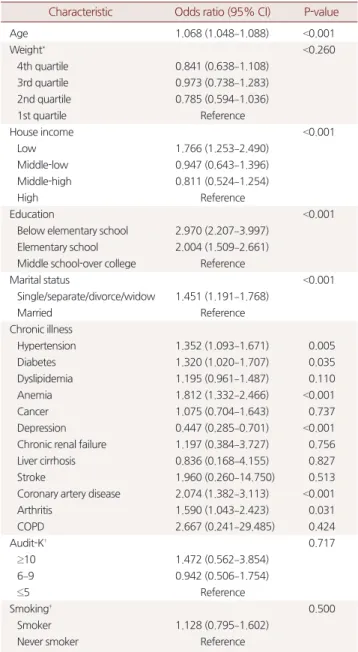
Table 1은 EQ-5D index와 체중 및 영향을 줄 수 있는 여러 변수들 에 대해 단변수 로지스틱 회귀분석을 시행하여 HRQoL의 관련성을 나타낸 것이다. 나이가 많을수록 삶의 질 불만족군에 속할 위험도 가 1.068배(95% CI, 1.048–1.088) 높아졌으며 체중 1분위군을 기준으 로 했을 때 체중이 많이 나갈수록 교차비는 각 0.785 (0.594–1.036), 0.973 (0.738–1.283), 0.841 (0.638–1.108)으로 유의미한 연관성을 보이 지 않았다(P<0.260). 가구 수입은 상군을 기준으로 하여 각각 교차비 가 0.811 (0.524–1.254), 0.947 (0.643–1.396), 1.766 (1.253–2.490)으로 증 가하는 양상을 보였으며 교육 정도는 중학교 이상 학력군을 기준으 로 하였을 때 초등학교, 초등학교 미만인 학력군의 교차비가 각각 2.004 (1.509–2.661), 2.970 (2.207–3.997)으로 증가함을 보였다. 결혼한 상태의 대상자에 비하여 미혼 상태일 때 삶의 질 불만족군에 속할 위험도가 1.451배(1.191–1.768) 높아지는 것으로 나타났다. 만성 질환 항목에서는 질환이 동반된 대상자에서 삶의 질 불만족군에 속할 위 험도가 더 높게 나타났으며 음주와 흡연은 삶의 질과 유의미한 상관 관계를 보이지 않았다. Table 2는 Table 1의 단변수 로지스틱 회귀분 석 결과를 토대로 연관성을 나타낸 변수들을 보정하여 체중과 삶의 질 사이의 관련성에 대해 보여주고 있다. 유의한 결과를 보인 변수들 로 다변수 로지스틱 회귀분석을 시행한 결과 체중은 HRQoL과 유의 미한 관련성을 보이지 않았다.
구보경 외. 국내 여성 노인의 체중과 건강관련 삶의 질 간 상관관계 Korean Journal of Family Practice
KJFP
고 찰
본 연구는 제 5기 국민건강영양조사 중 2010년과 2011년 자료를 이 용하여 국내 만 65세 이상 여성을 대상으로 체중과 HRQoL 간의 연 관성에 대해 알아본 단면 연구이다. 비만을 진단하기 위해 보편적으 로 사용되는 기준은 BMI와 복부비만을 평가하기 위한 허리둘레가
흔히 사용되고 있으며, 각 지표와 HRQoL의 관계를 조사한 연구들 은 많이 이루어지고 있다.6-8)
1996년 미국에서 성인 109,076명을 대상으로 BMI와 HRQoL의 관 계를 조사하여 BMI가 정상보다 낮거나 높으면 삶의 질을 감소시킨 다는 결과를 얻었으며, 1997년 스웨덴에서 16세 이상 성인 남녀 5,633 명 중 과체중, 비만인 경우 정상 체중인 사람보다 삶의 질이 역시 악
화되었다.9,10)
체중의 변화 값 또는 비율과 삶의 질의 관계에 대한 연구는 찾아 볼 수 있다. León-Muñoz 등11)의 연구에 따르면 스페인의 60세 이상 노인 2,364명을 대상으로 체중 변화가 HRQoL에 미치는 영향을 알아 보기 위해 선형회귀분석을 하였고 비만하지 않은 사람은 체중이 감 소할수록, 비만한 사람은 체중이 증가할수록 삶의 질이 낮아지는 경 향을 보였으며 여성에서 두드러지게 나타났다.
국외의 연구에서 체중과 삶의 질의 관계를 보고자 할 때 체중 측 정값 자체를 사용하지 않고 BMI를 이용하고 있다.6-8) BMI와 HRQoL 사이에 중요한 상관성을 보인다는 연구에 따르면 BMI가 낮아지거나 Table 1. Association between EQ-5D index and other variables using
univariate logistic regression
Characteristic Odds ratio (95% CI) P-value
Age 1.068 (1.048–1.088) <0.001
Weight* <0.260
4th quartile 0.841 (0.638–1.108)
3rd quartile 0.973 (0.738–1.283)
2nd quartile 0.785 (0.594–1.036)
1st quartile Reference
House income <0.001
Low 1.766 (1.253–2.490)
Middle-low 0.947 (0.643–1.396)
Middle-high 0.811 (0.524–1.254)
High Reference
Education <0.001
Below elementary school 2.970 (2.207–3.997) Elementary school 2.004 (1.509–2.661) Middle school-over college Reference
Marital status <0.001
Single/separate/divorce/widow 1.451 (1.191–1.768)
Married Reference
Chronic illness
Hypertension 1.352 (1.093–1.671) 0.005
Diabetes 1.320 (1.020–1.707) 0.035
Dyslipidemia 1.195 (0.961–1.487) 0.110
Anemia 1.812 (1.332–2.466) <0.001
Cancer 1.075 (0.704–1.643) 0.737
Depression 0.447 (0.285–0.701) <0.001
Chronic renal failure 1.197 (0.384–3.727) 0.756
Liver cirrhosis 0.836 (0.168–4.155) 0.827
Stroke 1.960 (0.260–14.750) 0.513
Coronary artery disease 2.074 (1.382–3.113) <0.001
Arthritis 1.590 (1.043–2.423) 0.031
COPD 2.667 (0.241–29.485) 0.424
Audit-K† 0.717
≥10 1.472 (0.562–3.854)
6–9 0.942 (0.506–1.754)
≤5 Reference
Smoking‡ 0.500
Smoker 1.128 (0.795–1.602)
Never smoker Reference
EQ-5D, EuroQol five dimensions questionnaire; CI, confidence interval; COPD, chronic obstructive pulmonary disease; Audit-K, alcohol use disorder identifica- tion test-Korea.
*1st quartile (<49.3 kg), 2nd quartile (49.3–54.6 kg), 3rd quartile (54.7–60.7 kg), 4th quartile (≥60.8 kg). †≤5 (normal), 6–9 (harmful alcohol consumption),
≥10 (suggestive of alcohol dependence). ‡Never smoker (<100 cigarettes in life), smoker (≥100 cigarettes in life).
Table 2. Association between EQ-5D index and other variables using multivariate logistic regression
Characteristic Adjusted odds ratio
(95% CI) P-value
Age 1.148 (1.035–1.273) 0.009
Weight* 0.340
4th quartile 0.865 (0.266–2.815)
3rd quartile 1.862 (0.555–6.246)
2nd quartile 1.865 (0.564–6.162)
1st quartile Reference
House income 0.059
Low 5.306 (1.546–18.213)
Middle-low 3.097 (0.784–12.232)
Middle-high 4.852 (0.890–26.446)
High Reference
Education 0.003
Below elementary school 7.692 (2.340–25.285) Elementary school 3.367 (1.244–9.111) Middle school-over college Reference
Marital status 0.835
Single/separate/divorce/widow 0.913 (0.388–2.149)
Married Reference
Chronic illness
Hypertension 0.891 (0.365–2.174) 0.800
Diabetes 0.980 (0.362–2.652) 0.969
Anemia 1.357 (0.341–5.400) 0.665
Depression 0.405 (0.177–0.928) 0.033
Coronary artery disease 1.000 (0.000) 0.189
Arthritis 2.642 (2.089–3.341) <0.001
EQ-5D, EuroQol five dimensions questionnaire; CI, confidence interval.
*1st quartile (<49.3 kg), 2nd quartile (49.3–54.6 kg), 3rd quartile (54.7–60.7 kg), 4th quartile (≥60.8 kg).
Bo Kyung Goo, et al. Weight and QoL of Eldery Women in Korea
Korean Journal of Family Practice
KJFP
높아질수록 HRQoL은 감소하게 됨을 알 수 있었다.9,10,12) 이는 세계보 건기구(World Health Organization)에서 과체중과 비만을 비정상 혹 은 과도하게 지방이 축적되어 건강을 저하시킬 수 있는 상태로 정의 하고 BMI가 체지방을 간접적으로 측정해 볼 수 있는 방법으로 널리 사용되고 있기 때문으로 보인다.13) 하지만 BMI도 비만을 측정하는 도구로서 불완전한 부분이 있다. 나이, 성별, 골격 구조, 지방 분포 또 는 근육량 등이 고려되지 않았다는 점이다.14) 한계점이 있지만 대다 수의 사람들이 근육, 골격이 운동선수들처럼 발달하지는 않기 때문 에 대부분 사람들에게 BMI는 체지방 정도를 파악하는 데 좋은 계 측이 된다는 의견도 있다.15)
본 연구가 단면연구이기 때문에 체중과 HRQoL 사이의 관계에 대 해 일반적인 결론을 이끌어 내는 것은 어렵다는 제한점이 있다. 그러 나 국내 여성 노인의 대표성을 지닌 인구에 대한 자료를 통해 그 연관 성을 분석하였다는 점에서 의미가 있다. 또한 다수의 논문에서 자기 보고 방식으로 신체 계측 정보를 얻고 있는데16,17) 이러할 경우 과소평 가되는 경향이 있으나 본 연구에서는 직접 계측한 자료를 이용하였 기 때문에 오류를 줄일 수 있다는 장점이 있다고 본다. BMI, 허리와 엉덩이의 비율(waist to hip ratio), 체지방(body fat)과 HRQoL 간의 부 정적 관계를 밝힌 연구가 있듯이18) 개개인의 신체 상태를 반영하지 못하는 단순 체중 대신 비만 상태를 보다 객관적으로 나타낼 수 있 는 신체 계측 방법을 사용하거나 다른 비만관련 지표를 포함하여 국 내 여성 노인들의 HRQoL 간의 관련성에 대한 분석이 더 필요할 것 으로 보인다. 또한 본 연구에서 조사한 단순 체중만으로는 대한비만 학회 기준에 따른 비만 상태를 명확히 하는 데 어려움이 있다는 제 한점이 있으므로 단순 체중이 아닌 체중의 변화 값에 따른 HRQoL 의 유의미한 관계를 보여주는 연구결과를 근거로11) 국내 노인 여성 에도 동일하게 적용되는지 향후 연구가 이루어진다면 본 연구 결과 를 보완할 수 있을 것이라 생각한다.
요 약
연구배경:
노년기는 많은 변화를 경험하는 시기이며 이러한 변화는 삶의 질 저하로 이어질 수 있다. 현재 비만은 노인인구에서도 그 비 율이 증가하고 있으며 발병할 위험도 높아지게 되어 삶의 질에 부정 적인 영향을 미칠 수 있다. 그러나 국내 여성 노인의 체중과 HRQoL 에 대한 자료는 많지 않다. 본 연구는 국내 65세 이상의 여성을 대상 으로 체중과 HRQoL 사이의 관계를 통해 체중이 여성 노인의 삶의 질에 어떤 영향을 미치는지를 알아보고자 하였다.방법:
제5기 국민건강영양조사(2010–2011년) 자료에서 EuroQol five dimensions questionnaire (EQ-5D) index에 유효값을 보인 만 65세 이상 여성 1,607명을 대상으로 하였다. 대상자들을 체중에 따라 4분위 수로 나누었으며 EQ-5D index 중앙값인 0.854를 기준으로 삶의 질 만족군과 불만족군으로 구분하였다. EQ-5D index와 삶의 질 관련 변수들 간 관련성을 알아보기 위해 단변수 로지스틱 회귀분석을 하 였고 유의한 변수들을 보정한 상태로 다변수 로지스틱 회귀분석을 하여 체중과 EQ-5D index 사이의 관련성을 분석하였다.
결과:
총 1,607명 대상자들의 체중을 4분위수를 기준으로 4개 군으 로 구분한 결과 1사분위에서 4사분위까지 각 400명(24.9%), 403명 (25.1%), 397명(24.7%), 407명(25.3%)이 해당되었다. 체중 1사분위 그룹 을 기준으로 단변수로지스틱 회귀분석을 시행하였을 때 2사분위, 3 사분위, 4사분위 그룹으로 체중이 증가 시 교차비는 각 0.785 (0.594–1.036), 0.973 (0.738–1.283), 0.841 (0.638–1.108)로 의미 있는 결과를 보 이지 않았으며, 관련 변수를 보정하여 다변수로지스틱 회귀분석을 시행한 결과 통계적으로 유의함을 보이지 않았다.
결론:
국내 노인 여성에서 체중과 HRQoL은 유의미한 관계를 보이 지 않는다.중심단어:
체중; 삶의 질; 여성; 고령REFERENCES
1. Kim JY, Lee SG, Lee SK. The relationship between health behaviors, health status, activities of daily living and health-related quality of life in the elderly.
J Korean Gerontol Soc 2010; 30: 471-84.
2. Fontaine KR, Cheskin LJ, Barofsky I. Health-related quality of life in obese persons seeking treatment. J Fam Pract 1996; 43: 265-70.
3. Sarlio-Lähteenkorva S, Stunkard A, Rissanen A. Psychosocial factors and quality of life in obesity. Int J Obes Relat Metab Disord 1995; 19 Suppl 6: S1- 5.
4. Lee YH, Choi JS, Rhee JA, Ryu SY, Shin MH, Kim JH. A study on the appli- cation of the Korean valuation weights for EuroQoL-5 dimension. J Korean Soc Health Educ Promot 2009; 26: 1-13.
5. Ock MS, Jo MW, Lee SI. Measuring health related quality of life using EQ- 5D in South Korea. J Health Tech Assess 2013; 1: 103-11.
6. Giuli C, Papa R, Bevilacqua R, Felici E, Gagliardi C, Marcellini F, et al. Corre- lates of perceived health related quality of life in obese, overweight and nor- mal weight older adults: an observational study. BMC Public Health 2014;
14: 35.
7. Fontaine KR, Barofsky I. Obesity and health-related quality of life. Obes Rev 2001; 2: 173-82.
8. Garner RE, Feeny DH, Thompson A, Bernier J, McFarland BH, Huguet N, et al. Bodyweight, gender, and quality of life: a population-based longitudi- nal study. Qual Life Res 2012; 21: 813-25.
9. Ford ES, Moriarty DG, Zack MM, Mokdad AH, Chapman DP. Self-report- ed body mass index and health-related quality of life: findings from the Be- havioral Risk Factor Surveillance System. Obes Res 2001; 9: 21-31.
10. Larsson U, Karlsson J, Sullivan M. Impact of overweight and obesity on
구보경 외. 국내 여성 노인의 체중과 건강관련 삶의 질 간 상관관계 Korean Journal of Family Practice
KJFP
health-related quality of life--a Swedish population study. Int J Obes Relat Metab Disord 2002; 26: 417-24.
11. León-Muñoz LM, Guallar-Castillón P, Banegas JR, Gutiérrez-Fisac JL, López-García E, Jiménez FJ, et al. Changes in body weight and health-relat- ed quality-of-life in the older adult population. Int J Obes (Lond) 2005; 29:
1385-91.
12. Søltoft F, Hammer M, Kragh N. The association of body mass index and health-related quality of life in the general population: data from the 2003 Health Survey of England. Qual Life Res 2009; 18: 1293-9.
13. Gallagher D, Visser M, Sepúlveda D, Pierson RN, Harris T, Heymsfield SB.
How useful is body mass index for comparison of body fatness across age, sex, and ethnic groups? Am J Epidemiol 1996; 143: 228-39.
14. Rothman KJ. BMI-related errors in the measurement of obesity. Int J Obes
(Lond) 2008; 32 Suppl 3: S56-9.
15. Obesity prevention source, obesity definition [Internet]. Boston: Harvard T.H. Chan School of Public Health [cited 2016 Feb 4]. Available from:
https://www.hsph.harvard.edu/obesity-prevention-source/obesity-defini- tion/.
16. Huang IC, Frangakis C, Wu AW. The relationship of excess body weight and health-related quality of life: evidence from a population study in Taiwan.
Int J Obes (Lond) 2006; 30: 1250-9.
17. Jia H, Lubetkin EI. The impact of obesity on health-related quality-of-life in the general adult US population. J Public Health (Oxf) 2005; 27: 156-64.
18. Theodoropoulou E, Karteroliotis K, Koskolou M, Nassis G. The association of total and abdominal obesity with health-related quality of life in a sample of Greek healthy adults. Epidemiol Biostat Public Health 2013; 10: 8842-50.