INTRODUCTION
Allergic diseases are of significant concern and responsible for considerable morbidity and mortality. The rapid increase in the prevalence of allergies in modern times has yielded many in- sightful hypotheses1-6 and recent clinical advances.7-10 However, allergy epidemics persist,11 and the burden extends into older adult populations.12,13 Nevertheless, the pathophysiology of al- lergies still needs elucidation.14-16
Korean allergists have made efforts to elucidate the patho-
physiology of allergic diseases since 1972. The establishment of the academic society, the Korean Academy of Asthma, Allergy, and Clinical Immunology (KAAACI), was the start of allergo-
Progress and Prospect: A Bibliometric Analysis of Research Papers by Korean Allergists Over Recent Five Years (2009-2013)
Woo-Jung Song,
1Hye Mi Jee,
2Dong In Suh,
3Hyeon-Jong Yang,
4Jong-seo Yoon,
5Jinho Yu,
6Sang-Heon Kim,
7Young-Min Ye,
8Tae-Bum Kim,
9Seung Youp Shin,
10Kapsok Li,
11Cheol-Woo Kim,
12* The KAAACI Scientific Program Committee
1Department of Internal Medicine, Seoul National University College of Medicine, Seoul, Korea
2Department of Pediatrics, CHA University School of Medicine, Seongnam, Korea
3Department of Pediatrics, Seoul National University College of Medicine, Seoul, Korea
4Department of Pediatrics, Soonchunhyang University College of Medicine, Seoul, Korea
5Department of Pediatrics, College of Medicine, the Catholic University of Korea, Seoul, Korea
6Department of Pediatrics, Childhood Asthma Atopy Center, Asan Medical Center, University of Ulsan College of Medicine, Seoul, Korea
7Department of Internal Medicine, Hanyang University College of Medicine, Seoul, Korea
8Department of Allergy and Clinical Immunology, Ajou University School of Medicine, Suwon, Korea
9Department of Allergy and Clinical Immunology, Asan Medical Center, University of Ulsan College of Medicine, Seoul, Korea
10Department of Otorhinolaryngology-Head and Neck Surgery, Kyung Hee Medical Center, Seoul, Korea
11Department of Dermatology, Chung-Ang University College of Medicine, Seoul, Korea
12Department of Internal Medicine, Inha University School of Medicine, Incheon, Korea
This is an Open Access article distributed under the terms of the Creative Commons Attribution Non-Commercial License (http://creativecommons.org/licenses/by-nc/3.0/) which permits unrestricted non-commercial use, distribution, and reproduction in any medium, provided the original work is properly cited.
Since the establishment of the academic society in 1972, Korean allergists have made continuous efforts to elucidate pathogenic mechanisms and therapeutic advances for allergic diseases. The present study aimed to summarize recent progress and explore future prospects of research perfor- mance by Korean allergists. We performed a comprehensive bibliometric analysis for research papers published in the Science Citation Index (SCI) or SCI-expanded journals by Korean allergists between 2009 and 2013. Research performance was quantitatively analyzed for the numbers of pa- pers by publication year, research type, and main topic. In addition, the performance was also examined for qualitative indices, such as impact fac- tor and citation number. A total of 1,091 papers were identified. The number of publication increased continuously, with an annual increase rate of 12.3%. Clinical and basic studies were the most frequent types of research, and recently the number of epidemiological studies has increased. By research topic, asthma was the most commonly studied, accounting for 20.9% of the total number of publications. Notably, the amount of rhinitis/
rhinosinusitis research has risen steeply in 2013. Qualitative analyses also indicated continuous progress; the median impact factor of published journals increased from 1.918 in 2009 to 2.746 in 2013, yielding an annual increase rate of 7.4%. In conclusion, the present analyses identified a continuous increase in the research performance of Korean allergists over a recent 5 year period (2009-2013), both quantitatively and qualitatively. A more significant contribution is expected in the forthcoming era.
Key Words: Allergy; asthma; bibliometrics; Korea
Correspondence to: Cheol-Woo Kim, MD, PhD, Department of Internal Medicine, Inha University School of Medicine, 27 Inhang-ro, Jung-gu, Incheon 400-711, Korea.
Tel: +82-32-890-3495; Fax: +82-32-882-6578; E-mail: [email protected] Received: January 10, 2015; Accepted: January 28, 2015
•Woo-Jung Song and Hye Mi Jee contributed equally on this paper.
•There are no financial or other issues that might lead to conflict of interest.
Allergy Asthma Immunol Res. 2015 September;7(5):507-512.
http://dx.doi.org/10.4168/aair.2015.7.5.507 pISSN 2092-7355 • eISSN 2092-7363
logical research in Korea. In 1981, the official journal of the KAAACI was launched to promote academic communication between domestic researchers. Since then, Korean allergists have also yielded international scientific products, with the start of the first allergological research papers published in the Science Citation Index (SCI) journal in 1985 by Kim and his col- leagues.17
The growth of previous research performance by Korean al- lergists was briefly reviewed in 200918; the review showed a dra- matic increase in publications during the recent decades (1990- 2008). However, the review employed Pubmed with simple search terms (keywords, such as ‘allergy OR asthma OR hyper- sensitivity’ AND affiliation ‘Korea’), and thus had limited infor- mation.
The bibliometric analysis is a useful tool to look back on re- cent progress and also to look forward to future directions. We present here a comprehensive bibliometric analysis for re- search papers by the KAAACI members over a recent 5 year pe- riod (2009-2013).
MATERIALS AND METHODS Literature search
We performed a semi-systematic literature search in the Pubmed database to identify research papers written by the members of the KAAACI. The initial search terms were ‘(allergy OR hypersensitivity OR atopy OR asthma OR rhinitis [All Fields]) AND Korea [Affiliation]’ for articles published in peer-reviewed journals between January 2009 and December 2013. Additional articles were manually retrieved by e-mail feedback with all the members. Inclusion criteria were as follows: (1) research papers published in the SCI or SCI-Expanded (SCI-E) journals, and (2) having main authors (the first or corresponding authors) who are the members of the KAAACI.
Classification of individual studies
Individual studies were classified by at least 2 authors, accord- ing to their research type or main topic. The qualified literature was classified as clinical, basic, epidemiological, and secondary research according to the classification of medical research.19 By the primary intention of each study, clinical research includ- ed both interventional studies (performed on humans with the aim of investigating the efficacy or safety of intervention) and patient-related observational studies in which patients were given a specific therapy. Basic research included animal experi- ments, in vitro cell experiments, and investigations in biochem- ical or physiological aspects. Epidemiological research was de- fined so as to investigate the distribution and historical changes in the frequency of diseases and the causes in the general or specific population. Genetic research included any human in- vestigation of genetic associations in clinical or epidemiological aspects. This classification generally followed previously sug-
gested systems,19 except for genetic studies; we separately clas- sified genetic studies from clinical or epidemiological studies as we wanted to examine this specific type. Clinical research was further classified as a randomized controlled trial (RCT), a case- control study, or a patient group study. Reviews were classified as a systematic review/meta-analysis or a narrative review.
The classification by the primary topic included asthma, rhi- nitis/rhinosinusitis, allergen/atopy, aspirin hypersensitivity, atopic dermatitis, anaphylaxis, cough, drug allergy, food aller- gy, immunotherapy, insect allergy, occupational allergy, urti- caria/angioedema, basic immunology, and other respiratory diseases. We expected that it could be difficult to classify indi- vidual studies into a single category and resolved any disagree- ment through discussion between co-authors.
Retrieval of impact factor and citation of individual studies The 1 and 5-year impact factors (IF) of journals were retrieved from the Journal Citation Report (JCR) 2013 database (http://
isiknowledge.com). The top 5 influential journals within the subject category were determined by the 5-year IF in the JCR 2013 database but only selected in this analysis if they pub- lished the relevant, original articles. The number of citations for each article was manually gathered from Google Scholar (ac- cess date 2014/Nov/7).
Statistical analysis
The primary quantitative outcome was the number of publi- cations. The outcome was further analyzed by publication year and also classified by research type, topic, or published journal.
Qualitative analyses were performed to examine the propor- tion of publications in top journals, annual trends in IF out- comes, or the number of citations. For descriptive statistics, cat- egorical variables were presented as numbers and percentages.
Variables, such as IF or citation number, which did not show a normal distribution, were presented as medians and at 90%
confidence intervals (90% CI; the 5th to the 95th percentile). All statistical tests were performed using the Stata software pack- age (release 12.0; Stata Corp., TX, USA). All statistical tests were 2-sided, and P values of <0.05 were considered statistically sig- nificant.
RESULTS
Quantitative analyses
A total of 1,908 papers were initially retrieved from the search strategy, and 1,091 papers were finally determined to meet the inclusion criteria. The total number of published journals was 210. The number of published papers increased year by year from 2009 to 2013, with an annual increase rate of 12.3% (Fig. 1).
Clinical research was the most frequent type of research over the 5 year period (33.1%, Table 1). Annual publication trend analyses also showed a consistent preponderance of clinical re-
search during the period (Fig. 2). Basic research was the second most frequent type (27.2%), yielding a marked increase be- tween 2011 and 2013. Epidemiological research has also in- creased continuously and has become more selected than ge- netic research in 2013. However, the proportions of RCTs and systematic reviews were low (4.7% in clinical research and 1.6%
in reviews, respectively).
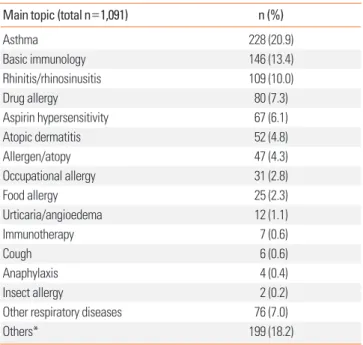
When classified by research topic, the most common topics were asthma, basic immunology, rhinitis/rhinosinusitis, and drug allergies (Table 2). Asthma was the leading topic for recent 5 years (Fig. 3). The 2 major research types regarding asthma were clinical (75/228) and basic research (66/228). However, the
number of rhinitis/rhinosinusitis publications has shown a marked increase since 2012; basic research was the most select- ed type on this topic (47/109), and clinical research was the sec- ond most selected type (42/109). Regarding drug allergies, case studies were the most frequent type (34/80), but other research types were also frequent (clinical research [17/80], genetic re- search [15/80], and epidemiological research [13/80]). Aspirin hypersensitivity, atopic dermatitis, allergen/atopy, and food al- lergies were also frequent topics (Table 2), and experienced quantitative increases during the 5 year period (data not shown).
The 5 most popular journals were ‘Allergy Asthma and Immu- nology Research,’ ‘Annals of Allergy Asthma and Immunology,’
‘Journal of Korean Medical Science,’ ‘American Journal of Rhi- nology and Allergy,’ and ‘Allergy’ (Table 3). ‘Allergy Asthma and Fig. 1. Publication number by year .
Publication (number)
2009 2010 2011 2012 2013
300
200
100
0
Annual increase 12.3%
Year 157
205 210
239
280
Table 1. Frequency of publication by research type (2009-2013)
Research type (total n=1,091) n (%)
Clinical research 361 (33.1)
Basic research 297 (27.2)
Genetic research 138 (12.6)
Epidemiological research 97 (8.9)
Review 62 (5.7)
Case study 136 (12.5)
Fig. 2. Annual trends of publication number by research type.
Publication (number)
2009 2010 2011 2012 2013
120
80
40
0
Year
Clinical Basic
Epidemiological Genetic
Table 2. Frequency of publication by topics (2009-2013)
Main topic (total n=1,091) n (%)
Asthma 228 (20.9)
Basic immunology 146 (13.4)
Rhinitis/rhinosinusitis 109 (10.0)
Drug allergy 80 (7.3)
Aspirin hypersensitivity 67 (6.1)
Atopic dermatitis 52 (4.8)
Allergen/atopy 47 (4.3)
Occupational allergy 31 (2.8)
Food allergy 25 (2.3)
Urticaria/angioedema 12 (1.1)
Immunotherapy 7 (0.6)
Cough 6 (0.6)
Anaphylaxis 4 (0.4)
Insect allergy 2 (0.2)
Other respiratory diseases 76 (7.0)
Others* 199 (18.2)
*Others indicate the papers with non-allergic topics such as general otolaryn- gology, dermatology, or surgical outcomes.
Fig. 3. Annual trends of publication number by research topic.
Publication (number)
2009 2010 2011 2012 2013
60
40
20
0
Year
Asthma
Rhinitis/rhinosinusitis Basic immunology Drug allergy
Immunology Research’ was the most commonly popular jour- nal across all the research types (15.8%).
Qualitative analyses
Qualitative aspects of the publications were examined with regard to IF and citation number. IFs were identified in 1,087 papers, as 2 journals were just recently indexed as SCI-E jour- nals and did not officially announce their IFs. Overall, annual IFs continued to increase from 1.918 (90% CI 0.632-6.380) in 2009 to 2.746 (90% CI 0.954-5.995) in 2013 (Table 4). An annual increase rate in IF was 7.4%.
Among the original articles, 114 (10.4%) were published in the 5 most influential journals in the specialty field of allergies (Ta- ble 5). However, in the field of respiratory medicine, 23 papers (2.1%) were published in the 5 most influential journals.
The total number of citations was 10,431. The median num-
ber of citations was 6 (90% CI 0-33), and the mean value was 10.
A distributional dot plot for the numbers of publications and corresponding citations is presented in Fig. 4. The highest num- Table 3. The 5 most popular journals in each research type (2009-2013)
n (%) (a) Total (n=1,091)
Allergy Asthma and Immunology Research 172 (15.8) Annals of Allergy Asthma and Immunology 55 (5.0) Journal of Korean Medical Science 44 (4.0) American Journal of Rhinology and Allergy 39 (3.6)
Allergy 34 (3.1)
(b) Clinical research (n=361)
Allergy Asthma and Immunology Research 41 (11.4) American Journal of Rhinology and Allergy 18 (5.0) Annals of Allergy Asthma and Immunology 17 (4.7) Journal of Korean Medical Science 17 (4.7)
Journal of Asthma 16 (4.4)
(c) Basic research (n=297)
Allergy Asthma and Immunology Research 24 (8.1) American Journal of Rhinology and Allergy 18 (6.1)
Allergy 13 (4.4)
Annals of Allergy Asthma and Immunology 13 (4.4) Journal of Dermatological Science 10 (3.4) (d) Epidemiological research (n=97)
Allergy Asthma and Immunology Research 19 (19.6) Journal of Korean Medical Science 12 (12.4) Annals of Allergy Asthma and Immunology 10 (10.3) International Archives of Allergy and Immunology 6 (6.7)
PLoS One 6 (6.7)
(e) Genetic research (n=138)
Allergy Asthma and Immunology Research 19 (13.8) Annals of Allergy Asthma and Immunology 9 (6.5)
Allergy 6 (4.4)
Journal of Human Genetics 6 (4.4)
Pharmacogenomics 5 (3.6)
Table 5. Original articles published in the 5 most influential journals (2009- 2013)
5-year
impact factor Publication number (a) Allergy
Journal of Allergy and Clinical Immunology 9.664 13
Allergy 5.953 27
Clinical and Experimental Allergy 4.337 18
Pediatric Allergy Immunol 3.017 7
Annals of Allergy Asthma and Immunology 2.981 49 (b) Respiratory medicine
American Journal of Respiratory and
Critical Care Medicine 11.284 6
Thorax 8.271 1
Chest 6.916 4
European Respiratory Journal 6.68 4
American Journal of Physiology-Lung
Cellular and Molecular Physiology 4.338 2 Table 4. Summary statistics of impact factor by publication year
Publication year Publication number Impact factor*
2009 156 1.918 (0.632-6.38)
2010 205 2.096 (0.832-6.519)
2011 210 2.149 (0.870-11.003)
2012 237 2.248 (0.948-5.883)
2013 279 2.746 (0.954-5.995)
Total 1,087 2.297 (0.835-6.36)
*Data are presented as median (90% confidence interval; 5th to 95th percen- tile).
Fig. 4. Distributional dot plot for the numbers of publication and citation (2009- 2013).
Number of citations
0 50 100 150 200 250
100 80 60 40 20 0
Number of publications
ber of citations was 95, in the review article titled ‘Impact of oxi- dative stress on lung diseases’ by Park et al.20 published in the
‘Respirology’ journal in 2009.
DISCUSSION
This is the first bibliometric analysis for research trends and performance of Korean allergists. In recent 5 years, research performance continuously increased both in quantitative and qualitative aspects.
Quantitatively, the annual increase in publication number was 12.3% between 2009 and 2013. Increasing trends were clearly observed in various research types, including clinical, basic, and epidemiological studies, which indicated a recent expansion of the research base for allergists in Korea.
A quantitative increase was observed under various topics. In particular, asthma remained the most frequently studied topic over the 5 year period. These findings may be related to the his- torical background for the society foundation in 1972 and indi- cate the inborn interest of the KAAACI for asthma.18 Another notable finding was the marked increase in upper airway dis- ease research performed very recently; this finding may indi- cate the traditional significance of upper and lower airway rela- tionships, named as the ‘united airway disease’ concept21 but also suggests increasing global interest in rhinosinusitis.22 Drug allergies have been another topic of particular interest for aller- gists, posing significant clinical and public health problems.23,24 The present analyses also found that multiple approaches are being made for drug allergy, including clinical, genetic, and ep- idemiological studies.
Progress was also consistently observed in the quality of re- search. The median IF of the publications increased from 1.918 in 2009 to 2.746 in 2013, showing an annual increase rate of 7.4%. It needs to be mentioned that the IF is just an index for evaluating journals but not individual articles or researchers.25 Also, our increasing trends in IF could have been due to the in- crease in IF of published journals. However, this continual in- crease in IF indicates that the research performance of the KAAACI members has matured in order to better compete in influential journals. Citation analyses showed that the papers were being cited frequently, with a median of 6 ditations and a mean of 10 citations. The upper 5% of the papers had a citation frequency exceeding 30 times.
In this progress, the roles of the ‘Allergy Asthma and Immu- nology Research’ journal may have been essential. Since its launch in 2009,26 it has been rapidly listed in the SCI-E 2011,27 and expanded to a bimonthly publication from a quarterly one in January 2012.28 Moreover, IF continuously increased from 1.91 in 2011 to 3.084 in 2013.29 The present analyses identified the journal as the most cited one (15.8%). Thus, one may ques- tion if the recent progress shown in this analysis was largely de- pendent on the specific journal. However, here we found that
the annual increase rate in publication number and median IF were 7.9% and 2.3% respectively, even excluding the journal (specific data not shown), suggesting that the recent progress was not solely dependent on this.
Despite the recent progress, several shortcomings were iden- tified. First, RCT and systematic review/meta-analysis were not frequent (4.7% and 1.6%, respectively), which are traditionally regarded as a high index of publication quality30 and could po- tentially contribute to evidence-based medicine. Second, the proportion of papers published in the most influential journals was still low. Further efforts need to be made to promote op- portunities of education and scientific discussion.
The present analyses have several limitations. First, we only analyzed the papers published in SCE or SCI-E journals, and thus could not fully assess the entire research performance of the KAAACI members. Depending on the study purpose, high quality studies may be published in domestic journals. More- over, papers published in the journals with a high IF do not al- ways have a higher impact on clinical practice or further re- search. Second, we utilized a single database source (Google Scholar) to identify the citation index of individual papers.
Google Scholar usually retrieves more citations in cases of re- cent articles than the Web of Science does,31 because it is not re- stricted to journal articles but widely embraces other types of publications like technical reports, theses, dissertations, or con- ference proceedings. Conversely, the search strategy of Google Scholar might overestimate citation indices over that of Web of Science or Scopus. Indeed, these 3 sources usually have com- plementary roles for each other in citation analyses.32 However, citation analysis was not the primary intention of our study, and thus was performed rather in a simplified way. In addition, our citation analyses may have limited values because the cita- tion indices for recent papers are underestimated.
In conclusion, the present analyses identified the progress in the research performance of the KAAACI members during the recent 5 year period, both quantitatively and qualitatively. We hope that the present findings will be a motivation to look back and forward to research directions. We also expect more signifi- cant contributions of Korean allergists to clinical practice and basic research in the forthcoming era.
ACKNOWLEDGMENTS
This work was supported by the Korean Academy of Asthma, Allergy and Clinical Immunology (KAAACI).
REFERENCES
1. Strachan DP. Hay fever, hygiene, and household size. BMJ 1989;
299:1259-60.
2. Haahtela T, Holgate S, Pawankar R, Akdis CA, Benjaponpitak S, Caraballo L, et al. The biodiversity hypothesis and allergic disease:
world allergy organization position statement. World Allergy Or-
gan J 2013;6:3.
3. Kim YM, Kim YS, Jeon SG, Kim YK. Immunopathogenesis of aller- gic asthma: more than the th2 hypothesis. Allergy Asthma Immu- nol Res 2013;5:189-96.
4. Park SM, Park JS, Park HS, Park CS. Unraveling the genetic basis of aspirin hypersensitivity in asthma beyond arachidonate pathways.
Allergy Asthma Immunol Res 2013;5:258-76.
5. Holgate ST. Mechanisms of asthma and implications for its preven- tion and treatment: a personal journey. Allergy Asthma Immunol Res 2013;5:343-7.
6. Kim BJ, Lee SY, Kim HB, Lee E, Hong SJ. Environmental changes, microbiota, and allergic diseases. Allergy Asthma Immunol Res 2014;6:389-400.
7. Khoriaty E, Umetsu DT. Oral immunotherapy for food allergy: to- wards a new horizon. Allergy Asthma Immunol Res 2013;5:3-15.
8. Ahn K. The usefulness of component-resolved diagnostics in food allergy. Allergy Asthma Immunol Res 2014;6:103-4.
9. Olin JT, Wechsler ME. Asthma: pathogenesis and novel drugs for treatment. BMJ 2014;349:g5517.
10. Hsu Blatman KS, Castells MC. Desensitizations for chemotherapy and monoclonal antibodies: indications and outcomes. Curr Aller- gy Asthma Rep 2014;14:453.
11. Wong GW, Leung TF, Ko FW. Changing prevalence of allergic dis- eases in the Asia-pacific region. Allergy Asthma Immunol Res 2013;5:251-7.
12. Yáñez A, Cho SH, Soriano JB, Rosenwasser LJ, Rodrigo GJ, Rabe KF, et al. Asthma in the elderly: what we know and what we have yet to know. World Allergy Organ J 2014;7:8.
13. Song WJ, Kang MG, Chang YS, Cho SH. Epidemiology of adult asthma in Asia: toward a better understanding. Asia Pac Allergy 2014;4:75-85.
14. Leung DY, Guttman-Yassky E. Deciphering the complexities of atopic dermatitis: shifting paradigms in treatment approaches. J Allergy Clin Immunol 2014;134:769-79.
15. Wenzel SE. Asthma phenotypes: the evolution from clinical to mo- lecular approaches. Nat Med 2012;18:716-25.
16. Akdis CA, Bachert C, Cingi C, Dykewicz MS, Hellings PW, Naclerio RM, et al. Endotypes and phenotypes of chronic rhinosinusitis: a PRACTALL document of the European Academy of Allergy and Clinical Immunology and the American Academy of Allergy, Asth- ma & Immunology. J Allergy Clin Immunol 2013;131:1479-90.
17. Kim YY, Holgate ST, Church MK. Inhibition of histamine release
from dispersed human lung and tonsillar mast cells by nicardipine and nifedipine. Br J Clin Pharmacol 1985;19:631-8.
18. Kim YY. Past, present, and future of allergy in Korea. Allergy Asth- ma Immunol Res 2010;2:155-64.
19. Röhrig B, du Prel JB, Wachtlin D, Blettner M. Types of study in medical research: part 3 of a series on evaluation of scientific pub- lications. Dtsch Arztebl Int 2009;106:262-8.
20. Park HS, Kim SR, Lee YC. Impact of oxidative stress on lung diseas- es. Respirology 2009;14:27-38.
21. Ciprandi G, Caimmi D, Miraglia Del Giudice M, La Rosa M, Salpi- etro C, Marseglia GL. Recent developments in united airways dis- ease. Allergy Asthma Immunol Res 2012;4:171-7.
22. Bachert C, Pawankar R, Zhang L, Bunnag C, Fokkens WJ, Hamilos DL, et al. ICON: chronic rhinosinusitis. World Allergy Organ J 2014;
7:25.
23. Demoly P, Adkinson NF, Brockow K, Castells M, Chiriac AM, Greenberger PA, et al. International Consensus on drug allergy. Al- lergy 2014;69:420-37.
24. Kim MH, Lee JM. Diagnosis and management of immediate hy- persensitivity reactions to cephalosporins. Allergy Asthma Immu- nol Res 2014;6:485-95.
25. Hong ST. Over the journal impact factor. J Korean Med Sci 2013;28:
969.
26. Park CS. AAIR, a leading open access journal in allergy, asthma and immunology research. Allergy Asthma Immunol Res 2009;1:1-2.
27. Park CS. Congratulations are due to Allergy, Asthma, & Immunolo- gy Research (AAIR) on being listed in Web of Science (SCIE). Aller- gy Asthma Immunol Res 2011;3:145.
28. Park CS. Congratulations to all are in order, as Allergy, Asthma &
Immunology Research (AAIR) is going to change to a bimonthly publication from a quarterly one. Allergy Asthma Immunol Res 2012;4:1.
29. Park HS. Embarking on a new journey with the Allergy, Asthma &
Immunology Research. Allergy Asthma Immunol Res 2014;6:1-2.
30. Harbour R, Miller J. A new system for grading recommendations in evidence based guidelines. BMJ 2001;323:334-6.
31. Noruzi A. Google Scholar: the new generation of citation indexes.
Libri 2005;55:170-80.
32. Bakkalbasi N, Bauer K, Glover J, Wang L. Three options for citation tracking: Google Scholar, Scopus and Web of Science. Biomed Dig- it Libr 2006;3:7.