49(3) : 270∼ 277 (2018)
270
LC-ESI-MS/MS를 이용한 평위산 주요 성분의 함량 분석
서창섭·신현규*
한국한의학연구원 한약연구부
Quantitative Determination of the Marker Components in Pyungwi-San Using LC-ESI-MS/MS
Chang-Seob Seo and Hyeun-Kyoo, Shin*
Herbal Medicine Research Division, Korea Institute of Oriental Medicine, 1672 Yuseong-daero, Yuseong-gu, Daejeon, 34054, Korea
Abstract − Pyungwi-san has been used to treat the digestive system diseases, physconia, nausea, anorexia, and dyspepsia in Korea. In this study, an ultra–performance liquid chromatography–electrospray ionization-mass spectrometry (UPLC-ESI-MS/
MS) method was optimized for simultaneous determination of the 14 marker components, spinosin, liquiritirn apioside, liquir- itin, narirutin, 6ʹʹʹ-feruloylspinosin, hesperidin, liquiritigenin, glycyrrhizin, 6-gingerol, atractylenolide III, honokiol, atracty- lenolide II, magnolol, and atractylenolide I in Pyungwi-san extract. All analytes were separated on a Waters Acquity UPLC BEH C18 analytical column (2.1×100 mm, 1.7 μm) with maintained at 45oC. The mobile phase consisted of 0.1% (v/v) aqueous formic acid and acetonitrile. The MS conditions were as follows: capillary voltage 3.3 kV, extractor voltage 3.0 V, RF lens volt- age 0.3 V, source temperature 120oC, desolvation temperature 300oC, desolvation gas 600 L/h, cone gas 50 L/h and collision gas 0.14 mL/min. The coefficient of determination of 14 analytes was 0.9989–1.0000. The limits of detection and quantification values of the all analytes were 0.04–2.56 and 0.13–7.69 ng/mL, respectively. As a result of the analysis using the established LC-ESI-MS/MS method, the 5 components, spinosin, 6'''-feruloylspinosin, atractylenolide III, II, and I derived from Zizyphi Fructus and Atractylodis Rhizoma, were not detected in this extract. On the other hand, the 9 components except for the 5 com- ponents were 4.15–498.87 mg/kg in lyophilized Pyungwi-san extract. Among these components, glycyrrhizin, marker com- pound of Glycyrrhizae Radix et Rhizoma, was detected the most amount as a 498.87 mg/kg.
Keywords − Pyungwi-san, Quantitative determination, LC-ESI-MS/MS
평위산(平胃散)은 宋代 陳師文의 『太平惠民和制局方』1)
에 최초로 수록된 처방으로 창출(蒼朮), 진피(陳皮), 후박(厚 朴), 생강(生薑), 대조(大棗) 및 감초(甘草) 등 6종의 생약으 로 구성되어 있다. 이후 우리나라에서도 許浚의 『東醫寶 鑑』2)에 비위(脾胃)의 불화(不和)로 인한 식욕부진(食慾不 振), 복통(腹痛), 오심(惡心), 복부팽만(腹部膨滿) 등 소화기 계 질환을 치료하는데 사용된다고 기록되어 있으며, 한의원 처방 사용 빈도 5위와 한방의료기관 급여 한약제제 투약일 수에서 6위를 차지할 만큼 사용 빈도가 높은 처방이다.3) 본 처방의 현대과학적 생리활성 연구로는 galactosamine으로 유도된 간독성에 대한 보호 효과,4) 카할간질세포의 활성을
통한 위장관 운동 개선 효과,5) 평위산 전탕액과 파우치의 보관 방법 및 온도에 따른 항염증 효과6,7)및 평위산 약침액 을 이용한 항산화 효과8) 등이 보고되었다. 또한 평위산의 안 전성 평가를 위한 급성 및 유전 독성 연구가 보고되었다.1,9,10) 평위산을 구성하는 구성 생약의 성분에 관한 연구는 창출 로부터 sesquiterpenoid(atractylenolide I, II 및 III),11) 진피로 부터 flavonoid(hesperidin),12) 후박으로부터 lignans(honokiol과 magnolol),13)생강으로부터 phenols(6-, 8- 및 10-gingerol),14) 대조로부터 flavonoids(spinosin과 6ʹʹʹ-feruloylspinosin)15) 및 감초로부터 triterpene saponin(glycyrrhizin)과 flavonoids (liquiritin 및 liquiritin apioside)16) 등이 분리 보고되었다. 이 에 저자들은 소화기계 질환에 주로 처방되어 사용되고 있 는 평위산의 품질관리를 위해 각 구성 생약들의 지표물질 을 선정하고 선정된 지표물질들에 대한 함량을 비교 분석
*교신저자(E-mail):[email protected] (Tel): +82-42-868-9464
Vol. 49, No. 3, 2018 271 하고자 하였다. 지표물질의 선정은 창출의 atractylenolide I,
II 및 III, 진피의 narirutin과 hesperidin, 후박의 honokiol과 magnolol, 생강의 6-gingerol, 대조의 spinosin과 6ʹʹʹ-feruloy- lspinosin 및 감초의 liquiritirn apioside, liquiritin, liquiriti- genin, glycyrrhizin의 14종에 대하여 질량분석기가 결합된 초고성능 액체크로마토그래피(ultra–performance liquid chromatography–mass spectrometer, UPLC–MS)를 이용하여 평위산에 함유되어 있는 이들 성분의 함량을 분석하였다.
재료 및 방법
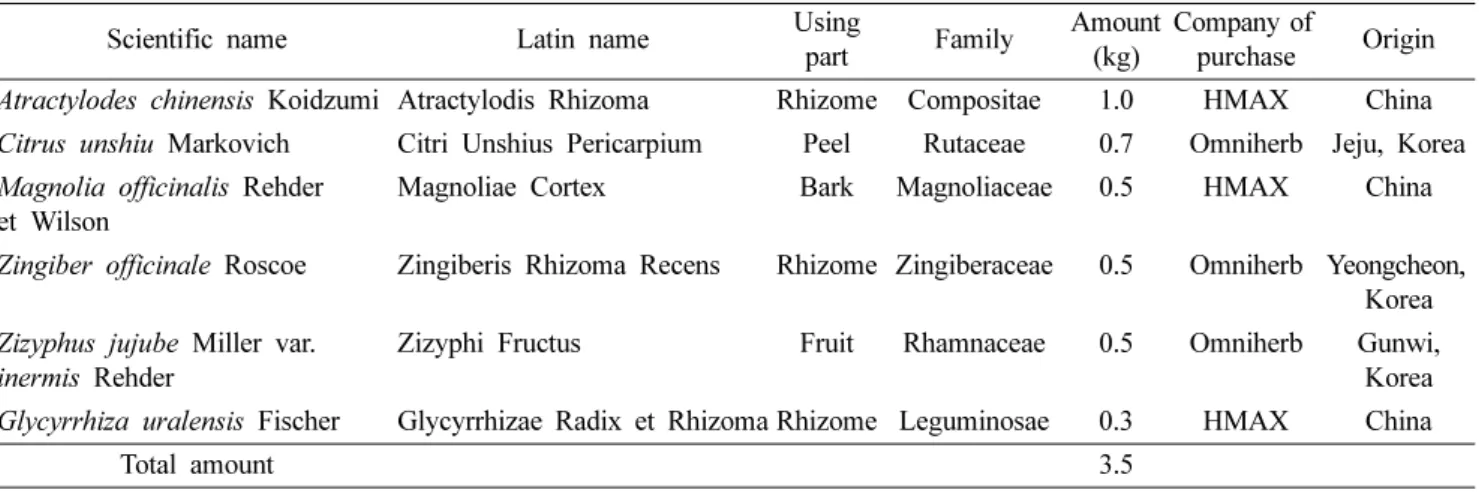
실험재료 − Table I과 같이 창출을 비롯한 6종의 평위산 구 성 생약은 HMAX(Jecheon, Korea)와 Omniheb(Yeongcheon, Korea)로부터 구입하여 대전대학교 한의과대학 본초학교실 서영배 교수(Daejeon, Korea)로부터 한약재 관능검사 해설
서17,18)에 따라 감정 후 사용하였다. 본 처방을 구성하는 각
각의 생약(2008–KE18–1~2008–KE18–6)과 평위산 물 추출 물(KE18)은 한국한의학연구원 한약연구부에 보관하였다.
시약 − 평위산에 함유된 주요 성분의 함량 분석을 위해 사 용된 14종의 표준품 중 spinosin(PubChem CID: 155692, purity 98.8%), 6'''-feruloylspinosin(PubChem CID: 21597353, purity 99.7%), narirutin(PubChem CID: 442431, purity 99.5%) 및 hesperidin(PubChem CID: 10621, purity 98.6%) 은 Biopurify Phytochemicals(Chengdu, China), liquiritin (PubChem CID: 503737, purity 99.6%), glycyrrhizin (Pub- Chem CID: 14982, purity 99.0%) 및 6-gingerol(PubChem CID: 442793, purity 98.0%)은 Wako Chemicals(Osaka, Japan), liquiritigenin(PubChem CID: 114829, purity 98.0%), honokiol(PubChem CID: 72303, purity 98.0%) 및 magnolol (PubChem CID: 72300, purity 98.0%)은 ChemFaces (Wuhan, China), atractylenolide I(PubChem CID: 5321018, purity 99.0%), atractylenolide II(PubChem CID: 14448070,
purity 99.0%) 및 atractylenolide III(PubChem CID: 155948, purity 99.0%)는 KOC Biotech(Daejeon, Korea) 및 liquiritin apioside(PubChem CID: 10076238, purity 98.0%)는 Shanghai Sunny Biotech(Shanghai, China)로부터 각각 구입하였다(Fig.
1). 이들 표준품의 표준용액 제조를 위한 메탄올과 LC–MS 분석에 사용된 물과 아세토나이트릴은 모두 high–performance liquid chromatography(HPLC)용으로 J.T. Baker(Phillipsburg, NJ, USA), 개미산은 Merck KGaA(Darmstadt, Germany)로 부터 각각 구입하여 사용하였다.
평위산 물 추출물 조제 − Table I과 같이 창출, 진피, 후 박, 생강, 대조 및 감초 등 6 종의 생약으로 구성된 평위산 물 추출물은 총 약 3.5 kg의 약재에 물 35 L를 넣은 후 초 고속진공저온추출기(Cosmos 660, Kyungseo Machine Co., Incheon, Korea)를 이용하여 98 kPa 압력으로 100oC에서 2 시간 전탕하였다. 냉각 후 표준체(No. 270, 53 μm, Chung Gye Sang Gong Sa, Seoul, Korea)를 이용하여 여과하였으 며, 여과된 액은 819.5 g(23.4%)의 파우더 시료를 얻기 위 해 PVT100 동결건조기(IlShinBioBase, Yanju, Korea)를 이 용하여 동결 건조하였다. 동결 건조된 시료는 냉장 보관하 면서 실험에 사용하였다.
표준용액 및 분석용 검액 조제 − Spinosin을 포함한 14종 의 표준품에 대한 표준용액은 메탄올을 이용하여 1,000 μg/
mL의 농도로 조제한 후 냉장 보관하면서 분석 전에 희석하 여 사용하였다. 평위산의 주요 성분에 대한 분석용 검액은 조제된 물 추출물 약 21.7 mg에 70% 메탄올 5 mL을 넣은 후 5분간 초음파 추출 후 1 분간 잘 섞어 주었다. 추출된 용 액을 70% 메탄올을 이용하여 100배 희석하여 검액으로 하 였다. 조제된 검액은 LC-MS/MS에 주입하기 전에 0.22 μm 멤브레인 필터(Pall, Ann Arbor, MI, USA)하였다.
UPLC 및 LC-MS/MS 분석 조건 − 제조된 평위산 물 추 출물의 주요 성분에 대한 함량 분석은 Waters의 ACQUITY UPLC system(Milford, MA, USA)을 사용하였다. 평위산의
Table I. Composition of Pyungwi-san
Scientific name Latin name Using
part Family Amount (kg)
Company of
purchase Origin Atractylodes chinensis Koidzumi Atractylodis Rhizoma Rhizome Compositae 1.0 HMAX China Citrus unshiu Markovich Citri Unshius Pericarpium Peel Rutaceae 0.7 Omniherb Jeju, Korea Magnolia officinalis Rehder
et Wilson
Magnoliae Cortex Bark Magnoliaceae 0.5 HMAX China Zingiber officinale Roscoe Zingiberis Rhizoma Recens Rhizome Zingiberaceae 0.5 Omniherb Yeongcheon,
Korea Zizyphus jujube Miller var.
inermis Rehder
Zizyphi Fructus Fruit Rhamnaceae 0.5 Omniherb Gunwi, Korea Glycyrrhiza uralensis Fischer Glycyrrhizae Radix et Rhizoma Rhizome Leguminosae 0.3 HMAX China
Total amount 3.5
Fig. 1. Chemical structures of biomarker compounds of Pyungwi-san.
Vol. 49, No. 3, 2018 273 주요 성분은 45oC로 유지되는 ACQUITY UPLC BEH C18
(2.1×100 mm, 1.7 μm) 칼럼과 0.1%(v/v) 개미산이 함유된 물(용매 A)과 아세토나이트릴(용매 B)로 구성된 이동상을 이용하여 다음과 같은 조건으로 분리하였다: 20–95% B(0–
14분), 95–100% B(14–15분) 및 100–20% B(15–15.1분). 그 후 3분동안 기기를 안정화시켰다. 함량 분석을 위한 평위산 시료는 5oC로 유지되었으며, 유속은 분당 0.3 mL, 주입량은 2.0 μL였다. 질량분석기는 전자분무이온화(electrospray ionization; ESI) 소스가 장착된 탠덤 사중극자 질량분석기 (ACQUITY TQD LC-MS/MS, Waters, Milford, MA, USA) 를 사용하여 다중반응탐색법(multiple reaction monitoring, MRM)으로 다음과 같은 조건으로 분석하였다: capillary voltage 3.3 kV, extract voltage 3.0 V, source temperature 120oC, RF lens 0.3 V, desolvation temperature 300oC, desolvation gas 600 L/h, cone gas 50 L/h 및 collision gas 0.14 mL/min. 모든 크로마토그래피 및 질량분석 데이터는 Waters MassLynx software(version 4.1, Milford, MA, USA)에 의해 수집되고 처리되었다.
결과 및 고찰
LC-MS/MS 분석 조건 확립 − 평위산을 구성하는 6종의 구성 생약 중 창출의 atractylenolide I, II 및 III, 진피의 narirutin과 hesperidin, 후박의 honokiol과 magnolol, 생강의 6-gingerol, 대조의 spinosin과 6ʹʹʹ-feruloylspinosin 및 감초의 liquiritirn apioside, liquiritin, liquiritigenin, glycyrrhizin의 14종에 대하여 LC-MS/MS MRM 분석법을 이용하여 동시
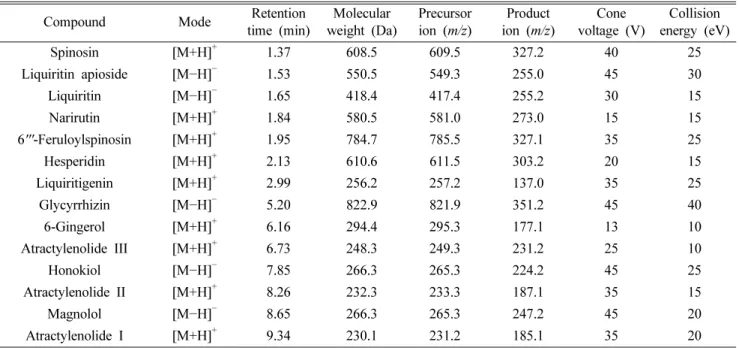
정량을 실시하였다. UPLC BEH C18(2.1×100 mm, 1.7 μm) 분석용 칼럼을 사용하여 14종 성분의 분리를 실시하였으며, 이동상으로는 물과 유기용매(메탄올 또는 아세토나이트릴) 에 산의 첨가 여부를 확인하여 최적의 분석 조건을 탐색하 였다. 분석대상 물질의 분리, 피크 모양 및 꼬리 끌림 현상 등을 종합하여 분석 조건을 선정한 결과 0.1%(v/v) 개미산 이 함유된 물과 아세토나이트릴 두 용매를 이용하여 기울 기 용매조건으로 정성 및 정량 분석을 실시하였다. 최적의 칼럼 오븐 온도는 45oC로 설정하였으며, 유속은 분당 0.3 mL 로 흘려주었다. ESI 소스의 양이온 모드와 음이온 모드에서 MRM 방법으로 Table II와 같은 조건으로 분석한 결과 14 종의 성분 모두 10분 이내로 분리되었다(Fig. 2).
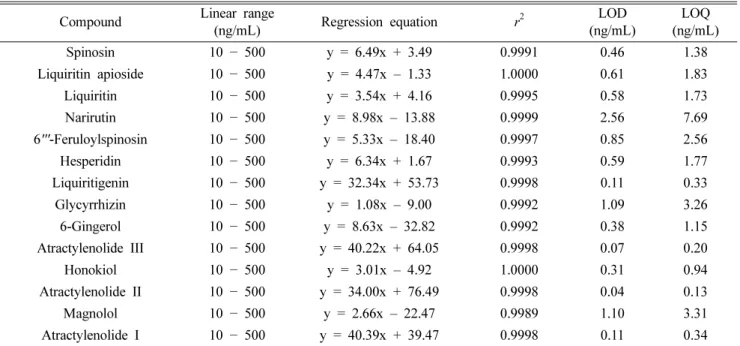
검량선, 직선성, 검출한계 및 정량한계 작성 − Spinosin을 비롯한 14종의 분석 성분에 대한 검량선은 10 − 500 ng/mL 의 농도 범위에서 각각의 농도에 대한 피크 면적을 이용하 여 작성하였으며, 결정계수(coefficient of determination, r2) 로 직선성을 판단하였다. 또한 각 성분의 검출한계(limit of detection, LOD)와 정량한계(limit of quantification, LOQ)는 신호 대 잡음 비(S/N)를 이용하여 3과 10으로 계산하였다.
그 결과 검량선의 직선성을 나타내는 결정계수 값이 0.99이 상으로 우수한 직선성을 보였으며, 0.04–2.56 ng/mL의 검 출한계 값과 0.13–7.69 ng/mL의 정량한계 값을 나타내었다 (Table III).
평위산 물 추출물 중 14종 성분의 동정 − LC-MS/MS를 이용하여 창출, 진피, 후박, 생강, 대조 및 감초로 구성된 평 위산에서 spinosin 등 14종의 주요 성분에 대한 분석을 위해 0.1%(v/v) 개미산이 포함된 물–아세토나이트릴 시스템의 이
Table II. Chromatographic retention time, MRM parameters, cone voltage, and collision energy for 14 marker compounds
Compound Mode Retention
time (min)
Molecular weight (Da)
Precursor ion (m/z)
Product ion (m/z)
Cone voltage (V)
Collision energy (eV)
Spinosin [M+H]+ 1.37 608.5 609.5 327.2 40 25
Liquiritin apioside [M−H]− 1.53 550.5 549.3 255.0 45 30
Liquiritin [M−H]− 1.65 418.4 417.4 255.2 30 15
Narirutin [M+H]+ 1.84 580.5 581.0 273.0 15 15
6'''-Feruloylspinosin [M+H]+ 1.95 784.7 785.5 327.1 35 25
Hesperidin [M+H]+ 2.13 610.6 611.5 303.2 20 15
Liquiritigenin [M+H]+ 2.99 256.2 257.2 137.0 35 25
Glycyrrhizin [M−H]− 5.20 822.9 821.9 351.2 45 40
6-Gingerol [M+H]+ 6.16 294.4 295.3 177.1 13 10
Atractylenolide III [M+H]+ 6.73 248.3 249.3 231.2 25 10
Honokiol [M−H]− 7.85 266.3 265.3 224.2 45 25
Atractylenolide II [M+H]+ 8.26 232.3 233.3 187.1 35 15
Magnolol [M−H]− 8.65 266.3 265.3 247.2 45 20
Atractylenolide I [M+H]+ 9.34 230.1 231.2 185.1 35 20
동상을 이용하여 각 성분에 대한 분자 이온을 동정하였다.
그 결과 spinosin, narirutin, 6'''-feruloylspinosin, hesperidin, liquiritigenin, 6-gingerol, atractylenolide III, atractylenolide II 및 atractylenolide I 등 9종의 성분은 각각 m/z 609.5,
581.0, 785.5, 611.5, 257.2, 295.3, 249.3, 233.3 및 231.2에 서 [M+H]+ 형태로 분자 이온 피크가 검출되었으며, liquiritin apioside, liquiritin, glycyrrhizin, honokiol 및 magnolol의 5 종은 m/z 549.3, 417.4, 821.9, 265.3 및 265.3에서 [M−H]− Fig. 2. Total ion chromatograms of the 14 reference standard mixtures (A) and lyophilized Pyungwi-san decoction sample (B) by LC-ESI-MS/MS MRM mode. Spinosin (1), liquiritin apioside (2), liquiritin (3), narirutin (4), 6'''-feruloylspinosin (5), hesperidin (6), liquiritigenin (7), glycyrrhizin (8), 6-gingerol (9), atractylenolide III (10), honokiol (11), atractylenolide II (12), magnolol (13), and atractylenolide I (14).
Vol. 49, No. 3, 2018 275 형태로 분자 이온 피크가 각각 검출되었다(Table II).
평위산 물 추출물 중 14종 성분의 함량 분석 − LC-MS/
MS에서 양이온 또는 음이온 모드에서 동정 된 각각의 지표 성분들에 대하여 Table II와 같이 cone voltage, collision energy, precursor ion(Q1) 및 product ion(Q3) 등과 같은 LC-MS/MS MRM 모드 조건을 설정하였다. 각 성분별 Q1 및 Q3에 대한 MRM 분석 조건은 다음과 같다. Spinosin는 m/z 609.5의 Q1 피크에서 glucose 1분자와 C4H6O4가 이탈
된 [M+H−Glu−C4H6O4]+의 형태인 m/z 327.2를 Q3로 설정 하였으며,19) liquiritin apioside는 m/z 549.3의 Q1 피크에서 apiosyl 그룹과 glucosyl 그룹이 이탈된 [M−H−apiosyl- glucosyl]− 형태인 m/z 255.0을 Q3로 설정하였다.20) Liquiritin 과 glycyrrhizin은 m/z 417.4와 821.9에서 확인된 각각의 Q1 피크에서 glucose 1분자와 glucose 2분자가 각각 떨어진 [M−H−Glu]−와 [M−H−2Glu]−의 형태인 m/z 255.2와 351.2 를 각각의 Q3로 설정하였으며,21) narirutin과 hesperidin은
Table III. Linearities, regression equation, correlation coefficients, LOD, and LOQ for 14 marker compounds Compound Linear range
(ng/mL) Regression equation r2 LOD
(ng/mL)
LOQ (ng/mL)
Spinosin 10 − 500 y = 6.49x + 3.49 0.9991 0.46 1.38
Liquiritin apioside 10 − 500 y = 4.47x – 1.33 1.0000 0.61 1.83
Liquiritin 10 − 500 y = 3.54x + 4.16 0.9995 0.58 1.73
Narirutin 10 − 500 y = 8.98x – 13.88 0.9999 2.56 7.69
6'''-Feruloylspinosin 10 − 500 y = 5.33x – 18.40 0.9997 0.85 2.56
Hesperidin 10 − 500 y = 6.34x + 1.67 0.9993 0.59 1.77
Liquiritigenin 10 − 500 y = 32.34x + 53.73 0.9998 0.11 0.33
Glycyrrhizin 10 − 500 y = 1.08x – 9.00 0.9992 1.09 3.26
6-Gingerol 10 − 500 y = 8.63x – 32.82 0.9992 0.38 1.15
Atractylenolide III 10 − 500 y = 40.22x + 64.05 0.9998 0.07 0.20
Honokiol 10 − 500 y = 3.01x – 4.92 1.0000 0.31 0.94
Atractylenolide II 10 − 500 y = 34.00x + 76.49 0.9998 0.04 0.13
Magnolol 10 − 500 y = 2.66x – 22.47 0.9989 1.10 3.31
Atractylenolide I 10 − 500 y = 40.39x + 39.47 0.9998 0.11 0.34 Table IV. Amount of marker compounds in Pyungwi-san (n = 3)
Compound Amount (mg/kg)
Source
Mean SD RSD (%)
Spinosin ND1 − − Z. jujube
Liquiritin apioside 374.13 4.90 1.31 G. uralensis
Liquiritin 170.57 7.56 4.43 G. uralensis
Narirutin 245.40 11.27 4.59 C. unshiu
6'''-Feruloylspinosin ND - - Z. jujube
Hesperidin 365.63 15.60 4.27 C. unshiu
Liquiritigenin 6.27 0.55 8.79 G. uralensis
Glycyrrhizin 498.87 27.65 5.54 G. uralensis
6-Gingerol 4.15 0.78 18.74 Z. officinale
Atractylennolide III ND - - A. chinensis
Honokiol 5.70 0.57 9.92 M. officinalis
Atractylennolide II ND - - A. chinensis
Magnolol 14.00 1.65 11.76 M. officinalis
Atractylennolide I ND - - A. chinensis
1ND: not detected.
m/z 581.0과 611.5의 Q1 피크에서 두 성분 모두 rutinoside (rhamnosylglucose) 그룹이 이탈된 aglycone으로 [M+H−
rutinoside]+ 형태인 m/z 273.0과 303.2를 각각 Q3로 설정하 였다.22,23) 6'''-Feruloylspinosin은 m/z 785.5의 Q1 피크에서 spinosin의 MS fragmentation에서 하나의 feruloyl group이 더 이탈된 [M+H−feruloyl−Glu−C4H6O4]+의 형태인 m/z 327.1을 Q3로 설정하였으며,19) liquiritigenin, 6-gingerol 및 honokiol은 m/z 257.2, 295.3 및 265.3에서 확인된 각각의 Q1 피크에서 C8H8O8, C6H12O2 및 C3H5 분자가 각각 이탈 된 [M+H−C8H8O8]+, [M+H−C6H12O2]+ 및 [M−H−C3H5]−의 형태인 m/z 137.0, 177.1 및 224.2를 Q3로 설정하였다.21,24) Atractylenolide III와 magnolol은 m/z 249.3와 265.3의 Q1 피크에서 두 성분 모두 1개의 물 분자가 떨어진 [M+H−H2O]+ 와 [M−H−H2O]− 형태로 m/z 231.2와 247.2를 Q3로 설정하 였으며,24,25) atractylenolide II와 atractylenolide I은 m/z 233.3과 231.2의 Q1 피크에서 두 성분 모두 물 분자 1개와 CO가 이탈된 [M+H−H2O−CO]+의 형태인 m/z 187.1과 185.1을 각각의 Q3로 설정하였다.25)이와 같이 평위산의 지 표 성분으로 선정한 14종의 성분에 대하여 Q1 및 Q3를 설 정한 후 LC-MS/MS MRM으로 분석하였다. 분석 결과 spinosin, liquiritirn apioside, liquiritin, narirutin, 6ʹʹʹ- feruloylspinosin, hesperidin, liquiritigenin, glycyrrhizin, 6- gingerol, atractylenolide III, honokiol, atractylenolide II, magnolol 및 atractylenolide I의 머무름시간이 14종의 성분 은 1.37, 1.53, 1.65, 1.84, 1.95, 2.13, 2.99, 5.20, 6.16, 6.73, 7.85, 8.26, 8.65 및 9.34분으로 10분 이내에 모든 성 분이 분리되었다(Table II 및 Fig. 2). 설정된 LC-MS/MS MRM 분석법을 적용하여 평위산 물 추출물을 분석한 결과 창출로부터 유래된 atractylenolide I, atractylenolide II 및 atractylenolide III와 대조로부터 유래된 spinosin과 6ʹʹʹ- feruloylspinosin 등 5종은 검출이 되지 않았으며, 이를 제외 한 9종의 함량이 4.15–498.87 mg/kg으로 나타났다(Table IV).
결 론
평위산은 창출, 진피, 후박, 생강, 대조 및 감초로 구성되 어 복통, 구토 및 설사 등의 소화기 계통의 질병의 치료에 처방되어지는 한약 처방으로, 품질관리의 기초 자료로 활용 하고자 주요 성분인 spinosin, liquiritin apioside, liquiritin, narirutin, 6'''-feruloylspinosin, hesperidin, liquiritigenin, glycyrrhizin, 6-gingerol, atractylenolide III, honokiol, atractylenolide II, magnolol 및 atractylenolide I 14종에 대 하여 LC-MS/MS MRM 방법으로 함량 분석을 실시하였다.
그 결과 본 한약 처방의 구성 생약인 감초의 주요 성분인 glycyrrhizin이 498.87 mg/kg으로 가장 많이 검출되었다. 이
외에도 hesperidin(진피), liquiritin apioside 및 liquiritin(이상 감초)이 365.63, 374.13 및 170.57 mg/kg으로 검출되었다.
이러한 분석 결과는 평위산을 비롯한 관련 한약 처방의 성 분 분석을 위한 기초 자료로 활용될 수 있을 것으로 사료된다.
사 사
본 연구는 한국한의학연구원에서 지원하는 ‘한약 처방의 과학적 근거 기반 구축사업(K17251)’와 ‘한약처방 안전성·
유효성 연구(K18241)’에 의해 수행되었으며 이에 감사 드 린다.
인용문헌
1. Shin, I. S., Kim, J. H., Ha, H. K., Huang, D. S., Huh, J. I. and Shin, H. K. (2010) Study on safety of Pyungwi-san in Sprague-Dawley rats. Korean J. Oriental Physiol. Pathol. 24:
426-429.
2. Heo, J. (2004) Donguibogam, 150. Namsandang, Seoul.
3. Seo, C. S., Kim, J. H., Lim, S. H. and Shin, H. K. (2011) Esti- mation of shelf-life by long-term storage test of Pyungwi-san.
Korean J. Orient. Med. Prescr. 19: 183-194.
4. Jin, S. E., Jeong, S. J., Shin, H. K. and Ha, H. (2013) Hepa- toprotective effect of 25 herbal formulas in primary rat hepatocytes. Korean J. Oriental Physiol. Pathol. 27: 617-624.
5. Lee, M. C., Park, J. R., Shim, J. H., Ahn, T. S. and Kim, B.
J. (2015) Effect of traditional Chinese herbal medicine Shengmai-san and Pyungwi-san on gastrointestinal motility in mice. J. Korean Med. Obes. Res. 15: 68-74.
6. Seo, C. S., Lee, J. A., Jung, D., Lee, H. Y., Lee, J. K., Ha, H., Lee, M. Y. and Shin, H. K. (2011) Simultaneous determi- nation of liquiritin, hesperidin, and glycyrrhizin by HPLC- photodiode array detection and the anti-inflammatory effect of Pyungwi-san. Arch. Pharm. Res. 34: 203-210.
7. Ha, H., Shin, I. S., Lim, H. S., Jeon, W. Y., Kim, J. H., Seo, C. S. and Shin, H. K. (2012) Change in anti-inflammatory effect of Pyungwi-san decoction according to the preserva- tion temperature and period. Herb. Formula Sci. 20: 29-35.
8. Lee, H. S. and Moon, J. Y. (2007) Scavenging property of Pyungwi-san herbal acupuncture solution on ROS and RNS.
Korean J. Orient. Physiol. Pathol. 21: 165-170.
9. Jang, D. R., Hwang, Y. H., Jung, K. Y., Ha, J. H., Park, H. Y.
and Ma, J. Y. (2013) A study on acute oral toxicity of Pyungwi-san and fermented Pyungwi-san in ICR mice. J.
Orient. Obstet. Gynecol. 26: 59-68.
10. Shin, I. S., Seo, C. S., Ha, H. K., Lee, M. Y., Huang, D. S., Huh, J. I. and Shin, H. K. (2011) Genotoxicity assessment of Pyungwi-san (PWS), a traditional herbal prescription. J. Eth- nopharmacol. 133: 696-703.
11. Tsai, C. J., Liang, J. W. and Lin, H. R. (2012) Sesquiter-
Vol. 49, No. 3, 2018 277 penoids from Atractylodes macrocephala act as farnesoid X
receptor and progesterone receptor modulators. Bioorg. Med.
Chem. Lett. 22: 2326-2329.
12. Liu, E. H., Zhao, P., Duan, L., Zheng, G. D., Guo, L., Yang, H. and Li, P. (2013) Simultaneous determination of six bio- active flavonoids in Citri Reticulatae Pericarpium by rapid resolution liquid chromatography coupled with triple quad- rupole electrospray tandem mass spectrometry. Food Chem.
141: 3977-3983.
13. Jiang, Y., Vaysse, J., Gilard, V., Balayssac, S., Déjean, S., Malet-Martino, M., David, B., Fiorini, C. and Barbin, Y.
(2012) Quality assessment of commercial Magnoliae offi- cinalis cortex by 1H-NMR-based metabolomics and HPLC methods. Phytochem. Anal. 23: 387-395.
14. Zick, S. M., Ruffin, M. T., Djuric, Z., Normolle, D. and Bren- ner, D. E. (2010) Quantitation of 6-, 8- and 10-gingerols and 6-shogaol in human plasma by high-performance liquid chro- matography with electrochemical detection. Int. J. Biomed.
Sci. 6: 233-240.
15. Niu, C. and Zhang, J. (2011) Quantitative analysis and chro- matographic fingerprinting of the Semen Zizyphi Spinosae by ultra-high-performance liquid chromatography coupled with diode-array detector. J. Sep. Sci. 34: 2989-2996.
16. Zhang, Q. and Ye, M. (2009) Chemical analysis of the Chi- nese herbal medicine Gan-Cao (licorice). J. Chromatogr. A.
1216: 1954-1969.
17. Moon, C. J. (2006) The guideline on the visual and organ- oleptic examination of herbal medicine I, 17, 64, 90. Ministry of Food and Drug Safety, Seoul.
18. Yoon, Y. P. (2008) The guideline on the visual and organ- oleptic examination of herbal medicine II, 29, 100, 125. Min- istry of Food and Drug Safety, Seoul.
19. Ren, Y., Wang, P., Wu, C., Zhang, J. and Niu, C. (2013) Iden-
tification of the metabolites after oral administration of extract of Ziziphi Spinosae Semen to rats or dogs by high- performance liquid chromatography/linear ion trap FTICR hybrid mass spectrometry. Biomed. Chromatogr. 27: 17-26.
20. Li, L., Liang, S., Du, F. and Li, C. (2007) Simultaneous quan- tification of multiple licorice flavonoids in rat plasma. J. Am.
Soc. Mass Spectrom. 18: 778-782.
21. Tan, G., Zhu, Z., Jing, J., Lv, L., Lou, Z., Zhang, G. and Chai, Y. (2011) Characterization of constituents in Sini decoction and rat plasma by high-performance liquid chromatography with diode array detection coupled to time-of-flight mass spectrometry. Biomed. Chromagogr. 25: 913-924.
22. Wang, C., Pan, Y., Fan, G., Chai, Y. and Wu, Y. (2010) Appli- cation of an efficient strategy based on MAE, HPLC-DAD- MS/MS and HSCCC for the rapid extraction, identification, separation and purification of flavonoids from Fructus Auran- tii Immaturus. Biomed. Chromagogr. 24: 235-244.
23. Zhou, D., Xu, Q., Xue, X., Zhang, F. and Liang, X. (2006) Identification of O-diglycosyl flavanones in Fructus Aurantii by liquid chromatography with electrospray ionization and collision-induced dissociation mass spectrometry. J. Pharm.
Biomed. Anal. 42: 441-448.
24. Yu, Q., Xiang, J., Tang, W. F., Liang, M. Z., Qin, Y. P. and Nan, F. (2009) Simulataneous determination of the 10 major components of Da-Cheng-Qi decoction in dog plasma by liq- uid chromatography tandem mass spectrometry. J. Chro- matogr. B 877: 2025-2031.
25. Chen, L., Qi, J., Chang, Y., Zhu, D. and Yu, B. (2009) Iden- tification and determination of the major constituents in Tra- ditional Chinese Medicinal formula Danggui-Shaoyao-San by HPLC-DAD-ESI-MS/MS. J. Pharm. Biomed. Anal. 50:
127-137.
(2018. 8. 30 접수; 2018. 9. 17 심사; 2018. 9. 19 게재확정)