• 검색 결과가 없습니다.

Phytoplankton variability in digestive tract of the Manila clam Ruditapes philippinarum in Gomso Bay, west coast of Korea

N/A
N/A
Protected

Academic year: 2021

Share "Phytoplankton variability in digestive tract of the Manila clam Ruditapes philippinarum in Gomso Bay, west coast of Korea"

Copied!
10
0
0

로드 중.... (전체 텍스트 보기)

전체 글

(1)

서해 곰소만에서 바지락 소화관 내용물의 변동 특성

김형섭

군산대학교 해양생명응용과학부

Phytoplankton variability in digestive tract of the Manila clam Ruditapes philippinarum in Gomso Bay, west coast of Korea

Hyung Seop Kim

School of Marine Applied Bioscience, Kunsan National University, Gunsan, 54150, Korea

ABSTRACT

Feeding behaviour of the manila clam Ruditapes philippinarum was qualitatively and quantitatively characterized by comparing the contents composition in digestive tract of the clam and the phytoplankton community in surface sea water in Gomso Bay, west coast of Korea. The contents of digestive tract comprised diatoms (71.5%), dinoflagellates (13.1%), nannoplankton (6.6%), and detritus including mesozooplankton. The abundance of food organisms in digestive tract of the clam was high in winter and spring, while low in summer and autumn. But The biomass of phytoplankton in surface sea water revealed the highest value in autumn. Also, the larger the clam size increases the abundance of food organisms in digestive tract. The dominant species in digestive tract were Paralia sulcata and Navicula arenaria such as benthic diatoms and dinoflagellate cysts, whereas the dominant species in surface sea water were Chaetoceros, Skeletonema, Asterionellopsis such as pelagic diatoms in genus, cryptomonads, and P. sulcata. Analyses of digestive tract revealed that benthic diatoms especially represent an important constituent of food organisms in the malina clam and different of phytoplankton size and morphology explain preference for food selectivity.

Key word : manila clam, digestive tract, phytoplankton, food organism, food selectivity

서 론

바지락 (Ruditapes philippinarum) 은 조간대에서부터 수 심 10 m 이내의 사니질에 잠입하여 서식하는 종으로, 우리나 라의 경우 조간대 서식 패류 중 가장 많은 생산량을 기록하는 매우 중요한 수산자원이다 . 바지락과 같은 잠입성 이매패류는 수관 (siphon) 을 퇴적물 밖으로 내어 수중의 식물플랑크톤 이 외에도 박테리아 등의 다양한 유기쇄설물을 먹이로 섭취하면 서 생활한다 (Langdon and Newell, 1990). 이들 이매패류의 성장은 수온과 염분 등의 이화학적 요인 이외에도 먹이생물로

서 수중에 존재하는 식물플랑크톤의 시공간적 변동에 따라 좌 우된다 . 특히 조간대에서 잠입․서식하는 여과섭식성 이매패류 는 수관 길이에 따라 주변 해수에 존재하는 각종 유기물질을 섭취하는데 , 밀물시 재부유된 저서성 식물플랑크톤과 수중에 존재하는 부유성 식물플랑크톤을 섭취하게 된다 . 이들 이매패 류는 섭취된 식물플랑크톤을 아가미에서 크기에 따라 걸러낸 후 선택적으로 섭식하는 것으로 알려져 있다 (Shumway et al., 1985; Arakawa et al., 1997; Brillant and Macdonald, 2000).

최근 안정동위원소 기법을 이용해 조간대 및 조하대 저서동 물의 먹이원으로서 저서성 식물플랑크톤의 중요성을 확인하였 는데 (Kang et al., 2001; 2003; 2006), 특히 조간대에서 재 부유된 저서성 식물플랑크톤은 조간대 저서동물 뿐만 아니라 조하대로 수송되어 조하대에 서식하는 동물의 먹이원으로 크 게 이용된다 (Kang et al., 2003; Koh et al., 2006). 또한 광 합성 색소 분석을 통해 재부유된 저서성 식물플랑크톤이 저서 동물의 먹이원으로 활용되고 있음을 확인하였다 (Lee et al., 2009; 2012). 그러나 실제로 소화관 내용물을 현미경 관찰을 Received: September 26, 2016; Revised: September 28, 2016;

Accepted: September 30, 2016

Corresponding author : Kim, Hyung Seop

Tel: +82 (63) 469-4592, e-mail: [email protected] 1225-3480/24624

This is an Open Access article distributed under the terms

of the Creative Commons Attribution Non-Commercial

License with permits unrestricted non-commercial use,

distribution, and reproducibility in any medium, provided

the original work is properly cited.

(2)

고, 외국의 경우에는 Shumway et al. (1987) 의 가리비류 (Placopecten magellanicus), Villalejo-Fuerte et al.

(2005) 의 굴류 (Hyotissa hyotis), Davenport et al. (2011) 의 키조개류 (Pinna nobilis), Rouillon et al. (2005) 의 진 주담치 (Mytilus edulis) 에 관한 연구 등을 찾아볼 수 있으 나, 소화관 내에 존재하는 식물플랑크톤의 동정이 어려워 단편 적인 연구가 많고 소화관 내 섭식량에 관한 정량적인 연구는 매우 부족한 실정이다.

따라서 본 연구에서는 곰소만에서 서식하는 바지락을 대상으 로 시기와 크기별로 세분화하여 소화관 내 내용물과 해수 중의 식물플랑크톤의 종조성과 정량 분석을 통해 바지락의 섭식량과 저서 및 부유성 식물플랑크톤의 가용성을 파악하고자 하였다.

재료 및 방법

1. 연구해역

바지락을 채취한 곰소만은 전라북도 부안군과 고창군을 따 라 육지 쪽으로 길게 만입된 큰 만으로, 폭 7-9 km, 길이 약 20 km 이다. 곰소만의 만 입구는 평균 수심 6-8 m 의 조하대 로 비교적 평탄한 지형을 이루고, 주조류는 만 입구에서 곰소 항까지 북쪽 해안을 따라 길게 발달하며, 최대 수심 약 18.5 m, 최대 폭 약 900 m 에 이른다. 조간대는 주조류로 근처의 2 m 등심선에서 남쪽의 해안선까지 곰소만의 대부분을 차지 한다 (Chang et al., 2007).

넓은 조간대에는 바지락, 가무락 등의 패류 양식장이 약 1,400 ha 에 이르는 서해안의 대규모 패류 양식장이다. 곰소 만에서 90% 이상의 비율을 차지하고 있는 바지락은 연간 약 8,000 M/T 이상을 생산하여 국내 생산량의 약 30%를 점유하 였으나, 1990년대 중반부터 지속적인 대량폐사로 인해 생산량 이 급격히 감소하고 있다 (미발표).

2. 시료채집 및 분석

바지락의 소화관 내용물을 조사하기 위하여 2000년 2월부 터 12월까지 격월별로 간조시에 바지락을 채집하였다 (Fig.

1). 바지락은 해수가 약간 남아있는 곳에서 입출수공이 나와 있는 개체들을 채집하여 소화시간을 최소화시킬 수 있도록 하 였으며, 채집한 즉시 여과해수로 만든 10% 중성포르말린에 고 정하였다.

채집된 바지락은 크기에 따라 구분하고, 각 크기별 (각장 2 cm 미만, 각장 2-3 cm, 각장 3-4 cm, 각장 4 cm 이상) 로 5-10 개체를 해부하여 입에서부터 항문까지 소화관 전체를 적 출하였다. 적출된 소화관은 5% 중성포르말린이 담긴 15 ml conical tube에 넣고 전체 용량이 5 ml 가 되도록 하였다. 핀 셋으로 소화관을 으깬 다음 완전히 혼합한 후 일부 (0.2-0.5 ml) 를 취하여 Sedgwick-Rafter counting chamber에 넣고 광학현미경 (Olympus BX50) 200 배율에서 정량 분석하고, 400-1,000 배율에서 최대한 종 단위까지 분류․동정하였다.

바지락의 주요 먹이생물인 식물플랑크톤은 바지락 채집 당 일 곰소만 주조류로의 7개 정점을 선정하여 만조시에 선박을 이용하여 채집하였고, 동시에 수온과 염분을 수질측정기 (YSI 30, USA) 를 이용해 측정하였다 (Fig. 1). 채수는 표층으로부 터 0.5 m 깊이에서 채수기를 이용하여 채수한 후 현장에서 Lugol 용액으로 최종 농도가 1%가 되도록 고정하였다. 고정 된 시료는 실험실에서 24시간 이상 정치시킨 다음 상등액을 제거한 후 일정량으로 농축시켰다. 농축된 시료는 충분히 흔든 다음 이중 1 ml 를 취하여 소화관 내용물 분석 방법과 같이 종 단위까지 분류․동정하였다.

바지락의 먹이선택성을 분석하기 위해 Ivlev (1961) 의 먹 이선택 지수 (E) 를 이용하였다.

E = (r

i

- p

i

) / (r

i

+ p

i

)

여기서, r

i

는 바지락의 소화관 내용물에서 i종이 차지하는 개체수 비율이고, p

i

는 해수 중에서 i종이 차지하는 개체수 비율이다. 또한 바지락의 먹이선택성에 관한 식물플랑크톤 각 Fig. 1. Locations of seawater (●) and manila clam (■)

sampling stations.

(3)

종별 특징을 분석하기 위해 동정된 식물플랑크톤의 생태학적 특징은 Shim (1994) 과 Tomas (1997) 의 문헌을 참고하여 부유성 또는 저서성 , 군체 (colony) 또는 사슬 (chain) 형성 여 부로 구분하였다 .

결 과

1. 수온 및 염분

곰소만 조하대에 위치한 7개 정점의 표층 해수에서 평균 수 온은 3.4℃ (2월)-28.4℃ (8월) 의 범위로 나타났고, 20℃ 이 상의 높은 수온을 나타낸 시기는 6월부터 10월까지이었다 ( Fig. 2). 7개 정점의 월별 평균 염분은 28.8 psu (10월)-32.0 psu (8월) 로 평균 30.7 psu 이었고, 가장 염분이 낮았던 10 월을 제외하면 모든 시기에 30 psu 이상의 염분을 기록하였다 (Fig. 2).

2. 바지락 소화관 내용물의 변화

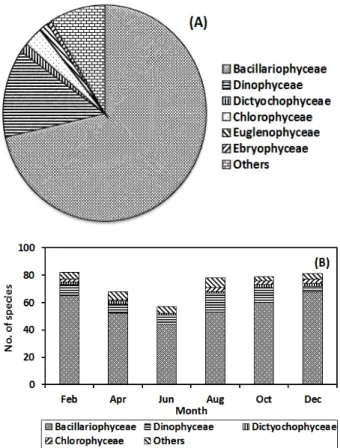
바지락의 소화관에서 동정된 먹이생물은 모두 137 종류이었 고, 규조류가 가장 많은 98종류로 71.5%를 차지하였으며, 와 편모류 18종류 (13.1%), 규질편모류 2종, 녹조류 4종류, 유글 레나류 2종, 에브리아류 1종으로 구성되었다 (Fig. 3a). 기타 미동정 편모류를 포함하여 유종류 (Tintinnidae), 유공충류 (Foraminifera), 윤충류 (Rotifera), 이매패류 유생 (Veliger), 요각류 (Copepoda) 의 다리, 지각류 (Cladocera) 의 내구란 등의 동물플랑크톤도 확인되었으나 이들의 비율은 매우 낮았 다. 2월에 84 종류로 가장 많은 먹이생물이 출현하였고, 10월 과 12월은 각각 82종류와 81종류이었으며, 6월에 가장 적은 57종류가 출현하였다 (Fig. 3b). 매 시기 규조류의 출현비율이 68.0-84.0%로 가장 높았으며, 와편모류는 4.9-18.0%로 수온 이 높은 8월에 가장 높은 비율을 나타냈고, 2월과 12월을 제외 하면 매 시기 10% 이상을 점유하였다.

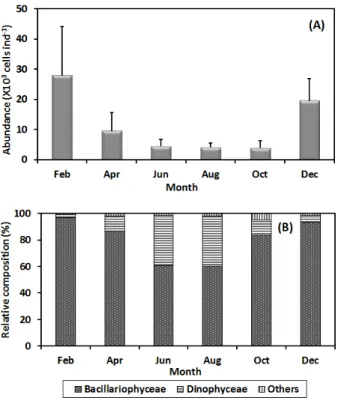
바지락의 소화관에서 먹이생물의 섭식량은 2월에 가장 많은 27.8 × 10

3

cells ind.

-1

를 기록한 이후 점차 감소하여 10월에 가장 적은 3.9 × 10

3

cells ind.

-1

를 섭취하였다 (Fig. 4a). 수 온이 20℃ 이상되는 6월부터 10월에는 약 4.0 × 10

3

cells ind.

-1

전후의 낮은 섭식량을 나타냈다. 바지락의 섭식량 중 규 조류가 차지하는 비율이 89.2%로 가장 높았고, 와편모류는 9.2%, 기타 편모류는 1.6%를 차지하여 매우 적은 양을 나타냈 다 (Fig. 4b). 크기에 따른 섭식량은 각장 2 cm 미만에서 평균 5.2 ± 5.5 × 10

3

cells ind.

-1

로 가장 적었고, 각장 2-3 cm 9.9

± 8.8 × 10

3

cells ind.

-1

, 각장 3-4 cm 12.3 ± 9.8 × 10

3

cells ind.

-1

, 각장 4 cm 이상 18.7 ± 17.4 × 10

3

cells ind.

-1

로, 각장이 증가할 수록 섭식량이 증가하였다 (Fig. 5a). 그러 나 먹이생물 종류의 출현 비율은 바지락 크기에 상관없이 비슷 하게 나타났다 (Fig. 5b).

바지락의 소화관에서 동정된 먹이생물 중 3% 이상의 출현 비율을 나타낸 우점종 중 규조류의 Paralia sulcata가 36.6-79.2%를 차지하여 가장 우점하는 종이었다 (Table 1).

수온이 높았던 6-10월에는 50% 이하의 점유율을 나타냈으나, 이후의 시기에는 약 70% 이상을 차지하였다. 와편모류의 cyst Fig. 2. Bimonthly variations of temperature and salinity in the

surface seawater of Gomso Bay during 2000.

Fig. 3. Species composition (A) and bimonthly variations (B)

of species number for food organisms observed in

digestive tract of the manila clam.

(4)

는 6월과 8월에 각각 26.2%와 27.4%를 차지하여 높은 출현 비율을 보였으나 그 외의 시기에는 10% 이하를 기록하였다.

일시적으로 10% 이상의 점유율을 보였던 종을 보면, 규조류의 Navicula arenaria는 2월에 13.1%, 규조류의 Chaetoceros 휴면포자 (resting spore) 는 10월에 12.2%, 와편모류의 Prorocentrum minimum은 6월에 10.9%를 기록하였다.

3. 해수 중의 식물플랑크톤 변화

곰소만에서 출현한 식물플랑크톤의 현존량은 10월에 평균 3,760 cells ml

-1

(1,582-5,936 cells ml

-1

) 로 가장 많았고, 12월에 평균 107 cells ml

-1

(65-168 cells mL

-1

) 로 가장 적 었다 (Fig. 6). 4월과 12월을 제외하면 매 시기 500 cells ml

-1

이상의 현존량을 나타냈다. 우점종은 시기에 따라 천이양상을 뚜렷하게 나타냈는데, 2월에는 Asterionellopsis glacialis, Fig. 4. Bimonthly variations on mean abundance (A) and

relative composition (B) of food organisms in digestive tract of the manila clam. Bars are standard deviation.

Fig. 5. Mean abundance (A) and relative composition (B) of food organisms in digestive tract on shell length of the manila clam. Bars are standard deviation.

Dominant species Feb Apr Jun Aug Oct Dec

Actinocyclus octonarius 1.69 2.27 1.28 1.59 2.30 3.99

Chaetoceros resting spore - 0.03 0.17 0.46 12.24 -

Cyclotella sp.1 7.96 0.56 0.18 0.10 1.70 2.47

Navicula arenaria 13.06 0.12 0.17 1.87 4.25 0.49 Paralia sulcata 71.70 75.57 48.85 36.56 38.34 79.19 Thalassiosira anguste-lineata 0.15 0.47 0.45 0.05 5.43 1.43 Tryblioptychus cocconeiformis 0.07 - - 0.72 6.22 0.04 Pennales (Bacillariophyceae) 0.28 0.35 0.76 5.53 3.73 0.46 Dictyocha fibula 0.11 0.11 0.19 0.27 3.05 0.81 Prorocentrum minimum 0.08 0.90 10.87 5.02 1.05 0.08

Dinoflagellates cysts 1.90 9.44 26.17 27.44 7.87 5.37

Tabel 1. Relative ratios of dominant species for food organisms observed in digestive tract of the manila clam

(5)

Chaetoceros socialis, Paralia sulcata, Skeletonema costatum, Thalassiosira nordenskioeldii 등이 10-20%의 점유율을 나타내 특정 종이 우점하지 않았으나, 4월에는 Asterionellopsis kariana, 6월에는 S. costatum과 cryptomonads, 8월에는 Chaetoceros curvisetus와 Leptocylindrus danicus가 20% 이상의 높은 점유율을 나타 냈으며, 10월에는 Chaetoceros debilis 1종이 82.7%의 매우

높은 점유율을 보였다 (Fig. 7). 12월에는 P. culcata와 S.

costatum이 우점하였다.

4. 바지락의 먹이선택성
표층 해수에서 우점했던 주요 식물플랑크톤 5종 (A.

kariana, C. curvisetus, C. debilis, S. costatum, Cryptomonads) 은 바지락의 소화관에서 전혀 관찰되지 않거 나, 소수의 출현량을 보여 매우 낮은 먹이선택성을 보였다 (Fig. 8). 반면, 바지락의 소화관에서 출현한 주요 우점종 중 Chaetoceros 휴면포자와 와편모류 cyst는 해수 중에서 출현하 지 않거나 매우 적은 양이 출현하여 높은 양의 먹이선택성을 보였다. 저서 규조류인 N. arenaria는 시기에 따라 해수 중에 존재하는 양이 많아 음의 먹이선택성을 보였으나 전체적으로 는 양의 선택성을 보였고, 와편모류의 Prorocentrum minimum 역시 양의 먹이선택성을 보였다. 저서성이면서 일 시 부유하는 P. sulcata는 매 시기 양의 먹이선택성을 보여 매 우 선호하는 먹이생물로 나타났다.

바지락 소화관과 표층 해수에서 출현한 모든 식물플랑크톤 의 속 (genus) 명을 기준으로 매 시기 출현여부에 따른 빈도와 Fig. 7. Relative composition of phytoplankton dominant

species in surface sea water of Gomso Bay.

Fig. 6. Mean abundance of phytoplankton in surface sea water of Gomso Bay. Bars are minimum values and maximum values.

Fig. 8. Selectivity indices of phytoplankton dominant species

in digestive tract of the manila clam and surface sea

water.

(6)

Asterionellopsis

Bacteriastrum + P, C

Bellerochea + +++ P, C

Caloneis ++ B, N

Cerataulina ++ P, C

Chaetoceros + +++ P, C

Chaetoceros resting spore ++++ + B, N

Cocconeis +++ +++ B, N

Coscinodiscus +++ +++ P/B, N

Cyclotella ++++ ++ B, N

Cylindrotheca +++ ++++ P/B, N

Cymbella ++ B, N

Dactyliosolen +++ P, C

Dectonula + P, C

Dimeregramma ++ B, N

Diploneis ++++ +++ B, N

Ditylum ++++ P, N

Eucampia ++++ P, C

Fragilaria ++ + B, N

Grammatophora ++ B, C

Guinardia +++ P, C

Gyrosigma + +++ B, N

Hanzschia ++ P, N

Helicotheca ++ P, C

Hemiaulus + P, C

Hyalodiscus ++++ P, N

Lauderia ++ P, C

Leptocylindrus ++ P, C

Licmophora ++ ++ B, C

Mastogloia ++++ + B, N

Melosira + + P, C

Meuniera ++ P, C

Navicula ++++ ++++ B, N

Nitzschia ++ ++ B, N

Odontella ++ ++ P/B, C

Paralia ++++ ++++ B, C

Pinnularia + B, N

Plagiogrammopsis +++ ++++ B, C

(7)

Phytoplankton (genus) Frequency*

Digestive gut Sea water EC**

Pleurosigma ++ +++ B, N

Pseudonitzschia +++ P, C

Rhaphoneis ++++ B, N

Rhizosolenia + ++ P, N

Skeletonema + ++++ P, C

Stephanopyxis + P, C

Stephanopyxis resting spore ++ + B, C/N

Surirella +++ ++ B, N

Synedra ++ B, N

Thalassionema ++++ +++ P, C

Thalassiosira ++++ +++ P/B, C/N

Trachyneis +++ B, N

Triceratium +++ B, N

Tryblioptychus ++++   B, N

DICTYOCHOPHYCEAE    

Dictyocha ++++ +++ P, N

CRYPTOPHYCEAE  

Cryptomonads ++++ P, N

RAPHIDOPHYCEAE  

Heterosigma + P, N

DINOPHYCEAE  

Alexandrium +++ + P, C/N

Ceratium ++ P, N

Dinophysis ++++ + P, N

Gonyaulax + ++ P, N

Gymnodinium + ++ P, C/N

Gyrodinium + ++ P, C/N

Heterocapsa +++ P, N

Oxyphysis +   P, N

Polyckrikos + P, N

Prorocentrum +++ ++ P, N

Protoperidinium ++ ++ P, N

Scrippsiella ++ ++++ P, N

Dinoflagellate cysts ++++   B, N

CHLOROPHYCEAE  

Scenedesmus +++   P, C

Staurastrum +++   P, C

Trachelomonas +++   P, N

PRASINOPHYCEAE  

Pyramimoids +++   P, N

EUGLENOPHYCEAE  

Euglena +++ P, N

Eutreptiella +++ ++++ P, N

CYANOPHYCEAE  

Oscillatoria   +++ P, C

* + : >25%, ++ : 25-50%, +++ : 50-75%, ++++ : >75%

**EC: Ecoclogical characteristics, P: Planktonic species, B: Benthic species, C: chain (or colony) forming species, N: chain (or colony) non-forming species

Continue

(8)

곰소만 해역에서 수온 변화는 우리나라 해역의 일반적인 특 징을 잘 반영하였으나, 염분 변화는 10월에 연중 가장 낮은 염 분 농도를 보였고, 오히려 8월에 가장 높게 나타남으로써 채집 당일을 기준으로 이전의 강우량에 크게 좌우되었던 것으로 판 단된다. 이는 해수 중 식물플랑크톤의 생물량이 연중 최대치를 기록한 것과도 관련이 있다.

바지락의 소화관에는 무기물 입자와 더불어 규조류, 와편모 류, 녹조류 및 미소 편모류 등의 다양한 식물플랑크톤 이외에 도 섬모류, 유공충류, 윤충류, 이매패류 유생 및 지각류의 내구 란 등의 동물플랑크톤이 관찰되었다. 그러나 이매패류의 소화 관 내용물은 지역의 해수 중에 존재하는 식물플랑크톤에 따라 다소 차이는 있으나, 많은 연구 (Shumway et al., 1987;

Villalejo-Fuerte et al., 2005; Rouillon et al., 2005;

Davenport et al., 2011) 에서 규조류와 와편모류의 생물량이 많았으며, 본 연구에서도 규조류와 와편모류가 출현종수에서는 80% 이상을, 생물량에서는 95% 이상을 차지하였다. 또한 이 매패류가 중형 동물플랑크톤을 섭식한다는 이전의 보고 (Lehane and Davenport, 2002; Davenport et al., 2011) 와 일치하고 있으나, 이들의 비율은 매우 적었다.

이매패류의 소화관 내용물 검경을 통한 섭식량의 정량적 자 료는 매우 적은데, 보령해역의 조하대에 서식하는 살조개의 섭 식량은 114-159 cells ind.

-1

(Jo et al., 2004), 태안해역의 조 간대 서식 굴은 평균 40 × 10

3

cells ind.

-1

이하, 바지락은 평 균 10 × 10

3

cells ind.

-1

이하로 보고 (Baek et al., 2008) 하 였다. 본 연구에서는 평균 27.8 × 10

3

cells ind.

-1

이하의 섭 식량을 보였는데, 지역에 따른 차이 및 채집 당시 식물플랑크 톤의 양과도 관련이 있을 것으로 판단된다. 또한 바지락의 섭 식량은 가을철인 10월에 가장 낮았는데, 이 시기의 표층해수 중 식물플랑크톤의 현존량은 연중 가장 높은 밀도를 나타내 상 반된 결과를 보였다. Yoon (2012) 은 곰소만 바지락의 비만도 가 2000년 10월에 연중 가장 낮고, 폐사율이 약 62%로 가장 높게 나타났음을 보고하였고, Lee et al. (2012) 은 동일 시기 및 장소에서 2000년 10월과 12월에 조간대 퇴적물에서 chlorophyll a의 농도가 연중 낮게 나타났다고 보고하였다. 따

류가 먹이의 크기에 따라 먹이를 선택하는 것은 잘 알려져 있 으고, 내시경과 유세포분석기를 통해 굴은 살아있는 입자성 먹 이와 죽은 입자성 먹이를 구별할 수 있으며 (Ward et al.

(1997), 가리비류는 같은 먹이 종류라도 물리적적으로 영양학 적 차이를 구분할 수 있다 (Brillant and MacDonald, 2000;

2003). 또한 Tang et al. (2014) 은 담치류 (Dreissena rostriformis bugensis) 가 먹이의 크기보다는 식물플랑크톤 의 종류에 따른 선택성이 더 크고, 식물플랑크톤의 크기, 형태, 세포벽의 특징 및 화학적 조성의 차이에 의해 전후섭식 (pre- and post-ingestive)에서 선택행동을 보인다고 하였다.

본 연구에서 만조시 표층 해수에 우점하는 Asterionellopsis 속, Chaetoceros 속, Skeletonema 속 등은 바지락 소화관에 서 단독이거나 2-3개 세포가 연결된 상태로 소수 관찰되었을 뿐 해수 중에 존재하는 형태와 같이 많은 세포가 연결된 상태 로는 관찰되지 않았다. 따라서 바지락은 사슬이나 군체를 형성 하거나 Chaetoceros 속과 같이 센털 (setae) 을 갖는 식물플 랑크톤은 먹이로서 적당하지 않은 것으로 판단되며, 이는 Jo et al. (2004) 이 살조개를 대상으로 실내에서 해수 및 소화관 내 식물플랑크톤 섭식 실험을 통해 Chaetoceros 속, Skeletonema 속 , Eucampia 속, Rhizosolenia 속 등의 식물플랑크톤을 소화 관 내에서 관찰하지 못한 결과를 설명할 수 있다.

Loret et al. (2000) 은 광학현미경과 HPLC를 이용한 색소 분석을 통해 진주조개류 (Pinctada margaritifera) 의 주요 먹이원으로 은편모류와 같은 미소편모류 (nannoflagellate) 임 을 보고하였는데, 본 연구에서 은편모류는 해수 중에 우점종으 로 출현하였으나, 바지락 소화관에서는 발견되지 않았다. 이는 은편모류가 영양학적으로 좋은 먹이생물임에도 불구하고 (Brown et al., 1998), 세포막이 연약하기 때문에 쉽게 소화 되었기 때문으로 생각된다 (Newell et al., 1989).

서해 연안에서 잠입성 이매패류의 소화관 내용물 중에서 우 점종의 분포를 보면 , Jo et al. (2004) 은 살조개에서 P.

sulcata, Coscinodiscus marginatus, Thalassiosira

leptopus 등이었고, Paek et al. (2008) 은 굴과 바지락에서

P. sulcata, Coscinodiscus spp., Melosira nummuloides

(9)

등이었으며, Park et al. (2015) 은 P. sulcata, Navicula spp., Cylindrotheca spp. 등이었다. 본 연구에서도 P.

sulcata, Navicula arenaria, Prorocentrum minimum 등 의 규조류와 와편모류가 우점하였는데, 이들 이매패류의 주요 먹이원은 저서성 규조류인 P. sulcata를 포함하여 저서성이거 나 단독으로 존재하는 Navicula 속이나 Coscinodiscus 속 등 으로 여겨진다. 또한 소화관 내용물에 존재하는 식물플랑크톤 중 규조류의 대부분은 저서성이었고, 부유성일 경우에도 원형 이나 사슬을 형성하지 않는 단순한 형태의 규조류나 와편모류 를 섭식하였다 (Table 2). 따라서 퇴적물에 잠입하여 서식하는 바지락은 입수관 주변에 존재하는 재부유된 저서성 식물플랑 크톤과 해수 중에 존재하는 부유성 식물플랑크톤을 흡입하여 먹이생물 세포의 형태나 모양에 따라 섭식 여부를 결정한다고 판단된다.

본 연구에서 와편모류의 cyst와 규조류의 휴면포자가 소화 관 내용물 중에서 시기에 따라 우점하였는데, 와편모류의 cyst 에는 지방과 전분이 함유되어 있기 때문에 소화가 가능하다면 좋은 먹이생물이 될 수 있기 때문에 (Persson, 2000), cyst의 소화가능 여부와 더불어 이매패류의 분변 (fecal pellet) 에서 나온 cyst의 부화 연구는 적조 발생과 관련된 cysts의 동태 연 구에 좋은 자료가 될 것이다.

요 약

바지락의 섭식 특성을 분석하기 위해 서해의 곰소만에서 바 지락의 소화관 내용물과 표층 해수의 식물플랑크톤 군집에 대 해 정량 및 정성분석을 실시하였다. 바지락의 소화관에는 규조 류 (71.5%), 와편모류 (13.1%), 미소플랑크톤 (6.6%) 과 중형 동물플랑크톤을 포함한 유기쇄설물 등이 관찰되었다. 소화관 내에서 섭식량은 겨울과 봄에 많았고 여름과 가을에 낮게 나타 난 반면, 표층 해수의 식물플랑크톤 현존량은 가을에 가장 많 았다. 또한 바지락의 크기가 클수록 섭식한 먹이생물의 양은 증가하였다. 소화관에서 관찰된 우점종은 저서성 규조류인 Paralia sulcata 및 Navicula arenaria와 와편모류의 cyst 이었던 반면 표층해수에서 우점종은 부유성 규조류인 Chaetoceros 속, Skeletonema 속, Asterionellopsis 속 등과 cryptomonads 및 P. sulcata이었다. 소화관 내용물 분석을 통해 바지락의 주요 먹이원은 저서성 규조류이며, 식물플랑크 톤의 크기와 모양에 따라 선택적으로 섭식함을 확인하였다.

사 사

본 논문은 2012학년도 군산대학교 대학자체 학술공모 과제 와 해양수산부 수산특정연구개발과제 (패류 양식장에서 지속

적인 생산성 유지를 위한 최적 생산기술 개발) 의 연구비 지원 에 의하여 연구되었습니다.

REFERENCES

Arakawa, H., Yaoita, T., Koide, T., Morinaga, T. (1997) Size of suspended particles caught by manila clam, Ruditapes philippinarum. La. mer., 35: 149-156.

Back, S.H., Lee, J., Lee, H.O., Han, M.S. (2008) Study of the food characteristics on pacific oyster Crassostrea gigas and manila clam Ruditapes philippinarum in the intertidal zone of Taeahn, Korea. Korean Journal of Environmental Biology, 26(3): 145-158. (in Korean)

Brillant, M.G.S., MacDonald, B.A. (2000) Post-ingestive selection in the sea scallop, Placopecten magellanicus (Gmelin) : the role of particle size and density.

Journal of Experimental Marine Biology and Ecology, 253: 211-227.

Brillant, M.G.S., MacDonald, B.A. (2003) Post-ingestive sorting of living and heat-killed Chlorella within the sea scallop, Placopecten magellanicus (Gmelin).

Journal of Experimental Marine Biology and Ecology, 290(1): 81-91.

Brown, M.R., McCausland, M.A., Kowalski, K. (1998) The nutritional value of four Australian microalgal strains fed to Pacific oyster Crassostrea gigas spat.

Aquaculture, 165: 281-293.

Chang, J.H., Ryu, S.O., Jo, Y.J. (2007) Long-term variation of tidal-flat sediments in Gomso Bay, west coast of Korea. Journal of the Korean Earth Science Society, 28(3): 357-366. (in Korean)

Davenport, J., Ezgeta-Balic, D., Peharda, M., Skejic, S., Nincevic-Gladan, Z., Matijevic, S. (2011) Size-differential feeding in Pinna nobilis L.

(Mollusca: Bivalvia): Exploitation of detritus, phytoplankton and zooplankton. Estuarine, Coastal and Shelf Science, 92: 246-254.

Ivlev, V.S. (1961) Experimental ecology of the feeding of fishes. 302pp. Yale University Press, New Haven.

Jo, S.G., Kim, J.H., Kim, Y.H., Lee, C.H. (2004) Feeding selectivity of the jedo venus clam, Protothaca jedoensis on phytoplankton. Korean Jouranl of Malacology, 20(1): 27-34. (in Korean)

Kang, C.K., Kim, J.B., Kim, J.B., Lee, P.Y., Hong, J.S.

(2001) The importance of intertidal benthic autotrophs to the Kwangyang Bay (Korea) food webs:

δ13C analysis. Journal of the Korean Society of Oceanography, 36(1): 109−123.

Kang, C.K., Kim, J.B., Lee, K.S., Kim, J.B., Lee, P.Y., Hong, J.S. (2003). Trophic importance of benthic microalgae to macrozoobenthos in coastal bay systems in Korea: dual stable C and N isotope analyses.

Marine Ecology Progress Series, 259: 79−92.

Kang, C.K., Lee, Y.W., Choy, E.J., Shin, J.K., Seo, I.S.,

Hong, J.S. (2006) Microphytobenthos seasonality

determines growth and reproduction in intertidal

(10)

Lee, C.S. (1997) Studies on the feeding activity and environmental tolerance of geoduck clam, Panopea japonica. Journal of Aquaculture, 10(2): 213-218. (in Korean)

Lee, Y.W., Choi, E.J., Kim, Y.S., Kang, C.K. (2009) Seasonal variations of microphytobenthos in sediments of the estuarine muddy sandflat of Gwangyang Bay: HPLC pigment analysis. 「The Se a」 Journal of the Korean Society of Oceanography, 14(1): 48-55.

Lee, Y.W., Park, M.O., Yoon, J.H., Hur, S.B. (2012) Temperal and spatial variation of microalgal biomass and community structure in seawater and surface sediment of the Gomso Bay as determined by chemotaxonomic analysis. 「The Sea」 Journal of the Korean Society of Oceanography, 17(2): 87-94.

Lehane, C., Davenport, J. (2002) Ingestion of mesozooplankton by three species of bivalve; Mytilus edulis, Cerastoderma edule and Aequipecten opercularis. Journal of the Marine Biological Association of the United Kingdom, 82(4): 615-619.

Newell, C.R., Shumway, S.E., Cucci, T.L., Selvin, R.

(1989) The effects of natural seston particle size and type on feeding rates, feeding selectivity and food resource availability for the mussel Mytilus edulis L., 1758 at bottom culture sites in Maine. Journal of Shellfish Research, 8: 187-196.

Loret, P., Pastoureaud, A., Bacher C., Delesalle B. (2000) Phytoplankton composition and selective feeding of the pearl oyster Pinctada margaritifera in the Takapoto lagoon (Tuamotu Archipelago, French Polynesia): in situ study using optical microscopy and HPLC pigment analysis. Marine Ecology Progress Series, 199: 55-67.

Park, S.K., Kim, B.Y., Oh, J.S., Park, K.J., Choi, H.G.

(2015) Seasonal variations of microphytobenthos and growth of Ruditapes philippinarum at Jeongsanpo and Hwangdo tidal flat, Taean, Korea. Korean Journal of Environmental Ecology, 29(6): 884-894. (in Korean)

flora of Korea: Marine phytoplankton (Vol. 34).

487pp. Ministry of Education, Seoul.

Shumway, S.E., Cucci, T.L., Newell, R.C., Yentsch, C.M.

(1985) Particle selection, ingestion, and absorption in filter-feeding bivalves. Journal of Experimental Marine Biology and Ecology, 91: 77-92.

Shumway, S.E., Selvin, R., Schick, D.F. (1987) Food resources related to habitat in the scallop Placopecten magellanicus (Gmelin, 1791): A qualitative study. Journal of Shellfish Research, 6(2):

89-95.

Tang, H., Vanderploeg, H.A., Johengen, T.H., Liebig, J.R.

(2014) Quagga mussel (Dreissena rostriformis bugensis) selective feeding of phytoplankton in Saginaw Bay. Journal of Great Lakes Research, 40(S1): 83-94.

Tomas, C.R. (1997) Identifying marine phytoplankton.

858pp. Academic Press, California.

Villalejo-Fuerte, M., Muneton-Gomez, M.S., Garate-Lizarraga, I., Garcia-Dominguez, F. (2005) Gut content, phytoplankton abundance and reproductive season in the black oyster (Hyotissa hyotis, Linne, 1758) at Isla Espiritu Santo, Gulf of California. Journal of Shellfish Research, 24(1):

185-190.

Yoon J.H. (2012) The Study population ecology of the manila clam, Ruditapes philippinarum in Gomso Bay. Ph. D. thesis, Pukyong National University, Korea. 193pp.

Ward, J.E., Levinton, J.S., Shumway, S.E., Cucci, T.

(1997) Site of particle selection in a bivalve mollusc.

Nature, 390: 131-132.

Zimba, P.V., Hill, E.M., Withers, K. (2016) Benthic microalgae serve as the major food resource for porcelain crabs (Petrolisthes spp.) in oyster reefs:

Digestive track content and pigment evidence.

Journal of Experimental Marine Biology and Ecology,

483: 53-58.

수치

Fig. 3. Species composition (A) and bimonthly variations (B)  of  species  number  for  food  organisms  observed  in  digestive tract of the manila clam
Tabel 1. Relative ratios of dominant species for food organisms observed in digestive tract of the manila clam
Fig.  6.  Mean  abundance  of  phytoplankton  in  surface  sea  water  of  Gomso  Bay

참조

관련 문서

Seasonal changes in the Perkinsus olseni infection in an annual reproduction of Manila Clam Ruditapes philippinarum from a tide flat on Jonghyun in Incheon bay on the west cost

Quantification of nitric oxide concentration in the hemocytes of Manila clam Ruditapes philippinarum by using.. 4,5-diaminofluorescein diacetate

Gonad development of the female manila clam, Ruditapes philippinarum following exposure to naphthalene during 20 weeks.. In:

In order to understand the effect of introduction of oyster rack culture on natural short-necked clam, Ruditapes philippinarum, stock, we investigated the status of natural

Growth patterns of the Manila clam, Ruditapes philippinarum in each tidal level were studied in the intertidal zone in Tae-an on the west coast of South Korea from April

NFRDI (National Fisheries Research and Development Institute) (2010) Report on stock assessment and utilization implications of the manila clam, Ruditapes philippinarum in

Response optimization for extrusion cooking conditions for the preparation of seasoning from Manila clam Ruditapes philippinarum Optimal conditions.. X 1 (Barrel temperature, °C) X

This study screened the biological activity of an acidified gill extract of the Manila clam Ruditapes philippinarum in- cluding antimicrobial, hemolytic,