Received January 14, 2010; Revised February 15, 2010;
Accepted February 22, 2010
Corresponding author: Kwang-Sik Choi
Tel: +82 (64) 756-3422 e-mail: [email protected] 1225-3480/24340
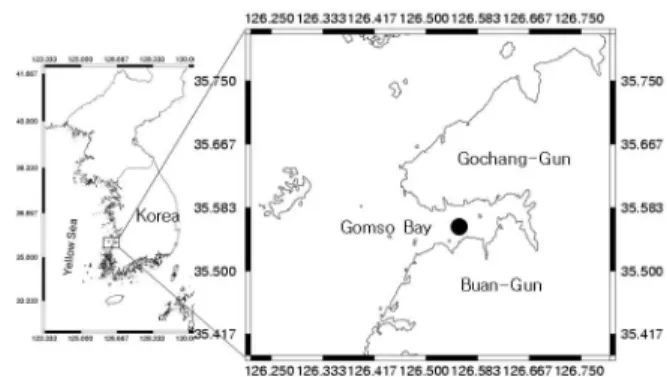
Fig. 1. Location of Gomso Bay in Korea.
DENSITY DEPENDENT GRWOTH AND MORTALITY OF MANILA CLAM Ruditapes
philippinarum REARED IN CAGES IN GOMSO-BAY, KOREA
Kyung-Il Park1, Hyun-Sung Yang2, Do-Hyung Kang3 and Kwang-Sik Choi2
1Department of Aquatic Life Medicine, College of Ocean Science and Technology, Kunsan National University, Gunsan 573-701, Republic of Korea
2Faculty of Marine Biomedical Sciences, College of Ocean Science, Jeju National University, Jeju 690-756, Republic of Korea
3Korea Ocean Research and Development (KORDI), Ansan P.O. Box 29, Seoul 425-600, Republic of Korea
ABSTRACT
Density-dependant growth and mortality rate of Manila clam Ruditapes philippinarum reared in net cages was investigated in Gomso Bay, Korea where unusually high mortality of clams has been reported. For the experiment, four groups of clam cages were set up with a density of 2,000 clams/m2 (group A), 1,000 clams/m2 (group B), 500 clams/m2 (group C) and 100 clams/m2 (group D). Mortality and growth of clams in each experimental cage was monitored biweekly from May 2001 to September 2001. Highest mortality in group A was observed in late August, while highest mortality of rest groups was observed in early September. In September, the cumulative mortality in group A was 99%, while it was 93.2% in group B, 91.2% in group C and 88% in group D. Shell growth rate of clams in thecages was found to be density dependent; monthly shell length increase was 0.67 mm in group A, 1.33 mm in group B, 1.63 mm in group C and 1.71 mm in group D. Our study indicated that clam growth and mortality in the Bay is density dependent and the growth and survival rate is negatively correlated with the density.
Key words: Mortality, Ruditapes philippinarum, Perkinsus olseni, Growth rate, Density.
INTRODUCTION
Manila clam (= littleneck clam or short-necked clam), Ruditapes (= Tapes) philippinarum is very common in sand beaches and tidal flats along the coasts of Korea. Clams are often commercially raised and considered to be one of the most important shellfish resources supporting the aquaculture industry in Korea (MIFAFF, 2010). Clam landings in Korea, however, have dramatically decreased since 1993: Manila clam landing from shallow-sea culture during the period of 2001-2009 was approximately
16,000 tons, which is only one fifth of the clam landings in 1990 (MIFAFF, 2010). Numerous investigations have reported mass mortality of clam in spring or fall depending on clam beds and the mortality is attributed to the decline of clam production in Korea (Choi et al., 1996, Park et al., 1999; DRMAFO, 2007).
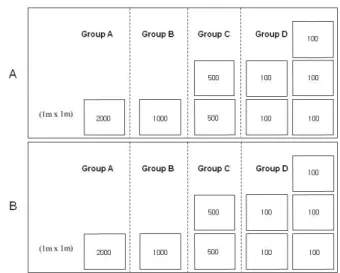
Fig. 2. Diagram of clam cages used in the present study.
Fig. 3. An arrangement of clam culture cages used in the study.
Mass mortalities of R. philippinarum have been reported in Gomso Bay (Fig. 1) off the west coast of Korea in early fall (Park et al., 2006). The fall mortalities observed in the Bay was in part, associated with high level of P. olseni infection which exerted poor growth and retarded reproduction in clams (Park and Choi, 2001; Park et al., 2006). Poor growth and health is often linked to density of rearing clams, although effects of high density on clam growth and overall physiology is poorly understood in Korean shellfish aquaculture (Liu et al., 2006; Gagné et al., 2008).
We have examined effects of rearing density on clam growth and mortality in Gomso Bay using net cages. In this study we report growth and mortality rate of clams raised in cages with different densities.
MATERIALS AND METHODS
To rear clams, a 1 x 1 x 0.6 m iron cage was built and fenced with nylon net (mesh size of 1cm, Fig. 2).
For the experiment, 2 sets of the cages were installed on a commercial clam beds in Gomso Bay, one for examining the mortality and the other for measuring shell and meat growth. Ninethousand calms were planted on May 14, 2001 in two sets of four treatment types according to clam densities (Fig. 3):
group A (2000 clams/m2), group B (1000 clams/m2), group C (500 clams/m2), and group D (100 clams/m2).
Mortality of clams rearing in different cages with different densities was monitored bi-weekly or monthly until the end of September 2001. Forty clams were sampled when the mortality was recorded.
Sampled clams were transported to the laboratory and shell length and flesh weight were measured using calipers and an electronic balance, respectively.
To calculate clam shell length increase, mean shell length of the previous sampling period was subtracted from the mean shell length of next sampling period.
For histology, 50 clams were collected from the same cages where clams were collected for measuring shell and meat growth. After measuring the length, tissue was fixed in Davidson’s fixative, dehydrated, embedded in paraffin, sliced at 5 μm thick, and stained with hematoxylin and eosin Y. The histological preparations were examined under a light microscope to evaluate pathologic symptoms and pathogens in the tissues.
RESULTS AND DISCUSSION
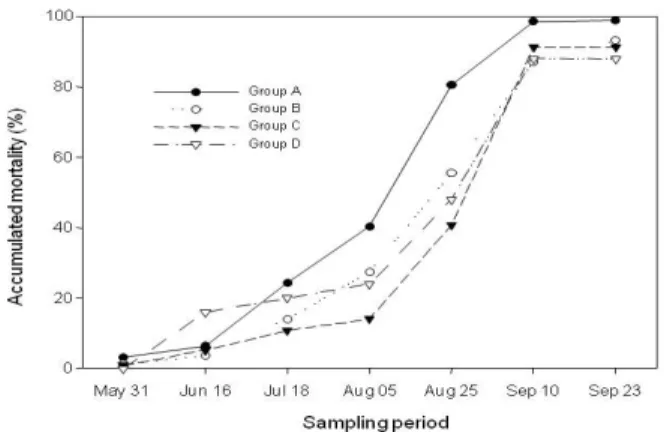
Mortality of the clams in each cage was calculated by dividing the number of dead clams by the initial number of the clams in the cage. Mortalities in all cages were less than 5% at the end of the first month, while the mortalities increased remarkably after July. In August the mortalities reached 40% in group A, 28% in group B, 27% in group C and 24% in group D. At the end of the experiment in mid September, the mortality was 18% in group A, 32% in group B, 50% in group C and 40% in group D.
Fig. 4. Mortality rates (%) of R. philippinarum in the different clam group density.
Fig. 5. Shell growth of R. philippinarum in different clam densities.
Fig. 6. Tissue wet weight increase of R. philippinarum in different clam densities.
Cumulative mortalities in each cage in September were 99% in group A, 93.2% in group B, 91.2% in group C and 88% in group D, indicating that the observed mortality was density-dependent (Fig. 4).
The growth of the clams in the different experimental conditions is summarized in Fig. 5. There were substantial differences in the growth of shell length among the groups the group A, the highest clam density, showed the lowest final mean lengths (< 32 mm) and tissue wet weight (approximately 1.5 g), while the group C and D, the lower clam densities, showed the higher final mean length (> 33 mm) and flesh weight (> 2.0 g) (Fig. 6).. Such low shell and tissue growths of the clams in high density were common in various studies (Hadley and Manzi, 1984 Yan et al., 2006). Increased metabolic wastes and food limitations in high density population are considered to be the main reason for the retarded growth of clams(Yan et al., 2006).
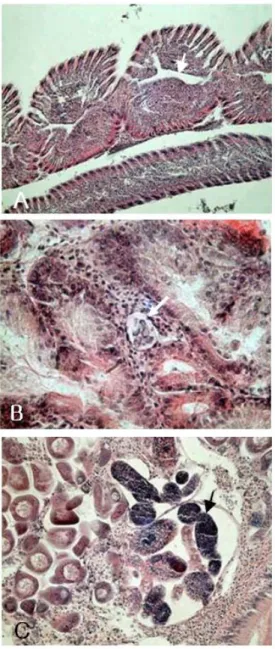
In histological examination, protozoan and trematode parasites were observed. The protozoan parasite P. olseni was mostly found in the gill and the digestive gland of the clam (Fig. 7A & B).
Inflammatory reaction or infiltration of clam hemocytes was observed around the trophozoites of the parasites (Fig. 7B). In addition, the trematode, Cercaria sp. was mostly distributed in the gonadal tissue (Fig. 7C), and its prevalence was 4.2%
throughout the study period. Recent publications reported a number of pathogens in commercially raised R. philippinarum in Korea (Lee et al., 2001;
Limpanont, 2010). These studies suggested that R.
philippinarum are exposed to various kinds of pathogenic effects. In accordance with our data, there are several studies reported a positive correlation between clam density and disease. Ford et al.
(2002)reported a significant correlation between higher disease levels and higher rearing densities, although there was a considerable variability. A modeling study also showed that disease dynamics is density-dependent in aquatic animals, suggesting that host density is a key factor and should be evaluated carefully to decrease disease transmission in aquaculture species (Liao et al., 2006).
Fig. 7. Histopathological observation of pathogens in R. phlilippinarum tissues.
Finally, mortality, shell and flesh weight growths were confirmed to be density-dependant. This is likely explained by exploitive competition for food and the possibility of exposure to an epidemic disease. In particular, the protozoan parasite Perkinsus shows high prevalence and infection intensity at higher rearing density, insufficient food supply and physiological stress and often it results in the reduced growth rate and mass mortality of clams.
ACKNOWLEDGMENTS
We appreciate the staff of the Shellfish Research Lab at Jeju Nation National University for data acquisition. This study was financially supported by the Korea Ministry of Food, Agriculture, Forestry and Fisheries (MIFAFF) research fund, F20814208H220 000110.
REFERENCES
Choi, D.L., Kwon, J.N., and Kim, Y.C. (1996) Survey on the mass mortality of the Manila clam Ruditapes philippinarum. pp. 226-236. NFRDI Research Report of West Sea Fisheries Research Institute.
DRMAFO (Daesan Regional Maritime Affairs &
Fisheries Office) (2007).
http://daesan.momaf.go.kr/fishery/news/month_list.asp Ford, S.E., Kraeuter, J.N., Barber, R.D., and Mathis, G.
(2002) Aquaculture-associated factors in QPX disease of hard clams: density and seed source.
Aquaculture, 208: 23-38.
Gagné, F., Blaise, C., Pellerin, J., Fournier, M., Durand, M.J., and Talbot, A. (2008) Relationships between intertidal clam population and health status of the soft-shell clam Mya arenaria in the St. Lawrence Estuary and Saguenay Fjord (Québec, Canada).
Environment International, 34: 30-43.
Hadley, N.H., and Manzi, J.J. (1984) Growth of seed clams, Mercenaria mercenaria, at various densities in a commercial scale nursery system. Aquaculture, 36: 369-378.
Lee, M.-K., Cho, B.-Y., Lee, S.-J., Kang, J.-Y., Jeong, H.D., Huh, S.H., and Huh, M.-D. (2001) Histopathological lesions of Manila clam, Tapes philippinarum, from Hadong and Namhae coastal areas of Korea. Aquaculture, 201: 199-209.
Liao, C.-M., Chang, C.-F., Yeh, C.-H., Chen, S.-C., Chiang, K.-C., Chio, C.-P., Chou, B.Y.-H., Jou, L.-J., Lien, G.-W., Lin, C.-M., Shen, H.-H., and Wu, G.-D.
(2006) Metal stresses affect the population dynamics of disease transmission in aquaculture species.
Aquaculture, 257: 321-332.
Limpanont, Y. (2010) Histopathological and biological survey on marine bivalve parasites in Korean waters. Ph.D. dissertation, Jeju National University, pp. 171.
Liu, B., Dong, B., Tang, B., Zhang, T., and Xiang, J.
(2006) Effect of stocking density on growth, settlement and survival of clam larvae, Meretrix meretrix. Aquaculture, 258: 344-349.
MIFAFF. (2010)
http://www.mifaff.go.kr/USR/WPGE0201/m_119/DTL.j sp
Park, K.-I., and Choi, K.-S. (2001) Spatial distribution of the protozoan parasite Perkinsus sp. found in the Manila clams, Ruditapes philippinarum, in Korea.
Aquaculture, 203: 9-22.
Park, K.-I., Choi, K.-S., and Choi, J.-W. (1999) Epizootiology of Perkinsus sp. found in the Manila clam, Ruditapes philippinarum in Komsoe Bay, Korea. J. Korean Fish. Soc., 32: 303-309.
Park, K.-I., Figueras, A., and Choi, K.-S. (2006) Application of enzyme-linked immunosorbent assay (ELISA) for the study of reproduction in the Manila clam Ruditapes philippinarum (Mollusca: Bivalvia):
II. Impacts of Perkinsus olseni on clam reproduction. Aquaculture, 251: 182-191.
Yan, X., Zhang, G., and Yang, F. (2006) Effects of diet, stocking density, and environmental factors on growth, survival, and metamorphosis of Manila clam Ruditapes philippinarum larvae. Aquaculture, 253:
350-358.