Received: March 9, 2012 ; Accepted: March 21, 2012 Corresponding author: Chae Woo Ma
Tel: +82 (41) 530-1283 e-mail: [email protected] 1225-3480/24423
태안 안면도 조간대에 서식하는 바지락 (
Ruditapes philippinarum
) 의 조위별 성장양상한형섬, 마채우, 김지연 순천향대학교 해양생명공학과
Growth Patterns of the Manila Clam, Ruditapes philippinarum at Each Tidal Level in the Intertidal Zone in Tae-an, West Coast of
South Korea
Hyoung Sum Han, Chae Woo Ma and Ji Yeon Kim
Department of Marine Biotechnology, Soonchunhyang University, Asan, Chungcheongnam-do, 336-745 South Korea.
ABSTRACT
Growth patterns of the Manila clam, Ruditapes philippinarum in each tidal level were studied in the intertidal zone in Tae-an on the west coast of South Korea from April to August 2009. Environmental factors and the specimens of R. philippinarum were monthly collected at three intertidal locations: low intertidal zone, low-middle intertidal zone and middle intertidal zone. Temperature of sediment in low intertidal zone were lower than those in other intertidal locations. Concentrations of Chl-α were not significantly different between in each tidal level. Exposure hours in low intertidal zone were shorter than those in other intertidal locations. Density of each year class in low intertidal zone were higher than those in low-middle intertidal zone and middle intertidal zone. Growth factors of R.
philippinarum in low intertidal zone were better than those in other intertidal locations. The growth rate of under one year class individuals of low intertidal zone were higher than those in low-middle intertidal zone and middle intertidal zone, before the main recruitment period of R. pilippinarum. Although the growth patterns of R.
philippinarum may be affected by various environmental factors, we suggests that the exposure duration is the main affect in the growth patterns of R. philippinarum in intertidal zone.
Keywords: Manila clam, Ruditapes philippianarum, growth, intertidal zone, exposure duration
서 론
바지락 (Ruditapes philippinarum) 은 이매패강 (Bivalvia), 백합목 (Family Veneridae) 에 속하는 종으로 수심 10 m 내외의 60-80% 사질을 함유한 간석지에 주로 분 포하는 주요 양식종이다 (Yoo, 1998). 바지락은 예로부터 연 안 어민들이 즐겨먹던 수산물로 1912년에 우리나라에서 처음 으로 양식이 시작된 이래로 지금까지 천해 간석지에 많은 양이 양식 되고 있다. 바지락은 현재 우리나라 생산되는 패류 중 굴
과 더불어 생산량이 높아 수산자원적인 측면에서도 매우 중요 한 종이다 (Kim and Jhang, 1999; Shin and Shin, 1999).
우리나라 서해안의 경우, 4월과 6월 사이에 식물플랑크톤이 대증식하며, 이에 따라 바지락은 5월에 성성숙과 산란을 한다 (Yoo and Choi, 2005). 바지락은 부유성 유생기를 거쳐 일반 적으로 각장의 크기가 0.3 mm 정도가 되면 매년 늦은 봄과 초가을에 선택적으로 연성 기저 (soft bottom) 에 정착 (settlement)을 하는데 (Coutteau et al., 1994;
Drummond et al., 2006), 이들은 운동력이 약하기 때문에 정착 후 수온과 염분을 비롯한 무생물적 영향과 먹이생물의 시․공간적 변동 및 종간 먹이경쟁 등 생물학적 영향을 받는다 (Kim, 1988; Kim and Kho, 2004; Toba and Yamakawa, 1993).
특히 대기온도는 간출시 조간대에 서식하는 이매패류에 직
Fig. 1. Sampling stations of the Manila clam, Ruditapes philippinarum in Taean, the west coast of South Korea.
The intertidal zone was divided into three subzones: Middle intertidal zone (M); Low-middle intertidal zone (LM); Low intertidal zone (L).
접적인 영향을 주며 (Fournier et al. 2002; Mills, 2000;
Pechenik, 2005), 이들의 치패 시기에 사망률과 생존율을 조 절하는 주요 환경요인이다 (Laing and Child, 1996;
Darrigran et al., 2004; Yan et al., 2006). 또한 대기온도 는 조간대 내에서 조위와 매우 상관관계가 높고, 조위의 변화 는 이매패류의 산란조절작용에 영향을 준다 (Holland and Chew, 1974).
조간대에 서식하는 이매패류와 수중에서 서식하는 이매패류 는 섭이가능시간에 차이가 있다. 부유성 유생 시기를 거쳐 선 택적으로 조하대 연성기질에 정착한 이매패류는 먹이생물에 대한 제약을 받지 않지만, 조간대에 정착한 이매패류는 조수 간만의 차에 따른 섭이 활동시간의 제약을 받는다 (Akberali and Trueman, 1985; Coutteau et al., 1994). 그러므로 조 간대 내 노출시간의 차이는 바지락 성장에 영향을 줄 것으로 생각되나 국내에서는 바지락의 서식 조위에 따른 바지락의 성 장과 밀도에 관한 연구는 미미한 실정이다.
본 연구는 태안군 안면도 고남면 양식장내 서식하고 있는 바지락을 대상으로 정점별 서식환경과 성장의 차이를 규명하 고자 조사하였으며, 특히 대기 중의 노출시간이 바지락의 성장 변화에 미치는 영향을 이해하고자 했다. 또한 국내 주요 양식 대상 생물인 바지락의 자원생물학적 연구에 기초자료를 제공 하고자 한다.
재료 및 방법 1. 조사지 저서환경요인 및 표본채집
저질온도는 각 정점 마다 디지털온도계 (Iondocom co.) 를 퇴적물에 10 cm 가량 삽입하여 측정하였고, 저서 미세조류의 정량 채집을 위해 Chl-α를 Core를 사용하여 표면에서 시료
를 채집하여 UV-VIS spectrophotometer로 흡광도를 측정 하였다. 측정된 흡광도 중 630, 647 그리고 664, 3개 구간의 값을 Strickland and Parsons (1972) 의 공식을 사용하여 산출하였다.
Chl-α의 양은 (1) 식을 사용하여 구하였다.
Chl-α = 11.43 A663 - 0.64 A630 (1)
조사지역의 경사도는 대조 시 에 조간대 최저조선부터 10 m 간격으로 반복하여 측정하였고, 월별 노출시간은 경사도를 이용하여 정점별 조위와 조석시간을 이용하여 정점별 누적 노 출시간을 구하고, 누적 노출시간을 월별 일수로 나누어 산출하 였다.
표본 채집은 바지락 자연 서식지인 안면도 고남리에 위치한 영목 조간대내에 조차에 따라 하부지역 (Low intertidal zone, 이하 L) 과 중부지역 (Middle intertidal zone, 이하 M) 으로 약 100 m 간격으로 나뉘었고, 각 지역별로 적외선 거리측정기 (Nikon laser 600) 를 사용하여 횡적으로 50 m 간격으로 4개의 정점을 선정하였다. 2009년 4월부터 8월 까 지 매월 사리 때에 실시하였으며, 추가적으로 조위에 따라 중․
하부지역 (Low-middle intertidal zone, 이하 LM) 에 4개 정 점을 추가하여 2009년 6월부터 8월 까지 실시하였다 (Fig. 1).
2. 분석방법 1) 표본의 측정
측정방법의 가능 범위에 따라서 각장 20 mm를 기준으로 하였다. 20 mm 이상 개체의 각장과 각고 측정은 각 정점마다 30개체를 기준으로 무작위로 선택하고, 0.01 mm 까지 측정 이 가능한 Digimatic caliper (CD-15CP) 를 사용하여 측정 하였다. 윤경 (radial length: Rn) 의 측정은 육질부를 완전
Fig. 2. Measurements of shell length and height of the Manila clam, Ruditapes philippinarum (Rn: each radial length from umbo)
10 15 20 25 30 35
Apr May Jun Jul Aug
Temperature of sediment (℃) .
L LM M
Fig. 3. Monthly variations of the temperature of sediment the intertidal zone in Tae-an, west coast of Korea. The intertidal zone was divided into three subzones: middle intertidal zone (M); low-middle intertidal zone (LM); low intertidal zone (L).
히 제거한 후, 불투명대투명대의 경계선을 윤경으로 간주하고, 좌우 패각 중 윤경이 뚜렷하게 형성된 쪽을 선택하여 후연까지 의 최장거리를 측정하였다 (Fig. 2). 20 mm 이상 개체의 전 중량은 표본의 패각 안쪽에 있는 수분을 동일한 방법으로 제거 후, 패각과 육질 부위를 포함하여 0.001 g 까지 측정하였고, 건조 육중량은 패각과 육질부를 분리하여 육질부만 90℃로 10시간 이상 건조시킨 후 0.001 g 까지 측정하였다. 20 mm 이하 개체의 각장과 각고 측정은 현미경 snapshot 이미지파 일을 이용한 Image-pro express v.3.2 을 사용하여 측정 하 였다.
3. 바지락의 성장
각장과 각고의 관계는 일차 선형식을 사용하여 분석하였으 며, 정점별 각장과 각고의 관계는 각 조위별 기울기를 사용하 여 비교하였다.
사용된 선형식은 (2) 와 같다.
SH = a × SL + b (2)
여기서 SH은 각고, SL은 각장, a은 체형간 기울기 그리고 b은 상수이다.
각장과 중량과의 관계는 power function 식을 적용하여 구하였으며, 정점별 각장과 전중량, 건조 육중량의 관계를 상 태 기울기를 통해 비교하였다.
사용된 선형식은 (3) 과 같다.
W = a × SLb (3)
여기서 W은 중량 (전중량 또는 건조육중량), SL은 각장, a 은 상수 그리고 b는 각고에 따른 중량의 상대성장 기울기이다.
위 식을 ln (W) = ln (a) + (b × ln (SL))의 선형식으로 변환시킨 후, 성장식을 이용하여 a와 b를 추정하였다.
4. 통계분석
군집간 요인별 차이는 Wilcoxon sigh ranks test (이하 W-S test) 를 실시하였고, Chl-α 양과 노출시간이 정점간 차 이가 있는지를 알아보기 위하여 Kruskal Wallis test (이하 K-W test) 를 실시하였다. 정점간의 바지락 각장, 각고, 전중 량이 차이가 있는 지를 알아보기 위하여 one-way ANOVA 를 실시하였고, 요인별 상관관계는 Pearson's correlation test 를 실시하였다. 모든 통계분석 통계패키지 소프트웨어는 SPSS ver.12를 사용하였다.
결 과 1. 조사지역내 조위별 저질온도
4월 정점별 온도는 L에서 13.5℃, M에서 12.8℃로 L에서 높았다. 5월부터 8월까지의 정점별 온도는 L에서 5월에 16.
4℃, 6월에 19.4, 7월에 25.4℃ 그리고 8월에 26.2℃이었고, M에서 5월에 18.8℃, 6월에 23.3℃, 7월에 30.7℃ 그리고 31.2℃로 M에서의 저질온도가 L 보다 높았다 (W-S test, p
= 0.043). 6월부터 측정한 LM에서의 저질온도는 6월에 20.
6℃, 7월에 26.6℃ 그리고 8월에 27.7℃로 M보다 낮았고, L 과는 비슷한 수준이었다 (Fig. 3).
2. 조사지역내 Chl-α의 생체량 및 대기 노출시간
Chl-α는 L 0.57 - 1.99 μg/ml, LM에서 0.67 - 2.54 μ g/ml 그리고 M에서 0.36 - 2.39 μg/ml로 조사기간 중 8월 에 평균 2.31로 가장 높았다. 하지만 조위에 따른 Chl-α양은 유의하게 차이나지 않았다 (K-W test, χ2 = 1.407 p = 0.495, Fig. 4). 조사기간 정점별 월평균 대기 노출시간은 L 에서 0.2 hrs/day, LM은 3.6 hrs/day 그리고 M은 10.7 hrs/day 로 M에서 노출시간이 상대적으로 다른 정점에 비해
0 1 2 3 4
Apr May Jun Jul Aug
Sampling month
Chl-α (ug/ml)
L LM M
Fig. 4. Monthly variations of Chl-α in the sediment at each station in the intertidal area in Tae-an, west coast of Korea. Error bars indicate standard deviations. The intertidal zone was divided into three subzones: middle intertidal zone (M); low-middle intertidal zone (LM); low intertidal zone (L). The error bars represent S mean ± SD. Different letters on the bar mean significantly difference (P < 0.05).
Monthly mean exposed hours (hrs/day)
April May June July August
L 0.4 0.2 0.2 0.1 0.2
LM 3.9 4.7 4.2 2.6 2.7
M 10.8 12.0 11.5 9.7 9.3
Table 1. Monthly mean exposed hours at each station in the intertidal zone in Tae-an, west coast of Korea. The intertidal zone was divided into three subzones: middle intertidal zone (M); low-middle intertidal zone (LM); low intertidal zone (L).
Year class
0 1 2 3 4
Density (inds./m2)
0 20 40 60 80 100 400 420
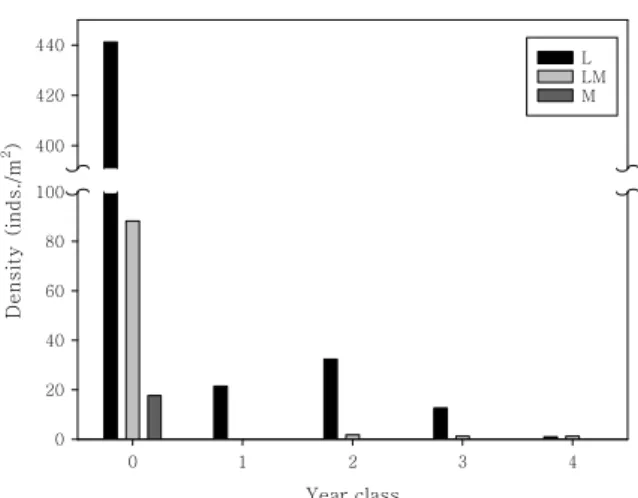
440 L
LM M
Fig. 5. Density of each year class in the intertidal zone in Tae-an, west coast of Korea. The intertidal zone was divided into three subzones: middle intertidal zone (M);
low-middle intertidal zone (LM); low intertidal zone (L).
d.f. F-value p
Shell length 2 23.99 0.001
Shell height 2 15.90 0.001
Total wet weight 2 16.34 0.002
Table 2. Results of one-way ANOVA for shell length, shell height, total wet weight and flesh dry weight by each station
높은 것으로 나타났다 (K-W test, χ2 = 12.5 p < 0.05) (Table 1).
3. 바지락 연령군별 분포 및 밀도
전체 표본 2,567개체 중 0세의 표본 수는 2,208개체였고, 1세 이상의 표본 수는 359개체였다. 정점별 연령군의 개체수 는 L에서 제1세군 107개체, 제2세군 162개체, 제3세군 63개 체 그리고 제4세군 5개체가 출현 하였고, LM에서 제1세군 1 개체, 제2세군 9개체 그리고 제3세군과 제4세군이 각각 6개체 가 출현 하였다. M에서는 모든 표본 수가 1세 이하였다.
연령군별 바지락의 밀도는 L에서 제0세군 441 inds./m2, 제1세군 21 inds./m2, 제2세군 32 inds./m2, 제3세군 13 inds./m2 그리고 제4세군이 1 inds./m2 가 출현하였다. LM 에서는 제0세군 88 inds./m2 를 제외한 나머지 연령군에서 2 inds./m2 미만이 출현하였고, M에서는 제0세군 18 inds./m2
를 제외한 나머지 연령군은 출현하지 않았다. 제4세군 미만의 연령군에서 하부지역이 중하부지역과 중부지역에 비하여 확연 히 높은 밀도가 나타났다 (K-W test, χ2 = 6.385, p <
0.05, Fig. 5).
4. 조위별 바지락 성장과 요인 상관관계 분석
조위별 바지락의 각장과 각고, 전중량 그리고 건조 육중량을 비교하였을 때에 모두 95% 통계학적 유의수준에서 차이가 있 는 것으로 나타났다 (Table 2). 조위별 바지락의 각장과 각고 의 상대성장식은 아래의 상관관계식 <L: (4); LM: (5); M:
(6)>과 같다. LM과 M에서의 체형 기울기 값이 각각 0.801, 0.768으로 L에서의 체형 기울기보다 상대적으로 높아 난형에 가까웠다 (Fig. 6).
SH = 0.7003×SL + 0.2461 (4) SH = 0.8013×SL + 0.0214 (5) SH = 0.7676×SL + 0.1365 (6)
0 5 10 15 20 25 30 35 40 45 50
0 10 20 30 40 50
Shell length (mm)
Shell height (mm)
L LM M L LM M
L MLM
Fig. 6. Relationships between shell length and shell height by station of the Manila clam, Ruditapes philippinarum at the intertidal zone in Tae-an, west coast of Korea. The intertidal zone was divided into three subzones: middle intertidal zone (M); low-middle intertidal zone (LM); low intertidal zone (L).
0 10 20 30
0 5 10 15 20 25 30 35 40 45 50
Shell length (mm)
Total wet weigt (g/ind.)
L LM M L LM M
M L
LM
Fig. 7. Relationships between shell length and total wet weight by station of manila clam, Ruditapes philippinarum in the intertidal area in Tae-an, west coast of Korea. The intertidal zone was divided into three subzones: middle intertidal zone (M); low-middle intertidal zone (LM); low intertidal zone (L).
FW = 0.0638TW + 0.1436
0 0.5 1 1.5 2
0 5 10 15 20 25
Total wet weight (g/ind.)
Flesh dry weight (g/ind.)
Fig. 8. Relationships between total wet weight and flesh dry weight of the Manila clam, Ruditapes philippinarum at the intertidal zone in Tae-an, west coast of Korea (Pearson correlation, r2 = 0.878 p < 0.05)
조위별 바지락의 각장과 전중량 관계는 L, LM 그리고 M의 각장에 따른 전중량의 상대성장식<L: (7); LM: (8); M:
(9)>은 아래의 상관관계 식과 같다. 기하평균 회귀함수에서 기울기는 L에서 3.113로 LM의 2.850과 M에서의 2.741 보 다 높았다 (Fig. 7).
TW = 0.0001 × SL3.1134 (7) TW = 0.0003 × SL2.8496 (8) TW = 0.0055 × SL2.7406 (9)
바지락의 전중량에 따른 건조육중량의 상대성장식(10)은 일 차 선형식을 사용하였고, 관계식은 아래와 같다. 전중량과 건 조육중량의 상관계수는 0.88로 상관관계가 있었다 (Fig. 8).
FW = 0.0638 × TW + 0.1436 (10)
(FW = Flesh dry weight, TW = Total wet weight)
조위별 바지락의 L 그리고 LM의 각장에 따른 건조육중량 의 상관계수<L: (11); LM: (12)>는 L에서 0.879, LM에서 0.982로 적합도가 높았다. L에서의 각장에 따른 건조육중량 상대성장 기울기 값은 L에서 2.976로 LM의 2.924 보다 높아 동일 각장 개체의 건조육중량이 L에서 LM에서보다 높은 것 으로 나타났다 (Fig. 9).
FW = 2E - 05 × SL2.9764 (11) FW = 2E – 05 × SL2.9243 (12)
0 0.3 0.6 0.9 1.2 1.5 1.8
0 10 20 30 40 50
Shell length (mm)
Flesh dry weigt (g/ind.)
L LM L LM
LM L
Fig. 9. Relationships between shell length and flesh dry weight by station of the Manila clam, Ruditapes philippinarum at the intertidal area in Tae-an, west coast of Korea. The intertidal zone was divided into three subzones: middle intertidal zone (M); low-middle intertidal zone (LM); low intertidal zone (L).
5. 조위별 1세 미만 소형 바지락 성장
조위별 바지락 1세 미만 치패 각장은 L에서 4월 5.05 mm 에서부터 7월 11.68 mm까지 성장하다가 8월에 0.1 mm 이 하로 감소하였다. M에서는 4월 2.99 mm에서부터 8월 5.12 mm까지 성장 하였지만, L에 비해 상대적으로 성장 변동 폭이 낮았다. LM은 6월 3.2 mm, 7월 7.2mm 그리고 8월에 1.1 mm로 나타났다. 4월 1세 미만 소형 바지락의 크기는 L에서 5.05 mm, M에서 3.0 mm로 L에서의 각장이 2 mm 이상 컸으며, 7월 치패 각장의 길이는 L에서 11.68 mm, M에서 3.56 mm로 8 mm 이상 차이가 났다. 조위별 1세 미만 소형 바지락 각장의 성장은 M에서 보다 L에서 더 높은 양상이 있 는 것으로 나타났다 (Wilcoxon signed ranks test, p=0.06) (Fig. 9).
고 찰
Choi (1965) 는 바지락의 서식환경이 안정적인 곳에서 체 형 상대성장 기울기가 높아 장형에 가깝고, 상대적으로 불안정 한 곳에서는 기울기가 낮아 난형에 가까워진다고 하였다. 본 조사지역내에 정점별 각장과 각고의 체형 상대성장 기울기는 중부지역과 중, 하부지역에서 바지락이 난형에 가까워 서식환 경의 안정적인 면에서의 차이를 확인이 되었으며, 조사지역에 서식하는 바지락의 각장과 각고의 상대성장 기울기는 0.7489
로, Lee et al. (1996) 이 보고한 남해안 광양만에서의 바지 락 각장과 각고 상대성장기울기 0.7176보다 컸다. 그러나 이 결과를 기준으로 국내 조간대 서식환경 및 바지락의 건강도를 비교하는 것에는 무리가 있기 때문에 차후 많은 연구 결과를 통하여 지역별 조간대에 서식하는 바지락의 서식환경과 건강 도를 종합, 비교 및 분석하여 판단하는 것이 바람직할 것으로 사료된다. 조위별 바지락 각장과 습중량 상관관계 기울기를 비 교한 결과, 중부지역과 중, 하부지역에서 하부지역보다 동일 각장에서 습중량이 높은 것으로 나타났다. 이는 하부지역에서 는 상대적으로 소형 개체가 다량 가입하기 때문이며, 중하부지 역과 중부지역은 상대적으로 대형 개체가 출현하였기 때문이 다. 이것은 Kim (2004) 의 연구결과와 같이, 상대적으로 소 형개체의 경우 환경스트레스에 민감하게 반응하며, 기존의 개 체가 시간의 흐름에 따라서 환경 스트레스로 인해 사망한다는 결과와 동일하였다. Chl-α양에 따른 성장과 연령군별 밀도의 변화는 없었으나, Laing and Child (1996), mills (2000), Shpigel et al. (1992) 그리고 Bartol et al. (1999) 의 연구 결과와 마찬가지로, 본 연구에서도 조사지역의 조위별 노출시 간에 따른 스트레스 정도가 서식하는 바지락의 성장과 연령군 별 밀도에 영향을 주었다고 사료된다. 더욱이, Won and Hur (1993) 의 연구 결과와 마찬가지로, 바지락은 이동성이 매우 낮기 때문에 치패의 정착 위치가 바지락의 밀도를 좌우하고, 정착 후 노출스트레스 정도에 따른 능동적 대처 기작 또한 없 어 직접적인 영향을 받을 것으로 사료된다. 이 결과를 바탕으 로 태안 안면도에 서식하는 바지락은 조위에 따라서 성장 양상 이 상이하며, 조간대 하부 지역은 중부 및 중․하부지역에 비해 바지락 성장에 안정적인 환경을 제공하기 때문에 어민들의 소 득 증대를 위한 바지락 채취와 종패살포는 조간대 하부지역에 서 실시하는 것이 바람직할 것으로 사료된다.
결 론
조위별 바지락 성장의 차이를 알아보기 위해 2009년 4월부 터 9월까지 매월 태안 안면도에서 조간대 상중하별 바지락 표 본, 저질온도, Chl-α 그리고 대기 노출시간을 채집 및 측정하 였다.
하부지역의 저질온도는 중부와 중하부지역보다 낮았다. 반 면, Chl-α는 조위별 차이가 없는 것으로 나타났다. 대기노출 시간은 하부지역이 중부와 중하부지역보다 짧았다. 연령별 출 현밀도는 하부지역에서 중하부와 중부지역보다 높았다. 바지 락의 각장, 각폭, 습중량 그리고 건중량 성장을 위한 환경 조 건은 하부지역이 중하부와 중부지역 보다 안정적인 것으로 나 타났다. 1세 미만개체의 조사지역 바지락 주가입시기 이전까 지 성장은 하부, 중하부 그리고 중부 순으로 높았다. 비록 바 지락 성장에는 매우 다양한 환경요인이 복합적으로 작용하지
만, 본 연구에서 조간대에 서식하는 바지락의 성장에는 조위 에 따른 대기 노출시간이 가장 주요인으로 작용하는 것으로 나 타났다.
참고문헌
Akberali, H.B. and Trueman, E.R. (1985) Effects of environmental stress on marine bivalvia molluscs.
Advances in Marine Biology, 22: 102-136.
Bartol, I.K, Mann, R. and Luckenbach, M. (1999) Growth and mortality of oysters (Crassostrea virginica) on constructed intertidal reefs: effects of tidal height and substrate level. Journal of Experimental Marine Biology and Ecology, 237:
157-184.
Choi, S. (1965) Onthe morphological variation special feature of the elongated and the stunted forms in the Short necked clam, Tapes japonica. Journal of Korean Zoology, 8: 1-7.
Coutteau, P., Cure, K. and Sorgeloos, P. (1994) Effect of algal ration on feeding and growth of juvenile manila clam, Tapes philippinarum. Journal of Shellfish Research, 13: 47-55.
Darrigran, G.A., Maronas, M.E. and Colautti, D.C.
(2004) Air exposure as a control mechanism for the golden mussel, Limnoperna fortunei (Bivalvia:
Mytilidae). Journal of Freshwater Ecology, 19:
461-464.
Drummond, L., Mulcahy, M. and Culloty, S. (2006) The reproductive biology of the manila clam, Ruditapes philippinarum, from the North-West of Ireland.
Journal of Aquaculture, 245: 326-340.
Fournier, M., Pellerin, J., Lebeuf, M., Brousseau, P., Morin, Y. and Cyr, D. (2002) Effects of exposure of Mya arenaria and Mactromeris polynyma to contaminated marine sediments on phagocytic activity of hemocytes. Journal of Aquatic Toxicology, 59: 83-92.
Holland, D.A. and Chew, K.K. (1974) Reproductive cycle of the Manila clam (Venerupis japonica), from Hood canal, Washington. Proceedings of the National Shellfisheries Association. 64: 53-58.
Ishii, R., Sekiguchi, H. Nakahara, Y. and Jinnai, Y.
(2001) Larval recruitment of the manila clam, Ruditapes philippinarum in Ariake Sound, southern Japan. Journal of Fisheries Science. 67: 579-591.
Kim, C.W. and Kho, K.H. (2004) Effects of water temperature and salinity on dietary feeding of Manila clam (Ruditapes philippinarum). Korean Journal of Environmental Biology. 22: 28-34.
Kim, H.J. and Jhang, C.I. (1999) A Population Ecological Study of Short-necked Clam, Tapes philippinarum in the Adjacent Water of Jinhae.
Journal of the Korean Society of Fisheries Resources. 2: 32-43.
Kim, J.B. (2004) Study on growth of Ruditapes philippinarum in Gomso tidal flat. Master of science thesis, Mokpo University, Korea. 42 pp.
Kim, Y.S. (1988) Sedimentary environments and evolution of intertidal deposits I Sajangpo coast, Cheonsu bay, west coast of Korea. Philosophy Doctor of Thesis, Seoul University, Korea. 169 pp.
Laing, I. and Child, A.R. (1996) Comparative tolerance of small juvenile paloudes (Tapes decussatus) and manila clam (Tapes philippinarum) to low temperature. Journal of Experimental Marine Biology and Ecology, 195: 267-285.
Lee, Y.C., Chang, Y.J., Lim, H,K. and Chung, G.S.
(1996) Comparision of growth and survival rate in shortnecked clam, Ruditapes philippinarum from different seeding production areas. Journal of Aquaculture, 9: 223-232.
Mills, D. (2000) Combined effects of temperature and algal concentration on survival, growth and feeding physiology of Pinctata maxima (jameson) spat.
Journal of Shellfish Research, 19: 159-166.
Pechenik, J.A. (2005) Biology of the invertebrates (fifth edition). Mc. Graw Hill Higher Education. pp 2-3.
Shin, H.C. and Shin, S.H. (1999) Population biology of Short-necked clam (Ruditapes philippinarum:
Bivalvia) in Kwangyang Bay, Southern coast of Korea. Journal of Malacological Society of Korea, 15: 31-31.
Shpigel, M., Barber, B.J. and Mann, R. (1992) Effects of elevated temperature on growth, gametogenesis, physiology, and biochemical composition in diploid and triploid Pacific oysters, Crassostrea gigas Thunberg. Journal of Experimental Marine Biology, 161: 15-25.
Strickland, J.D.H and Parsons, T.R. (1972) A practical hand book of seawater analysis. Fisheries Research Board of Canada Bulltin, 167: 185-199.
Toba, M.Y.N and Yamakawa, H. (1993) Reproductive cycles of manila clam, Ruditapes phillippinarum collected from Funabashi waters, Tokyo Bay. Nippon Suisan Gakkaishi, 59: 15-22.
Won, M.S. and Hur, S.B. (1993) Fatness index and spat occurrence of the Shortnecked clam, Ruditapes philippinarum. Journal of Aquaculture, 6: 133-146.
Yan, X., Zhang, G. and Yang, F. (2006) Effects of diet, stocking density, and metamorphosis of manila clam, Ruditapes philippinarum larvae. Journal of Aquaculture, 253: 350-358.
Yoo, M.H. and Choi, J.K. (2005) Seasonal distribution and primary production of microphytobenthos on an intertidal mud flat of the Janghwa in Gangwa Island, Korea. Journal of Korean Society of Oceanography, 10: 8-18.
Yoo, S.G. (1998) Marinculture. ed. Gooduk, Busan, pp 290-300.